Route guide for visitors throughout Catalonia – Barcelona – Costa Brava – Catalan Pyrenees – Personalized experiences – Customized tour guide services – A small tribute to the wonderful city and land that saw us born – Transforming experiences into unforgettable memories - Magic Dreams Collection: exclusive universes inspired by Salvador Dalí and Gaudí. Niche perfumes, jewelry, lithographs, and collectible items celebrating the Mediterranean spirit.
Avinguda de Pau Casals is one of the most emblematic and elegant avenues in Barcelona, located next to the historic Turó Park in the Sant Gervasi-Galvany neighborhood, within the Sarrià-Sant Gervasi district. This avenue combines cultural history, distinguished residential architecture, and one of the city’s …
La Barceloneta is one of Barcelona’s most iconic and evocative neighbourhoods. Located in the Ciutat Vella district, this former fishing quarter retains a unique identity shaped by the Mediterranean, fishing traditions and the urban evolution of a city that has always found one of its …
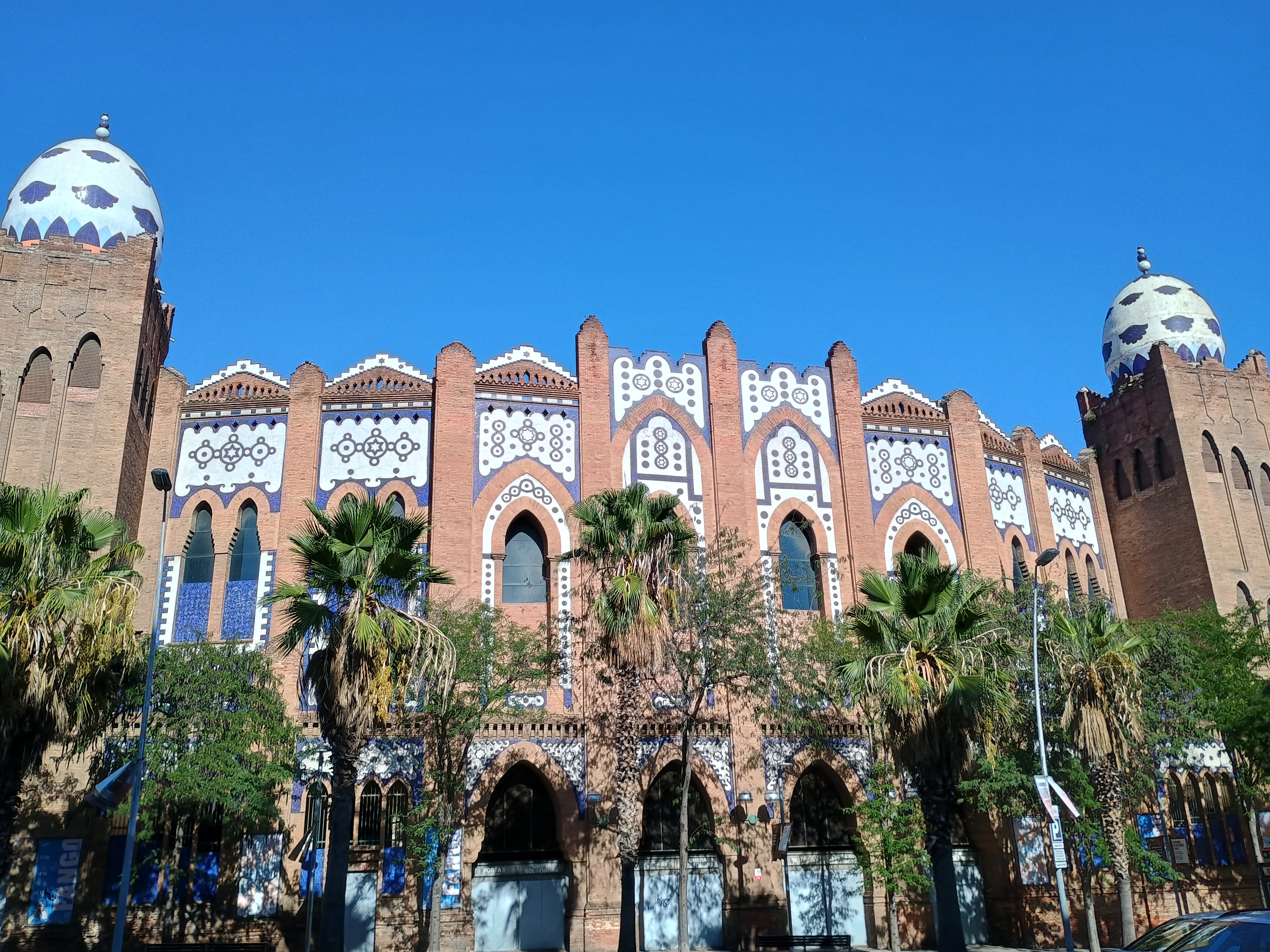
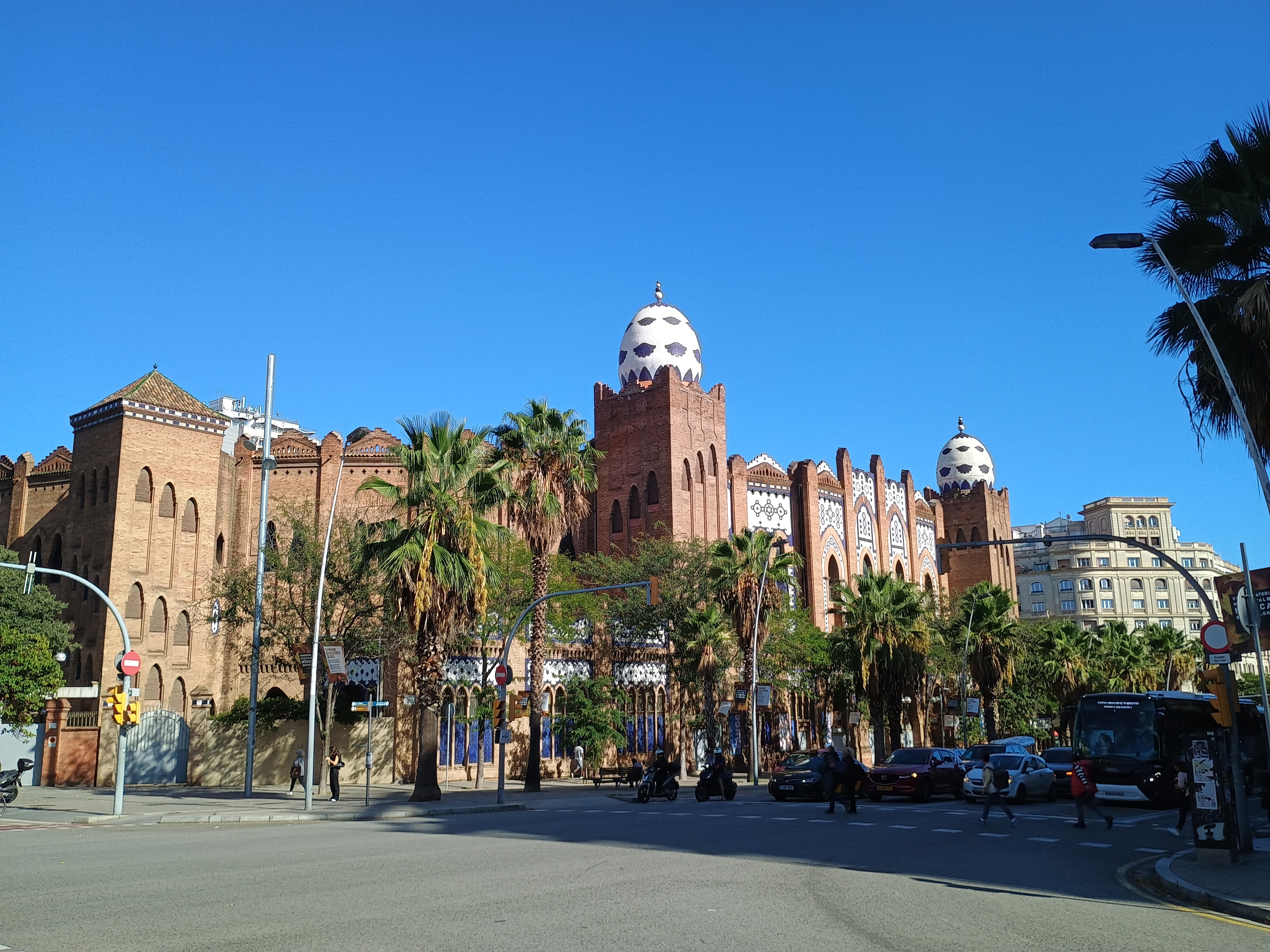
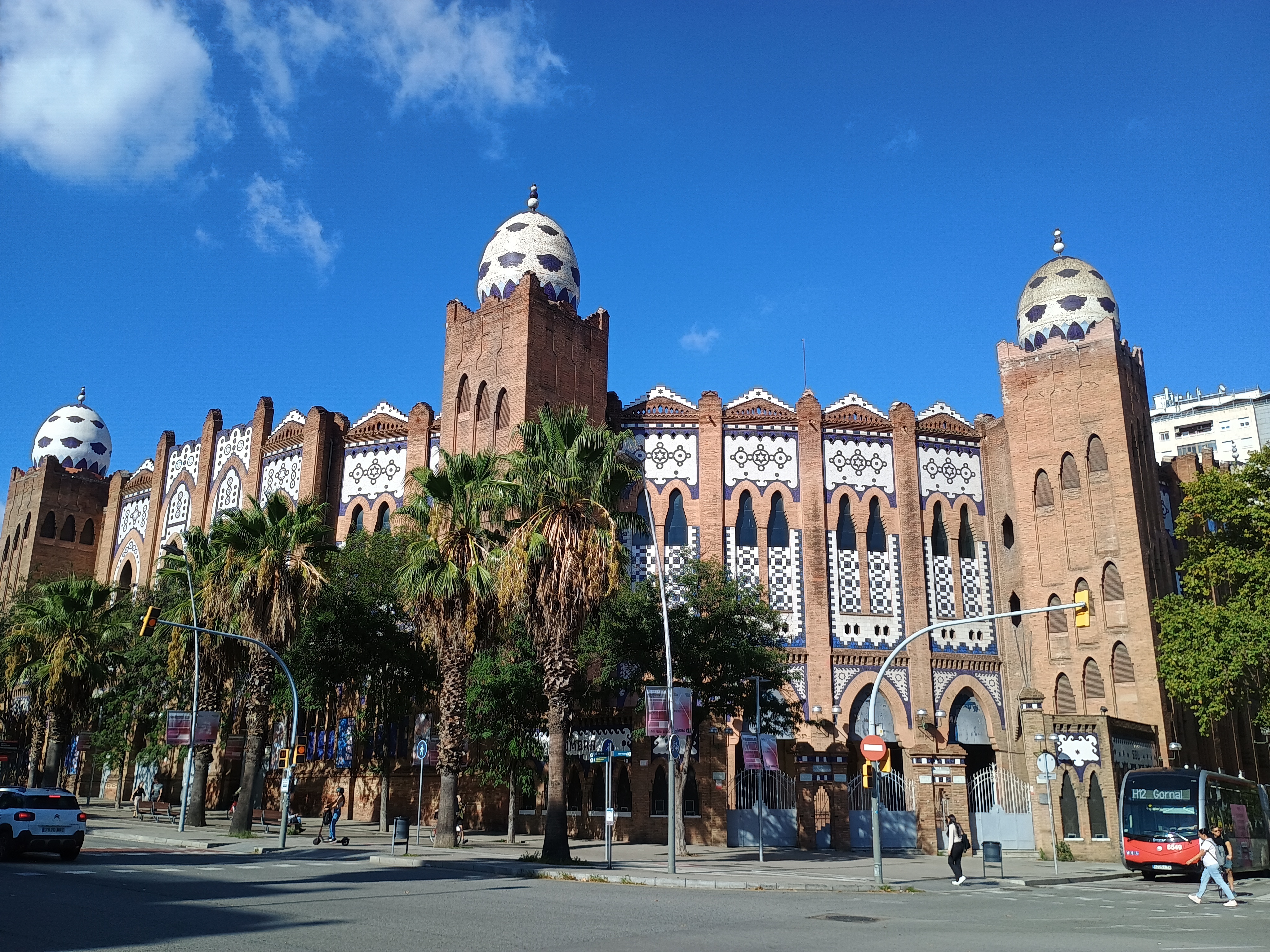
At the intersection of Gran Via de les Corts Catalanes and Carrer de Marina stands one of Barcelona’s most distinctive buildings.
The Monumental Bullring, known simply as La Monumental, has been part of the city’s architectural, social, and cultural memory for more than a century.
Its history began in 1914 as a bullring.
For decades, it was one of Barcelona’s major venues for bullfighting, but it also hosted boxing, circus performances, public events, political rallies, and, especially from the 1960s onward, some of the most important concerts held in the city.
Today, it is no longer an operating bullring.
The arena that for almost a century welcomed bullfighters and spectators has been transformed into a venue for music, festivals, and a wide range of cultural events.
La Monumental has changed its purpose, but not its prominence.
The Origins of La Monumental
When Barcelona was building a new city
At the beginning of the 20th century, Barcelona was undergoing a profound urban transformation.
The Eixample had become one of the city’s main areas of expansion, and its new avenues were beginning to fill with buildings, theatres, cafés, shops, and entertainment venues serving a rapidly changing society.
It was in this context that La Monumental was born.
The building was inaugurated on 12 April 1914 under the name El Sport.
The original structure was designed by architect Manuel Joaquim Raspall, one of the figures associated with Catalan Modernisme and Noucentisme.
Its initial appearance, however, was different from the one we know today.
The growing popularity of bullfighting soon led to plans for an expansion.
1916: La Monumental is Born
A transformation that completely changed its appearance
Just two years after its inauguration, the building was expanded and renovated.
The project was taken over by Ignasi Mas i Morell, in collaboration with Domènec Sugranyes, and the bullring acquired the monumental appearance that has survived to the present day.
It was then that it definitively adopted the name La Monumental.
The renovation added a spectacular exterior crown featuring Neo-Mudéjar and Neo-Byzantine influences, combined with decorative elements characteristic of Catalan Modernisme.
Ceramics, mosaics, arches, and ornamental motifs transformed the building into something much more complex than a simple bullring.
The architecture itself became an essential part of the spectacle.
Architecture Between the East and Barcelona
Ceramics, brick, and geometry
La Monumental has an architectural personality very different from that of Barcelona’s other major buildings.
Its façades combine brick, ceramics, arches, and decorative elements inspired by Eastern traditions.
The result is a richly visual architecture in which different artistic languages coexist.
Neo-Mudéjar architecture contributes its Arab-inspired motifs.
Neo-Byzantine influence can be seen in certain decorative and compositional solutions.
And the Catalan context of the early 20th century introduces a Modernist and Noucentista sensibility that makes the complex a unique feature of the Eixample landscape.
The towers marking the entrances, the mosaics, and the ceramic ornamentation are among the elements that make La Monumental recognisable even from a distance.
One of Barcelona’s Great Bullrings
The age of bullfighting
When La Monumental began operating, Barcelona already had a strong bullfighting tradition.
The city had previously had other major bullrings.
The first was El Torín, inaugurated in 1834 in Barceloneta.
Later came Las Arenas, inaugurated in 1900 in what is now Plaça d’Espanya.
La Monumental joined this history in 1914 and would eventually become the last of Barcelona’s major bullrings to remain active.
For decades, it hosted major bullfights and some of the most prominent figures in bullfighting.
Following the 1916 expansion, the bullring reached a capacity of approximately 24,000 spectators. After subsequent alterations, its current capacity is around 19,500 seats.
A Bullring That Survived the War
La Monumental during the Spanish Civil War
The building’s history is also connected to one of the most difficult periods in Barcelona’s contemporary history.
During the Spanish Civil War, La Monumental temporarily ceased to operate as a bullring.
The venue was used as a garage and scrap-metal warehouse.
Some of the old wooden benches were even removed to allow vehicles to move through the building and to create concrete ramps.
For a time, the building ceased to be a place of entertainment and became a practical facility within a city profoundly affected by war.
1946: A Change of Ownership
The Balañà family and a new era
In 1946, Pere Milà’s widow sold the bullring to the businessman and bullfighting promoter Pedro Balañà.
La Monumental then entered a new era associated with one of Barcelona’s most important entertainment-business families.
During the following decades, the building continued to host bullfights, but its enormous capacity allowed it to take on a much broader role.
La Monumental could transform itself.
And that ability to transform would prove fundamental to its future.
A Venue for Much More Than Bullfighting
Boxing, circuses, celebrations, and major events
The history of La Monumental was never limited exclusively to bullfighting.
Its large central arena and tiered seating allowed it to accommodate many different types of events.
The venue hosted boxing matches, circus performances, festivals, public events, and political rallies, as well as cultural activities.
The circular architecture of the bullring offered an extraordinary advantage: it could adapt to different types of audiences and performances.
But it was music that would ultimately make La Monumental famous far beyond the world of bullfighting.
1965: The Beatles Arrive
The concert that forever changed the history of La Monumental
On 3 July 1965, Barcelona experienced one of the most important musical events in its history.
The Beatles performed at La Monumental in the only concert they ever gave in Barcelona.
The British group was at the height of its worldwide explosion, and its arrival in Spain was an extraordinary event.
La Monumental was filled with young people eager to see John Lennon, Paul McCartney, George Harrison, and Ringo Starr up close.
The concert took place under Franco’s dictatorship and was surrounded by enormous public excitement and official surveillance.
The performance lasted just over half an hour, but it left an extraordinary mark on Barcelona’s collective memory.
Sixty years later, in 2025, previously unseen colour footage of the concert even emerged, later preserved by the Filmoteca de Catalunya.
La Monumental had definitively entered the history of rock music.
The Golden Age of Music
When the biggest stars filled the arena
After The Beatles, La Monumental began to establish itself as one of Barcelona’s great music venues.
Before the construction and development of large venues such as the Palau Sant Jordi, Barcelona needed spaces capable of accommodating thousands of spectators.
La Monumental could do exactly that.
During the 1970s, 1980s, and 1990s, the bullring welcomed major names from both international and Spanish music.
They included:
The Beatles, in 1965.
The Rolling Stones, in 1976, during their first concert in Spain.
Bob Marley, in 1980.
Luis Miguel, in 1985.
Tina Turner, in 1990.
Dire Straits, in 1992.
Bruce Springsteen, in 1992.
Sau, in 1992.
The bullring thus became an enormous open-air concert venue.
Bob Marley at La Monumental
An unforgettable night of reggae
On 30 June 1980, La Monumental welcomed Bob Marley & The Wailers.
More than 18,000 people attended the concert, one of the most memorable performances in the venue’s musical history.
Marley was on his Uprising tour, and Barcelona was one of the stops on that international tour.
The concert was particularly significant because it was one of the artist’s final major performances before his death in 1981.
That night, Marley’s music filled a venue that until then had been primarily associated with bullfighting.
Once again, the arena demonstrated that it could become almost anything.
Bruce Springsteen and the Great Concerts
La Monumental becomes an international stage
In the 1990s, the relationship between La Monumental and music entered another major phase.
Bruce Springsteen performed at the bullring in July 1992.
One of those concerts attracted around 16,500 people, transforming the arena into a gigantic rock stage.
La Monumental was completely full, with the audience surrounding the stage.
The bullring was no longer merely a venue for bullfighting.
It had become one of Barcelona’s great popular stages.
La Monumental as a Venue in Transition
From major spectacle to a changing city
The 1990s also marked the beginning of a profound transformation in the way Barcelona organised its major events.
The construction of new venues and the evolution of the city following the 1992 Olympic Games provided new alternatives for large-scale concerts.
The Palau Sant Jordi, the Olympic Stadium, and other major venues began to take on many of the city’s largest musical events.
La Monumental, however, retained something that modern arenas could not reproduce:
its architecture.
A concert at La Monumental was not simply a concert.
It was a performance inside a historic building.
2011: The Final Bullfighting Chapter
The last bullfight in Catalonia
On 25 September 2011, La Monumental hosted the last bullfight held in Catalonia.
The bill featured José Tomás, Juan Mora, and Serafín Marín.
The event attracted enormous attention and was accompanied by protests from both supporters and opponents of bullfighting.
Tickets sold out rapidly.
That afternoon brought an end to almost a century of bullfighting history at La Monumental.
From 1 January 2012, the ban on bullfighting in Catalonia approved by the Catalan Parliament in 2010 came into effect.
Although the Spanish Constitutional Court overturned that ban in 2016, bullfighting did not resume at La Monumental.
Life After Bullfighting
A new life for an old arena
The end of bullfighting did not mean the end of La Monumental.
On the contrary.
The building began to develop a new identity as a venue for music, festivals, and other events.
The arena once again filled with spectators, but now for completely different reasons.
Concerts.
Festivals.
Electronic music events.
Family activities.
Performances.
Cultural events.
The transformation did not erase its previous history.
It added to it.
Monumental Club
Music returns to the arena
One of the projects that has contributed to this new chapter is Monumental Club.
The former bullring is periodically transformed into a music and leisure venue where concerts, DJ sets, food offerings, and activities for different audiences come together.
Its programme has included independent music, electronic music, indie, rumba, and other contemporary styles.
The image is almost poetic:
where once the sounds of bullfighting trumpets and cheers filled the arena, guitars, bass lines, synthesizers, and thousands of voices can now be heard again.
La Monumental in 2026
A historic building full of life
La Monumental is not a building frozen in the past.
In 2026, it continues to operate as a venue for musical and cultural events.
During autumn 2026, for example, the venue is once again part of the SOUNDIT programme, with several electronic music events taking place between October and December.
The programme includes names such as Marcel Dettmann, Paranoid London, Joy Orbison, Aurora Halal, Jeff Mills, and Surgeon & Nørbak, among others.
Monumental Club also continues to offer new music and cultural events.
The former bullring therefore maintains a direct connection with contemporary Barcelona.
Would You Like to Discover La Monumental With Us?
A place where history can still be felt
Discovering La Monumental means exploring more than a century of Barcelona’s history through extraordinary architecture and the stories of the people who once filled its stands.
From the early days of El Sport to the Monumental of the great concerts.
From Joselito and the great figures of bullfighting to The Beatles and Bob Marley.
From legendary nights of rock to contemporary festivals.
Each era has left its own memory.
At Magic Dreams Barcelona, we believe that Barcelona’s great places should not only be seen.
They should be understood through their history.
Our guide, a native expert specialising in architecture, botany, art, history, and ornithology, accompanies every experience with a knowledgeable, engaging, and deeply human narrative.
We take care of absolutely everything so that you do not have to worry about a thing.
We organise day trips, weekend getaways, week-long stays, excursions through the Catalan Pyrenees and the Costa Brava, as well as completely personalised experiences.
Our services are available in Spanish, Catalan, and English and, with sufficient advance notice, we can accommodate other languages.
We combine heritage, architecture, nature, gastronomy, music, and private experiences to discover Barcelona from a different perspective.
Because Barcelona is not only what appears in a guidebook.
It is also what remains hidden behind its buildings.
A Masterpiece of Catalan Gothic Architecture, Where History, Art and Spirituality Come Together Barcelona Cathedral, officially known as the Cathedral of the Holy Cross and Saint Eulalia, is one of the most emblematic monuments of the Catalan capital and one of the finest expressions of …
Where History Sails Towards the Mediterranean Future Port Vell is one of the oldest and most symbolic spaces in Barcelona’s relationship with the sea and remains, in 2026, one of the great places where the city meets the Mediterranean. It was Barcelona’s first major permanent …
Casa Batlló is one of the masterpieces of Antoni Gaudí and one of Barcelona’s most famous buildings. Located on Passeig de Gràcia, in the heart of the Eixample district, this extraordinary building is one of the great landmarks of Catalan Modernism and forms part of the group of Gaudí’s works declared UNESCO World Heritage Sites.
More than just a building, Casa Batlló is an architectural experience in which light, color, nature, geometry and imagination come together to create a unique space.
Its façade seems to change depending on the daylight, while the interior introduces us to a universe of curved shapes, ceramics, wood, glass and details inspired by nature.
Although Casa Batlló is often referred to as the house of the dragon, its architecture is much more complex. Gaudí transformed an existing building into a true work of art without neglecting essential aspects such as lighting, ventilation and functionality.
Where is Casa Batlló?
Casa Batlló is located at 43 Passeig de Gràcia, one of Barcelona’s most important and elegant avenues.
Its location is particularly interesting because it forms part of the famous Block of Discord, a section of Passeig de Gràcia where several outstanding examples of Catalan Modernist architecture can be found.
Within just a few metres, we can see buildings designed by some of the most important architects of the period:
Casa Batlló, by Antoni Gaudí.
Casa Amatller, by Josep Puig i Cadafalch.
Casa Lleó Morera, by Lluís Domènech i Montaner.
Casa Mulleras, by Enric Sagnier.
Casa Josefina Bonet, by Marcel·lí Coquillat.
The result is one of Barcelona’s most remarkable architectural ensembles.
The History of Casa Batlló
Although we know the building today as Casa Batlló, its history began before Gaudí’s intervention.
The original building was constructed in 1877 by architect Emili Sala Cortés, who had also been one of Gaudí’s architecture professors. At the time, Passeig de Gràcia was still developing into one of the major urban avenues of modern Barcelona.
In 1903, textile entrepreneur Josep Batlló i Casanovas acquired the building.
The original plan even contemplated demolishing the building and constructing an entirely new one. However, Gaudí succeeded in completely transforming the existing structure, and the decision was ultimately made to carry out a major renovation, undertaken between 1904 and 1906.
Josep Batlló gave Gaudí considerable creative freedom, allowing the architect to transform virtually every essential aspect of the property.
Gaudí modified the façade, reorganized the interior spaces, enlarged the light well and transformed functional elements of the residence into authentic architectural features.
Gaudí and the Transformation of the Building
One of the most fascinating aspects of Casa Batlló is that Gaudí did not start with an empty site.
He worked on an existing structure and succeeded in giving it an entirely new identity.
The intervention particularly affected:
the main façade;
the main floor;
the light well;
the staircases;
the interior spaces;
the attic;
and the rooftop.
The result demonstrates one of the fundamental characteristics of Gaudí’s architecture: decoration and functionality do not have to be separate.
At Casa Batlló, elements that serve a practical purpose also form part of the building’s artistic composition.
Ventilation, the entry of natural light, circulation between the different floors and the distribution of spaces were all carefully considered.
Architecture Inspired by Nature
Nature is one of the great protagonists of Casa Batlló.
Gaudí rejected rigid lines and sought inspiration in the forms he encountered in the natural world.
This is why we find curves, organic shapes, botanical elements, marine references and structures reminiscent of bones, scales and shells.
The architecture seems alive.
There are hardly any surfaces that feel completely conventional.
The walls undulate, the ceilings take on sinuous forms and the decorative elements seem to be part of a single organism.
This approach makes visiting Casa Batlló a very different experience from visiting a traditional historic building.
The Spectacular Façade of Casa Batlló
The façade is probably the building’s best-known feature.
Gaudí used different materials and techniques to create an extraordinarily dynamic surface.
We find sandstone, ceramics, glass and iron, combined to create a composition full of movement.
The surface seems to change depending on how the light falls upon it.
Fragments of ceramic and glass create reflections and colors reminiscent of water and the Mediterranean.
The balconies, meanwhile, have shapes that have inspired countless interpretations.
Some resemble masks, others skulls, while others suggest marine forms.
The columns on the ground floor and the main gallery also feature organic shapes that reinforce the impression that the building belongs to a natural world.
The House of Bones
One of Casa Batlló’s best-known nicknames is Casa dels Ossos, or House of Bones.
The name refers to the appearance of some of the elements on the façade.
The columns resemble skeletal structures, while the balconies have been interpreted by some as masks or skulls.
This fantastical appearance has helped make Casa Batlló one of the most photographed buildings in Barcelona.
However, it is important to understand that many of the symbolic interpretations of the façade are later readings and cannot always be documented as specific intentions on Gaudí’s part.
The Dragon of Saint George
The image of the dragon is one of the most popular interpretations of Casa Batlló.
The roof resembles the back of a huge animal covered in scales.
Ceramic pieces in different shades create an effect that makes the roof appear almost alive.
According to the traditional interpretation, the roof represents the dragon of Saint George, while the cross at the top symbolizes the saint’s sword.
This interpretation connects Gaudí’s architecture with one of Catalonia’s best-known legends: the story of Saint George and the dragon.
It is precisely this combination of architecture, tradition and symbolism that has made Casa Batlló one of Barcelona’s great cultural icons.
The Four-Armed Cross
At the top of the building we find one of Casa Batlló’s most recognizable features: the four-armed cross.
The cross crowns a small tower and becomes one of the most important visual elements of the façade.
The placement of this feature was also influenced by the architectural context of the Block of Discord and the presence of Casa Amatller, designed by Josep Puig i Cadafalch.
In this way, Gaudí did not design Casa Batlló in isolation, but took the surrounding buildings into consideration.
The Light Well: A Lesson in Light and Color
One of the most interesting spaces inside the building is the light well.
Gaudí designed it to improve the distribution of natural light and ventilation throughout the building.
The ceramic tiles feature different shades of blue, becoming more intense toward the upper floors and progressively lighter toward the lower levels.
This creates a sense of continuity and depth.
The distribution of color is not merely decorative: it forms part of the architectural strategy for making the most of natural light.
It is one of the finest examples of how Gaudí combined aesthetics and functionality.
The Main Floor
The main floor was the principal living space of the Batlló family.
Here we find some of the most spectacular interior elements, including large windows, curved forms, finely crafted woodwork and decorative details specifically designed for the building.
The main rooms were conceived to make the most of the incoming light and to create a continuous relationship between architecture and furniture.
The experience is very different from that of a traditional early twentieth-century residence.
The Attic and Gaudí’s Arches
The attic is another essential part of the visit.
Here we find the famous catenary arches, a structural solution characteristic of Gaudí.
Their forms resemble the ribs of a huge animal and have also helped reinforce the interpretation of Casa Batlló as a kind of living organism.
The attic itself creates an experience very different from that of the main living floors.
It is more restrained, yet at the same time deeply expressive.
Today, visitors can explore this space and experience Gaudí’s architecture at particularly close range.
The Rooftop and Chimneys
The rooftop is one of the most photographed areas of Casa Batlló.
Here we find the famous dragon-like roof, together with a collection of chimneys and architectural elements that Gaudí turned into a fundamental part of the overall composition.
The chimneys were not treated simply as technical elements.
Gaudí grouped them together and designed them so that they would contribute to creating a distinctive architectural landscape.
From the rooftop, visitors can also enjoy views across central Barcelona and observe details that are easy to miss from street level.
The current visitor experience includes access to the rooftop with certain ticket options.
Why Is Casa Batlló So Important?
Casa Batlló represents one of the most mature stages of Gaudí’s architecture.
It brings together several of his central preoccupations:
nature, light, color, geometry, structure and functionality.
But there is something that makes this work particularly distinctive: Gaudí’s ability to transform a private residence into a complete artistic experience.
He did not simply design rooms.
He designed doors, windows, ceilings, staircases, courtyards, chimneys, railings, lighting and decorative elements as parts of a single universe.
For this reason, walking through Casa Batlló allows us to better understand Gaudí’s idea that architecture should be a total experience.
Casa Batlló and UNESCO World Heritage
Casa Batlló forms part of the group of Antoni Gaudí’s works inscribed on the UNESCO World Heritage List.
This recognition includes other fundamental works by the architect, including Park Güell, Palau Güell, Casa Milà, Casa Vicens, the Nativity façade and crypt of the Colònia Güell.
The inscription recognizes the outstanding universal value of these works and their importance in the development of modern architecture.
Casa Batlló Today
The history of Casa Batlló did not end with Gaudí.
The building ceased to belong to the Batlló family during the 1950s and subsequently served different purposes.
Since the 1990s, the property has been owned by the Bernat family, which undertook an important restoration process.
In 1995, the house opened its doors to the public and began a new chapter as a cultural space. Since 2002, cultural visits have also been offered, and these experiences have continued to evolve over time.
Today, Casa Batlló combines heritage, architecture, technology, art and immersive experiences.
A Visit That Goes Beyond Architecture
The current visitor experience is designed to bring Gaudí’s work closer to visitors through a variety of resources.
The general experience includes an audio guide available in 15 languages and access to different areas of the building, including the main floor, courtyard, attic, staircases, atrium and rooftop, depending on the ticket type.
There are also technological resources that allow visitors to discover Gaudí’s creative universe from a contemporary perspective.
Among them is the Gaudí Cube, a 360-degree audiovisual experience created by digital artist Refik Anadol, as well as augmented-reality experiences available with certain visit options.
Casa Batlló at Night
The experience can also be enjoyed at night.
Evening visits incorporate special lighting that transforms the perception of the interior spaces.
Depending on the available experience, the visit may also include a welcome drink and other special elements. The programme and opening times may vary, so it is advisable to check the official information before planning your visit.
Art, Music and New Experiences
Casa Batlló also functions as a cultural venue and hosts different programmes throughout the year.
These include musical experiences, temporary exhibitions and special activities.
In 2026, for example, the official programme includes Magical Nights, featuring a visit, a drink and a concert, as well as new exhibition proposals.
The exhibition “Gaudí-Miró-Gomis: Deconstructed” can also currently be visited. It connects the work of Gaudí with Joan Miró and Josep Gomis through original pieces and digital interventions.
How Long Does the Visit Take?
The general visit lasts approximately 1 hour and 15 minutes.
If you choose an experience that includes additional exhibitions, the visit may take longer. For example, the combined visit with the exhibition “Gaudí-Miró-Gomis: Deconstructed” lasts approximately 1 hour and 45 minutes.
We recommend allowing at least an hour and a half if you want to explore Casa Batlló at a relaxed pace and take time to appreciate the details.
When Should You Visit Casa Batlló?
Casa Batlló is open throughout the year, although opening hours may vary depending on the experience selected.
General visiting hours currently run from 9:00 a.m. to 7:15 p.m., while the last admission time may vary depending on the type of visit.
If you want to see the façade under different lighting conditions, the morning and the final hours of the afternoon offer very different visual experiences.
For a special experience, you can also check the evening visits and cultural programme.
How Much Does It Cost to Visit Casa Batlló?
The price depends on the type of ticket and the experience selected.
The official website currently offers different options, with general admission starting at €29, while certain experiences have higher prices. Children aged 0 to 12 enter free of charge under the ticket options specified by the official website.
As prices, discounts and experiences may change, we recommend checking the official website before purchasing tickets.
How to Get to Casa Batlló
Casa Batlló’s location makes it easy to reach by public transport.
Metro
The nearest stations are:
Passeig de Gràcia, served by lines L2, L3 and L4.
Diagonal, served by lines L3 and L5.
Train
Passeig de Gràcia Station provides connections with various railway and commuter services.
Bus
Numerous bus routes run along Passeig de Gràcia and the surrounding streets.
The exact address is:
Passeig de Gràcia, 43 08007 Barcelona
Casa Batlló and Passeig de Gràcia
A visit to Casa Batlló can easily be combined with a walk along Passeig de Gràcia.
This avenue is one of the best areas in Barcelona for discovering Catalan Modernist architecture.
You can begin at Casa Batlló and continue towards Casa Amatller, Casa Lleó Morera and other Modernist works.
You can also continue towards La Pedrera – Casa Milà, another of Gaudí’s great masterpieces.
This makes it possible to spend several hours exploring one of Barcelona’s most important concentrations of Modernist architecture.
Tips for Visiting Casa Batlló
If this is your first visit, we recommend:
Buying your tickets in advance.
Allowing approximately 1–1.5 hours for the visit.
Not limiting yourself to photographing the façade: the interior is an essential part of the experience.
Paying particular attention to the light well, attic and rooftop.
Comparing Casa Batlló with Casa Amatller and Casa Lleó Morera.
Checking the special experiences available on your chosen date.
Reviewing the official opening hours and prices before visiting.
Magic Dreams Barcelona: Discover Casa Batlló in a Different Way
At Magic Dreams Barcelona, we believe that Barcelona is not discovered simply by visiting monuments.
It is discovered by understanding their stories, observing their details and connecting each place with the city’s culture, architecture and way of life.
That is why we can design personalized experiences around Casa Batlló and Gaudí’s universe.
Our services include:
Personalized organization and logistics.
Architectural and cultural itineraries.
Modernist architecture tours of Barcelona.
Private and exclusive experiences.
Botanical and nature tours connected to Gaudí’s universe.
Private gastronomy and culinary experiences.
Concerts and cultural experiences.
A selection of accommodation and personalized services.
Our team works in Spanish, Catalan and English, with other languages available upon prior request.
The idea is simple: to turn a sightseeing visit into a deeper, carefully curated and personalized experience.
Casa Batlló: A Work of Art That Deserves a Second Look
Perhaps one of the best ways to understand Casa Batlló is to see it first from the street and then step inside.
From the outside, we discover the dragon, the balconies, the colors and the undulating forms.
But once inside, we discover another Casa Batlló.
We encounter light, courtyards, doors, arches, textures, curves and all those small details that demonstrate the extent to which Gaudí designed the building as a unified whole.
Casa Batlló is not simply one of the most photographed places in Barcelona.
It is a work that allows us to understand the way Antoni Gaudí transformed architecture and turned an Eixample residence into one of the city’s great symbols.
And precisely for that reason, when walking along Passeig de Gràcia, it is worth stopping at number 43 and looking up.
Detalle exterior de Casa Batlló diseñada por el arquitecto Barcelonés Antoni Gaudí.
Perspectiva a pie de parte de Casa Amatller proyectada por el arquitecto Josep Puig i Cadafalch junto a la Casa Batlló de Antoni Gaudí.
Detalle interior de la Casa Batlló de Antoni Gaudí.
Detalle exterior de Casa Batlló de Antoni Gaudí.
Detalle mosaico diseño «Trencadís» terraza Casa Batlló de Antoni Gaudí.
Detalle exterior de Casa Batlló de Antoni Gaudí.
Detalle interior de la Casa Batlló de Antoni Gaudí.
Perspectiva exterior de Casa Batlló de Antoni Gaudí.
Detalle mosaico diseño «Trencadís» terraza Casa Batlló de Antoni Gaudí.
Detalle exterior de Casa Batlló diseñada por el arquitecto Barcelonés Antoni Gaudí.
Detalle exterior de Casa Batlló diseñada por el arquitecto Barcelonés Antoni Gaudí.
Detalle exterior de Casa Batlló diseñada por el arquitecto Barcelonés Antoni Gaudí.
Perspectiva a pie de la fachada de Casa Batlló de Antoni Gaudí.
Detalle mosaico diseño «Trencadís» terraza Casa Batlló de Antoni Gaudí.
Cruz Gaudí de Casa Batlló
Detalle exterior de Casa Batlló de Antoni Gaudí.
Detalle interior de la Casa Batlló de Antoni Gaudí.
Detalle interior de la Casa Batlló de Antoni Gaudí.