Route guide for visitors throughout Catalonia – Barcelona – Costa Brava – Catalan Pyrenees – Personalized experiences – Customized tour guide services – A small tribute to the wonderful city and land that saw us born – Transforming experiences into unforgettable memories - Magic Dreams Collection: exclusive universes inspired by Salvador Dalí and Gaudí. Niche perfumes, jewelry, lithographs, and collectible items celebrating the Mediterranean spirit.
There are places where history is not simply told — it is felt. On the Costa Brava, overlooking the Mediterranean, the archaeological site of Empúries offers an extraordinary journey through more than two thousand years of history. Here, the remains of an ancient Greek settlement …
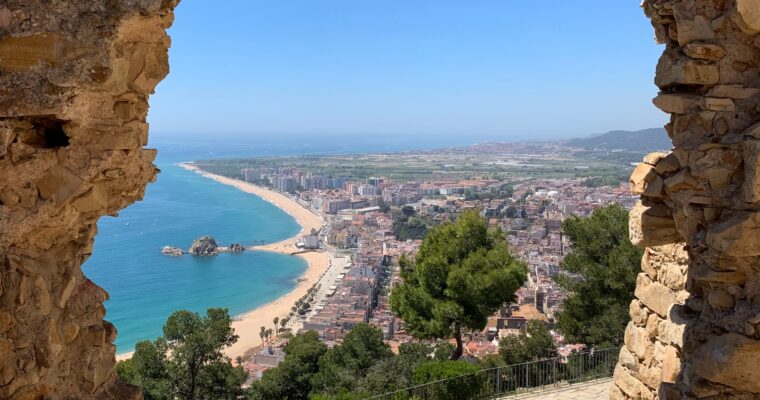
At the southernmost end of the province of Girona, where the Tordera River meets the Mediterranean, begins one of Catalonia’s most iconic coastal territories. It is Blanes, an ancient fishing town traditionally regarded as the Gateway to the Costa Brava. Its landscape brings together many …
Los Jardines de Santa Clotilde, en Lloret de Mar, son uno de los espacios paisajísticos más elegantes y singulares de la Costa Brava. Situados sobre un acantilado entre Cala Boadella y la playa de Fenals, fueron concebidos como un jardín novecentista inspirado en los grandes jardines del Renacimiento italiano.
Su particularidad está en la combinación de arquitectura, vegetación mediterránea, esculturas, terrazas y mar. El Mediterráneo no aparece simplemente como paisaje de fondo: forma parte de la propia composición del jardín.
Los jardines están construidos sobre el terreno inclinado de un antiguo espacio de viñedos y ocupan aproximadamente 26.830 m².
¿Dónde están los Jardines de Santa Clotilde?
Los jardines se encuentran en:
Paratge de Santa Clotilde
17310 Lloret de Mar, Girona
Cataluña, España
Su posición elevada permite contemplar directamente el litoral de la Costa Brava y, especialmente, Cala Boadella, que queda a los pies de los acantilados.
La localización es uno de sus grandes atractivos: mientras se recorren las terrazas y escalinatas, el paisaje vegetal se abre constantemente hacia el Mediterráneo.
¿Cuándo se construyeron?
La historia de Santa Clotilde comienza a principios del siglo XX.
El marqués Raúl Roviralta adquirió unos terrenos que anteriormente estaban dedicados al cultivo de la vid. En total llegó a poseer siete viñedos en esta zona.
En 1919, encargó el proyecto al arquitecto paisajista Nicolau Maria Rubió i Tudurí, uno de los grandes nombres del paisajismo catalán.
Rubió i Tudurí recibió una fuerte influencia de los jardines clásicos y de las ideas del paisajista francés Jean-Claude Nicolas Forestier. Santa Clotilde se convirtió así en uno de los ejemplos más destacados del Noucentisme aplicado al paisaje.
La historia de Clotilde
El nombre de los jardines tiene una historia personal.
Raúl Roviralta había conocido a Clotilde Rocamora, una joven de Barcelona que llegó a Lloret de Mar en 1917, cuando esta zona todavía estaba dominada por los viñedos.
Clotilde murió en 1927, antes de poder contemplar los jardines terminados.
La construcción quedó paralizada durante un periodo y posteriormente se reanudó después de que Roviralta contrajera matrimonio con su segunda esposa, Odile.
Las obras continuaron hasta después de la Guerra Civil española. Finalmente, el jardín conservó el nombre de Santa Clotilde en homenaje a su primera esposa.
Un jardín de inspiración renacentista italiana
Santa Clotilde no fue diseñado como un jardín botánico convencional.
Rubió i Tudurí creó un auténtico escenario paisajístico utilizando los principios de los jardines italianos clásicos:
Terrazas escalonadas
Escalinatas monumentales
Ejes visuales
Miradores
Fuentes
Estanques
Esculturas
Vegetación mediterránea
Perspectivas abiertas hacia el mar
El resultado es un jardín en el que la arquitectura y la naturaleza están cuidadosamente integradas.
La Generalitat de Catalunya lo considera un ejemplo de jardín novecentista y está catalogado como Bien Cultural de Interés Nacional.
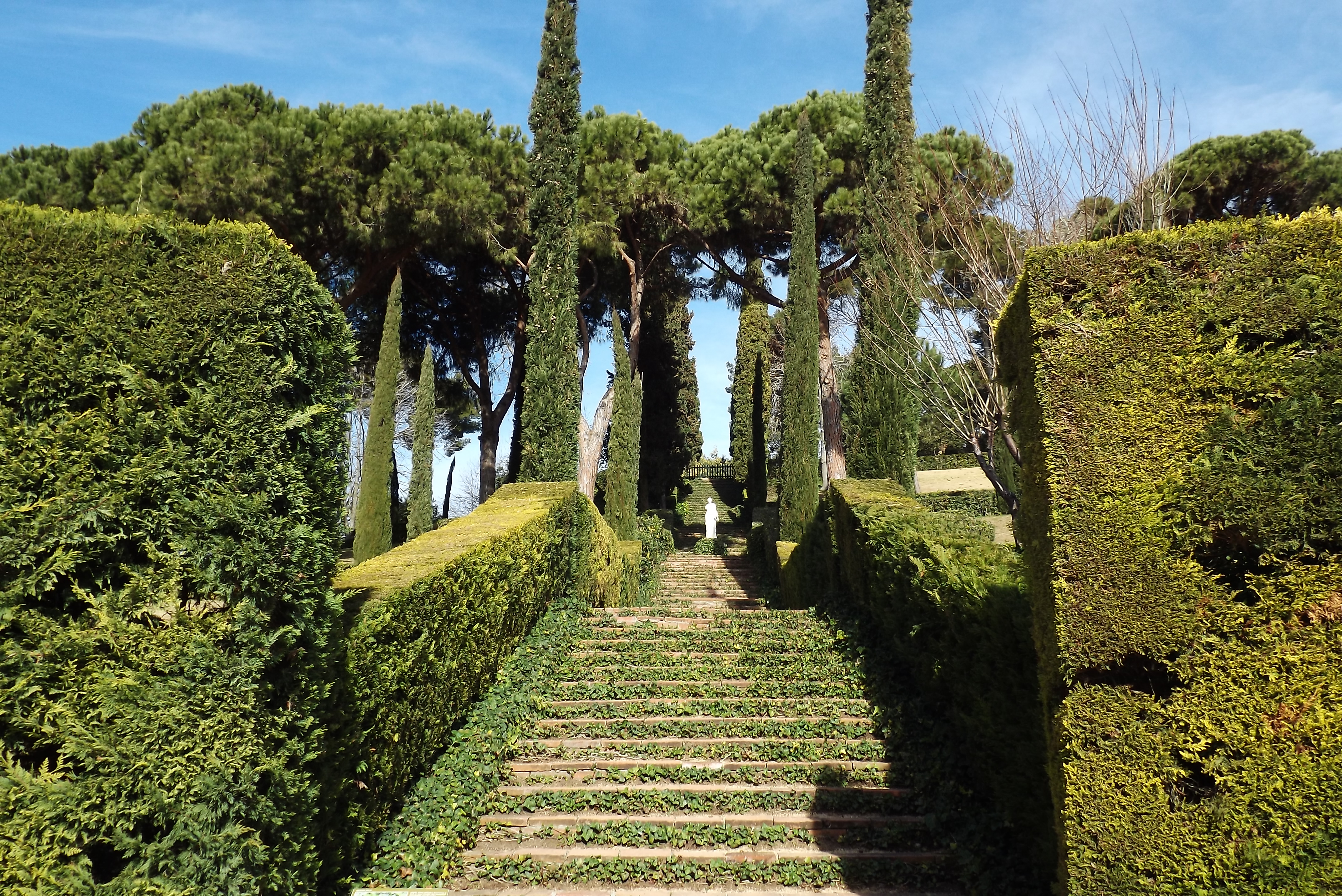
La Escalera de las Sirenas
Uno de los lugares más conocidos de Santa Clotilde es la Escalera de las Sirenas.
Esta gran escalinata constituye uno de los principales ejes del jardín y está acompañada por esculturas de sirenas realizadas por la escultora Maria Llimona.
A medida que se desciende por la escalera, el jardín cambia de perspectiva y el mar aparece progresivamente como telón de fondo.
Es uno de los mejores ejemplos de cómo Santa Clotilde utiliza la perspectiva para convertir el paisaje mediterráneo en parte de la arquitectura del jardín.
La botánica de Santa Clotilde
La vegetación está adaptada fundamentalmente al clima mediterráneo de la Costa Brava.
Entre las especies y grupos vegetales destacados por las fuentes patrimoniales y turísticas se encuentran:
Pinos
Tilos
Álamos
Cipreses
Laureles
Plantas aromáticas
Arbustos mediterráneos
Vegetación ornamental
Los aromas tienen también un papel importante. La propia Generalitat destaca cómo, al descender por las escaleras, se mezclan los olores de las resinas, laureles y plantas aromáticas con el olor del mar.
Un jardín diseñado para el clima mediterráneo
La elección de especies no es casual.
El jardín está situado expuesto al sol, al viento y a la influencia marina, por lo que la vegetación mediterránea forma parte esencial de su identidad.
El resultado es muy diferente al de un jardín centroeuropeo: aquí predominan las plantas capaces de soportar períodos de calor y sequedad, combinadas con especies ornamentales utilizadas para crear volumen, sombra, color y estructura.
¿Qué fauna puede encontrarse?
Santa Clotilde no es un parque zoológico ni una reserva natural, por lo que no existe un catálogo de fauna turística comparable al de un espacio natural protegido.
Sin embargo, su combinación de vegetación, árboles, flores, estanques y proximidad al Mediterráneo crea un hábitat adecuado para observar aves pequeñas, insectos polinizadores y otros animales habituales de los jardines y del paisaje mediterráneo.
Entre los visitantes habituales que pueden observarse en este tipo de entorno se encuentran pequeñas aves de jardín, mariposas, abejas y otros insectos asociados a la vegetación mediterránea.
Además, la proximidad de los acantilados y del mar permite que el visitante pueda observar ocasionalmente aves relacionadas con el litoral.
La fauna, por tanto, forma parte del paisaje vivo del jardín, aunque el gran atractivo de Santa Clotilde continúa siendo la integración entre vegetación, arquitectura y Mediterráneo.
La cala que se ve desde los jardines: Cala Boadella
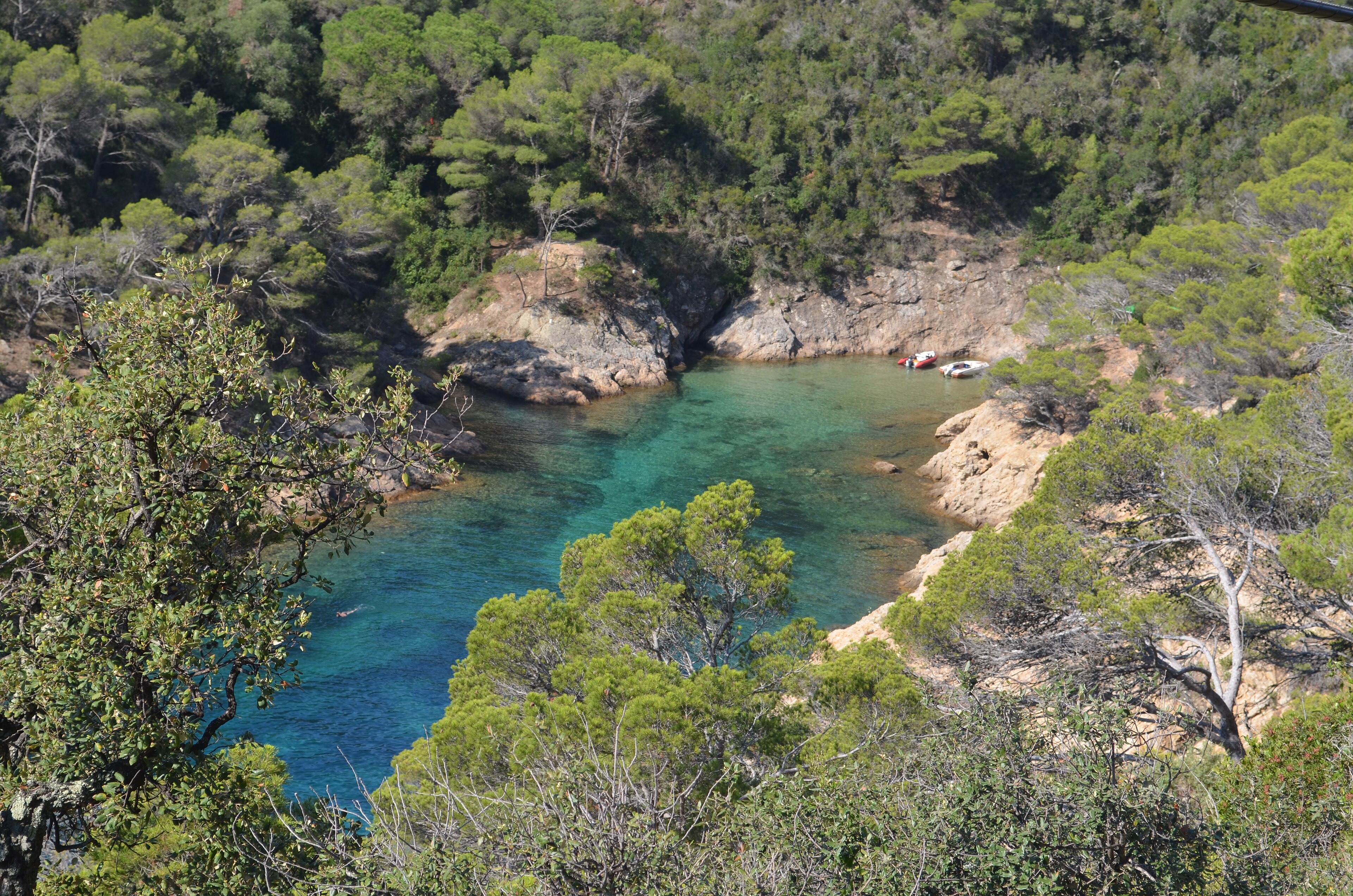
Uno de los grandes secretos visuales de Santa Clotilde es la cala situada justo debajo de los acantilados.
Se trata de Cala Boadella, también conocida como Sa Boadella.
La cala tiene aproximadamente 250 metros de longitud y se caracteriza por sus agua transparente, arena gruesa y un entorno de pinos y acantilados.
Desde determinados puntos elevados de los Jardines de Santa Clotilde puede contemplarse la cala desde arriba, creando una de las panorámicas más características de este rincón de la Costa Brava.
¿Por qué es tan especial Cala Boadella?
Su situación entre zonas de pinar y acantilados hace que conserve una apariencia mucho más natural que otras playas de Lloret.
El fondo marino presenta zonas rocosas, cuevas y pequeñas formaciones que hacen que la zona resulte interesante también para practicar snorkel y otras actividades acuáticas.
La playa tiene además una tradición nudista, especialmente en determinadas zonas, por lo que conviene conocer esta característica antes de visitarla.
La casa y el patrimonio arquitectónico
Cerca de la entrada se conserva la casa original vinculada al conjunto.
Destacan sus arcadas de medio punto, la gran terraza y una torre de tres plantas.
En la fachada sur de la torre existe además un panel de azulejos pintados dedicado a Santa Clotilde que data de 1930.
El conjunto permite comprender que Santa Clotilde no es únicamente un jardín, sino una obra completa en la que arquitectura, escultura, vegetación y paisaje están concebidos conjuntamente.
¿Cuándo pasaron a ser públicos?
Los jardines permanecieron durante décadas vinculados a la familia Roviralta.
En 1997, el Ayuntamiento de Lloret de Mar decidió adquirirlos, restaurarlos y convertirlos en patrimonio municipal.
Previamente, en 1994, habían sido declarados Bien Cultural de Interés Nacional por la Generalitat de Catalunya.
Horarios actuales
Según la información oficial disponible actualmente:
De abril a octubre:
10:00–20:00 h, todos los días.
De noviembre a enero:
10:00–17:00 h, todos los días.
Febrero y marzo:
10:00–18:00 h, todos los días.
La última admisión es una hora antes del cierre.
El recinto permanece cerrado los días 25 de diciembre, 1 de enero y 6 de enero.
La tarifa reducida se aplica, entre otros casos, a jubilados, titulares del Carnet Jove, estudiantes, familias y personas con discapacidad.
Los grupos de más de 15 personas deben solicitar tarifa específica.
Importante: no se permite la entrada con animales de compañía.
¿Cuánto se tarda desde Barcelona?
Desde Barcelona hasta Lloret de Mar hay aproximadamente 73 km por carretera y el trayecto en coche puede durar alrededor de 58 minutos en condiciones favorables, aunque el tiempo real puede aumentar considerablemente dependiendo del tráfico, especialmente durante los fines de semana y la temporada turística.
Para llegar a Santa Clotilde debe continuar desde Lloret de Mar hacia la zona de los jardines.
Como referencia práctica:
Barcelona – Jardines de Santa Clotilde
Aproximadamente 75–80 km, dependiendo del punto de salida y de la ruta elegida.
Tiempo estimado en coche: aproximadamente 1 h – 1 h 30 min, pudiendo ser superior con tráfico.
Cómo llegar desde Barcelona en coche
Una ruta habitual consiste en:
Barcelona – AP-7 – salida hacia Lloret de Mar – Lloret de Mar – zona de Santa Clotilde/Fenals.
Una vez en Lloret de Mar, siga las indicaciones hacia los Jardines de Santa Clotilde.
La dirección oficial es:
Paratge de Santa Clotilde, 17310 Lloret de Mar, Girona.
¿Se puede llegar en transporte público?
Sí. Lloret de Mar está conectado con Barcelona mediante autobús directo, con servicios que parten de la Estació d’Autobusos Barcelona Nord. El trayecto Barcelona–Lloret ronda aproximadamente una hora en condiciones habituales.
Desde Lloret de Mar deberá continuar hasta la zona de Santa Clotilde mediante transporte local o a pie, dependiendo del punto exacto de llegada y de la temporada.
¿Cuánto tiempo dedicar a la visita?
Para una visita tranquila recomiendo reservar aproximadamente:
1–1,5 horas para recorrer los jardines con calma.
Si desea realizar fotografías, detenerse en los miradores, disfrutar de la arquitectura y observar la vegetación, puede dedicar 2 horas sin que resulte excesivo.
La visita merece especialmente la pena sin prisas, porque buena parte de su atractivo consiste precisamente en ir descubriendo las perspectivas del mar entre las terrazas y las escalinatas.
Curiosidades de Santa Clotilde
1. Antes había viñedos
El terreno donde actualmente se encuentran los jardines estaba dedicado anteriormente al cultivo de la vid.
2. Clotilde nunca llegó a ver los jardines terminados
La primera esposa del marqués murió en 1927, cuando el proyecto todavía no estaba terminado.
3. El mar forma parte del diseño
Los jardines fueron concebidos de tal manera que muchas de sus terrazas, escaleras y miradores dirigen la mirada hacia el Mediterráneo.
4. Las sirenas son uno de sus símbolos
Las esculturas de sirenas de Maria Llimona forman parte de la identidad visual del jardín y acompañan la famosa escalinata principal.
5. Es un jardín novecentista
Santa Clotilde es considerado uno de los ejemplos más representativos del jardín vinculado al Noucentisme catalán, movimiento cultural y artístico que buscó recuperar el orden, el equilibrio y las referencias clásicas.
6. Está sobre un acantilado
Su posición elevada es precisamente la razón por la que se obtienen las impresionantes vistas sobre Cala Boadella y el Mediterráneo.
¿Merece la pena visitar los Jardines de Santa Clotilde?
Sí, especialmente si busca una visita diferente a las playas tradicionales de Lloret de Mar.
Santa Clotilde ofrece algo poco habitual: un jardín histórico de inspiración italiana construido sobre un acantilado mediterráneo, donde las esculturas, las terrazas, los cipreses, las plantas aromáticas y las vistas al mar están diseñados como una única composición.
Y hay un punto especialmente recomendable: busque los miradores desde los que se contempla Cala Boadella desde arriba. Es una de las imágenes más espectaculares de la visita.
Detalle Jardines Santa Clotilde -By krysi@, CC BY 3.0, https://commons.wikimedia.org/w/index.php?curid=61024135.
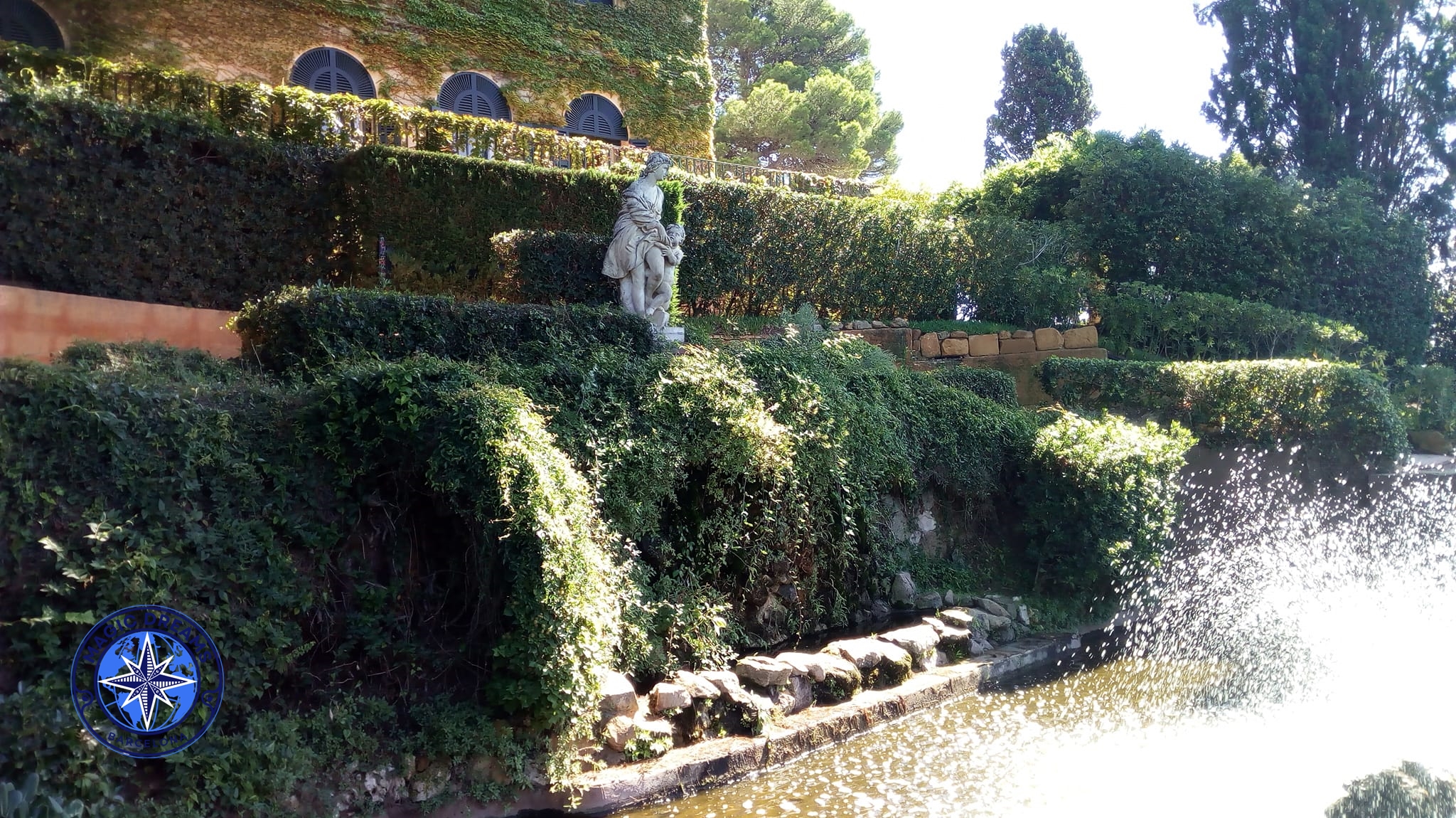
Fuente Jardines Santa Clotilde – By krysi@, CC BY 3.0, https://commons.wikimedia.org/w/index.php?curid=61024145.
Detalle jardines de Santa Clotilde -By Dawid Glawdzin, CC BY 3.0, https://commons.wikimedia.org/w/index.php?curid=54626861.
Jardines de Santa Clotilde Magic Dreams Barcelona.
Sirena de Jardines de Santa Clotilde – Дмитрий Мозжухин, CC BY 3.0, via Wikimedia Commons.
Jardines de Santa Clotilde – By JopkeB – Own work, CC BY-SA 4.0, https://commons.wikimedia.org/w/index.php?curid=149692532.
Plaza de Jardines Santa Clotilde – By JopkeB – Own work, CC BY-SA 4.0, https://commons.wikimedia.org/w/index.php?curid=149692531.
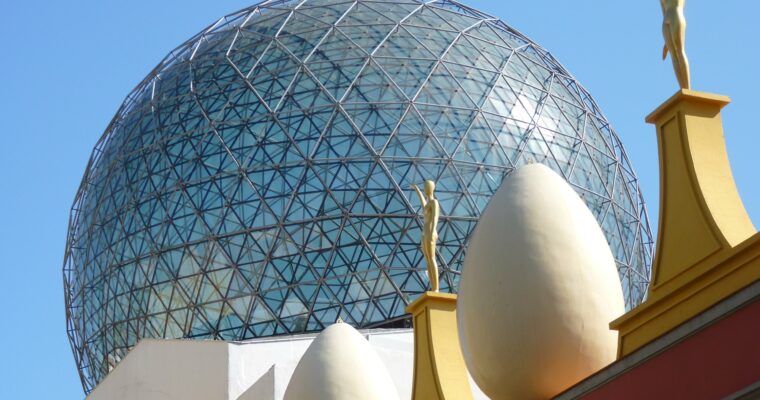
Salvador Dalí’s great surrealist universe The Dalí Theatre-Museum in Figueres is one of the most extraordinary museums in Catalonia and one of the most iconic places associated with Salvador Dalí. Conceived as a total work of art, the museum invites visitors to enter the artist’s …
Discover Llançà with Magic Dreams Barcelona At the northernmost end of the Costa Brava, between the deep blue waters of the Mediterranean and the natural landscapes of Alt Empordà, lies Llançà, a charming fishing village that preserves the authentic spirit of the Catalan coast. Its …
Tossa de Mar: the fishing village of the walls, the lighthouse, Ava Gardner, the coves and Chagall’s Blue Paradise
A medieval wall overlooking a Mediterranean Sea of crystal-clear waters, ancient watchtowers, cobbled streets rising between stone houses, a lighthouse built on the site where the castle once stood, the remains of a Roman villa, Mediterranean forests where megalithic monuments still survive, hidden coves among the cliffs, and a history shaped by fishermen, artists and Hollywood stars.
Tossa de Mar is one of those places on the Costa Brava where the beauty of the landscape and history seem to have agreed to create an extraordinary setting.
Recognized by the Generalitat de Catalunya with the designation of “Fishing Village”, Tossa preserves an identity deeply connected to the Mediterranean. Its location between Sant Feliu de Guíxols and Lloret de Mar, protected inland by the Cadiretes-Ardenya Massif, makes it possible to enjoy historical heritage, nature, hiking, beaches, coves, gastronomy and sea-related activities all in the same destination.
And all of this approximately 100 kilometres from Barcelona, making it an exceptional destination for a day trip, a romantic weekend or a longer stay dedicated to discovering the Costa Brava at a leisurely pace.
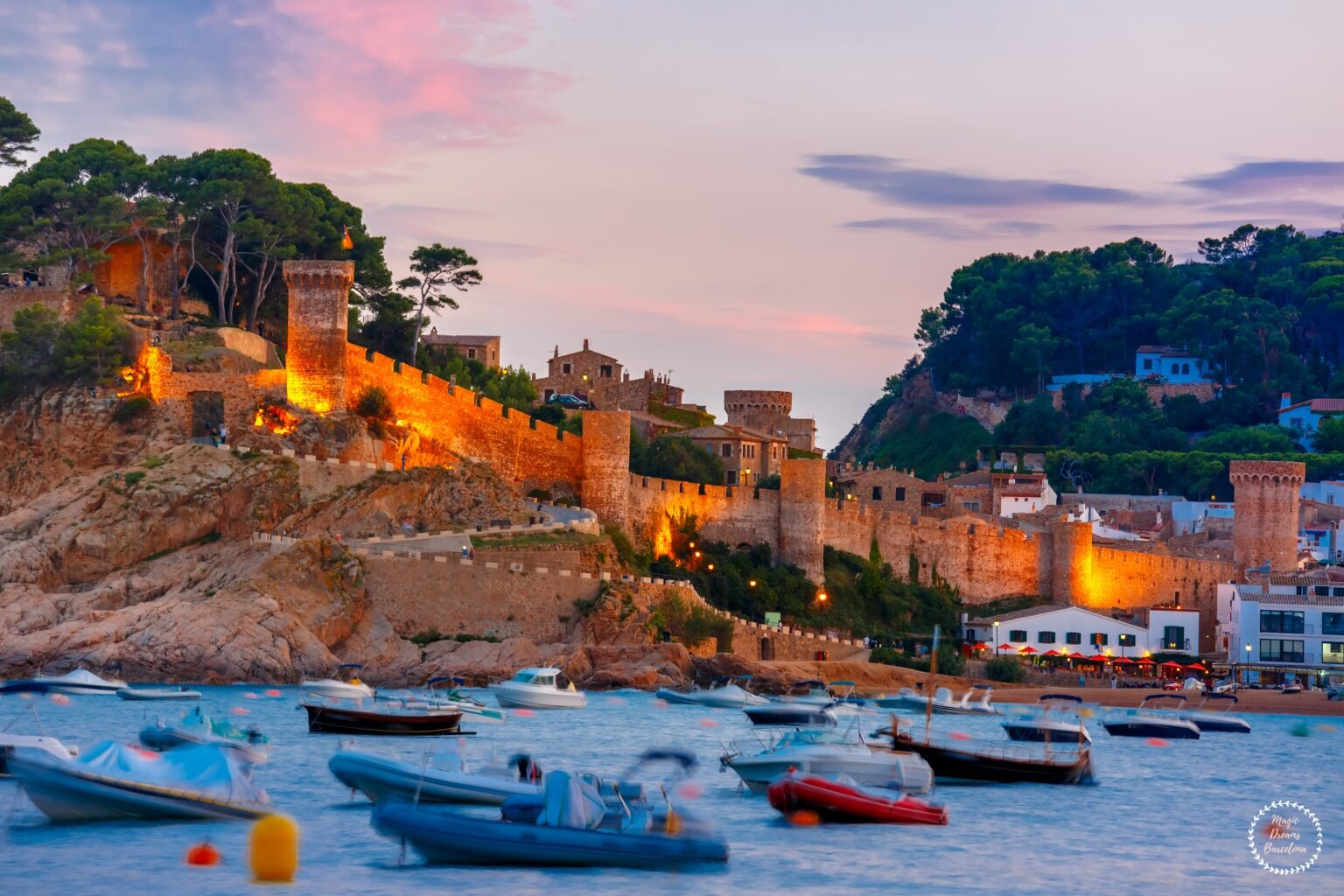
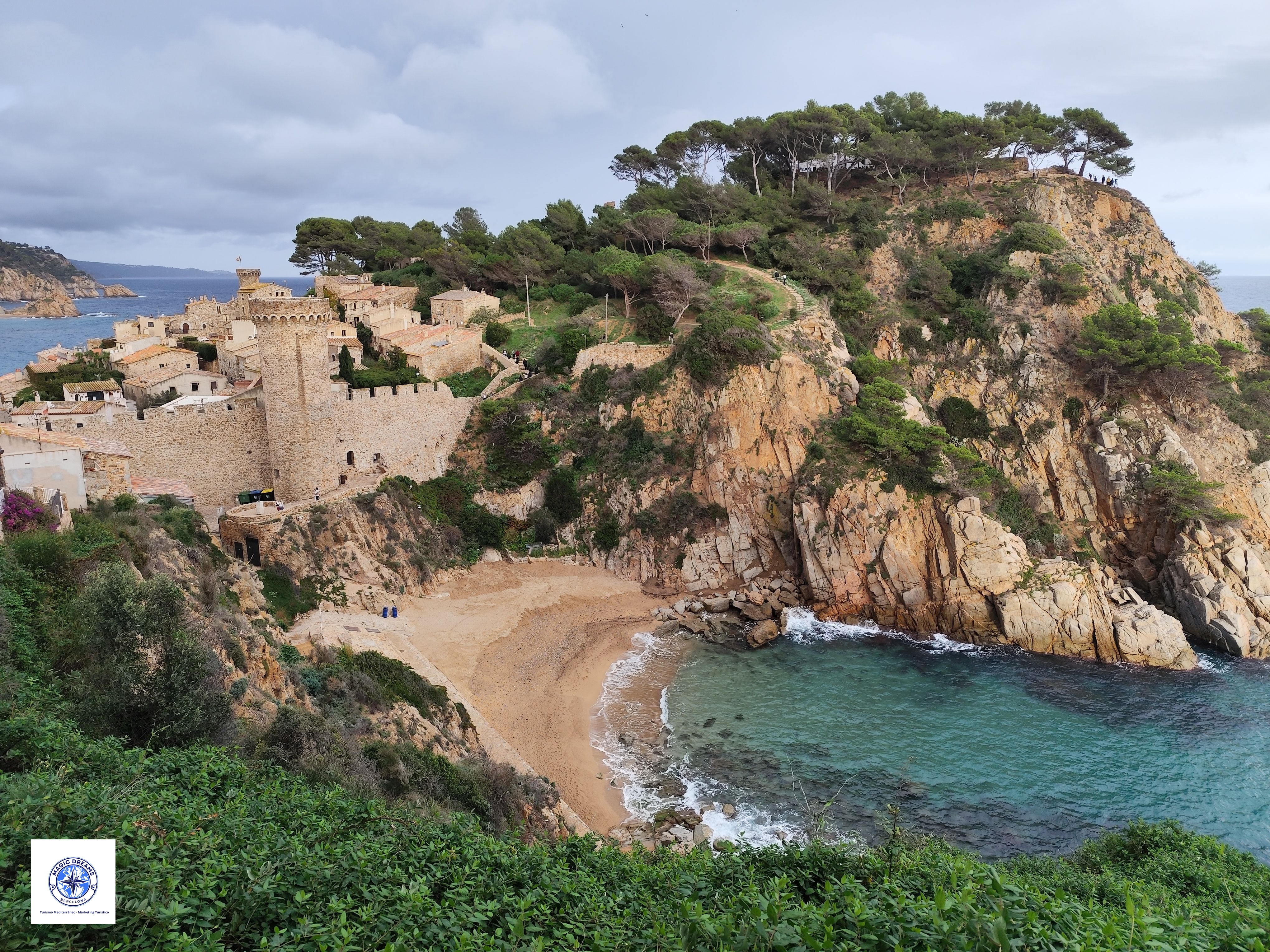
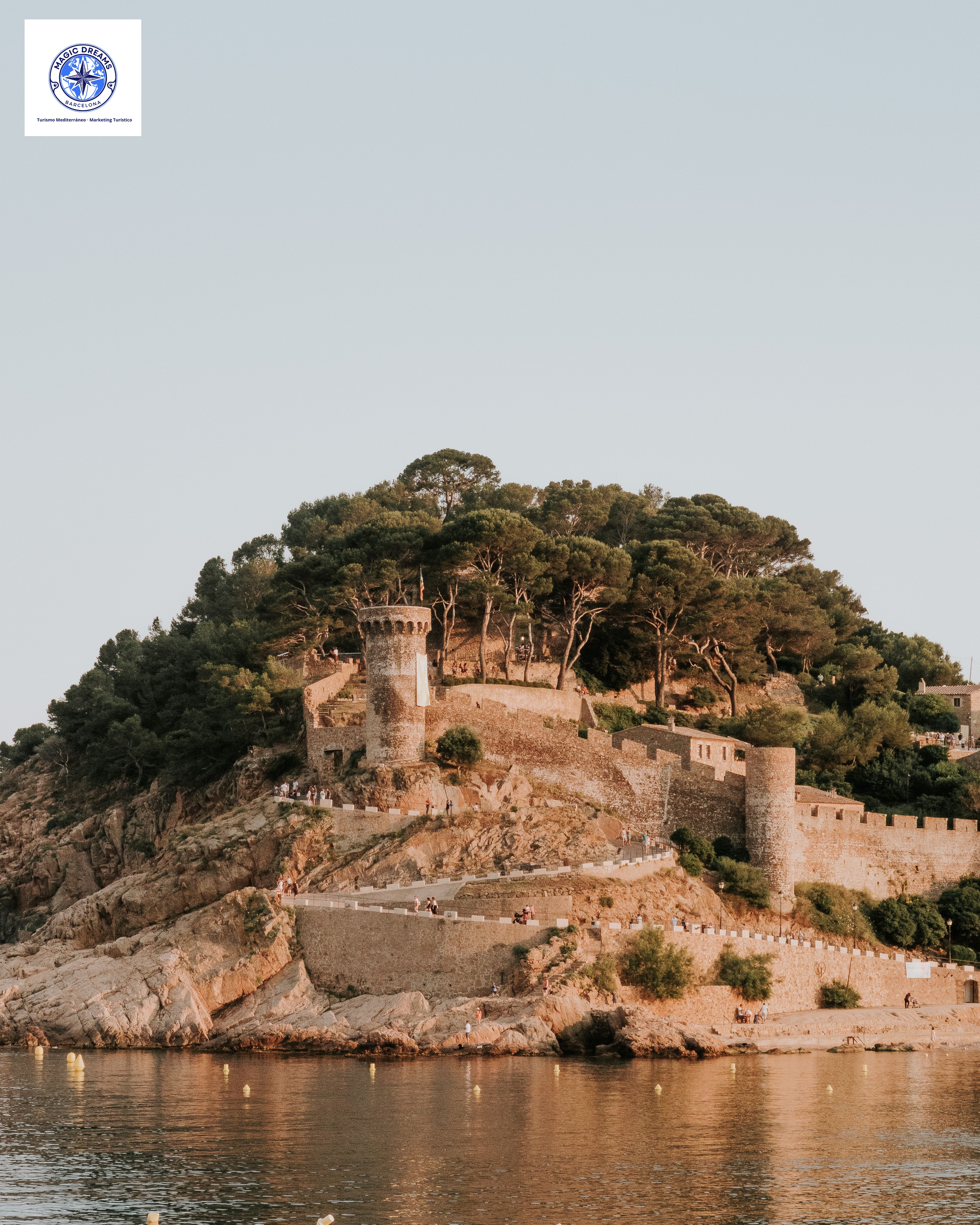
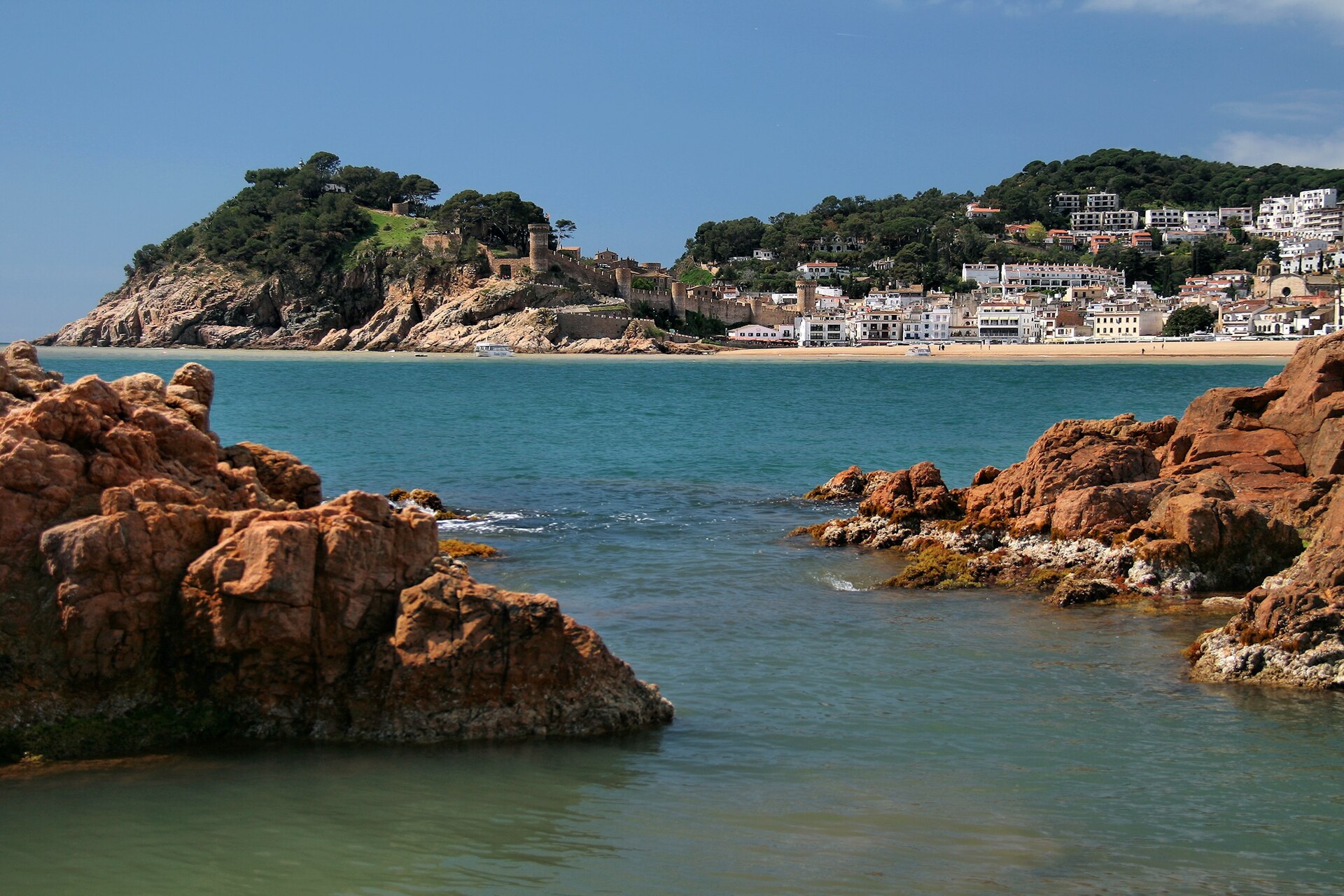
But if there is one image that defines Tossa de Mar above all others, it is that of its Vila Vella, the ancient walled town rising above the Mediterranean.
Vila Vella: the historic heart of Tossa de Mar
Vila Vella is Tossa’s great monumental treasure.
The walled enclosure began to be built at the beginning of the 13th century to protect the population from pirate attacks and preserves practically its entire original perimeter. In 1931, it was declared a National Historic-Artistic Monument.
The Tossa Tourist Office currently considers it the only surviving example of a fortified medieval settlement on the Catalan coast. The enclosure can be visited free of charge and remains open throughout the year, 24 hours a day, although certain cultural spaces inside have their own opening hours.
Entering Vila Vella means leaving contemporary tourist Tossa behind for a few moments.
Visitors pass through the magnificent Portal de la Vila Vella, with its large voussoir arch, and enter the former parade ground.
From here, the route continues among walls, towers, houses, small squares, stairways and viewpoints.
And the higher you climb, the more spectacular the landscape becomes.
On one side lies the Mediterranean.
On the other, the houses and streets of the old town.
And ahead, the immense blue horizon that explains why Tossa eventually became a refuge for artists.
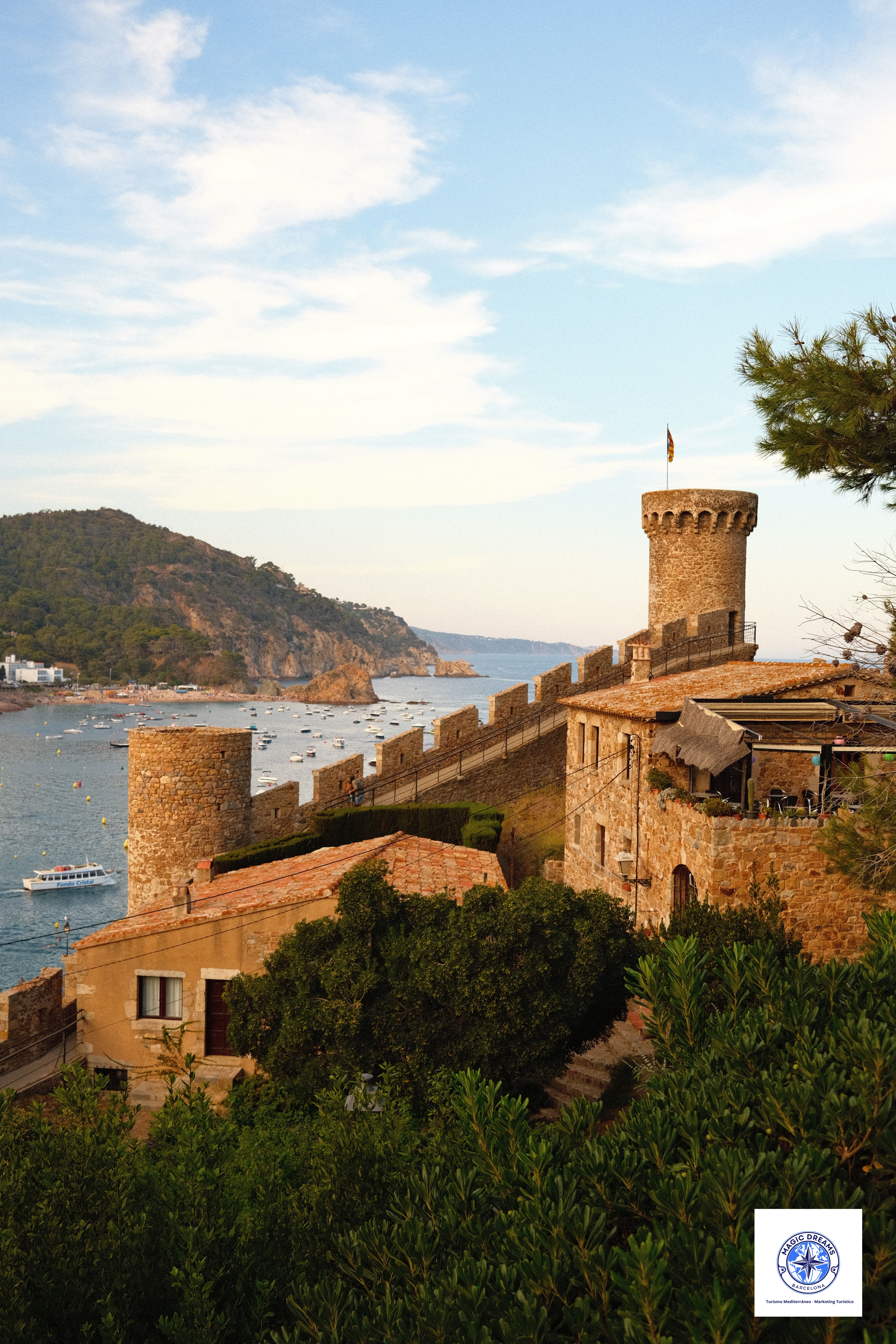
The towers that protected the medieval town
The wall preserves a complex defensive system made up of towers and cylindrical turrets topped with machicolations.
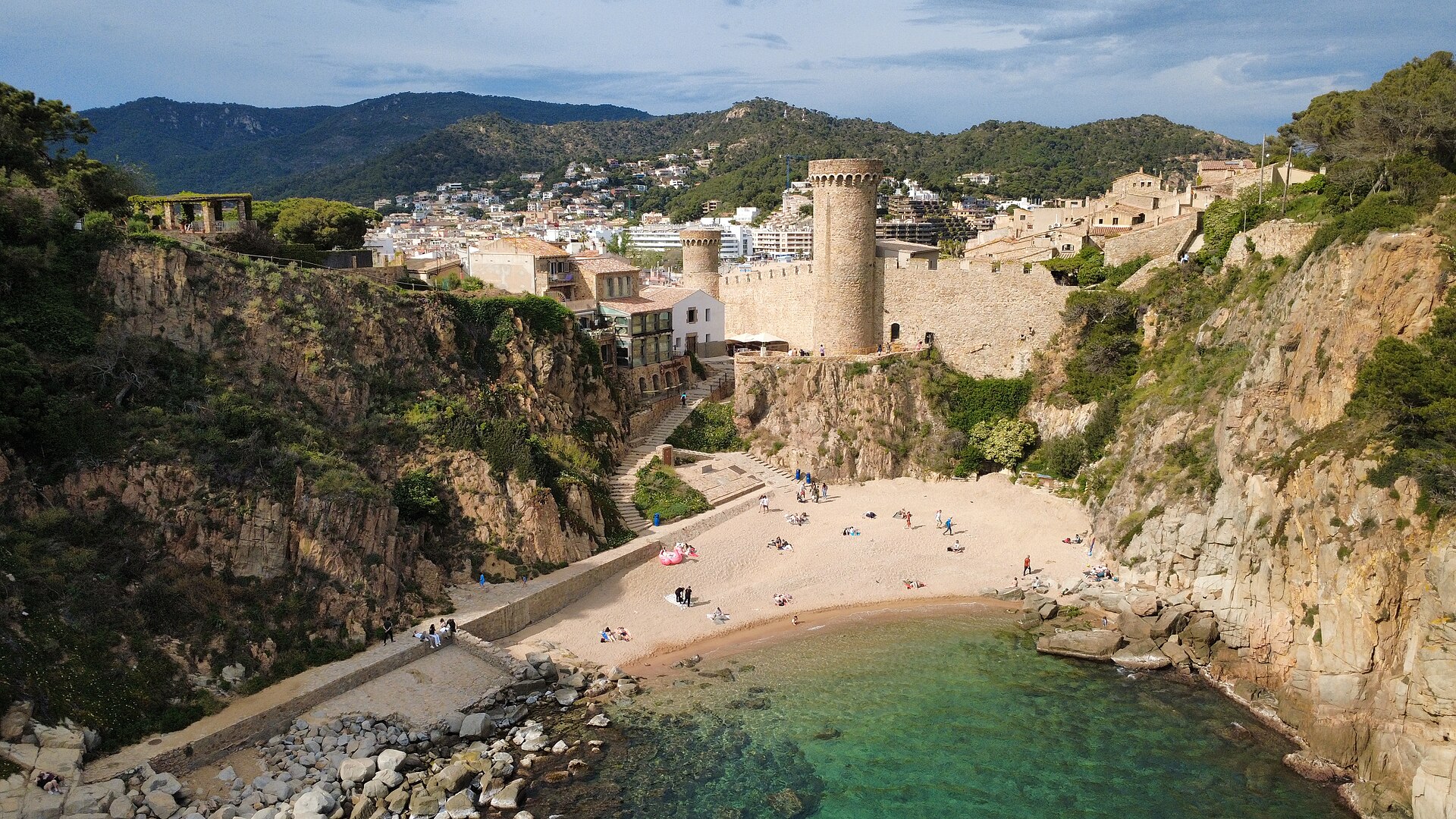
Among the best known are Torre d’en Joanàs, overlooking the bay; Torre de les Hores, next to the entrance to the former parade ground; and Torre d’es Codolar or Torre del Homenatge, which dominates Es Codolar beach.
Torre de les Hores takes its name from the fact that it was once home to the old public clock.
Torre d’en Joanàs occupies a privileged position above the sea and is one of the best places to understand the defensive function of the fortification.
And Torre d’es Codolar overlooks a small beach historically associated with the activities of fishermen.
These towers are not merely decorative elements.
They were lookout posts.
From them, the horizon was monitored and warnings were given when suspicious vessels approached.
For centuries, living beside the sea also meant living with an eye constantly on the sea.
The streets of Vila Vella: a city within the walls
One of the biggest mistakes would be to visit Tossa, photograph the wall from the beach and leave.
The real experience begins when you enter.
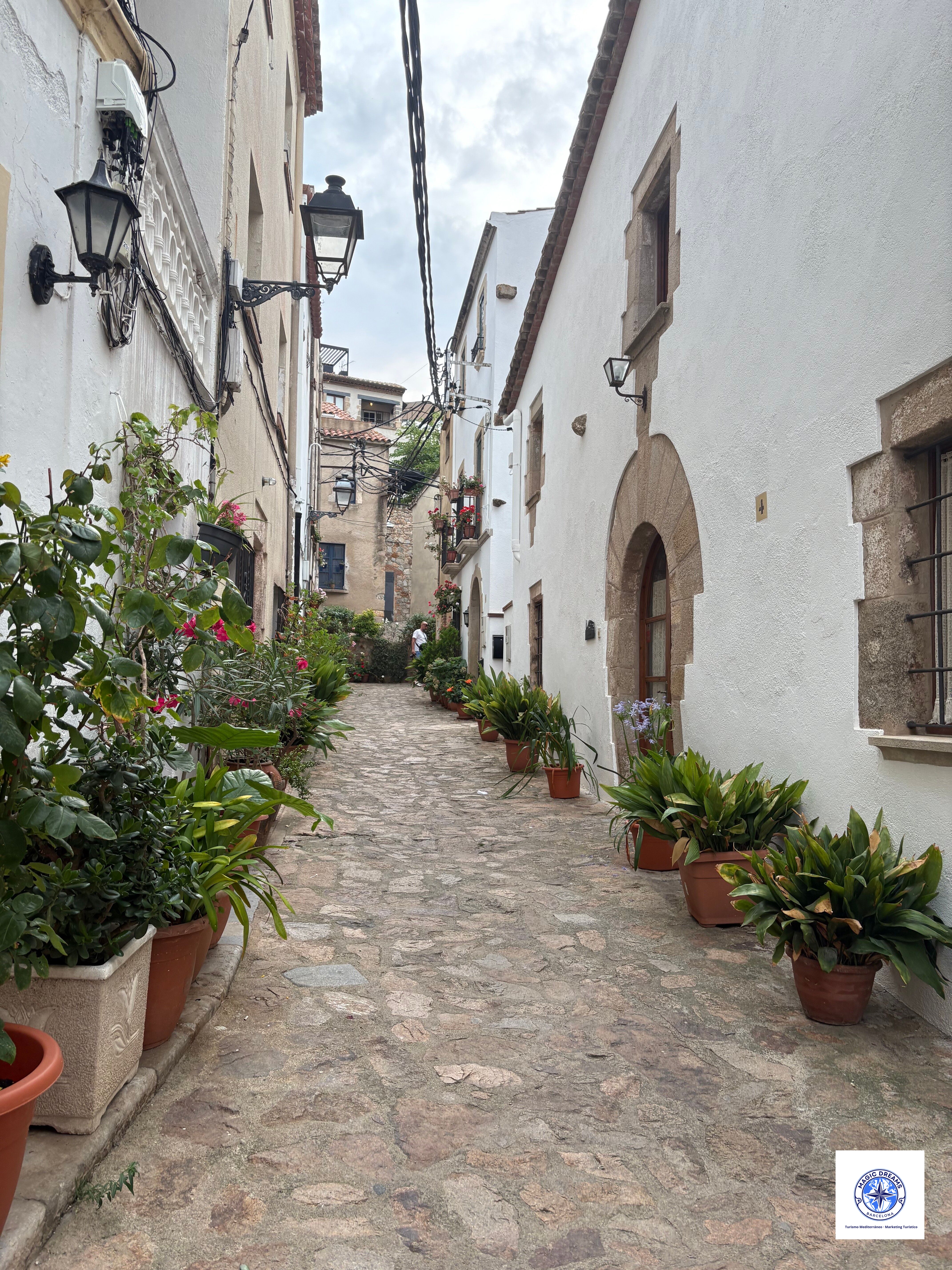
Vila Vella preserves a collection of narrow streets, stone houses, small squares and corners that allow visitors to imagine what everyday life was like in the old settlement.
Here we do not find merely a monument.
We find an ancient city.
The houses made use of the protection provided by the wall and were arranged around the interior streets.
As we climb, new viewpoints appear.
The sea reappears between the houses.
The towers rise above the rooftops.
And the ancient stones reflect the different stages through which Tossa has passed.
El Forat del Dimoni: one of Vila Vella’s little stories
Among the most curious corners is the well-known Forat del Dimoni, or “Devil’s Hole.”
It is a small opening associated with one of the traditional accesses towards the Es Codolar area.
Local traditions and stories connected with ancient fishermen have turned this small passage into one of those corners that add a touch of mystery to the route.
The exit leads towards a spectacular setting above the coast.
It is precisely in places like this that a guided visit takes on another dimension: you are not simply looking at stones, but discovering stories, legends and ways of life connected to the sea.
The ancient church of Sant Vicenç
In the upper part of Vila Vella we find the remains of the old church of Sant Vicenç, testimony to the medieval population that lived within the walls.
Its presence helps us understand that Vila Vella was an inhabited settlement for centuries and that the fortification contained a real community, with homes, religious spaces and public buildings.
Later, as the population grew outside the walled enclosure, urban life gradually moved towards what became known as Vila Nova.
The present parish church of Sant Vicenç is located there. It was built in the 18th century and is associated with late popular Baroque architecture.
Its interior preserves various artistic elements and chapels, although a significant part of its religious heritage was lost during the Spanish Civil War.
The present church is another essential place for understanding Tossa’s evolution from a medieval settlement into the modern town.
The Batlle Palace and the Municipal Museum
Inside Vila Vella we also find the former Palau del Batlle de Sac or Casa del Governador, a building that later became the headquarters of the Municipal Museum.
The museum was inaugurated on 1 September 1935, during one of the most important artistic periods in Tossa, and played a pioneering role in promoting contemporary art. According to the Tourist Office, it was the first contemporary art museum in Spain.
The museum houses archaeological heritage from the Villa Romana dels Ametllers and works connected with the artists who found inspiration in Tossa.
Important for today’s visitor: the Tourist Office currently reports that the Municipal Museum is closed for renovations, so it is advisable to check its current status before planning your visit.
Tossa Lighthouse: the highest point of Vila Vella
And then one of the most beautiful parts of the visit begins.
The climb towards the lighthouse.
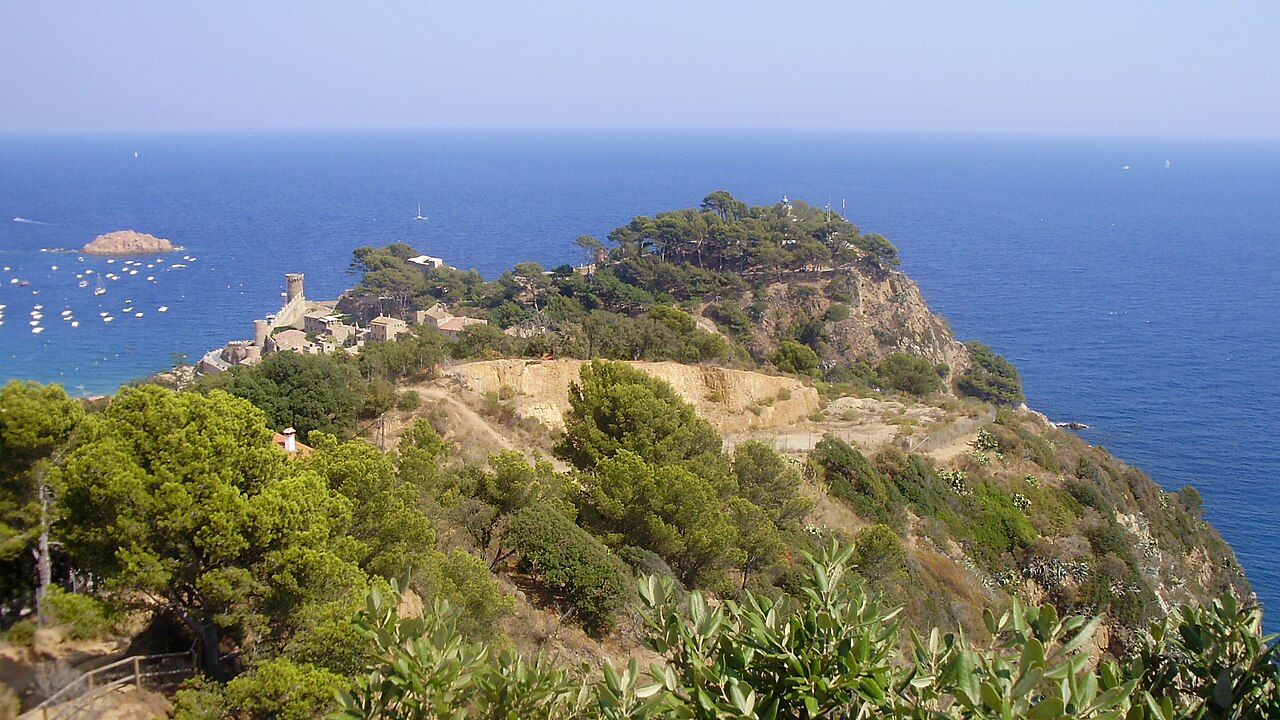
The highest point of Cape Tossa was once occupied by the medieval castle.
The fortress disappeared over the centuries and the strategically important promontory was later dedicated to navigation.
The current lighthouse was built in 1917 and now houses the museum project “Tossa Lighthouse. A Century of Maritime Signals on the Costa Brava.”
The lighthouse helps us understand the importance of maritime signals on a coastline such as this.
Cliffs.
Headlands.
Coves.
Rocks.
Navigation areas.
For generations, lighthouses were essential for guiding ships and warning them of the dangers of the coast.
The Interpretation Centre explains precisely this evolution and the history of maritime signalling.
Tossa Lighthouse opening hours
According to the current information from the Tourist Office:
Monday to Sunday: 10:00–13:00 and 16:00–20:00.
The currently published price is €3, with a reduced rate of €1.50. It is advisable to check the opening hours before visiting, especially during the low season or in case of changes.
The wall, on the other hand, remains freely accessible throughout the year.
The restaurant and a gastronomic break near the lighthouse
Reaching the lighthouse does not necessarily mean that the visit has to end immediately.
In the upper part of Vila Vella and its surroundings there are establishments where visitors can stop for a drink and enjoy the views.
The lighthouse area offers the opportunity to take a break while contemplating the Mediterranean from a privileged position, and there are restaurants and terraces in the Vila Vella surroundings.
For example, La Placeta is located in Plaça de les Armes, within the historic complex, while other establishments in the area offer terraces and drinks with views.
There are also options such as Vila Vella Terraza Bar, located on the Vila Vella promenade, where the experience is particularly connected to the atmosphere of the fortification and the panoramic views over the bay.
For those who prefer a more complete gastronomic experience, Tossa offers a wide variety of restaurants around the old town and the fishermen’s quarter.
The local cuisine deserves to be part of the visit in its own right.
Es Xalet d’en Bram: one of the most romantic viewpoints
Very close to the lighthouse we find another unique spot:
Es Xalet d’en Bram.
It is a viewpoint carved into the rock whose history is connected with Abraham Canals, a local man from Tossa who returned from Cuba and created this peculiar space in the rock.
From here, the views change once again.
The coastline appears sharply outlined.
The water takes on different shades of blue and green.
The cliffs descend towards the sea.
It is one of those places where it becomes easy to understand why so many artists were attracted to Tossa.
Marc Chagall and the Blue Paradise
During the 1930s and 1940s, Tossa experienced one of the most extraordinary cultural chapters in its history.
Between 1930 and 1936, the town became an important centre of artistic avant-garde activity.
Artists such as Marc Chagall, André Masson, Georges Kars, Rafael Benet and Pere Créixams passed through and worked in Tossa.
The Tourist Office calls this period “The Babel of the Arts,” reflecting the variety of nationalities and disciplines that came together in the town.
Marc Chagall arrived in Tossa in 1934 and was deeply impressed by its light, calling Tossa his “Blue Paradise.”
Here he found the blues of the Mediterranean, the contrast between the houses and stone, the walls and a light that transformed the landscape.
One of the works associated with this experience is The Celestial Violinist, connected with Chagall’s period in Tossa.
Ava Gardner: when Hollywood came to Tossa
And then the cameras arrived.
In 1951, Tossa became the setting for Pandora and the Flying Dutchman, starring Ava Gardner and James Mason.
The film brought the small fishing town to millions of viewers around the world.
But the filming left more than just cinematic images.
It left a story.
Ava Gardner became closely associated with Tossa and with her relationship with bullfighter and actor Mario Cabré, and the two became protagonists of countless stories and anecdotes connected with that summer.
The memory of the actress remains present in the town.
In Vila Vella stands her famous bronze statue, facing the Mediterranean.
Ava looks towards the sea.
And her figure has become one of the essential photographs of Tossa.
Ava Gardner’s Kisses: Tossa’s sweet memory
Ava Gardner’s story also has a gastronomic side.
At the historic Granja Tomàs, a pastry shop founded in 1885, visitors can find the famous “Ava Gardner’s Kisses”, small meringues associated with the traditional Illes de Tossa.
It is the perfect stop after exploring Vila Vella.
A small box of meringues.
A photograph of Ava Gardner.
And the memory of one of the most famous cinematic stories on the Costa Brava.
For a couple, it can even become a little ritual:
visit Ava’s statue, discover her story and finish the route by sharing her famous “Kisses.”
The Villa Romana dels Ametllers: when Tossa was Turissa
Long before Ava Gardner and long before Vila Vella, this area was already of extraordinary importance.
The Villa Romana dels Ametllers was discovered in 1914, and its origins date back to the 1st century BC, remaining active until approximately the 5th century AD.
It was an important agricultural estate in the Roman world, dedicated particularly to vine cultivation and the production and export of wine.
The complex was divided into two main areas:
the pars urbana, intended for the residential and elite area;
and the pars fructuaria, dedicated to agricultural and industrial activities.
The remains include baths, mosaics, stucco, a nymphaeum, a swimming pool and various structures associated with the production of wine, olive oil, salted products and cereals.
It is one of Tossa’s great contrasts:
in the morning, we can be walking through a medieval city;
and a few minutes later, looking at the remains of a major Roman agricultural estate.
The architecture of Tossa: medieval stone, fishing traditions and Modernisme
Tossa does not have a single architectural style.
Its identity is made up of different layers.
The medieval stone of Vila Vella.
The traditional fishermen’s houses.
The religious architecture of Sant Vicenç.
The bourgeois buildings of the late 19th and early 20th centuries.
And Modernista buildings reflecting the town’s economic and social transformation.
Visitors who walk slowly through the centre can discover façades, balconies, courtyards and architectural details that are often overlooked when a visit is limited to the wall.
That is why Tossa deserves more than a photograph.
It deserves a walk.
Tossa’s forests: a Costa Brava that cannot be seen from the beach
Tossa is also mountains.
The Cadiretes-Ardenya Massif forms the great natural lung of the municipality.
Pine forests, holm oak forests, cork oaks, forest tracks, streams, springs, viewpoints and ancient paths allow visitors to discover a Mediterranean landscape completely different from the coastline.
There are different hiking routes.
Among them is the Megalithic Route, measuring 10.50 kilometres, with an easy difficulty level, approximately 480 metres of maximum elevation and a duration of around 3 hours. It starts at the Sanctuary of Sant Grau and crosses an area particularly rich in megalithic monuments.
One of its main features is Pedra-sobre-altra, literally “Stone upon stone.”
There is something fascinating about walking through this landscape.
While the sea draws our gaze towards the horizon, the dolmens force us to look backwards, towards a history thousands of years old.
Dolmens, standing stones and a prehistoric Tossa
The megalithic monuments are evidence that these mountains were used by human communities long before the arrival of the Romans.
The route allows visitors to discover different funerary constructions and monumental stones integrated into the landscape.
It is not a route of grand urban monuments.
Its beauty lies precisely in the opposite.
We find them among the trees.
In places where the landscape seems to have protected them for centuries.
The Megalithic Route is not signposted on the ground, and it is advisable to use the Natura Local application to follow it.
For this reason, for a private experience it is advisable to plan the route carefully rather than improvise.
The Camí de Ronda: walking among forests, cliffs and the Mediterranean
If the Megalithic Route allows us to discover the interior, the Camí de Ronda reveals the coastline.
These traditional coastal paths cross pine forests, cliffs and small coves.
In Tossa we find some of the most spectacular landscapes along these trails.
The Camí de Ronda routes are walks where the scent of salt, rosemary and thyme accompanies visitors while the cliffs descend towards the sea and coves appear between the rocks.
There is no need to cover great distances to enjoy them.
We can select a short section.
One of moderate difficulty.
A romantic route.
Or a longer trail for experienced hikers.
The beaches and coves of Tossa de Mar
One of the municipality’s greatest attractions is the variety of its coastline.
The Tourist Office lists Platja Gran, Mar Menuda, Es Codolar, Cala Bona, Cala d’en Carlos, Cala Figuera, Cala Llevadó, Cala Pola, Cala Giverola, Cala Futadera, Cala Salions, Vallpresona, the beaches of Llorell, Porto Pi and Cala Morisca.
They are not all the same.
Some are urban.
Others are semi-urban.
Others retain a completely natural character.
Some have restaurants and services.
At others, you need to bring absolutely everything yourself.
And this is precisely where the richness of Tossa’s coastline lies.
Platja Gran: the postcard beach
Distance from Tossa: within the town centre.
Approximate length: 370 metres.
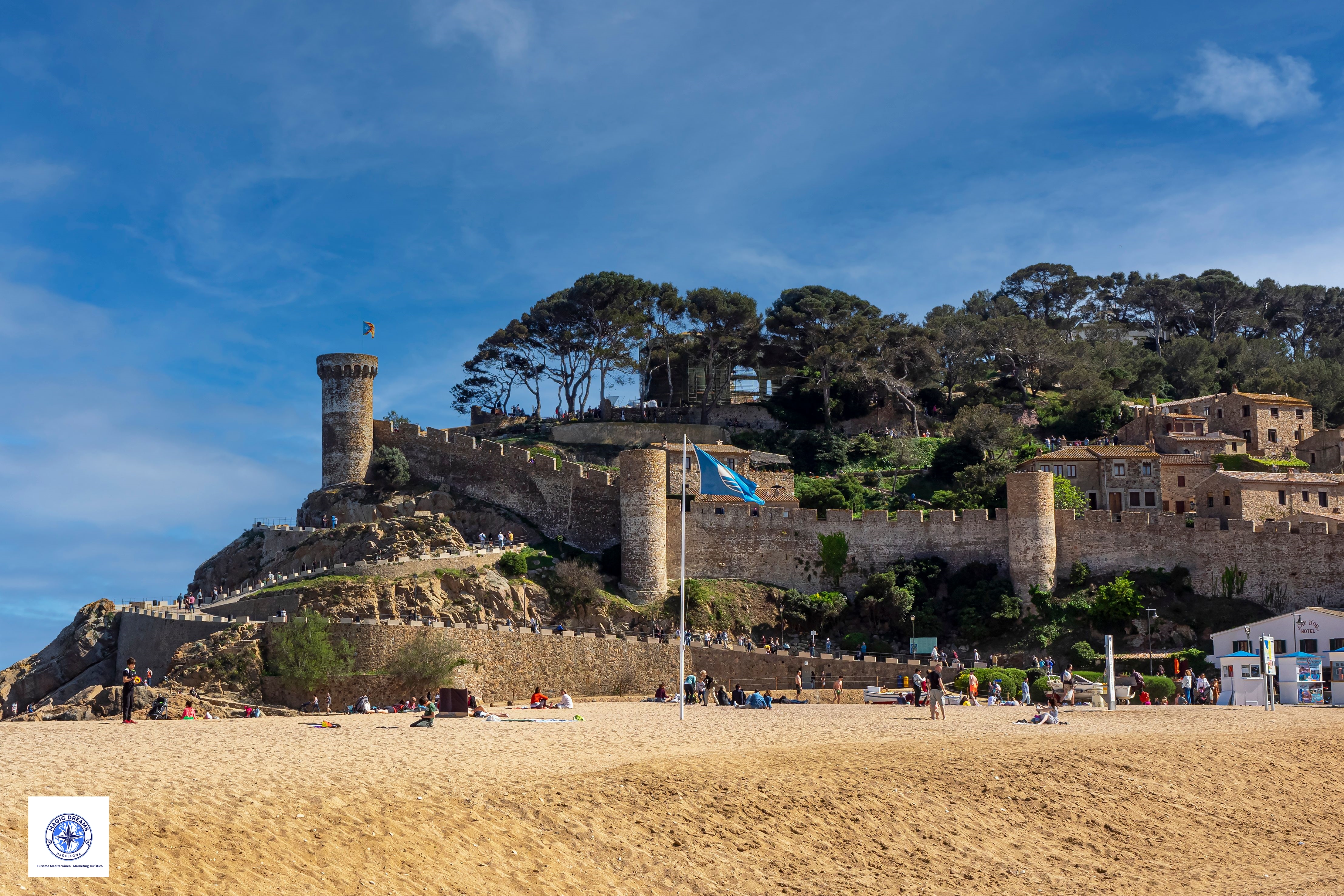
This is Tossa’s main beach and the one that appears in most photographs of the town.
It is located at the foot of Vila Vella and offers one of the most famous panoramas on the Costa Brava.
It has showers, adapted toilets, lifeguard services, accessibility for people with reduced mobility, restaurants, bars, beach bars, sun loungers, water activities and other services.
It is the best option for those who want to combine:
beach + gastronomy + history + convenience.
Mar Menuda and Banyera de ses Dones
Mar Menuda is located a short distance from the centre.
Its surroundings are rockier and quieter and make it one of the most interesting areas for enjoying the sea.
Within it we find the well-known Banyera de ses Dones, a small area of calm, shallow water.
It is particularly pleasant for families and for those who want to enjoy the water in a more peaceful setting.
It is also known for its snorkelling and diving opportunities.
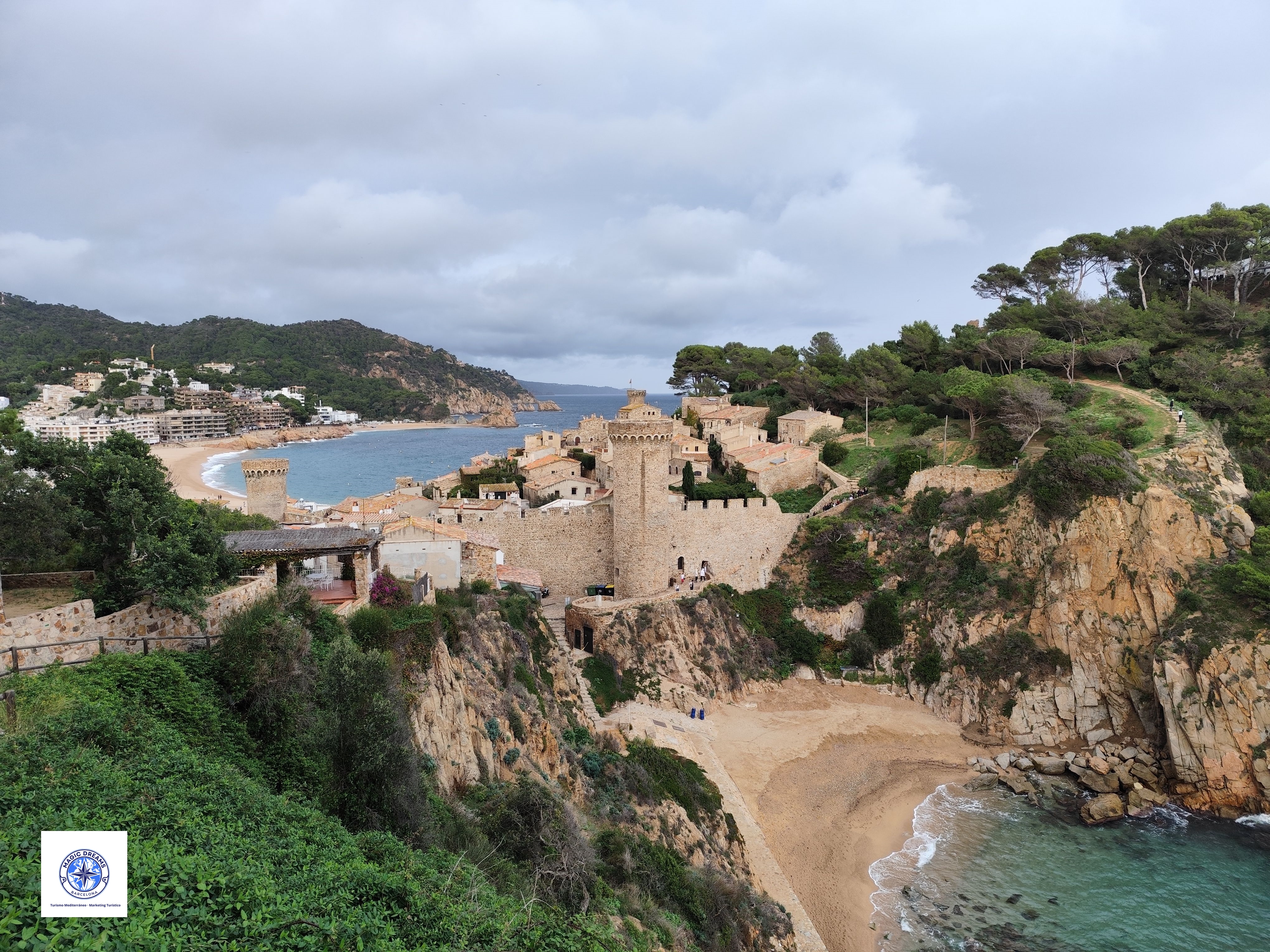
Es Codolar: the beach beneath the walls
Few beaches on the Costa Brava have such a spectacular location.
Es Codolar lies directly beneath Vila Vella.
The small beach is protected by the cliffs and the fortification itself.
It is the perfect place to understand the historical relationship between Tossa and the sea.
Fishermen used these natural spaces to shelter their boats.
Today it is one of the most photographed corners of the municipality.
Cala Bona
Cala Bona is a small, more natural-looking cove.
It can be reached via coastal paths or from the sea.
It is suitable for those who prefer smaller, quieter spaces to urban beaches.
Its rocky surroundings and Mediterranean vegetation provide an experience very different from that of Platja Gran.
Cala d’en Carlos
Cala d’en Carlos is another small stretch of Tossa’s coastline where the forest almost reaches the sea.
Its transparent waters and rocky seabed make it particularly interesting for snorkelling enthusiasts.
It is a cove for experiencing the Mediterranean in a more natural way.
Cala Figuera
Cala Figuera is a small natural cove.
Its main attraction is precisely its tranquillity and surroundings.
Visitors should not expect the same level of services as at Platja Gran.
Here, the landscape is the main attraction.
Cala Llevadó
Cala Llevadó combines nature and the sea.
It is surrounded by vegetation and offers transparent waters.
Access is influenced by the facilities in its surroundings, so it is advisable to check conditions before visiting.
It is an interesting alternative for those looking for a beach integrated into nature.
Cala Pola
Distance from Tossa: approximately 4 kilometres.
Length: around 70 metres.
Cala Pola is one of the most characteristic landscapes of Tossa’s coastline.
Located in a semi-urban setting, it has a beach bar and toilets. It can be reached by road and then on foot, via the Camí de Ronda, or by private boat.
The cove is surrounded by vegetation and cliffs.
For a romantic experience, arriving by sea is particularly appealing.
Approaching by boat allows you to contemplate the coastline from another perspective before entering the small bay.
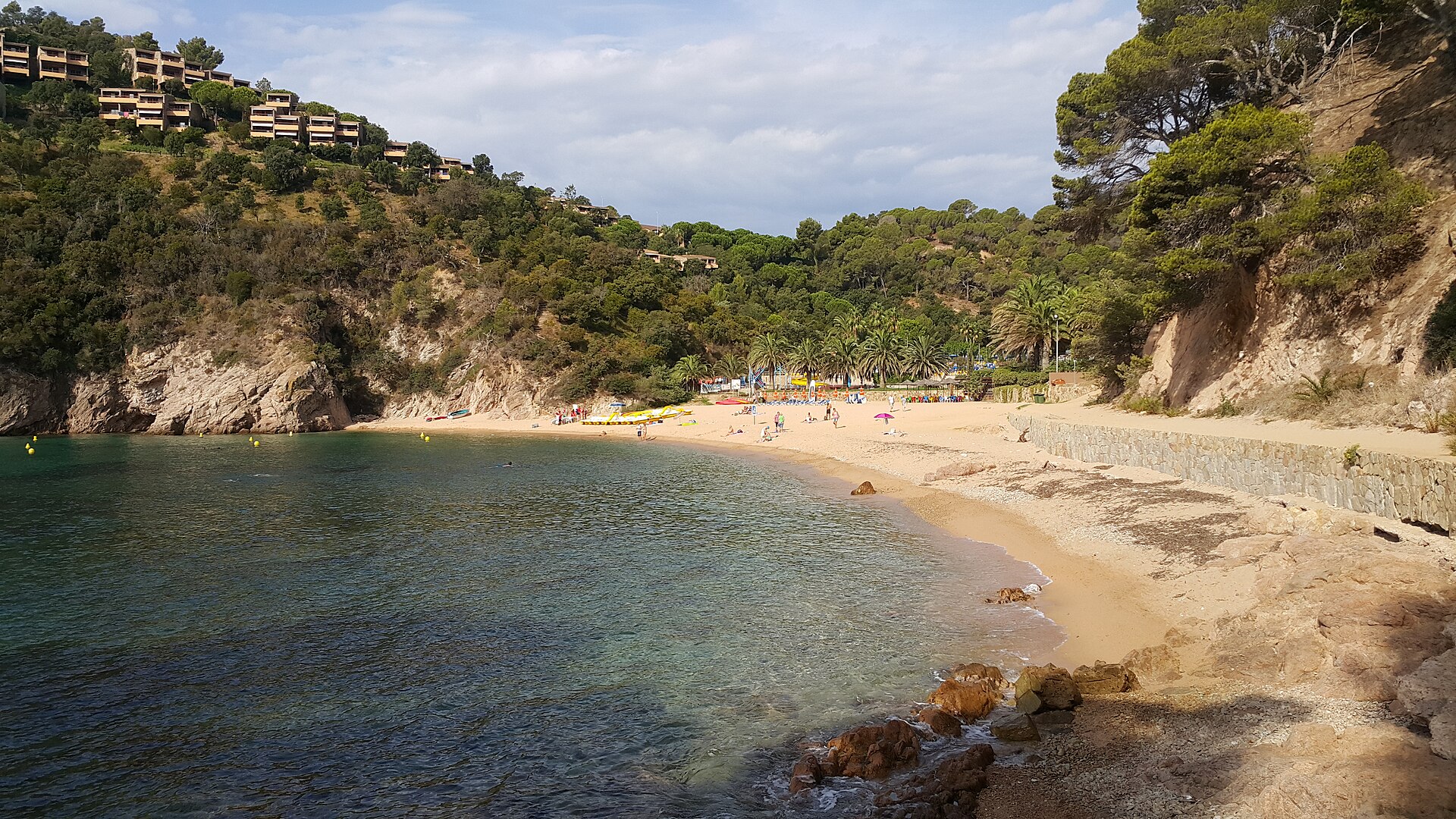
Cala Giverola
Distance from Tossa: approximately 5 kilometres.
Length: around 175 metres.
Cala Giverola is one of the municipality’s most fully equipped coves.
Crystal-clear waters.
Pine trees.
Cliffs.
Coarse sand.
Restaurant.
Bar.
Beach bar.
Showers.
Adapted toilets.
Sun loungers.
Parasols.
Water activities.
Equipment rental.
Mooring area.
And paid parking.
It can also be reached by private boat or by tourist boats with glass bottoms departing from Platja Gran.
It is one of the best options for those who want nature without giving up services.
Cala Futadera: one of the great natural jewels
Distance from Tossa: approximately 6 kilometres.
Length: around 80 metres.
The Tourist Office classifies it as a natural environment.
It is located beneath a cliff and surrounded by vegetation.
Its waters display emerald tones and the landscape has an almost untouched appearance.
There are no services.
Access requires leaving the vehicle on the road and walking for a few minutes before descending a long flight of steps.
For this reason, it is recommended for people who can manage the access comfortably.
It is also advisable to go in the morning, as the cliff itself can leave the cove in the shade during the afternoon.
Cala Salions
Cala Salions combines a beautiful coastal landscape with a residential area and various services.
It is an option for those who want to enjoy the coastline without completely giving up tourist infrastructure.
It also allows visitors to combine swimming with gastronomy and maritime activities.
Vallpresona: the wildest Costa Brava
Distance from Tossa: approximately 10 kilometres.
Length: around 160 metres.
Vallpresona represents one of the most natural versions of the coastline.
The beach consists of pebbles, stones and rocks and is surrounded by lush vegetation.
It is a completely untouched area with no services. Access from the road requires continuing on foot for approximately ten minutes.
It is precisely the absence of services that gives this place its special charm.
Llorell
The beaches of Llorell offer a different landscape, with a greater presence of facilities and services.
They are suitable for families and visitors who want to combine nature with comfort.
They are a good alternative when the objective is not to find a completely isolated cove but rather to enjoy a coastal setting with services nearby.
Cala Morisca
Cala Morisca is a small natural cove.
It is suitable for those looking for quieter and less urbanized spaces.
As with other small coves in the area, access and services may be more limited than at the main beaches.
Porto Pi
Porto Pi is also part of the municipality’s collection of beaches and coves.
However, due to the terrain and possible risks of rockfalls, it is especially important to check the current official safety recommendations before organizing a visit.
In Tossa, the beauty of the landscape should always be accompanied by respect for safety conditions.
The Mediterranean beneath our feet: Posidonia and marine life
Tossa should not only be experienced from land.
Its seabeds are among the great natural treasures of the coastline.
Rocky areas and meadows of Posidonia oceanica provide shelter and food for a wide variety of species.
Octopuses.
Moray eels.
Conger eels.
Groupers.
Sea bream.
Lobsters.
And an enormous variety of small Mediterranean fish.
For those who snorkel or dive, discovering this underwater world means experiencing a second Tossa.
A silent Tossa.
A blue Tossa.
A Tossa where every rock can hide life.
Tossa’s seahorses
Among the species that inspire particular fascination are seahorses.
Tossa’s diving and marine observation tradition has made these small animals one of the great symbols of the municipality’s underwater biodiversity.
However, it is advisable to avoid absolute claims such as saying that Tossa has “the largest population in Catalonia” unless supported by an up-to-date scientific study.
What truly matters is that its seabeds provide suitable habitats for a wide variety of species and that the seahorse perfectly represents the fragility of these ecosystems.
Seeing one in the wild requires patience.
Do not touch it.
Do not chase it.
Do not disturb the vegetation.
Do not stir up sediment.
Simply observe.
And understand that the true beauty of this experience lies in leaving the Mediterranean exactly as we found it.
The cuisine of a former Fishing Village
Tossa’s history can also be tasted.
Traditional cuisine is linked to fishing and to the so-called fishermen’s boat dishes, recipes that originated in the everyday lives of fishermen.
One of the most representative dishes is cim i tomba, traditionally prepared with fish and potatoes and closely associated with the local maritime cuisine.
Gastronomy can thus become another way of getting to know the town.
A lunch by the sea.
Fresh fish.
Rice.
Seafood.
A Catalan 0.0 Alcohol Free wine.
And afterwards, to finish, the famous Ava’s Kisses.
Tossa de Mar from Barcelona
Tossa is located approximately 100 kilometres from Barcelona, although the exact distance depends on the starting point.
By private vehicle, the journey usually takes around 1.5 hours under normal conditions, although during summer, weekends and public holidays it can take considerably longer.
There are different road access options, including the AP-7 and connections from Vidreres, Lloret de Mar and Sant Feliu de Guíxols.
There are also bus connections.
For a comfortable experience, especially when the plan is to visit several coves or combine Tossa with inland routes, a private vehicle is much more practical.
Tossa de Mar in one day
A first visit could be organized as follows:
Morning
Arrival in Tossa.
Walk through Vila Vella.
Medieval gateway.
Walls.
Towers.
Forat del Dimoni.
Ancient church of Sant Vicenç.
Governor’s House.
Climb to the Lighthouse.
Interpretation Centre.
Es Xalet d’en Bram viewpoint.
Midday
Mediterranean lunch.
Fish.
Seafood.
Cim i tomba.
Catalan 0.0 Alcohol Free wine.
Afternoon
Platja Gran, Mar Menuda or one of the coves.
Or:
Camí de Ronda.
Forest route.
Megalithic route.
Sunset
Return to Vila Vella.
Mediterranean views.
Ava Gardner.
A walk through the medieval streets.
And Ava’s Kisses as a souvenir.
Tossa de Mar for a nature and wellness weekend
If we have more time, the experience can be expanded.
Day One: history and culture.
Vila Vella.
Lighthouse.
Church.
Roman Villa.
Ava Gardner.
Chagall.
Gastronomy.
Day Two: nature and sea.
Forest route.
Dolmens.
Camí de Ronda.
Cove.
Snorkelling.
Meditation.
Fresh fruit.
Fresh juices.
Massage.
Spa.
Sauna or hammam.
Dinner overlooking the Mediterranean.
In this way, Tossa ceases to be simply a day trip.
It becomes a complete experience.
A moment of silence facing the Mediterranean
For those looking for a different experience, a walk through the forest can end at a quiet cove.
After walking among trees and megalithic monuments, reaching the sea creates an extraordinary contrast.
We can sit facing the water.
Breathe.
Listen to the waves.
Close our eyes.
Practice a short guided meditation.
Or simply remain silent.
For those who practise spirituality, it can also become a moment of personal prayer.
And afterwards:
a basket of fresh fruit,
fresh juices,
water,
and time to enjoy the Mediterranean.
Always respecting the rules of the natural area and avoiding any activity that could disturb the environment.
Massages, spa and relaxation
After a day of hiking, wellness options can complete the experience.
Depending on availability and the season, we can incorporate:
personalized Lomi-Lomi massages by the sea,
water circuits,
sauna,
steam bath,
hammam,
body treatments
or simply a few hours of relaxation.
The idea is not to fill the day with activities.
Quite the opposite.
It is about leaving empty spaces.
Spaces to breathe.
To contemplate.
To rest.
Because wellness also means not having to rush.
The Tossa de Mar experience with Magic Dreams Barcelona
And this is where our proposal can naturally fit in.
We do not want visitors to see Tossa solely from a tourist perspective.
We want them to experience it.
We can organize private transportation from Barcelona, adapt the routes, coordinate visits, select restaurants, arrange wellness experiences and design a day according to each guest’s preferred pace.
But Tossa remains the protagonist.
The protagonist is the wall.
The lighthouse.
Ava Gardner.
Chagall.
The fishermen.
The dolmens.
The forest.
The coves.
The Mediterranean.
The gastronomy.
And the history.
Our services simply make it possible to enjoy all of this with greater comfort.
A romantic getaway to Tossa de Mar
Imagine starting the morning in Barcelona.
A private vehicle is waiting.
The journey towards the Costa Brava.
Upon arrival in Tossa, the first sight:
the wall above the sea.
Walk through the gateway.
Climb among the stones.
Discover the towers.
Reach the lighthouse.
Contemplate the Mediterranean.
Descend towards the town.
Discover the story of Ava Gardner.
Buy a box of Ava’s Kisses.
Have lunch with fresh fish.
In the afternoon, leave the town and enter the forest.
Discover the ancient megalithic monuments.
Walk.
Breathe.
Later, reach a cove.
Sit facing the sea.
A basket of fruit.
Fresh juices.
A moment of silence.
And, if desired, a massage and a few hours at the spa.
At sunset, return to Vila Vella.
The stone begins to change colour.
The sea reflects the last light.
And the walls once again become the image of that Tossa that captivated artists and filmmakers.
Tossa de Mar: much more than a beach
Tossa should not be discovered only in summer.
In spring, the forest paths take on another dimension.
In autumn, the routes can be enjoyed in more pleasant temperatures.
In winter, Vila Vella can be experienced with much greater tranquillity.
And in summer, the Mediterranean transforms its coves into the perfect setting for swimming, snorkelling, boating and water activities.
Each season offers a different Tossa.
But the wall remains.
The lighthouse remains.
The history remains.
And the Mediterranean continues to be the great protagonist.
Tossa de Mar, the place where history looks out to sea
Perhaps that is the best way to describe Tossa.
A town where history always ends up looking towards the Mediterranean.
The Romans arrived by the coast.
The fishermen lived from the sea.
The walls were built to protect the town from those who arrived from the sea.
The lighthouse was created to guide those who sailed upon it.
Artists came, attracted by its light.
Ava Gardner arrived with Hollywood.
Chagall found his Blue Paradise.
And today we continue to arrive to discover all of this.
Tossa de Mar is wall and beach.
It is forest and Mediterranean.
It is Rome and the Middle Ages.
It is Chagall and Ava Gardner.
It is hiking and gastronomy.
It is history and nature.
It is a hidden cove and a terrace overlooking the sea.
It is a dolmen among the trees and a medieval tower above the water.
And it can also be a place to stop.
To breathe.
To share a basket of fresh fruit.
To contemplate the sea.
To enjoy a massage.
To listen to the silence.
To savour a good dish of maritime cuisine.
To end the day watching the sun disappear behind the Costa Brava.
And that is precisely the experience we want to offer at Magic Dreams Barcelona: to make an authentic, historic, natural, romantic and Mediterranean Tossa accessible to our guests, taking care of the logistics and the details so that they can devote their time to what truly matters:
enjoying the journey.
Tossa-de-Mar-Magic-Dreams-Barcelona.
Tossa-de-Mar-Magic-Dreams-Barcelona.
Tossa-de-Mar-Magic-Dreams-Barcelona.
Tossa-de-Mar-Magic-Dreams-Barcelona.
Tossa-de-Mar-Magic-Dreams-Barcelona.
Tossa-de-Mar-Magic-Dreams-Barcelona.
Tossa-de-Mar-Magic-Dreams-Barcelona.
Tossa de Mar – By Jorge Franganillo – Own work, CC BY-SA 4.0, https://commons.wikimedia.org/w/index.php?curid=41186774.
Tossa al atardecer – By Moahim – File:!MQ_DSF9592-EnhancedAnd2more_fused_1.jpg, CC BY-SA 4.0, https://commons.wikimedia.org/w/index.php?curid=92798820.
Tossa de Mar – By Alberto-g-rovi – Own work, CC BY 3.0, https://commons.wikimedia.org/w/index.php?curid=42278527.
Muralla del Pueblo Medieval de Tossa – By EliziR, CC BY-SA 3.0, https://commons.wikimedia.org/w/index.php?curid=56360496.
Tamariu visto desde la GR-92 hacia el sur – By Chris j wood – Own work, CC BY-SA 4.0, https://commons.wikimedia.org/w/index.php?curid=125087399.
Playa de Es Codolar en Tossa de Mar – By Sylvestre – Own work, CC BY-SA 4.0, https://commons.wikimedia.org/w/index.php?curid=198493196.
Detalle de Tossa de Mar des del Camí de ronda tranvía – By klimmanet, CC BY 3.0, https://commons.wikimedia.org/w/index.php?curid=54554875.
Perspectiva a pie en Tossa – By Felipe Gabaldón – Costa Brava, CC BY 2.0, https://commons.wikimedia.org/w/index.php?curid=63294183.
Perspectiva a pie en Tossa – By Felipe Gabaldón – Costa Brava, CC BY 2.0, https://commons.wikimedia.org/w/index.php?curid=63294183.
Iglesia de Sant Vicenç (Tossa de Mar) – By Enric – Own work, CC BY-SA 4.0, https://commons.wikimedia.org/w/index.php?curid=94151734.
Cala Giverola, Tossa de Mar – By Friviere – Own work, CC BY-SA 3.0, https://commons.wikimedia.org/w/index.php?curid=62081939.
Cala Bona – Magic Dreams Barcelona – Karsten Ratzke, CC0, via Wikimedia Commons.
Forat del Dimoni – Txllxt TxllxT, CC BY-SA 4.0 , via Wikimedia Commons.