Route guide for visitors throughout Catalonia – Barcelona – Costa Brava – Catalan Pyrenees – Personalized experiences – Customized tour guide services – A small tribute to the wonderful city and land that saw us born – Transforming experiences into unforgettable memories - Magic Dreams Collection: exclusive universes inspired by Salvador Dalí and Gaudí. Niche perfumes, jewelry, lithographs, and collectible items celebrating the Mediterranean spirit.
La Calle Balmes, situada en el corazón del Eixample de Barcelona, es una de las arterias urbanas más representativas de la evolución de la ciudad moderna. Más que una simple vía de circulación, Balmes es un relato urbano donde se entrelazan historia, arquitectura, economía y …
In the heart of Barcelona’s Eixample district, along the prestigious Rambla de Catalunya, stands a building that embodies history, style, and distinction: Cases Godó‑Lallana. Located at numbers 112–114, on the corner with Carrer Rosselló, this residence is not only a testament to early 20th-century architecture …
Casa Verdú – Modernism in Barcelona’s Eixample District
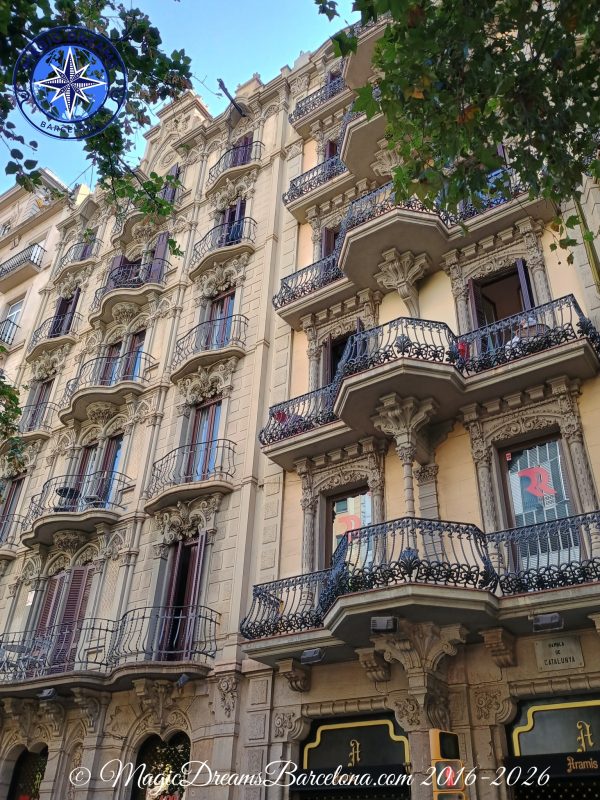
We are standing in front of the building known as Casa Verdú, located at 103 Rambla de Cataluña, at the intersection with Provenza Street, in the emblematic Eixample district of Barcelona.
This property is a remarkable example of Barcelona’s Modernist architecture. It was designed between 1903 and 1904 by architect Maurici Augé i Robert, with later contributions by Melcior Viñals and Salvador Viñals, which further enriched its artistic and architectural value.
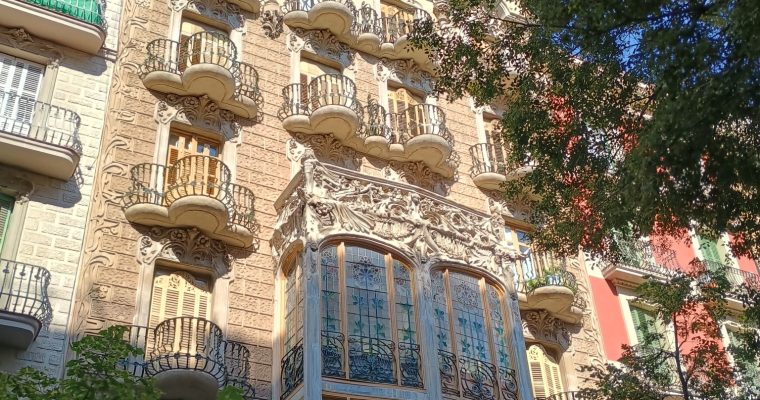
The chamfered façade reflects the characteristic layout of Barcelona’s urban expansion, yet it stands out for its refined ornamental composition. Among its most notable features are the wrought iron balconies, showcasing organic and flowing forms inspired by nature; the glazed ceramic elements, introducing a subtle polychromy typical of the Modernist style; and the window and lintel moldings, decorated with delicate floral and geometric motifs.
Particularly noteworthy is the vertical axis at the corner, conceived as the main compositional element, which visually organizes the entire building and gives it a distinguished urban presence.
For collaborations, projects or professional inquiries – Reservations and quotes
Please leave your details and phone number, and we will get in touch with you as soon as possible, within the same day.
Casa Verdú – Modernismo en el Eixample de Barcelona Nos encontramos frente al edificio conocido como Casa Verdú, situado en la Rambla de Cataluña número 103, a la altura de la calle Provenza, en el emblemático barrio del Eixample de Barcelona. Este inmueble constituye un …
En el corazón del distrito del Eixample, uno de los paisajes urbanos más emblemáticos de Barcelona, se encuentra la elegante Casa Sala-Cairó, un edificio residencial que forma parte del rico patrimonio del Modernisme català. Situada en la calle Enric Granados, una de las vías más …
En uno de los accesos más emblemáticos al Eixample barcelonés está situado el Edificio Residencial de Plaça Francesc Macià, un inmueble que define la personalidad urbana de la ciudad y le invita a descubrir la elegancia arquitectónica de Barcelona de la década de 1930.
Este edificio monumental representa una de las expresiones más elegantes del Beaux Arts – Monumentalismo Classicista en la ciudad y se distingue por su fachada semicircular, su gran cúpula central y los detalles que evocan la tradición arquitectónica europea.
Un Icono Arquitectónico con Espíritu Europeo
Construido en 1935, el edificio fue proyectado por el arquitecto barcelonés Josep Rodríguez Lloveras, reconocido por su capacidad para crear obras de gran presencia urbana. Su estilo combina la monumentalidad clásica con elementos propios de las grandes capitales europeas, creando un inmueble que se distingue por su sobriedad, elegancia y singularidad.
La fachada semicircular recuerda al célebre Royal Crescent de Bath (Reino Unido), generando un efecto envolvente que dota a la plaza Francesc Macià de una personalidad señorial única.
Detalles Arquitectónicos y Simbolismo
Al recorrer el edificio, usted podrá apreciar:
Columnas clásicas y relieves ornamentales.
Frontones decorativos, jarrones y volutas escultóricas.
Mansardas de pizarra en la cubierta superior, poco habituales en Barcelona.
Gran cúpula central que actúa como eje visual.
Templetes laterales que refuerzan la monumentalidad.
Curiosas proas de barcos de vela en el coronamiento, evocando el espíritu mediterráneo de la ciudad.
Estos detalles hacen del Edificio Residencial de Plaça Francesc Macià un verdadero diálogo arquitectónico entre Barcelona y las grandes ciudades europeas.
La Entrada Señorial al Eixample
Su situación en un nodo urbano clave convierte al edificio en un punto de referencia dentro de la ciudad, marcando la transición entre la Barcelona histórica y su expansión moderna hacia el Eixample. Desde esta perspectiva, usted podrá contemplar la armonía entre diseño urbano y monumentalidad, disfrutando de un recorrido único por la historia de la ciudad.
Descubra Barcelona con Magic Dreams Barcelona
Desde Magic Dreams Barcelona, le invitamos a descubrir el Edificio Residencial de Plaça Francesc Macià y su entorno mediante experiencias privadas y personalizadas. Nuestras propuestas combinan:
Arquitectura e historia urbana.
Arte contemporáneo y diseño.
Espacios verdes y rincones secretos.
Experiencias gastronómicas exclusivas en los mejores locales.
Nuestro equipo de guías locales expertos le ofrece una mirada profunda y auténtica de la ciudad, revelando historias, secretos y detalles arquitectónicos que escapan al visitante convencional.
Nos encargamos de toda la logística, garantizando comodidad, puntualidad y un servicio completamente adaptado a sus necesidades, ya sea para visitas culturales, experiencias gastronómicas privadas o itinerarios diseñados a medida.
Atendemos en castellano, catalán e inglés, y bajo solicitud previa adaptamos las experiencias a otros idiomas, asegurando un servicio cercano, profesional y de máxima calidad.
Desde nuestra perspectiva experiencial, local y profesional, le invitamos a descubrir Barcelona con autenticidad, emoción y elegancia.
An iconic promenade between two of Barcelona’s landmarks Avinguda Gaudí is one of Barcelona’s most distinctive, elegant, and harmonious promenades. Located in the Eixample district, this pedestrian avenue connects two of the great masterpieces of Catalan Modernism: the Sagrada Família and the Hospital de Sant …
Un paseo emblemático entre dos iconos de Barcelona La Avenida Gaudí es uno de los paseos más singulares, elegantes y armoniosos de Barcelona. Situada en el distrito del Eixample, esta avenida peatonal conecta dos de las grandes obras maestras del modernismo catalán: la Sagrada Familia …
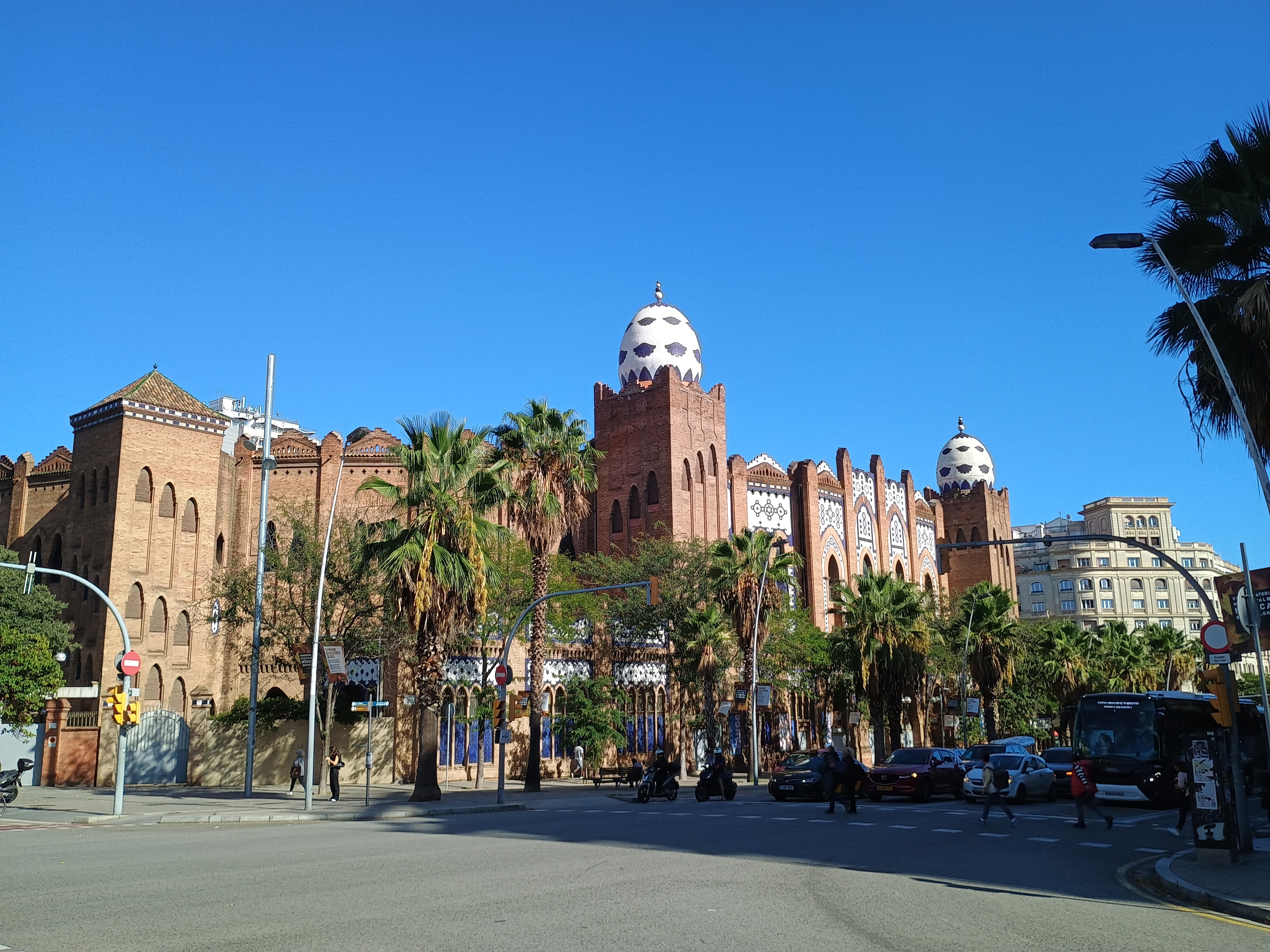
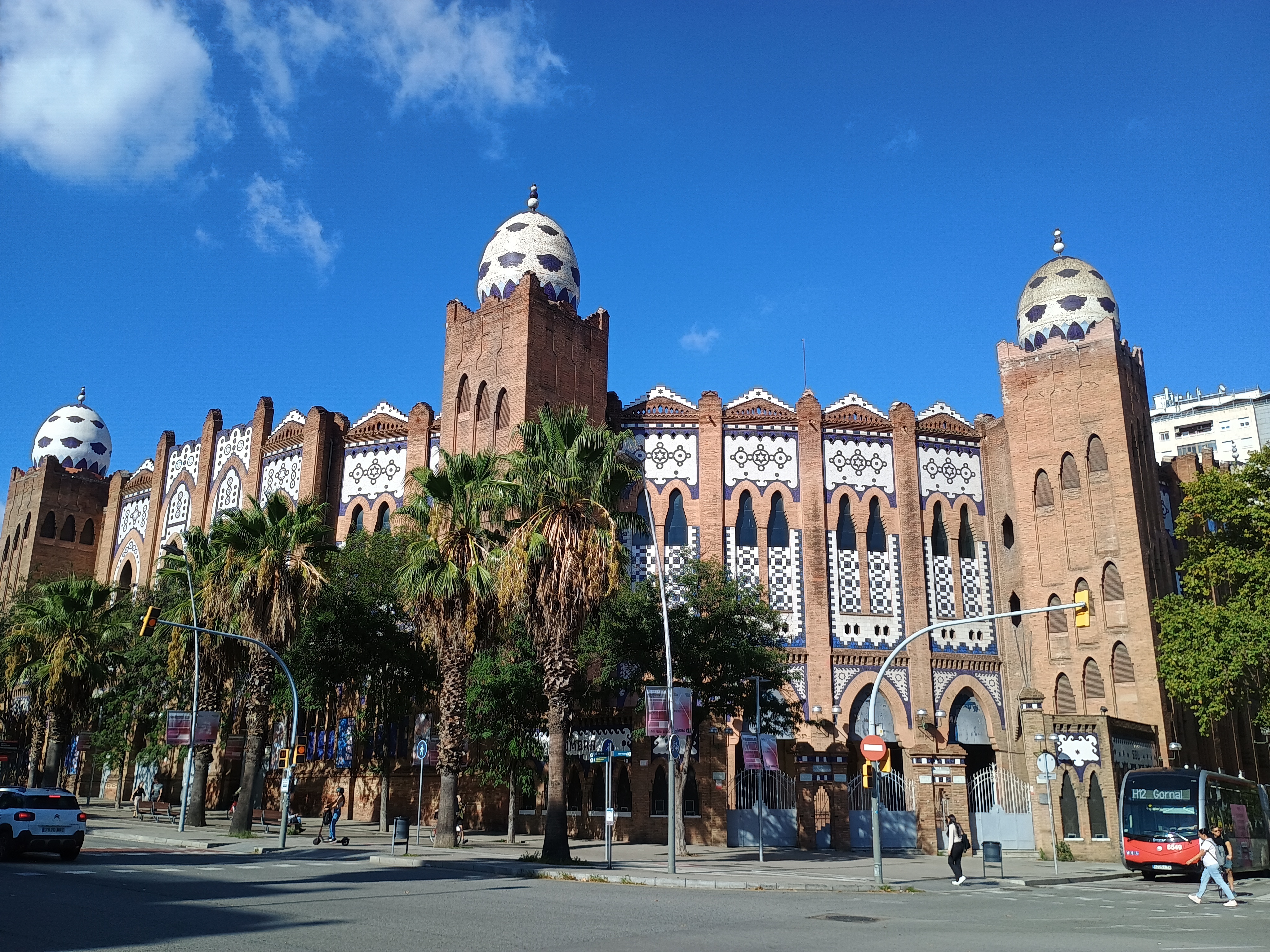
At the intersection of Gran Via de les Corts Catalanes and Carrer de Marina stands one of Barcelona’s most distinctive buildings.
The Monumental Bullring, known simply as La Monumental, has been part of the city’s architectural, social, and cultural memory for more than a century.
Its history began in 1914 as a bullring.
For decades, it was one of Barcelona’s major venues for bullfighting, but it also hosted boxing, circus performances, public events, political rallies, and, especially from the 1960s onward, some of the most important concerts held in the city.
Today, it is no longer an operating bullring.
The arena that for almost a century welcomed bullfighters and spectators has been transformed into a venue for music, festivals, and a wide range of cultural events.
La Monumental has changed its purpose, but not its prominence.
The Origins of La Monumental
When Barcelona was building a new city
At the beginning of the 20th century, Barcelona was undergoing a profound urban transformation.
The Eixample had become one of the city’s main areas of expansion, and its new avenues were beginning to fill with buildings, theatres, cafés, shops, and entertainment venues serving a rapidly changing society.
It was in this context that La Monumental was born.
The building was inaugurated on 12 April 1914 under the name El Sport.
The original structure was designed by architect Manuel Joaquim Raspall, one of the figures associated with Catalan Modernisme and Noucentisme.
Its initial appearance, however, was different from the one we know today.
The growing popularity of bullfighting soon led to plans for an expansion.
1916: La Monumental is Born
A transformation that completely changed its appearance
Just two years after its inauguration, the building was expanded and renovated.
The project was taken over by Ignasi Mas i Morell, in collaboration with Domènec Sugranyes, and the bullring acquired the monumental appearance that has survived to the present day.
It was then that it definitively adopted the name La Monumental.
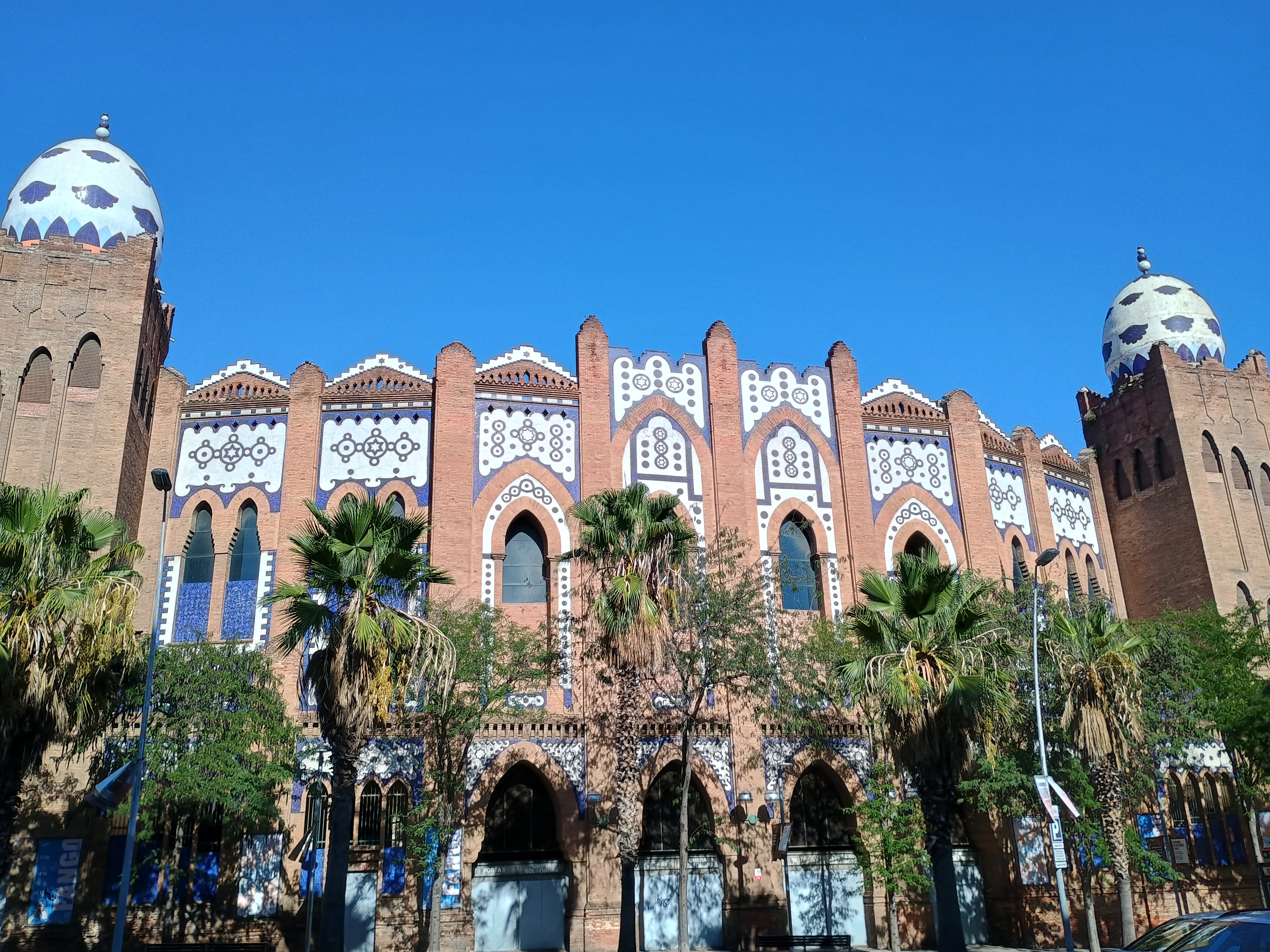
The renovation added a spectacular exterior crown featuring Neo-Mudéjar and Neo-Byzantine influences, combined with decorative elements characteristic of Catalan Modernisme.
Ceramics, mosaics, arches, and ornamental motifs transformed the building into something much more complex than a simple bullring.
The architecture itself became an essential part of the spectacle.
Architecture Between the East and Barcelona
Ceramics, brick, and geometry
La Monumental has an architectural personality very different from that of Barcelona’s other major buildings.
Its façades combine brick, ceramics, arches, and decorative elements inspired by Eastern traditions.
The result is a richly visual architecture in which different artistic languages coexist.
Neo-Mudéjar architecture contributes its Arab-inspired motifs.
Neo-Byzantine influence can be seen in certain decorative and compositional solutions.
And the Catalan context of the early 20th century introduces a Modernist and Noucentista sensibility that makes the complex a unique feature of the Eixample landscape.
The towers marking the entrances, the mosaics, and the ceramic ornamentation are among the elements that make La Monumental recognisable even from a distance.
One of Barcelona’s Great Bullrings
The age of bullfighting
When La Monumental began operating, Barcelona already had a strong bullfighting tradition.
The city had previously had other major bullrings.
The first was El Torín, inaugurated in 1834 in Barceloneta.
Later came Las Arenas, inaugurated in 1900 in what is now Plaça d’Espanya.
La Monumental joined this history in 1914 and would eventually become the last of Barcelona’s major bullrings to remain active.
For decades, it hosted major bullfights and some of the most prominent figures in bullfighting.
Following the 1916 expansion, the bullring reached a capacity of approximately 24,000 spectators. After subsequent alterations, its current capacity is around 19,500 seats.
A Bullring That Survived the War
La Monumental during the Spanish Civil War
The building’s history is also connected to one of the most difficult periods in Barcelona’s contemporary history.
During the Spanish Civil War, La Monumental temporarily ceased to operate as a bullring.
The venue was used as a garage and scrap-metal warehouse.
Some of the old wooden benches were even removed to allow vehicles to move through the building and to create concrete ramps.
For a time, the building ceased to be a place of entertainment and became a practical facility within a city profoundly affected by war.
1946: A Change of Ownership
The Balañà family and a new era
In 1946, Pere Milà’s widow sold the bullring to the businessman and bullfighting promoter Pedro Balañà.
La Monumental then entered a new era associated with one of Barcelona’s most important entertainment-business families.
During the following decades, the building continued to host bullfights, but its enormous capacity allowed it to take on a much broader role.
La Monumental could transform itself.
And that ability to transform would prove fundamental to its future.
A Venue for Much More Than Bullfighting
Boxing, circuses, celebrations, and major events
The history of La Monumental was never limited exclusively to bullfighting.
Its large central arena and tiered seating allowed it to accommodate many different types of events.
The venue hosted boxing matches, circus performances, festivals, public events, and political rallies, as well as cultural activities.
The circular architecture of the bullring offered an extraordinary advantage: it could adapt to different types of audiences and performances.
But it was music that would ultimately make La Monumental famous far beyond the world of bullfighting.
1965: The Beatles Arrive
The concert that forever changed the history of La Monumental
On 3 July 1965, Barcelona experienced one of the most important musical events in its history.
The Beatles performed at La Monumental in the only concert they ever gave in Barcelona.
The British group was at the height of its worldwide explosion, and its arrival in Spain was an extraordinary event.
La Monumental was filled with young people eager to see John Lennon, Paul McCartney, George Harrison, and Ringo Starr up close.
The concert took place under Franco’s dictatorship and was surrounded by enormous public excitement and official surveillance.
The performance lasted just over half an hour, but it left an extraordinary mark on Barcelona’s collective memory.
Sixty years later, in 2025, previously unseen colour footage of the concert even emerged, later preserved by the Filmoteca de Catalunya.
La Monumental had definitively entered the history of rock music.
The Golden Age of Music
When the biggest stars filled the arena
After The Beatles, La Monumental began to establish itself as one of Barcelona’s great music venues.
Before the construction and development of large venues such as the Palau Sant Jordi, Barcelona needed spaces capable of accommodating thousands of spectators.
La Monumental could do exactly that.
During the 1970s, 1980s, and 1990s, the bullring welcomed major names from both international and Spanish music.
They included:
The Beatles, in 1965.
The Rolling Stones, in 1976, during their first concert in Spain.
Bob Marley, in 1980.
Luis Miguel, in 1985.
Tina Turner, in 1990.
Dire Straits, in 1992.
Bruce Springsteen, in 1992.
Sau, in 1992.
The bullring thus became an enormous open-air concert venue.
Bob Marley at La Monumental
An unforgettable night of reggae
On 30 June 1980, La Monumental welcomed Bob Marley & The Wailers.
More than 18,000 people attended the concert, one of the most memorable performances in the venue’s musical history.
Marley was on his Uprising tour, and Barcelona was one of the stops on that international tour.
The concert was particularly significant because it was one of the artist’s final major performances before his death in 1981.
That night, Marley’s music filled a venue that until then had been primarily associated with bullfighting.
Once again, the arena demonstrated that it could become almost anything.
Bruce Springsteen and the Great Concerts
La Monumental becomes an international stage
In the 1990s, the relationship between La Monumental and music entered another major phase.
Bruce Springsteen performed at the bullring in July 1992.
One of those concerts attracted around 16,500 people, transforming the arena into a gigantic rock stage.
La Monumental was completely full, with the audience surrounding the stage.
The bullring was no longer merely a venue for bullfighting.
It had become one of Barcelona’s great popular stages.
La Monumental as a Venue in Transition
From major spectacle to a changing city
The 1990s also marked the beginning of a profound transformation in the way Barcelona organised its major events.
The construction of new venues and the evolution of the city following the 1992 Olympic Games provided new alternatives for large-scale concerts.
The Palau Sant Jordi, the Olympic Stadium, and other major venues began to take on many of the city’s largest musical events.
La Monumental, however, retained something that modern arenas could not reproduce:
its architecture.
A concert at La Monumental was not simply a concert.
It was a performance inside a historic building.
2011: The Final Bullfighting Chapter
The last bullfight in Catalonia
On 25 September 2011, La Monumental hosted the last bullfight held in Catalonia.
The bill featured José Tomás, Juan Mora, and Serafín Marín.
The event attracted enormous attention and was accompanied by protests from both supporters and opponents of bullfighting.
Tickets sold out rapidly.
That afternoon brought an end to almost a century of bullfighting history at La Monumental.
From 1 January 2012, the ban on bullfighting in Catalonia approved by the Catalan Parliament in 2010 came into effect.
Although the Spanish Constitutional Court overturned that ban in 2016, bullfighting did not resume at La Monumental.
Life After Bullfighting
A new life for an old arena
The end of bullfighting did not mean the end of La Monumental.
On the contrary.
The building began to develop a new identity as a venue for music, festivals, and other events.
The arena once again filled with spectators, but now for completely different reasons.
Concerts.
Festivals.
Electronic music events.
Family activities.
Performances.
Cultural events.
The transformation did not erase its previous history.
It added to it.
Monumental Club
Music returns to the arena
One of the projects that has contributed to this new chapter is Monumental Club.
The former bullring is periodically transformed into a music and leisure venue where concerts, DJ sets, food offerings, and activities for different audiences come together.
Its programme has included independent music, electronic music, indie, rumba, and other contemporary styles.
The image is almost poetic:
where once the sounds of bullfighting trumpets and cheers filled the arena, guitars, bass lines, synthesizers, and thousands of voices can now be heard again.
La Monumental in 2026
A historic building full of life
La Monumental is not a building frozen in the past.
In 2026, it continues to operate as a venue for musical and cultural events.
During autumn 2026, for example, the venue is once again part of the SOUNDIT programme, with several electronic music events taking place between October and December.
The programme includes names such as Marcel Dettmann, Paranoid London, Joy Orbison, Aurora Halal, Jeff Mills, and Surgeon & Nørbak, among others.
Monumental Club also continues to offer new music and cultural events.
The former bullring therefore maintains a direct connection with contemporary Barcelona.
Would You Like to Discover La Monumental With Us?
A place where history can still be felt
Discovering La Monumental means exploring more than a century of Barcelona’s history through extraordinary architecture and the stories of the people who once filled its stands.
From the early days of El Sport to the Monumental of the great concerts.
From Joselito and the great figures of bullfighting to The Beatles and Bob Marley.
From legendary nights of rock to contemporary festivals.
Each era has left its own memory.
At Magic Dreams Barcelona, we believe that Barcelona’s great places should not only be seen.
They should be understood through their history.
Our guide, a native expert specialising in architecture, botany, art, history, and ornithology, accompanies every experience with a knowledgeable, engaging, and deeply human narrative.
We take care of absolutely everything so that you do not have to worry about a thing.
We organise day trips, weekend getaways, week-long stays, excursions through the Catalan Pyrenees and the Costa Brava, as well as completely personalised experiences.
Our services are available in Spanish, Catalan, and English and, with sufficient advance notice, we can accommodate other languages.
We combine heritage, architecture, nature, gastronomy, music, and private experiences to discover Barcelona from a different perspective.
Because Barcelona is not only what appears in a guidebook.
It is also what remains hidden behind its buildings.
De plaza de toros a escenario de la música y la cultura En la confluencia de la Gran Vía de les Corts Catalanes con la calle Marina está situado uno de los edificios más singulares de Barcelona. La Plaza de Toros Monumental, conocida simplemente como …
Casa Batlló is one of the masterpieces of Antoni Gaudí and one of Barcelona’s most famous buildings. Located on Passeig de Gràcia, in the heart of the Eixample district, this extraordinary building is one of the great landmarks of Catalan Modernism and forms part of …