Route guide for visitors throughout Catalonia – Barcelona – Costa Brava – Catalan Pyrenees – Personalized experiences – Customized tour guide services – A small tribute to the wonderful city and land that saw us born – Transforming experiences into unforgettable memories - Magic Dreams Collection: exclusive universes inspired by Salvador Dalí and Gaudí. Niche perfumes, jewelry, lithographs, and collectible items celebrating the Mediterranean spirit.
The summit of Barcelona where history, nature and entertainment come together Tibidabo, the highest part of the city of Barcelona, stands at 575 metres above sea level, offering an incomparable perspective of the city, the Mediterranean Sea and the surrounding hills. This remarkable place combines …
Las Ramblas of Barcelona: History, Culture & Unique Experiences Las Ramblas of Barcelona is one of the city’s most emblematic and visited promenades. Stretching approximately 1.3 kilometers, this historic boulevard connects Plaça de Catalunya with Port Vell, forming the natural boundary between the Barri Gòtic …
Where History Sails Towards the Mediterranean Future
Port Vell is one of the oldest and most symbolic spaces in Barcelona’s relationship with the sea and remains, in 2026, one of the great places where the city meets the Mediterranean.
It was Barcelona’s first major permanent port area and, among its quays, buildings and basins, it preserves the memory of a city that grew for centuries with its eyes turned towards the sea.
Trade, navigation, shipbuilding, fishing, cultural exchange and everyday life all coexisted here.
Barcelona cannot be fully understood without understanding its port.
And Port Vell represents precisely that meeting point between the historic city and the Mediterranean.
Today, however, Port Vell is much more than a port area.
It is a place where history, architecture, maritime heritage, contemporary art, gastronomy, yachting, innovation, sustainability and culture come together.
A place that has succeeded in transforming its relationship with the water without losing the memory of what it once was.
The Origins of Port Vell
Barcelona’s First Permanent Harbour
Port Vell forms the oldest part of Barcelona’s present-day port waterfront.
Its history is deeply connected to Barcelona’s maritime and commercial expansion and to its role within the medieval Mediterranean.
For centuries, this area was the setting for the arrival of goods, vessels, sailors and visitors from different Mediterranean territories.
The port grew alongside the city and gradually became one of Barcelona’s great economic engines.
Commercial institutions, shipyards, markets, warehouses and spaces associated with navigation developed around it.
For centuries, the relationship between city and port was inseparable.
But it was also a changing relationship.
As Barcelona expanded, port infrastructure was progressively enlarged and moved farther away from the urban centre, until the transformation of the waterfront made it possible to reclaim a fundamental part of this territory for the public.
The great transformation would come in the final decades of the 20th century.
From Industrial Port to Citizens’ Port
The Transformation That Brought Barcelona Back to the Mediterranean
For much of the 20th century, the port represented a physical barrier between Barcelona and the sea.
The city had turned its back on its coastline, while much of the port infrastructure was devoted exclusively to industrial and commercial activities.
The transformation began to take on a new dimension with the urban renewal process associated with the 1992 Barcelona Olympic Games.
In 1988, the Port 2000 Urban Development Agency was established and, in 1989, the Port Vell Special Plan was approved. Its objective was to preserve the area’s port character while introducing new cultural, commercial, tourist and civic uses.
The result was one of Barcelona’s most important waterfront urban transformation projects.
The former port area began to become a true citizens’ port.
And the city began walking towards the sea once again.
The Royal Shipyards
The Naval Architecture of Medieval Barcelona
One of the key points of the route is the Royal Shipyards of Barcelona (Drassanes Reials).
This extraordinary Gothic complex preserves the memory of medieval Barcelona’s maritime heritage and of the construction of large vessels destined to sail across the Mediterranean.
Its enormous halls, arches and architectural structure make it possible to understand the importance of shipbuilding to the Crown of Aragon and to Barcelona’s Mediterranean expansion.
Inside is the Maritime Museum of Barcelona (Museu Marítim de Barcelona), dedicated to preserving and explaining the historic relationship between the city and the sea.
Its collections include vessels, ship models, nautical instruments, cartography and various objects associated with navigation.
Among its highlights is the section devoted to the Shipyards and Galleys, which offers an insight into 13th-century Barcelona and the era of the great Mediterranean galleys.
Visiting the Royal Shipyards is, in a sense, entering the naval memory of Barcelona.
La Llotja de Mar
Trade, Art and Economic Power
The historical journey continues towards La Llotja de Mar, one of the fundamental buildings for understanding Barcelona’s economic and commercial history.
Its origins lie in the medieval market hall, associated with trade and mercantile activity.
The present building is predominantly Neoclassical in appearance, although its interior preserves elements and remains of the earlier Gothic structure.
For centuries, La Llotja was one of the city’s great economic centres.
But its history is not limited to commerce.
It was also closely associated with artistic education.
The former School of Fine Arts of Barcelona was based here, and among its students were artists who would later achieve international recognition.
La Llotja therefore represents an extraordinary connection between commerce, architecture, culture and artistic creation.
Portal de la Pau
Barcelona’s Symbolic Gateway to the Sea
Portal de la Pau is one of the most prominent spaces in Port Vell.
Here stands one of the great symbols of Barcelona’s waterfront: the Monument to Christopher Columbus, inaugurated on the occasion of the 1888 Universal Exhibition.
The monument stands approximately 60 metres high and contains an elevator leading to a viewing platform at the same height.
From there, visitors can enjoy a 360-degree panorama over the port, Ciutat Vella, Montjuïc, the Eixample and the Mediterranean.
The image of Columbus pointing towards the horizon has become an inseparable part of Barcelona’s visual skyline.
There is, however, a particularly interesting detail.
Although the statue is traditionally interpreted as pointing towards America, its actual orientation does not correspond to the American continent.
The monument was conceived as a symbolic representation of Barcelona’s connection with navigation and maritime expansion.
Rambla de Mar
A Walkway Between the City and the Mediterranean
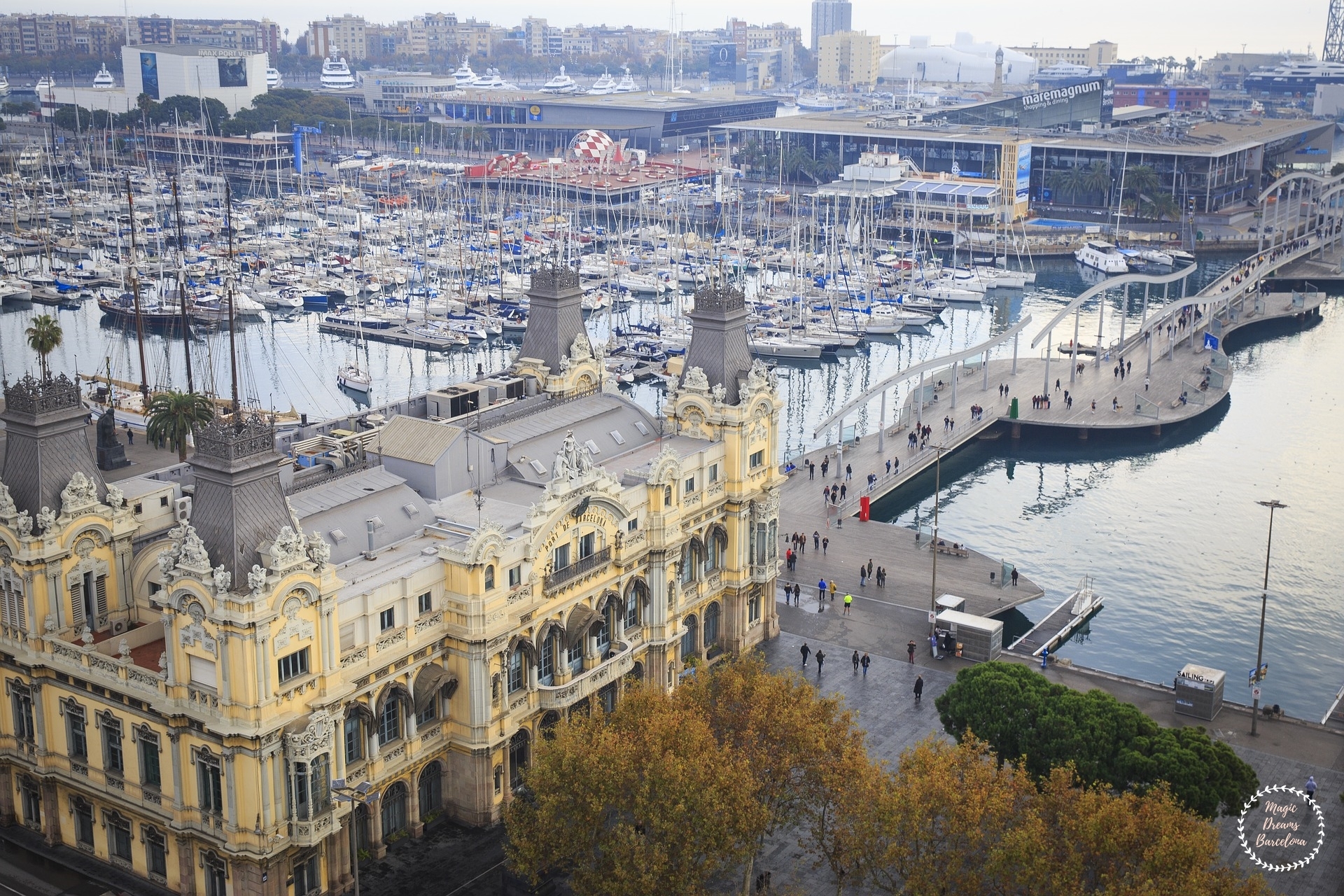
From Portal de la Pau begins Rambla de Mar, a pedestrian walkway extending over the water and connecting the waterfront with Moll d’Espanya.
Its architecture creates a very particular sensation.
As you walk along it, the city seems to fall behind and the Mediterranean becomes immediately present.
The movement of the water, the vessels, the reflections and the structure of the walkway create one of the most distinctive routes in Port Vell.
It is particularly atmospheric at sunrise, sunset and during the evening hours, when Barcelona’s lights begin to reflect across the water.
Maremàgnum
Urban Leisure on the Mediterranean
Maremàgnum is literally located over the water, at Moll d’Espanya.
Its arrival was one of the key elements in transforming Port Vell into a civic space.
Today it brings together a variety of retail, dining and leisure options, as well as being located beside one of Barcelona’s major marine attractions.
Its position provides particularly open views across the harbour and towards Barcelona’s maritime horizon.
But the true underwater world is only a few metres away.
L’Aquàrium de Barcelona
The Mediterranean Turned into an Experience
L’Aquàrium de Barcelona is one of the city’s principal facilities dedicated to understanding marine life.
Its exhibition features more than 11,000 specimens belonging to more than 600 species, distributed across nearly 80 aquariums.
The journey allows visitors to discover different marine ecosystems, from the Mediterranean to tropical environments.
One of its best-known spaces is the large Oceanarium, where sharks, rays and other marine species can be observed through an underwater tunnel.
Beyond its tourist appeal, L’Aquàrium also plays an important role in education and raising awareness of marine biodiversity.
It is another way of experiencing the Mediterranean.
This time, from beneath its surface.
Contemporary Art by the Sea
When Port Vell Becomes an Open-Air Gallery
Port Vell can also be explored as a genuine open-air museum of contemporary art.
Throughout its different spaces are works by artists who have left their visual mark on Barcelona.
Among them is The Head of Barcelona (El Cap de Barcelona) by Roy Lichtenstein, one of the most distinctive works in the urban landscape of Moll de la Fusta.
There are also interventions associated with the creative universe of Xavier Mariscal.
But Port Vell also contains a particularly poetic sculptural presence.
Miraestels
A Figure Suspended Between Sky and Water
Above the waters of Port Vell stands Miraestels, by Catalan artist Robert Llimós.
The human figure appears to contemplate the sky while suspended above the Mediterranean.
Its presence introduces a different dimension to the harbour landscape.
It is no longer simply about boats, quays or architecture.
It is a figure that invites us to pause.
To look upwards.
To think.
To observe how a city can engage with the sea through poetry, rather than solely through engineering.
Miraestels has therefore become one of those small works that can easily go unnoticed during a quick walk, but which acquires particular power once its story and meaning are understood.
The Port from the Sea
Barcelona Changes Completely When Seen from the Water
One of the best ways to understand Port Vell is precisely to leave it for a few minutes.
From the sea, the perspective changes.
The façades of Ciutat Vella, the Columbus Monument, Montjuïc, Barceloneta and Barcelona’s urban skyline take on a different dimension.
For more than a century, Las Golondrinas have offered visitors the opportunity to discover the harbour from the water.
Their current harbour tour lasts approximately 40 minutes and allows passengers to observe the different port and marina facilities from a maritime perspective.
The experience is particularly useful for understanding how the different areas of the port connect with one another.
Barcelona from Above
The Mediterranean from a Bird’s-Eye View
Another completely different experience is the Port Cable Car (Transbordador Aeri del Port).
The system connects the Barceloneta area with Montjuïc via a route suspended above the harbour.
The experience offers an exceptional perspective over Barcelona.
From above, the port appears as a vast urban composition in which water, architecture, mountain and city form a single landscape.
From this height, it becomes particularly clear just how deeply the Mediterranean is embedded in Barcelona’s very structure.
Marina Port Vell
International Yachting in the Heart of Barcelona
Port Vell is not only about history.
It is also one of contemporary Barcelona’s major nautical centres.
Marina Port Vell specialises in large yachts and currently offers capacity for 148 vessels, with berths for yachts of up to 120 metres.
Its location, virtually in the heart of the city, makes the marina a unique destination within the Mediterranean.
During the 37th America’s Cup Barcelona 2024, the marina welcomed more than 150 superyachts, establishing itself as one of the major international meeting points associated with the competition.
Luxury yachting, private events and sea-based experiences now form part of Port Vell’s new identity.
The America’s Cup Barcelona 2024
Barcelona Looks Towards the World from the Sea Once Again
The staging of the 37th America’s Cup in Barcelona in 2024 represented one of the most important international sailing events in the city’s recent history.
The event accelerated various transformation processes in Port Vell.
The competition helped drive infrastructure modernisation, new public spaces, urban improvements and the incorporation of solutions related to innovation and sustainability.
The transformation did not end with the competition.
Quite the opposite.
The America’s Cup acted as a catalyst for a much broader process in the evolution of the citizens’ port.
A New Transformation of Port Vell
More Space for the City
Between 2023 and 2024, a first major phase of transformation was carried out involving 17 projects and more than €86 million in public-private investment.
The projects included interventions at Barcelona Nord, Drassanes and Pescadors quays, the redevelopment of Moll d’Espanya, the restoration of the historic Portal de la Pau building, improvements to the Jaume I Tower, new spaces associated with yachting and various urban improvements.
The objective was not simply to modernise the port.
It was to continue transforming the relationship between Barcelona and the Mediterranean.
To create new open spaces.
To improve accessibility.
To introduce new activities.
And to make the port part of the city’s everyday life.
Moll de Pescadors
Barcelona’s Fishing Heritage
As part of this transformation, Moll de Pescadors has particular importance.
This area preserves a fundamental part of Barcelona’s maritime identity: fishing.
It is home to the historic Clock Tower (Torre del Rellotge), one of the most distinctive heritage landmarks on the waterfront.
The tower was originally built as a lighthouse and later acquired different functions before becoming a clock tower.
Its silhouette is a reminder that Port Vell was not created as a tourist destination.
It was created as a port.
And behind every quay lie centuries of work, navigation and maritime life.
A 70-Hectare Port Vell
A Territory Between City, Culture and Sea
Today, Port Vell covers approximately 70 hectares and receives around 16 million visitors each year.
Within this space coexist:
Promenades.
Cultural facilities.
Museums.
Restaurants.
Commercial activities.
Marinas.
Businesses.
Nautical education.
Sports facilities.
Leisure activities.
International events.
Historic heritage.
More than 300 companies are currently based in Port Vell, generating more than 7,500 direct jobs.
This economic dimension is important because it demonstrates that Port Vell is not simply a tourist destination.
It is also a productive territory.
A place where the blue economy, innovation and maritime activity are part of Barcelona’s future.
Port Vell Towards 2030
Sustainability, Innovation and the Blue Economy
In 2026, the Port of Barcelona presented its 5th Strategic Plan 2026–2030, which for the first time integrates the commercial port, logistics port and citizens’ port within a single vision.
For Port Vell, the future vision is based on consolidating it as a local and global benchmark for a diversified, innovative and sustainable citizens’ port.
The new plan incorporates 120 initiatives grouped into 25 environmental, social and economic objectives.
Future priorities include:
The energy transition.
Emissions reduction.
Sustainable mobility.
Digitalisation.
The blue economy.
Technological innovation.
Education and training.
Job creation.
Greater integration between port and city.
Improvements to public spaces.
The intention is clear.
Port Vell does not want to become merely a place for contemplating the past.
It also wants to be a laboratory for the future.
Innovation and the Blue Economy
The Mediterranean as an Engine of Knowledge
The blue economy is becoming increasingly important within the Port Vell strategy.
Yachting, marine technology, education, innovation, research and new energy solutions are part of an ecosystem seeking to generate economic activity while maintaining a more sustainable relationship with the Mediterranean.
The concept of the citizens’ port is therefore evolving towards a new idea:
an open, intelligent, sustainable port connected to society.
Culture and Major Events
An International Stage on the Mediterranean
Port Vell continues to host cultural, business, nautical and gastronomic events with an international dimension.
These include various events connected to yachting and superyachts, as well as cultural activities and initiatives linked to maritime heritage.
The presence of large vessels, exhibitions, conferences and international events periodically transforms the harbour into a meeting point between Barcelona and the world.
But perhaps one of Port Vell’s greatest attractions lies precisely in its ability to combine the extraordinary with the everyday.
A superyacht may be found beside a small fishing boat.
An ancient Gothic building can coexist with contemporary architecture.
A sculpture may appear above the water.
And a medieval building may share the same landscape with one of the city’s major leisure centres.
Port Vell at Sunset
When Barcelona Changes Colour
There is a particularly magical moment to discover Port Vell.
Sunset.
As the sun begins to descend over Montjuïc and the light reflects across the water, the harbour takes on a completely different atmosphere.
The silhouettes of the boats become a succession of dark forms.
The city’s façades take on warm tones.
The Columbus Monument begins to light up.
And the Mediterranean ceases to be simply a geographical space and becomes part of the experience.
It is one of those moments when Barcelona is best understood by walking slowly.
Without rushing.
Without needing to follow a rigid itinerary.
A Barcelona That Looks Towards the Sea
Port Vell as a Living Memory of the City
The true value of Port Vell lies not only in the beauty of its buildings or in the number of activities it brings together.
Its real value lies in continuity.
Here, an essential part of Barcelona’s history can be explored without leaving virtually the same landscape.
The medieval galleys.
The merchants.
The shipyards.
Fishing.
Navigation.
Trade.
The 1888 Universal Exhibition.
The Olympic transformation.
The citizens’ port.
International yachting.
The America’s Cup.
The blue economy.
Everything forms part of the same story.
A story that is still being written.
What Can You Discover in Port Vell?
A Journey Through Heritage, Culture and the Mediterranean
A complete Port Vell experience can include:
The Royal Shipyards (Drassanes Reials) and the Maritime Museum.
Portal de la Pau.
The Columbus Monument and its viewing platform.
Rambla de Mar.
Moll d’Espanya.
Maremàgnum.
L’Aquàrium de Barcelona.
Contemporary sculptures along the waterfront.
Miraestels.
Moll de Pescadors.
The historic Clock Tower.
Marina Port Vell.
Views towards Barceloneta and Montjuïc.
The different harbour basins and nautical areas.
A maritime tour with Las Golondrinas.
The Port Cable Car.
Gastronomic experiences overlooking the Mediterranean.
Private boat or yacht experiences.
Each of these places tells a different part of the story.
Together, they create a much deeper image of Barcelona.
How to Discover Port Vell
A Route That Deserves to Be Experienced Without Rushing
Port Vell can be explored on foot from different points of Ciutat Vella.
A particularly interesting route can begin at the Royal Shipyards, continue towards Portal de la Pau and the Columbus Monument, cross Rambla de Mar and reach Moll d’Espanya.
From there, you can continue towards Moll de Pescadors and Barceloneta.
Another possibility is to begin from the sea and subsequently discover the harbour from land.
Combining both perspectives offers a much better understanding of the character of the place.
A Different Experience with Magic Dreams Barcelona
Port Vell Through a Deep, Emotional and Authentic Perspective
Discovering Port Vell means entering one of the essential parts of Barcelona’s maritime soul.
But there is a huge difference between visiting a place and truly understanding it.
At Magic Dreams Barcelona, we design fully personalised experiences to discover Port Vell through a cultural, historical, artistic and emotional perspective.
We take care of every detail.
We organise private routes through Port Vell and Ciutat Vella, architecture and heritage tours, nautical experiences, private boat trips, Mediterranean dining and cultural experiences designed around each visitor’s interests.
We can combine Port Vell with the Royal Shipyards, Barceloneta, Montjuïc, the Gothic Quarter, the Eixample or different gastronomic and artistic experiences across Barcelona.
We also design full-day experiences, weekend escapes and personalised stays lasting several days.
The Mediterranean as a Stage
When Travel Becomes More Than a Visit
We can organise private experiences at sea, from peaceful sunset cruises to gastronomic experiences aboard a yacht.
We can also incorporate:
Private picnics overlooking the Mediterranean.
Personalised catering.
Floristry.
Professional photography.
Live music.
Themed romantic dinners.
Local or international cuisine.
Gastronomic tours.
Private cultural experiences.
Artistic activities.
Personalised workshops.
Family experiences.
Couples’ programmes.
Private group experiences.
Each experience is designed around the preferences, pace and personality of our clients.
We do not simply offer a visit.
We create an experience.
A Barcelona Discovered from the Water
History, Architecture and Emotion Sailing Together
Port Vell offers an extraordinary summary of Barcelona’s evolution.
A medieval city that built galleys.
A commercial city that looked towards the Mediterranean.
An industrial city that for decades became physically separated from the sea.
An Olympic Barcelona that reopened itself to the waterfront.
And a contemporary city now seeking to make its port more sustainable, innovative and connected with its citizens.
That is why walking through Port Vell means experiencing much more than a port.
It means walking through the history of Barcelona.
And sailing into its future.
Would You Like to Discover Port Vell with Us?
Barcelona from Its Maritime Essence
At Magic Dreams Barcelona, we believe that the most special places are not discovered solely with the eyes.
They are discovered through stories, details, sounds, aromas, gastronomy, architecture and the emotions that remain long after the journey.
Our team accompanies every experience with a sophisticated, warm and deeply human narrative.
We speak Spanish, Catalan and English and, upon prior request, can adapt the service to other languages.
We take care of logistics, transportation, reservations, accommodation and every small detail that transforms a special day into a truly personalised experience.
We can design anything from a private visit lasting a few hours to a complete stay in Barcelona, combining heritage, nature, gastronomy, art, sailing and culture.
Because Port Vell can be visited.
But it can also be felt.
And when it is discovered from the sea, among the memory of the ancient Royal Shipyards, the light of the Mediterranean and Barcelona’s horizon, the city takes on another dimension.
Magic Dreams Barcelona transforms Port Vell into a journey to the maritime essence of Barcelona, where history, architecture, nature and emotion sail together.
Port Vell.
Rambla Mar.
Port Vell.
Port Vell.
Port Vell.
Port Vell.
Port Vell.
Port Vell.
Port Vell.
Port Vell.
Port Vell.
Port Vell.
Port Vell.
Port Vell.
Perspectiva de parte de la ciudad de Barcelona.
Detalle en el Port Vell.
Detalle en el Port Vell.
Detalle en el Port Vell.
Detalle en el Port Vell.
Port Vell.
Port Vell.
Port Vell.
Port Vell.
Port Vell.
Port Vell.
Perspectiva superior aérea Centro Comercial Maremagnum.
Port Vell.
Atardecer en el Port Vell.
Perspectiva desde Rambla Mar.
Perspectiva desde Rambla Mar
Perspectiva aérea del Port Vell.
Detalle barco en el Port Vell.
Perspectiva nocturna en el Port Vell.
Perspectiva de parte de la ciudad de Barcelona desde el Port Vell
Casa Batlló is one of the masterpieces of Antoni Gaudí and one of Barcelona’s most famous buildings. Located on Passeig de Gràcia, in the heart of the Eixample district, this extraordinary building is one of the great landmarks of Catalan Modernism and forms part of …