Route guide for visitors throughout Catalonia – Barcelona – Costa Brava – Catalan Pyrenees – Personalized experiences – Customized tour guide services – A small tribute to the wonderful city and land that saw us born – Transforming experiences into unforgettable memories - Magic Dreams Collection: exclusive universes inspired by Salvador Dalí and Gaudí. Niche perfumes, jewelry, lithographs, and collectible items celebrating the Mediterranean spirit.
Hidden among the gentle slopes of the Sarrià-Sant Gervasi neighborhood, the Jardins de la Tamarita represent one of the most elegant and tranquil green spaces in Barcelona. Far from the urban bustle, these gardens invite visitors to discover a universe where landscape architecture, Mediterranean botany, …
The Royal Palace of Pedralbes, located at 686 Avinguda Diagonal, is one of Barcelona’s most distinctive heritage sites. Surrounded by historic gardens and removed from the hustle and bustle of the city’s main avenues, this remarkable place invites visitors to discover an essential part of …
Perched dramatically above the Mediterranean on the Costa Brava, the Santa Clotilde Gardens in Lloret de Mar offer one of the most beautiful combinations of historic garden design and coastal scenery in Catalonia.
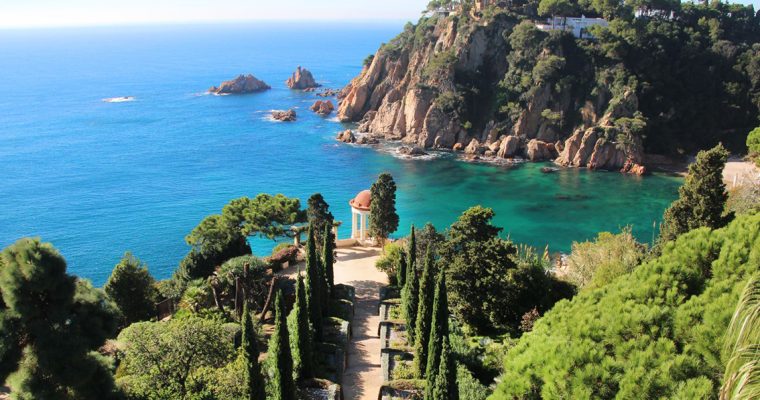
Among their most spectacular features is the view towards Cala Boadella, a small Mediterranean cove surrounded by pine-covered cliffs and crystal-clear waters. Seen from the elevated terraces of the gardens, the cove becomes part of a carefully composed landscape in which nature, architecture, sculpture and the sea exist in perfect harmony.
A Historic Garden Overlooking the Mediterranean
The Santa Clotilde Gardens were created on a cliff between Cala Boadella and Fenals Beach, in one of the most privileged locations on the Costa Brava.
Their history began in 1919, when the Marquis of Roviralta commissioned landscape architect Nicolau Maria Rubió i Tudurí to design an elegant private garden on land that had previously been occupied by vineyards.
Rubió i Tudurí was one of the most important figures in Catalan landscape architecture and designed Santa Clotilde within the principles of Catalan Noucentisme, drawing strong inspiration from the formal beauty of Italian Renaissance gardens.
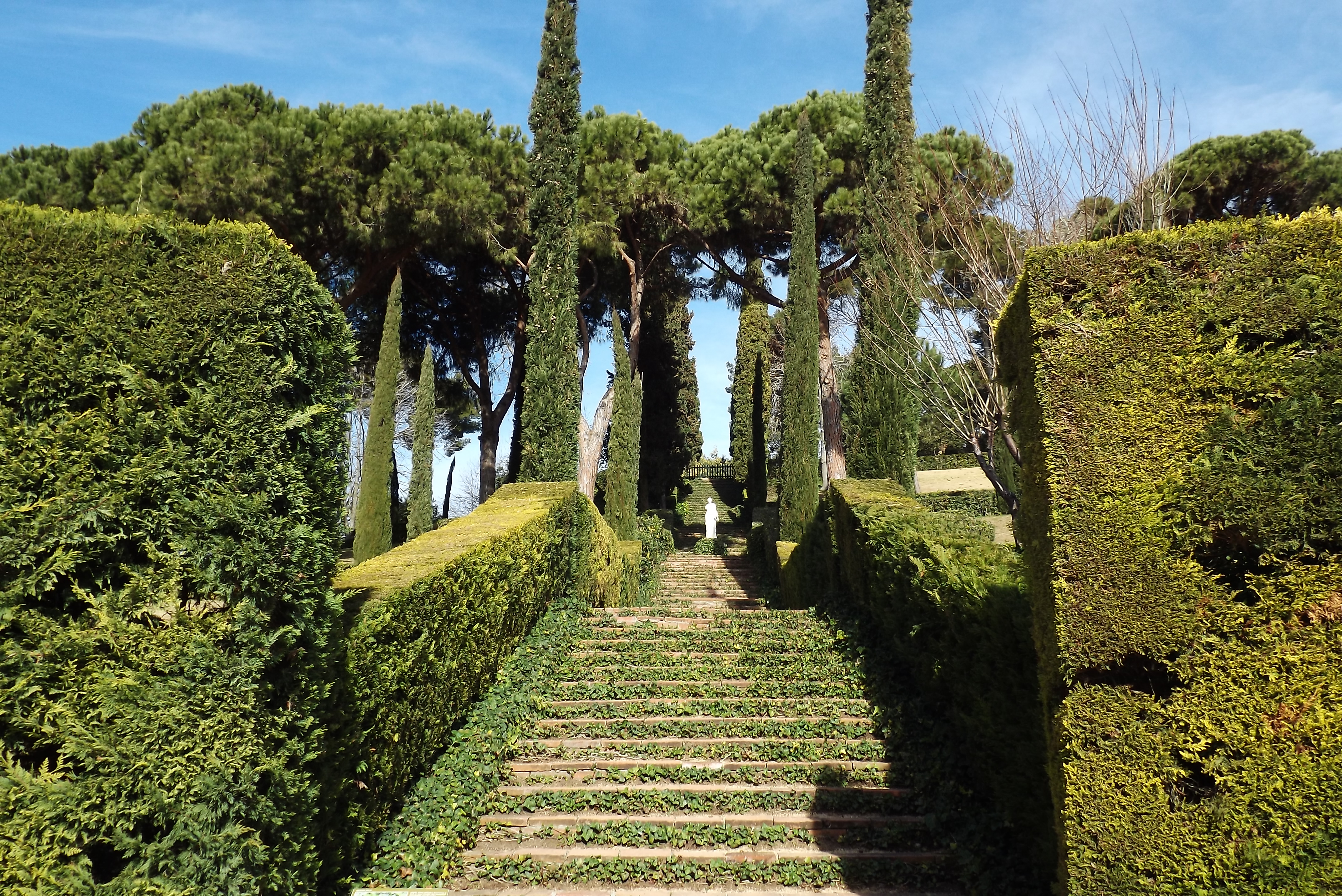
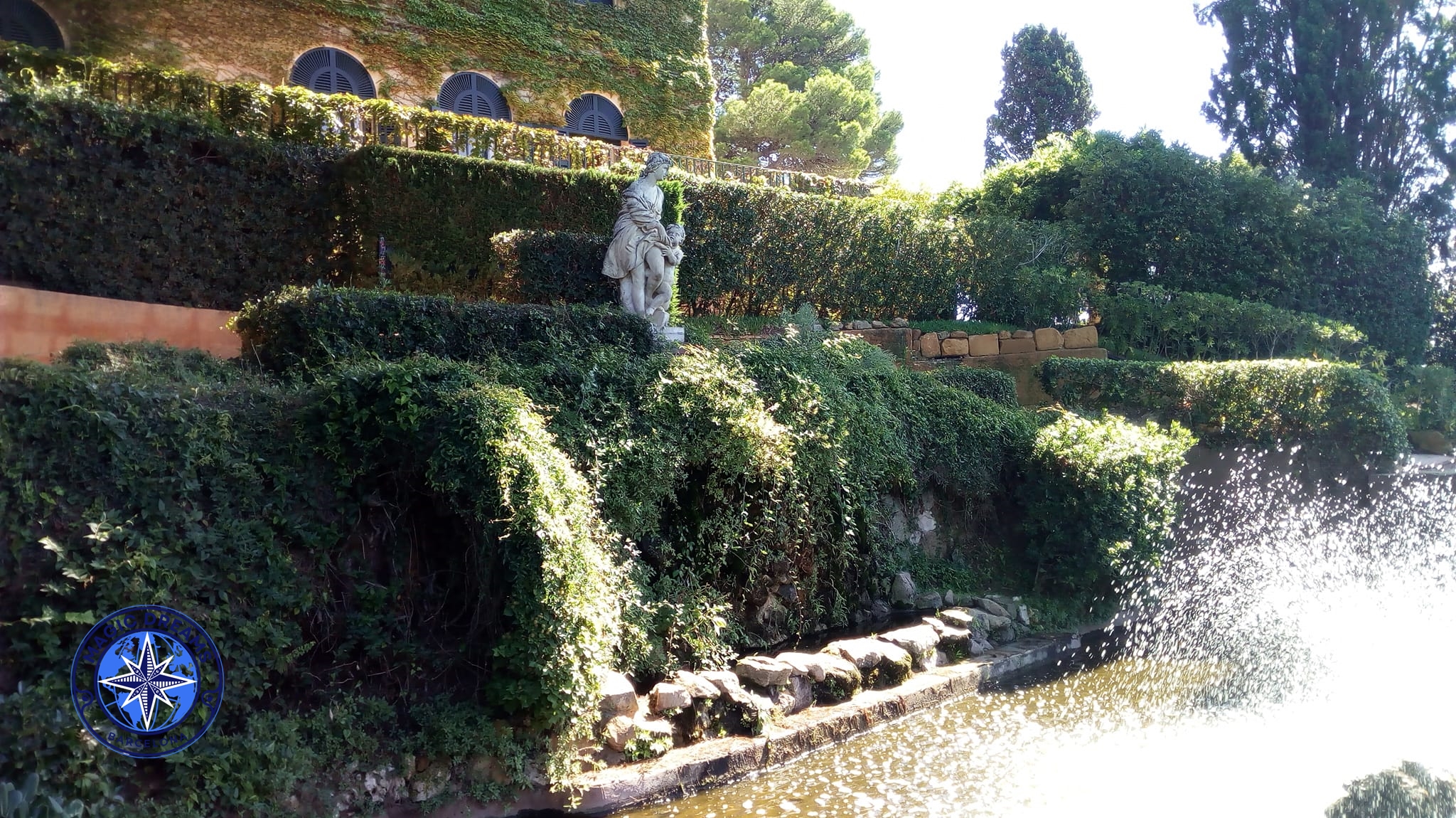
The result was a garden of terraces, monumental stairways, sculptures, fountains, ponds and Mediterranean vegetation, all carefully positioned to take advantage of the natural landscape.
Clotilde Rocamora and the Origins of the Gardens
The gardens were named after Clotilde Rocamora, the first wife of the Marquis of Roviralta.
When the family arrived in the area in 1917, the land was largely made up of vineyards. Roviralta acquired several plots and began transforming the landscape into an ambitious private garden.
Clotilde died in 1927, before the project was completed. Construction was subsequently interrupted and later continued, eventually transforming the site into one of the most remarkable historic gardens on the Catalan coast.
The story of Clotilde gives the gardens a particularly personal dimension. What began as a private landscape created for a family became, decades later, an important part of the cultural heritage of Lloret de Mar.
The Influence of the Italian Renaissance
The design of Santa Clotilde reflects the principles of the great Italian Renaissance gardens.
Rather than simply following the natural terrain, the garden organises it into a succession of terraces and perspectives.
Long paths, geometric hedges, monumental stairways and carefully positioned sculptures create a sense of order and symmetry, while the Mediterranean landscape remains visible beyond the garden.
This dialogue between formal garden design and the wild character of the Costa Brava is one of Santa Clotilde’s greatest strengths.
The garden appears highly controlled from one perspective, yet completely open to the sea from another.
Cala Boadella from Above
The view towards Cala Boadella is one of the defining images of Santa Clotilde.
From the elevated terraces, the cove can be seen below, surrounded by pine trees, rocky slopes and the intense blue of the Mediterranean.
The perspective from above reveals the natural shape of the coastline in a way that cannot be appreciated from the beach itself.
The golden curve of the sand contrasts with the surrounding vegetation and the blue-green tones of the sea, creating a quintessential Costa Brava landscape.
The cove is approximately 250 metres long and retains a relatively natural character, making it one of the most attractive coastal landscapes around Lloret de Mar.
The Sea as Part of the Garden
At Santa Clotilde, the Mediterranean is not simply a backdrop.
It is an essential part of the garden’s visual composition.
As visitors move along the terraces, the sea appears between trees, hedges, sculptures and architectural elements. Each change in elevation creates a different perspective.
This was one of the most sophisticated aspects of Rubió i Tudurí’s design: the garden establishes a continuous visual relationship between its cultivated landscape and the natural coastline beyond.
The result is a sequence of views in which the Mediterranean constantly reappears.
The Stairway of the Sirens
One of the most recognisable features of Santa Clotilde is the Stairway of the Sirens, decorated with sculptures by Catalan artist Maria Llimona.
The sirens contribute a classical and almost mythical character to the garden.
The staircase also plays an important role in the visual experience. As it descends through the terraces, it creates new perspectives over the vegetation and the sea.
The combination of classical sculpture, geometric architecture and Mediterranean scenery gives the gardens a distinctive theatrical quality.
Mediterranean Botany
Vegetation is fundamental to the identity of Santa Clotilde.
The gardens contain a mixture of Mediterranean and ornamental species, including pines, cypresses, lime trees, poplars, laurels and aromatic plants.
The vegetation has both an aesthetic and architectural function.
Trees create vertical lines, hedges define spaces, flowering plants introduce colour, and aromatic species add another sensory dimension to the experience.
The scent of Mediterranean vegetation mixes with the sea air, reinforcing the feeling that the garden belongs naturally to its coastal surroundings.
Wildlife Among the Gardens
Although Santa Clotilde is a historic garden rather than a wildlife reserve, its mature vegetation provides a habitat for a variety of small Mediterranean species.
Birds can be seen moving through the trees and hedges, while butterflies, bees and other pollinating insects are attracted by flowering plants.
The proximity of the sea also means that coastal birds may occasionally be observed from the higher viewpoints.
The presence of this small wildlife adds movement and life to an otherwise highly structured landscape.
Architecture and Garden Design
Near the main entrance stands the original residence associated with the estate.
Its architecture includes rounded arches, a large terrace and a three-storey tower, creating a direct connection between the residence and the garden.
A painted ceramic panel dedicated to Santa Clotilde, dated 1930, is another historical element of the property.
The architecture was never intended to compete with the landscape. Instead, buildings, terraces, stairways and vegetation were integrated into a unified composition.
A Masterpiece of Catalan Noucentisme
Santa Clotilde is regarded as one of the finest examples of Noucentista garden design in Catalonia.
Its importance lies not only in its beauty but also in the way it represents an important period in Catalan cultural and artistic history.
The garden combines classical references with Mediterranean vegetation and the dramatic natural setting of the Costa Brava.
It is this combination that makes Santa Clotilde different from a conventional historic garden.
It is simultaneously a work of landscape architecture, a cultural heritage site and a spectacular Mediterranean viewpoint.
A Landscape Designed for the Sea
Perhaps the most memorable aspect of Santa Clotilde is the way the garden constantly directs the eye towards the Mediterranean.
The terraces provide elevated perspectives, while vegetation frames sections of the coastline like living paintings.
Cala Boadella appears below as one of the garden’s most beautiful natural compositions.
From above, the cove, pine forest, cliffs and sea create a landscape that seems almost untouched, while the carefully designed garden provides a sophisticated frame around it.
This contrast between cultivated beauty and natural scenery is at the heart of the Santa Clotilde experience.
The Essence of the Costa Brava
Santa Clotilde Gardens capture many of the elements that define the Costa Brava: Mediterranean vegetation, dramatic cliffs, clear blue water, hidden coves and an intense connection between landscape and sea.
The view of Cala Boadella from above is particularly powerful because it brings all these elements together.
It is a place where the geometry of a historic garden meets the irregularity of the coastline, where classical sculptures stand among Mediterranean plants and where the sea stretches endlessly beyond the terraces.
For this reason, Santa Clotilde is not simply a historic garden.
It is one of the most beautiful viewpoints from which to understand the landscape of the Costa Brava.
Detalle Jardines Santa Clotilde -By krysi@, CC BY 3.0, https://commons.wikimedia.org/w/index.php?curid=61024135.
Fuente Jardines Santa Clotilde – By krysi@, CC BY 3.0, https://commons.wikimedia.org/w/index.php?curid=61024145.
Detalle jardines de Santa Clotilde -By Dawid Glawdzin, CC BY 3.0, https://commons.wikimedia.org/w/index.php?curid=54626861.
Jardines de Santa Clotilde Magic Dreams Barcelona.
Sirena de Jardines de Santa Clotilde – Дмитрий Мозжухин, CC BY 3.0, via Wikimedia Commons.
Jardines de Santa Clotilde – By JopkeB – Own work, CC BY-SA 4.0, https://commons.wikimedia.org/w/index.php?curid=149692532.
Plaza de Jardines Santa Clotilde – By JopkeB – Own work, CC BY-SA 4.0, https://commons.wikimedia.org/w/index.php?curid=149692531.
An extraordinary botanical landscape between Montjuïc Mountain and the Mediterranean Sea On the southern slopes of Montjuïc Mountain, bathed in Mediterranean sunlight and sheltered from cold winds, lie the Mossèn Costa i Llobera Gardens, one of Barcelona’s most remarkable botanical spaces. Dedicated primarily to xerophytic …
Located in Blanes, on the Costa Brava, the Marimurtra Botanical Garden is one of the most spectacular natural attractions to visit near Barcelona. Perched on the cliffs of Sant Joan Mountain, Marimurtra combines an extraordinary collection of plants from different parts of the world with …