Route guide for visitors throughout Catalonia – Barcelona – Costa Brava – Catalan Pyrenees – Personalized experiences – Customized tour guide services – A small tribute to the wonderful city and land that saw us born – Transforming experiences into unforgettable memories - Magic Dreams Collection: exclusive universes inspired by Salvador Dalí and Gaudí. Niche perfumes, jewelry, lithographs, and collectible items celebrating the Mediterranean spirit.
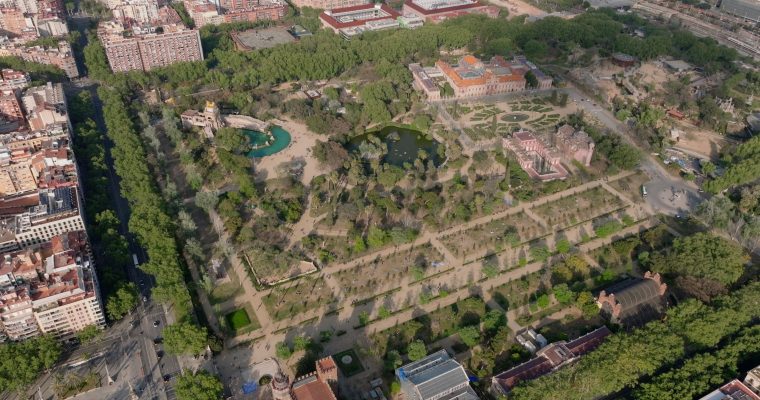
In the heart of Barcelona, Ciutadella Park stands as a true haven of history, art, and nature. This emblematic space, carefully designed in the mid-19th century, combines lush gardens, sculptures, and impressive fountains, offering a journey that transcends the visual to become a full sensory …
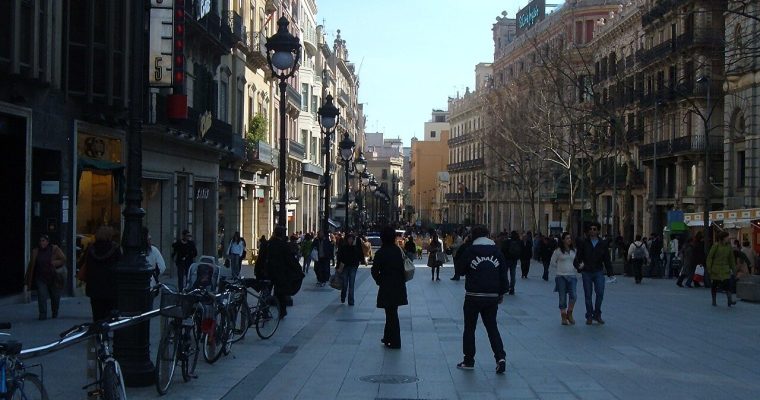
From an ancient medieval gateway to one of Barcelona’s major shopping thoroughfares In the very heart of Barcelona, between Plaça de Catalunya and the narrow streets of the Gothic Quarter, lies one of the city’s best-known, busiest and most representative pedestrian avenues: Portal de l’Àngel. …
The Plaça del Pi Artisan Market: Historic Places in Barcelona
Among Catalan Gothic architecture, ancient Roman roads, vanished streams and the culture of artisan producers
In the heart of Barcelona’s Barri Gòtic, just a few steps from La Rambla and the city’s ancient medieval streets, lies Plaça del Pi. This square brings together centuries of history, architecture, commercial tradition and popular culture.
Dominated by the impressive Basilica of Santa Maria del Pi, the square retains a very special character. Its historic buildings, small outdoor terraces, artists and regular artisan food market make it one of those corners where it is still possible to discover a quieter, more welcoming and authentic Barcelona.
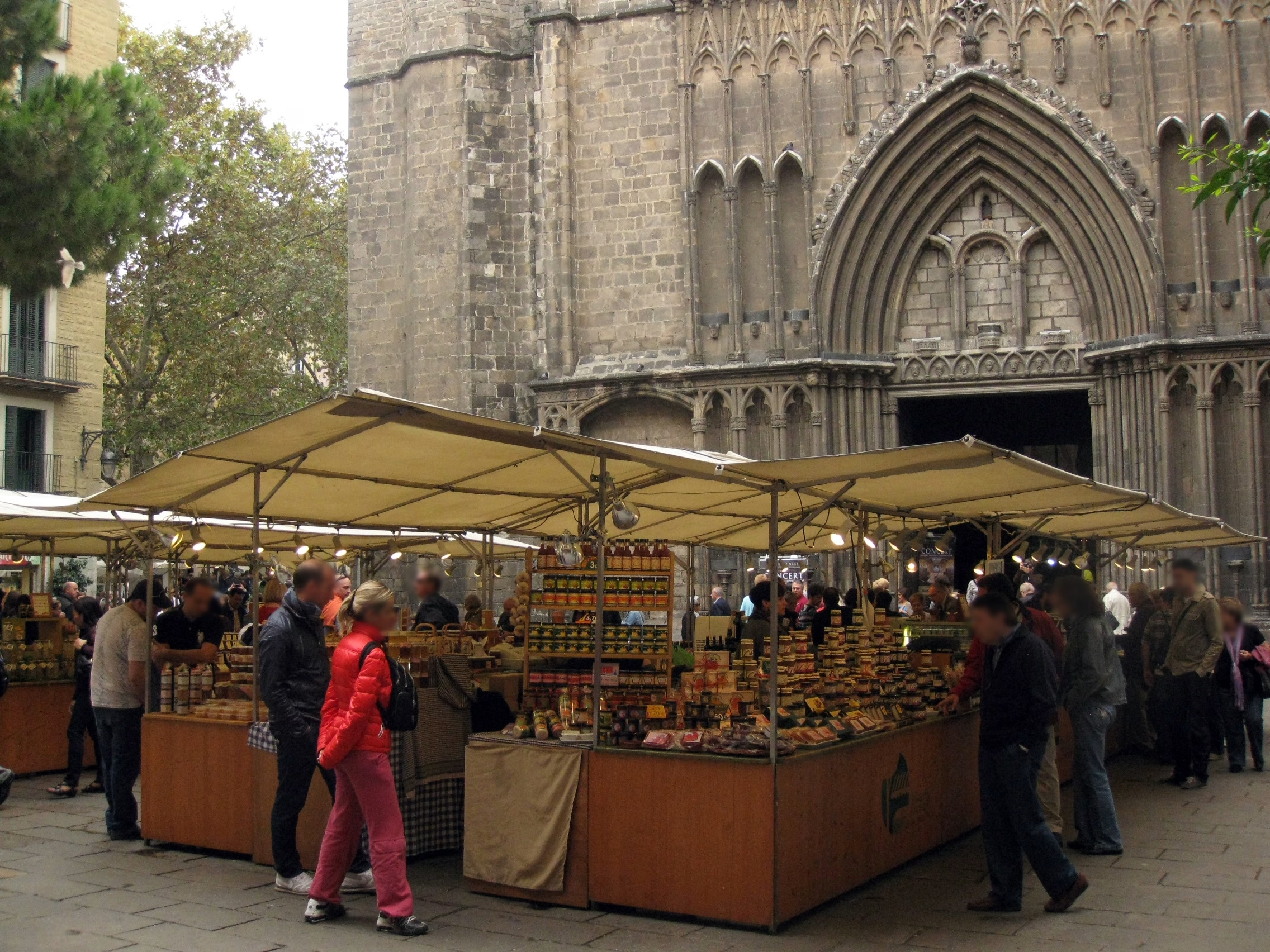
A food fair dedicated to artisan products is held here, bringing together small producers and traders who offer traditional preparations, locally sourced products and gastronomic specialities.
The experience invites visitors to rediscover a way of shopping that goes far beyond a simple commercial transaction: meeting the people who make the products, asking how a particular food is produced, discovering its ingredients, tasting it and listening to the story behind each item.
But Plaça del Pi is much more than a market. Its history is connected to ancient Roman roads, the streams that once crossed the Barcelona plain, medieval guilds, religious traditions and the urban development of Barcelona.
THE ORIGINS OF PLAÇA DEL PI
A place shaped by roads, fields, city walls and waterways
To truly understand the history of this square, we must go back to a time when Barcelona was still a much smaller city.
The ancient Roman city of Barcino was protected by its walls and occupied a relatively small area. Beyond its gates stretched agricultural land, vegetable gardens, country roads, small settlements and waterways flowing down from the surrounding hills towards the Mediterranean.
The area where Plaça del Pi stands today was located to the west of the ancient Roman city. It gradually gained importance as Barcelona expanded and its commercial and religious activities spread beyond the original city walls.
Historical references to the area surrounding Santa Maria del Pi date back to the year 965, demonstrating that this place had its own identity many centuries before acquiring its present architectural layout.
At that time, the landscape consisted of vegetable gardens, country roads and open land. The population maintained close links with agricultural activities and the commercial exchanges taking place along Barcelona’s western approaches.
We should not yet imagine a square surrounded by buildings and terraces, but rather a transitional space between the city and its surrounding territory.
Over the centuries, roads gradually became streets, fields disappeared beneath buildings and the former rural landscape was absorbed by the city’s urban expansion.
THE ANCIENT ROMAN ROAD TOWARDS THE WEST
Communications between Barcino and the surrounding agricultural territory
One of the most interesting aspects of this area’s history is its connection with the ancient roads leading westwards out of Barcelona.
These routes connected the city with nearby settlements and surrounding agricultural areas.
Farmers, merchants, pack animals, visitors and goods destined to supply the population travelled along them.
The road was not merely a communication route: it was a place of exchange between the rural and urban worlds.
This relationship helps explain why the area around El Pi gradually developed such important commercial activity.
Agricultural products arrived from nearby market gardens, while merchants and artisans found this area an ideal location to establish their businesses.
Over the centuries, this rural landscape became fully integrated into the medieval city.
THE MYSTERY OF THE PINE TREE THAT GAVE THE SQUARE ITS NAME
A tree that became a symbol of collective identity
In Catalan, the word pi means pine tree. The name of the square, the church and the neighbourhood is connected to the historical presence of this tree in front of the church.
We are not referring solely to the tree that stands there today, but to a tradition of successive replacements that has preserved its symbolic presence across generations.
The current pine tree was planted in 1985, although other specimens had previously occupied approximately the same spot.
One of the best-known stories tells how an ancient pine tree survived for centuries until, during the Napoleonic invasion, a French soldier pierced its trunk with a bayonet, causing its death.
This episode forms part of the neighbourhood’s popular memory, although it is important to distinguish between oral tradition and historically documented events.
Another legend connects the tree with the origins of devotion to Santa Maria del Pi.
According to this story, a sailor discovered an image of the Virgin Mary among the branches of a pine tree. A small chapel was subsequently built to commemorate the event.
This account should be understood as a traditional legend rather than a historically proven fact.
In any case, the tree eventually became a fundamental element of the identity of this corner of Barcelona.
In the medieval city, trees located in front of churches and public spaces could become meeting places, visual landmarks and points of orientation.
The pine tree in the square is, in a way, a living witness to Barcelona’s transformation.
SANTA MARIA DEL PI: ONE OF THE GREAT TREASURES OF CATALAN GOTHIC ARCHITECTURE
From the first medieval churches to the great fourteenth-century basilica
The history of the square is inseparable from the Basilica of Santa Maria del Pi.
Historical references confirm the existence of a church dedicated to Saint Mary dating back to the tenth century, although the existence of an earlier religious building should be treated with caution.
The present basilica is the result of a major architectural transformation that began in the early fourteenth century.
Construction began around 1319–1320 and continued throughout much of that century. The church was finally consecrated in 1453.
At that time, Barcelona was experiencing a period of considerable economic and commercial development. Its maritime activity and relations with other Mediterranean territories had made the city one of the major urban centres of the Crown of Aragon.
The new church was intended to meet the needs of an increasingly large parish community.
An impressive architectural structure
Santa Maria del Pi features an architectural layout characteristic of Catalan Gothic: a large, spacious and uncluttered single nave, accompanied by side chapels positioned between the buttresses.
Its dimensions are impressive:
Approximate length: 54 metres.
Width: 16.50 metres.
Nave height: 28.50 metres.
Bell tower height: 54 metres.
The spacious interior creates a remarkable sense of unity.
The pillars and vaulted ceilings guide the eye towards the high altar, while the side chapels preserve different spaces of devotion and historical memory.
The church was not simply a religious building. It was also an important social and economic centre.
Guilds and religious brotherhoods financed altars, altarpieces and decorative elements, using their chapels to express their professional and religious identities.
The great rose window: light, geometry and symbolism
One of the most spectacular features of the façade is its enormous Gothic rose window.
This circular composition of stone and glass allows light to enter the interior of the church and also possesses a profound symbolic dimension.
Its radial geometry organises the elements around a central point, creating a visual structure associated with medieval ideas of harmony and perfection.
The original fourteenth-century rose window was destroyed during the fire that affected the basilica in July 1936, at the beginning of the Spanish Civil War.
Its reconstruction was carried out by Josep Maria Jujol, an architect closely associated with Antoni Gaudí, using photographs and documentation of the original as references.
The present rose window is one of the church’s main attractions and is considered one of the most important in Catalonia.
The 54-metre bell tower
The bell tower is another major feature of the complex.
It is an octagonal tower whose construction began in 1379 and continued over several decades.
It was one of the most prominent features of medieval Barcelona’s skyline.
At that time, bell towers served purposes beyond religious needs. They also provided elevated views of the surrounding territory, helped identify neighbourhoods and allowed people to observe the area around the city.
The tower suffered damage during various military conflicts, particularly during the Siege of Barcelona in 1713–1714.
Today, visiting it offers extraordinary views over Ciutat Vella, La Rambla, the port and much of Barcelona’s urban landscape.
THE ANCIENT STREAMS OF BARCELONA
The waterways that disappeared beneath the city
One of the least-known aspects of Plaça del Pi’s history is its relationship with Barcelona’s ancient hydrological landscape.
The Barcelona plain was crossed by numerous torrents and streams flowing down from the Collserola mountain range and nearby elevations towards the Mediterranean.
Unlike permanent rivers, Mediterranean streams have an irregular flow.
For much of the year, they may remain almost completely dry. However, during periods of heavy rainfall, they can become powerful drainage channels capable of carrying enormous quantities of water, sediment and debris.
These waterways profoundly influenced Barcelona’s development.
The streams provided moisture for agricultural land, but they also represented a risk to buildings and communication routes.
The Riera d’en Malla and the ancient Rambla
One of the major features of Barcelona’s historical drainage network was the Riera d’en Malla.
Its course descended from the surrounding hills and crossed areas that were later completely urbanised.
The relationship between the ancient streams and present-day La Rambla is particularly interesting.
During the Middle Ages, La Rambla did not have the appearance of the urban promenade we know today.
Its name comes from the Arabic word ramla, associated with sandy ground and watercourses through which water flowed irregularly.
The ancient Rambla was a natural drainage area that collected water from the surrounding territory.
During the fifteenth century, major changes were made to the routes of various waterways, diverting them towards Barcelona’s western sector so that they could flow towards the sea.
Over the centuries, this area gradually changed until it became one of the city’s main urban thoroughfares.
Do the streams still flow beneath the square?
This is one of the most interesting questions to consider when walking through the historic centre.
The ancient streams were gradually modified, diverted, covered and channelled as urban development progressed.
During the nineteenth and twentieth centuries, major underground infrastructures were developed to collect rainwater and wastewater.
Today, rainwater from Ciutat Vella flows through a complex network of sewers and drainage collectors.
Therefore, we should not imagine that an open stream with the same route it followed during the Middle Ages still exists beneath Plaça del Pi.
Nor is it correct to claim, without specific cartographic evidence, that a particular watercourse passes directly beneath the foundations of the square.
What we can say is that this territory was shaped by ancient waterways and that their transformation left an important mark on Barcelona’s urban development.
MEDIEVAL COMMERCE AND THE ANCIENT GUILDS
The headquarters of the Gremi de Revenedors
Plaça del Pi preserves another historically significant feature: the former guild house of the Gremi de Revenedors.
This guild was founded in 1447 and is one of Barcelona’s most important historical professional organisations.
The revenedors were merchants who purchased goods in order to resell them, playing a fundamental role in the distribution and supply of the city.
In a Barcelona where food arrived from different territories, these professionals ensured that agricultural products and other goods reached the urban population.
The guilds regulated various aspects of commercial activity and provided support and assistance mechanisms for their members.
The former guild headquarters reminds us of the important role that professional corporations played in organising medieval Barcelona’s economic and social life.
Its presence is particularly significant in understanding the relationship between this square and today’s artisan market.
FROM THE ANCIENT MEDIEVAL CEMETERY TO THE SQUARES OF ARTISTS
Plaça de Sant Josep Oriol
Plaça del Pi forms part of a group of small public spaces historically connected to Santa Maria del Pi.
Among them, neighbouring Plaça de Sant Josep Oriol stands out.
During the Middle Ages, churches were usually surrounded by parish cemeteries. The spaces now occupied by the surrounding squares originally served precisely this funerary purpose.
The main cemetery was located in the area of today’s Plaça de Sant Josep Oriol.
Over the centuries, the former cemeteries gradually ceased to be burial grounds and acquired a public function.
Today, these small squares form one of the most attractive urban settings in the neighbourhood.
THE ARTISAN FOOD MARKET
Restoring the relationship between producers and consumers
We now come to one of the square’s main attractions today: its artisan food fair.
This is not a covered municipal market or a daily food market, but a periodic open-air fair organised by groups of artisans and producers.
Its activity connects with the area’s long commercial tradition and revives a form of exchange based on local production, knowledge of the products and direct contact with the people who make them.
When does it take place?
Barcelona City Council lists different events:
The Fira del Col·lectiu d’Artesans d’Alimentació, with events during the first and third weekends of each month.
The traditional Catalan products fair, announced on certain occasions for the last Saturday and Sunday of the month.
Dates and opening hours may change due to special events, so it is advisable to check the municipal programme before planning your visit.
What can you find there?
Depending on the participating producers, the selection may include:
CHEESE AND DAIRY PRODUCTS
Cheeses made from cow’s, sheep’s or goat’s milk, different varieties of maturation and products from small cheesemakers.
CURED MEATS AND MEAT PRODUCTS
Longanizas, fuets, salchichones and other traditional preparations associated with Catalonia’s food-preservation culture.
BAKERY AND PASTRY
Traditional fermented breads, different types of flour, biscuits, sweets and pastry products.
HONEY, PRESERVES AND VEGETABLE PRODUCTS
Artisan products from small-scale agricultural producers, using different preservation techniques.
REGIONAL GASTRONOMIC SPECIALITIES
Products associated with Catalan culinary traditions and other gastronomic cultures.
The exact selection changes according to the participants and the dates.
The importance of talking to the producers
One of the most interesting aspects of this fair is the opportunity to speak directly with the people who make the products.
We can ask where the raw ingredients come from, how the animals are fed, how long a cheese is aged, which varieties of wheat are used or what the difference is between two seemingly similar products.
This conversation is part of the gastronomic experience.
Shopping stops being simply about purchasing a product and becomes an opportunity to discover a story, a territory and a particular way of working.
The Slow Food philosophy
The philosophy behind this fair can be linked to many of the principles of the international Slow Food movement: protecting food biodiversity, promoting gastronomic traditions, encouraging responsible production and restoring the relationship between producers and consumers.
Nevertheless, it is important to distinguish between a fair that shares these values and a market officially organised or certified by Slow Food.
THE CATALAN MONTMARTRE: PAINTERS, ARTISTS AND BOHEMIAN ATMOSPHERE
Plaça de Sant Josep Oriol as an open-air art gallery
The area’s connection with the artistic world is another of its great attractions.
In Plaça de Sant Josep Oriol, we find artists exhibiting their work outdoors.
Painters, illustrators and creative artists transform the square into a small open-air gallery.
Visitors can discover urban landscapes, portraits, watercolours, drawings and different artistic interpretations of Barcelona.
This tradition has helped the area become popularly known as the Catalan Montmartre.
The comparison with the famous Parisian neighbourhood is no coincidence.
Both places share an artistic atmosphere where creativity blends with everyday life, outdoor terraces, visitors and small businesses.
In Barcelona, this activity is also set against an extraordinary architectural backdrop.
The Gothic façade of Santa Maria del Pi, the narrow streets of the neighbourhood and the small squares create an environment that invites visitors to stop and take in their surroundings.
WHAT TO VISIT AND WHERE TO STOP AROUND PLAÇA DEL PI
Carrer de Petritxol: the street of chocolate
Just a few steps from Plaça del Pi, we find Carrer de Petritxol, one of Barcelona’s best-known streets for its traditional chocolate establishments.
It is a narrow pedestrian street lined with art galleries, historic shops and small chocolate cafés.
For generations, its traditional granjas have been meeting places where people enjoy hot chocolate accompanied by melindros, ensaimadas and other sweet specialities.
Among its best-known establishments are:
GRANJA DULCINEA
Founded in 1941, it is one of the traditional chocolate cafés on Petritxol. It is particularly renowned for its hot chocolate and pastry accompaniments.
LA PALLARESA
An establishment specialising in hot chocolate, churros and the traditional suís, a hot chocolate drink topped with whipped cream.
CHOCOLATERIA EQUADOR
An alternative for discovering artisan chocolates, pralines and different cocoa-based creations.
Bar del Pi: tapas and traditional atmosphere
In neighbouring Plaça de Sant Josep Oriol, we find Bar del Pi, an establishment associated with the bar culture and social gatherings of Barcelona’s historic centre.
Its outdoor terrace offers one of the finest views of the monumental surroundings.
It is an ideal place to stop for an aperitif, share some tapas or enjoy a drink while watching the activity in the square.
Espai Quera: books, mountains and gastronomy
Also on Carrer de Petritxol, we find Espai Quera, connected to the historic Llibreria Quera, a bookshop specialising in publications about mountains, hiking and nature.
Its concept combines culture and gastronomy through small dishes, sharing plates and wines.
It is an interesting option for those looking for establishments with character.
Plaça Reial
A few minutes’ walk away, we find Plaça Reial, one of Barcelona’s best-known arcaded squares.
Its nineteenth-century Neoclassical architecture, palm trees and arcades create an atmosphere very different from that of the small medieval squares nearby.
One of its most curious features is its street lighting, designed by Antoni Gaudí as one of his first public commissions in Barcelona.
The square also has a long musical and nightlife tradition.
The Cathedral and the old Jewish Quarter
Walking northwards, we reach Barcelona Cathedral and Plaça Nova, where important remains of the Roman walls of Barcino have been preserved.
From there, we can explore El Call, the former Jewish Quarter.
Its narrow streets preserve part of the medieval urban layout and help us understand the importance of the Jewish community in Barcelona’s history.
It is also worth visiting Plaça de Sant Felip Neri, a small square of great historical and architectural significance, where traces of shrapnel from the Spanish Civil War bombings can still be seen.
HOW TO GET TO PLAÇA DEL PI
Plaça del Pi is located in Ciutat Vella, within the Barri Gòtic. Its proximity to La Rambla makes it very easy to reach.
Address:
Plaça del Pi, Barcelona.
BY METRO
L3 – Liceu: located on La Rambla, just a few minutes’ walk away.
L1 and L3 – Catalunya: provides access from Plaça de Catalunya.
L4 – Jaume I: an alternative for reaching the area from Via Laietana and the Cathedral.
BY BUS
The area is served by several urban bus routes. It is advisable to check the current stops and routes with TMB, as these may change due to roadworks and traffic modifications.
ON FOOT
One of the best ways to reach the square is to walk from Plaça de Catalunya.
The journey takes approximately 10–15 minutes, depending on the route chosen.
From there, we can walk down Portal de l’Àngel, approach the Cathedral and continue through the narrow streets of the Barri Gòtic until we reach Plaça del Pi.
Another option is to enter from La Rambla via Carrer de la Boqueria or Carrer del Cardenal Casañas.
Our recommendation is to walk from Plaça de Catalunya, gradually leaving the shopping streets behind and entering the medieval network of streets that characterises the neighbourhood.
A GASTRONOMIC AND ANTHROPOLOGICAL EXPERIENCE IN THE HEART OF BARCELONA
Visiting Plaça del Pi on a market day allows us to discover a side of Barcelona that does not always feature on the main tourist routes.
Here, we find not only monuments, but also a way of understanding local culture through food.
Artisan products, conversations with producers, small traditional shops and the artistic activity in the neighbouring squares all form part of the same experience.
We can stop to taste a cheese, discover a preserve, talk to the person who made a particular product, admire a painting displayed in the street and finish the day with a cup of hot chocolate on Petritxol.
All of this takes place within a relatively small area, yet one that is full of history.
The square allows us to understand how medieval Barcelona grew around its churches, roads, markets and commercial activities, and how some of these functions remain present today, albeit in transformed ways, in contemporary urban life.
DISCOVERING BARCELONA FROM A DIFFERENT PERSPECTIVE
At Magic Dreams Barcelona, we believe that places acquire a special dimension when we discover the stories hidden within them.
Our tours aim to go beyond conventional explanations of monuments, bringing together architecture, history, nature, gastronomy and popular traditions.
Plaça del Pi offers an especially rich experience: from the ancient landscape of the streams to the symbolism of the pine tree, from Catalan Gothic architecture to the culture of the guilds, and from artisan products to historic little chocolate cafés.