Catalan-Style Spinach.
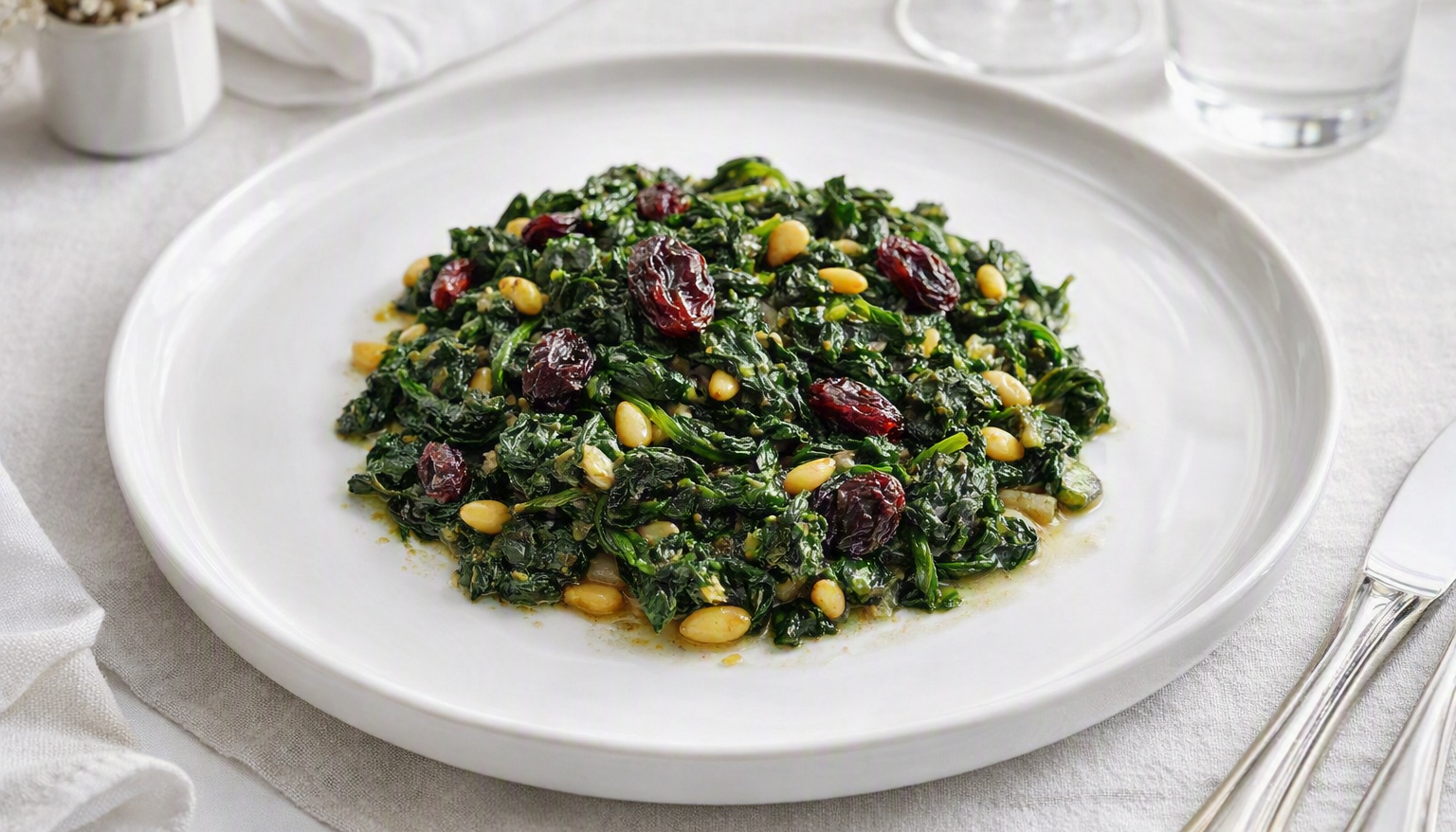
A traditional taste of Catalonia, where spinach, raisins and pine nuts meet Mediterranean simplicity
There are recipes that prove that great cooking does not always require complicated techniques or an endless list of ingredients.
Catalan-Style Spinach is one of them.
This traditional Catalan preparation brings together fresh spinach, raisins, pine nuts, garlic and extra virgin olive oil, creating a beautiful balance between earthy vegetables, natural sweetness and toasted Mediterranean flavors.
A Little History
Catalan-Style Spinach belongs to the tradition of home-style Catalan cooking, where seasonal vegetables were combined with ingredients commonly found in the pantry.
The combination of vegetables with dried fruit and nuts is deeply rooted in Mediterranean gastronomy. Raisins add a gentle sweetness, while pine nuts provide richness, aroma and a delicate crunch.
In Catalan cooking, this contrast between sweet and savory appears in many traditional preparations. It reflects an old culinary philosophy: making the most of simple, local ingredients and allowing their natural flavors to complement one another.
Spinach was an especially practical vegetable for everyday cooking, while raisins and pine nuts could be kept in the pantry and used throughout the year.
The result is a dish that is humble in its ingredients but surprisingly sophisticated in its balance.
Today, Catalan-Style Spinach can be served as a starter, side dish or light vegetarian meal, accompanied by good rustic bread.
It is a recipe that represents the essence of Mediterranean cooking:
seasonal produce, simple preparation and extraordinary flavor.
Ingredients
Serves 4
- 28 oz (800 g) fresh spinach
- 2 oz (60 g) raisins
- 1.8 oz (50 g) pine nuts
- 2 garlic cloves
- 4 tbsp extra virgin olive oil
- Sea salt, to taste
- Freshly ground black pepper
- A small pinch of nutmeg, optional
For finishing
- A drizzle of extra virgin olive oil
- A few additional toasted pine nuts
- A few additional raisins
- Flaky sea salt, optional
1. Preparing the Spinach
Wash the spinach thoroughly under cold running water to remove any traces of soil.
Drain very well.
If using large mature spinach leaves, remove any particularly thick stems and roughly chop the leaves.
Place the spinach in a large saucepan with a few drops of water.
Cook for approximately 3–5 minutes, until the leaves have softened and reduced considerably in volume.
There is no need to add much water.
Spinach naturally contains a large amount of moisture and will release it during cooking.
The ideal texture is tender and vibrant green, but not overcooked.
Drain thoroughly.
Gently press the spinach with the back of a spoon or leave it in a colander for several minutes to remove excess moisture.
This is an important step.
Excess water can dilute the olive oil and prevent the spinach from absorbing the flavors of the garlic, raisins and pine nuts.
2. Preparing the Raisins
Place the raisins in a small bowl.
If they are particularly dry, cover them with warm water and allow them to soak for approximately 10 minutes.
Drain thoroughly before using.
This simple step gives the raisins a softer, juicier texture.
If the raisins are already naturally soft, soaking is not necessary.
For a more refined interpretation, they can also be gently hydrated with a little natural apple juice.
The goal is to create a subtle sweetness that complements the spinach rather than overpowering it.
3. Toasting the Pine Nuts
Heat a large skillet over medium heat.
Add the pine nuts without oil.
Toast them gently for a few minutes, stirring constantly.
They should become lightly golden and fragrant.
Watch them carefully because pine nuts can burn quickly.
As soon as they are golden, transfer them to a plate and set aside.
This simple step makes a significant difference.
Toasting intensifies the natural flavor of the pine nuts and creates a delicate crunch that contrasts beautifully with the tender spinach.
4. The Garlic and Olive Oil
Using the same skillet, add the extra virgin olive oil.
Thinly slice the garlic cloves and add them to the oil.
Cook gently over low to medium heat.
The garlic should slowly perfume the olive oil and become lightly golden.
Do not allow it to burn.
The objective is to create a fragrant olive-oil base that will carry the flavors of the entire dish.
When the garlic is lightly golden, add the raisins.
Cook for approximately one minute, stirring gently.
The warmth will soften the raisins and allow their natural sweetness to blend into the garlic-infused olive oil.
5. Adding the Spinach
Add the thoroughly drained spinach to the skillet.
Gently toss it with the garlic, raisins and olive oil.
Cook for approximately 3–5 minutes over medium-low heat.
There is no need for prolonged cooking.
The spinach has already been softened; now it simply needs to absorb the aromas of the olive oil, garlic and raisins.
Season with sea salt.
Add freshly ground black pepper.
For a warmer aromatic note, add a very small pinch of nutmeg.
6. Adding the Toasted Pine Nuts
Add most of the toasted pine nuts to the skillet.
Reserve a small handful for the final presentation.
Fold everything together gently.
The pine nuts should remain visible rather than disappearing into the spinach.
Each serving should contain a balance of:
tender spinach, sweet raisins and crunchy toasted pine nuts.
This contrast is what gives the dish its distinctive character.
7. Finding the Perfect Balance
The beauty of Catalan-Style Spinach lies in its balance.
The spinach brings an earthy, fresh vegetable flavor.
The raisins introduce a gentle sweetness.
The pine nuts provide richness, aroma and crunch.
The garlic adds depth.
And the extra virgin olive oil brings everything together.
The raisins should never make the dish taste like a dessert.
The pine nuts should enhance rather than dominate.
The garlic should be present without becoming aggressive.
The final result should be savory, gently sweet, aromatic and unmistakably Mediterranean.
8. The Resting Time
Remove the skillet from the heat.
Allow the spinach to rest for approximately 2–3 minutes before serving.
This short resting period allows the flavors to settle and the olive oil to distribute evenly through the dish.
Catalan-Style Spinach is best served warm or at room temperature.
If prepared in advance, reheat gently in a skillet just before serving.
Avoid prolonged reheating, which can affect the texture and color of the spinach.
Gourmet Finishing Touch
For a more refined presentation, finish the dish with a delicate drizzle of high-quality extra virgin olive oil.
An elegant Arbequina olive oil works particularly well because of its fruity and gently sweet character.
Add the reserved toasted pine nuts.
Scatter a few additional raisins over the top.
A few flakes of sea salt can provide small bursts of flavor.
The philosophy is simple:
keep the traditional recipe intact, but give every ingredient the attention it deserves.
Presentation
For a traditional presentation, serve the spinach in a rustic Mediterranean ceramic dish.
Arrange the spinach naturally, making sure the raisins and pine nuts remain visible.
Finish with:
- Toasted pine nuts
- A few raisins
- Extra virgin olive oil
- Flaky sea salt
For a more contemporary presentation, use a round plating ring.
Place the spinach in the center of the plate and gently compact it.
Carefully remove the ring.
Finish with toasted pine nuts and a few raisins on top.
Add a few drops of olive oil around the plate.
Small spinach leaves or delicate green shoots can provide a sophisticated finishing touch.
Serve with slices of toasted Catalan pa de pagès, a rustic country-style bread.
The crisp bread is perfect for soaking up the aromatic olive oil left on the plate.
The Secret to Great Catalan-Style Spinach
The secret is quality ingredients and careful cooking.
The spinach should be fresh and thoroughly drained.
The pine nuts should be gently toasted rather than darkened.
The raisins should be tender and naturally sweet.
The garlic should perfume the olive oil without burning.
And the extra virgin olive oil should be of good quality because it plays a central role in the final flavor.
Do not overcook the spinach.
Excessive cooking can dull its color, soften its texture too much and reduce its fresh vegetable character.
This is one of the great lessons of traditional Catalan cuisine:
when the ingredients are good, simplicity becomes sophistication.
Traditional Variations
The classic combination of spinach, raisins and pine nuts can be adapted in several ways while maintaining its Mediterranean character.
A few drops of white wine vinegar added at the end can introduce a delicate acidic contrast.
Pine nuts can partially be replaced with toasted almonds for a different texture.
For a more substantial vegetarian meal, the spinach can be served with cooked chickpeas.
Thin slices of apple can also be gently sautéed and added for a contemporary interpretation of the sweet-and-savory combination.
However, if the goal is to remain close to the traditional spirit, the combination of:
spinach + raisins + pine nuts + garlic + extra virgin olive oil
remains the most elegant choice.
A Healthy Mediterranean Recipe
Catalan-Style Spinach is a wonderful example of Mediterranean cooking based on vegetables, nuts, dried fruit and olive oil.
Spinach provides fiber and a variety of vitamins and minerals.
Pine nuts contribute plant-based protein, unsaturated fats and satisfying texture.
Raisins provide natural sweetness and energy.
Extra virgin olive oil adds the characteristic healthy fats associated with the Mediterranean diet.
The recipe requires no cream, heavy sauce or excessive amounts of fat.
It can be enjoyed as a starter, side dish or vegetarian meal.
For a more complete plate, serve it with chickpeas, whole grains, potatoes or rustic whole-grain bread.
Storage
Catalan-Style Spinach can be stored in the refrigerator for approximately 2 days in an airtight container.
To reheat, place it in a skillet over low heat.
Add a small drizzle of extra virgin olive oil if necessary.
Avoid reheating for too long.
If preparing the dish in advance, keep a few toasted pine nuts aside and add them immediately before serving.
This ensures that they retain their characteristic crunch.
Perfect Accompaniments
The simplest accompaniment is toasted Catalan country bread.
Its crisp crust contrasts beautifully with the tender spinach and allows you to enjoy every drop of the garlic-infused olive oil.
Other excellent accompaniments include:
- Roasted potatoes
- Brown rice
- Chickpeas
- Mediterranean salad
- Roasted vegetables
- Poached or soft-boiled egg
For a complete Mediterranean meal, serve the spinach alongside grilled or roasted white fish.
The combination is light, balanced and full of Mediterranean character.
Alcohol-Free Pairing
A Fresh Catalan 0.0% White
Catalan-Style Spinach pairs beautifully with a fresh, dry Catalan-style 0.0% alcohol-free white wine.
A Xarel·lo 0.0% can be an excellent choice.
Its freshness and acidity balance the earthy character of the spinach while providing a pleasant contrast to the sweetness of the raisins.
Another elegant option is a 0.0% Brut sparkling wine, served well chilled.
Its fine bubbles add freshness and help cleanse the palate after the richness of the pine nuts and olive oil.
Ideal Serving Temperature
Serve the 0.0% white wine between 46–50°F (8–10°C).
For a 0.0% Brut sparkling wine, approximately 43–46°F (6–8°C) is ideal.
Vichy Catalan: Mediterranean Refreshment
For a completely alcohol-free alternative, serve Vichy Catalan chilled.
Its natural carbonation provides a refreshing contrast to the tender spinach, sweet raisins and toasted pine nuts.
Serve it directly from the refrigerator.
For an aromatic touch, add a thin slice of lemon.
You can also prepare a simple sparkling water with lemon, fresh mint and a few basil leaves.
A light, natural and refreshing accompaniment that preserves the Mediterranean spirit of the dish.
A Humble Dish with Catalan Soul
Spinach.
Raisins.
Pine nuts.
Garlic.
Olive oil.
Five simple elements that come together to create a dish with remarkable depth.
Catalan-Style Spinach is much more than a vegetable side dish.
It is a small expression of Catalan culinary tradition: seasonal produce, pantry ingredients, sweet-and-savory contrasts and respect for the natural character of each ingredient.
It is a recipe born from everyday cooking that remains relevant because its balance of flavors still works beautifully today.
The green freshness of the garden.
The sweetness of dried fruit.
The crunch of toasted pine nuts.
The warmth of garlic.
And the smoothness of extra virgin olive oil.
All on one plate.
Simple enough for everyday cooking.
Traditional enough for a family table.
Elegant enough for a gourmet presentation.
Catalan-Style Spinach.
The essence of the Catalan garden, transformed into a simple, healthy Mediterranean dish full of flavor and tradition.