An iconic promenade between two of Barcelona’s landmarks
Avinguda Gaudí is one of Barcelona’s most distinctive, elegant, and harmonious promenades.
Located in the Eixample district, this pedestrian avenue connects two of the great masterpieces of Catalan Modernism: the Sagrada Família and the Hospital de Sant Pau.
Its layout, trees, terraces, and surrounding architecture make it much more than simply a place to pass through.
It is a space for strolling at a leisurely pace, observing the city, enjoying its gastronomy, and discovering a Barcelona where architectural heritage blends naturally with everyday life.
There is a particularly interesting visual relationship between the two monuments.
From certain points along the avenue, the eye can follow the axis and establish a dialogue between the monumental presence of the Sagrada Família and the Modernist elegance of the Hospital de Sant Pau.
It is precisely this combination of architecture, urban space, gastronomy, and Mediterranean atmosphere that makes Avinguda Gaudí one of the most special promenades in Barcelona.
The Origins of Avinguda Gaudí
An urban connection within the Eixample
Avinguda Gaudí forms part of the urban fabric developed from the great expansion plan for Barcelona designed by Ildefons Cerdà in the 19th century.
The Eixample completely transformed the city through a new network of wide streets, regular blocks, and the characteristic chamfered corners that still define much of Barcelona today.
However, Avinguda Gaudí has a particular feature.
Its diagonal layout partially breaks the regularity of the Eixample grid and creates a direct connection between two of the area’s great monumental complexes.
The avenue was conceived as an urban axis capable of strengthening the relationship between the Sagrada Família and the Hospital de Sant Pau, two fundamental buildings for understanding Catalan Modernism.
Over time, this connection became one of the most prominent pedestrian promenades in the area.
An Axis Between Two Masterpieces
Sagrada Família and Hospital de Sant Pau
The true character of Avinguda Gaudí can be understood by discovering its two ends.
At one end stands the Sagrada Família, the most famous work of Antoni Gaudí and one of Barcelona’s great architectural symbols.
At the other is the Hospital de Sant Pau, designed primarily by Lluís Domènech i Montaner, an extraordinary example of Modernist architecture and a former hospital complex.
Both are part of the UNESCO World Heritage.
The avenue therefore functions as a kind of cultural corridor between two different approaches to Modernism.
In the Sagrada Família, Gaudí created an architectural universe that is deeply symbolic, organic, and spiritual.
At Sant Pau, Domènech i Montaner created a complex in which architecture, ornamentation, nature, and hospital functionality were integrated into an extraordinarily advanced composition for its time.
Walking between the two buildings allows visitors to discover this relationship in a peaceful and natural way.
An Avenue Designed for Walking
The Eixample from a different perspective
One of the great attractions of Avinguda Gaudí is its pedestrian character.
Visitors can walk without the intensity of traffic that characterizes many of Barcelona’s other major thoroughfares.
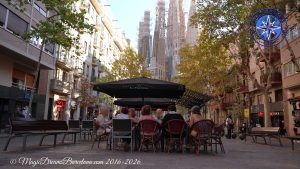
Trees, resting areas, benches, and terraces create an especially pleasant environment for strolling.
The avenue invites you to slow down.
Here, visitors can stop for a coffee, admire the façades, enjoy a meal, or simply observe the everyday life of the neighborhood.
This human dimension is precisely one of its greatest virtues.
It is not simply about visiting two monuments.
It is about experiencing the space that connects them.
Architecture Around the Avenue
Modernism, the Eixample, and urban life
Although the Sagrada Família and the Hospital de Sant Pau are the main protagonists, the architecture surrounding the avenue also deserves attention.
The residential façades of the Eixample reflect different stages in the architectural evolution of Barcelona.
Balconies, bay windows, galleries, mouldings, and geometric compositions are integrated into buildings that form part of everyday city life.
Unlike the great monumental works, these buildings were not necessarily designed to become tourist attractions.
Precisely for this reason, they offer an opportunity to discover a more everyday Barcelona.
Avinguda Gaudí allows visitors to observe how architectural heritage coexists with homes, shops, restaurants, and neighborhood spaces.
Catalan Modernism as a Common Thread
An avenue between art, architecture, and nature
Catalan Modernism is not simply a collection of spectacular buildings.
It is a way of understanding the relationship between architecture, nature, decorative arts, and everyday life.
On Avinguda Gaudí, this philosophy can be especially clearly appreciated.
Vegetation, façades, urban perspectives, and monuments become part of a single experience.
Visitors gradually move from one monumental architectural setting to another while passing through a much quieter urban environment.
The avenue thus acts as a transition between different scales of Barcelona.
The Perspective Towards the Sagrada Família
One of the promenade’s most characteristic views
One of the great attractions of Avinguda Gaudí is the perspective towards the Sagrada Família.
As visitors walk along the promenade, the basilica’s towers appear as a constant visual reference.
The relationship between the avenue and the monument changes depending on the viewpoint.
In the morning, the light can illuminate certain façades and towers.
At sunset, the stone takes on warmer tones.
This changing light makes the promenade a different experience depending on the time of day.
For photography enthusiasts, it is particularly interesting to explore the avenue early in the morning or during the final hours of the afternoon.
The Hospital de Sant Pau
A Modernist universe at the end of the promenade
The northern end of Avinguda Gaudí leads to one of Barcelona’s most extraordinary Modernist complexes.
The Sant Pau Modernist Site, designed by Lluís Domènech i Montaner, was originally conceived as a large hospital complex.
Its design broke away from the traditional concept of a closed, dark hospital.
The different pavilions were separated by gardens and connected through underground spaces, encouraging natural light, ventilation, and improved hygienic conditions.
The architecture combines brick, ceramics, stone, mosaics, sculptures, and decorative elements inspired by nature.
The result is one of the most important examples of Modernist architecture in Europe.
Visiting the complex makes it possible to understand why Avinguda Gaudí truly comes into its own when experienced from one end to the other.
A Route Between Two World Heritage Sites
A cultural promenade of extraordinary value
Avinguda Gaudí offers a feature that is difficult to find in other cities.
Within a relatively short walk, visitors can connect two major architectural complexes recognized by UNESCO.
The Sagrada Família is part of the works of Antoni Gaudí inscribed as World Heritage.
The Sant Pau Modernist Site is also recognized by UNESCO.
The promenade connecting them therefore offers a small architectural journey without the need for transportation.
It is an especially appealing experience for those who wish to discover Barcelona beyond the conventional tourist circuits.
Gastronomy on Avinguda Gaudí
Mediterranean flavours with privileged views
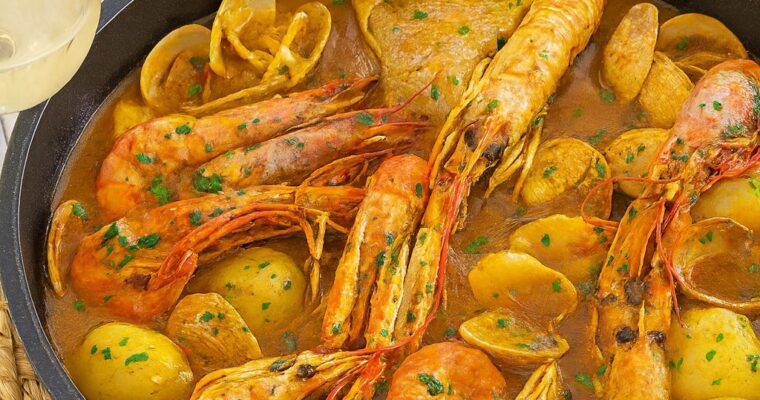
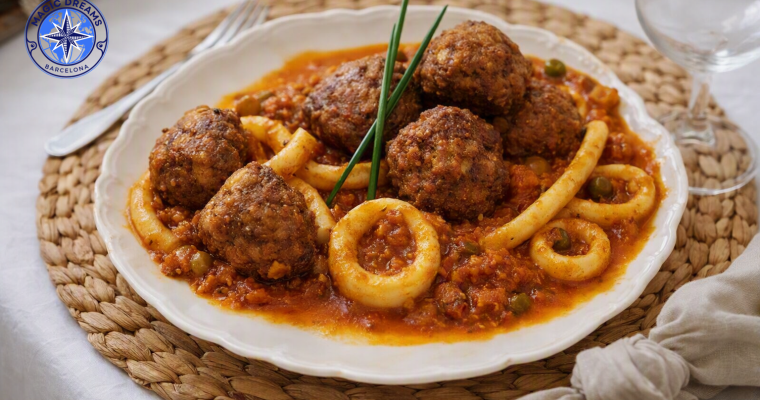
Gastronomy is another great reason to explore the avenue.
Its terraces provide the opportunity to enjoy a meal or a drink while watching the city go by.
The culinary offering is diverse and reflects Barcelona’s international character.
Visitors can find:
- Mediterranean cuisine.
- Catalan gastronomy.
- Traditional tapas.
- International restaurants.
- Italian cuisine.
- Asian cuisine.
- Cafés.
- Pastry shops and bakeries.
- Places specializing in breakfast and afternoon treats.
The proximity of the Sagrada Família also means that some terraces offer particularly attractive views.
For a more authentic experience, we recommend combining the walk with a leisurely meal and allowing plenty of time to enjoy the atmosphere.
The Atmosphere of the Avenue
Between local life and international visitors
During the day, Avinguda Gaudí offers a relaxed atmosphere.
Families, local residents, students, workers, and visitors naturally share the space.
The terraces become meeting points, while the movement of tourists blends with the everyday life of the neighborhood.
As evening approaches, the atmosphere changes.
The illumination of the buildings and the activity around the terraces create a more intimate and sophisticated feeling.
It is one of those places where Barcelona simultaneously reveals two sides of itself:
the monumental city and the everyday city.
A Particularly Mediterranean Promenade
Light, greenery, and architecture
Avinguda Gaudí has a deeply Mediterranean quality.
Not only because of its climate or vegetation.
It is also reflected in the way the avenue invites people to experience public space.
To walk.
To sit.
To talk.
To have a coffee.
To enjoy a meal.
To admire architecture.
To wait for sunset.
This relaxed way of experiencing the city is part of Barcelona’s identity.
The avenue offers precisely that balance between heritage and outdoor life that characterizes many of the city’s most beloved urban spaces.
Avinguda Gaudí at Night
When the promenade takes on a different personality
As night falls, the avenue transforms.
The illumination of the Sagrada Família creates a monumental presence in the distance, while the terraces take on a warmer atmosphere.
Restaurants and cafés extend their activity into the evening, while the promenade retains a sense of tranquillity that contrasts with some of the city’s busier areas.
It is an especially appealing time for those looking for a more relaxed experience.
A Mediterranean dinner.
A stroll.
A drink.
And illuminated architecture as the backdrop.
Photography and Perspectives
A natural setting for discovering Barcelona
Avinguda Gaudí offers countless opportunities for urban photography.
The combination of perspective, vegetation, and architecture allows for very different compositions depending on the viewpoint.
Some of the most interesting scenes include:
- The perspective of the Sagrada Família from the promenade.
- Eixample façades.
- Trees and terraces framing the architecture.
- The basilica’s towers at sunset.
- The arrival at the Hospital de Sant Pau.
- Night-time compositions featuring the city’s illumination.
For a more sophisticated photographic experience, we recommend exploring the avenue without rushing and observing how the light changes across the buildings.
Local Shopping
Small details of everyday Barcelona
Avinguda Gaudí is not a major shopping district like Passeig de Gràcia.
And that is precisely part of its charm.
Here, visitors encounter a more neighborhood-oriented form of commerce:
- Small shops.
- Bakeries.
- Pastry shops.
- Specialty stores.
- Gift shops.
- Artisan products.
- Food establishments.
This smaller-scale retail environment helps preserve a more authentic atmosphere.
Visitors can discover small local businesses while exploring the avenue, combining monumental sightseeing with everyday neighborhood life.
What to Do on Avinguda Gaudí
An experience to enjoy without rushing
The avenue can be visited quickly.
But we recommend not doing so.
A complete experience might include:
01 · Visit the Sagrada Família
Begin the journey by discovering Gaudí’s architectural universe.
02 · Walk along Avinguda Gaudí
Stroll through the promenade at a leisurely pace, taking in its perspectives and architecture.
03 · Enjoy a gastronomic break
Stop for a coffee, an aperitif, or a Mediterranean meal.
04 · Visit the Hospital de Sant Pau
Continue to the Modernist Site and discover the architecture of Domènech i Montaner.
05 · Return to the promenade
Enjoy the avenue at sunset and watch how the changing light transforms the surroundings.
This combination turns a simple urban connection into a complete cultural experience.
How to Get There
A privileged location in the Eixample
Avinguda Gaudí is located between the Sagrada Família and the Hospital de Sant Pau, in Barcelona’s Eixample district.
Its location makes it particularly easy to reach by public transport.
Metro
The Sagrada Família and Sant Pau | Dos de Maig stations provide easy access to both ends of the promenade.
The metro lines serving the area make it possible to connect the avenue with different parts of Barcelona.
Bus
Several city bus routes operate near the avenue, providing access from different neighborhoods.
On Foot
Avinguda Gaudí can also easily be incorporated into a walking route through the Eixample.
Its connection with the Sagrada Família, Sant Pau, and other Modernist landmarks makes it possible to create cultural itineraries of different lengths.
The Best Time to Visit Avinguda Gaudí
Every moment has its own light
There is no single perfect time.
It depends on the experience you are looking for.
In the Morning
Ideal for enjoying a peaceful walk and a lower intensity of visitors.
At Midday
Perfect for combining architecture with a Mediterranean meal on one of the terraces.
At Sunset
Probably one of the most special moments.
The warm light transforms the façades, while the Sagrada Família takes on an especially photogenic glow.
At Night
Ideal for dinner, enjoying the terraces, and discovering the avenue illuminated after dark.
Avinguda Gaudí and Authentic Barcelona
Beyond the great monuments
Barcelona has monuments capable of attracting millions of visitors.
But the true experience of the city can also be found in the spaces that connect them.
Avinguda Gaudí represents precisely that.
It is where monumental heritage merges with everyday life.
Where visitors can go from admiring a masterpiece by Gaudí to sitting down at a terrace.
From discovering a Modernist façade to shopping at a small local business.
From walking among tourists to observing residents going about their daily lives.
This combination is one of Barcelona’s greatest treasures.
A Promenade to Discover Slowly
Beauty is also found in the journey
Avinguda Gaudí demonstrates that a tourist itinerary does not have to be a succession of monuments.
The journey itself can be part of the experience.
The shade of the trees.
The sounds of the terraces.
The architecture of the Eixample.
The towers of the Sagrada Família.
The Modernist details of Sant Pau.
The Mediterranean light.
Everything forms part of the same urban landscape.
That is why we recommend exploring the avenue without rushing.
Look upwards.
Observe the façades.
Discover the small details.
Sit down for a few minutes.
And let Barcelona unfold around you.
Would You Like to Discover Avinguda Gaudí With Us?
Barcelona from a different perspective
At Magic Dreams Barcelona, we believe that getting to know a city is not simply about visiting its monuments.
It is about understanding its history, discovering its hidden corners, tasting its gastronomy, and experiencing it from a more personal perspective.
Our native guide, specializing in architecture, history, botany, art, and ornithology, can accompany you along Avinguda Gaudí and tailor the experience to your interests.
We can organize private experiences combining the Sagrada Família, Avinguda Gaudí, and the Hospital de Sant Pau, creating a fully personalized cultural day.
We also design one-day experiences, weekend getaways, week-long stays, and excursions through the Catalan Pyrenees and Costa Brava.
We take care of the organization so that you can enjoy the experience without having to worry about the details.
We can incorporate carefully selected accommodation, gastronomic experiences, restaurants, picnics with table linen and catering, seaside experiences, yacht outings, professional photography, floristry, musicians, themed romantic dinners, and personalized workshops.
For those wishing to explore Catalan culture in greater depth, we also offer experiences connected with gastronomy, art, and local traditions, including trencadís, cooking, Surrealism, fragrance workshops, and other tailor-made activities.
Each experience is adapted to the visitor’s preferences after understanding their interests, whether through a Premium proposal or a completely personalized experience.
Avinguda Gaudí with Magic Dreams Barcelona is discovered from the soul.