Route guide for visitors throughout Catalonia – Barcelona – Costa Brava – Catalan Pyrenees – Personalized experiences – Customized tour guide services – A small tribute to the wonderful city and land that saw us born – Transforming experiences into unforgettable memories - Magic Dreams Collection: exclusive universes inspired by Salvador Dalí and Gaudí. Niche perfumes, jewelry, lithographs, and collectible items celebrating the Mediterranean spirit.
In the heart of Sant Gervasi, at 282 Muntaner Street, lies a green treasure of the city of Barcelona: the gardens of the Fundación Julio Muñoz Ramonet. Originally designed in 1916 by the French landscape architect Jean-Claude Nicolas Forestier, who introduced the concept of the …
Situado en el exclusivo barrio de Pedralbes, dentro del distrito de Les Corts en Barcelona, el Parque de Cervantes es un remanso de tranquilidad en plena ciudad. Este jardín público está situado estratégicamente entre la Avenida Diagonal y la Avenida de Esplugues, muy cerca de …
Where History, Art, and the Mediterranean Lifestyle Converge
Plaça de Catalunya is the epicentre of Barcelona, a vibrant meeting point where the historic district of Ciutat Vella meets the modern Eixample neighbourhood. Considered one of the city’s most iconic public spaces, the square connects some of Barcelona’s most famous streets and avenues: La Rambla, Passeig de Gràcia, Rambla de Catalunya, Avinguda del Portal de l’Àngel, Carrer de Pelai, as well as Ronda de la Universitat and Ronda de Sant Pere.
This strategic location has made the square one of Barcelona’s principal urban, commercial, and transport hubs, frequented by both local residents and visitors from around the world.
Although it may seem as though the square has always existed, its development as a major public space took place between the late nineteenth and early twentieth centuries, following the demolition of Barcelona’s old medieval walls. It was officially inaugurated in 1927 by King Alfonso XIII, marking a decisive moment in the city’s urban transformation.
Today, Plaça de Catalunya remains a vibrant stage for Barcelona’s everyday life. Demonstrations, sporting celebrations, community gatherings, and cultural events regularly bring the space to life, where the city’s historical identity coexists with its contemporary character.
More than simply a place to pass through, the square is an ideal starting point for discovering Barcelona’s architecture, cultural heritage, shopping districts, and Mediterranean lifestyle.
Art and Monuments
Sculptures, Ornamental Fountains, and Artistic Heritage
Plaça de Catalunya houses an outstanding collection of public sculptures created by renowned artists, including Josep Clarà and Josep Llimona. These works help define the square’s artistic character, transforming a major urban intersection into a genuine open-air art gallery.
The sculptures reflect different artistic movements and periods, offering an introduction to Catalan sculptural heritage and the evolution of public art in Barcelona.
The ornamental fountains add another visual dimension to the setting. The movement of the water, its reflections, and the presence of these features create a refreshing contrast with the surrounding architecture and the city’s fast-paced rhythm. After dark, the fountain lighting enhances the atmosphere of the square, although any special light displays or cultural programmes should be checked in advance.
The area’s cultural history extends far beyond its monuments. In the late nineteenth and early twentieth centuries, celebrated cafés, restaurants, and entertainment venues around the square played a fundamental role in Barcelona’s intellectual and social life.
Establishments such as Maison Dorée, Colón, La Lluna, and El Suís became meeting places for literary discussions, political debates, and social gatherings. These venues reflected an era when cafés served as essential centres of communication and cultural exchange.
The area was also home to historic theatres and entertainment venues, including Bon Retir (1876–1885), Circ Eqüestre Alegria (1879–1895), El Dorado Concert (1887), and Teatre Barcelona (1923). All formed part of the vibrant cultural life that developed around the square.
Today, visitors can also enjoy elevated views of Plaça de Catalunya from the café and restaurant area on the upper floors of El Corte Inglés, a popular vantage point for admiring the square, its fountains, and the surrounding streets.
Views from street level and from above offer two complementary perspectives on Barcelona: the energy of urban life and the geometry of its historic centre.
A Square at the Crossroads of Barcelona
The Meeting Point Between Ciutat Vella and Eixample
One of Plaça de Catalunya’s most distinctive features is its role as both a geographical and symbolic link between two very different urban environments.
To the south lies Ciutat Vella, Barcelona’s old town, with its medieval streets, historic squares, heritage buildings, and narrow pedestrian passageways. From here, visitors can explore the Gothic Quarter, El Raval, and the lower stretch of La Rambla.
To the north begins Eixample, the extensive urban district developed during Barcelona’s nineteenth-century expansion, when the city began to grow beyond its former walls. Its broad streets, characteristic chamfered corners, and grid layout reflect a new approach to urban planning.
The square therefore marks a transition between two fundamental stages in Barcelona’s evolution: the compact, labyrinthine medieval city and the modern metropolis.
From Plaça de Catalunya, visitors can walk towards Passeig de Gràcia, one of Barcelona’s most prestigious avenues, renowned for its architecture, luxury boutiques, and outstanding examples of Catalan Modernisme. Continuing along this avenue leads to iconic buildings such as Casa Batlló and La Pedrera, also known as Casa Milà.
In the opposite direction, La Rambla descends towards the waterfront, passing historic streets, cultural venues, and the surroundings of the traditional La Boqueria market.
A short walk along Portal de l’Àngel leads to one of the city’s main pedestrian shopping streets, while Rambla de Catalunya offers a different atmosphere, with outdoor terraces, restaurants, and elegant urban façades.
This exceptional connectivity makes Plaça de Catalunya an ideal starting point for creating a personalised itinerary around Barcelona.
The Hidden History Beneath the Square
The Legacy of the Spanish Civil War and Air-Raid Shelters
Beneath Barcelona’s modern streets lies another dimension of its history, shaped by conflict, resilience, and the experiences of its inhabitants.
During the Spanish Civil War (1936–1939), Barcelona endured intense aerial bombardments that placed the civilian population at risk. In response, residents and local authorities developed an extensive network of protective spaces and air-raid shelters throughout the city.
Barcelona’s shelter network forms an important part of the city’s civil-defence history. Historical references often mention approximately 1,322 shelters or protective spaces, although the exact figure depends on the classification criteria and historical records consulted.
These structures remain a powerful testament to the hardships endured by the population during the conflict.
Claims about specific air-raid shelters located directly beneath Plaça de Catalunya should be distinguished from the broader history of Barcelona’s shelter network. Their precise locations, state of preservation, and accessibility require confirmation through reliable municipal or archival sources.
Although many historic shelters are not open to the public, visitors can explore the legacy of the Spanish Civil War through museums, historical tours, and documented sites elsewhere in the city.
For those interested in the relationship between urban spaces and collective memory, this historical dimension adds depth to a visit that might otherwise focus exclusively on architecture, shopping, and sightseeing.
Plaça de Catalunya is therefore much more than a transport interchange: it forms part of a city whose squares and avenues have witnessed urban transformations, social movements, and historically significant events.
A Vibrant Stage for Barcelona’s Urban Life
Celebrations, Demonstrations, and Everyday City Life
For decades, Plaça de Catalunya has been one of Barcelona’s principal meeting places.
Its central location and expansive open space make it a regular venue for demonstrations, public celebrations, community events, and collective expressions of identity. Throughout the year, the square reflects the city’s changing pulse, from everyday encounters to moments of particular historical and cultural significance.
It is also an iconic setting for sporting celebrations, particularly when major football victories bring thousands of supporters onto the streets.
For visitors, observing the square offers an opportunity to experience Barcelona beyond its monuments. Street performers, pedestrians, workers, shoppers, and tourists create an ever-changing urban scene in which local life and international tourism intertwine.
The atmosphere varies throughout the day. Mornings are often characterised by commuters and shoppers, while afternoons and evenings bring more visitors to the shopping streets, terraces, and public spaces.
This diversity defines the identity of Plaça de Catalunya: a civic space, a transport hub, a commercial centre, and a gateway to Barcelona’s cultural heritage.
Shopping, Gastronomy, and Urban Lifestyle
From Historic Cafés to the Contemporary Shopping District
Plaça de Catalunya occupies a privileged position within one of Barcelona’s principal shopping and dining areas.
The surrounding streets offer a wide range of experiences, from major international brands and fashion retailers to independent boutiques, traditional cafés, and contemporary restaurants.
Portal de l’Àngel stands out for its pedestrian shopping atmosphere, while Passeig de Gràcia combines luxury shopping with an extraordinary architectural heritage. Along Rambla de Catalunya, visitors can enjoy a more relaxed atmosphere, with outdoor terraces, restaurants, cafés, and elegant façades.
The square also provides easy access to Barcelona’s gastronomic traditions. Visitors can discover Catalan cuisine, sample local pastries, enjoy tapas, or visit restaurants that reinterpret Mediterranean cooking from a contemporary perspective.
For those wishing to combine culture and gastronomy, a carefully designed itinerary can begin with a guided walk through the old town, continue towards the Modernista architecture of Passeig de Gràcia, and conclude with a culinary experience at a selected restaurant.
The area is also ideal for taking a break at a café overlooking the square and comfortably observing the everyday rhythm of Barcelona.
For those seeking a more personalised experience, the surrounding neighbourhoods can be explored through private food tours, curated shopping itineraries, and cultural walks tailored to individual interests.
Experiences with Magic Dreams Barcelona
Culture, Discovery, and Bespoke Experiences
With Magic Dreams Barcelona, a visit to Plaça de Catalunya and its surroundings can become a carefully curated cultural and sensory journey, in which every detail contributes to an elegant, comfortable, and enriching experience.
Our services include private transport and professional guides offering tours in Spanish, Catalan, and English, with other languages available upon request.
We design personalised itineraries covering Barcelona’s principal historical, architectural, and cultural landmarks, adapting each experience to our visitors’ interests, pace, and preferences.
Our guides can explore the city’s history, the symbolism of public art, the evolution of its architecture, and the stories hidden behind its most iconic streets and squares.
Our experiences include:
Private transport and professional guides, with itineraries tailored to each visitor’s needs.
Personalised cultural tours of Plaça de Catalunya, Ciutat Vella, and Eixample.
Art and symbolism tours, exploring public sculptures, architectural details, and the cultural significance of Barcelona’s urban spaces.
Exclusive sensory picnics, featuring carefully selected food and thoughtfully arranged settings in locations where such activities are permitted.
Creative workshops, including Catalan cooking classes and trencadís workshops, introducing participants to the decorative mosaic technique associated with Catalan Modernisme.
Professional photography sessions to preserve special memories of the city.
Live music experiences, arranged according to location, required permits, and availability.
Private gastronomic tours featuring selected restaurants and culinary destinations across Barcelona.
Day trips and weekend excursions to the Costa Brava and the Catalan Pyrenees, with exclusive itineraries.
Nature-based experiences, including botanical interpretation and birdwatching where local conditions allow.
Each proposal is designed to combine discovery, comfort, and cultural knowledge, offering a more personal way to experience Barcelona.
Our aim is not simply to transport visitors from one landmark to another, but to create meaningful connections between the city’s history, artistic heritage, inhabitants, and Mediterranean surroundings.
Gastronomy and Private Experiences
Exceptional Flavours in Carefully Selected Settings
For those seeking a more exclusive way to discover Barcelona, Magic Dreams Barcelona organises personalised gastronomic experiences, subject to availability and advance booking.
These experiences may include private chefs preparing Catalan, Spanish, and international cuisine at the client’s accommodation, themed breakfasts, bespoke dinners, and culinary experiences at selected restaurants.
Additional services may include:
Private chef services and individually designed menus.
Curated gastronomic tours around Barcelona.
Professional photography and floral arrangements.
Live music featuring piano, violin, or saxophone, where the venue and availability permit.
Sensory picnics with table linen, personalised tableware, and catering, at locations where these activities are permitted.
Culinary experiences inspired by Catalan culture and Mediterranean ingredients.
The objective is to combine the city’s gastronomic identity with each visitor’s preferences, creating distinctive and memorable experiences.
Art, Creativity, and Cultural Discovery
Exploring Barcelona Through Artistic Expression
Barcelona’s artistic identity extends far beyond its best-known monuments. Its streets, public sculptures, architectural details, and decorative traditions express a rich cultural history that can be explored through personalised activities.
Magic Dreams Barcelona offers creative experiences that may include trencadís mosaic workshops, introductions to Catalan Modernisme, art activities inspired by Surrealism, and floral art or fragrance-making workshops.
These experiences offer a practical, participatory way to explore the connections between art, history, craftsmanship, and the Mediterranean landscape.
For those wishing to learn more about the work of Antoni Gaudí or Salvador Dalí, bespoke cultural itineraries can also be arranged around relevant locations and exhibitions, subject to opening hours, ticket availability, and reservations.
Wellbeing and Personalised Excursions
A Different Pace for Discovering Catalonia
For visitors wishing to complement cultural sightseeing with moments of relaxation, Magic Dreams Barcelona can organise selected wellbeing experiences and private excursions.
Depending on location and availability, services may include access to spas and thermal facilities, meditation, guided prayer and reflection in suitable outdoor settings, private transport, and scenic excursions.
We also organise personalised trips to the Costa Brava and the Catalan Pyrenees, combining natural landscapes, local culture, gastronomy, and opportunities to discover destinations beyond Barcelona.
Each itinerary is planned around the practical requirements of the activity, including travel times, weather conditions, access restrictions, and advance reservations.
With Magic Dreams Barcelona, the city becomes more than a tourist destination: it becomes a collection of personal experiences designed around each visitor’s interests.
Practical Information for Visiting Plaça de Catalunya
Transport, Accessibility, and Useful Tips
Plaça de Catalunya is one of Barcelona’s principal transport interchanges, making it easy to reach from different parts of the city and its metropolitan area.
Metro: The square is served by metro lines L1 and L3, providing connections to numerous destinations across Barcelona.
Train: Catalunya station provides access to selected Rodalies commuter rail services and railway connections, depending on current timetables.
Ferrocarrils de la Generalitat de Catalunya (FGC): The station also serves FGC lines connecting the city centre with various districts and towns beyond Barcelona.
Bus: Several urban bus routes stop on nearby streets. It is advisable to check current route numbers and stop locations before travelling.
Barcelona Bus Turístic: Tourist bus services offer a convenient way to discover several of the city’s principal attractions. Routes, stops, and timetables may vary by season.
Taxi and private transport: Taxis are widely available in the city centre. Private transport can also be arranged for visitors who prefer personalised transfers or need to coordinate several visits.
The square can be explored on foot, although crowds, roadworks, and pedestrian crossing layouts may affect certain routes. Visitors with reduced mobility should check the most suitable access points and the availability of lifts at transport stations in advance.
Recommended Walking Routes
Plaça de Catalunya is an excellent starting point for exploring Barcelona on foot.
Route 1: Historic Barcelona
Begin at Plaça de Catalunya and walk down La Rambla towards the old town, exploring the streets and squares of the Gothic Quarter.
Route 2: Architecture and Luxury Shopping
Head north along Passeig de Gràcia to discover Catalan Modernisme, prestigious boutiques, and iconic buildings such as Casa Batlló and La Pedrera.
Route 3: Cafés and Urban Life
Explore Rambla de Catalunya to enjoy its restaurants, outdoor terraces, and distinctive urban atmosphere.
Route 4: Shopping and Pedestrian Streets
Discover Portal de l’Àngel and the surrounding shopping streets before continuing towards the historic city centre.
The duration of each route will depend on walking pace, stops, and whether visitors choose to enter museums, shops, or historic buildings.
When Is the Best Time to Visit the Square?
Plaça de Catalunya can be visited throughout the year, although its atmosphere changes with the seasons and the city’s event calendar.
Early mornings are appealing to visitors who wish to photograph the surroundings with fewer people around. Late afternoons and evenings offer a livelier atmosphere, with restaurants, shops, and public spaces frequented by residents and visitors.
As in other busy tourist areas, visitors are advised to keep their belongings secure and remain aware of their surroundings, particularly in crowded areas and at transport interchanges.
Interesting Facts About Plaça de Catalunya
Details That Enrich Your Visit
A connection between two Barcelonas: The square links the historic street network of Ciutat Vella with the urban planning of Eixample.
A major transport hub: Visitors can access the metro, commuter trains, Ferrocarrils de la Generalitat, and various bus services from the surrounding area.
An open-air art space: Its sculptures offer an opportunity to discover works associated with prominent Catalan artists.
A strategic starting point: La Rambla, Passeig de Gràcia, and Portal de l’Àngel are all just a short walk away.
A setting for collective memory: The square has hosted political, social, and sporting events that form part of Barcelona’s contemporary history.
An exceptional location for urban photography: Its fountains, sculptures, and constantly moving crowds offer countless opportunities to capture everyday city life.
A commercial and gastronomic destination: The nearby streets make it easy to combine culture, shopping, cafés, and Mediterranean cuisine in a single day.
For more specific historical information, such as the exact installation dates of individual sculptures or details of recent fountain renovations, it is advisable to consult up-to-date municipal documentation before publication.
Plaça de Catalunya: An Open Gateway to the Best of Barcelona
Discovering the City’s History, Art, and Mediterranean Spirit
Plaça de Catalunya is one of Barcelona’s most distinctive urban spaces, connecting the medieval heritage of Ciutat Vella with the orderly streets and architectural treasures of Eixample.
Its sculptures, ornamental fountains, historical associations, and surrounding avenues make it much more than a transport hub. It is a place where past and present merge, where everyday life unfolds among works of art, and where visitors can begin discovering Barcelona from a variety of perspectives.
From the historic cafés and theatres that once animated the area to today’s commercial districts, cultural landmarks, and nearby gastronomic experiences, the square offers an introduction to the many facets of the city.
Its central location also makes it an ideal starting point for exploring La Rambla, Passeig de Gràcia, Portal de l’Àngel, and the historic streets of the old town.
With Magic Dreams Barcelona, we invite you to discover Plaça de Catalunya and its surroundings from a more personal perspective: a journey designed around history, art, gastronomy, and carefully curated experiences.
Because sometimes, the best way to understand a city is not simply to admire its monuments, but to discover the stories, details, and connections that bring them to life.
La catedral del pueblo, el alma de la Ribera En el corazón del barrio del Born, entre estrechas callejuelas medievales que aún conservan el pulso del antiguo puerto de Barcelona, está situada la Basílica de Santa María del Mar, uno de los testimonios más puros …
Descubra una de las avenidas históricas de Barcelona, sus edificios emblemáticos y los mejores lugares donde comer durante un paseo por el centro histórico. Vía Layetana es una de las avenidas más singulares de Barcelona. Situada en el corazón de Ciutat Vella, conecta el entorno …
An iconic promenade between two of Barcelona’s landmarks
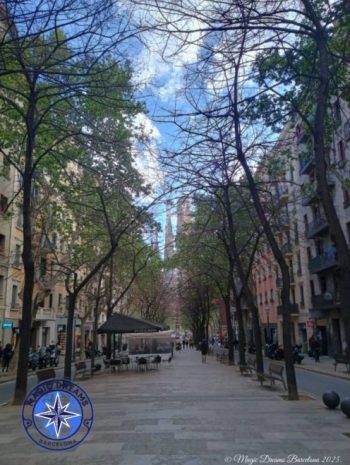
Avinguda Gaudí is one of Barcelona’s most distinctive, elegant, and harmonious promenades.
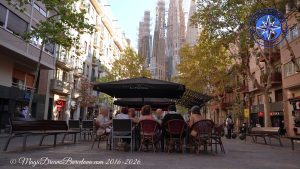
Located in the Eixample district, this pedestrian avenue connects two of the great masterpieces of Catalan Modernism: the Sagrada Família and the Hospital de Sant Pau.
Its layout, trees, terraces, and surrounding architecture make it much more than simply a place to pass through.
It is a space for strolling at a leisurely pace, observing the city, enjoying its gastronomy, and discovering a Barcelona where architectural heritage blends naturally with everyday life.
There is a particularly interesting visual relationship between the two monuments.
From certain points along the avenue, the eye can follow the axis and establish a dialogue between the monumental presence of the Sagrada Família and the Modernist elegance of the Hospital de Sant Pau.
It is precisely this combination of architecture, urban space, gastronomy, and Mediterranean atmosphere that makes Avinguda Gaudí one of the most special promenades in Barcelona.
The Origins of Avinguda Gaudí
An urban connection within the Eixample
Avinguda Gaudí forms part of the urban fabric developed from the great expansion plan for Barcelona designed by Ildefons Cerdà in the 19th century.
The Eixample completely transformed the city through a new network of wide streets, regular blocks, and the characteristic chamfered corners that still define much of Barcelona today.
However, Avinguda Gaudí has a particular feature.
Its diagonal layout partially breaks the regularity of the Eixample grid and creates a direct connection between two of the area’s great monumental complexes.
The avenue was conceived as an urban axis capable of strengthening the relationship between the Sagrada Família and the Hospital de Sant Pau, two fundamental buildings for understanding Catalan Modernism.
Over time, this connection became one of the most prominent pedestrian promenades in the area.
An Axis Between Two Masterpieces
Sagrada Família and Hospital de Sant Pau
The true character of Avinguda Gaudí can be understood by discovering its two ends.
At one end stands the Sagrada Família, the most famous work of Antoni Gaudí and one of Barcelona’s great architectural symbols.
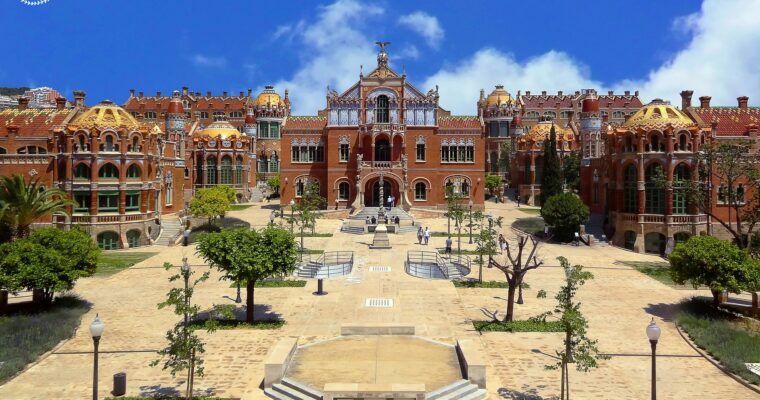
At the other is the Hospital de Sant Pau, designed primarily by Lluís Domènech i Montaner, an extraordinary example of Modernist architecture and a former hospital complex.
Both are part of the UNESCO World Heritage.
The avenue therefore functions as a kind of cultural corridor between two different approaches to Modernism.
In the Sagrada Família, Gaudí created an architectural universe that is deeply symbolic, organic, and spiritual.
At Sant Pau, Domènech i Montaner created a complex in which architecture, ornamentation, nature, and hospital functionality were integrated into an extraordinarily advanced composition for its time.
Walking between the two buildings allows visitors to discover this relationship in a peaceful and natural way.
An Avenue Designed for Walking
The Eixample from a different perspective
One of the great attractions of Avinguda Gaudí is its pedestrian character.
Visitors can walk without the intensity of traffic that characterizes many of Barcelona’s other major thoroughfares.
Trees, resting areas, benches, and terraces create an especially pleasant environment for strolling.
The avenue invites you to slow down.
Here, visitors can stop for a coffee, admire the façades, enjoy a meal, or simply observe the everyday life of the neighborhood.
This human dimension is precisely one of its greatest virtues.
It is not simply about visiting two monuments.
It is about experiencing the space that connects them.
Architecture Around the Avenue
Modernism, the Eixample, and urban life
Although the Sagrada Família and the Hospital de Sant Pau are the main protagonists, the architecture surrounding the avenue also deserves attention.
The residential façades of the Eixample reflect different stages in the architectural evolution of Barcelona.
Balconies, bay windows, galleries, mouldings, and geometric compositions are integrated into buildings that form part of everyday city life.
Unlike the great monumental works, these buildings were not necessarily designed to become tourist attractions.
Precisely for this reason, they offer an opportunity to discover a more everyday Barcelona.
Avinguda Gaudí allows visitors to observe how architectural heritage coexists with homes, shops, restaurants, and neighborhood spaces.
Catalan Modernism as a Common Thread
An avenue between art, architecture, and nature
Catalan Modernism is not simply a collection of spectacular buildings.
It is a way of understanding the relationship between architecture, nature, decorative arts, and everyday life.
On Avinguda Gaudí, this philosophy can be especially clearly appreciated.
Vegetation, façades, urban perspectives, and monuments become part of a single experience.
Visitors gradually move from one monumental architectural setting to another while passing through a much quieter urban environment.
The avenue thus acts as a transition between different scales of Barcelona.
The Perspective Towards the Sagrada Família
One of the promenade’s most characteristic views
One of the great attractions of Avinguda Gaudí is the perspective towards the Sagrada Família.
As visitors walk along the promenade, the basilica’s towers appear as a constant visual reference.
The relationship between the avenue and the monument changes depending on the viewpoint.
In the morning, the light can illuminate certain façades and towers.
At sunset, the stone takes on warmer tones.
This changing light makes the promenade a different experience depending on the time of day.
For photography enthusiasts, it is particularly interesting to explore the avenue early in the morning or during the final hours of the afternoon.
The Hospital de Sant Pau
A Modernist universe at the end of the promenade
The northern end of Avinguda Gaudí leads to one of Barcelona’s most extraordinary Modernist complexes.
The Sant Pau Modernist Site, designed by Lluís Domènech i Montaner, was originally conceived as a large hospital complex.
Its design broke away from the traditional concept of a closed, dark hospital.
The different pavilions were separated by gardens and connected through underground spaces, encouraging natural light, ventilation, and improved hygienic conditions.
The architecture combines brick, ceramics, stone, mosaics, sculptures, and decorative elements inspired by nature.
The result is one of the most important examples of Modernist architecture in Europe.
Visiting the complex makes it possible to understand why Avinguda Gaudí truly comes into its own when experienced from one end to the other.
A Route Between Two World Heritage Sites
A cultural promenade of extraordinary value
Avinguda Gaudí offers a feature that is difficult to find in other cities.
Within a relatively short walk, visitors can connect two major architectural complexes recognized by UNESCO.
The Sagrada Família is part of the works of Antoni Gaudí inscribed as World Heritage.
The Sant Pau Modernist Site is also recognized by UNESCO.
The promenade connecting them therefore offers a small architectural journey without the need for transportation.
It is an especially appealing experience for those who wish to discover Barcelona beyond the conventional tourist circuits.
Gastronomy on Avinguda Gaudí
Mediterranean flavours with privileged views
Gastronomy is another great reason to explore the avenue.
Its terraces provide the opportunity to enjoy a meal or a drink while watching the city go by.
The culinary offering is diverse and reflects Barcelona’s international character.
Visitors can find:
Mediterranean cuisine.
Catalan gastronomy.
Traditional tapas.
International restaurants.
Italian cuisine.
Asian cuisine.
Cafés.
Pastry shops and bakeries.
Places specializing in breakfast and afternoon treats.
The proximity of the Sagrada Família also means that some terraces offer particularly attractive views.
For a more authentic experience, we recommend combining the walk with a leisurely meal and allowing plenty of time to enjoy the atmosphere.
The Atmosphere of the Avenue
Between local life and international visitors
During the day, Avinguda Gaudí offers a relaxed atmosphere.
Families, local residents, students, workers, and visitors naturally share the space.
The terraces become meeting points, while the movement of tourists blends with the everyday life of the neighborhood.
As evening approaches, the atmosphere changes.
The illumination of the buildings and the activity around the terraces create a more intimate and sophisticated feeling.
It is one of those places where Barcelona simultaneously reveals two sides of itself:
the monumental city and the everyday city.
A Particularly Mediterranean Promenade
Light, greenery, and architecture
Avinguda Gaudí has a deeply Mediterranean quality.
Not only because of its climate or vegetation.
It is also reflected in the way the avenue invites people to experience public space.
To walk.
To sit.
To talk.
To have a coffee.
To enjoy a meal.
To admire architecture.
To wait for sunset.
This relaxed way of experiencing the city is part of Barcelona’s identity.
The avenue offers precisely that balance between heritage and outdoor life that characterizes many of the city’s most beloved urban spaces.
Avinguda Gaudí at Night
When the promenade takes on a different personality
As night falls, the avenue transforms.
The illumination of the Sagrada Família creates a monumental presence in the distance, while the terraces take on a warmer atmosphere.
Restaurants and cafés extend their activity into the evening, while the promenade retains a sense of tranquillity that contrasts with some of the city’s busier areas.
It is an especially appealing time for those looking for a more relaxed experience.
A Mediterranean dinner.
A stroll.
A drink.
And illuminated architecture as the backdrop.
Photography and Perspectives
A natural setting for discovering Barcelona
Avinguda Gaudí offers countless opportunities for urban photography.
The combination of perspective, vegetation, and architecture allows for very different compositions depending on the viewpoint.
Some of the most interesting scenes include:
The perspective of the Sagrada Família from the promenade.
Eixample façades.
Trees and terraces framing the architecture.
The basilica’s towers at sunset.
The arrival at the Hospital de Sant Pau.
Night-time compositions featuring the city’s illumination.
For a more sophisticated photographic experience, we recommend exploring the avenue without rushing and observing how the light changes across the buildings.
Local Shopping
Small details of everyday Barcelona
Avinguda Gaudí is not a major shopping district like Passeig de Gràcia.
And that is precisely part of its charm.
Here, visitors encounter a more neighborhood-oriented form of commerce:
Small shops.
Bakeries.
Pastry shops.
Specialty stores.
Gift shops.
Artisan products.
Food establishments.
This smaller-scale retail environment helps preserve a more authentic atmosphere.
Visitors can discover small local businesses while exploring the avenue, combining monumental sightseeing with everyday neighborhood life.
What to Do on Avinguda Gaudí
An experience to enjoy without rushing
The avenue can be visited quickly.
But we recommend not doing so.
A complete experience might include:
01 · Visit the Sagrada Família
Begin the journey by discovering Gaudí’s architectural universe.
02 · Walk along Avinguda Gaudí
Stroll through the promenade at a leisurely pace, taking in its perspectives and architecture.
03 · Enjoy a gastronomic break
Stop for a coffee, an aperitif, or a Mediterranean meal.
04 · Visit the Hospital de Sant Pau
Continue to the Modernist Site and discover the architecture of Domènech i Montaner.
05 · Return to the promenade
Enjoy the avenue at sunset and watch how the changing light transforms the surroundings.
This combination turns a simple urban connection into a complete cultural experience.
How to Get There
A privileged location in the Eixample
Avinguda Gaudí is located between the Sagrada Família and the Hospital de Sant Pau, in Barcelona’s Eixample district.
Its location makes it particularly easy to reach by public transport.
Metro
The Sagrada Família and Sant Pau | Dos de Maig stations provide easy access to both ends of the promenade.
The metro lines serving the area make it possible to connect the avenue with different parts of Barcelona.
Bus
Several city bus routes operate near the avenue, providing access from different neighborhoods.
On Foot
Avinguda Gaudí can also easily be incorporated into a walking route through the Eixample.
Its connection with the Sagrada Família, Sant Pau, and other Modernist landmarks makes it possible to create cultural itineraries of different lengths.
The Best Time to Visit Avinguda Gaudí
Every moment has its own light
There is no single perfect time.
It depends on the experience you are looking for.
In the Morning
Ideal for enjoying a peaceful walk and a lower intensity of visitors.
At Midday
Perfect for combining architecture with a Mediterranean meal on one of the terraces.
At Sunset
Probably one of the most special moments.
The warm light transforms the façades, while the Sagrada Família takes on an especially photogenic glow.
At Night
Ideal for dinner, enjoying the terraces, and discovering the avenue illuminated after dark.
Avinguda Gaudí and Authentic Barcelona
Beyond the great monuments
Barcelona has monuments capable of attracting millions of visitors.
But the true experience of the city can also be found in the spaces that connect them.
Avinguda Gaudí represents precisely that.
It is where monumental heritage merges with everyday life.
Where visitors can go from admiring a masterpiece by Gaudí to sitting down at a terrace.
From discovering a Modernist façade to shopping at a small local business.
From walking among tourists to observing residents going about their daily lives.
This combination is one of Barcelona’s greatest treasures.
A Promenade to Discover Slowly
Beauty is also found in the journey
Avinguda Gaudí demonstrates that a tourist itinerary does not have to be a succession of monuments.
The journey itself can be part of the experience.
The shade of the trees.
The sounds of the terraces.
The architecture of the Eixample.
The towers of the Sagrada Família.
The Modernist details of Sant Pau.
The Mediterranean light.
Everything forms part of the same urban landscape.
That is why we recommend exploring the avenue without rushing.
Look upwards.
Observe the façades.
Discover the small details.
Sit down for a few minutes.
And let Barcelona unfold around you.
Would You Like to Discover Avinguda Gaudí With Us?
Barcelona from a different perspective
At Magic Dreams Barcelona, we believe that getting to know a city is not simply about visiting its monuments.
It is about understanding its history, discovering its hidden corners, tasting its gastronomy, and experiencing it from a more personal perspective.
Our native guide, specializing in architecture, history, botany, art, and ornithology, can accompany you along Avinguda Gaudí and tailor the experience to your interests.
We can organize private experiences combining the Sagrada Família, Avinguda Gaudí, and the Hospital de Sant Pau, creating a fully personalized cultural day.
We also design one-day experiences, weekend getaways, week-long stays, and excursions through the Catalan Pyrenees and Costa Brava.
We take care of the organization so that you can enjoy the experience without having to worry about the details.
We can incorporate carefully selected accommodation, gastronomic experiences, restaurants, picnics with table linen and catering, seaside experiences, yacht outings, professional photography, floristry, musicians, themed romantic dinners, and personalized workshops.
For those wishing to explore Catalan culture in greater depth, we also offer experiences connected with gastronomy, art, and local traditions, including trencadís, cooking, Surrealism, fragrance workshops, and other tailor-made activities.
Each experience is adapted to the visitor’s preferences after understanding their interests, whether through a Premium proposal or a completely personalized experience.
Avinguda Gaudí with Magic Dreams Barcelona is discovered from the soul.
The Royal Palace of Pedralbes, located at 686 Avinguda Diagonal, is one of Barcelona’s most distinctive heritage sites. Surrounded by historic gardens and removed from the hustle and bustle of the city’s main avenues, this remarkable place invites visitors to discover an essential part of …
The La Rotonda building —also known as Torre Andreu— is one of the most iconic architectural landmarks of Sant Gervasi–La Bonanova, located on Avinguda del Tibidabo in the upper area of Barcelona. Over more than a century, this emblematic structure has served multiple purposes, from …
An extraordinary botanical landscape between Montjuïc Mountain and the Mediterranean Sea
On the southern slopes of Montjuïc Mountain, bathed in Mediterranean sunlight and sheltered from cold winds, lie the Mossèn Costa i Llobera Gardens, one of Barcelona’s most remarkable botanical spaces.
Dedicated primarily to xerophytic plants—species adapted to arid climates and water scarcity—this exceptional setting offers visitors a sensory and aesthetic experience of extraordinary beauty. Here, the urban landscape gradually fades into a world of sculptural cacti, agaves, aloes and other succulents.
Nature takes on an almost architectural dimension. Columnar stems, geometric rosettes, spines and wonderfully unusual silhouettes form a living gallery of natural sculptures, with each species displaying its own distinctive strategy for adapting to its environment.
Far from the bustle of the city’s main avenues, the gardens invite visitors to wander at a leisurely pace, observe the intricate details of the vegetation and discover a different perspective on Barcelona, with the harbour and Mediterranean Sea providing a spectacular backdrop.
Location and surroundings
A privileged microclimate on Montjuïc Mountain
Mossèn Costa i Llobera Gardens are located on the southern slopes of Montjuïc, in the Miramar area overlooking Barcelona’s harbour. Their privileged position creates favourable conditions for a remarkable collection of plants adapted to warm, dry climates.
The southern exposure and natural shelter provided by the mountain help maintain favourable temperatures. These conditions allow many species to grow outdoors that would require special protection during the colder months in other parts of Europe.
The combination of abundant sunshine, mild temperatures and Mediterranean conditions makes the gardens an ideal place to understand how plants from arid regions adapt to their surroundings.
Their location also creates a distinctive relationship between botany and landscape. From several points along the paths, visitors can enjoy views of Barcelona’s harbour, the coastline and the open sea.
The result is a remarkable setting where three essential elements come together: mountain, vegetation and Mediterranean landscape.
History and design
A garden dedicated to plants from arid climates
The gardens opened in 1970 and were named in honour of Miquel Costa i Llobera, a Mallorcan poet whose work reflects a profound sensitivity to nature and landscape.
The project was promoted by Barcelona City Council and designed by landscape architect Joan Pañella, with the collaboration of municipal gardener Joan Bassegoda.
From the outset, the aim was to create a specialised botanical garden devoted to plants from desert and semi-desert regions, bringing together species from different continents in an environment suited to their growth.
Over the decades, the gardens have become one of Europe’s most notable collections of cacti and succulent plants, thanks to the diversity of their specimens and the local climate, which allows many species to thrive outdoors.
The design goes beyond simply assembling a botanical collection. The arrangement of the plants, the changes in elevation, the pathways and the viewing points encourage visitors to discover the vegetation from different perspectives, making landscape composition just as important as the individual species.
An extraordinary botanical collection
Cacti, agaves and succulents from different continents
According to published tourism information, Mossèn Costa i Llobera Gardens are home to more than 800 species. The collection includes plants originating from regions such as the Americas, Africa and Australia.
This diversity reveals the extraordinary range of forms developed by plants adapted to water scarcity. Some species have thick stems that store water, while others feature fleshy leaves, protective surfaces or spines that help reduce moisture loss and deter herbivores.
Among the most remarkable plant groups are:
Columnar cacti from Mexico and Peru, whose vertical silhouettes create a striking sculptural landscape.
Opuntias, or prickly pears, with their distinctive flattened segments and varied growth patterns.
Agaves and aloes, whose leaves form beautifully geometric rosettes.
African euphorbias, some of which develop branching forms resembling miniature trees or mineral structures.
Succulent plants from Madagascar, adapted to particularly distinctive environmental conditions.
The differences between these plants reveal fascinating evolutionary strategies. In many cacti, the stem performs photosynthesis and stores water, while the leaves have evolved into spines.
In other succulents, fleshy leaves serve as reservoirs, allowing the plants to survive extended periods of drought.
This variety makes the gardens an appealing destination for both botany enthusiasts and visitors wishing to better understand how plants adapt to extreme environments.
The sculptural beauty of cacti
Geometry, texture and adaptation
One of the gardens’ most captivating features is the extraordinary variety of plant forms.
Spherical cacti resemble compact sculptures, while columnar species rise towards the sky. Branching varieties create silhouettes reminiscent of candelabras, bare trees or fantastical figures.
Agaves spread their leaves like botanical stars, while certain euphorbias form compositions that look almost architectural.
Mediterranean sunlight accentuates the contrasts between green, bluish and greyish surfaces, the spines, the shadows and the textures of the stems. At certain times of day, the sun transforms the garden into a changing landscape of volumes and lines.
This aesthetic dimension encourages visitors to appreciate the plants from an artistic perspective while recognising their remarkable biological adaptations.
Beneath their apparent stillness lies a story of survival, evolution and adaptation to environments where water is a precious and limited resource.
The sculpture La puntaire
Art and landscape at one of the garden’s viewpoints
The visit also reveals artistic elements integrated into the botanical surroundings. One of the highlights is La puntaire, a sculpture by Josep Viladomat situated at one of the garden’s viewpoints.
The sculpture introduces a cultural dimension to the experience, establishing a dialogue between the human figure, the vegetation and the maritime landscape.
From this area, views of the harbour and Barcelona’s coastline offer a different perspective on the city, where nature and artistic heritage complement one another.
The sculpture reinforces the distinctive character of these gardens, conceived not merely as a botanical collection but also as a place for contemplation and appreciation of the landscape.
A journey through nature and contemplation
Paths, terraces and viewpoints overlooking the Mediterranean
Walking through Mossèn Costa i Llobera Gardens feels like entering an almost dreamlike landscape.
Paths wind between landscaped terraces, impressive botanical specimens and peaceful corners offering panoramic views of Barcelona’s harbour and the Mediterranean Sea.
The combination of light, tranquillity and botanical geometry creates a contemplative atmosphere that contrasts with the rhythm of the city.
Each section of the route offers a different perspective, from close-up observations of spines and plant surfaces to sweeping views of vast cactus arrangements silhouetted against the sky.
The gardens also demonstrate how vegetation can transform our perception of space. Larger plants act as sculptural features, while the pathways guide the eye and shape the visitor’s experience.
To appreciate the gardens fully, visitors are encouraged to walk slowly, take time to observe the species and enjoy the various panoramic viewpoints.
The visit can be combined with a walk through other green spaces on Montjuïc, particularly Miramar Gardens, to extend the landscape experience and discover additional perspectives of the mountain.
Botany and adaptation: how xerophytic plants survive
Nature’s ingenuity in the face of water scarcity
The gardens provide an exceptional opportunity to observe the strategies developed by plants living in arid climates.
Xerophytic species possess adaptations that help them reduce water loss, store moisture or take advantage of favourable periods for growth.
Common strategies include:
Water storage: fleshy stems or leaves accumulate reserves that help plants withstand drought.
Reduced leaf surface area: in many species, small leaves or leaves modified into spines help limit transpiration.
Protective cuticles: certain plant surfaces have protective coatings that reduce moisture loss.
Specialised growth forms: spherical, columnar and branching architectures reflect different adaptations to environmental conditions.
Adapted root systems: roots help plants access available soil moisture according to the conditions of their habitats.
These adaptations are not identical in all succulent plants. Cacti, agaves, aloes and euphorbias belong to different botanical groups and have developed their own evolutionary solutions.
Observing them together allows visitors to compare their forms, understand their differences and discover how nature responds to similar environmental challenges through a variety of strategies.
Opening hours and access
Practical information for planning your visit
Mossèn Costa i Llobera Gardens are a public green space in Barcelona. Opening conditions should be checked before setting out, as access may be affected by maintenance or other circumstances.
The length of the visit depends on the pace of the walk and the visitor’s interest in the botanical collection. As a guide, the municipal botanical itinerary dedicated to the gardens covers approximately 700 metres and takes around 50 minutes.
Visitors wishing to extend their experience can continue towards Miramar Gardens, adding approximately another 800 metres and 45 minutes to the walk.
On sunny days, especially during summer, it is advisable to bring drinking water, sun protection and comfortable footwear.
It is also worth noting that the terrain includes slopes, and some sections may require more physical effort than others.
How to reach Mossèn Costa i Llobera Gardens
Different ways to discover Montjuïc
The gardens are located in the Miramar area of Montjuïc Mountain, with access from Carretera de Miramar and the surrounding Passatge de les Bateries area.
The best way to get there depends on your starting point, mobility requirements and whether you wish to include a walk through the mountain in your visit.
Barcelona Tourist Bus
One of the most convenient options for visitors wishing to explore several of Barcelona’s attractions is the Barcelona Bus Turístic.
The red route includes a stop called Miramar – Jardins Costa i Llobera, providing access to the area and allowing visitors to combine the gardens with other highlights of Montjuïc.
It is advisable to check the service’s current routes, operating hours and conditions before planning your journey.
Metro and city bus
Paral·lel station, served by metro lines L2 and L3, provides access to the Montjuïc funicular, which continues up the mountain.
However, reaching the funicular’s upper station does not mean arriving directly at the gardens’ entrance. Visitors should check the remaining walking route and take the slopes into account.
City buses may also be useful, although current routes and stops should be checked to identify the most convenient option for the chosen entrance.
The standard single ticket for one transport zone is quoted here at €2.90. Travel passes and integrated tickets may offer better value depending on the number of journeys. Please check current fares before travelling.
Montjuïc Cable Car
For visitors wishing to add a panoramic experience to their journey, the cable car offers privileged views of Barcelona, the harbour and the surrounding mountain.
Standard adult fares have been quoted at €12 for a single journey and €19 for a return ticket, although promotional offers and reduced fares may be available subject to conditions. These prices should be verified before booking.
Please note that the cable car does not take visitors directly to the gardens’ entrance. Before choosing this option, check the walking route and the remaining elevation change.
Taxi or private vehicle
A taxi can be a convenient alternative for reaching the Miramar area, particularly for visitors who prefer to avoid walking up the slopes of Montjuïc.
The cost and journey time depend on the starting point, traffic and road conditions.
Before travelling, check the nearest suitable access point and the availability of stopping or parking facilities in the surrounding area.
Our recommendation: plan your journey in advance, especially on hot days or if you intend to combine the gardens with other Montjuïc attractions.
An elevated experience with Magic Dreams Barcelona
Botany, culture and tailor-made experiences
A visit to Mossèn Costa i Llobera Gardens can become a deeply personal and exclusive experience with the services of Magic Dreams Barcelona.
Our guides are native speakers and offer tours in Spanish, Catalan and English, with additional languages available upon request. Their expertise encompasses history, architecture, art, symbolism and botany, with particular attention to disciplines such as lepidopterology, ornithology, floriculture and arboriculture.
We also organise experiences inspired by the creative worlds of Antoni Gaudí and Salvador Dalí, alongside cultural tours and tailor-made excursions throughout Barcelona, the Costa Brava and the Catalan Pyrenees.
Our aim is to design each day around our visitors’ interests, pace and preferences, carefully managing the details so they can enjoy the experience without worrying about the logistics.
Private dining and exclusive experiences
We offer personalised culinary services that may include:
Private chefs preparing Catalan, Spanish and international cuisine at your accommodation, including breakfasts, lunches and dinners themed around different historical periods and artistic worlds.
Live music, with options such as piano, violin and classical singing, subject to availability.
Floristry services and professional photography sessions.
Curated gastronomic tours throughout Barcelona, the Pyrenees and the Costa Brava.
Tickets and cultural experiences, arranged subject to availability and access conditions.
Sensory picnics featuring table linen, personalised tableware, catering, soft drinks and alcohol-free sparkling drinks, in gardens, by the sea or aboard a yacht.
Private barbecues at your accommodation or aboard a yacht, with a chef and additional services.
Art, nature and creative workshops
For those wishing to explore Barcelona’s artistic heritage in greater depth, we organise personalised workshops in trencadís mosaic, Surrealism, gastronomy, floral art and fragrance creation, among other possibilities.
These activities offer an opportunity to discover different forms of artistic expression and explore the connections between nature, materials, culture and creativity.
Well-being and connection with nature
Our services also include experiences designed to promote relaxation and well-being:
Outdoor Lomi Lomi Hawaiian massages in suitable locations by the sea.
Access to spas, thermal circuits and saunas through arranged services and reservations.
Guided meditation, prayer and reflective practices outdoors, accompanied by baskets of fresh fruit, tea, natural juices and thoughtful gifts.
The availability of each activity depends on the location, weather conditions and advance arrangements.
Tailor-made excursions and experiences
We provide planning and logistical services that may include private vehicles, hiking, cultural excursions, visits to natural spaces and panoramic experiences, depending on the nature of each proposal.
We also design special sunset experiences featuring stories about the history and landscape of selected locations, for visitors wishing to discover Barcelona from a more intimate and sensory perspective.
With Magic Dreams Barcelona, every journey becomes a carefully crafted experience in which each detail—from a gourmet breakfast to a stroll among extraordinarily shaped cacti—helps create an unforgettable memory.
Mossèn Costa i Llobera Gardens: a different side of Barcelona
A botanical sanctuary where nature becomes art
Mossèn Costa i Llobera Gardens reveal a distinctive side of Barcelona, away from the city’s best-known monumental attractions yet deeply connected to its Mediterranean identity.
Their collection of cacti and succulents, privileged microclimate and views over the harbour make them an exceptional destination for nature lovers, photographers, botanical enthusiasts and anyone who appreciates beautiful landscapes.
Visiting these gardens is a reminder that beauty does not always reside in grand monuments. Sometimes it can be found in the stillness of a pathway, the geometry of a succulent or the silhouette of a cactus against the Mediterranean sky.
With Magic Dreams Barcelona, we invite you to discover this botanical oasis from a different perspective: more personal, more sensitive and deeply connected with nature.
Jardines de Mossèn Costa i Llobera – Magic Dreams Barcelona.
A Walk Through Port History and the Mediterranean The Moll de la Fusta is one of the most emblematic spaces along Barcelona’s waterfront. Located opposite the historic city centre, next to Port Vell, this promenade represents much more than a pleasant area by the sea. …
El edificio La Rotonda —también conocido como Torre Andreu— es uno de los grandes símbolos arquitectónicos de Sant Gervasi–La Bonanova, situado en la Avinguda del Tibidabo, en la zona alta de Barcelona. A lo largo de más de un siglo de historia, este emblemático edificio …
A Masterpiece of Catalan Gothic Architecture, Where History, Art and Spirituality Come Together
Barcelona Cathedral, officially known as the Cathedral of the Holy Cross and Saint Eulalia, is one of the most emblematic monuments of the Catalan capital and one of the finest expressions of Gothic art in Catalonia.
Located in the heart of the Gothic Quarter, its imposing architecture is the result of centuries of history, transformation and devotion. Its stone walls, pinnacles, vaults, sculptures and famous gargoyles form a monumental ensemble in which medieval architecture engages in a dialogue with the city’s collective memory.
Dedicated to the Holy Cross and Saint Eulalia, the patron saint of Barcelona, the cathedral is much more than a religious building. It bears witness to the city’s historical evolution, offers extraordinary artistic value and is a place where every detail seems to tell a story.
Among its most striking features are sculptures of fantastic animals, mythological figures and monstrous creatures. The gargoyles include unexpected figures such as a bull, a unicorn and an elephant. Its bells, traditionally identified by female names, add another intriguing detail to this symbolic world.
The cathedral invites visitors to slow down, discover its details and understand how architecture, religion, popular tradition and urban history intertwine in one of Barcelona’s most fascinating heritage sites.
The Origins of the Cathedral
From Roman Barcelona to the Great Gothic Architecture
The history of Barcelona Cathedral dates back to the earliest centuries of Christianity. Religious buildings once stood in this same area, reflecting the evolution of Barcino, the ancient Roman city.
Before the construction of the present Gothic cathedral, Barcelona had a Romanesque cathedral, consecrated in the eleventh century. The expansion of the medieval city, its growing political and commercial importance, and the development of new artistic forms encouraged the construction of a more ambitious building.
Work on the Gothic cathedral began in 1298, during the reign of James II of Aragon, at a time when medieval Barcelona was flourishing. The project unfolded over several generations, and the principal Gothic structures took shape during the fourteenth and fifteenth centuries.
However, the building we see today also reflects later interventions. The main façade, monumental in appearance and deeply inspired by medieval Gothic architecture, was completed between the late nineteenth and early twentieth centuries, following a design based on the Gothic style.
This evolution reveals one of the cathedral’s most interesting characteristics: its visual unity is not the result of a single construction campaign, but of a long historical process in which different periods left their mark.
Architecture That Reaches Towards the Sky
Verticality as an Expression of the Spiritual
Barcelona Cathedral embodies some of the essential principles of Gothic art: soaring spaces, the pursuit of light, structural complexity and the integration of sculpture into architecture.
Its main façade is dominated by a large rose window and features pointed arches, archivolts, pinnacles and abundant sculptural ornamentation. Saints, angels, botanical motifs and fantastic figures coexist in a decorative programme that invites visitors to pause and appreciate the details.
The exterior buttresses help distribute the building’s structural loads and form part of an architectural system characteristic of the Gothic style. Inside, the ribbed vaults transfer weight to the pillars and reinforce the sensation of height.
Light plays a fundamental role. It enters through the stained-glass windows, gradually transforming the appearance of the stone and creating contrasts between illuminated areas and more secluded corners.
The cathedral cannot be understood through its monumental scale alone. Its true richness emerges when we observe the relationships between structure, proportion, sculpture and light.
Every element reflects a conception of space in which construction techniques and spiritual experience form part of the same architectural vision.
The Crypt of Saint Eulalia
The Memory of a Young Martyr and Patron Saint of Barcelona
Beneath the presbytery lies one of the cathedral’s most significant spaces: the crypt of Saint Eulalia, which houses the saint’s tomb.
According to Christian tradition, Eulalia was a young martyr who was persecuted during Roman times for remaining faithful to her beliefs. Her martyrdom is traditionally dated to AD 304, although the accounts that have come down to us belong to a hagiographic tradition developed over many centuries.
Her story represents strength, fidelity to one’s convictions and resistance in the face of persecution. Over time, her cult acquired extraordinary importance in Barcelona, making her one of the city’s principal patron saints.
The tomb is a work of considerable artistic and historical interest. Its position beneath the high altar establishes a direct connection between the cathedral’s monumental architecture and the memory of Barcelona’s Christian community.
The crypt is also a place of retreat. In contrast to the height of the naves and the complexity of the exterior architecture, this space offers a more intimate experience, defined by silence and contemplation.
The Gothic Cloister
A Medieval Garden in the Heart of the Gothic Quarter
The cloister is one of the cathedral’s most distinctive and charming corners.
Built mainly between the fourteenth and fifteenth centuries, it consists of Gothic galleries arranged around an inner garden, where vegetation introduces a natural dimension into the monumental complex.
Palm trees, magnolias, an orange tree and other plant species help create a peaceful atmosphere. Water, present in the garden’s traditional features, reinforces the relationship between nature, architecture and spirituality.
The cloister was not merely decorative. It formed part of the daily organisation of the ecclesiastical community and provided passage between different areas of the cathedral complex.
Its galleries, with their arches and sculptural details, offer a different perspective on Gothic architecture: less monumental than the main façade, yet particularly rich in detail and subtlety.
The Thirteen Geese of Saint Eulalia
One of the cloister’s best-known features is the group of geese that live in its garden.
Tradition associates their number, thirteen, with the age Saint Eulalia was said to have been when she was martyred. It is also symbolically linked to the thirteen tortures that, according to hagiographic tradition, the young saint endured.
The presence of these birds makes the cloister especially beloved by visitors and adds a storytelling dimension to the experience.
Beyond their curious appeal, the geese form part of the cathedral’s popular memory. They remind us that heritage is made up of more than stone and works of art: it is also shaped by the stories, symbols and customs that a community passes down from one generation to the next.
The Organ and the Choir
Music as Part of Sacred Architecture
Music is another important dimension of Barcelona Cathedral.
Its historic organ, located in the upper gallery near the Portal of Sant Iu, is one of the most remarkable instruments in the cathedral’s musical heritage. Construction began between 1537 and 1539, and the instrument has undergone several transformations throughout its history.
The organ is more than a historical artefact. Its sound takes advantage of the Gothic space’s acoustic properties, as the vaulted ceilings and the dimensions of the naves allow the music to resonate throughout the building.
Concerts and musical events held at the cathedral offer a different way to experience the building: not only through sight, but also through sound.
The choir is another of the interior’s most valuable artistic spaces. Its carved wooden stalls, ornamental details and arrangement reflect the importance of liturgical life in the organisation of the cathedral.
Among the stone, wood and music, visitors discover how medieval and Renaissance art come together in an experience that unites architecture and spirituality.
The Cathedral Rooftop
Barcelona from a Privileged Perspective
Visiting the upper levels of the cathedral reveals a lesser-known dimension of the monument.
Access to the rooftop by lift, when available as part of the relevant visitor experience, offers privileged views of the bell towers, the lantern tower and the architectural features crowning the building.
From this vantage point, visitors can better appreciate the proportions of the upper structures and the complexity of the Gothic ornamentation. It is also possible to view the cloister from a different perspective and observe how the cathedral relates to the surrounding urban fabric of the Gothic Quarter.
The octagonal lantern tower, crowned by the Holy Cross and associated with the image of Saint Helena, is one of the most distinctive features of the cathedral’s silhouette.
From above, Barcelona reveals the overlapping historical layers that characterise its historic centre: medieval streets, later buildings and urban spaces that have evolved around the ancient city.
The rooftop helps visitors understand the cathedral not as an isolated building, but as an essential part of Barcelona’s historic landscape.
The Chapel of the Holy Christ of Lepanto
Devotion, Legend and Artistic Richness
The Chapel of the Holy Christ of Lepanto is one of the cathedral’s most important spaces in terms of religious devotion and historical interest.
Its architectural configuration is linked to the transformation of the medieval cathedral and to interventions carried out during the fifteenth century. The architect Arnau Bargués, associated with important works in Barcelona during that period, occupies a significant place in its history.
The chapel houses the revered image of the Holy Christ of Lepanto, which inspires deep popular devotion.
Tradition connects this image with the Battle of Lepanto in 1571 and associates it with the naval events of that historical episode. The stories surrounding the image form part of Barcelona’s religious memory and should be understood within the devotional traditions passed down through the centuries.
Its star-patterned ribbed vault and architectural ornamentation reflect the sophistication achieved by Catalan Gothic architecture. Another notable feature is the central vault boss depicting Pentecost, attributed to the sculptor Joan Claperós and dated to 1454.
The ensemble is completed by the Baroque tomb of Saint Olegarius, which adds another historical and artistic layer to this space.
The chapel illustrates how a single place can bring together different periods, styles and expressions of religious devotion, from Gothic architecture to Baroque artistic traditions.
The Cathedral’s Gargoyles
Fantastic Animals, Medieval Creatures and Symbolism
Among the cathedral’s most fascinating features are the gargoyles projecting from its walls and rooftops.
These sculptures served a practical purpose: to channel rainwater away from the building’s walls. However, their designs also made them part of one of the most imaginative sculptural repertoires in medieval architecture.
Their forms depict animals, fantastic creatures and monstrous figures that appear to watch over the building from above.
Among the figures popularly identified are an elephant, a bull and a unicorn. These representations contrast with the more familiar imagery of religious art and arouse the curiosity of those exploring the cathedral’s exterior.
In medieval culture, animals could carry moral, religious or symbolic meanings. Nevertheless, not every sculpted figure has a single, documented interpretation. Some reflect established iconographic traditions, while others can be understood as expressions of ornamental imagination.
The gargoyles reveal a less solemn side of Gothic art: a world in which the sacred coexists with the fantastic, morality with imagination, and practical construction with artistic expression.
Looking at them carefully allows visitors to discover details that might otherwise go unnoticed during a first visit.
The Cathedral’s Bells
Twenty-One Voices That Form Part of Barcelona’s Memory
For centuries, bells have played a fundamental role in the life of the city.
Their sounds announced religious celebrations, marked certain moments of the day and accompanied important events within the community.
The cathedral’s tradition highlights its twenty-one bells and the female names associated with them, a distinctive feature that arouses the curiosity of many visitors.
Beyond their acoustic role, the bells form part of the cathedral’s historical identity. Each belongs to an artisanal tradition involving metal casting, the shape of the instrument and the acoustic characteristics that determine its sound.
The bell towers, visible from various points throughout the Gothic Quarter, are also an essential element of the cathedral’s silhouette.
The relationship between architecture and sound offers a different way of understanding the building: as a monument that has also played an active role in Barcelona’s everyday life.
The Lantern Tower and Bell Towers
An Unmistakable Silhouette in the Urban Landscape
The cathedral’s exterior appearance is defined by its bell towers, pinnacles and the lantern tower rising above the roofline.
The lantern tower, with its octagonal design and crowning spire, is one of the ensemble’s most striking visual features.
Its verticality reflects the Gothic conception of the building, in which ascending lines reinforce the impression of height and establish a visual relationship between architecture and the sky.
The towers, meanwhile, are more than functional structures. They are landmarks within the historic landscape and help visitors recognise the cathedral from different streets and squares in the old town.
Stone, geometry and ornamental details combine to create a silhouette that captures much of the visual identity of medieval Barcelona.
The Cathedral and the Gothic Quarter
A Monument Inseparable from the City’s History
Barcelona Cathedral cannot be fully understood without exploring its surroundings.
The Pla de la Seu, the narrow streets of the Gothic Quarter and the nearby squares form part of an urban landscape where Roman remains, medieval architecture and buildings from later periods coexist.
The surrounding area reveals how the city developed around its principal religious, political and commercial institutions.
The proximity of other historic sites makes a visit an opportunity to understand Barcelona’s evolution from ancient Barcino to the contemporary metropolis.
In this setting, the cathedral serves as a cultural and architectural landmark. Its presence has accompanied the transformations of the historic centre and continues to form part of everyday life in the city.
One of the most rewarding ways to experience the area is to combine a visit to the cathedral’s interior with a leisurely walk through its surroundings, observing doorways, reliefs, courtyards and hidden corners that preserve the memory of different eras.
A Building Constructed Over the Centuries
From the Medieval Project to Its Present Monumental Appearance
Construction of the cathedral began in 1298, and its development continued over several centuries. The Gothic building took shape primarily during the fourteenth and fifteenth centuries, while some of its most visible features, such as the main façade, acquired their present appearance much later.
This chronology explains why the cathedral combines historical elements with later reconstructions.
The Neo-Gothic façade, completed between the late nineteenth and early twentieth centuries, draws inspiration from medieval architectural language and contributes to the monumental appearance that identifies the building today.
Rather than diminishing its interest, this evolution helps us understand how each generation interprets and transforms its heritage.
The cathedral is therefore a historical work in the broadest sense: it preserves the legacy of medieval Barcelona while reflecting later generations’ desire to preserve and complete one of the city’s principal symbols.
Barcelona Cathedral Today
Heritage, Worship and Cultural Life
Today, the Cathedral of the Holy Cross and Saint Eulalia continues to serve as a place of worship and remains a fundamental monument within Barcelona’s cultural heritage.
Its interior preserves chapels, tombs, sculptural works and liturgical objects that reveal different stages in Catalonia’s artistic history.
A visit offers the opportunity to explore Gothic art from multiple perspectives: architecture, sculpture, music, religious tradition and urban history.
The cathedral continues to fulfil its spiritual function, so visitors are encouraged to respect worship schedules and the rules established for visitors.
Preserving the building requires continuous maintenance and restoration. Stone, stained glass, metalwork and rooftops are all affected by the passage of time and environmental conditions, making conservation an essential part of the monument’s historical continuity.
Visiting the cathedral means discovering an exceptional work of art and architecture, but also recognising our collective responsibility to preserve it for future generations.
Fascinating Facts You May Not Know
The Small Details That Make the Cathedral Extraordinary
Thirteen geese in the cloister. Their number is traditionally associated with Saint Eulalia’s age at the time of her martyrdom and with the thirteen tortures attributed to her in tradition.
Fantastic animals among the gargoyles. Figures popularly identified include a bull, a unicorn and an elephant.
More than seven centuries of history. Work on the Gothic cathedral began in 1298, although its present monumental appearance incorporates much more recent interventions.
A historic organ. Initially constructed between 1537 and 1539, it forms part of the cathedral’s musical heritage.
A panoramic rooftop. When access is available, the rooftop offers privileged views of the towers, lantern tower and rooftops of the Gothic Quarter.
A cathedral dedicated to two sacred invocations. Its official name, Santa Creu i Santa Eulàlia, brings together devotion to the Holy Cross and the memory of Barcelona’s patron saint.
A cloister within the city. Just a short distance from the busiest streets of the historic centre, the inner garden offers a peaceful atmosphere that contrasts with the surrounding urban activity.
Practical Information for Visitors
Everything You Need to Know Before Planning Your Visit
Location
Pla de la Seu, 3, Barcelona.
The cathedral is situated in the Gothic Quarter, very close to Via Laietana and other points of interest in the historic centre.
Visiting Hours
As a general reference, the following tourist visiting hours have been provided:
Weekdays: 9:30 a.m.–6:30 p.m.
Saturdays and public holidays: 9:30 a.m.–5:30 p.m.
Sundays: 2:00 p.m.–5:00 p.m.
These hours may vary depending on the season, religious celebrations and scheduled activities. Visitors are advised to check the official information before travelling, particularly if they wish to access the rooftop or visit specific areas.
How to Get There
Metro: Line L4, the yellow line, getting off at Jaume I station.
Bus: Route 47, with a stop near Via Laietana and Plaça de Ramon Berenguer.
On foot: Walking from other parts of the Gothic Quarter allows visitors to combine the cathedral visit with a tour of the historic centre.
Things to Keep in Mind
Allow enough time to explore both the interior and exterior of the cathedral.
Check which areas are included in the chosen ticket option.
Confirm rooftop access availability and the conditions for visiting the cloister.
Respect areas reserved for worship and follow staff instructions.
Consider a guided tour to gain a deeper understanding of the sculptures’ symbolism and the building’s architectural evolution.
An Experience Best Discovered Slowly
Architecture Is Observed, History Is Understood and Beauty Is Felt
Visiting Barcelona Cathedral is about much more than admiring a monumental façade or walking through its naves.
It means pausing before a gargoyle, observing the light passing through a stained-glass window, listening to the organ’s resonance, discovering the silence of the cloister and understanding the historical significance of a chapel.
It also means looking up towards the pinnacles, recognising the different stages of construction and discovering how a building can become a witness to a city’s evolution.
The cathedral is a place to discover gradually, with an attentive eye for detail and an openness to the many layers of meaning it contains.
Would You Like to Discover Barcelona Cathedral with Us?
A Bespoke Cultural Experience with Magic Dreams Barcelona
At Magic Dreams Barcelona, we transform visits to the Gothic Cathedral and other emblematic sites across the city into personalised experiences designed to explore heritage from a cultural, sensory and deeply human perspective.
Our tours offer an opportunity to discover Catalan Gothic history, art and architecture through stories tailored to each visitor’s interests, pace and preferences.
We organise private experiences and personalised itineraries that can combine the cathedral with other historic sites in Barcelona, architectural routes, gardens, cultural venues and lesser-known corners of the historic centre.
We also design special experiences for those who wish to go beyond a conventional sightseeing visit:
Expert guides specialising in history, art and architecture, with explanations tailored to each visitor.
Private, personalised tours, designed around cultural interests, available time and individual pace.
Sensory experiences, incorporating music, literature and carefully selected aromas into the itinerary whenever conditions at the venue allow.
Signature gastronomy and exclusive picnics, arranged in suitable locations selected to complement the experience.
Creative workshops, including mosaic-making, trencadís art and activities inspired by Catalan traditions.
Getaways to the Costa Brava and the Catalan Pyrenees, featuring landscapes, heritage sites and carefully selected gastronomic experiences.
Personalised services throughout your stay, from romantic experiences to cultural activities and gastronomic tours.
We take care of the details to ensure that each day unfolds comfortably and seamlessly, with personalised attention throughout. Our experiences are designed according to each client’s preferences and the availability of venues and services.
Our goal is to transform heritage from a succession of dates and monuments into a memorable experience, combining historical knowledge with the excitement of discovery.
Barcelona Cathedral is much more than a masterpiece of Gothic architecture. It is a place where centuries of history, art, devotion and urban life come together.
With Magic Dreams Barcelona, every journey becomes a dialogue between past and present, where beauty can be experienced through all the senses.
La Catedral de la Santa Creu i Santa Eulàlia de Barcelona.
La Catedral de la Santa Creu i Santa Eulàlia de Barcelona.
La Catedral de la Santa Creu i Santa Eulàlia de Barcelona.
La Catedral de la Santa Creu i Santa Eulàlia de Barcelona.
La Catedral de la Santa Creu i Santa Eulàlia de Barcelona.
La Catedral de la Santa Creu i Santa Eulàlia de Barcelona.
La Catedral de la Santa Creu i Santa Eulàlia de Barcelona.
La Catedral de la Santa Creu i Santa Eulàlia de Barcelona.
Located in the heart of Barcelona, next to Avinguda de Gaudí and just a few minutes from the Sagrada Família, this extraordinary architectural complex was conceived as a hospital, but also as a genuine city within the city. Pavilions made of exposed brick, mosaics, ceramics, …