Route guide for visitors throughout Catalonia – Barcelona – Costa Brava – Catalan Pyrenees – Personalized experiences – Customized tour guide services – A small tribute to the wonderful city and land that saw us born – Transforming experiences into unforgettable memories - Magic Dreams Collection: exclusive universes inspired by Salvador Dalí and Gaudí. Niche perfumes, jewelry, lithographs, and collectible items celebrating the Mediterranean spirit.
Casa Verdú – Modernism in Barcelona’s Eixample District We are standing in front of the building known as Casa Verdú, located at 103 Rambla de Cataluña, at the intersection with Provenza Street, in the emblematic Eixample district of Barcelona. This property is a remarkable example …
A major urban artery in Barcelona, connecting the Eixample, Sant Gervasi and Avinguda del Tibidabo Balmes Street is one of Barcelona’s most important thoroughfares and one of the streets that best represents the city. Its route, connecting the city centre with the upper neighbourhoods, is …
A hidden corner of Barcelona where Modernisme, bourgeois architecture and contemporary gastronomy come together.
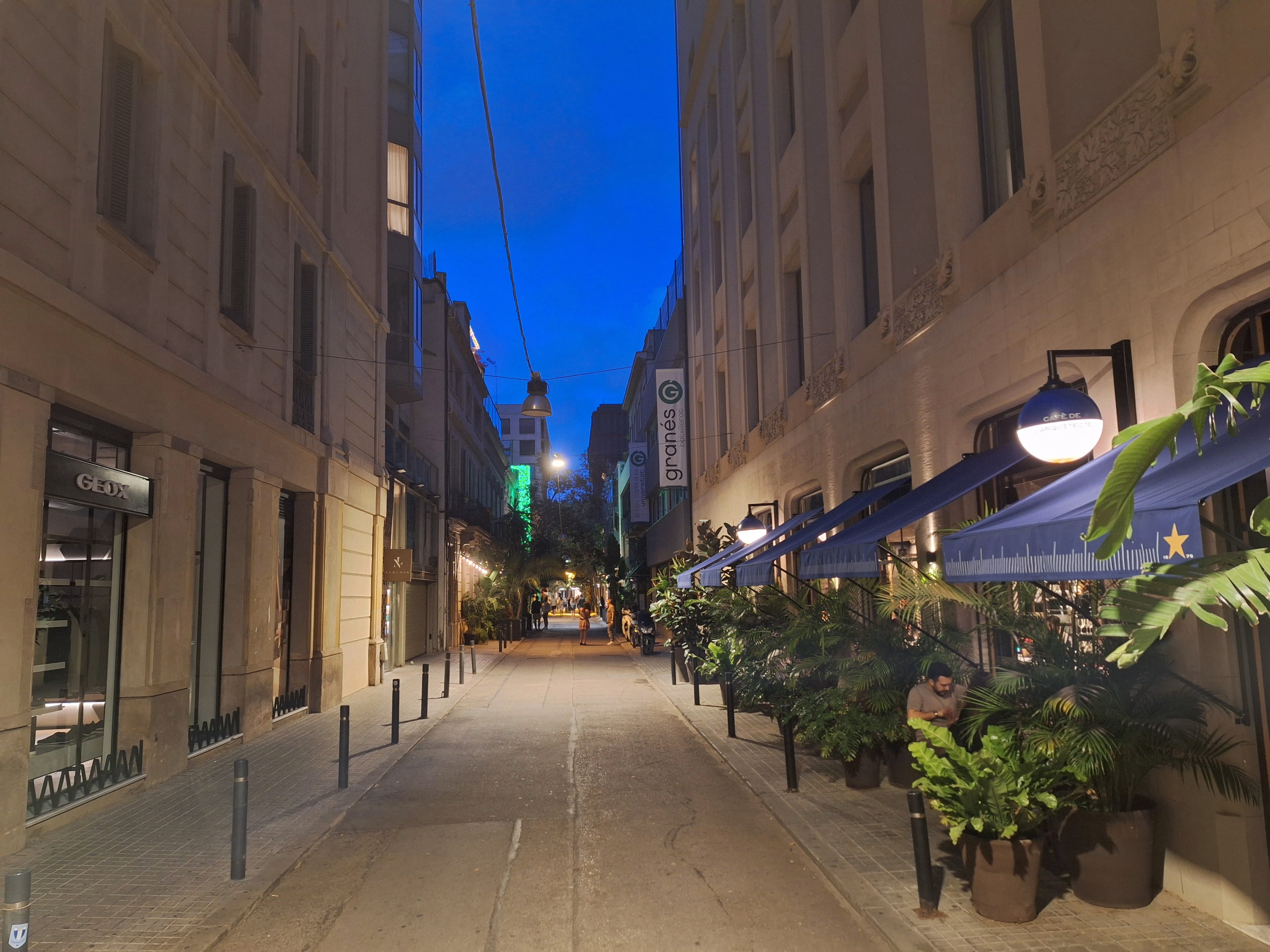
In the very heart of Barcelona’s Eixample district, between two of the city’s most iconic thoroughfares, Passeig de Gràcia and Rambla de Catalunya, lies one of those places that allows visitors to discover a different side of Barcelona: Passatge de la Concepció.
Discreet from the outside yet full of character, this passage is a little urban world of its own, where the memory of bourgeois Barcelona, Eixample architecture, historic establishments and a gastronomic scene that has turned the area into one of the city’s best-known social meeting places coexist.
Its appeal lies not only in the restaurants that occupy its premises today. The passage offers an insight into a particular vision of the city that emerged during the expansion of the Eixample, when Barcelona began transforming its former urban boundaries into a new landscape of wide streets, residential buildings, shops and communal spaces.
Walking through it reveals a Barcelona of contrasts: the tranquillity of an enclosed passageway set against the bustle of the main avenues, historic architecture alongside contemporary businesses, and everyday life alongside the city’s tourist attractions.
THE ORIGINS OF A SMALL PASSAGE WITH A GREAT HISTORY
From the early years of the Eixample to one of Barcelona’s best-known gastronomic destinations.
Passatge de la Concepció began to take shape during a decisive period in Barcelona’s urban development. The city had started expanding beyond its former walls, and Ildefons Cerdà’s Eixample project was profoundly transforming its urban landscape.
The newly available land offered opportunities for the construction of residential buildings, small family homes and commercial premises. It was in this context that various internal passageways emerged, conceived as small connecting streets between the main thoroughfares, with a more domestic scale and a distinctive character of their own.
Passatge de la Concepció was one of them.
The earliest buildings were generally modest houses, featuring eclectic and historicist façades. Some have survived to this day, allowing us to recognise an urban building typology that is particularly interesting because of its rarity within the Eixample landscape.
Unlike the grand avenues, these passages offered a more intimate atmosphere, with smaller buildings and a much closer relationship between homes and the street.
Over the years, many of the ground-floor premises were converted, and the passage gradually acquired a new identity until it became an important gastronomic destination.
Its evolution is a good example of how Barcelona has managed to adapt certain historic spaces to new lifestyles without entirely losing their original character.
A HISTORICAL CONNECTION WITH LA PEDRERA
Josep Guardiola, Roser Segimon and the origins of one of Gaudí’s great masterpieces.
One of the most fascinating episodes in the passage’s history is directly connected to Casa Milà, better known as La Pedrera.
At number 4 stands an old house associated with Josep Guardiola, an indiano who had accumulated considerable wealth in Guatemala before returning to Barcelona after developing his business interests in the Americas.
The initials JG, which can still be seen above the building’s entrance, recall his presence here.
Guardiola married Roser Segimon, who inherited a considerable fortune following the death of her first husband in 1901.
Roser subsequently married Pere Milà, a Barcelona businessman with whom she would promote the construction of the celebrated Casa Milà, commissioned from Antoni Gaudí.
This story is particularly revealing because it helps us understand that behind one of the most extraordinary buildings in Catalan architecture lies a history of inheritances, personal relationships and fortunes accumulated overseas.
Roser Segimon’s inherited wealth was an important part of the financial resources that made this remarkable project possible.
In this way, the small building in Passatge de la Concepció retains a historical connection with one of Barcelona’s most admired architectural landmarks.
THE ARCHITECTURE OF THE PASSAGE
Small historic houses, distinctive façades and contemporary architectural interventions.
Although the passage is relatively short, it is well worth exploring at a leisurely pace and taking the time to observe its different buildings.
Its architectural interest lies precisely in the coexistence of different periods.
On the one hand, we find modest historic buildings dating from the passage’s earliest development. On the other, there are more recent interventions associated with Barcelona’s transformation into a city of services, offices, hotels and gastronomic establishments.
It is not a monumental street in the traditional sense. Rather, its personality emerges from the diversity of its buildings and the way they come together to form a distinctive urban ensemble.
THE MBM ARQUITECTES OFFICE BUILDING
One of the most interesting contemporary interventions is the building at numbers 7–9, designed between 2001 and 2004 by the architectural practice MBM Arquitectes.
The studio was founded by three influential figures in contemporary Catalan architecture: Oriol Bohigas, Josep Martorell and David Mackay.
Its façade combines concrete and a curtain-wall system, incorporating a distinctive arrangement of stainless-steel rods and telescopic tensioning elements that create reflections across the exterior.
This construction solution gives the building a technological and distinctive appearance, establishing an interesting contrast with the historic architecture of its surroundings.
It is an excellent example of how contemporary architecture can introduce its own language into a traditional urban setting.
AN ENRIC SAGNIER MASTERPIECE WORTH DISCOVERING
Casa Dolors Vidal: Modernista architecture and sculpture by Josep Llimona.
At the junction of the passage and Rambla de Catalunya stands one of the buildings that most deserves a closer architectural examination: the former family residence of architect Enric Sagnier i Villavecchia.
Known as Casa Dolors Vidal, it was built between 1892 and 1894 and represents a particularly personal work within Sagnier’s architectural output.
The architect designed the residence for his own family, allowing him considerable creative freedom.
Its most distinctive features include the upper-floor oriel window, Gothic-inspired ornamental details and decorative reliefs dedicated to painting and music.
However, one of its most interesting features is located on the corner: a sculpture of the Immaculate Conception by Josep Llimona, one of the great sculptors of Catalan Modernisme.
The sculpture depicts the Virgin Mary standing on a hemisphere, beneath which appears a serpent, symbolising the sin that Mary overcomes through her purity.
Its presence also explains the symbolic connection between religious iconography and the name of the passage.
The building was subsequently restored and converted into the Casa Sagnier hotel, which opened in 2022. This contemporary intervention has given the property a new purpose while preserving its heritage value.
THE ARTIST AND SCULPTURE THAT SURPRISE VISITORS
Isao and the relationship between art, architecture and gastronomy.
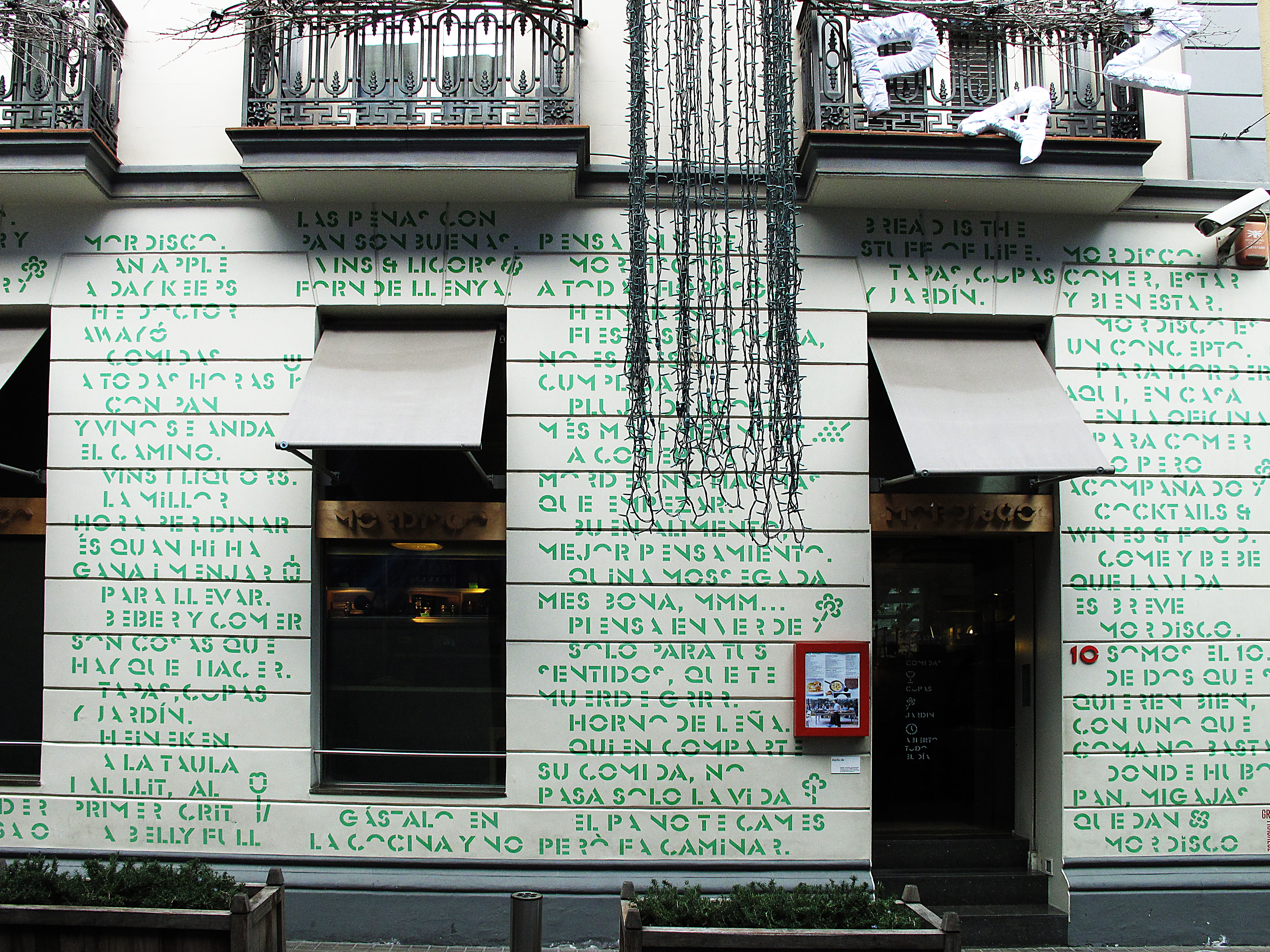
One of the most striking artistic details in Passatge de la Concepció can be found near Mordisco, at number 10.
A prominent sculpture by Isao, son of artist and ceramicist Joan Gardy Artigas, marks the entrance to the establishment.
The piece forms part of the restaurant’s artistic identity, where design, decoration and works of art have historically played an important role.
The family connection between Isao and Joan Gardy Artigas is particularly interesting within the Catalan art scene. Joan collaborated with major figures in twentieth-century art and developed an important career in ceramics and sculpture.
Mordisco also features a work by Javier Mariscal, alongside decoration incorporating photographs, graphic design and various spaces, each conceived with its own distinctive identity.
Isao’s sculpture is therefore one of those unexpected discoveries that make exploring the passage much more than a gastronomic experience.
PASSATGE DE LA CONCEPCIÓ AND ITS GASTRONOMIC TRANSFORMATION
From a small residential street to a showcase for Barcelona’s restaurant scene.
For much of its history, the passage retained an essentially residential and commercial character.
Its transformation into a gastronomic destination took place particularly from the late twentieth century onwards.
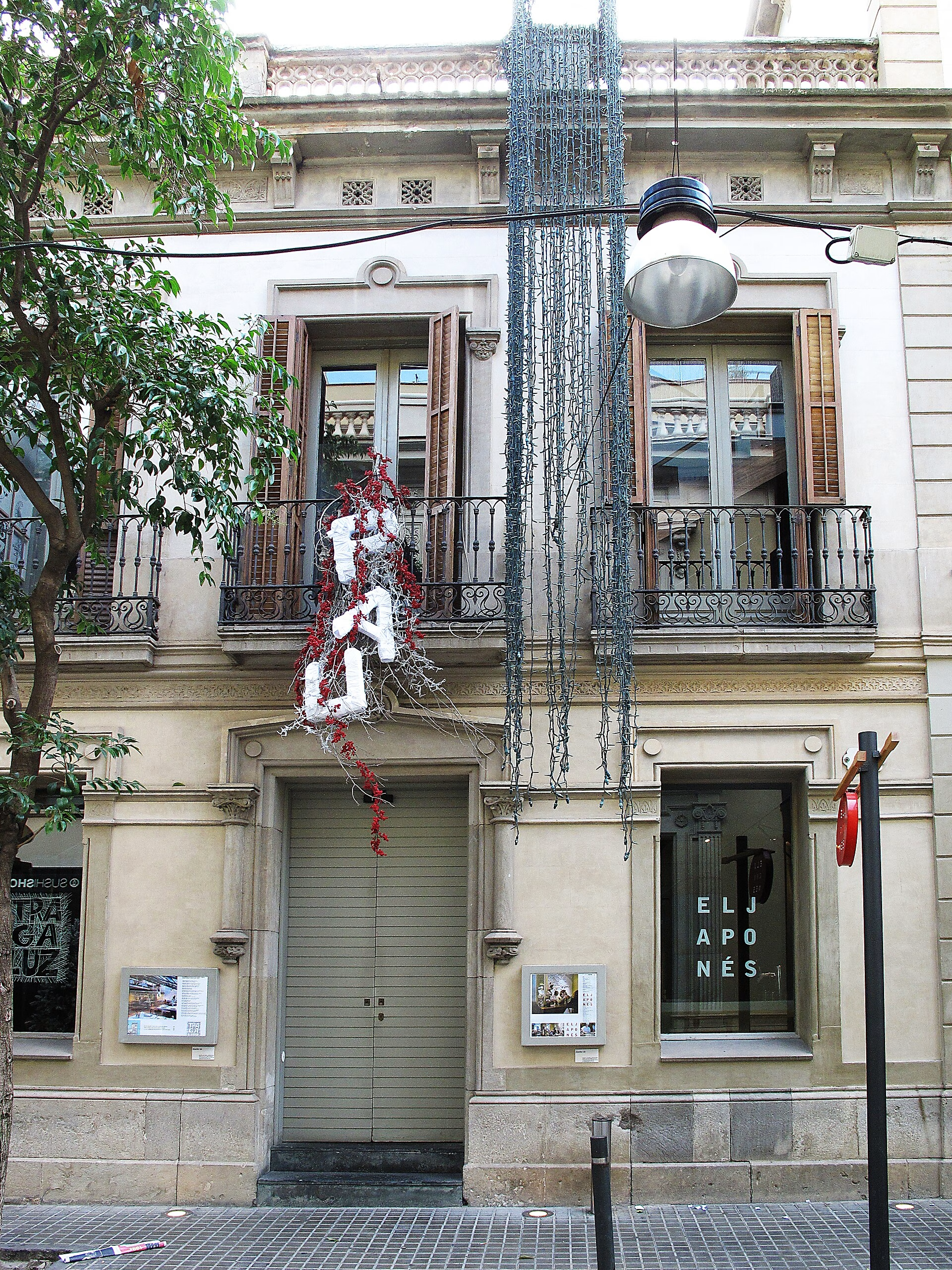
One of the establishments that marked the beginning of this new chapter was Tragaluz, founded by entrepreneur Rosa Esteva, which opened its doors in 1991.
Its concept introduced a new approach to dining in this small urban setting, combining market-fresh Mediterranean cuisine, interior design and a cosmopolitan atmosphere.
The initiative was followed by other establishments, gradually consolidating the passage’s reputation.
From then on, the area began attracting a Barcelona audience interested in gastronomy, design, socialising and distinctive venues.
Within just a few metres, a concentration of restaurants emerged, transforming this small street into a destination in its own right.
THE PASSAGE’S ICONIC ESTABLISHMENTS: PAST AND PRESENT
Restaurants, design, fashion and social life.
Over the years, Passatge de la Concepció has been home to a variety of establishments. Some have disappeared, others have changed their names or concepts, while several continue to form part of its identity.
TRAGALUZ
Address: Passatge de la Concepció, 5.
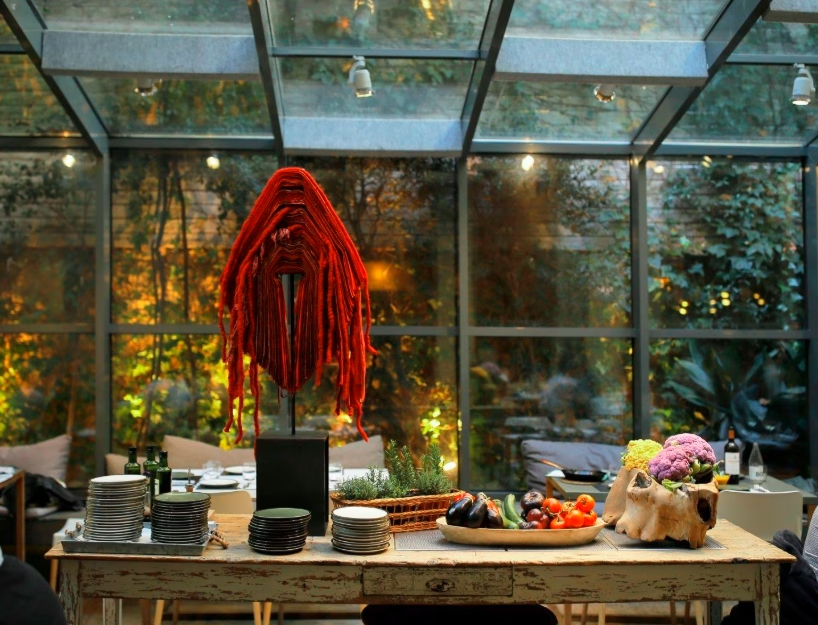
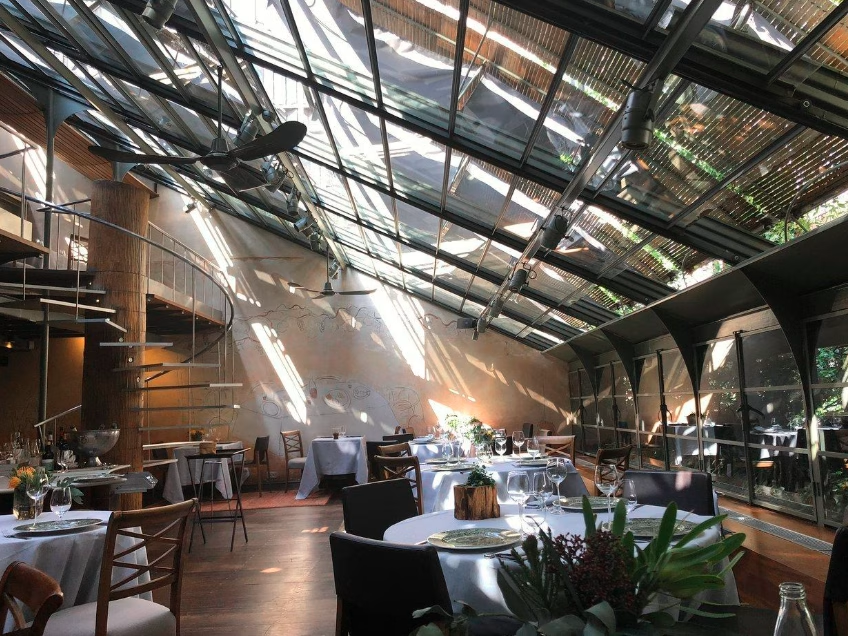
One of the establishments that initiated the passage’s gastronomic transformation. Its Mediterranean cuisine and interior design, featuring bright spaces and glass ceilings, have become part of the area’s recent history.
One of the passage’s most distinctive establishments. Its history dates back to the 1980s, and it has long been a meeting place for businesspeople, artists, journalists and creative professionals.
A particular highlight is its indoor dining area with a garden-like atmosphere, as well as its distinctive graphic identity.
Mediterranean cuisine, fish and seafood, combined with sophisticated interior design.
The establishment has become one of the passage’s best-known venues. Its wider concept also includes Boca Chica, associated with cocktails and nightlife.
An establishment associated with Catalan cuisine, which has featured prominent figures in the restaurant industry, including Fermí Puig and Nandu Jubany, during different periods of its history.
The current offering should be checked before planning a visit, as establishments may change their opening hours, menus and activities.
Galería Gastronómica: When Art by Lorenzo Quinn Came to Passatge de la Concepció
Passatge de la Concepció was also home to a remarkable project that brought gastronomy and contemporary art together. In November 2004, sculptor Lorenzo Quinn opened Galería Gastronómica at number 7, an Italian restaurant that also served as an exhibition space for his own sculptures.
The establishment was much more than a conventional restaurant. Its interiors were developed in collaboration with designer Estrella Salietti, and Quinn personally took part in designing several bespoke features, including the door handles and cutlery. His sculptures were integrated into the different areas of the restaurant, making art an essential part of the visitor experience.
The project reflected some of the principles that define Lorenzo Quinn’s artistic vision. His philosophy centres on the idea of “give and receive” and on the power of art to communicate universal values such as love, empathy, solidarity and respect. For Quinn, art should go beyond aesthetic beauty: it should move people, communicate ideas and contribute to positive change in society.
One of the most recognisable symbols in his work is the human hand, which he uses to express the dual nature of humanity: our ability to create, care and love, but also to destroy. In other works, the sculptor explores the relationship between humankind and the planet, encouraging reflection on sustainability and environmental protection.
Galería Gastronómica entered a new phase and changed management around 2007. Nevertheless, its presence at number 7 remains a little-known chapter in the history of the passage: a place where Italian cuisine and sculpture came together, and where art became part of everyday life.
ARCHITECTURAL AND CULTURAL HIGHLIGHTS IN THE SURROUNDING AREA
A journey through one of Barcelona’s most extraordinary architectural districts.
The passage enjoys a privileged location from which to organise a short cultural walking tour of the Eixample.
Just a few minutes away on foot, we find some of the buildings that best represent Catalan Modernisme and Barcelona architecture from the late nineteenth and early twentieth centuries.
CASA MILÀ – LA PEDRERA
Architect: Antoni Gaudí.
Built between 1906 and 1912, it is one of the fundamental works of modern architecture. Its undulating façade and extraordinary sculptural rooftop terrace are unmistakable.
CASA BATLLÓ
Architect: Antoni Gaudí.
Remodelled between 1904 and 1906, it is one of the finest expressions of Gaudí’s naturalistic imagination. Its façade evokes an underwater landscape, with sculptural balconies and a roof reminiscent of a dragon’s back.
CASA AMATLLER
Architect: Josep Puig i Cadafalch.
Built between 1898 and 1900, it stands out for its stepped Flemish-inspired façade, sculptural details and richly ornamental architecture.
CASA LLEÓ MORERA
Architect: Lluís Domènech i Montaner.
One of the great jewels of Catalan Modernisme, where architecture, sculpture, mosaics and decorative arts come together in an extraordinarily elaborate ensemble.
CASA FUSTER
Architect: Lluís Domènech i Montaner.
Built between 1908 and 1911, it is distinguished by its pink stone columns, trilobed windows and cylindrical corner tower. Today, it houses an iconic hotel.
This area allows visitors to appreciate the extraordinary concentration of architectural talent that shaped Barcelona during the Modernista period, with figures such as Gaudí, Puig i Cadafalch, Domènech i Montaner and Sagnier.
BARCELONA’S PASSAGEWAYS AND THEIR LITTLE STORIES
An urban heritage worth rediscovering.
Passatge de la Concepció belongs to an urban typology that played a significant role in the expansion of the Eixample.
Passageways are small streets that connect two main thoroughfares or provide routes through certain city blocks, creating intimate, human-scale urban spaces.
Some still retain their historic houses, others have evolved towards commercial and gastronomic uses, while others have disappeared as a result of urban redevelopment.
Their significance lies in the fact that they reveal a less monumental side of Barcelona, one that is more intimate and closely connected to everyday life.
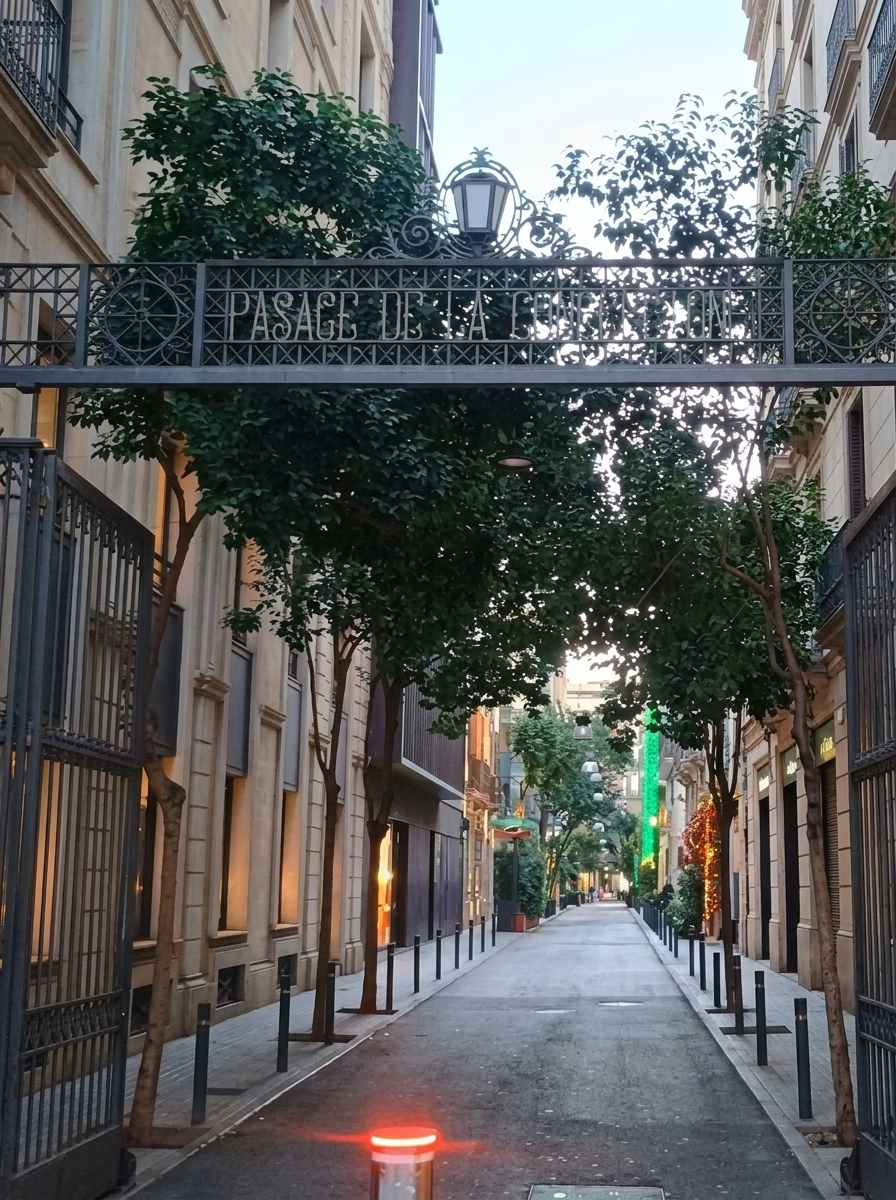
The passage itself preserves an intriguing detail: on its old entrance gate, the inscription «Pasage de la Concepcion» can still be read, written using an old Spanish spelling.
It is also worth remembering that the name refers to the Immaculate Conception of the Virgin Mary, a religious dedication represented artistically by Josep Llimona’s sculpture at the corner with Rambla de Catalunya.
HOW TO GET TO PASSATGE DE LA CONCEPCIÓ
A privileged location in the heart of Barcelona.
The passage connects two of Barcelona’s best-known thoroughfares:
Passeig de Gràcia.
Rambla de Catalunya.
Its location makes it accessible from either end, allowing visitors to explore it comfortably on foot.
BY METRO
The most convenient stations are:
Diagonal: Lines L3 and L5.
Passeig de Gràcia: Lines L2, L3 and L4, as well as connections with the suburban rail network.
From Diagonal, the passage can be reached within a few minutes on foot, while Passeig de Gràcia provides access from the central area of the city.
BY FERROCARRILS DE LA GENERALITAT (FGC)
Provença station offers convenient access from various towns and cities within the metropolitan area and the FGC network.
BY TRAIN
Passeig de Gràcia station is served by Rodalies commuter trains, as well as providing connections with the metro network.
BY BUS
The area is served by numerous city bus routes running along Passeig de Gràcia, Avinguda Diagonal and Rambla de Catalunya.
We recommend checking routes and any service changes before setting off.
HOW TO GET THERE BY PRIVATE VEHICLE
Access from Barcelona’s main roads.
If travelling by car, the most suitable route will depend on your starting point.
From northern Barcelona, one option is to approach via Avinguda Diagonal and then continue towards the streets around Passeig de Gràcia.
From the city centre, access may be possible via Aragó, València or Gran Via, depending on traffic direction and current restrictions.
The passage itself is a pedestrian street and is not designed for vehicle access or parking.
We therefore recommend heading directly to a nearby public car park and completing the final stretch on foot.
You should also take Barcelona’s Low Emission Zone (LEZ) restrictions into account, particularly if travelling in a foreign-registered vehicle or one without a valid environmental classification.
WHERE TO PARK NEARBY
Car parks for a worry-free visit to the passage.
Barcelona has several public car parks in the Passeig de Gràcia and Rambla de Catalunya area.
One option worth knowing about is Parking Mercat de la Concepció, located at Aragó 313–317, although it is slightly further away than the car parks immediately surrounding the passage.
PARKING MERCAT DE LA CONCEPCIÓ
Address: Carrer d’Aragó, 313–317, Barcelona.
Underground car park.
75 parking spaces.
Maximum vehicle height: 2.20 metres.
Vehicle entrance from Carrer d’Aragó.
Pedestrian exits towards Aragó and València.
Rates:
First hour, from 8:00 am to 3:00 pm: €3.00.
Subsequent hours, from 8:00 am to 3:00 pm: €2.76 per hour.
From 3:00 pm to 9:45 pm: €1.20 per hour.
Full-day rate: €14.00.
The car park is open Monday to Saturday, from 8:00 am to 9:45 pm, and is closed on Sundays and public holidays.
It is important to note that these rates apply specifically to this car park and not to the parking facilities located closer to the passage.
For those who prefer to park nearer, there are other car parks around València, Bruc and the streets close to Passeig de Gràcia. We recommend comparing prices and availability before arriving.
OTHER HISTORIC AND CULTURAL ESTABLISHMENTS
Much more than just restaurants.
The passage’s identity has not been shaped by restaurants alone. It has also been home to commercial, educational and professional activities that contribute to its distinctive character.
The immediate surroundings of Rambla de Catalunya and Passeig de Gràcia are home to institutions, historic establishments and businesses connected with culture, education and tourism.
The historic Barcelona fashion house Santa Eulalia, located at Passeig de Gràcia, 93, represents an important part of the city’s commercial and fashion heritage.
Its history is an excellent example of how certain long-established businesses have successfully adapted to the changing face of the city while preserving their identity.
A LITTLE HIDDEN GEM WAITING TO BE DISCOVERED
Barcelona’s history can also be found in its most discreet corners.
Passatge de la Concepció is one of those places that surprises visitors precisely because it does not need to be large to offer a truly rewarding experience.
Its history takes us back to the early years of the Eixample, introduces us to the families who helped shape Barcelona’s transformation and reveals a fascinating connection with the construction of La Pedrera.
Its architecture tells us the story of Enric Sagnier, the passage’s earliest houses and the contemporary interventions by MBM Arquitectes.
Its sculptural heritage introduces us to Josep Llimona and Isao Gardy Artigas.
And its gastronomic evolution reflects how a small urban passageway can become a meeting point for the social and cultural life of a major city.
Perhaps its greatest attraction lies precisely in this: the opportunity to discover several different sides of Barcelona within just a few metres.
A bourgeois Barcelona, a Modernista Barcelona, an artistic Barcelona and a contemporary Barcelona.
Passatge de la Concepció is not simply somewhere to walk through. It is somewhere worth stopping to explore.
WOULD YOU LIKE TO DISCOVER THIS SIDE OF BARCELONA WITH US?
Magic Dreams Barcelona: cultural experiences with a different perspective.
Discovering Passatge de la Concepció can become a much richer experience when you understand its history, its characters, its architects and the little details that so often go unnoticed.
At Magic Dreams Barcelona, we design our experiences as genuine journeys of discovery, bringing together heritage, architecture, art, nature, gastronomy and local culture.
Our native guide, specialising in architecture, history, art, botany and ornithology, accompanies each tour with insightful explanations, historical anecdotes and a particularly attentive eye for detail.
We organise private tours throughout Barcelona and Catalonia, one-day cultural excursions, weekend getaways, week-long stays and tailor-made experiences in the Catalan Pyrenees and along the Costa Brava.
We can complement an architectural visit with:
Private tours of Barcelona’s Modernista buildings.
Cultural and artistic visits with specialist explanations.
Gastronomic experiences at carefully selected restaurants.
Private meals and picnics in gardens and exceptional settings.
Art and architecture workshops, including trencadís mosaic techniques.
Botanical experiences and bird and butterfly watching.
Professional photography and personalised services.
Themed dinners, live music and romantic experiences.
Carefully selected accommodation and private transport services.
We offer our services in Spanish, Catalan and English, and can accommodate other languages upon request.
Every experience is designed around the interests, pace and preferences of our visitors.
MAGIC DREAMS BARCELONA
Discovering places is important, but understanding the stories they hold is what transforms a visit into an unforgettable memory.
Detalle interior del restaurante Mordisco en el Edificio al pge. de la Concepció, 10 – Magic Dreams Barcelona.
Restaurante Tragaluz en Passatge de la Concepció, 5 – Magic Dreams Barcelona.
Edificio al pge. de la Concepció, 10 (Barcelona), restaurante Mordisco – Enric, CC BY-SA 4.0, via Wikimedia Commons.
Edificio pág. de la Concepció, 5 (Barcelona), restaurante El Japonès – By Enric – Own work, CC BY-SA 4.0, https://commons.wikimedia.org/w/index.php?curid=108293358.