Route guide for visitors throughout Catalonia – Barcelona – Costa Brava – Catalan Pyrenees – Personalized experiences – Customized tour guide services – A small tribute to the wonderful city and land that saw us born – Transforming experiences into unforgettable memories - Magic Dreams Collection: exclusive universes inspired by Salvador Dalí and Gaudí. Niche perfumes, jewelry, lithographs, and collectible items celebrating the Mediterranean spirit.
The Jardins del Doctor Pla i Armengol occupy a former estate in the Guinardó district of Barcelona, a space where history, architecture, art, nature and biodiversity now coexist. The site was originally connected to the Institut Ravetllat-Pla, founded by doctors Ramon Pla i Armengol and …
The summit of Barcelona where history, nature and entertainment come together Tibidabo, the highest part of the city of Barcelona, stands at 575 metres above sea level, offering an incomparable perspective of the city, the Mediterranean Sea and the surrounding hills. This remarkable place combines …
At the top of Montjuïc Mountain, overlooking the port, the sea, and much of the city of Barcelona, stands one of the most important and historically significant fortresses in Catalonia: Montjuïc Castle.
Situated approximately 173 metres above sea level, this impressive defensive complex occupies a privileged strategic position from which Barcelona can be viewed in virtually every direction.
But Montjuïc Castle is much more than an impressive viewpoint. Its walls preserve more than four centuries of history, and the site has served as a military fortress, prison, scene of conflicts, museum, and, today, a heritage and cultural space open to the public.
Its history is closely connected to the history of Barcelona and Catalonia itself. A visit allows you to explore its courtyards, moats, bastions, and different rooms while discovering some of the city’s most important—and also most difficult—historical episodes.
Where Is Montjuïc Castle?
Montjuïc Castle is located at the highest point of Montjuïc Mountain, within the Sants-Montjuïc district, in the Poble-sec neighbourhood.
The address is:
Carretera de Montjuïc, 66 08038 Barcelona
The complex is located high above the Port of Barcelona and offers extensive views over the city, coastline, and surrounding areas.
Its location explains the military importance it held for centuries. From the summit of Montjuïc, it was possible to visually control both the city and the port, as well as the main access routes to Barcelona.
The History of Montjuïc Castle
The history of Montjuïc Castle began long before the fortress we know today existed.
At the summit of the mountain there was an old watchtower or “farell”, used to monitor the surrounding territory and warn of possible threats.
It was during the Reapers’ War, in 1640, that the authorities of Barcelona ordered the construction of an initial fortification around the old tower.
The first fort was built very quickly. According to historical documentation, construction took approximately thirty days, creating a quadrangular enclosure protected by four half-bastions and a moat.
This first fortification would become the origin of today’s Montjuïc Castle.
The Battle of Montjuïc in 1641
The new fortification played an important role almost from its earliest years.
On 26 January 1641, during the Reapers’ War, the event known as the Battle of Montjuïc took place. The forces defending Barcelona repelled an attack by the troops of Philip IV.
The elevated position of the mountain and the fortification made it possible to control one of the main access routes to Barcelona.
During the following decades, the small fort was expanded and modified until it gradually became a much more important fortress.
The Great Transformation of the 18th Century
The appearance we see today mainly dates from the major renovation carried out during the 18th century.
After the War of the Spanish Succession, the fortification acquired a permanent military function and became one of the main control points in Barcelona.
The military engineer Juan Martín Cermeño was responsible for a major remodelling project that began in the mid-18th century.
The works completely transformed the old fort, creating a fortress adapted to the topography of the mountain, with an irregular layout, four large bastions, a covered way, moats, military facilities, and defensive systems designed for artillery.
It is essentially this 18th-century fortress, with various later modifications, that we can visit today.
A Fortress That Was Also Used to Bombard Barcelona
The history of Montjuïc Castle is not limited to the defence of the city.
At different times during the 19th and 20th centuries, the fortress was also used to control and suppress insurrectionary movements.
Barcelona was bombarded from Montjuïc on several occasions during the 19th century, and the site was used as a prison for trade unionists, anarchists, and revolutionaries.
It also played a role during the Tragic Week of 1909.
During the Spanish Civil War, the castle once again had military functions and was subsequently used as a military prison and the site of court-martial proceedings.
Lluís Companys and the Historical Memory of the Castle
One of the best-known episodes in the contemporary history of Montjuïc Castle is connected to Lluís Companys, President of the Government of Catalonia.
On 15 October 1940, Companys was executed by firing squad at the castle by the Franco dictatorship.
Today, this episode forms part of the site’s historical memory and is one of the elements that helps us understand the castle not only as a military monument, but also as a place of remembrance.
From Military Museum to Public Space
During the 20th century, the castle continued to have military functions.
In 1963, a Military Museum was opened within the complex.
Later, Montjuïc Castle officially came under municipal ownership in 2007. The military museum was closed and the site was recovered for the city.
Since then, Barcelona City Council has managed the complex as a heritage, cultural, and historical-memory space.
What Can You Visit Inside Montjuïc Castle?
A visit allows you to explore much of the fortress’s defensive structure and discover its different spaces.
Among the most interesting places are:
the entrance bridge;
the main façade;
the Santa Eulàlia moat;
the parade ground;
the four bastions;
the terraces and viewpoints;
the covered way;
the interior rooms;
the former military areas;
the Interpretation Centre;
and temporary exhibitions.
General admission also includes access to the temporary exhibitions and the permanent exhibition at the Interpretation Centre.
The Entrance Bridge and Façade
One of the first elements you encounter when arriving is the impressive entrance to the fortress.
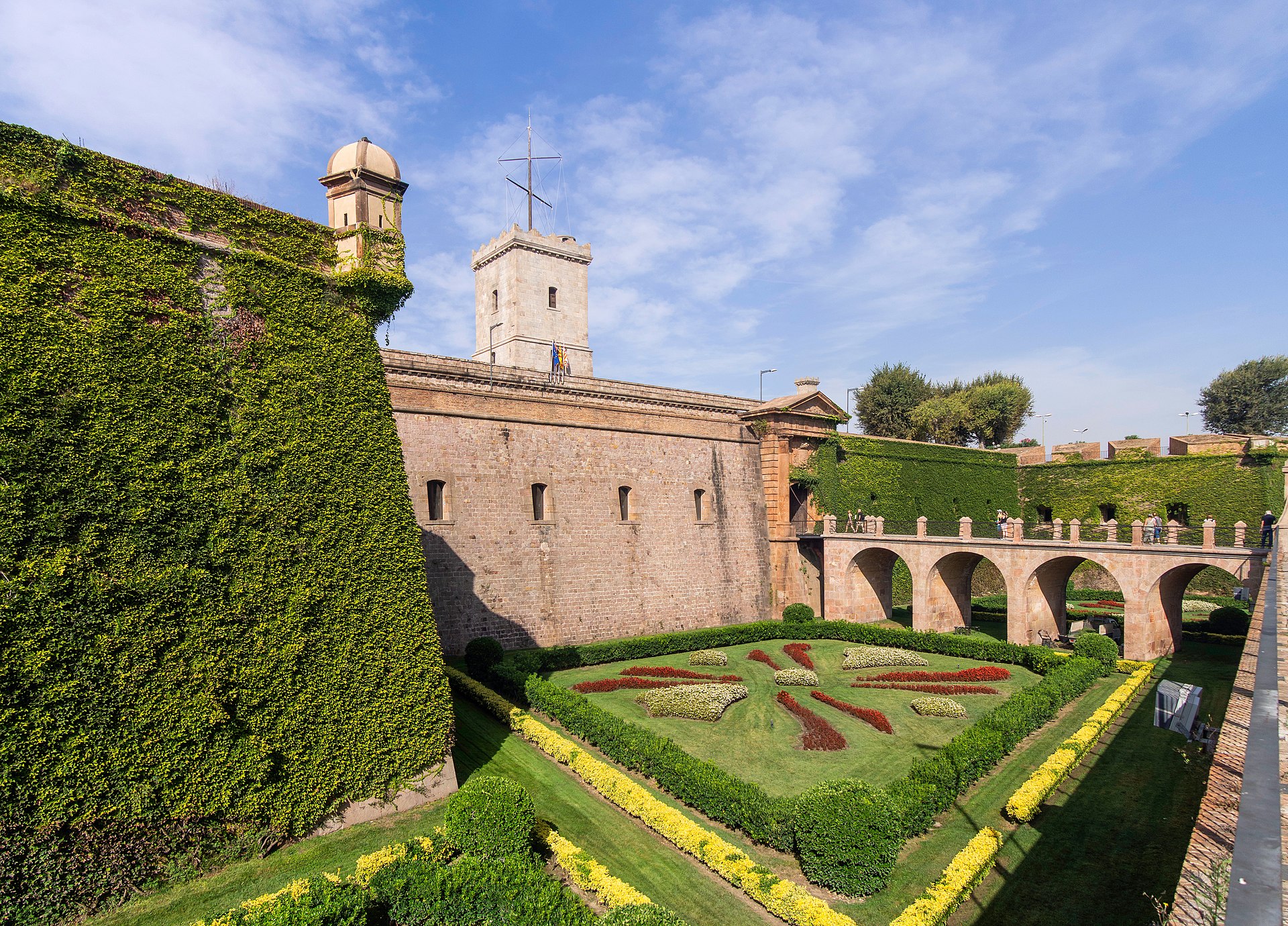
The bridge crosses the Santa Eulàlia moat and leads to the castle’s monumental entrance.
The current main façade forms part of the defences designed during Cermeño’s 18th-century renovation. The complex includes a monumental Neoclassical gate and various defensive elements.
It is one of the most interesting places to begin understanding the military architecture of the site.
The Parade Ground
Once through the entrance, we reach one of the central spaces of the fortress: the parade ground.
It is a large open space around which different areas of the castle were organised.
The major 18th-century renovation created a central building around this courtyard, with rooms intended for the governor and the garrison.
Today, it remains one of the most recognisable spaces in the complex and also serves as a starting point for various activities and tours.
The Four Bastions
One of the most interesting architectural features of Montjuïc Castle is its bastions.
The fortress has four large defensive structures located at its corners:
Sant Carles Bastion
Santa Amàlia Bastion
Velasco Bastion
Llengua de Serp Bastion
Their purpose was to reinforce the fortress’s defences and allow different angles to be controlled using artillery.
Some of these areas also offer extraordinary views of Barcelona and the coastline.
The Covered Way
Around the fortress we find what is known as the covered way, which forms part of the external defence system.
Walking through these spaces provides a much better understanding of how an early modern fortification worked and how its different defensive lines were organised.
It is also one of the places where the star-shaped design of the fortress can be appreciated most clearly.
The Montjuïc Castle Interpretation Centre
For those who want to truly understand the history of the monument, one of the most interesting visits is the Montjuïc Castle Interpretation Centre.
The permanent exhibition explains the evolution of the mountain and the fortress through different historical sections.
It covers subjects such as the old watchtower, the first fort of 1640, the transformation of the fortress, its defensive function, and its subsequent role as a prison and site of repression.
The renovated rooms incorporate original remains, audiovisual materials, and various resources designed to explain the history of the monument.
The Best Views of Barcelona
One of the great attractions of the visit is undoubtedly its location.
From the terraces and elevated areas of the castle, you can see:
the Port of Barcelona;
the Mediterranean Sea;
the coastline;
central Barcelona;
the Collserola mountain range;
Baix Llobregat;
and different parts of the metropolitan area.
The castle’s position, approximately 173 metres above sea level, provides a very different panoramic view of the city.
It is worth setting aside some time during your visit simply to stop and enjoy the scenery.
How Long Do You Need to Visit Montjuïc Castle?
For a relaxed visit, we recommend allowing approximately one and a half to two hours.
If you also want to take a guided tour, explore the Interpretation Centre in detail, enjoy the views, and take your time walking around the different defensive structures, you can easily spend two to three hours.
You can also combine the visit with other attractions in Montjuïc and turn it into a half-day or even a full-day excursion.
Montjuïc Castle Opening Hours
The current opening hours for 2026 are as follows:
March to October
Every day: 10:00 am to 8:00 pm.
November to February
Every day: 10:00 am to 6:00 pm.
Ticket sales end before closing time, and exhibitions and educational activities finish approximately half an hour before closing.
The castle is closed on 25 December and 1 January.
How Much Does It Cost to Enter Montjuïc Castle?
For 2026, the admission prices are:
General admission: €12
Reduced admission: €8
The reduced rate applies to certain groups, including children aged 8 to 12, unemployed people, and certain holders of cards and accreditation.
There are also various circumstances in which admission is free.
These include:
every Sunday from 3:00 pm onwards;
the first Sunday of each month;
children under 8;
holders of certain accreditations;
professional tour guides working in the course of their duties;
certain accredited teachers;
members of ICOM and the Associació de Museòlegs de Catalunya;
and other groups covered by Barcelona City Council regulations.
For this reason, before purchasing a ticket, it is advisable to check whether you qualify for one of these admission options.
Family Activities: Treasure Hunt
The castle also organises activities designed for families.
One of them is a treasure hunt, a type of scavenger hunt in which participants must solve puzzles and explore different corners of the fortress.
The activity is mainly aimed at children aged 6 to 12 accompanied by their families.
It begins in the parade ground, where participants receive a backpack containing instructions and materials.
At the end, participants receive a certificate.
The activity is scheduled on weekends and public holidays and participation is free, although the applicable admission fee for the site must be paid when required.
Temporary Exhibitions and Activities
In addition to the permanent exhibition, the castle hosts temporary exhibitions and various cultural activities.
The programme may include:
historical exhibitions;
photography routes;
guided commentary tours;
educational activities;
workshops;
family activities;
and events related to historical memory.
For this reason, if you are planning a specific visit, we recommend checking the castle’s programme before travelling, as some activities are occasional and require prior registration.
How to Get to Montjuïc Castle by Public Transport
There are several ways to reach the castle.
By Bus 150
One of the easiest options is to take bus route 150, which connects Plaça d’Espanya with Montjuïc Castle.
The stop is Castell.
This is a particularly practical option for visitors who want to reach the entrance directly without having to walk uphill.
By Metro, Funicular and Cable Car
Another option is to travel to Paral·lel using Metro lines L2 or L3.
From there, you can take the Montjuïc Funicular to the Parc de Montjuïc area and then continue with the Montjuïc Cable Car.
The cable car travels between Parc de Montjuïc and the castle, offering spectacular views during the ascent.
Important
Public transport timetables may change depending on the time of year, and services may be interrupted due to maintenance or construction work.
For example, TMB states that the Montjuïc Funicular has different timetables depending on the season. Between 30 March and 25 October 2026, it operates from 7:30 am to 10:00 pm on weekdays and from 9:00 am to 10:00 pm on Saturdays, Sundays, and public holidays.
Montjuïc Cable Car: 2026 Prices
The cable car is one of the most spectacular ways to reach the castle.
The published 2026 fares are:
Adult return: €17.10 online / €19 standard fare
Children aged 4 to 12 return: €11.70 online / €13 standard fare
Children under 4: free
A single ticket costs:
Adult: €12
Children aged 4 to 12: €10
Single tickets are sold only at the ticket office.
The journey begins at Parc de Montjuïc and reaches the castle directly, with no intermediate stops on the way up. On the return journey, there is an option to stop at the Mirador del Alcalde.
Montjuïc Cable Car Opening Hours
In 2026, the published opening hours are:
January–February: 10:00 am–6:00 pm
March–May: 10:00 am–7:00 pm
June–September: 10:00 am–9:00 pm
October: 10:00 am–7:00 pm
November–December: 10:00 am–6:00 pm
On 25 December, 1 January, and 6 January, the service operates from 10:00 am to 2:30 pm.
Can You Drive to Montjuïc Castle?
Yes. You can drive up Montjuïc using Carretera de Montjuïc.
The address to enter into your navigation system is:
Carretera de Montjuïc, 66, Barcelona.
However, bear in mind that parking near the castle is limited.
There is a free parking area near the mountain, from which you need to continue on foot for approximately 10 minutes to reach the castle.
For this reason, if you are visiting by car—especially on weekends, public holidays, or dates with special events—we recommend arriving with plenty of time.
You should not rely on finding a parking space directly next to the entrance.
Where to Park Near Montjuïc Castle
One of the parking options indicated for access by car is Pàrquing del Sot, from which the castle is approximately a ten-minute walk away.
There are also different parking areas elsewhere on Montjuïc, although the distance to the castle may be considerable.
For a conventional tourist visit, therefore, bus 150 may be much more convenient if you do not want to worry about finding parking.
Can You Walk Up to the Castle?
Yes.
Montjuïc has different paths and streets that allow you to walk up to the castle.
The climb can be an interesting option for those who want to combine their visit with a walk through the gardens and other areas of the mountain.
However, keep in mind that there is a significant incline, and during the hottest months walking during the middle of the day can be demanding.
We recommend bringing water, comfortable shoes, and sun protection.
Is Montjuïc Castle Accessible?
The site offers accessibility measures, and activities can be adapted for people with disabilities.
The castle’s educational programme states that activities can be adapted for people with disabilities and that resources are available in different languages, including Spanish, Catalan, English, and Catalan Sign Language, upon request.
For specific accessibility needs, it is advisable to contact the castle in advance to confirm the route and available services.
What Else Can You Visit in Montjuïc?
One of the advantages of visiting the castle is that you can take the opportunity to discover many other places on the mountain.
Nearby you will find:
Montjuïc Cable Car
Jardins de Miramar
Mirador del Alcalde
Joan Miró Foundation
National Art Museum of Catalonia
Lluís Companys Olympic Stadium
Poble Espanyol
Botanical Garden
Teatre Grec
and various gardens and viewpoints.
The cable car connects the Parc de Montjuïc area with the castle, making it possible to combine several of these attractions during the same day.
How Much Does a Complete Visit to Montjuïc Cost?
The budget depends on how you organise your day.
A basic visit to the castle costs €12 per adult.
If you add a return cable car ticket, the transport costs €17.10 per adult when purchased online.
Therefore, combining general admission to the castle with a return cable car ticket would cost approximately €29.10 per adult, excluding other expenses.
If you also want to take a guided tour, eat in the area, or visit other museums and monuments, the total budget will increase.
What Is the Best Time to Visit Montjuïc Castle?
If you want to avoid the busiest times, visiting first thing in the morning can be a good option.
Another possibility is to visit the castle in the afternoon and make the most of the final opening hours to enjoy the views.
During the summer months, the castle remains open until 8:00 pm, allowing visitors to explore it when temperatures are more pleasant.
On Sundays from 3:00 pm onwards, admission to the castle is also free, although this period may coincide with a higher number of visitors.
What Should You Bring to Montjuïc Castle?
Although this is an urban attraction, we recommend bringing:
comfortable shoes;
water;
sun protection during the warmer months;
a cap or hat;
a camera;
and some time to enjoy the terraces and viewpoints.
If you are planning to combine the castle with a route through Montjuïc, the gardens, or the cable car, comfortable footwear is especially recommended.
Is Montjuïc Castle Suitable for Children?
Yes.
The combination of walls, moats, courtyards, views, and defensive structures can be particularly appealing to younger visitors.
In addition, the castle’s programme includes family activities such as the treasure hunt, designed for children approximately 6 to 12 years old accompanied by family members.
A good option is to combine the visit with the Montjuïc Cable Car, as the journey itself can become an experience for the whole family.
A Different Kind of Visit: History and Memory
Montjuïc Castle should not be viewed simply as a beautiful fortress from which to take photographs of Barcelona.
It is a place that brings together different chapters of the city’s history.
Here, visitors can understand the development of early modern fortifications, the strategic importance of Montjuïc, military conflicts, the use of the site as a prison, and the episodes of repression and historical memory that took place within its walls.
The Interpretation Centre helps to put these events into context and understand why the castle continues to hold a special place within Barcelona’s heritage.
Monumento a los Caídos, Foso de Santa Elena, Castillo de Montjuïc, Barcelona – By Canaan – Own work, CC BY-SA 4.0, https://commons.wikimedia.org/w/index.php?curid=43307824.
Castillo de Montjuic (Barcelona), el baluarte de San Carlos desde la muralla de Marina – By Enric – Own work, CC BY-SA 4.0, https://commons.wikimedia.org/w/index.php?curid=130254236.
Castillo de Montjuic (Barcelona), el semibaluarte sur y el puerto desde el revellín – By Enric – Own work, CC BY-SA 4.0, https://commons.wikimedia.org/w/index.php?curid=130257376.
Castillo de Montjuic (Barcelona), puente sobre el foso, al fondo el baluarte de San Carlos – By Enric – Own work, CC BY-SA 4.0, https://commons.wikimedia.org/w/index.php?curid=130257655.
Monumento als Caiguts del Fossat, Castell de Montjuïc, escultura dels germans Oslé – By Enric – Own work, CC BY-SA 4.0, https://commons.wikimedia.org/w/index.php?curid=130257057.
Armaduras en el antiguo museo militar del castillo de Montjuïc – By Jordiferrer – Own work, CC BY-SA 3.0, https://commons.wikimedia.org/w/index.php?curid=19034130.
Museo Militar del Castell de Montjuïc – By Silar – Own work, CC BY-SA 4.0, https://commons.wikimedia.org/w/index.php?curid=143135814.