Route guide for visitors throughout Catalonia – Barcelona – Costa Brava – Catalan Pyrenees – Personalized experiences – Customized tour guide services – A small tribute to the wonderful city and land that saw us born – Transforming experiences into unforgettable memories - Magic Dreams Collection: exclusive universes inspired by Salvador Dalí and Gaudí. Niche perfumes, jewelry, lithographs, and collectible items celebrating the Mediterranean spirit.
A jewel of Catalan Modernisme in the Block of Discord The Casa Lleó i Morera is one of the most elegant and extraordinary expressions of Catalan Modernisme. Located at 35 Passeig de Gràcia in Barcelona, this masterpiece by Lluís Domènech i Montaner represents the union …
Una joya del Modernismo catalán en la Manzana de la Discordia La Casa Lleó i Morera constituye una de las expresiones más elegantes y extraordinarias del Modernismo catalán. Situada en el número 35 del Passeig de Gràcia de Barcelona, esta obra maestra de Lluís Domènech …
A hidden palace among Barcelona’s great architectural treasures
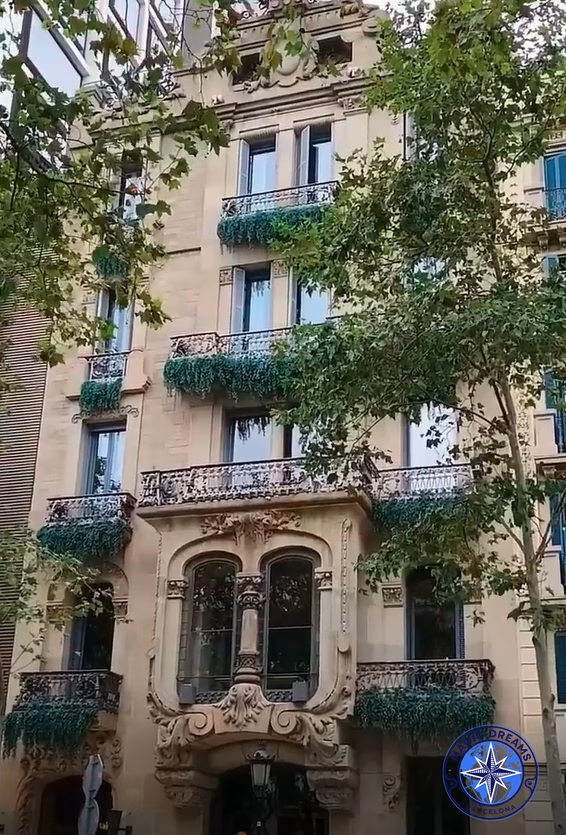
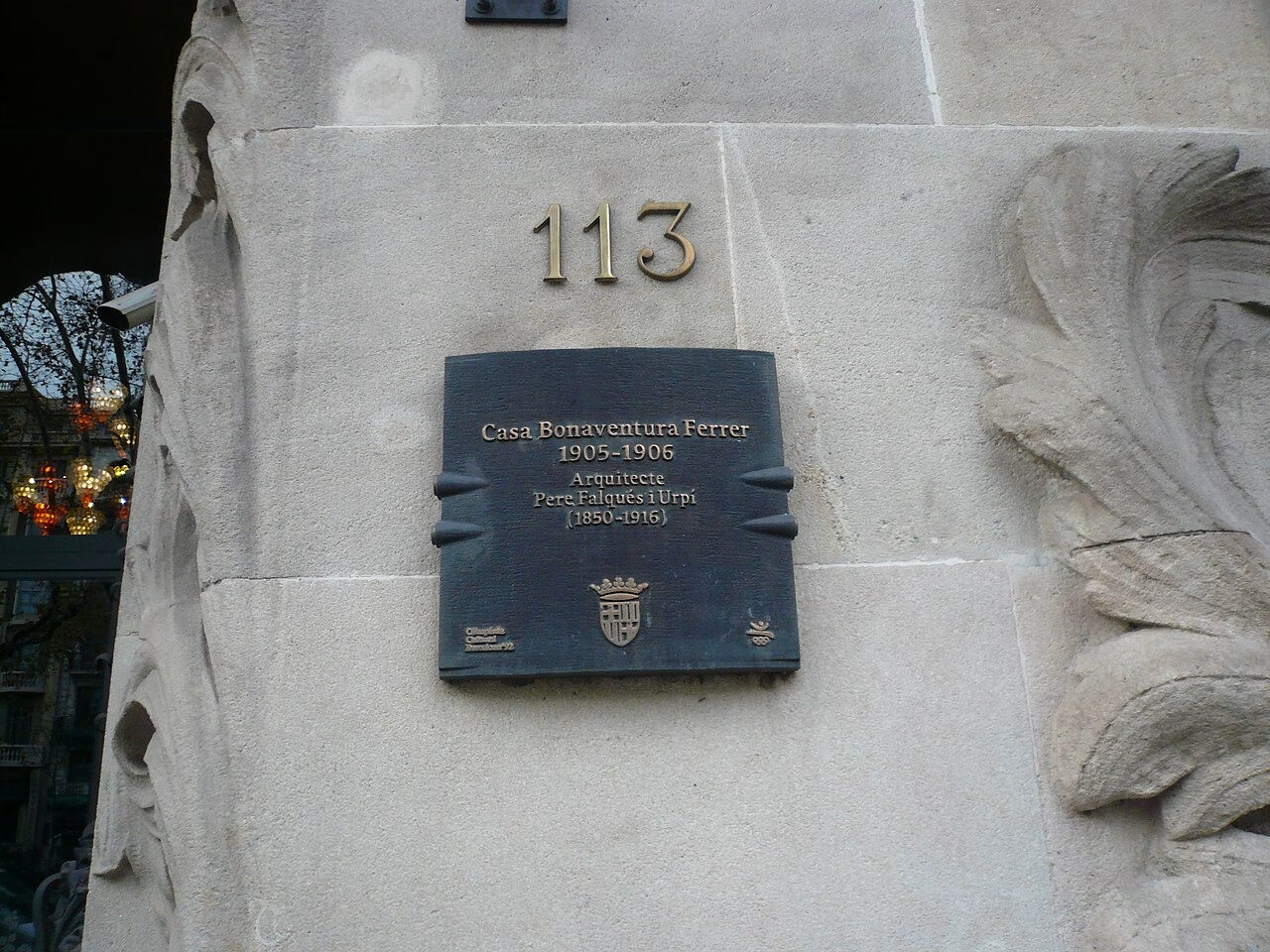
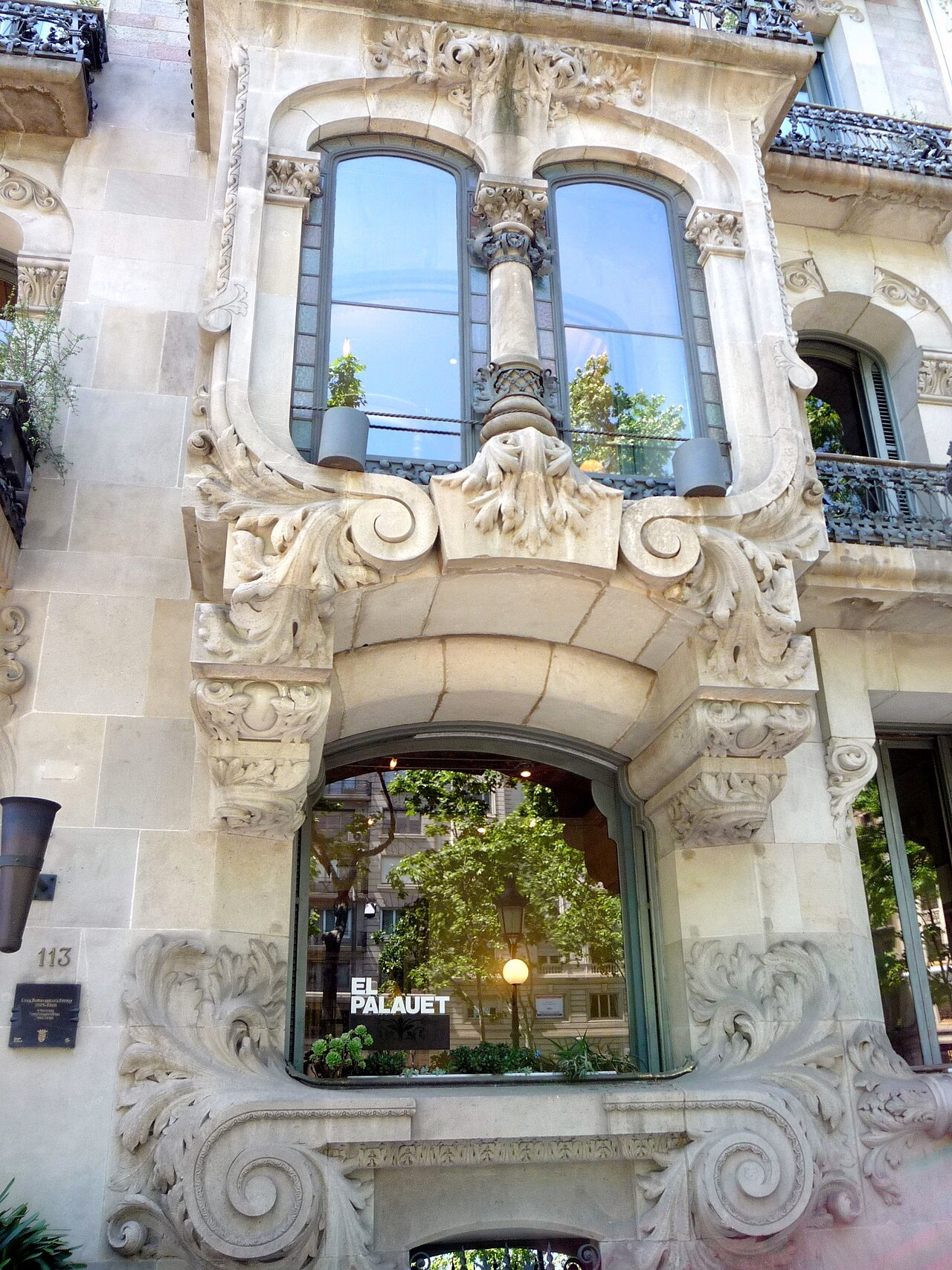
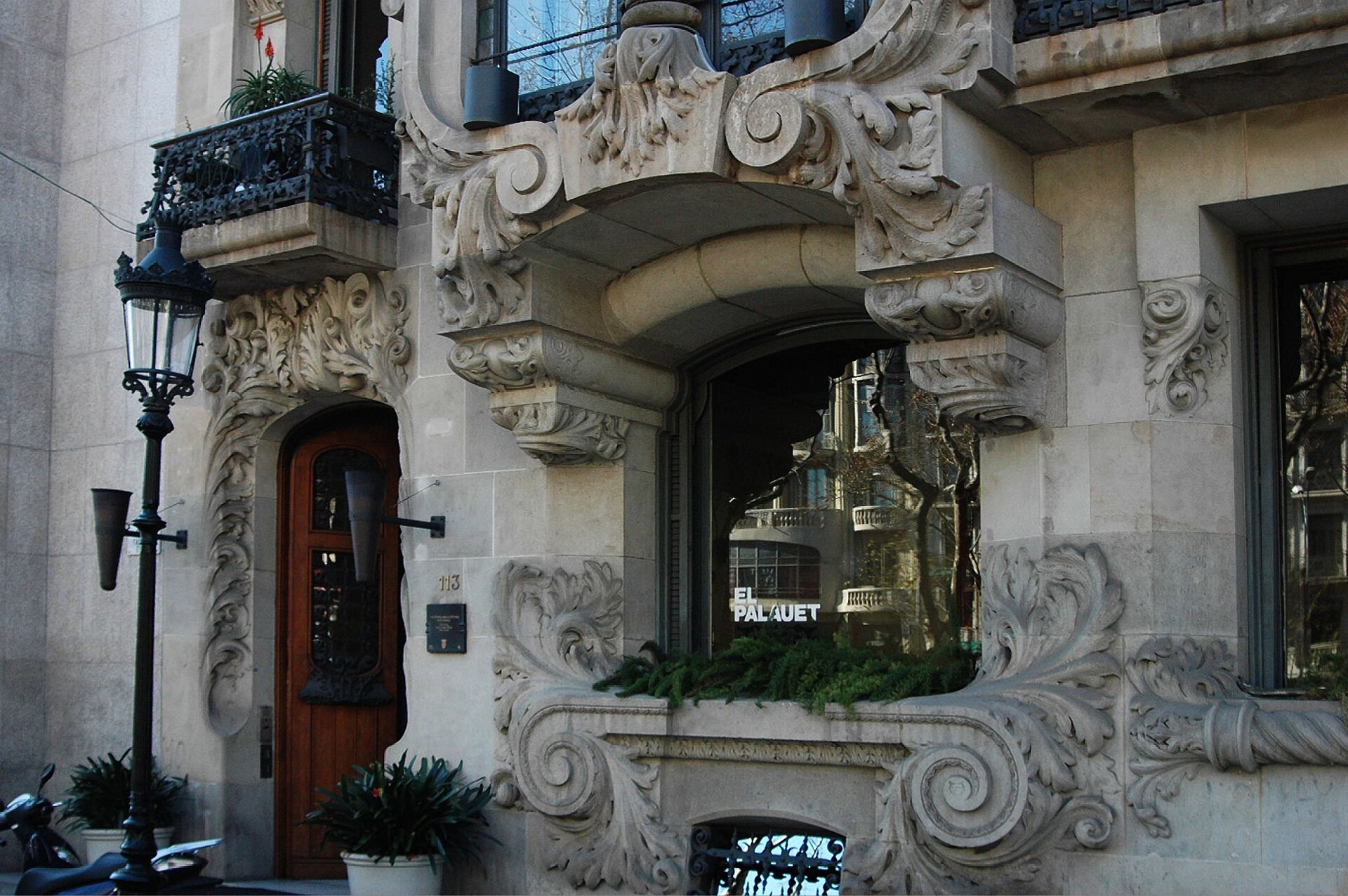
At number 113 on the emblematic Passeig de Gràcia, precisely where this elegant avenue meets the Jardins de Salvador Espriu (Jardinets de Gràcia) and Avenida Diagonal, stands one of Barcelona’s most fascinating and, for many visitors, lesser-known Modernist buildings: El Palauet, formerly known as Casa Bonaventura Ferrer.
Designed between 1905 and 1906 by Barcelona-born architect Pere Falqués i Urpí, the building is a magnificent example of Catalan Modernisme at the beginning of the 20th century. Its architectural language combines classical, Baroque and naturalistic influences in an exceptionally rich decorative composition.
Its stone façade, extraordinary sculptural bay window, wrought-iron balconies and beautifully decorated interiors make this building a small architectural jewel that deserves to be admired in detail.
But El Palauet offers much more than architectural beauty.
Behind its walls lies a romantic story attributed to Josep Matheu Mercader and his wife, Bonaventura Ferrer. According to the account preserved and shared by the establishment itself, this story was recorded on a parchment hidden somewhere inside the building, explaining why the house eventually became associated with a woman’s name.
We are therefore looking at a place where architecture, family memory, Catalan bourgeois society and romanticism come together in a single setting.
The origins of El Palauet
Barcelona, 1905–1906: the age of the bourgeoisie and Modernist splendour
At the beginning of the 20th century, Barcelona was undergoing a profound economic, urban and cultural transformation.
The Eixample district had become the preferred residential setting for wealthy bourgeois families, who sought to express their social standing through increasingly sophisticated homes, featuring monumental façades, noble materials and interiors designed both to entertain guests and to accommodate an active social life.
Passeig de Gràcia had become one of the main showcases of this new Barcelona.
It was within this context that Casa Bonaventura Ferrer was built, a residential property that perfectly reflected the aspirations of an era in which architecture and social prestige went hand in hand.
The project was developed between 1905 and 1906, at a time when its architect was also undertaking other significant works, including the celebrated lamppost-benches along Passeig de Gràcia.
The building occupies a plot between Passeig de Gràcia and Carrer de Riera de Sant Miquel. This position reveals a particularly interesting feature of its design: the building does not simply present a prestigious main façade, but incorporates different architectural spaces and solutions according to its various orientations.
Pere Falqués i Urpí
The architect who transformed Barcelona’s urban landscape
Pere Falqués i Urpí (1850–1916) was one of the most important architects in Barcelona during the late 19th and early 20th centuries.
Trained in the academic architectural tradition, he gradually developed a style that evolved from historicist approaches towards the decorative and constructional language associated with Modernisme.
His career was closely linked to Barcelona’s transformation. He served as municipal architect and participated in important urban development projects, public facilities and residential buildings.
Among his best-known works are:
The lamppost-benches along Passeig de Gràcia, one of Barcelona’s most distinctive examples of urban furniture.
The monumental lampposts at Cinc d’Oros, in what is now Plaça de Joan Carles I.
Casa Bonaventura Ferrer.
Casa de la Lactància, on Gran Via.
Various municipal buildings and public facilities.
An especially interesting historical detail is that, because of Falqués’ position as municipal architect, the plans for Casa Bonaventura Ferrer were signed by master builder Lluís de Miquel i Roca. Nevertheless, the architectural attribution of the building belongs to Pere Falqués.
This circumstance helps us understand some of the administrative particularities of architectural practice in Barcelona at the time.
Falqués was not simply interested in designing monumental buildings. His work demonstrates a remarkable sensitivity to the relationship between architecture, urban furniture, ornamentation and the cityscape.
El Palauet brings all these elements together: an architecture designed to impress, combined with extraordinary attention to traditional craftsmanship.
A love story hidden within its walls
Josep Matheu Mercader and Bonaventura Ferrer: the origins of the building’s name
The most romantic story associated with El Palauet takes us back to the elegant streets and promenades of bourgeois Barcelona at the beginning of the 20th century.
According to the historical account preserved and shared by El Palauet itself, Josep Matheu Mercader belonged to a family connected with Catalonia’s important textile industry.
He and his wife, Bonaventura Ferrer, regularly enjoyed strolling along Passeig de Gràcia, one of the city’s most fashionable avenues.
During one of these walks, Doña Bonaventura is said to have become captivated by the magnificent façade of a newly constructed building near the Jardinets de Gràcia.
She would stop to admire it, imagining what it might be like to live in such a Modernist palace, enjoy its balconies and contemplate Barcelona from such a privileged position.
The story tells us that Josep Matheu decided to turn his wife’s dream into reality.
He acquired the building as a gift for her, associating it with her name and giving rise to the designation Casa Bonaventura Ferrer.
The account includes an even more extraordinary detail: the story was supposedly recorded in poetic form on a parchment hidden somewhere inside the property.
There is insufficient independent documentation to verify every detail of this narrative. It is therefore best understood as a historical tradition associated with the building’s memory.
And yet its emotional appeal is undeniable.
In a city filled with stories of families, merchants, architects and great fortunes, few narratives are as evocative as that of a man who supposedly transformed his wife’s admiration for a beautiful building into a gift for the woman he loved.
The Matheu family and life inside the palace
A family residence and a setting for commercial representation
According to the story shared by El Palauet, Josep Matheu Mercader and Bonaventura Ferrer settled in the building with their three children: Josep, Magín and Joan.
The family was connected with the textile trade and belonged to a Catalan bourgeois society whose commercial relationships extended beyond Barcelona.
The property was not conceived solely as a private residence.
Its spaces also allowed the family to receive visitors, present textiles and welcome clients and merchants arriving in the city.
The building’s tradition recalls these salons as places of social interaction and commercial representation, where fabrics, mirrors, stained glass and decorative elements helped create an atmosphere of refinement and distinction.
Over the decades, different areas of the property were adapted to new uses, eventually leading to its present configuration as a luxury accommodation establishment.
A façade that seems sculpted
The monumental bay window and the ornamental language of Modernisme
The first impression created by El Palauet is that of a small aristocratic residence.
Its main stone façade is characterised by a vertical composition, with the monumental bay window on the principal floor standing out as its most striking feature.
This element is the visual heart of the building.
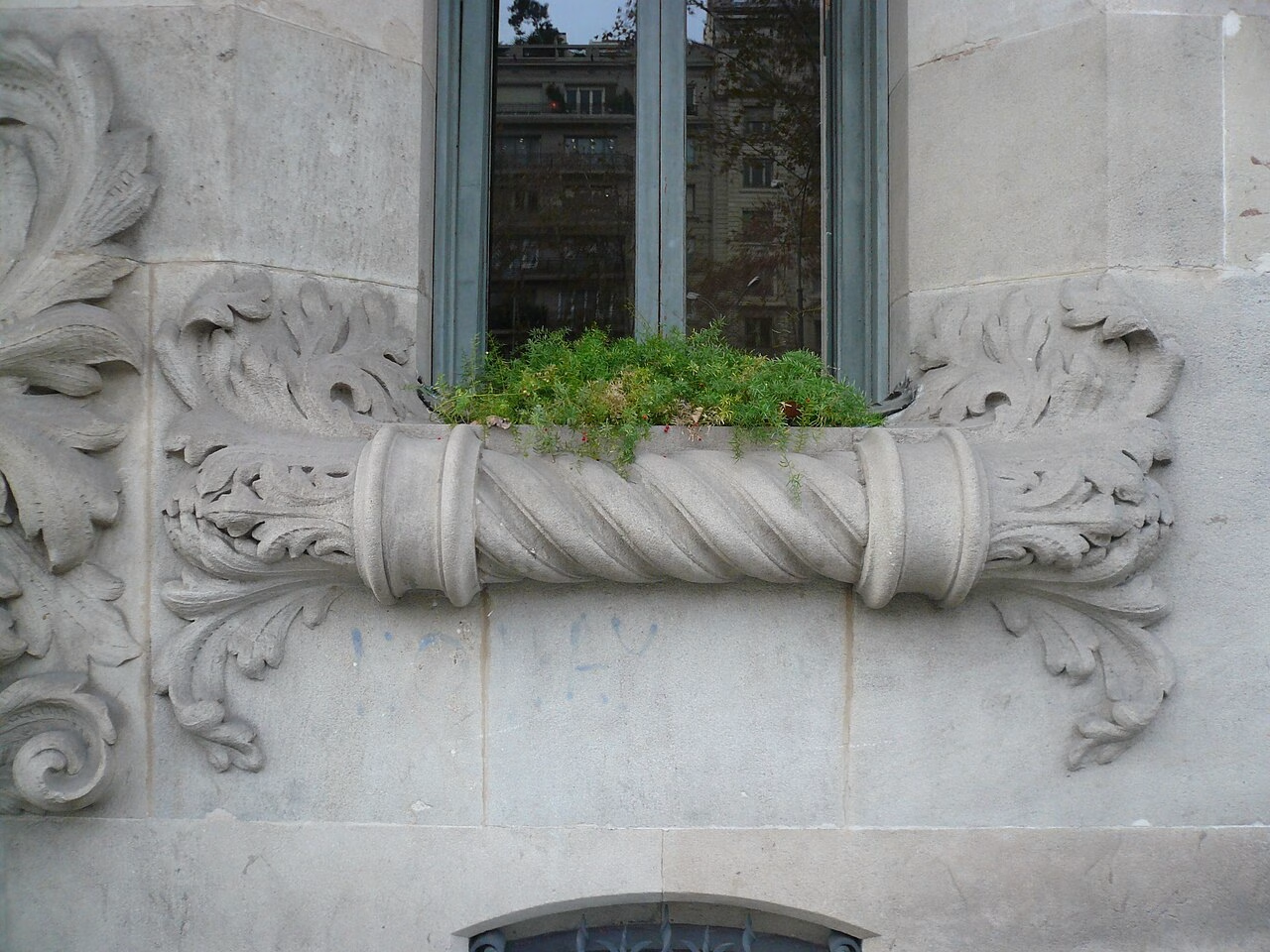
Richly ornamented, the bay window features a sculptural composition combining vegetal motifs, reliefs and sinuous forms. Its presence establishes a dialogue between the ground floor and the upper levels, giving the entire building its distinctive personality.
The wrought-iron balconies introduce movement into the façade.
Their railings avoid rigid geometric patterns, instead developing curved lines that recall the organic forms so highly appreciated by Modernist architects.
The decorative sgraffito work also deserves particular attention, especially its butterfly and clover motifs.
These small details invite us to take a closer look at an architecture designed to be appreciated up close.
The upper crowning, with its historicist and Baroque references, completes a composition in which different influences coexist without compromising its overall aesthetic unity.
Classical Modernisme
Between architectural tradition and decorative freedom
El Palauet is often described as an example of classical Modernisme.
This designation helps explain its particular character.
Unlike the more radical and organic works of Antoni Gaudí, this building follows an architectural composition closer to the traditional bourgeois residence, enriched with an exceptionally elaborate Modernist decorative vocabulary.
The overall structure retains a classical reading, while its decorative elements introduce formal freedom, movement and references to nature.
This is not architecture seeking to break completely with the past.
Rather, it represents an elegant reinterpretation of tradition, adapted to the tastes of a bourgeois society that aspired to modernity, elegance and distinction.
The interior: a world of craftsmanship and original details
57 listed ceilings and extraordinary decorative richness
If the façade invites us to stop and admire, the interior allows us to truly appreciate the artistic quality of the building.
One of El Palauet’s most remarkable features is the preservation of 57 listed ceilings, an exceptional collection of decorative work that forms an essential part of its heritage.
These ceilings display different plasterwork techniques, vegetal ornamentation, polychrome finishes and gilded details.
Some rooms feature particularly elaborate decoration, with floral motifs and ornamental compositions creating surfaces of extraordinary visual richness.
Original joinery, carefully crafted doors, historic lamps and preserved lighting elements help maintain the character of the residence.
Also noteworthy is a spectacular mirrored chandelier, together with other century-old light fittings that help recreate the atmosphere of the grand bourgeois homes of the period.
Each room offers a different experience.
Some spaces are dominated by wood, others by stained glass, while in others the ceilings become the undisputed protagonists.
It is precisely this variety that turns a visit to the interior into a fascinating lesson in Catalan decorative arts.
The grand staircase and the world of stained glass
Light as an architectural element
One of the building’s most interesting spaces is its vertical circulation area, where the grand staircase and timber structure take centre stage.
The composition is accompanied by a skylight featuring polychrome leaded stained glass, allowing natural light to transform the space throughout the day.
The finely crafted wood incorporates vegetal motifs into the handrails and decorative elements.
The staircase serves a purpose far beyond its practical function.
It becomes a statement piece, a ceremonial transition between floors and an expression of the extraordinary craftsmanship of the period.
Here, we can appreciate how Modernist architects integrated different artistic disciplines: carpentry, stained glass, sculpture, metalwork and interior decoration.
Architecture was conceived as a complete work of art.
The Conservatory
A small garden of light inside the building
Another of the property’s distinctive spaces is the area known as the Conservatory.
This is a semicircular room, designed with an iron structure and glazed panels, reminiscent of the historic conservatories and greenhouses of the period.
Its luminosity and enveloping character create a very special relationship between interior and exterior.
At a time when wealthy families particularly appreciated gardens, glazed spaces and the presence of vegetation, these rooms made it possible to introduce a sense of nature into the home itself.
The Conservatory represents one of the most delicate expressions of the dialogue between architecture and light found at El Palauet.
The Mirador Lounge and the Stained Glass Lounge
Two spaces preserving the elegance of the former residence
On the principal floor, we find two particularly representative spaces: the Mirador Lounge and the Stained Glass Lounge.
Both retain an important wealth of decorative features.
Their plaster ceilings, with polychrome and gilded finishes, combine ornamental motifs associated with Modernisme with later influences from the Art Deco vocabulary.
The joinery, wall lights and preserved decorative elements allow us to imagine the social life that once unfolded in these salons.
We can picture family gatherings, business meetings and private receptions, with architecture serving as the backdrop for social representation.
The quality of these spaces demonstrates that the importance of a bourgeois residence depended not only on its façade, but also on the experience it offered inside.
The balconies and their relationship with Barcelona
Living above Passeig de Gràcia
One of the most interesting aspects of Casa Bonaventura Ferrer is its relationship with the surrounding urban landscape.
Its location beside the Jardinets de Gràcia offers a different perspective on Passeig de Gràcia.
From its balconies, we can appreciate the importance of this avenue as a connection between Barcelona’s historic city centre and the former independent town of Gràcia.
At the end of the 19th century and beginning of the 20th, this promenade had become one of the most prestigious addresses for Barcelona’s bourgeois families.
People strolled along the avenue, visited fashionable shops and cafés, and admired the new buildings that were transforming the urban landscape.
El Palauet formed part of this world of modernity and prestige.
The rear façade and terrace
The more intimate side of the building
El Palauet’s architecture does not end with its main façade.
At the rear, facing Carrer de Riera de Sant Miquel, we find another composition of considerable interest.
A semicircular bay window stands out, combining wood, iron, ceramics and leaded glass.
This architectural solution has a different character from the main façade, while maintaining the same attention to materials and the integration of decorative arts.
The rear terrace, featuring white marble trencadís elements and a semicircular stained-glass window with floral motifs, adds another chapter to the property’s decorative richness.
The use of fragments of ceramic and stone materials in decorative compositions connects with one of the most characteristic techniques of Catalan Modernisme.
Here, the terrace is much more than an outdoor space: it is an extension of the building’s artistic language.
A lift from another era
The memory of domestic technology
Among the features worth remembering is the historic lift.
In the grand bourgeois apartment buildings of the early 20th century, the introduction of lifts represented a significant innovation in residential design.
Their presence transformed the way people inhabited multi-storey buildings and contributed to improving the comfort of urban residences.
At El Palauet, the period lift is another detail that allows us to travel mentally back to Barcelona in 1906.
It is not simply a functional object.
It forms part of the technological and social memory of an era when domestic architecture was beginning to incorporate new conveniences.
From Modernist residence to luxury accommodation
The transformation of El Palauet into a contemporary destination
Over the decades, the building has undergone various adaptations to meet changing needs.
Its current configuration preserves the historic character of the property while integrating it into a high-end accommodation concept.
Today, it is known as El Palauet Royal Suites, also marketed as El Palauet Living Barcelona.
The establishment offers six exclusive suites, each measuring approximately 150 square metres and accommodating up to four guests.
Their names preserve the memory of the family associated with the building: Suite 1906, Suite Bonaventura, Suite Matheu, Suite Josep, Suite Magin and Suite Joan.
The suites combine preserved historical elements, such as the Modernist ceilings, with contemporary equipment and amenities.
The accommodation concept focuses on a luxury residential experience, offering spacious interiors, personalised attention and private services.
Among the advertised services are 24-hour assistance from a dedicated suite ambassador, private breakfasts, private chef experiences and personalised arrangements.
The establishment also offers spaces for private events and gatherings, subject to availability and booking conditions.
For further information, please visit its official website:
The importance of preserving Modernist architecture
Casa Bonaventura Ferrer forms part of Barcelona’s protected architectural heritage.
Its classification as a Local Cultural Asset (BCIL – Bé Cultural d’Interès Local) recognises its historical, artistic and urban value.
Heritage protection is particularly important on an avenue such as Passeig de Gràcia, where historic buildings coexist with hotels, retail establishments, offices and new commercial activities.
Preserving a building such as El Palauet means protecting much more than a façade.
It means safeguarding part of the city’s collective memory: its construction techniques, artisans, ways of life and the aspirations of a society that found in architecture a way of expressing its identity.
El Palauet and the great architects of Modernisme
A privileged location from which to discover Modernist Barcelona
The building’s location makes it an excellent starting point for exploring some of the finest examples of Catalan Modernisme.
Just a few minutes away, we can discover buildings that reveal different approaches to architecture at the beginning of the 20th century.
Casa Fuster – Lluís Domènech i Montaner
Located at number 132 on Passeig de Gràcia, Casa Fuster is one of the great examples of Catalan Modernisme. Its stone façade, bay windows and decorative elements reflect the architectural maturity of Domènech i Montaner.
La Pedrera or Casa Milà – Antoni Gaudí
At number 92 on Passeig de Gràcia stands one of Gaudí’s most extraordinary works. Its undulating façade, interior courtyards and sculptural rooftop represent an organic approach to architecture.
Casa Batlló – Antoni Gaudí
At number 43 on the same avenue, this building transforms residential architecture into a universe of shapes, colours, light and natural references.
Casa Amatller – Josep Puig i Cadafalch
Located at number 41, Casa Amatller is a magnificent reinterpretation of Gothic architecture and Catalan architectural traditions.
Casa Lleó i Morera – Lluís Domènech i Montaner
At number 35, we find another of the great Modernist residences along the avenue, renowned for the quality of its decorative arts.
Together, these buildings demonstrate that Barcelona’s Modernisme was never a uniform style, but an extraordinarily diverse movement in which each architect developed a distinctive architectural language.
The Jardinets de Gràcia and the surrounding area
A stroll among architecture, gardens and urban life
El Palauet is located beside the Jardinets de Gràcia, officially known as Jardins de Salvador Espriu.
This green space offers a welcome pause amid the activity of Passeig de Gràcia.
Its location provides particularly interesting views towards the upper part of the avenue and Avenida Diagonal.
It is a pleasant place to stop, admire the façades and appreciate the contrast between historic architecture and contemporary Barcelona.
It is also worth paying attention to Pere Falqués’ urban furniture.
The lamppost-benches he designed for Passeig de Gràcia are among the avenue’s most characteristic features and provide a direct connection between the building and the architect’s wider work.
A gastronomic experience around El Palauet
Fine dining, historic hotels and restaurants with personality
El Palauet’s location offers access to an exceptional gastronomic scene.
The surrounding area brings together fine-dining restaurants, luxury hotel establishments, cocktail bars and contemporary culinary concepts.
For those wishing to complement an architectural visit with a special dining experience, we recommend considering the following options:
Aleia – Hotel Casa Fuster
Located at number 132 on Passeig de Gràcia, Aleia occupies a privileged space within another Modernist masterpiece by Lluís Domènech i Montaner.
Its creative, seasonal cuisine has earned two Michelin stars. It is an especially interesting choice for those wishing to combine historic architecture with fine dining.
The Michelin Guide places it in the highest price category. We recommend checking the current menu and prices before booking.
Moments – Mandarin Oriental Barcelona
Located at numbers 38–40 on Passeig de Gràcia, this restaurant offers a high-end gastronomic experience inside one of the city’s most exclusive hotels.
Its contemporary cuisine draws inspiration from Catalan culinary traditions and seasonal Mediterranean ingredients.
It is a particularly suitable choice for a celebratory lunch or dinner.
Espacio UMA
At Carrer de Mallorca 275, a short distance from Passeig de Gràcia, we find a fine-dining concept offering several tasting menus.
Its published prices include options at €86, €125 and €186 per person, with supplements depending on the selected experience. Prices may change, so we recommend checking them before making a reservation.
The area also offers an extensive selection of cafés, pastry shops, terraces and restaurants for those who prefer a more informal gastronomic experience.
Exclusive shopping on Passeig de Gràcia
Barcelona’s great luxury shopping destination
The area surrounding El Palauet is one of Spain’s leading luxury shopping destinations.
Along the avenue, visitors will find international boutiques, fashion houses, jewellery stores, watchmakers, accessories and specialist retailers.
The experience includes discovering the window displays of major international fashion brands and enjoying a shopping district closely connected to the history of the avenue.
Among the most interesting possibilities are the boutiques of international luxury brands and design stores located between Diagonal and Plaça de Catalunya.
The Modernist architecture also makes the shopping experience a cultural journey in its own right.
How to get to El Palauet
A privileged location in the heart of Barcelona
Address:
Passeig de Gràcia, 113
08008 Barcelona, Spain.
Its location makes it easily accessible by public transport and private vehicle.
By metro
The nearest station is Diagonal, served by:
L3, the green line.
L5, the blue line.
Depending on your starting point, you can also use the Gràcia station on the Ferrocarrils de la Generalitat de Catalunya (FGC).
By train
Passeig de Gràcia and Provença stations provide connections with different rail services across the city and metropolitan area.
The most convenient option will depend on your point of departure and planned itinerary.
By bus
Several urban bus routes operate along Avenida Diagonal and the surrounding streets.
We recommend checking TMB’s real-time information, as routes and stops may change.
By taxi or chauffeur-driven vehicle
Travelling by taxi is convenient from anywhere in Barcelona.
Private transfers with a professional driver can also be arranged, particularly for guests arriving from the airport, port or railway stations.
For a premium experience, a high-end vehicle with collection and return to the accommodation can be requested.
Parking near El Palauet
Options for visitors arriving by private vehicle
One of the most convenient options is Saba Bamsa Jardinets de Gràcia car park, located beneath the Jardins de Salvador Espriu, close to the junction of Passeig de Gràcia and Avenida Diagonal.
It has 432 parking spaces, operates 24 hours a day and offers facilities including spaces for people with reduced mobility and electric vehicle charging.
As a reference, the stated rate is €4.20 per hour for cars. Rates may change, so we recommend checking them before entering.
Another alternative is Saba Bamsa Passeig de Gràcia-La Pedrera, located at number 86 on the avenue, also with a stated hourly rate of €4.20.
For longer stays, we recommend checking advance booking rates and any available parking packages.
Visitors driving in Barcelona should also take into account the Low Emission Zone regulations and the vehicle access requirements in force.
Practical information for planning your visit
How to discover the interior of El Palauet
Unlike many other Modernist buildings in Barcelona, El Palauet operates primarily as a luxury accommodation establishment and event venue.
It should therefore not be considered a freely accessible monument or a museum with general visiting hours.
Access to the interior depends on the available visiting arrangements, private experiences and the establishment’s schedule.
If you would like to discover its original spaces, listed ceilings, stained-glass windows, grand staircase or historic salons, the best option is to contact the establishment in advance and enquire about private visits and services.
Contact information:
El Palauet Royal Suites
Passeig de Gràcia, 113
08008 Barcelona, Spain.
We recommend booking in advance and confirming which areas are included in each experience.
A visit that can become an exclusive experience
Discovering Modernist Barcelona beyond the usual landmarks
El Palauet is an especially interesting stop for those wishing to discover a different side of Barcelona.
It offers an opportunity to explore Catalan bourgeois society, the development of the Eixample, the great architects of the early 20th century, the decorative arts and an era when private residences were conceived as genuine works of art.
Its history also introduces a human dimension: that of a family, its commercial activities and the romantic tradition associated with the name of Bonaventura Ferrer.
A visit can be combined with an architectural tour of Casa Fuster, La Pedrera, Casa Batlló and the other major buildings along Passeig de Gràcia.
It is also possible to complete the day with a fine-dining experience, personalised shopping or a private guided walk through the most fascinating corners of the Eixample.
Would you like to discover El Palauet with us?
Magic Dreams Barcelona: architecture, culture and experiences designed around you
At Magic Dreams Barcelona, we believe that discovering a city means much more than simply visiting its monuments.
Every building, every garden and every hidden corner preserves a story worth telling.
We therefore invite you to discover El Palauet and Modernist Barcelona from a cultural, architectural and deeply human perspective.
Our native guide, specialised in architecture, history, botany and ornithology, will accompany you on a carefully researched journey, adapted to your interests and preferred pace.
We can organise a private day exploring Passeig de Gràcia, combining the history of El Palauet with the great works of Gaudí, Domènech i Montaner and Puig i Cadafalch.
We can also design multi-day stays, weekend escapes and personalised journeys through the Catalan Pyrenees, the Costa Brava and other destinations of interest.
Our services include private transport, carefully selected accommodation, gastronomic reservations, culinary experiences, professional photography, musicians, floral arrangements and romantic proposals specially designed for memorable occasions.
We can arrange exclusive picnics with elegant table settings and personalised catering in gardens, on beaches or in exceptional natural settings, and even experiences aboard a yacht.
For those wishing to explore local culture in greater depth, we also design workshops in cooking, art and traditional crafts such as trencadís.
Our experiences are available in Spanish, Catalan and English. Other languages can be arranged upon request.
Every experience is designed around your preferences, needs and expectations, with different levels of service, from premium proposals to entirely bespoke itineraries.
El Palauet reminds us that architecture can be much more than stone, iron and glass: it can become the setting for a love story.
And perhaps that is the finest way to discover Barcelona: not simply by looking at its buildings, but by understanding the human stories that continue to live within their walls.
Magic Dreams Barcelona. Discover the city from a different perspective.
Casa Bonaventura Ferrer. Pg. Gràcia, 113 – c/ Riera Sant Miquel, 6 – By Pere López, CC BY-SA 3.0, https://commons.wikimedia.org/w/index.php?curid=28037529.
Casa Bonaventura Ferrer – By Pere López, CC BY-SA 3.0, https://commons.wikimedia.org/w/index.php?curid=28037492.
Casa Bonaventura Ferrer – By Zarateman – Own work, CC0, https://commons.wikimedia.org/w/index.php?curid=58827363.
El Palauet – By Xavier Badia Castellà – Xavier Badia Graphic CollectionXavier Badia kindly provided this file by means of Amical Wikimedia & CitizenSqKm., CC BY-SA 3.0, https://commons.wikimedia.org/w/index.php?curid=56015974.
El Palauet o Casa Bonaventura Ferrer Magic Dreams Barcelona.