Route guide for visitors throughout Catalonia – Barcelona – Costa Brava – Catalan Pyrenees – Personalized experiences – Customized tour guide services – A small tribute to the wonderful city and land that saw us born – Transforming experiences into unforgettable memories - Magic Dreams Collection: exclusive universes inspired by Salvador Dalí and Gaudí. Niche perfumes, jewelry, lithographs, and collectible items celebrating the Mediterranean spirit.
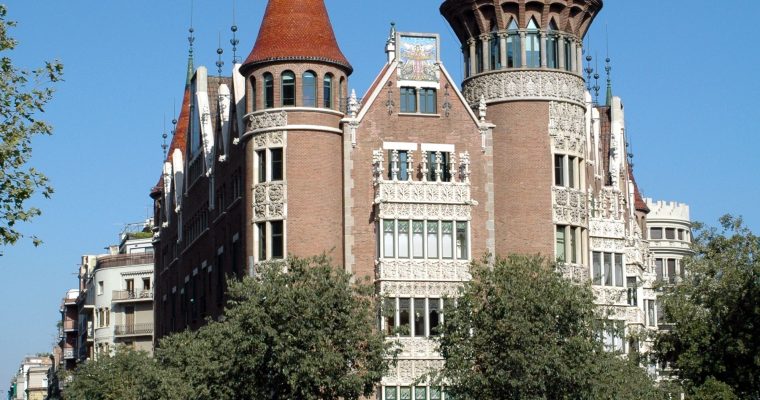
A jewel of Catalan Modernisme combining medieval legends, architecture and elegance Located in the Dreta de l’Eixample district, overlooking one of the chamfered corners of Avinguda Diagonal, Casa de les Punxes stands out among the most remarkable buildings created during Barcelona’s golden age of Modernisme …
Where History, Art, and the Mediterranean Lifestyle Converge Plaça de Catalunya is the epicentre of Barcelona, a vibrant meeting point where the historic district of Ciutat Vella meets the modern Eixample neighbourhood. Considered one of the city’s most iconic public spaces, the square connects some …
History, architecture, legends and one of the Maresme’s most extraordinary fortresses
There are places that seem to belong to another era.
Places where towers, battlements, courtyards and medieval galleries blend with stained glass, mosaics, sculptures and Modernist details.
Santa Florentina Castle, in Canet de Mar, is one of them.
Located in the upper part of the Canet valley, just a few kilometres from the Mediterranean, the castle brings together within a single building the remains of an ancient Roman domus, a medieval fortified house and the spectacular transformation carried out in the late 19th and early 20th centuries by one of the great architects of Catalan Modernisme: Lluís Domènech i Montaner.
The result is difficult to classify.
It is not simply a medieval castle.
Nor is it merely a Modernist building.
It is a palatial residence inspired by medieval, Romantic and Neo-Gothic architecture, built upon centuries of history and transformed into one of the most distinctive architectural landmarks in Canet de Mar.
Where is Santa Florentina Castle?
In the upper part of Canet de Mar, between the Mediterranean and Montnegre
Santa Florentina Castle is located in Canet de Mar, in the Maresme region of the province of Barcelona.
Canet de Mar lies approximately 47 kilometres from Barcelona, between the Mediterranean Sea and the surroundings of Montnegre Natural Park.
The castle stands in the upper part of the town, surrounded by woodland and valley landscapes that help create the impression of an isolated fortress that it still retains today.
Its address is:
Avinguda Dr. Marià Serra, s/n 08360 Canet de Mar, Barcelona
Its proximity to Barcelona makes Santa Florentina an excellent choice for travellers looking to discover a historic and truly unique destination without travelling too far from the city.
How long does it take to get there from Barcelona?
A Maresme getaway that can take less than an hour
Barcelona and Canet de Mar are approximately 47 kilometres apart.
By car, the journey can take around 40 minutes via the C-32 under normal traffic conditions, although actual travel times can vary considerably depending on traffic.
The usual route is to leave Barcelona towards the Maresme coast and continue along the C-32 to Canet de Mar.
It is also possible to travel via the N-II.
Once in Canet, continue towards the upper part of the municipality until reaching the castle.
Because of its proximity to Barcelona, it is an ideal destination for a half-day or full-day excursion from Barcelona.
At Magic Dreams Barcelona, we can help you organise this experience and tailor the itinerary to your interests, combining Santa Florentina with other highlights of Canet de Mar and the Maresme region.
How to get to Santa Florentina Castle
By private transport, train or as part of an organised excursion
There are several ways to reach Santa Florentina.
If you prefer to travel independently, you can drive to Canet de Mar and continue towards the castle area.
You can also travel by train.
However, if you are looking for comfort and want to make the most of your day by discovering other places of interest, Magic Dreams Barcelona can help you arrange private transportation from Barcelona.
This means you do not have to worry about driving, parking or coordinating the different stops along the way.
We can design a route such as:
Barcelona – Canet de Mar – Santa Florentina Castle – Modernisme – gastronomy – historic centre – Mediterranean – return to Barcelona.
The itinerary can be adapted to the time available and to your personal preferences.
Getting to Canet de Mar by train
An alternative for travellers who prefer public transport
It is also possible to travel from Barcelona to Canet de Mar by Rodalies R1.
The journey can take approximately 50 minutes, depending on the service.
From the station to the castle, it is around a 25-minute walk.
This is an interesting option if you want to visit the castle independently.
However, if you prefer a more comfortable and personalised experience, we can arrange private transportation from Barcelona and combine your visit to Santa Florentina with other points of interest in Canet de Mar.
The history of Santa Florentina Castle
From an ancient Roman domus to a fortified house and palatial residence
The history of this site began long before the castle we see today existed.
The building stands on the remains of an ancient Roman domus, associated with an urban settlement and agricultural and wine-producing activities.
Medieval documentary references appear at least as early as the 11th century.
In 1024, Guadamir de Canet is documented, while Gilabert de Canet appears in records dating from 1041.
During the Middle Ages, the ancient domus gradually became a fortified house.
The reason was highly practical.
The Maresme coast was exposed to incursions and attacks from the Mediterranean, so buildings in the area incorporated defensive features.
Over the centuries, the structure acquired new functions and underwent successive transformations until it became the spectacular architectural complex we know today.
Ferrer de Canet and the medieval fortification
The towers that still dominate the entrance
The great moment in the history of the former Domus de Canet came during the 14th century, under Ferrer de Canet.
Ferrer was an important member of the Catalan nobility and was connected with the courts of the kings of Aragon.
During this period, permission was granted to fortify the house, and the two towers that still flank the medieval entrance today were built.
These towers are not modern recreations.
They form part of the historic structure of the former fortified house.
Other defensive elements were also added, including the barbican.
Over the centuries, ownership passed through different generations and eventually became associated with the Montaner family.
Ramon de Montaner and the great transformation
When a fortified house became a castle
In 1881, Ramon de Montaner i Vila acquired the former Casa Forta de Canet, which had belonged to his ancestors.
Ramon de Montaner was an important publishing entrepreneur and one of the figures behind the renowned Montaner i Simón publishing house.
But his plans for Canet went far beyond preserving the old house.
He wanted to transform it into a monumental representation of family history and lineage.
To achieve this, he turned to his nephew, the architect Lluís Domènech i Montaner.
This marked the beginning of the transformation that explains much of the castle’s appearance today.
The former fortified house gradually became a spectacular palatial residence in which medieval architecture was combined with the artistic language of Catalan Modernisme.
Lluís Domènech i Montaner
The architect who created a medieval castle in the Modernist era
Domènech i Montaner was one of the leading figures of Catalan Modernisme.
From the late 19th century to the beginning of the 20th century, he completely transformed the former Casa Forta.
The works took place approximately between 1896 and 1912.
The architect designed the different spaces by integrating architecture, sculpture, decorative arts and historic elements.
The project introduced:
towers and battlements;
courtyards;
galleries;
stained-glass windows;
ceramics;
wrought iron;
sculptures;
marble;
carved wood;
coffered ceilings;
Gothic and Neo-Gothic elements.
The result was a kind of medieval castle imagined through the eyes of Modernisme.
And that is precisely where much of its charm lies.
Domènech i Montaner did not simply restore what already existed.
He created an architectural complex in which different periods, styles and materials coexist within a single work.
A medieval castle that is not entirely medieval
Santa Florentina’s great architectural curiosity
One of the most fascinating aspects of the castle is that its appearance can be deceptive.
When we look at its towers, battlements and stone walls, we feel as though we are standing before an almost perfectly preserved medieval fortress.
Yet much of the monumental image we see today dates from the transformation carried out between the 19th and 20th centuries.
Domènech i Montaner used historic elements from other locations to create this medieval atmosphere.
One of the most striking examples is the Tallat Monastery, from which architectural elements were transferred and incorporated into the castle.
The courtyard is one of the spaces where this mixture is most evident.
Here lies one of the keys to understanding Santa Florentina:
we are not looking at a conventional medieval reconstruction, but at an interpretation of the past created by a Modernist architect.
History became inspiration.
Architecture became theatre.
And ancient elements acquired a new life within an entirely new project.
The courtyard and Gothic gallery
One of the castle’s most impressive images
The inner courtyard is one of Santa Florentina’s great highlights.
It features a spectacular Gothic gallery, together with various sculptural and architectural elements.
Pieces transferred from the former Tallat Monastery help create an atmosphere that seems to have come straight from a medieval palace.
Yet everything is integrated into the artistic language of the early 20th century.
It is one of those places where it becomes difficult to completely separate:
history + architecture + imagination.
Ancient stones coexist with elements specifically designed for the new complex.
The result is deeply theatrical architecture, while at the same time being filled with historical and artistic details.
The Santa Florentina crypt
The castle’s most intimate and distinctly Modernist space
If the exterior transports us to a medieval castle, the crypt clearly reflects the Modernist spirit of the project.
It was designed by Domènech i Montaner to house the remains of Florentina Malattó, the wife of Ramon de Montaner.
This space contains sculptures, stained glass, mosaics and decoration that are much closer to the language of Modernisme.
The tomb, featuring the recumbent figure of Florentina, is particularly striking.
The crypt is probably one of the places where the artistic intention behind the entire project can best be understood.
The aim was not simply to build a castle.
It was to create a Gesamtkunstwerk — a total work of art, in which architecture, sculpture and decorative arts formed part of a single experience.
The legend of Santa Florentina
A story of relics, faith and tradition
The castle’s name is not accidental either.
The tradition surrounding Saint Florentina is linked to a relic which, according to the tradition preserved around the castle, was brought from Rome by Ferrer de Canet as a gift and source of protection.
The tradition also connects the name with Florentina Malattó i Suriñach, the wife of Ramon de Montaner.
There is also a close connection between the castle and the old Les Verges tradition, associated with the legend of Saint Ursula and the Eleven Thousand Virgins.
The tradition was revived in Canet from 1881 onwards, and the crypt’s decoration incorporates visual references to this story.
Here, it is important to distinguish between documented history and tradition.
This is not a medieval legend that literally explains the construction of the castle, but rather a collection of religious and family traditions that form part of the cultural identity of the site.
Precisely this combination of historical documentation and tradition is another feature that makes Santa Florentina so fascinating.
The visit of Alfonso XIII
When the castle welcomed a king
One of the most curious episodes in Santa Florentina’s modern history took place in 1908.
King Alfonso XIII accepted Ramon de Montaner’s invitation and spent several days at the castle accompanied by his court and other prominent figures.
The royal visit further contributed to turning Santa Florentina into one of the great social and cultural settings of the period.
Two years later, in 1910, Ramon de Montaner received the title of Count of the Valley of Canet.
The presence of the monarch reflects the social importance that the Montaner family had acquired and the role the castle played as a representative residence.
A castle of artists, intellectuals and prominent figures
Much more than a family residence
During Ramon de Montaner’s years of splendour, Santa Florentina also became a meeting place.
Writers, artists, politicians and intellectuals passed through its rooms.
The history of the castle is closely connected to the cultural atmosphere of Barcelona in the late 19th and early 20th centuries.
This helps explain why the building was not conceived solely as a fortress.
It was also a residence representing social status and a declaration of cultural and economic power.
The castle served as a setting for the social life of a family belonging to the industrial and cultural elite of the period.
What architectural style is Santa Florentina Castle?
Medieval, Neo-Gothic, Romantic and Modernist
Defining Santa Florentina with a single word is difficult.
Yet the interior clearly incorporates the language of Catalan Modernisme.
There are stained-glass windows, mosaics, ceramics, wrought iron, sculpture, wood and marble.
The architecture combines medieval, Gothic, Neo-Gothic and Romantic references with the technical and artistic possibilities of the late 19th and early 20th centuries.
We could describe Santa Florentina as:
a medieval castle imagined by a Modernist architect.
And that combination is precisely what makes it so special.
Can Santa Florentina Castle be visited?
Yes — and it is advisable to arrange your visit in advance
The castle is a private property and offers guided and audio-guided tours, depending on the calendar and availability.
During the visit, you can discover spaces such as the courtyard, the throne room and different rooms within the castle.
As the property is also used for private events, it is advisable to check availability in advance and organise your visit ahead of time.
If you would like to visit Santa Florentina from Barcelona, Magic Dreams Barcelona can help you organise the experience, including private transportation and itinerary planning.
This allows you to combine the castle visit with other places of interest in Canet de Mar without having to worry about the logistics.
Can the castle be rented for weddings?
Yes. And this is one of its most special contemporary uses
One of Santa Florentina’s great curiosities is that the castle is not simply a monument to visit.
It also functions as an event venue.
The castle offers its facilities for:
weddings;
ceremonies;
private celebrations;
corporate events;
photo shoots;
film and television productions.
Its variety of spaces makes it possible to host celebrations of different sizes.
Available spaces include the courtyard, gallery, reception room, throne room, wine cellar and royal apartments.
The inner courtyard, for example, has a stated surface area of 135 m², with an indicative capacity of up to 90 guests for a banquet and 150 for a cocktail reception.
If you are considering celebrating a special occasion in a historic setting, Santa Florentina offers a truly unique backdrop.
Santa Florentina Castle and Game of Thrones
When Santa Florentina became a fortress of Westeros
One of the curiosities that has helped make Santa Florentina famous beyond Catalonia is its appearance in the television series Game of Thrones.
The castle was used as the setting for Horn Hill, home of House Tarly, during the sixth season.
And when we look at its towers, courtyards and galleries, it is easy to understand why it was chosen.
Its architecture already looks as though it was designed for a medieval fantasy production.
But here we encounter one of the castle’s great paradoxes:
a building largely created between the 19th and 20th centuries ultimately became the setting for a fantasy world inspired by the Middle Ages.
Fiction found in Santa Florentina the perfect setting because the complex combines precisely what a medieval production requires: stone, towers, galleries, courtyards, battlements and a powerful architectural identity.
Curiosities about Santa Florentina Castle
Small details that make the visit even more fascinating
Santa Florentina is full of intriguing details.
1. It was built over an ancient Roman domus.
The history of the site goes back long before the present-day castle.
2. The medieval entrance towers are authentic.
They formed part of the former medieval fortified house.
3. Its current medieval appearance is largely the result of a major Modernist transformation.
Domènech i Montaner transformed the old house in the late 19th and early 20th centuries.
4. Historic pieces from other buildings were incorporated into the project.
These include elements from the former Tallat Monastery.
5. Alfonso XIII spent several days at the castle.
The royal visit took place in 1908.
6. The crypt commemorates Florentina Malattó.
Its decoration is one of the most interesting examples of Modernist design within the complex.
7. Weddings and events are currently held there.
The historic fortress continues to have a contemporary function.
8. It was a Game of Thrones filming location.
The castle represented the residence of House Tarly in the series.
9. Different historical periods coexist within the same space.
Rome, the Middle Ages, Modernisme and contemporary culture all form part of its story.
10. It is one of the most distinctive works associated with Domènech i Montaner.
Its particular combination of historic architecture and Modernist creation makes it difficult to find another building quite like it.
What else can we do in Canet de Mar?
A visit that deserves to become a complete getaway
It would be a mistake to travel to Canet solely to see the castle.
Canet de Mar has an extraordinary connection with Catalan Modernisme and, in particular, with the work of Lluís Domènech i Montaner.
We can combine the castle visit with a tour of the historic centre and discover other buildings connected with the architect, such as the Ateneu, Casa Roura and the Lluís Domènech i Montaner House-Museum.
We can also head towards the Mediterranean, enjoy the beach, take a gastronomic break and finish the day strolling through the town.
In this way, the excursion becomes a much more complete experience:
castle + Modernisme + Mediterranean + gastronomy + history.
At Magic Dreams Barcelona, we can help you design this itinerary as a private experience from Barcelona, adapting the timing and stops to your preferences.
How much time do we need to visit the castle?
An hour may be enough, but Canet invites you to stay longer
The castle visit can take approximately one hour, depending on the type of tour selected.
However, if you are travelling from Barcelona, we recommend allowing at least half a day for Canet de Mar.
An even better option is to reserve a full day.
Start with the castle.
Continue with a Modernist route.
Take a break for lunch.
Explore the historic centre.
And finish beside the sea.
A private excursion allows you to adapt the pace of the day.
A romantic getaway for a couple is not the same as a family excursion or an experience for a group of friends.
That is why Magic Dreams Barcelona can help you design an itinerary that best matches what you want to discover.
A perfect getaway from Barcelona
History and architecture less than an hour from the city
Santa Florentina Castle has an advantage that is difficult to find.
It is close enough to Barcelona to visit on a day trip, yet when we reach the upper part of Canet, the atmosphere changes completely.
We leave the pace of the city behind.
The woodland appears.
The valley.
The towers.
The stone.
And a building that seems to have been created to tell stories.
But the more we learn about its past, the more fascinating it becomes.
Because behind the medieval battlements lies a project from the early 20th century.
Behind the Modernisme lies an ancient fortified house.
And beneath the castle lies the memory of an ancient Roman domus.
Santa Florentina Castle today
Perhaps the most interesting thing about Santa Florentina is that it has not simply become a historical ruin.
The castle is still alive.
It can be visited.
It is photographed.
It is used for filming.
Weddings are held there.
Events are organised there.
And it continues to form part of the landscape of Canet de Mar.
The complex is also officially recognised as a Cultural Asset of National Interest.
We are therefore looking at a protected historic building that also continues to serve a contemporary purpose.
This combination of heritage and present-day activity is one of the features that makes Santa Florentina particularly attractive for an excursion.
Santa Florentina Castle: a story between two eras
For centuries, the former Domus de Canet was associated with defence, agriculture and local power.
Then came the great transformations.
The Montaner family.
The project of Domènech i Montaner.
The artists.
The sculptures.
The stained glass.
The medieval elements.
The visit of Alfonso XIII.
And finally, the transformation of the castle into one of the best-known buildings in Canet de Mar.
Today, we can walk through its courtyards and rooms while imagining all those layers of history.
Rome.
The Middle Ages.
Modernisme.
The industrial aristocracy of the early 20th century.
Film and television.
And present-day Canet de Mar.
Perhaps that is the true magic of Santa Florentina.
It does not belong entirely to a single era.
It belongs to many.
The Magic Dreams Barcelona touch
An excursion that goes far beyond visiting a castle
At Magic Dreams Barcelona, we can help you turn your visit to Santa Florentina Castle into a complete Maresme experience.
A day can combine:
Barcelona – Canet de Mar – Santa Florentina Castle – Modernisme – gastronomy – historic centre – Mediterranean – return to Barcelona.
Alternatively, you can extend your experience by spending the night at one of our aparthotels or residences, with a private romantic dinner, a themed experience of your choice, a private chef and live music.
We can arrange private transportation, adapt the itinerary and design the day around your interests and the amount of time you have available.
If you are looking for a more exclusive experience, we can create a private excursion that allows you to discover Canet de Mar at your own pace, without having to worry about organising the different transfers.
Because Santa Florentina is not simply a place to take a photograph.
It is a place to pause.
To appreciate the details.
To discover the history of the Montaner family.
To explore the architecture of Domènech i Montaner.
To understand the relationship between the medieval castle and Modernisme.
And to discover one of the most extraordinary corners of the Maresme coast.
At Magic Dreams Barcelona, we can help you discover it and turn your visit into an experience designed around you.
Interior Castillo de Santa Florentina Magic Dreams Barcelona.
Castell de Santa Florentina (Canet de Mar), pati d’armes, ángulo nord-est – Enric, CC BY-SA 3.0 , via Wikimedia Commons.
Perspectiva a pie entrada del Castillo de Santa Florentina Magic Dreams Barcelona.
Perspectiva a pie entrada del Castillo de Santa Florentina Magic Dreams Barcelona.
At the intersection of Avinguda Diagonal and Carrer de Balmes, a residential building with restrained façades, slate mansard roofs and a distinctive corner dome expresses one of the most fascinating aspects of Barcelona’s architecture: the French-inspired classicism of Enric Sagnier i Villavecchia. 1. Introduction: An …