Route guide for visitors throughout Catalonia – Barcelona – Costa Brava – Catalan Pyrenees – Personalized experiences – Customized tour guide services – A small tribute to the wonderful city and land that saw us born – Transforming experiences into unforgettable memories - Magic Dreams Collection: exclusive universes inspired by Salvador Dalí and Gaudí. Niche perfumes, jewelry, lithographs, and collectible items celebrating the Mediterranean spirit.
Casa Verdú – Modernism in Barcelona’s Eixample District We are standing in front of the building known as Casa Verdú, located at 103 Rambla de Cataluña, at the intersection with Provenza Street, in the emblematic Eixample district of Barcelona. This property is a remarkable example …
A Getaway to Montserrat Abbey and its Magical Mountain There are places you visit. And there are places you feel. Montserrat is one of them. Just over an hour from Barcelona, among extraordinary rock formations, forests and mountain trails, lies one of Catalonia’s most unique …
From an ancient medieval gateway to one of Barcelona’s major shopping thoroughfares
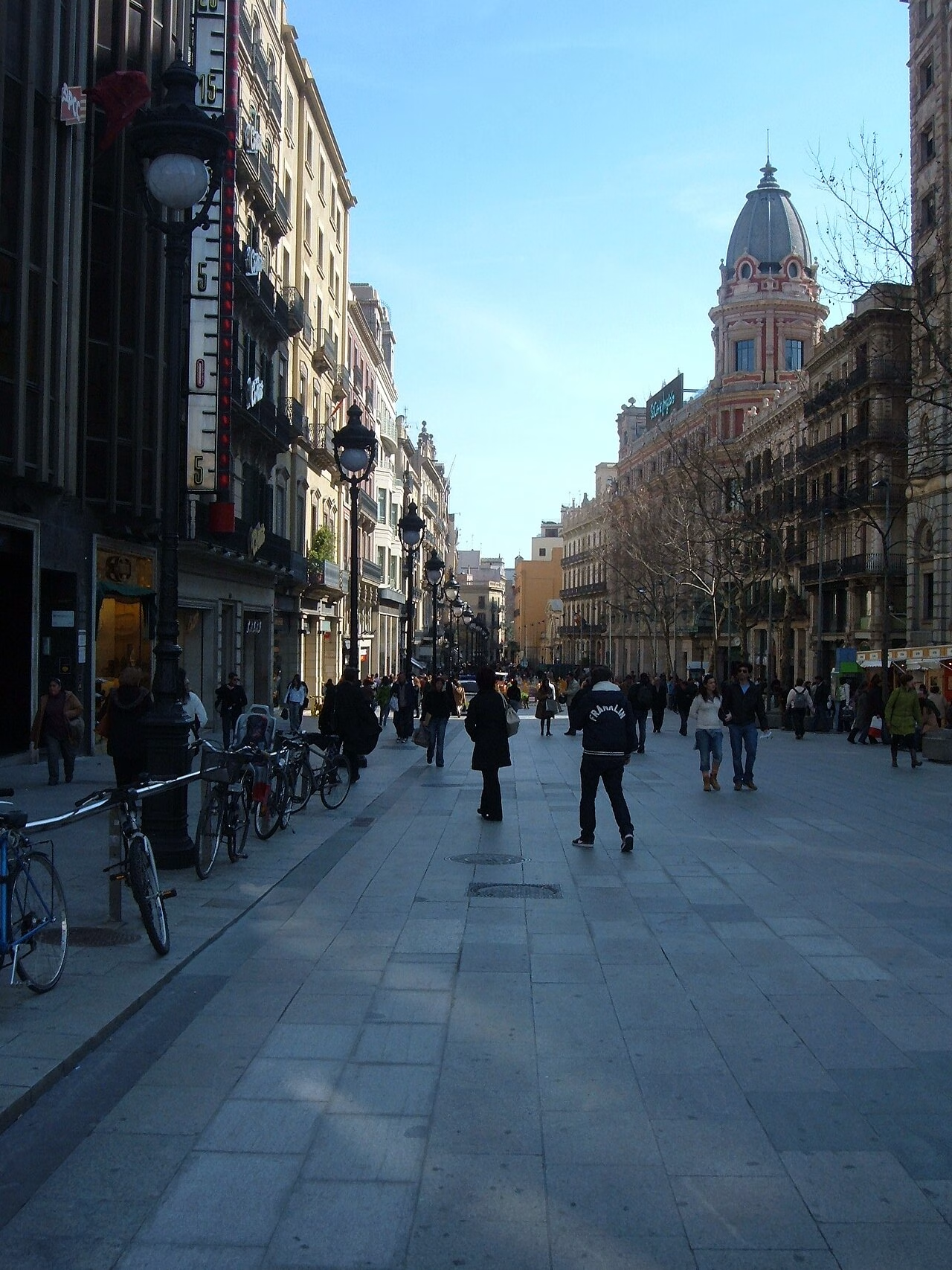
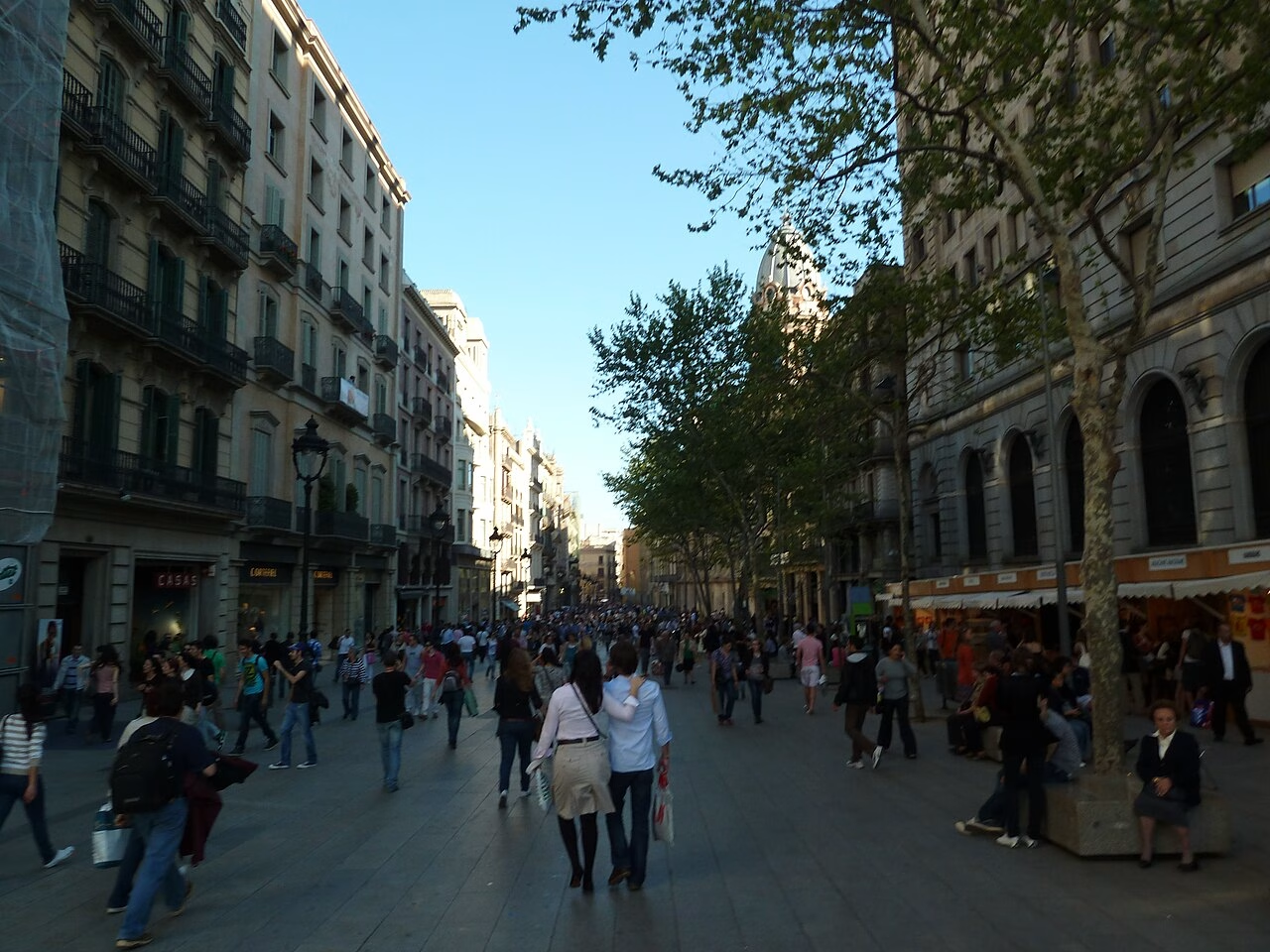
In the very heart of Barcelona, between Plaça de Catalunya and the narrow streets of the Gothic Quarter, lies one of the city’s best-known, busiest and most representative pedestrian avenues: Portal de l’Àngel.
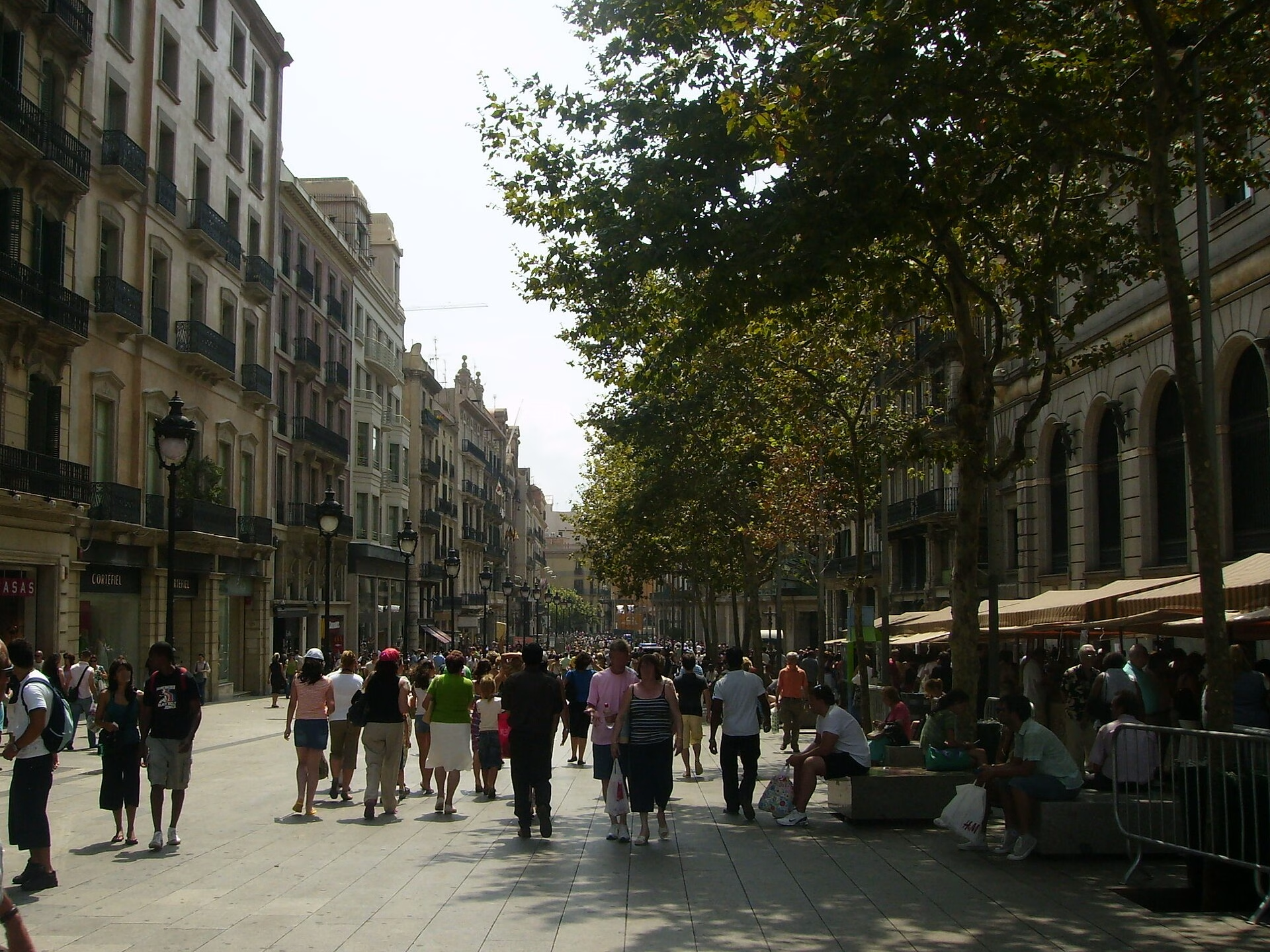
Today, it is synonymous with shopping, fashion, shop windows and constant movement. Thousands of people walk along its pavements every day, attracted by its shops, major international brands and privileged location in the historic city centre.
However, behind this intense commercial activity lies a much older story.
Portal de l’Àngel did not begin life as a shopping avenue. Originally, it was one of the gateways into medieval Barcelona, a place closely connected to the old city walls, religious legends and the urban transformation of a city that, over the centuries, expanded far beyond its original boundaries.
And although our attention today is inevitably drawn towards the shop windows, it is worth stopping for a moment and looking up. The façades preserve fascinating chapters of Barcelona’s commercial, architectural and social history.
The Origins of Portal de l’Àngel
From Portal dels Orbs to the legend of the guardian angel
Long before becoming one of Barcelona’s main shopping thoroughfares, this area was known as Portal dels Orbs, a Catalan expression that can be translated as the Gate of the Blind.
It was one of the ancient entrances to the walled city, associated with an area traditionally inhabited by a community of visually impaired people.
The gateway formed part of the medieval defensive system that protected Barcelona and controlled the movement of people and goods entering and leaving the city.
Its present-day name, however, has a much more legendary origin.
According to popular tradition, towards the end of the 14th century or the beginning of the 15th, the Dominican friar Saint Vincent Ferrer, one of the great preachers of his time, witnessed an extraordinary apparition as he approached the city.
Above one of the city gates, he is said to have seen a guardian angel who announced that he was protecting Barcelona by divine command.
The story became deeply rooted in popular memory and, in 1466, the presence of an image of the guardian angel at the gateway helped establish its new name: Portal de l’Àngel.
Over time, a small chapel was built beside the city walls to venerate the image.
This religious tradition remained associated with the area until the 19th century, when the demolition of Barcelona’s city walls definitively transformed the urban landscape.
Nothing remains of the original medieval gateway, but its memory lives on in the name of one of Barcelona’s busiest streets.
An Avenue Between Two Barcelonas
Connecting the historic city with modern Barcelona
Portal de l’Àngel occupies a particularly interesting position within Barcelona’s urban fabric.
It connects Plaça de Catalunya with the heart of the Gothic Quarter, creating a natural transition between modern, commercial Barcelona and the medieval city.
Its route follows the former boundary of the walled city, an area where commercial, religious and artisan activities were concentrated for centuries.
The avenue begins at Plaça de Catalunya, near the site of the former medieval entrance, and continues towards the Cathedral, reaching the area around Carrer de la Cucurulla, where it connects with the historic street network of the Gothic Quarter.
The route is approximately 400 metres long and can easily be walked in five to ten minutes, although it is well worth spending considerably longer exploring it.
This is not simply a shopping street to walk through. It is an opportunity to discover some of the most important chapters in Barcelona’s development.
Casa Jorba
An iconic building with a century of commercial history
If there is one building that deserves particular attention on Portal de l’Àngel, it is the former Casa Jorba, located at numbers 19–21.
Its monumental façade is one of the avenue’s most remarkable architectural features.
Its story begins with the Jorba family, an important business dynasty originally from Manresa, which developed one of Catalonia’s major commercial enterprises in the early 20th century.
The company, associated with Pere Jorba and his descendants, had begun operating in Barcelona at number 24 Carrer del Call in 1911.
The growth of the business led the family to seek larger premises in a more commercially advantageous location.
To achieve this, they commissioned architect Arnau Calvet i Peyronill (1874–1956) to design a new building on Portal de l’Àngel.
The first phase of the department store opened on 25 October 1926.
In 1927, the building received recognition from Barcelona City Council in its Artistic Buildings Competition, thanks to its architectural quality and monumental character.
Its design combines French-inspired classical references with elements characteristic of Catalan Noucentisme.
The façade stands out for the elegance of its columns, ornamental details and symmetrical composition, conveying an image of solidity and commercial prestige.
In 1932, a major extension towards Carrer de Santa Anna was completed, incorporating a distinctive corner dome and a new monumental entrance.
The complex was crowned by a large canopy and a decorative arch bearing the Latin motto:
LABOR OMNIA VINCIT
An expression taken from Virgil’s Georgics, meaning “Work conquers all”.
The sculptural and decorative elements surrounding the entrance reinforced the identity of these department stores, which were conceived as a true palace of commerce.
But Can Jorba was important for much more than its architecture.
It was also an extraordinarily innovative establishment for its time.
It became one of the first major commercial buildings in Spain to incorporate escalators, making it easier for customers to move between its different floors.
In addition to its retail departments, it eventually offered services that were unusual at the time, including a travel agency, a nursery and even a small zoo.
In 1963, the establishment passed into the hands of Galerías Preciados, maintaining its commercial importance for decades.
Later, in 1995, it was acquired by El Corte Inglés, which continued the department store tradition until its definitive closure on 31 August 2024.
In 2026, the building is undergoing a transformation process to accommodate new retail and office uses.
It is a building that has witnessed almost a century of Barcelona’s commercial history and remains one of the great architectural landmarks of Portal de l’Àngel.
An Avenue Worth Looking Up At
Architecture, façades and overlooked details
Although shopping takes centre stage, Portal de l’Àngel preserves architectural and heritage features that deserve a closer look.
The former Casa Jorba is undoubtedly its main monumental landmark, but it is not the only point of interest.
Along the avenue, we find buildings from different periods, with façades reflecting the evolution of Barcelona’s urban architecture.
Historically inspired and classical buildings stand alongside 20th-century commercial properties and residential buildings that retain ornamental details, balconies, decorative mouldings and architectural compositions typical of the historic city centre.
The best way to discover them is to walk without rushing, observe the upper floors and pay attention to the points where the façades meet the side streets.
In Barcelona, the most interesting stories are often not at eye level, but several metres above us.
Font de Santa Anna
One of Barcelona’s oldest historic fountains
Another heritage landmark worth stopping to admire is Font de Santa Anna, located near number 29 Portal de l’Àngel.
Its origins date back to 1356 and are connected to an old watering trough used by the horses of visitors and the horse-drawn carriages arriving in Barcelona.
The fountain is one of the most interesting surviving reminders of everyday life in the city centuries ago.
Its presence reminds us that, long before shop windows and major international brands, this area was already a place of movement, meeting and commercial activity.
It is one of those small urban treasures that can easily go unnoticed if we walk along the avenue focusing exclusively on the shops.
Eugeni d’Ors and the Frederic Marès Plaque
A historical curiosity at the corner of Carrer Comtal
Near number 2 Carrer Comtal, where it meets Portal de l’Àngel, we find a commemorative plaque dedicated to the writer and thinker Eugeni d’Ors, one of the leading figures of Catalan Noucentisme.
The plaque, created by sculptor Frederic Marès, was installed in 1956 and commemorates the writer’s supposed birthplace in that building.
However, there is a particularly interesting historical detail.
Although the plaque indicates number 2, subsequent research established that Eugeni d’Ors was actually born in the building opposite, at number 3 Carrer Comtal, which no longer exists.
Furthermore, he was born in 1881, not 1882, as stated on the inscription.
This small error has remained part of Barcelona’s urban memory and makes this corner a particularly curious stop for anyone who enjoys discovering the stories hidden within the city’s streets.
Portal de l’Àngel and Its Commercial Heritage
From traditional department stores to international brands
Commerce has always been part of this avenue’s identity.
The opening of the Jorba department stores marked a turning point in its development, establishing Portal de l’Àngel as one of Barcelona’s main shopping destinations.
Over the decades, traditional retail gradually gave way to large stores selling fashion, accessories, cosmetics, footwear and consumer goods.
Today, the avenue brings together a wide variety of international brands and specialist retailers.
Among the brands and shops found here are:
Zara, specialising in women’s and men’s fashion and accessories.
Mango, offering fashion collections and accessories.
Massimo Dutti, with a more sophisticated fashion offering.
Pull&Bear, featuring urban and youth-inspired clothing.
Bershka, aimed particularly at younger shoppers.
Stradivarius, specialising in fashion and accessories.
Tezenis, dedicated to underwear and everyday basics.
Foot Locker, specialising in sports footwear and urban fashion.
KIKO Milano, offering makeup and beauty products.
TOMÀS COLOMER, a historic jewellery and watchmaking brand.
Planelles Donat, a traditional shop renowned for its nougat and sweets.
There are also shops selling accessories, perfumes, mobile phones, food and drink, as well as smaller specialist businesses.
The commercial offering makes the avenue a lively destination throughout practically the entire day.
One of Spain’s Most Expensive Shopping Streets
The value of a privileged location
Portal de l’Àngel is also known for the high commercial value of its retail premises.
Its location, heavy pedestrian traffic and proximity to Plaça de Catalunya make it one of Barcelona’s most sought-after retail destinations.
Commercial rents are among the highest in Spain, reflecting the avenue’s strategic importance for major international brands.
However, this situation has also gradually transformed its commercial landscape.
Small traditional businesses have had to coexist with major retail chains and global brands, changing the identity of a street that, for generations, was one of the city’s most important shopping destinations.
Portal de l’Àngel therefore represents an interesting contradiction: it preserves a deeply Barcelona-rooted history while simultaneously reflecting the globalisation of urban retail.
How to Get to Portal de l’Àngel
A privileged location in the heart of Barcelona
Portal de l’Àngel is located in the Ciutat Vella district, between Plaça de Catalunya and the Gothic Quarter.
Its central location makes it easily accessible from practically anywhere in Barcelona.
Metro
The nearest stations are:
Catalunya: lines L1 and L3.
Urquinaona: lines L1 and L4.
Jaume I: line L4, particularly convenient for accessing the avenue from the Cathedral area.
Ferrocarrils de la Generalitat (FGC)
Plaça de Catalunya station connects with several FGC lines and provides direct access to the beginning of the avenue.
Renfe
Barcelona-Plaça de Catalunya station offers commuter rail connections.
Bus
The Plaça de Catalunya–Portal de l’Àngel bus stop is served by several urban routes, including lines 55, 59, V15 and H16, as well as various night buses.
There are also other stops in the surrounding streets, depending on the direction of travel.
Travelling by Car and Where to Park
Access routes and nearby car parks
Portal de l’Àngel is a pedestrian avenue, so it is not possible to drive along it.
If you wish to arrive by private vehicle, the best option is to use one of the public car parks located nearby.
Some of the closest alternatives include:
Parking Catedral de Barcelona (Saba), in the Antoni Maura area, approximately a five-minute walk away.
Parking Saba BAMSA Plaça de Catalunya, accessible from the Plaça de Catalunya area.
Parking El Triangle, located next to Plaça de Catalunya, with access through the shopping centre itself.
Parking Francesc Cambó, in the Ciutat Vella area.
As a guide, some nearby car parks advertise advance booking rates starting at approximately €3.90–€4.20, although the final price depends on the facility, length of stay, time of day and booking conditions.
It is advisable to check the latest prices before travelling and book in advance if you want to secure a parking space.
It is also important to check the access requirements for Barcelona’s Low Emission Zone.
An Avenue Worth More Than Just a Day of Shopping
History, architecture and urban life in the heart of Barcelona
Walking along Portal de l’Àngel means discovering an essential part of Barcelona’s evolution.
From the ancient medieval gateway of Portal dels Orbs to the arrival of the Jorba department stores, from the legends of the guardian angel to the expansion of international retail, this avenue has witnessed profound urban and social transformations.
Today, among shop windows, retail establishments and thousands of pedestrians, we can still discover fragments of the city that once was.
Casa Jorba tells us about the business ambition and architectural vision of the early 20th century.
Font de Santa Anna reminds us of everyday life in medieval Barcelona.
The Eugeni d’Ors plaque reveals a literary curiosity hidden away on a street corner.
And the avenue’s very name preserves the memory of an ancient gateway and a legend that has survived for centuries.
Perhaps that is why, the next time we walk along Portal de l’Àngel, it is worth taking a moment to look up.
Avenida Puerta del Ángel – By Enric – Own work, CC BY 4.0, https://commons.wikimedia.org/wiki/Special:Redirect/page/177568196.
Perspectiva a pie en Avenida Puerta del Ángel – By Niels Broekzitter from Piershil, The Netherlands – Barcelona 2006, CC BY 2.0, https://commons.wikimedia.org/wiki/Special:Redirect/page/108550631.
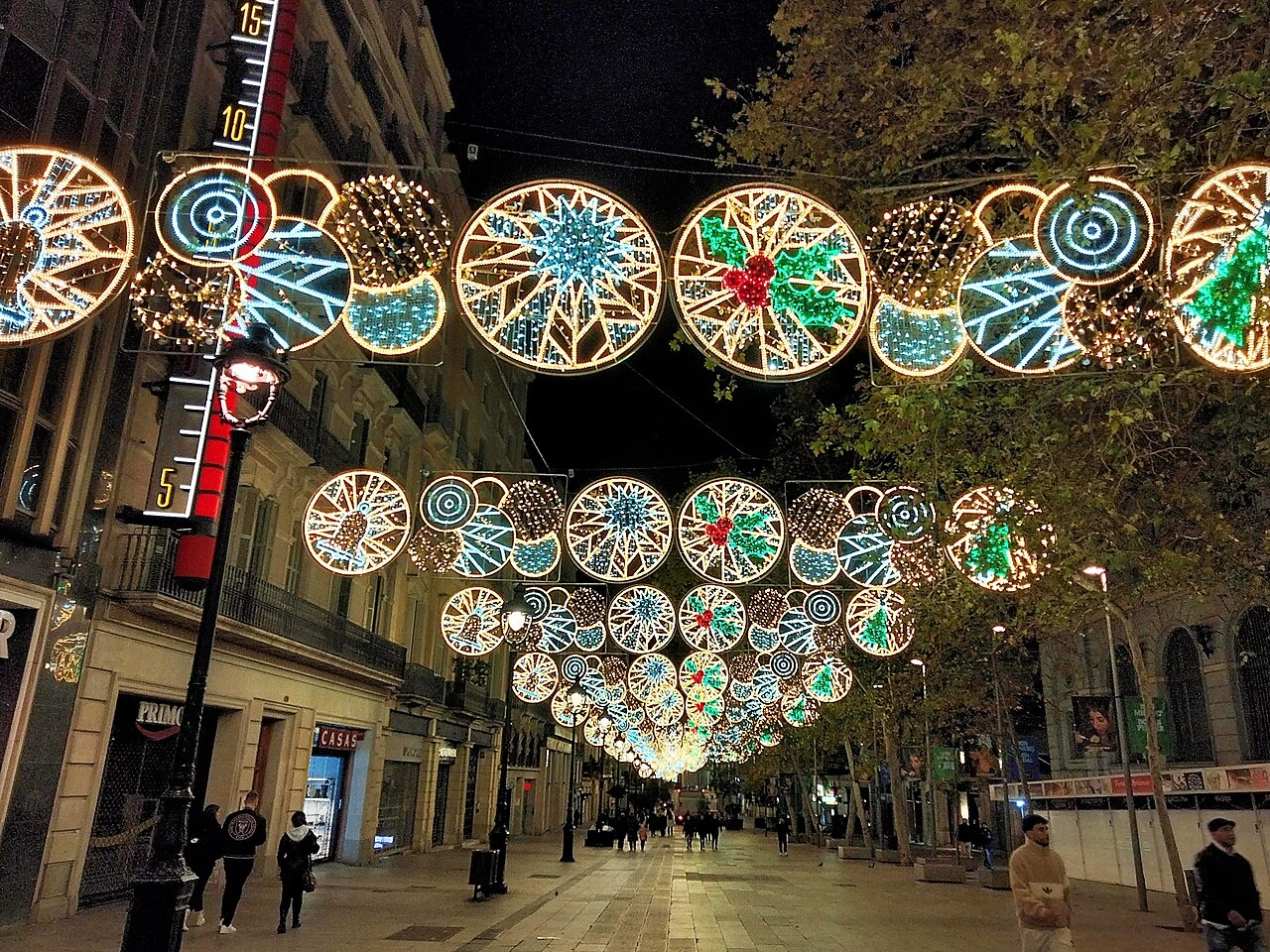
Luces de Navidad en la avenida Puerta del Ángel – By Pere López Brosa – Own work, CC BY-SA 4.0, https://commons.wikimedia.org/wiki/Special:Redirect/page/145049781.
Perspectiva a pie en la avenida Puerta del Ángel – By Sergei Gussev – Barcelona, CC BY 2.0, https://commons.wikimedia.org/wiki/Special:Redirect/page/115618951.
Perspectiva a pie en la avenida Puerta del Ángel – By Puigalder – Own work, Public Domain, https://commons.wikimedia.org/wiki/Special:Redirect/page/6738884.
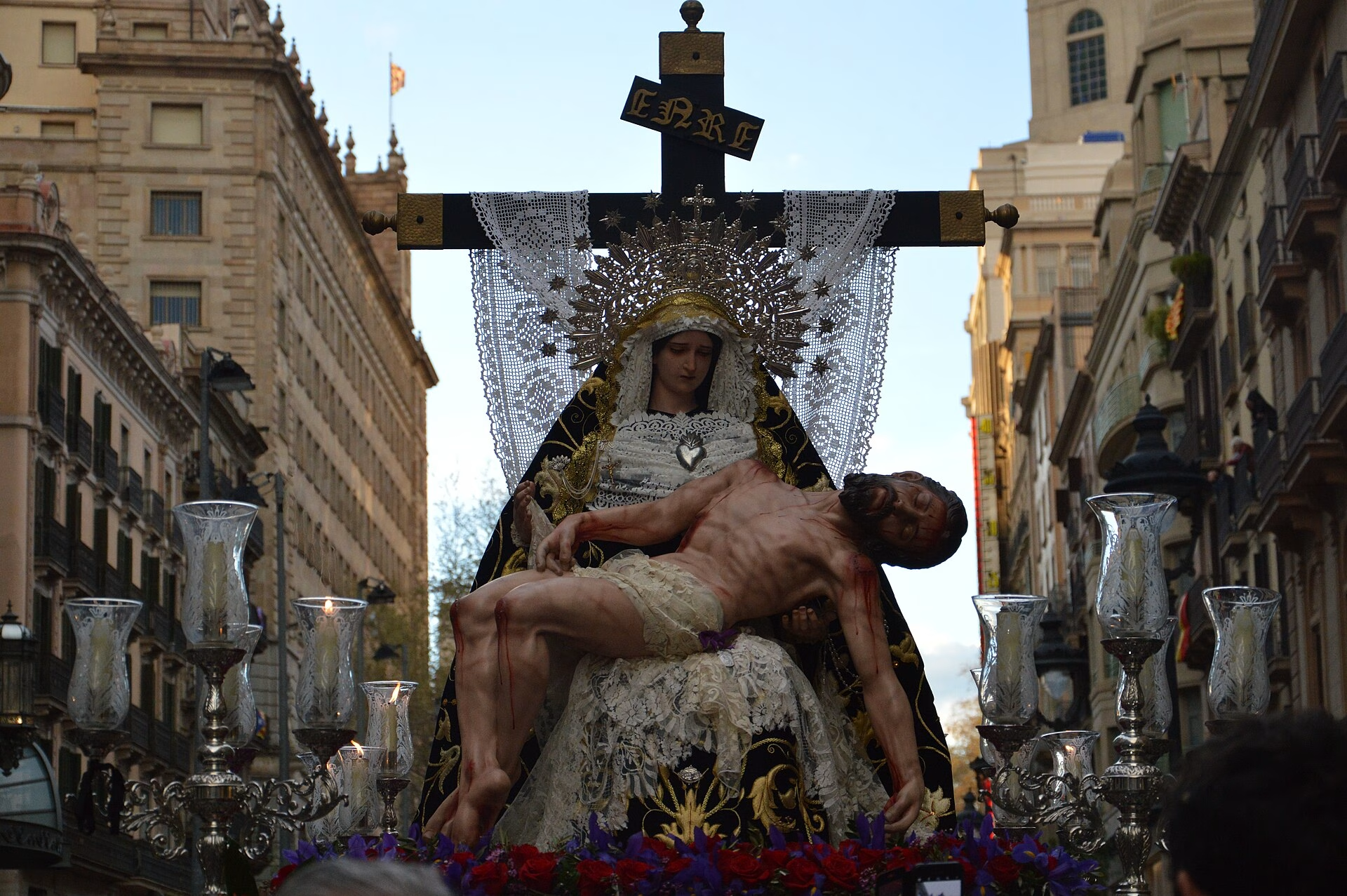
Imagen de Nuestra Señora de las Angustias de Barcelona en la Procesión General de Viernes Santo en la Puerta del Ángel – By Mpbarcelona – Own work, CC BY-SA 4.0, https://commons.wikimedia.org/wiki/Special:Redirect/page/76671177.
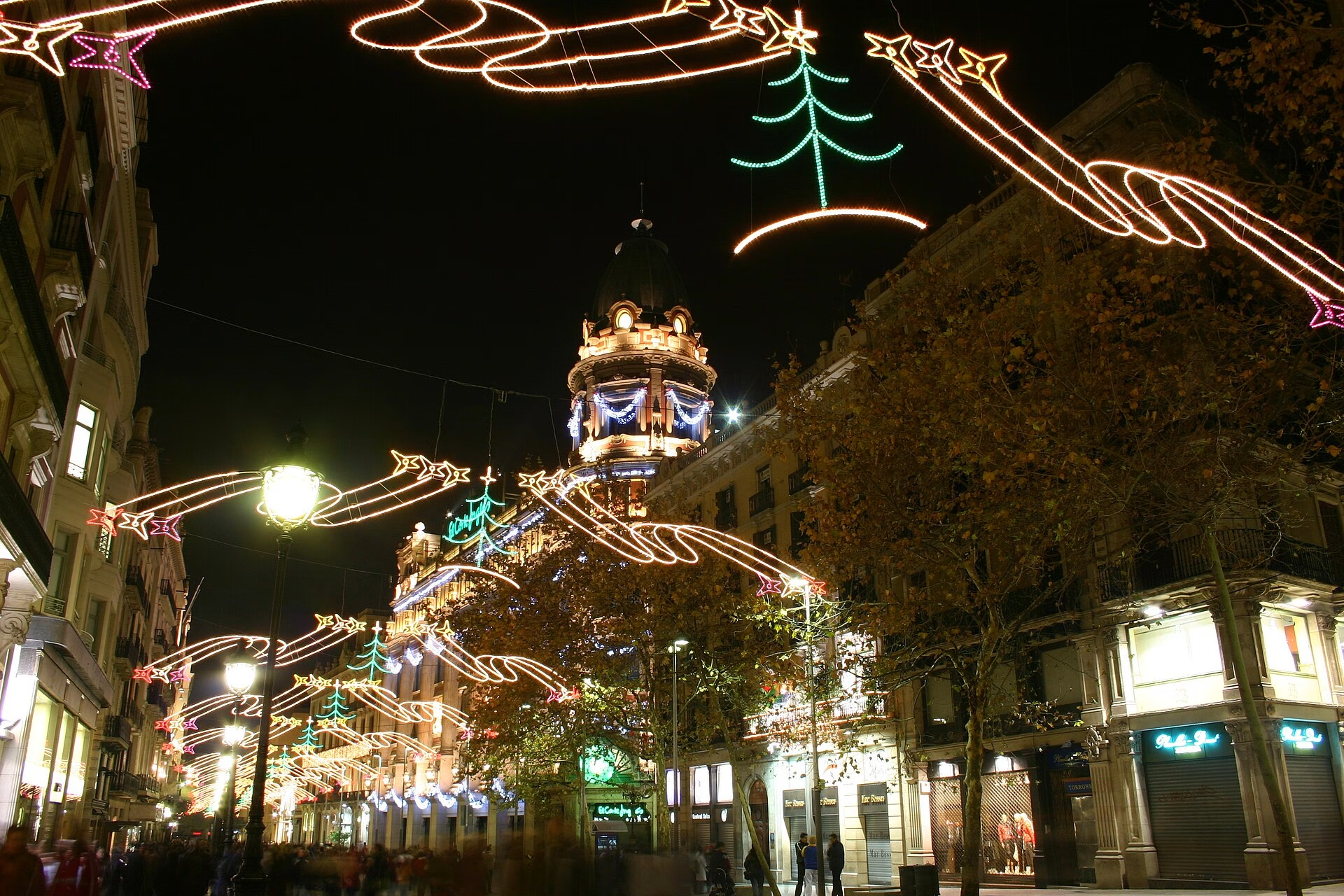
Iluminación navideña en la calle Portal del Ángel – By Year of the dragon – Own work, CC BY-SA 3.0, https://commons.wikimedia.org/wiki/Special:Redirect/page/481857.
Passeig de Gràcia Elegance, Architecture and Lifestyle in the Heart of Barcelona Passeig de Gràcia is one of Barcelona’s most iconic boulevards, an elegant avenue where history, architecture and cosmopolitan living come together in perfect harmony. Stretching from Plaça de Catalunya to Avinguda Diagonal, it …
Cadaqués: A Mediterranean Dream Cadaqués, the easternmost village on the Iberian Peninsula, is a place where time seems to stand still and the light of the Mediterranean transforms every moment into an unforgettable memory. Its narrow, whitewashed streets, houses that seem to embrace the sea, …