Getaway to Montserrat Abbey and Its Magic Mountain.

A Getaway to Montserrat Abbey and its Magical Mountain
There are places you visit.
And there are places you feel.
Montserrat is one of them.
Just over an hour from Barcelona, among extraordinary rock formations, forests and mountain trails, lies one of Catalonia’s most unique landmarks: the Benedictine Abbey of Montserrat.
A place where nature, spirituality, history and silence seem to come together in perfect harmony.
At around 720 metres above sea level, in the heart of Montserrat Natural Park, the monastery overlooks a landscape that has inspired legends, pilgrimages and dreams for centuries.
That is why, for us, Montserrat is not simply a day trip.
It is a getaway to pause, breathe and discover somewhere truly different.
The Journey Is Part of the Destination
Montserrat is located approximately 58–60 kilometres from Barcelona, around an hour by car, depending on traffic.
But once we leave the city behind, the experience truly begins.
The urban landscape gradually disappears.
The roads wind their way through mountains and forests.
And suddenly, those unmistakable rock formations of Montserrat appear before us.
Towers, pinnacles and stone giants seem to rise towards the sky.
It is then that we understand why this mountain has been known for centuries as the Magical Mountain.
Here, the journey is not simply the road to a destination.
The journey itself is part of the experience.
The Mountain of Legends
Montserrat is a mountain that seems to have been created to tell stories.
Its rocks, shaped by nature over millions of years, take on forms that awaken the imagination.
Some resemble castles.
Others, sleeping giants.
And others seem to represent figures that we only recognise once someone tells us their story.
For centuries, this landscape has been surrounded by legends.
The best known is undoubtedly the legend of the discovery of the Virgin of Montserrat.
But it is not the only one.
Stories of hermits, demons, miracles, battles and mysterious echoes have all contributed to the legends surrounding this mountain.
Perhaps that is why, when we walk among its rocks, we have the feeling that Montserrat hides something far beyond what we can see.
Montserrat Abbey
A Place of Faith Among the Mountains
At the heart of this landscape stands Montserrat Abbey.
For almost a thousand years, a Benedictine community has kept the spiritual tradition of the sanctuary alive, following the Rule of Saint Benedict and its well-known motto:
Ora et Labora.
Pray and work.
The monastic community has transformed Montserrat into a place of hospitality, study, culture, spirituality and contemplation.
Today, the community is made up of around seventy monks.
Their lives follow a rhythm very different from our own.
Prayer marks the day.
Study and work each have their place.
Culture forms part of their mission.
And hospitality makes the monastery a welcoming place for those who arrive here seeking answers, tranquillity, knowledge or simply a few moments of silence.
Montserrat is also an important cultural institution.
For decades, the Benedictine community has developed an extensive intellectual, artistic and publishing activity, helping to preserve and promote Catalan culture.
Its library houses manuscripts and documents of enormous historical and cultural value, including some of the oldest surviving testimonies of the Catalan language.
That is why, when we walk through Montserrat, we are not simply visiting a monastery.
We are entering a place where a way of life has remained alive for almost a thousand years.
And perhaps that is precisely what makes the silence of Montserrat feel different.
Here, Time Seems to Pass Differently
Here, time seems to pass differently.
More slowly.
With less noise.
With more space to observe.
And perhaps that is one of the most special experiences Montserrat has to offer:
the possibility of disconnecting from the world for a few hours.
La Moreneta
The Virgin Who Watches Over the Mountain
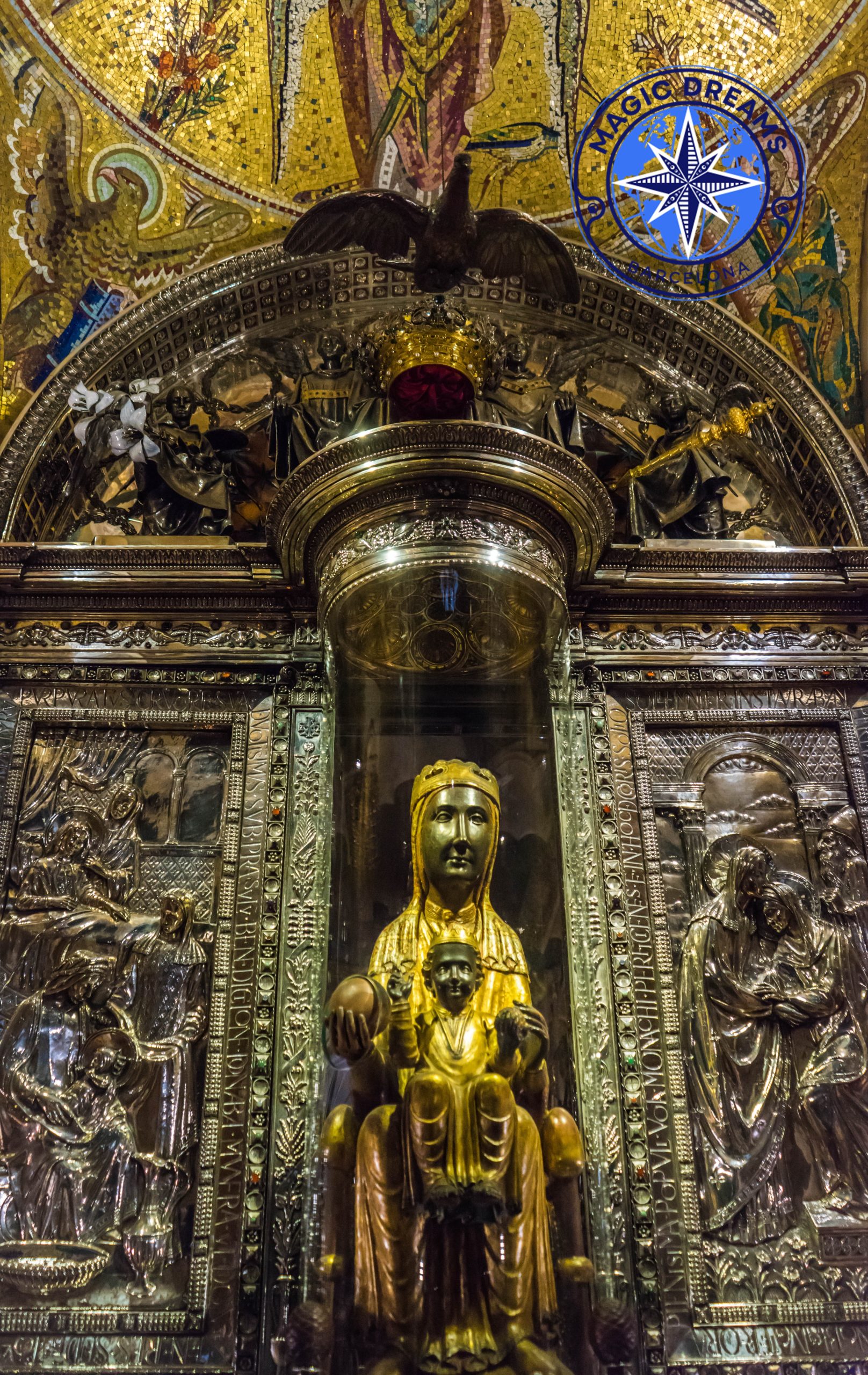
Inside the Basilica of Santa Maria de Montserrat, we find one of the most venerated religious images in Catalonia:
the Mare de Déu de Montserrat, popularly known as La Moreneta.
According to tradition, the image was discovered around the year 880 by shepherd children in the Santa Cova.
The sculpture we venerate today is a Romanesque wooden carving dating approximately from the late 12th century.
Its characteristic dark colour is the result of the natural oxidation of the varnish over the centuries.
But beyond its artistic and historical value, La Moreneta represents something much deeper for millions of people.
Faith.
Tradition.
Identity.
And a spiritual connection that has endured for generations.
The Santa Cova
Where the Story Began
One of the most special places in Montserrat is the Santa Cova, or Holy Cave.
According to tradition, this was precisely where the image of the Virgin was discovered.
The journey to the cave is an experience in itself.
We slowly descend along the mountain while the rocks, trees and silence accompany us.
Along the way, we encounter different sculptures and religious monuments that form part of the well-known Camí de la Santa Cova.
And it is precisely here that Montserrat takes on a particularly intimate dimension.
You do not have to be a believer to feel the power of this place.
Because some places convey something that is difficult to explain.
They are contemplated, walked through… and simply felt.
A Path Between Stone and Silence
There is an image that perfectly captures the essence of Montserrat.
A path.
The forest.
The enormous rock walls.
And, among the trees, a sculpture that reminds us of the spiritual meaning of this journey.
The representation of the Virgin Mary and Jesus wearing the crown of thorns makes us stop for a few seconds.
To observe.
To remain silent.
Because in Montserrat, even the sculptures seem to form part of the landscape.
It is not just a path… it is a story of faith carved into the mountains.
The Basilica
The Spiritual Heart of Montserrat
The Basilica of Santa Maria de Montserrat is the spiritual centre of the sanctuary.
Its history has been marked by periods of splendour as well as destruction.
During the Peninsular War against Napoleon’s troops, the monastery suffered severe damage and was subsequently rebuilt.
Inside, we find different artistic elements reflecting centuries of history.
Among them are the sculptures of the prophets Ezekiel, Jeremiah, Isaiah and Daniel, created by Josep Llimona in the late 19th century.
The large number of votive candles hanging inside the church is also particularly striking.
Each one represents a story.
A promise.
A family.
A city.
A person.
A request.
Or simply an expression of gratitude.
The Legends of the Magical Mountain
Between Reality and Imagination
Montserrat has always been surrounded by mystery.
Its extraordinary shapes, caves, forests and enormous stone pinnacles have inspired stories passed down from generation to generation for centuries.
It is therefore hardly surprising that popular tradition has transformed it into the Magical Mountain.
Some stories were born around the Virgin.
Others speak of demons, hermits, treasures and extraordinary events.
And others are connected to historical episodes that eventually became legends.
The Legend of the Discovery of La Moreneta
One of the best-known stories tells how, around the year 880, some shepherd children saw a mysterious light on the mountain.
The vision was repeated for several days.
The children returned with their families, and the authorities came to the site to discover what was happening.
According to tradition, they found the image of the Virgin there.
They tried to move it, but the statue became inexplicably heavy and they were unable to carry it away.
They interpreted this as a sign.
The Virgin wanted to remain on the mountain.
And that place would eventually become the spiritual heart of Montserrat.
Thus began one of the sanctuary’s most important traditions.
A story that, beyond faith, forms an inseparable part of the identity of this mountain.
The Woodcutter and the Pact with the Devil
But the legends of Montserrat also have a much darker side.
One popular story tells of a woodcutter who, desperate because of his circumstances, is said to have made a pact with the devil.
The mountain appears here as a mysterious setting, filled with caves, hidden paths and places where, according to tradition, supernatural events took place.
As with many ancient legends, it is difficult to separate history from imagination.
But perhaps that is precisely what makes them so fascinating.
Because in Montserrat, the boundary between reality and legend has always been particularly thin.
The Drum of El Bruc
There is another legend particularly connected to the history of Catalonia.
During the Peninsular War, Napoleon’s troops were advancing through the area.
According to popular tradition, a young drummer began beating his drum near the mountains of Montserrat.
The sound bounced off the rock walls.
The echoes multiplied the noise.
And from a distance, it sounded as though a much larger army was approaching.
Confused by the sound, which seemed to come from everywhere at once, the French soldiers are said to have eventually retreated.
Over time, the legend of the Drum of El Bruc was born.
A story in which the landscape once again becomes the protagonist.
Because in Montserrat, even an echo can become part of a legend.
Witches and Spirits of the Mountain
For centuries, stories have also circulated about witches, supernatural beings and mysterious gatherings in the most hidden parts of Montserrat.
The caves and rock formations provided the perfect setting for such tales.
When night falls and mist settles among the stone pinnacles, it is easy to understand how these stories may have emerged.
And perhaps that is why Montserrat has inspired such a powerful combination of devotion, respect and fascination for centuries.
A Mountain Between Faith and Mystery
Perhaps the most fascinating thing about Montserrat is precisely this combination.
On the one hand, we find almost a thousand years of Benedictine tradition.
Prayer.
Music.
The Virgin.
Pilgrims.
Culture.
Spirituality.
And at the same time, we find stories of miracles, legends, mysterious echoes and tales passed down through generations.
Faith and mystery.
History and nature.
Silence and legend.
Everything seems to coexist within the same landscape.
And when we walk along its paths, among the rocks and forests, it becomes easy to understand why Montserrat has inspired the imagination for centuries.
Perhaps the mountain does not have just one story.
Perhaps every person who visits takes their own story away with them.
When the Mountain Keeps Secrets
There is something special about walking through Montserrat without rushing.
We pass a hermitage.
We follow a path through the trees.
An extraordinary rock formation appears.
We discover a sculpture hidden among the vegetation.
And, for a moment, we can imagine all the people who have walked along the same path before us.
Monks.
Pilgrims.
Artists.
Hikers.
People searching for answers.
People simply searching for silence.
And then we understand that Montserrat is not merely a landscape.
It is also a mountain built from the stories of those who have walked through it.
The Spiritual Map of Montserrat

At first glance, this map may appear to be nothing more than a composition of names, coats of arms, religious figures, and symbols. But when we look closely at each element, we discover a representation of the history of spirituality at the Monastery of Montserrat.
It is not simply a decorative image. Its figures and symbols form a kind of spiritual journey connecting prayer, inner discipline, contemplation, and monastic tradition.
The Lamp: The Light of Prayer
At the center of the composition, we find a suspended lamp.
Its central position seems significant. The light can be understood as a symbol of prayer, living faith, and the inner life, a light that remains burning and connects the different elements of the map.
In a way, it is the spiritual heart of the entire composition.
García de Cisneros: The Exercitatorium
On one side appears García de Cisneros, Abbot of Montserrat and author of Exercitatorio de la vida espiritual, published in 1500.
The Exercitatorium was conceived as a guide for ordering the inner life through spiritual exercises, prayer, meditation, and contemplation.
That is why Cisneros represents a fundamental idea within the map: spirituality as a path and as a practice.
It is not simply about believing, but about learning how to direct one’s attention inward.
Ignatius of Loyola: Montserrat and the Beginning of a Spiritual Journey
Next to Cisneros appears the name Ignatius / Ignasii, referring to Ignatius of Loyola.
In 1522, Ignatius arrived at Montserrat at a decisive moment in his spiritual transformation. His stay at Montserrat is historically associated with the spiritual tradition developed by García de Cisneros.
This connection is particularly fascinating because Ignatian spirituality would later place strong emphasis on meditation, contemplation, discernment, and examination of the inner life.
Some Spiritual Exercises
One of the best-known elements of the Spiritual Exercises is meditation on the life of Christ.
The practitioner uses the imagination to place themselves within a Gospel scene: observing the setting, the people, their words, and their actions, and then reflecting on what the scene awakens within their own inner life.
Another important practice is the Examen: taking time at the end of the day to review what has been lived, recognizing what has brought one closer to what is good and what has led one away from it, and using that reflection to find a direction for the following day.
There is also contemplation, understood not simply as thinking about a subject, but as remaining attentively present before it, allowing the experience to gradually transform the person.
These exercises reveal an idea that connects particularly well with the map:
spirituality as an inner journey, practiced step by step.
Bartomeu Garriga
On the opposite side appears Bartomeu Garriga, a figure connected with the spiritual tradition of the Montserrat community.
His presence expands the map beyond a single individual and reminds us that the monastery’s spiritual tradition was shaped through generations of religious figures, spiritual teachers, and communities.
Coats of Arms and Ecclesiastical Figures
In the upper and lower sections, we find different coats of arms, religious figures, and ecclesiastical references.
These elements represent the institutional and spiritual memory of the monastery: abbots, religious figures, and others who form part of Montserrat’s history.
The coats of arms function as small pieces of memory within the map, while the human figures remind us that this spiritual tradition was transmitted from one generation to the next.
The Meaning of the Map
When we bring all the elements together, a deeper reading begins to emerge:
Cisneros → Spiritual Exercise → Prayer → Meditation → Contemplation → Ignatius
The lamp illuminates the entire composition, while the names, coats of arms, and figures create a spiritual memory around it.
This is why the map can be understood as a symbolic representation of how Montserrat became, over the centuries, a place of prayer, inner transformation, and contemplation.
And perhaps that is the key to understanding it:
We are not simply looking at a map of places, but at a map of the spiritual life.
The Music of Montserrat
There is a moment in Montserrat capable of completely transforming the visit.
When the music of the Escolania de Montserrat begins to fill the air.
This boys’ choir, one of the oldest in Europe, has formed part of the sanctuary’s musical tradition for centuries.
Their voices fill the basilica as the sound blends with the architecture and the silence.
And for a few minutes, everything seems to stop.
It does not matter how long we have been walking.
It does not matter how many photographs we have taken.
In that moment, we simply listen.
And we understand that Montserrat can also be discovered through sound.
A Mountain to Explore on Foot
Montserrat does not end at the monastery.
In fact, that is where another experience begins.
The mountain is crossed by paths that allow us to discover different viewpoints, hermitages, trails and rock formations.
For hiking enthusiasts, it is a true paradise.
We can choose peaceful walks or more demanding routes.
Walk through forests.
Climb towards the viewpoints.
Discover small hermitages hidden in the landscape.
Or simply sit facing the scenery and watch the mountains disappear into the horizon.
There is no need to rush.
Montserrat is best enjoyed at a slower pace.
Sant Joan
The Sky from Above
One of the most spectacular places in Montserrat is the area around Sant Joan.
We can reach it on foot or by funicular.
From there, the views open out across the Catalan landscape and allow us to truly appreciate the scale of the mountain.
The pinnacles of Montserrat rise all around us while the horizon stretches far beyond.
It is one of those places where sitting quietly for a few minutes feels completely natural.
Because when we are up there, the mountain does something very simple:
it reminds us how small we are in the face of nature.
The Mountain at Sunset
If there is a particularly special time to visit Montserrat, it is when evening begins to fall.
The light changes.
The rock walls take on golden tones.
The shadows stretch across the forest.
And little by little, the visitors begin to disappear.
Montserrat becomes silent once again.
It is one of those moments we especially recommend for a romantic getaway.
Walking together.
Sitting in front of the landscape.
Watching the light slowly disappear.
And letting the mountain do the rest.
A Night Under the Stars
For those who want to experience Montserrat in an even more special way, the mountain also offers the possibility of spending the night in a mountain refuge.
Sleeping away from the city lights completely changes our perception of the place.
When night falls, the sky fills with stars.
The noise disappears.
The forest becomes silent.
And the mountain takes on a completely different dimension.
A simple experience, but one that is difficult to forget.
Because sometimes we do not need luxury to experience something extraordinary.
All we need is a place to look up at the sky.
Art and Culture
Montserrat is also a first-class cultural destination.
The Montserrat Museum, founded in 1911, houses an extraordinary art collection.
Its holdings include works by artists such as El Greco, Caravaggio, Tiepolo, Fortuny, Rusiñol, Casas, Nonell, Picasso and Dalí, as well as works connected to French Impressionism and contemporary art.
The museum also includes spaces specifically dedicated to Marian iconography and religious art.
It is one of those visits that particularly surprises people who arrive in Montserrat expecting to find only a monastery.
Because here, culture is also part of the mountain.
Getting There Is Also an Experience
One of the advantages of Montserrat is that we can choose different ways to reach it.
The Montserrat Rack Railway climbs from Monistrol, offering spectacular views along the journey.
We can also take the Aeri de Montserrat cable car, which allows us to experience the mountain from a completely different perspective.
And once we are there, the Sant Joan and Santa Cova funiculars provide access to different parts of the surrounding area.
Each option offers a different experience.
And that is precisely the magic of Montserrat:
there are many ways to discover it.
Montserrat for a Romantic Getaway
Montserrat can also become the perfect escape for two.
A morning walking through the forests.
A visit to the basilica.
A walk to the Santa Cova.
Lunch overlooking the mountains.
An afternoon taking in the scenery.
And, if we want to extend the experience, a night away from the noise of Barcelona.
There is no need to fill the day with activities.
Sometimes, a romantic getaway simply means sharing the silence with the person we love.
Montserrat with Magic Dreams Barcelona
At Magic Dreams Barcelona, we design completely personalised getaways to Montserrat.
We adapt each experience to the pace, interests and preferences of our clients.
We can organise private excursions, transportation, cultural visits, hiking routes, gastronomic experiences, spiritual journeys and romantic experiences specially designed for couples.
Because not everyone wants to discover Montserrat in the same way.
Some are looking for nature.
Others, history.
Others, spirituality.
Others simply want to escape Barcelona for a few hours.
And we believe that a truly special experience begins precisely there:
by designing the journey around the person experiencing it.
We provide assistance in Spanish, Catalan and English, and, with advance notice, we can accommodate other languages.
We take care of every detail so that our clients do not have to worry about the organisation.
They simply enjoy.
The Other Gateway to Montserrat
Can Maçana, Where the Adventure Begins
There is another way to reach Montserrat.
A different gateway, much more closely connected to hikers, climbers and nature lovers.
We head towards Can Maçana, at the western end of the massif, along the road connecting El Bruc with Montserrat.
Here we find a large parking area and a rest and picnic area, with tables and spaces surrounded by trees, serving as a starting point for discovering one of the most spectacular parts of the mountain.
This is where another Montserrat begins.
A Montserrat of backpacks.
Hiking boots.
Trails.
Climbers.
Forests and enormous rock walls.
And, above all, paths that lead us towards the impressive Agulles region.
A Picnic Before Entering the Mountains
There is something particularly pleasant about Can Maçana.
Before beginning the hike, we can stop, take a breath and enjoy the tranquillity of the surroundings.
The picnic tables are set on small natural terraces among the trees, facing the first rock walls of Montserrat.
It is the perfect place to prepare our backpack, have a leisurely breakfast or regain our strength after a hike.
For many years, this area has also been part of the tradition of family outings and mountain gatherings.
Today, we must respect the rules of the Natural Park and not light fires, but the essence remains:
sitting together,
sharing something to eat,
taking in the mountain,
and deciding which path to take.
Because from here, we have several possibilities.
And each one leads us towards a different experience.
Towards the Agulles
From Can Maçana begins one of the best-known routes into the Agulles region.
The path gradually climbs and, almost without realising it, the first rock formations begin to appear among the trees.
The mountain grows before us.
At first, we see the walls in the distance.
Then they are almost above us.
And finally, we find ourselves walking among them.
The Roca Foradada, the Cadireta, the Agulles and the different monoliths that form this sector create one of the most characteristic landscapes of Montserrat.
It is a completely different Montserrat from the one we discover around the monastery.
Here, we are not simply looking.
Here, we walk in order to discover.
A Mountain for a Full Day
This area offers different types of hiking experiences.
We can take a short route and simply enjoy the landscape.
We can walk to the Roca Foradada.
We can explore part of the Agulles region.
Or, for those who are more experienced, we can take on more demanding routes that enter the steeper sections of the massif.
Some routes require experience, good physical condition and appropriate equipment, particularly where there are channels, rocky passages or exposed sections.
That is why Montserrat offers something for different types of hikers.
From a peaceful morning in nature…
to genuine mountain adventures.
The Vicenç Barbé Refuge
Sleeping in the Heart of the Magical Mountain
In the middle of this impressive region, we find a small mountain refuge that has become one of the most special places for those exploring Montserrat on foot.
It is the Vicenç Barbé Refuge.
Located at around 892 metres above sea level, in the heart of the Agulles region, this refuge is currently the only staffed mountain refuge in the Montserrat massif.
It has capacity for around 20 people and is mainly intended for hikers, trekkers and climbers.
The refuge was opened in 1961 and is named after climber Vicenç Barbé, who died in 1942 while climbing in the Frares Encantats area.
Getting here is part of the adventure.
You cannot drive to the refuge.
You have to walk.
From Can Maçana, for example, reaching the refuge takes approximately 45 minutes on foot; from El Bruc, around an hour and a half; while from the monastery, the journey can take around four hours.
And perhaps that is precisely what makes it so special.
A Night Among the Pinnacles
Imagine sleeping here.
It means experiencing a completely different Montserrat.
As the last hikers leave the trails and evening begins to fall, the enormous rock pinnacles become enveloped in silence.
Inside the refuge, a wood-burning stove, blankets and the simple atmosphere of a mountain refuge create a genuine sense of shelter against the vastness of the mountains.
This is not a luxury hotel.
And that is precisely where its magic lies.
Here, luxury means something else.
Sleeping surrounded by nature.
Waking up among the pinnacles of Montserrat.
Listening to the silence.
Opening the door in the morning to a landscape that seems to belong to another world.
The refuge offers basic facilities for mountaineers, including a wood-burning stove, blankets, toilets and food and drinks when the refuge is staffed.
The Magical Mountain
Montserrat is not simply a mountain.
It is a landscape.
A story.
A tradition.
A place of faith.
A natural refuge.
A museum.
A trail.
And, for many, a place they always wish to return to.
At Magic Dreams Barcelona, we invite you to discover it without rushing.
To walk.
To listen.
To contemplate.
To breathe.
To share.
Because there are destinations you visit once…
and others that, somehow, are always waiting for us.
Montserrat is one of them.




Copyright © 2016-2026 Magic Dreams Barcelona.