The Creation of Adam by Michelangelo: History, Meaning and Symbolism.
Few images in the history of Western art are as instantly recognizable as The Creation of Adam by Michelangelo.
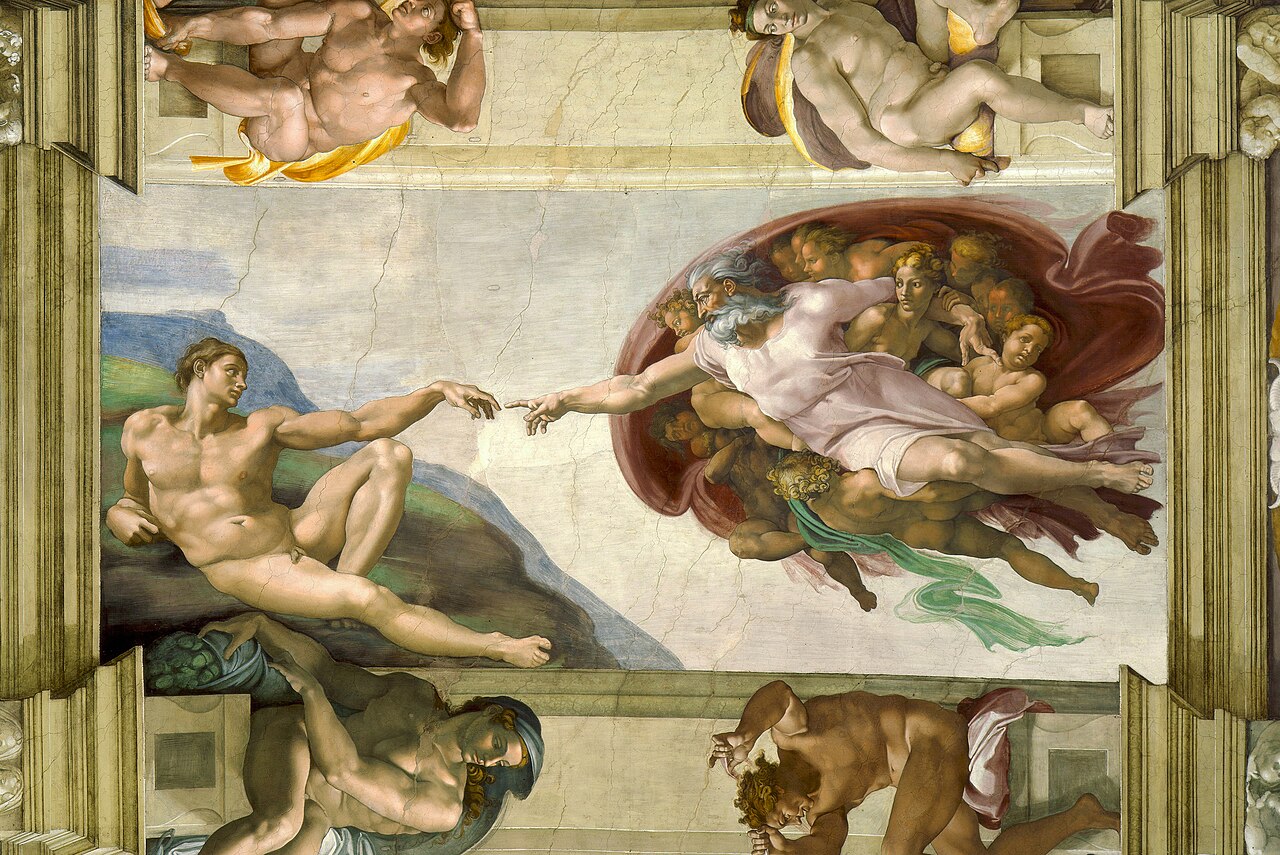
Two monumental figures stretch their arms toward one another across the painted space of the Sistine Chapel ceiling. God extends his hand toward Adam, while the first man raises his arm to receive the divine spark of life.
Their fingers almost touch.
But they do not.
That tiny space between the two hands has become one of the most famous visual symbols in the world. It has been interpreted as the moment when God gives life to humanity, as a representation of the relationship between the divine and the human, and even as a metaphor for human intelligence and consciousness.
Painted by Michelangelo Buonarroti between approximately 1508 and 1512, The Creation of Adam forms part of the extraordinary fresco cycle decorating the ceiling of the Sistine Chapel in Vatican City.
It is not simply a painting about the creation of the first man.
It is a work about life, God, humanity, beauty, the body, spirituality and the extraordinary Renaissance belief in human dignity.
To understand it fully, however, it is necessary to understand the artist who created it.
Who was Michelangelo?
Michelangelo di Lodovico Buonarroti Simoni was born on March 6, 1475, in Caprese, in Tuscany, Italy.
He died in Rome on February 18, 1564, at the age of 88.
He was one of the greatest artists of the Italian Renaissance and worked as a sculptor, painter, architect and poet.
Unlike many artists who specialized in one medium, Michelangelo moved between several disciplines throughout his extraordinarily long career.
His reputation was already enormous before he painted the Sistine Chapel ceiling.
Among his most celebrated works are the Pietà, created in his youth, and the monumental David, which became one of the defining masterpieces of Renaissance sculpture.
Michelangelo considered himself primarily a sculptor.
This is important when looking at The Creation of Adam.
The figures he painted do not seem flat or decorative. They appear almost carved from stone.
Their muscles, shoulders, arms and hands have an extraordinary sculptural quality.
The human body became one of Michelangelo’s most powerful artistic languages.
Michelangelo’s personality
Michelangelo was known for his extraordinary ambition, discipline and independence.
He could also be difficult, suspicious and intensely demanding.
He frequently disagreed with powerful patrons and defended his artistic decisions strongly.
His relationship with Pope Julius II, who commissioned the Sistine Chapel ceiling, was famously complicated.
Both men were ambitious and determined.
Julius II wanted monumental works that would reinforce the prestige of the papacy.
Michelangelo wanted to create art of exceptional quality and lasting significance.
Their relationship included disagreements, delays and tensions, but it also produced some of the most important works of the Renaissance.
The Sistine Chapel ceiling became one of the greatest results of this complicated relationship.
Michelangelo’s personal beliefs and spirituality
Michelangelo lived in a profoundly Christian society, and religion was central to his artistic world.
The Bible, Christ, salvation, sin, death and eternal life appear repeatedly throughout his work.
However, his religious life was not simply a matter of producing commissioned religious paintings.
His poetry reveals a deeply personal concern with spiritual questions.
During his later years, Michelangelo became particularly interested in questions of faith, salvation, mortality and divine grace.
His relationship with the poet Vittoria Colonna was especially significant.
Colonna was deeply religious, and the two developed an important intellectual and spiritual friendship.
Their correspondence and exchange of poetry reveal an artist who was increasingly concerned with the relationship between earthly beauty and spiritual truth.
This context is useful when interpreting Michelangelo’s representation of the human body.
His fascination with the body was not necessarily opposed to his spirituality.
For Michelangelo, physical beauty could point toward something beyond the physical world.
The Renaissance: a new vision of humanity
Michelangelo belonged to the High Renaissance, one of the most extraordinary periods in European art.
The Renaissance was characterized by renewed interest in the classical world, scientific observation, anatomy, perspective, mathematics and humanist philosophy.
But it is important to remember that the Renaissance was not a rejection of religion.
Much Renaissance art was profoundly religious.
What changed was the way artists represented humanity.
Human beings increasingly appeared as intelligent, beautiful and dignified creatures.
This is one of the central ideas visible in The Creation of Adam.
Adam is not shown as weak or insignificant.
He has the body of an idealized athlete.
His proportions are harmonious.
His body is monumental.
He looks almost like a classical Greek or Roman sculpture.
Yet he is also completely human.
This combination of human beauty and divine creation lies at the heart of the painting.
The Sistine Chapel
The Sistine Chapel is located within the Vatican complex in Vatican City.
It takes its name from Pope Sixtus IV, who rebuilt the chapel during the late fifteenth century.
The walls were decorated by several of the leading painters of the Italian Renaissance, including Perugino, Botticelli and Ghirlandaio.
Several decades later, Pope Julius II commissioned Michelangelo to decorate the ceiling.
The project began in 1508.
Michelangelo completed the enormous ceiling in 1512.
The finished work contains a complex theological program.
At its center are nine scenes from the Book of Genesis, including:
- The Separation of Light from Darkness
- The Creation of the Sun, Moon and Plants
- The Separation of Land and Water
- The Creation of Adam
- The Creation of Eve
- The Temptation and Expulsion from Paradise
- The Sacrifice of Noah
- The Flood
- The Drunkenness of Noah
The Creation of Adam is therefore not an isolated image.
It forms part of a much larger visual narrative about the relationship between God and humanity.
What does The Creation of Adam represent?
The scene is based on the biblical account of the creation of humanity in Genesis.
The biblical text states that God created man in his own image.
Michelangelo transformed this theological statement into one of the most powerful images ever created.
Adam has already been formed.
His body lies on the earth.
But he has not yet received the divine gift of life.
God approaches him.
Their hands move toward one another.
The moment is suspended.
Adam is alive in physical form, but the painting represents the instant immediately before the divine act is completed.
The Vatican Museums describe the contact between the fingers as the focal point of the composition and interpret it as the transmission of the breath of life from God to Adam.
The famous hands
The hands are the visual heart of the painting.
God’s right arm extends toward Adam.
Adam’s left arm rises to meet it.
Their fingers almost touch.
That distance is extraordinarily small, but it creates enormous tension.
If the fingers were touching completely, the action would already have happened.
By leaving a gap, Michelangelo freezes the moment before the miracle.
The viewer becomes aware of anticipation.
Something is about to happen.
Life is about to pass from God to man.
The space between the fingers can therefore be understood as a visual representation of potential.
It is the moment between nothing and something.
Between lifelessness and life.
Between creator and creation.
Why do God and Adam look so similar?
One of the most important details is the physical similarity between the two figures.
God and Adam are both represented with powerful, idealized bodies.
This reflects the biblical idea that humanity was created in the image and likeness of God.
Michelangelo makes this theological concept visible.
The human being resembles the divine.
But there is also a striking difference.
God is full of movement.
Adam is relaxed.
God reaches.
Adam receives.
God is the active source of creation.
Adam is the recipient of life.
The contrast between these two bodies gives the composition much of its extraordinary energy.
Adam’s posture
Adam is not standing.
He lies on the earth, supported by one arm.
His body appears relaxed, almost as though he has just awakened.
His gaze is directed toward God.
There is no obvious fear.
There is no resistance.
There is simply expectation.
This posture is essential to the meaning of the painting.
Adam is not portrayed as an already complete, independent human being.
He is on the threshold of existence.
His body exists, but the divine spark has not yet been fully communicated.
The beauty of the human body
Michelangelo’s knowledge of anatomy was fundamental to his art.
The muscles, joints and proportions of his figures reveal his deep interest in the structure of the human body.
In The Creation of Adam, anatomy becomes more than a demonstration of artistic skill.
The body itself becomes symbolic.
Adam’s physical perfection communicates the idea that the human body is part of God’s creation.
This was particularly powerful within Renaissance culture.
The human body was no longer merely something to hide or ignore.
It could be studied.
It could be admired.
It could express beauty, movement, emotion and spirituality.
For Michelangelo, the body became one of the most sophisticated instruments through which spiritual ideas could be represented.
Why is Adam naked?
Adam’s nudity has an important biblical context.
The scene takes place before the Fall of Man.
According to Genesis, Adam and Eve initially lived in innocence and were naked without shame.
After eating the forbidden fruit, their relationship with their bodies changed and they became aware of their nakedness.
Michelangelo therefore uses Adam’s naked body to represent the original innocence of humanity.
His nudity is not merely anatomical.
It places him in the primordial state before sin.
God as a powerful human figure
Michelangelo’s representation of God was extraordinarily bold.
God appears as a powerful elderly man with a long beard and muscular body.
He is surrounded by figures and wrapped in a flowing mantle.
The composition gives the impression that God is moving rapidly through space.
This is important because God is not presented as a distant symbol.
He feels physically present.
His body occupies space.
His hand reaches toward Adam.
The invisible creator becomes visible through the human form.
This creates one of the central paradoxes of the painting:
the invisible God is represented through the visible human body.
The mysterious figures surrounding God
God is surrounded by numerous figures beneath his mantle.
One of the most discussed figures is the female-looking figure near him.
Some interpretations have suggested that this could represent Eve, waiting to be created.
Other interpretations identify the figure as an angel or another symbolic presence.
There is no definitive evidence that establishes one interpretation beyond doubt.
This is an important distinction when discussing Renaissance symbolism.
Some interpretations are supported by historical evidence.
Others are modern hypotheses.
The mystery contributes to the painting’s enduring fascination.
Is there a human brain hidden in the painting?
One of the most famous modern interpretations of The Creation of Adam concerns the shape surrounding God.
Several researchers have argued that the mantle and figures around God resemble the structure of a human brain.
According to this theory, Michelangelo may have incorporated a hidden anatomical reference into the composition.
The interpretation is especially interesting because it would connect divine creation with human intelligence and consciousness.
However, there is an important caveat.
There is no surviving statement from Michelangelo confirming that he deliberately painted a brain.
Therefore, it should be described as an interpretation or hypothesis, rather than an established fact.
This distinction is essential when discussing the symbolism of the work.
Neoplatonism and Renaissance thought
Michelangelo also lived within the intellectual culture of Renaissance Florence, where Neoplatonic ideas were influential.
Neoplatonism proposed, among other things, that visible beauty could lead the mind toward a higher spiritual reality.
This way of thinking was particularly influential among intellectual circles associated with the Medici.
The idea helps explain why physical beauty could have such profound spiritual significance in Renaissance art.
Michelangelo’s idealized bodies can therefore be interpreted on two levels.
They are physically beautiful.
But they can also represent a higher spiritual order.
In The Creation of Adam, the perfect body of Adam becomes an image of the beauty of God’s creation.
The meaning of the space between the fingers
The gap between the fingers has inspired countless interpretations.
It can symbolize:
The transmission of life.
The relationship between God and humanity.
The separation between creator and creature.
Human dependence upon the divine.
The potential for consciousness and intelligence.
The moment before existence begins.
The painting does not provide a single written explanation.
Its power comes partly from the fact that one simple gesture can accommodate multiple levels of interpretation.
Did Michelangelo paint an image of electricity?
Modern viewers sometimes compare the space between the fingers to an electrical spark.
It is a visually compelling analogy.
But it should not be presented as Michelangelo’s intention.
Michelangelo lived centuries before modern electrical science developed.
The original theological context is much clearer: the scene represents the creation of Adam and the transmission of life from God to humanity.
The comparison with electricity is therefore best understood as a modern metaphor, not historical evidence.
The Creation of Adam and human dignity
One of the most important Renaissance ideas visible in the painting is the dignity of humanity.
Adam is not a tiny figure lost beneath a powerful God.
He is monumental.
His body occupies a large part of the composition.
His physical beauty commands attention.
The message is subtle but powerful:
humanity is a remarkable creation.
The human being is earthly, but carries the image of the divine.
This is one of the reasons the painting has remained meaningful even outside strictly religious contexts.
It speaks about humanity itself.
Creation and the Fall
The position of The Creation of Adam within the Sistine Chapel ceiling is also important.
The story does not end with creation.
The following scenes introduce the creation of Eve, the temptation, the Fall and the expulsion from Paradise.
The sequence therefore creates a broader meditation on human existence.
First comes creation.
Then innocence.
Then temptation.
Then sin.
Then separation.
The human story begins with extraordinary beauty but also contains the possibility of failure.
This theological structure would have been deeply meaningful to Michelangelo and to the people who originally viewed the ceiling.
Michelangelo and the body: from creation to judgment
There is an extraordinary connection between the Sistine Chapel ceiling and Michelangelo’s later work in the same building.
More than twenty years after completing the ceiling, Michelangelo returned to the Sistine Chapel.
Between 1536 and 1541, he painted the monumental Last Judgment on the altar wall.
The contrast is remarkable.
On the ceiling, Michelangelo represents the beginning of humanity.
On the altar wall, he represents the ultimate judgment of humanity.
Creation and judgment therefore face each other within the same sacred environment.
The young Adam of the ceiling and the countless bodies of the Last Judgment belong to different stages of Michelangelo’s life, but together they form an extraordinary meditation on human existence.
Michelangelo’s later spiritual concerns
As Michelangelo grew older, his art became increasingly concerned with mortality and salvation.
His poetry reveals a growing awareness of death.
The human body, which had fascinated him throughout his career, became increasingly associated with the temporary nature of earthly existence.
His later religious works are often more emotionally intense.
Christ becomes central.
The idea of salvation becomes more urgent.
The beauty of the body remains, but it is increasingly placed within a spiritual struggle.
This makes The Creation of Adam especially interesting when viewed as part of his entire career.
The painting captures humanity at the beginning.
Michelangelo’s later works ask what happens to humanity at the end.
Michelangelo as a poet
Michelangelo’s poetry is an important but sometimes overlooked part of his legacy.
He wrote poems throughout his life, particularly sonnets and other compositions dealing with love, beauty, spirituality and death.
His relationship with Vittoria Colonna encouraged this more introspective side of his personality.
His poems show that Michelangelo was not merely interested in creating beautiful objects.
He was deeply concerned with questions such as:
What is beauty?
What is the purpose of human existence?
What happens after death?
Can earthly beauty lead toward God?
What is the relationship between the physical and the spiritual?
These questions can add another layer to our understanding of his visual art.
Where is The Creation of Adam today?
Unlike many famous works that have been removed from their original locations and placed inside museums, The Creation of Adam remains in the place for which Michelangelo created it.
It is located on the ceiling of the Sistine Chapel, within the Vatican Museums in Vatican City, Rome.
This is one reason why seeing it in person is such a different experience from seeing a reproduction.
The painting is not an isolated canvas.
It is part of an enormous architectural and theological environment.
The viewer stands beneath the entire ceiling and sees The Creation of Adam as one element within Michelangelo’s monumental narrative.
Can you visit The Creation of Adam?
Yes.
The Sistine Chapel is included in the route through the Vatican Museums.
Visitors normally enter the Vatican Museums and follow the museum route before reaching the Sistine Chapel.
The official Vatican Museums website currently lists general opening hours of:
Monday to Saturday: 8:00 a.m. – 8:00 p.m.
The last admission is at 6:00 p.m.
On the last Sunday of the month, the museums generally open from 9:00 a.m. to 2:00 p.m., with last admission at 12:30 p.m., and admission is free on that day.
Opening hours and exceptional closures can change, so visitors should always check the official Vatican Museums calendar before planning their visit.
How to buy tickets
The Vatican Museums recommend purchasing tickets through their official online ticket portal.
This is particularly important because unofficial websites may sell Vatican tickets at significantly higher prices or imitate official booking pages.
For an international visitor, checking the official website before travelling is the safest way to confirm:
- opening dates;
- opening hours;
- ticket prices;
- availability;
- guided tours;
- special access;
- temporary closures.
The official Vatican Museums website is the authoritative source for current visitor information.
What should you wear?
The Sistine Chapel is a sacred religious space as well as a major cultural attraction.
Visitors are expected to follow a dress code.
The Vatican Museums indicate that clothing should cover the shoulders and knees. Very revealing clothing is not appropriate, and hats should be removed inside the chapel.
These rules apply regardless of whether someone is visiting primarily for religious or artistic reasons.
Can you take photographs inside the Sistine Chapel?
Visitors should also be aware that photography and filming are prohibited inside the Sistine Chapel.
This is particularly relevant because many visitors expect to photograph The Creation of Adam once they reach the chapel.
The best way to experience the work is therefore to take the time to observe it directly rather than concentrating on obtaining a photograph.
How to look at The Creation of Adam in person
When you finally enter the Sistine Chapel, it is tempting to immediately look for the famous hands.
But there is a better way to experience the work.
First, look at the entire ceiling.
Notice how the scenes relate to one another.
Then find The Creation of Adam.
Look at God.
Look at Adam.
Look at the movement of God’s body.
Look at Adam’s relaxed posture.
Then look at the hands.
Finally, concentrate on the tiny space between the fingers.
The longer you look, the more powerful the composition becomes.
Where is Michelangelo buried?
Although Michelangelo died in Rome, his remains were later transferred to Florence.
He was ultimately buried in the Basilica of Santa Croce, one of Florence’s most important historic churches.
His monumental tomb was designed by Giorgio Vasari.
The church contains memorials to numerous important figures from Florentine history.
For anyone interested in Michelangelo, visiting Santa Croce provides an opportunity to see another side of his story: not the monumental artist working on the ceiling of the Sistine Chapel, but the elderly man whose life had finally come to an end.
Michelangelo’s legacy
Michelangelo died in 1564, but his influence never disappeared.
His understanding of the human body transformed Renaissance art.
His approach to sculpture influenced generations of artists.
His painting helped redefine the possibilities of monumental fresco.
His architectural work influenced the development of European architecture.
And his poetry reveals a deeply personal intellectual and spiritual world.
Yet among all his achievements, The Creation of Adam has perhaps become his most universal image.
The two hands have been reproduced thousands of times.
They appear in books, documentaries, advertisements, posters and popular culture.
But the original remains remarkably powerful.
Why The Creation of Adam still matters
More than five centuries after Michelangelo painted it, people continue to ask what the painting means.
Perhaps the answer is not limited to one interpretation.
For a religious viewer, it can represent the moment when God gives life to humanity.
For an art historian, it is an extraordinary synthesis of Renaissance humanism, Christian theology and classical beauty.
For someone interested in philosophy, it can represent the relationship between creator and creation.
For another viewer, it can symbolize consciousness, human potential or the search for something greater than ourselves.
And for many people, it is simply one of the most beautiful images ever created.
The genius of the unfinished moment
The most remarkable thing about The Creation of Adam may be that Michelangelo did not show the miracle after it happened.
He showed it just before.
God’s finger approaches.
Adam’s finger responds.
The gap remains.
The entire meaning of the scene is concentrated in that fraction of space.
The viewer knows what is about to happen.
But the painting never actually shows the moment of contact.
That is why the image remains so alive.
It is not a completed action.
It is an eternal instant of anticipation.
The Creation of Adam: a meeting between heaven and humanity
Michelangelo’s masterpiece brings together some of the defining ideas of the Renaissance.
It celebrates the human body while remaining deeply connected to Christian theology.
It presents humanity as earthly but made in the image of God.
It transforms a biblical passage into an emotionally powerful visual experience.
And it demonstrates how a single gesture can communicate an enormous philosophical idea.
The two hands are separated by only a few centimeters.
Yet that distance can represent the entire relationship between God and humanity, creator and creation, spirit and body, life and existence.
That is the extraordinary achievement of Michelangelo.
He took one of the oldest stories in Western culture and transformed it into an image that still speaks to people more than five hundred years later.
The Creation of Adam is not simply a painting about the beginning of man.
It is a painting about what it means to be human.
Copyright © 2016-2026 Magic Dreams Barcelona.