Boí Valley: Skiing, Romanesque Art, Thermal Waters and Nature.
There are places you travel to in order to disconnect, and others that make you wish you could stay a few more days. The Boí Valley, in the heart of the Catalan Pyrenees, belongs firmly to the second category.
Surrounded by high mountains, small stone villages, Romanesque churches, forests, alpine meadows, thermal waters and the spectacular landscape of Aigüestortes i Estany de Sant Maurici National Park, the valley brings together an extraordinary concentration of natural and cultural heritage within a relatively small area.
Here, you can ski in winter, hike among lakes and waterfalls in summer, observe wildlife, discover one of the most important concentrations of Romanesque art in Catalonia, enjoy mountain cuisine and end the day relaxing in the thermal waters of Caldes de Boí.
It is precisely this combination that makes the Boí Valley such an appealing destination for a getaway combining nature, wellness, culture and gastronomy.
Where is the Boí Valley?
The Boí Valley is located in the Alta Ribagorça comarca, in the province of Lleida, in the Catalan Pyrenees.
The municipality comprises eight small population centres and preserves an exceptional architectural and natural heritage. The valley’s historic isolation helped preserve many of its traditional buildings and much of its landscape.
Its main attractions include:
- Taüll.
- Boí.
- Barruera.
- Erill la Vall.
- Durro.
- Cóll.
- Cardet.
- Pla de l’Ermita.
- Caldes de Boí.
- Boí Taüll.
- Aigüestortes i Estany de Sant Maurici National Park.
- The Romanesque churches designated a UNESCO World Heritage Site.
- Caldes de Boí Spa.
The altitude and terrain mean that the landscape changes dramatically throughout the year.
Taüll: the village of the great Pyrenean Romanesque heritage
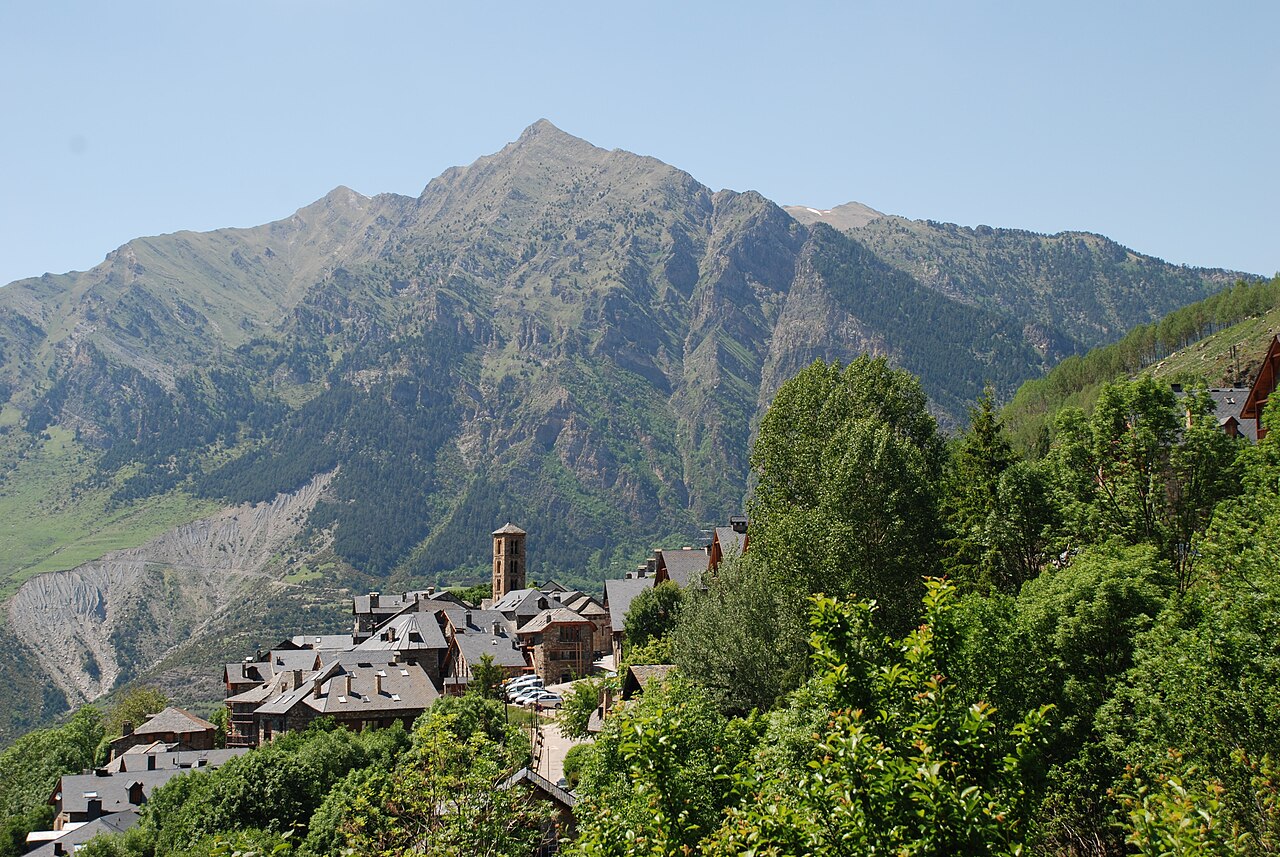
Taüll, located at around 1,510 metres above sea level, is probably one of the best-known names in the Boí Valley.
Historically, it was of considerable importance within the valley and served as a stopping point on routes crossing the mountains. Today, it is one of the essential places for understanding the region’s Romanesque heritage.
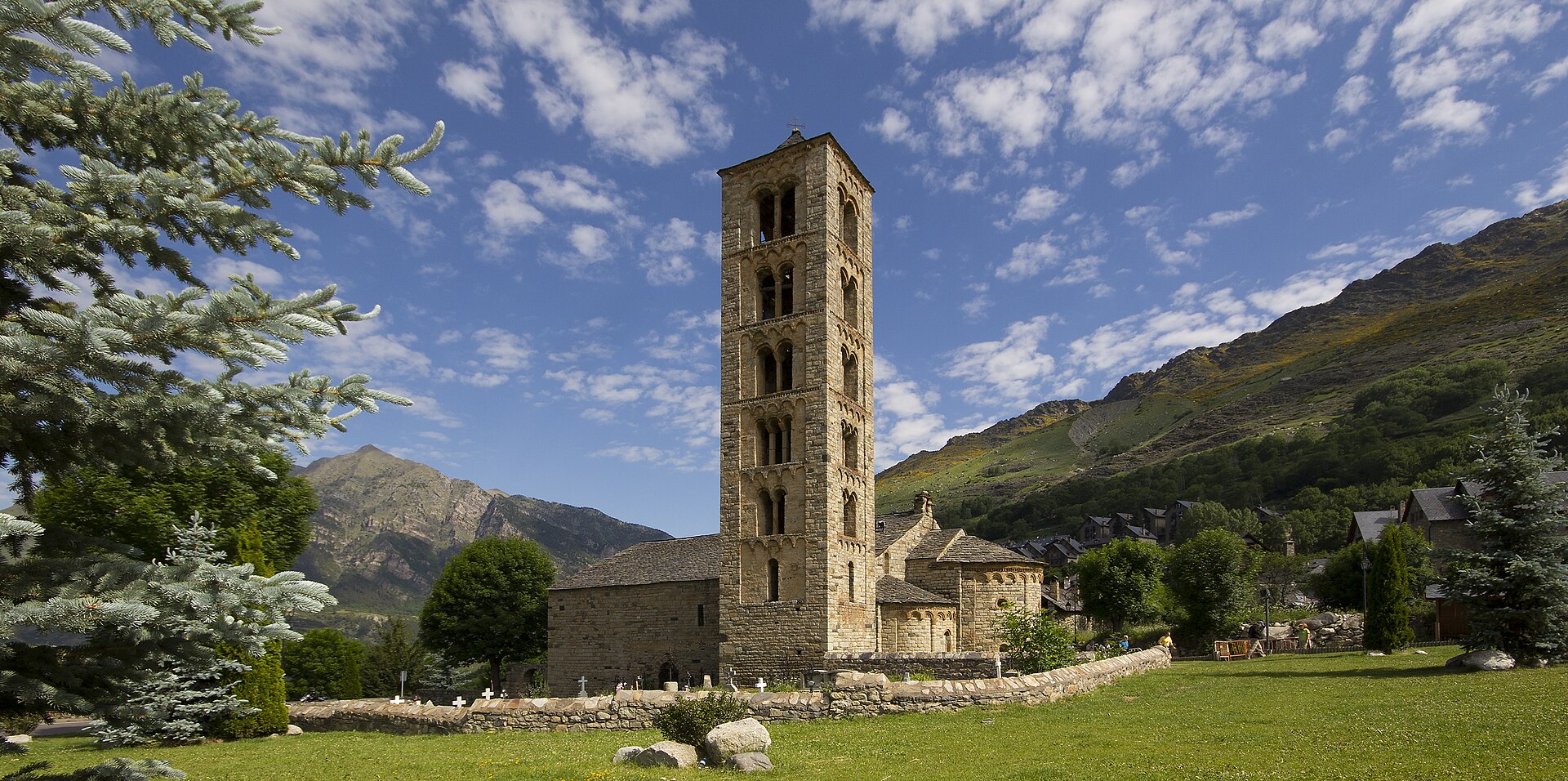
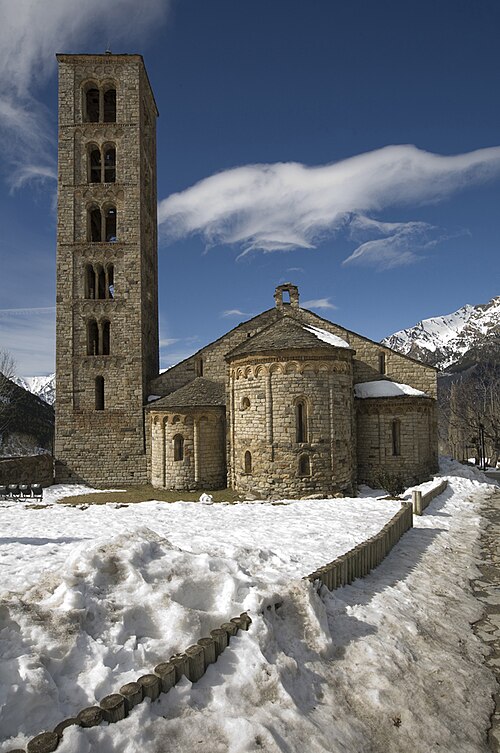
Its most prominent landmarks are the churches of Sant Climent de Taüll and Santa Maria de Taüll, two true icons of Catalan Romanesque architecture.
Their architecture is striking for its combination of stone, slate roofs and slender bell towers.
The Romanesque ensemble of the Boí Valley was inscribed on the UNESCO World Heritage List in 2000.
The Romanesque heritage of the Boí Valley
The Boí Valley contains an extraordinary concentration of Romanesque churches, built mainly during the 11th and 12th centuries.
The ensemble consists of eight churches and one hermitage:
- Sant Climent de Taüll.
- Santa Maria de Taüll.
- Sant Joan de Boí.
- Santa Eulàlia d’Erill la Vall.
- Sant Feliu de Barruera.
- La Nativitat de Durro.
- Santa Maria de Cardet.
- L’Assumpció de Cóll.
- Sant Quirc de Durro.
They share characteristics of Lombard Romanesque architecture, including bell towers, blind arches, Lombard bands and remarkably pure architectural forms.
But their importance lies not only in the buildings themselves.
The churches preserved exceptional ensembles of mural paintings, including the famous frescoes of Sant Climent and Santa Maria de Taüll and those of Sant Joan de Boí. Many of the original paintings are now preserved at the Museu Nacional d’Art de Catalunya (MNAC), while the churches contain reproductions and interpretation resources.
The fusion of architecture, painting, landscape and medieval culture is one of the territory’s greatest assets.
Sant Climent de Taüll and the Pantocrator
Few images represent Catalan Romanesque art as well as the Pantocrator of Sant Climent de Taüll.
The original mural painting was transferred to the MNAC to ensure its preservation, but the church contains a reproduction that helps visitors understand what the medieval pictorial space would have looked like.
The Taüll ensemble is also an extraordinary example of the relationship between architecture and painting: the walls, apses and bell towers formed part of an artistic and religious programme conceived as a unified whole.
Boí, Erill la Vall and the valley’s small villages
The Boí Valley is not limited to Taüll.
In Boí, the church of Sant Joan is particularly interesting for the remains of its mural decoration and its depictions of elements of medieval life.
In Erill la Vall, the church of Santa Eulàlia stands out for its impressive bell tower and its sculptural group of the Descent from the Cross, associated with the so-called Erill Workshop.
Durro, Barruera, Cardet and Cóll complete the Romanesque heritage route while also offering the opportunity to discover small mountain villages where traditional Pyrenean architecture is still preserved.
A high-mountain landscape
The Boí Valley lies in one of the most spectacular sectors of the Catalan Pyrenees.
The great natural protagonist is Aigüestortes i Estany de Sant Maurici National Park, the only national park in Catalonia.
The landscape consists of peaks, glacial valleys, rivers, waterfalls, forests, alpine meadows and an extraordinary concentration of mountain lakes.
Water is one of the defining elements of the landscape.
The National Park contains nearly 300 lakes as well as countless streams, ravines and waterfalls, creating one of the most distinctive high-mountain ecosystems in the Pyrenees.
Flora and botany of the Boí Valley
The wide range of elevations allows visitors to encounter different plant communities.
In the lower areas, forests include species such as:
- Scots pine.
- Birch.
- Hazel.
- Ash.
- Rowan.
- Various shrub species.
As the altitude increases, mountain pine, subalpine meadows and vegetation adapted to harsh climatic conditions become more prevalent.
During spring and summer, the alpine meadows burst into bloom.
For botany enthusiasts, it is particularly interesting to observe how vegetation changes according to orientation, altitude, humidity and soil type.
Among the characteristic species of the Pyrenean high mountains are various gentians, lilies, saxifrages, primroses, arnica and other alpine plants.
Flowering depends on altitude and the weather conditions of each year, so the months from May to July can offer very different botanical experiences.
Wildlife: chamois, marmots and large birds
Wildlife is another of the great attractions of the Boí Valley and the National Park.
The Pyrenean chamois, or isard, is one of the emblematic animals of these mountains.
Marmots can also be observed, particularly during the warmer months, when they are active after their winter hibernation.
Other species found in the area include:
- Red deer.
- Roe deer.
- Wild boar.
- Foxes.
- Squirrels.
- Stoats.
- Hares.
- Various small mammals.
The area is also of great interest for mountain birdwatching and the observation of birds of prey.
For any wildlife-watching activity, visitors should keep their distance, never feed animals and respect the regulations of the protected area. The Boí Valley itself recommends using binoculars, maintaining silence and hiring a guide when seeking a nature interpretation experience.
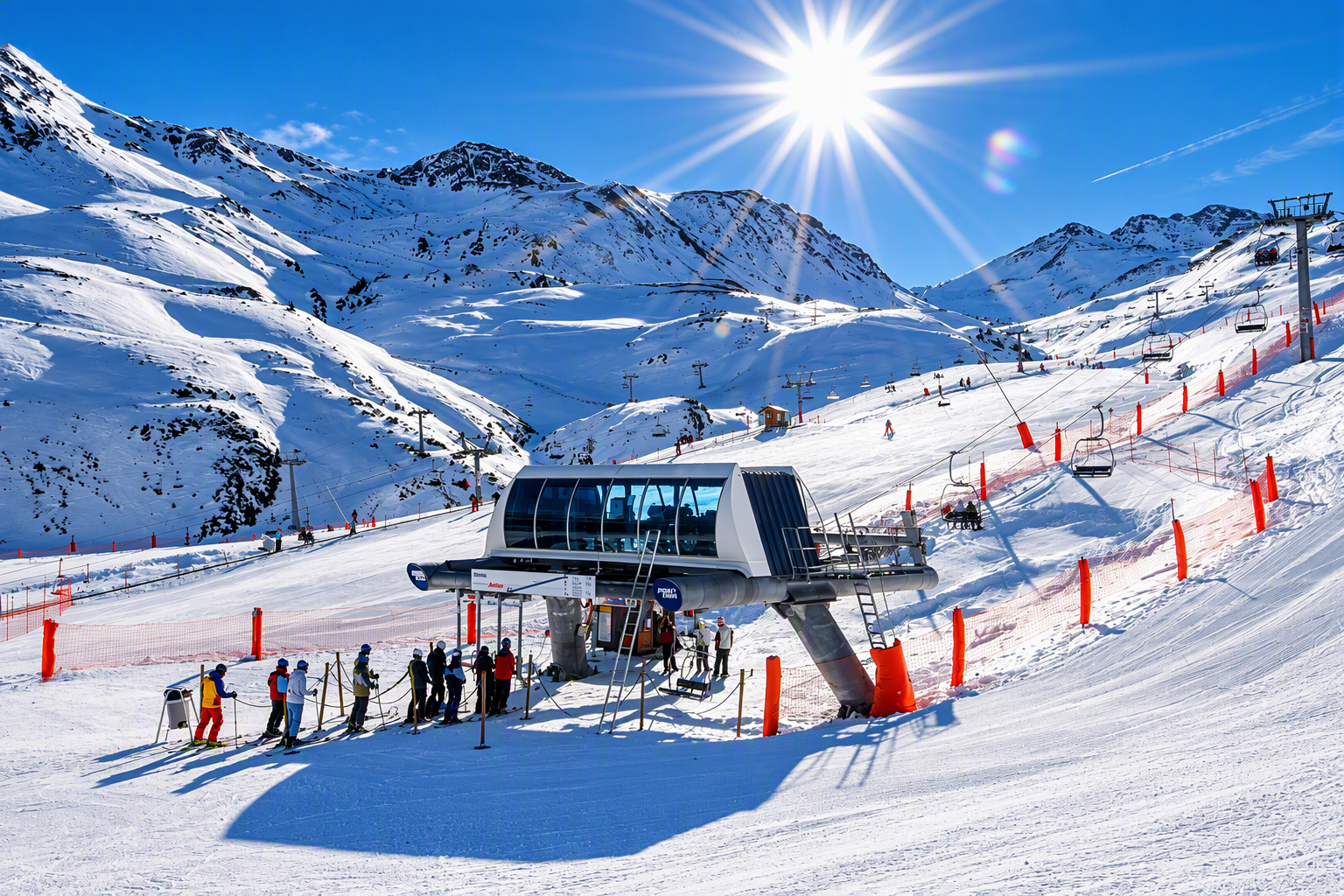
Boí Taüll: skiing at one of the highest resorts in the Pyrenees
During winter, the Boí Valley is transformed.
The Boí Taüll ski resort is located between 2,020 and 2,751 metres above sea level, reaching the summit of Puig Falcó.
Its orientation and altitude favour particularly interesting snow conditions during the winter season.
The resort currently offers:
- 45 km of marked ski runs.
- 42 alpine ski runs.
- 6 green runs.
- 6 blue runs.
- 15 red runs.
- 16 black runs.
- 4 ski-mountaineering itineraries.
- Snowpark.
- 5 chairlifts.
- 2 drag lifts.
- 3 conveyor belts.
- Beginners’ area.
- Ski school.
- Equipment rental.
- Snow garden and childcare.
- Medical service.
- Restaurants at the ski area.
The resort is suitable both for beginners and experienced skiers.
For beginners
The green runs and lower areas allow visitors to learn progressively.
The ski school, conveyor belts and children’s areas are particularly convenient for family trips.
For intermediate skiers
The blue runs allow skiers to gradually expand their terrain and explore different sectors of the resort.
For advanced skiers
The wide range of red and black runs and the high altitude provide options for those looking for more demanding terrain.
Boí Taüll also offers dedicated ski-mountaineering itineraries, with routes of varying difficulty and length.
When should you visit Boí Taüll?
Each season offers a different experience.
Winter: skiing, snowboarding, snowshoeing, ski mountaineering and snow-covered landscapes.
Spring: snowmelt, rivers, waterfalls and the gradual emergence of alpine vegetation.
Summer: hiking, high mountains, photography, botany, wildlife and access to the National Park.
Autumn: colourful forests, cooler temperatures and a particularly peaceful atmosphere.
For this reason, the Boí Valley should not be considered solely a snow destination.
Caldes de Boí: thermal waters in the mountains
One of the valley’s great distinguishing features is Caldes de Boí.
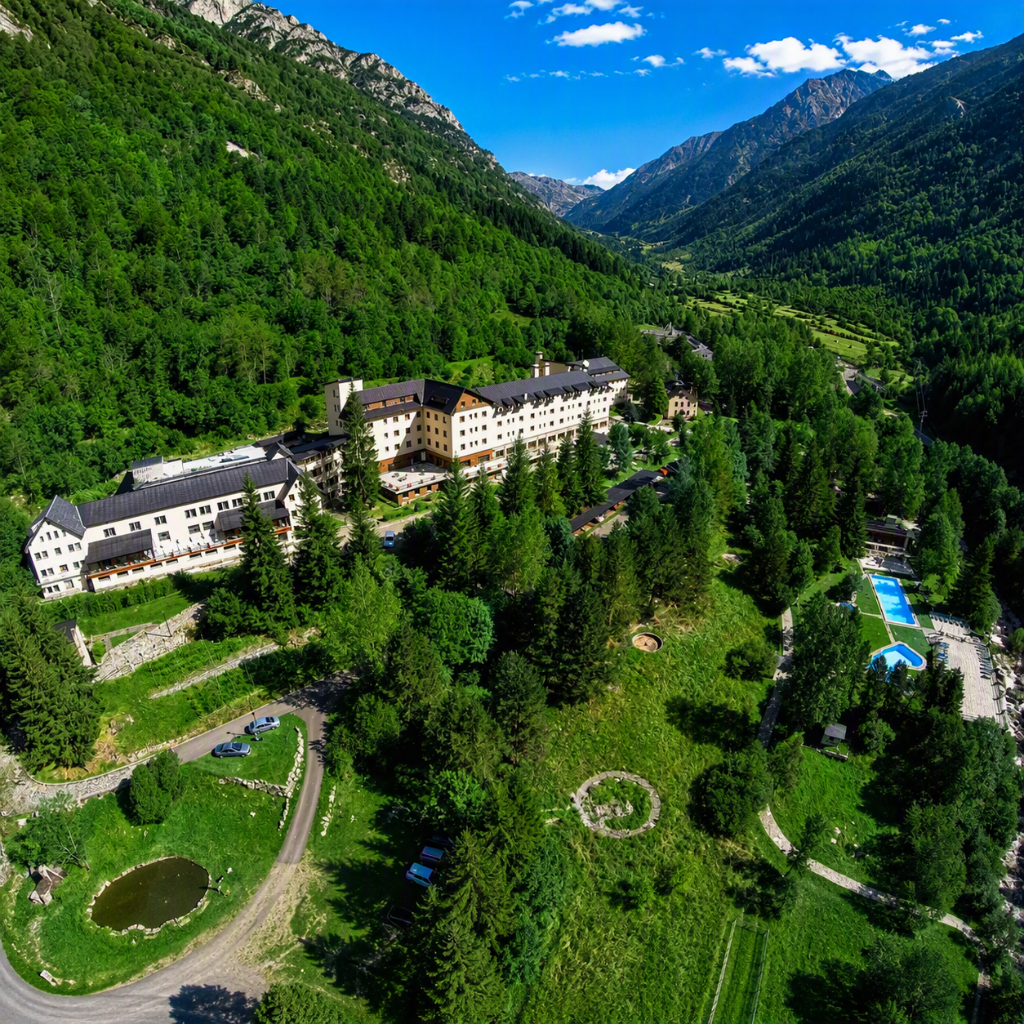
The spa is located at around 1,470 metres above sea level, beside the Noguera de Tor River and surrounded by a high-mountain landscape.
The site’s thermal tradition is very old, with references to the properties of its waters dating back to Roman times.
Today, the complex has 37 thermal springs, with temperatures ranging approximately from 4°C to 56°C.
The waters have different compositions and characteristics, allowing them to be used in a variety of thermal programmes and treatments.
What does Caldes de Boí Spa offer?
The complex combines:
- Thermal waters.
- Health treatments.
- Wellness programmes.
- Beauty treatments.
- Mud treatments.
- Natural steam rooms.
- Thermal services.
- Medical supervision for certain programmes.
- Accommodation.
- Dining.
- Swimming pools and relaxation areas during the relevant season.
The spa states that its waters are traditionally used in treatments associated with various conditions, including rheumatic, respiratory, dermatological, circulatory, urinary, digestive and nervous-system disorders. Therapeutic treatments should be understood within the medical and thermal framework of the establishment and not as substitutes for conventional medical care.
For a wellness getaway, the combination is particularly appealing: spend the day walking in the mountains and finish with a thermal experience.
Caldes de Boí – Thermal Spa Resort
Gastronomy in the Boí Valley
The valley’s cuisine emerges directly from its landscape.
It is a mountain cuisine traditionally based on products that could be found or produced locally.
Typical ingredients include:
- Potatoes.
- Vegetables.
- Lamb.
- Pork.
- Beef.
- Mushrooms.
- Trout.
- Seasonal produce.
- Local products.
Organic beef from the Boí Valley and lamb play a prominent role in local cuisine.
In recent years, various chefs have also reinterpreted traditional dishes using contemporary techniques, creating an offering that combines Pyrenean cuisine with creative gastronomy.
Two restaurants for a special gastronomic experience
The gastronomy of the Boí Valley is closely linked to the landscape and mountain traditions. The cuisine makes use of local products and combines traditional recipes with more contemporary approaches.
For a gastronomic getaway in the valley, two establishments are particularly worth considering: L’Aüt in Erill la Vall and El Fai in Taüll.
L’Aüt Restaurant, Erill la Vall
In Erill la Vall, just a few metres from the Romanesque church of Santa Eulàlia, you will find L’Aüt Restaurant, located within Hotel L’Aüt.
It is an especially interesting option for those looking for cuisine rooted in local produce. The restaurant highlights the use of local products and organic meats from the region, with grilled meats and traditional stews playing a particularly important role. Vegetarian, vegan and gluten-free options are also available upon request.
Dishes currently associated with its offering include:
- Escudella.
- Beef tenderloin with porcini mushroom sauce.
- Mushroom ravioli.
- Pappardelle with truffle, bacon and Parmesan.
- Mushroom and truffle croquettes.
- Dishes featuring blood sausage.
- Apple tarte Tatin with cinnamon ice cream.
The menu therefore combines Catalan cuisine, mountain produce and more contemporary-inspired dishes.
The restaurant is located at Carrer de Santa Eulàlia, 7, Erill la Vall, and also has a terrace overlooking the valley.
Average price at L’Aüt
For a realistic budget, allow approximately €30–40 per person, depending on whether you choose a starter, main course, dessert and drinks.
El Fai Restaurant, Taüll
In Taüll, you will find El Fai Restaurant, a different and somewhat more informal option, but a very interesting place to discover traditional cuisine from the Boí Valley.
The establishment describes itself as a home-style restaurant using local produce and has a large terrace overlooking Sant Climent de Taüll. Its location is one of its main attractions.
Its specialities include:
- Mushroom cannelloni with porcini mushroom sauce.
- Caracoles a la llauna.
- Organic beef from the Boí Valley.
- Organic grilled meats.
- Salads.
- Trinxat.
- Grilled vegetables.
- Risotto.
- Various traditional dishes.
Vegetarian options and a selection of dishes suitable for people with coeliac disease are also available.
Average price at El Fai
Prices are approximately €15–35 per person.
The restaurant offers an €18 set menu, a €12 children’s menu and an à la carte service.
Its terrace also offers views of Sant Climent de Taüll, making it particularly suitable for a cultural route through the village.
Traditional architecture
In addition to the Romanesque churches, it is worth paying attention to the valley’s civil architecture.
Traditional houses use materials characteristic of the area, especially stone, wood and slate.
The villages are adapted to the slopes and climatic conditions of the high mountains.
Sloping roofs, wooden balconies and stone walls form an architecture perfectly integrated into the landscape.
Taüll, Boí, Durro, Erill la Vall and Barruera allow visitors to discover this architecture while strolling through their streets.
The history of an isolated valley
For centuries, the Boí Valley remained relatively isolated.
Difficult communications, the climate and the terrain helped preserve traditional ways of life and an economy based mainly on livestock farming and mountain resources.
This isolation had an extraordinary cultural consequence: it helped the Romanesque heritage survive to the present day in an exceptional state of preservation.
The churches were not simply religious spaces.
They also played social roles within medieval communities, while their bell towers could serve as communication and lookout structures.
Hiking and high mountains
The Boí Valley is an excellent gateway to the National Park.
There are routes for different abilities, ranging from easy walks to high-mountain itineraries.
Possibilities include:
- Walks between villages.
- Family-friendly routes.
- Excursions to mountain lakes.
- Waterfalls.
- Nature interpretation trails.
- Ascents.
- Crossings.
- Landscape photography.
- Wildlife watching.
- Botany.
- Ski mountaineering.
For more demanding routes, it is essential to check the weather forecast, trail conditions and mountain conditions beforehand.
A destination for photography
The Boí Valley offers enormous photographic variety.
At sunrise, the churches of Taüll can be photographed in the first light falling across the mountains.
During the day, the lakes and waterfalls of the National Park provide spectacular landscape settings.
In summer, macro photography offers opportunities to discover flowers, butterflies and insects.
In autumn, the forests create a completely different palette.
And in winter, the Romanesque churches, stone villages and snow-covered mountains create some of the most characteristic images of the Pyrenees.
The Boí Valley under the stars
The valley and the surrounding National Park also offer excellent conditions for observing the night sky.
The Boí Valley is associated with Starlight Destination recognition, supported by the area’s dark skies and low light pollution.
On a clear night, visitors can see a sky very different from the one we are accustomed to in cities.
How to get to the Boí Valley from Barcelona
Barcelona is approximately 280 kilometres from the Boí Valley.
The usual route heads towards Lleida and continues towards Alta Ribagorça, passing through the area around Alfarràs and El Pont de Suert before taking the L-500 road towards the Boí Valley.
By car, the journey can take around 3½ to 4 hours, depending on traffic, weather conditions and the exact departure and destination points.
In winter, it is particularly important to check road conditions and carry appropriate equipment for mountain conditions.
Can you get there by public transport?
Yes.
The Boí Valley has bus connections.
There are bus services from Barcelona and Lleida to El Pont de Suert, operated by ALSA. From there, you can continue towards the Boí Valley using the transport options available in the valley.
Another possibility is to travel by train to Lleida and then continue by bus.
There are also taxi services and seasonal transport options within the valley for certain activities and periods, such as the Bus de la Neu during the ski season and the Bus del Parc during the National Park access season.
If you are planning a car-free trip, it is advisable to check the schedules for each connection according to your travel dates, as frequencies can vary considerably between high and low seasons.
How many days do we recommend?
For a first visit, a long three-day weekend allows you to enjoy a good introduction to the area.
Day 1: Heritage
Taüll, Sant Climent, Santa Maria, Boí and Erill la Vall.
Day 2: Nature
An excursion around the National Park, adapted to your fitness level and the season.
Day 3: Wellness and gastronomy
A leisurely morning, a thermal experience at Caldes de Boí and a gastronomic lunch before heading home.
In winter, the itinerary can change:
Day 1: arrival and Taüll village.
Day 2: skiing at Boí Taüll.
Day 3: snow, gastronomy and spa.
When is the best time to visit the Boí Valley?
There is no single best season.
There is a different Boí Valley for every time of year.
Winter for skiing and enjoying the snow.
Spring for snowmelt, waterfalls and the awakening of vegetation.
Summer for hiking, high mountains, wildlife, botany and the National Park.
Autumn for colourful forests, gastronomy and tranquillity.
This diversity means that the valley can be visited several times, with every trip offering something different.
Joan Ventosa i Calvell Refuge: a high-mountain experience above Estany Negre
For those who want to discover the Boí Valley from a more adventurous perspective, Joan Ventosa i Calvell Refuge offers one of the area’s most distinctive high-mountain experiences. Located at around 2,215 metres above sea level, inside Aigüestortes i Estany de Sant Maurici National Park and above the spectacular Estany Negre, the refuge is surrounded by high peaks, glacial lakes and granite landscapes.
Managed by the Centre Excursionista de Catalunya (CEC), it has 69 beds and operates as a staffed mountain refuge during the relevant season, providing accommodation, food and drinks, toilets and other basic services for mountaineers. There is also an emergency area for periods when the main refuge is closed, intended for emergencies and self-sufficient mountaineers.
Reaching the refuge: the Marmot Route
The most common approach from the Boí Valley begins at the Cavallers Reservoir, reached via the L-500 road towards Caldes de Boí. From Taüll, you descend through the valley and continue towards Caldes de Boí until reaching the Cavallers area.
From the car park, the true mountain experience begins. The trail climbs from the 1,784-metre Cavallers Reservoir to the 2,215-metre refuge, following the well-known Marmot Route.
The trail is approximately 4.4 kilometres each way, with a positive elevation gain of 431 metres and an estimated duration of around 2 hours and 15 minutes, although the actual time will depend on fitness, pace, weather and trail conditions. The route is considered difficult and crosses the Pletiu de Riumalo and the Llastres de la Morta section before reaching Estany Negre and the refuge.
The route begins beside the dam and continues around the reservoir before gradually entering a high-mountain landscape. As altitude is gained, the surroundings become increasingly rocky and spectacular. Estany Negre, located at 2,147 metres, is one of the great highlights of the excursion, surrounded by peaks and granite walls.
The route requires more than physical endurance: it is important to wear appropriate mountain footwear, carry sufficient water, protect yourself from sun and cold, and always check the weather forecast before setting out. Conditions in this high-mountain area can change quickly, and mobile coverage may be limited or unavailable. It is advisable to plan the route, check the weather and download the trail before starting the hike.
A night in the heart of the high mountains
The great attraction of Ventosa i Calvell is not simply reaching it. For those who want to extend the experience, spending a night at the refuge allows you to enjoy the landscape as the mountains fall silent and the last light of the day illuminates the peaks.
Accommodation is provided in shared spaces and the refuge supplies duvets or blankets, although you should check the current seasonal conditions and bring the personal equipment specified by the refuge. It also provides food and drinks, making it possible to arrange half-board or purchase certain services separately depending on the current conditions.
Reservations should be made in advance through the relevant booking system, particularly during busy periods. Conditions, prices and services may vary according to the season, so we recommend checking the latest information before setting out.
Rates and reservations
The refuge is not free accommodation when it is staffed. The price depends on the type of arrangement, the visitor’s age and, in certain cases, whether the mountaineer holds a federation licence or belongs to an organisation with specific agreements.
As a reference, in recent seasons half-board for non-federated adults has been around €65–70 per person per night, although this figure should be considered indicative and checked at the time of booking. Rates for federated members and other groups may differ.
When the main refuge is closed, there is a small emergency area, but this should not be confused with conventional free accommodation: it is intended for emergencies and for mountaineers undertaking activities outside the staffed season, with capacity for approximately 6 to 8 people.
Refuge services and operation
The philosophy of Ventosa i Calvell is that of a high-mountain refuge: to provide a safe place to rest, eat and recover in an environment that cannot be reached by road.
Available services include:
- 69 beds in shared dormitories.
- Duvets or blankets for guests.
- Toilets and showers, depending on seasonal operating conditions.
- Food and drinks.
- Communication via radio and the refuge telephone under the available conditions.
- An emergency area when the staffed refuge is closed.
Meal times and certain services are subject to the refuge’s operating arrangements and may change according to the season. It is therefore advisable to check the current conditions directly before making a reservation.
Much more than a hike
Ventosa i Calvell is also an excellent gateway to some of the most spectacular high-mountain landscapes around Aigüestortes. Various routes to lakes, mountain passes and peaks begin at or pass through the refuge, including trails towards Port de Caldes, the Travessani Lakes and other areas of the National Park. The route towards Port de Caldes, for example, continues from the refuge to 2,565 metres and offers views of the Besiberri massif, countless lakes and waterfalls and, ultimately, vistas towards the Aran Valley.
The refuge is also part of Carros de Foc, one of the great multi-refuge traverses in the Catalan Pyrenees, making the area particularly interesting for experienced hikers and enthusiasts of multi-day mountain routes.
For visitors to the Boí Valley, an excursion to Ventosa i Calvell can be planned as a full-day mountain experience or as a multi-day adventure, combining it with other routes through the National Park. In either case, the landscape is completely different from the villages and Romanesque heritage of the valley: here, high mountains take centre stage, with granite, glacial lakes, alpine meadows and great peaks as the backdrop.
An especially appealing experience for those seeking nature, landscape photography, high-mountain hiking and a deeper connection with the Pyrenees.
A getaway where everything is close
One of the great advantages of the Boí Valley is the possibility of combining very different experiences within a single trip.
In one getaway, you can:
Wake up in a stone village.
Visit a Romanesque church designated a World Heritage Site.
Walk through forests and high-mountain lakes.
Observe chamois and marmots.
Ski at more than 2,000 metres.
Discover alpine flowers.
Taste mountain cuisine.
Relax in thermal waters.
And finish the day watching the mountains at sunset.
The Boí Valley is not simply a mountain destination.
It is a territory where nature, heritage, gastronomy, wellness and sport come together as a single experience.
We design your private Boí Valley experience
If you would like to discover the Boí Valley in a different way, we can design a personalised experience for you.
Not every visitor is looking for the same thing.
Some want a romantic getaway with charming accommodation, gastronomy and a spa.
Others prefer several days of skiing.
We can also organise experiences focused on nature, photography, hiking, wildlife, botany, Romanesque heritage or gastronomy.
We design:
- Romantic getaways.
- Private trips.
- Gastronomic experiences.
- Wellness and thermal getaways.
- Ski trips.
- Nature experiences.
- Photography tours.
- Hiking and mountain experiences.
- Wildlife and botany experiences.
- Family trips.
- Weekend getaways.
- Tailor-made programmes for groups.
- Bespoke premium experiences.
Our aim is to ensure that you do not have to worry about coordinating every detail.
We can review your dates, number of people, interests, activity level and budget and create a proposal that fits the type of trip you want to take.
The Boí Valley can be experienced in many different ways. We design the one that best suits you.
Request your personalised proposal and discover the Pyrenees from a different perspective.






Copyright © 2016-2026 Magic Dreams Barcelona.