LA PEDRERA – CASA MILÀ BY ANTONI GAUDÍ.

Antoni Gaudí’s Last Great Civil Work
Casa Milà, universally known as La Pedrera, stands as one of the absolute masterpieces of modern architecture and as Antoni Gaudí’s last great civil work, developed between 1906 and 1912.
Conceived during the architect’s creative maturity, this masterpiece reflects the full development of his naturalist period, in which architecture merges with the organic laws of nature, ruled geometry, and unprecedented creative freedom.
Located on Passeig de Gràcia, in the heart of Barcelona’s Eixample district, La Pedrera was not conceived solely as a private residence, but as a modern, innovative apartment building deeply integrated into the city.
In 1984, Casa Milà was inscribed on the UNESCO World Heritage List as part of the group of works by Antoni Gaudí recognized for their outstanding universal value.
The Origins of La Pedrera
Pere Milà, Roser Segimon and an Extraordinary Residence
The building was commissioned in 1905 by the married couple Pere Milà and Roser Segimon, who entrusted Gaudí with the creation of their main residence on Passeig de Gràcia, while the rest of the building was intended for rental purposes.
The plans were submitted to Barcelona City Council on February 2, 1906, and construction began that same year. In 1909, the Eixample Commission recognized the monumental character of the building, and on October 31, 1912, Gaudí officially certified the completion of the works.
The project responded to an extraordinarily advanced conception of residential architecture. Gaudí did not limit himself to designing a spectacular façade; he conceived the building as a complete organism, carefully studying its structure, lighting, ventilation, circulation, and interior layout.
Architecture Without Straight Lines
Nature Transformed into Architecture
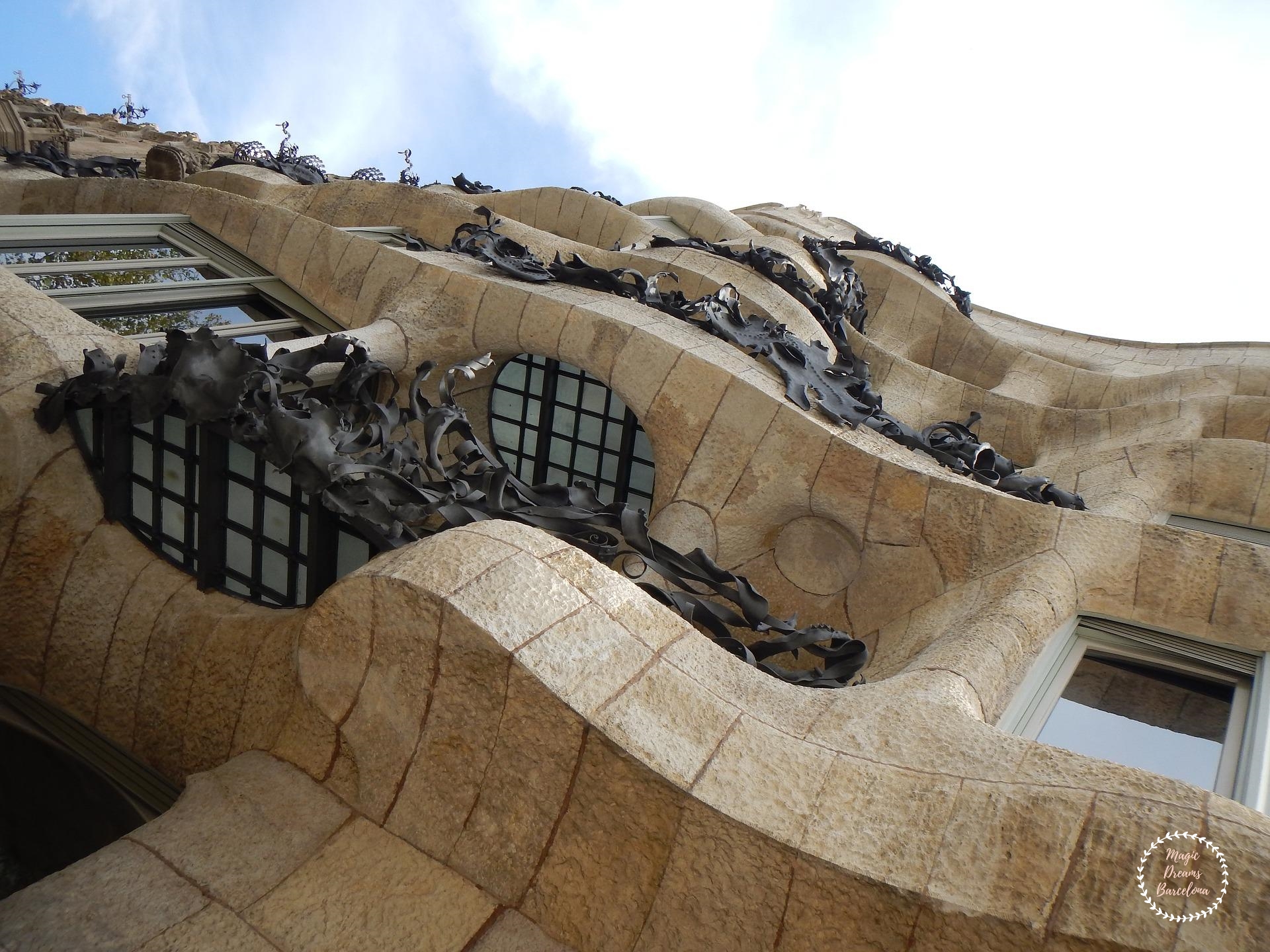
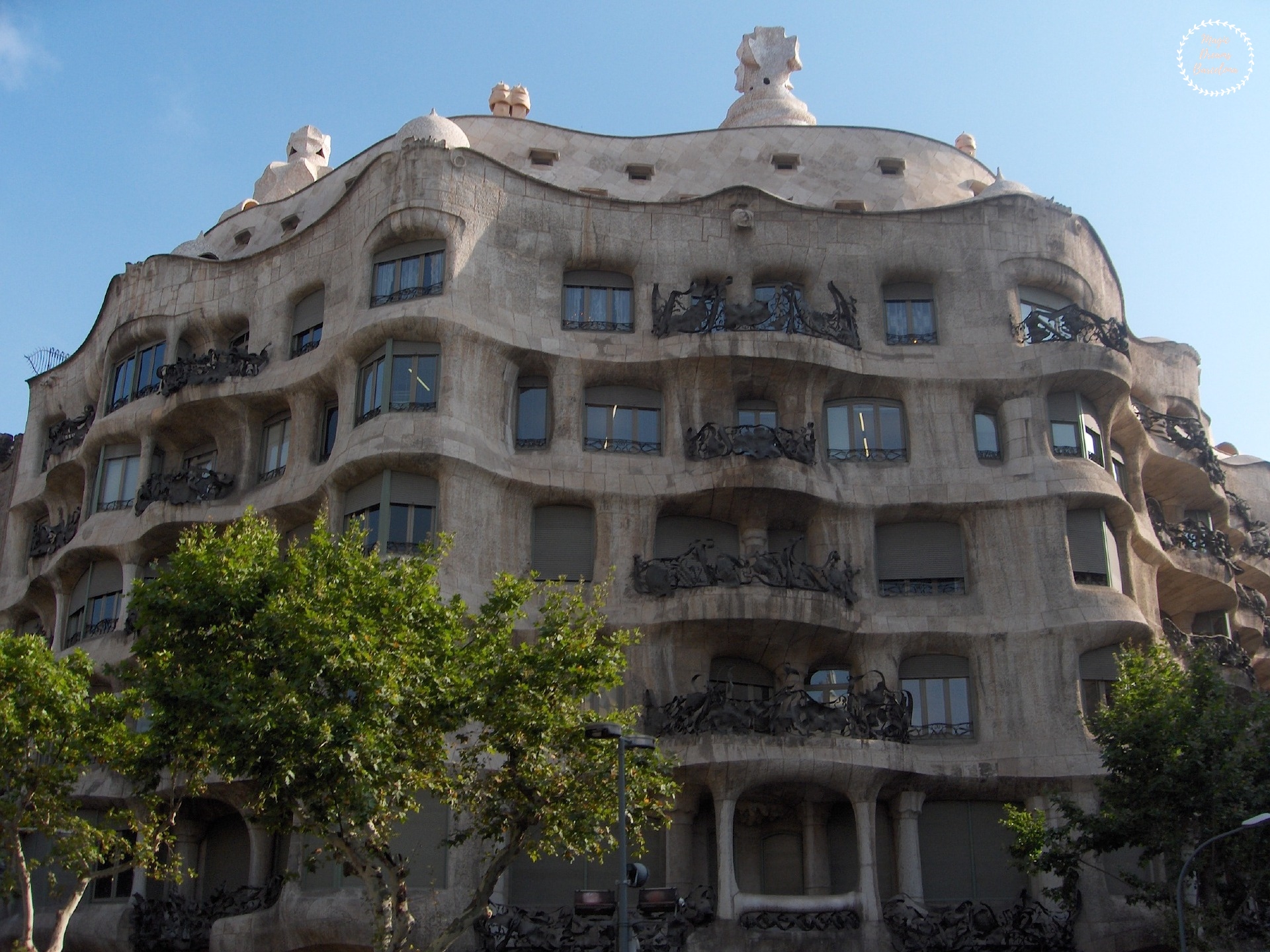
The undulating stone façade, free of straight lines, appears to have been sculpted by natural forces.
Its volumes evoke the forms of an eroded mountain, ocean waves, or a living geological formation. The stone seems to move, transforming a residential building into an authentic urban sculpture.
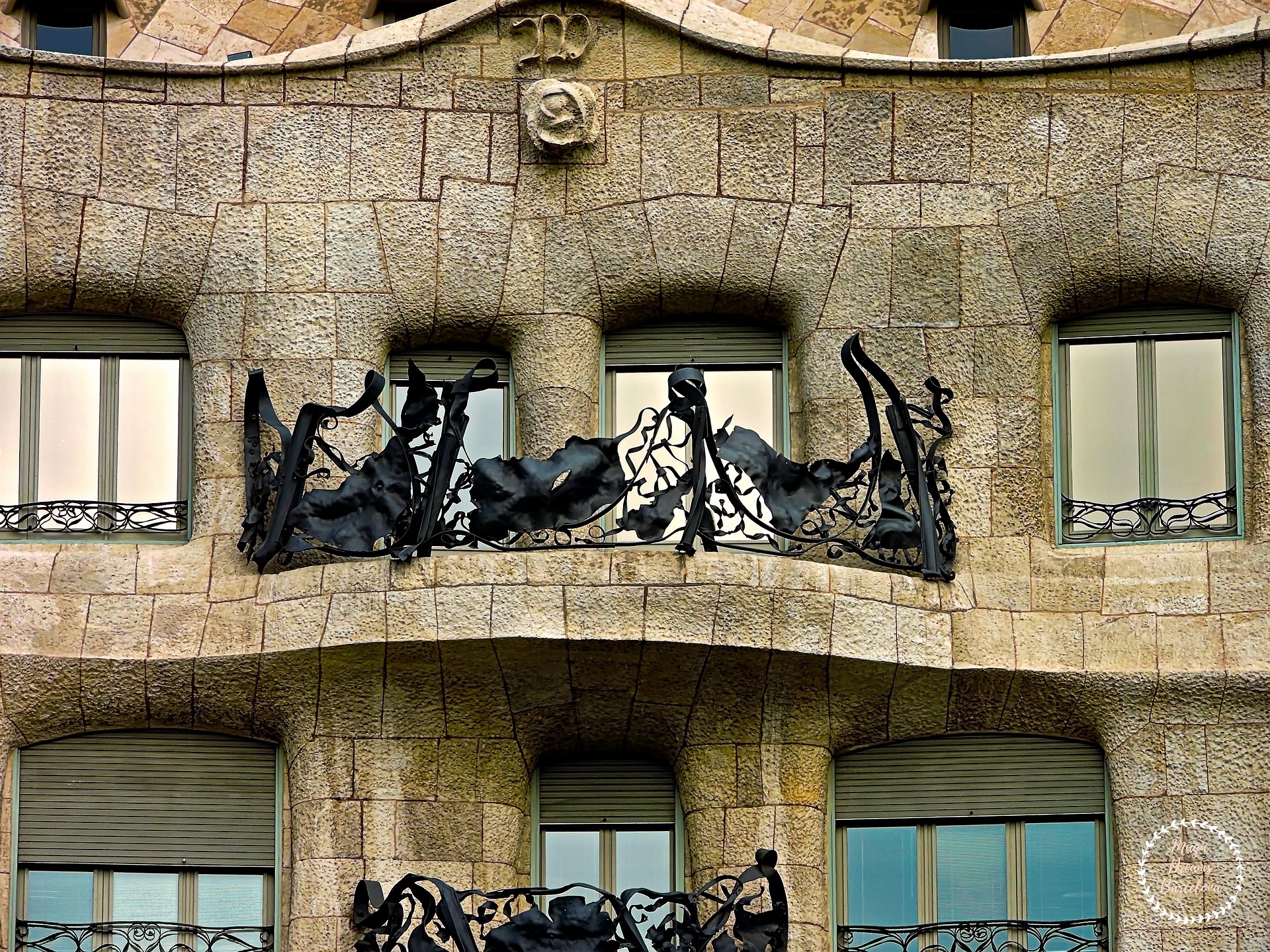
The wrought-iron balconies, each one unique and unrepeatable, evoke seaweed, vines, or marine movements, transforming metal into urban poetry.
Gaudí did not conceive these elements as mere ornaments, but as living sculptures that interact with light, air, and the city.
Every detail responds to the same idea: architecture should form an organic whole in which structure, decoration, and nature are inseparable.
Two Blocks and Two Large Courtyards
A Building Designed from the Inside Out
One of the least obvious aspects of La Pedrera from the street is its complex interior organization.
The building consists of two large residential blocks, with independent entrances, arranged around two large interconnected courtyards. These courtyards play a fundamental role in bringing light and ventilation into the apartments.
This organization makes it possible to better understand Gaudí’s true innovation: the exterior façade is only one part of a much more complex architectural system.
The interior layout was designed to provide bright and flexible spaces, while the pillar-based structure allowed an unusual degree of freedom for its time.
La Pedrera thus represents a particularly advanced reflection on how to construct a residential building on a chamfered corner of Barcelona’s Eixample.
A Work Ahead of Its Time
Functionality, Innovation and Beauty
Casa Milà was pioneering in countless ways.
It became the first residence on Passeig de Gràcia to have underground carriage parking, another example of the architect’s functional and innovative vision, anticipating future needs without sacrificing beauty.
Gaudí also introduced structural solutions that made it possible to create more flexible and luminous interior spaces.
The pillar structure largely freed the walls from their load-bearing function, opening up new possibilities for organizing the apartments.
At La Pedrera, construction, geometry, ergonomics, materials, light, and decoration form part of a single architectural conception.
The Courtyards of La Pedrera
Light, Colour and Nature at the Heart of the Building
The interior courtyards are one of La Pedrera’s great secrets.
From them, visitors can understand how Gaudí used architecture to bring light and air into the interior of the building.
Their curved forms, colours, and decoration transform these functional spaces into authentic architectural settings.
Walking through the courtyards also makes it possible to observe the relationship between the different floors and to discover how light constantly changes across the surfaces.
Far from being secondary spaces, they form an essential part of the La Pedrera experience.
The Attic and Espai Gaudí
The Architect’s Technical and Creative Universe
In the attic, popularly known as the whale attic, is the Espai Gaudí, dedicated to explaining the architecture and creative universe of the architect.
Its parabolic arches and structure provide an especially clear understanding of the relationship between geometry, nature, and construction.
This space displays models, studies, objects, and materials that help visitors understand the technical, symbolic, and spiritual depth of Gaudí’s work.
More than a simple exhibition, Espai Gaudí offers an insight into the thought and construction process behind buildings that, at first glance, seem to have emerged directly from the imagination.
The Rooftop of La Pedrera
A Landscape of Sculptures Above Barcelona
The rooftop of La Pedrera is one of the building’s most iconic and evocative spaces.
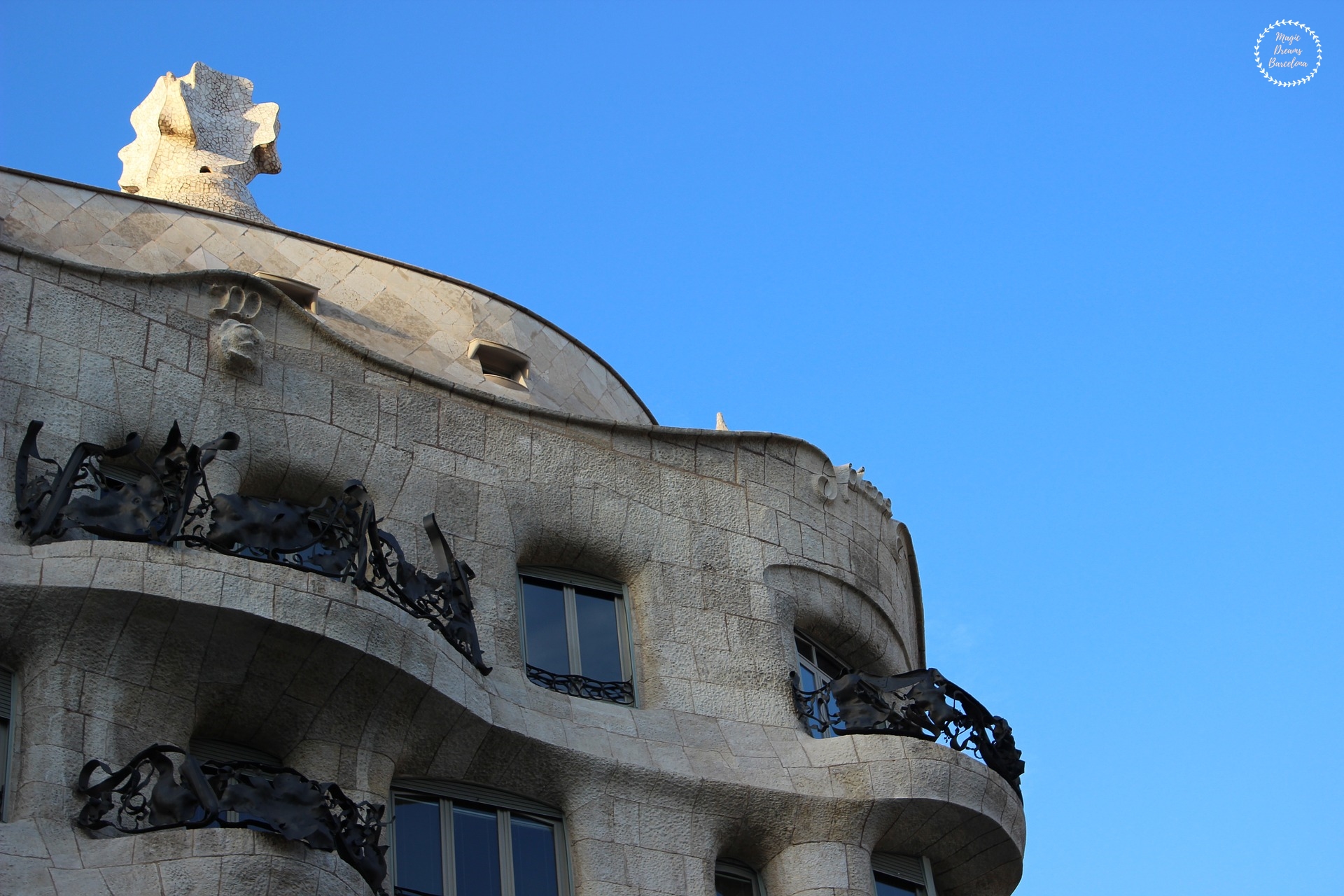
Rising above it are the famous chimneys, ventilation towers, and stairway exits which, beyond their technical function, take on powerful sculptural forms.
These figures — authentic mineral guardians — appear like motionless warriors, archaic beings, or creatures emerging from a dream, watching over the city from above.
Gaudí used trencadís, recycling fragments of glass and ceramics and transforming leftover materials into surfaces of extraordinary visual richness.
The rooftop contains thirty chimneys, two ventilation towers, and six stairway exits, each designed with a different formal solution.
From this privileged vantage point, the view reaches some of Barcelona’s major landmarks, establishing a visual dialogue between La Pedrera and other fundamental works by Gaudí, especially the Sagrada Família.
The Symbolism of the Rooftop
A Stage Between Architecture, Myth and Spirituality
The rooftop of La Pedrera has generated countless symbolic interpretations.
The philosopher and writer Josep Maria Carandell, in his work La Pedrera, cosmos de Gaudí, offered one of the best-known interpretations, defining the rooftop as a kind of religious allegorical drama: a staging connected with the origin of life, the family, and divine revelation.
According to this interpretation, the theatrical forms of the rooftop engage in dialogue with works such as Life Is a Dream by Calderón de la Barca, Hamlet by Shakespeare, and Ovid’s Metamorphoses, bringing together literature, religion, and cosmology.
The stairway exits thus become symbolic giants: the Fathers, located at the chamfered corner and represented as coiled dragons; the Children, represented in different moral and spiritual attitudes; and the two ventilation towers, identified as the King and Queen.
All of this can also be related to the Catalan tradition of giants, bestiaries, and ritual figures present in popular celebrations.
Regardless of whether these interpretations are understood as symbolic or open to different readings, they demonstrate the extent to which the rooftop of La Pedrera continues to inspire imagination, debate, and fascination.
A House That Has Changed with Barcelona
From Bourgeois Residence to Cultural Centre
The appreciation of La Pedrera has evolved enormously over time.
The building, which originally provoked controversy and differing opinions among Barcelona residents, eventually became one of the city’s great architectural symbols.
For decades, the building was subject to different uses and transformations.
In December 1986, Caixa Catalunya acquired the property and major restoration works began. In 1992, the restoration of the main floor was inaugurated as an exhibition space, and later the former garage was converted into an auditorium.
A permanent exhibition dedicated to the life and work of Gaudí was also installed in the attic.
Finally, in June 1996, after ten years of restoration, La Pedrera fully opened its doors to the public as a cultural centre.
La Pedrera Today
Heritage, Culture and Contemporary Life
Since January 2013, the building has housed the headquarters of the Fundació Catalunya La Pedrera, a private and independent foundation that develops social, environmental, educational, and cultural projects.
At the same time, La Pedrera continues to be a living building.
Its interior combines spaces open to visitors, exhibitions, cultural activities, offices, shops, and residential apartments.
This coexistence between historical heritage and contemporary life is one of the most distinctive features of Casa Milà.
In 2026, the building also celebrates 30 years since La Pedrera opened as a visitor attraction, an anniversary that recalls its transformation into one of Barcelona’s major cultural centres dedicated to Gaudí’s heritage.
La Pedrera and the Gaudí Year 2026
A Century Later, Gaudí Continues to Transform Barcelona
The year 2026 has special significance.
It marks the centenary of Antoni Gaudí’s death, and La Pedrera forms part of the special Gaudí Year programme, with new cultural proposals, exhibitions, activities, and events dedicated to exploring his work in greater depth.
The Nights of La Pedrera
Architecture, Music and Open Skies
During summer evenings, the rooftop of La Pedrera becomes one of Barcelona’s most magical cultural venues.
La Pedrera Jazz transforms this space into a place where architecture, music, and the night sky come together.
The experience begins with a visit to Espai Gaudí and culminates in an open-air concert, accompanied by a glass of cava, beneath the stars and with incomparable views of the city.
The architecture itself then takes on a completely different dimension.
The stone, curved forms, chimneys, and lights of Barcelona create a setting that is difficult to reproduce anywhere else.
What Can Be Visited
A Journey Through Gaudí’s Universe
The visit allows you to discover different fundamental spaces within the building:
- The interior courtyards.
- The former apartments.
- The main floor.
- The attic and Espai Gaudí.
- The monumental rooftop.
- The chimneys, ventilation towers, and stairway exits.
- Temporary exhibitions and cultural activities scheduled throughout the year.
The essential visit lasts approximately one and a half hours.
How to Get There from Barcelona
La Pedrera on Passeig de Gràcia
Casa Milà is located at:
Passeig de Gràcia, 92
Barcelona
Its location in the heart of the Eixample makes it easy to reach from virtually anywhere in Barcelona.
Metro
- Line L3 – Diagonal.
- Line L5 – Diagonal.
Rail
- FGC – Provença / La Pedrera.
- Renfe – Passeig de Gràcia.
Bus
Several bus lines stop in the vicinity of Passeig de Gràcia and Diagonal.
Its location also makes it easy to combine the visit with other major Modernist buildings along Passeig de Gràcia.
Practical Information
Everything You Need to Know Before Your Visit
La Pedrera is open to the public throughout the year, although opening hours depend on the season and the type of visit.
The options currently available include:
- La Pedrera Essential, with access to the courtyards, apartment, attic, and rooftop.
- La Pedrera Sunset, designed to enjoy the building at sunset.
- La Pedrera Night Experience, with a night visit, show, and glass of cava.
- La Pedrera Sunrise, an experience at dawn with access before general opening hours.
Opening hours and visit options may change throughout the year, so we recommend checking the official programme before planning your visit.
A Work to Be Observed Slowly
La Pedrera Cannot Be Discovered at a Single Glance
Visiting La Pedrera is not simply a matter of admiring a façade.
You need to pause in its courtyards, observe how the light enters, discover the forms of the balconies, explore the attic, look up at the arches, and walk slowly across the rooftop.
Each space expresses a different aspect of Gaudí’s thinking.
The structure speaks of engineering.
The stone speaks of nature.
The iron speaks of movement.
The rooftop speaks of myth.
The light constantly transforms the space.
And it is precisely this union of technique, beauty, nature, and symbolism that makes La Pedrera an exceptional work.
Would You Like to Discover La Pedrera with Us?
Casa Milà from a Different Perspective
Discovering La Pedrera means entering a universe where art, nature, symbolism, and emotion intertwine.
This experience reaches an even deeper dimension when experienced through the magical, sensitive, and expert perspective of Magic Dreams Barcelona.
Our native guide, specialized in architecture, botany, and ornithology, accompanies each visit with a cultured, engaging, and deeply human narrative.
We take care of absolutely everything so that you do not have to worry about a thing.
We organize one-day experiences, week-long stays, weekend getaways in the Catalan Pyrenees or along the Costa Brava, as well as personalized day trips.
We offer services in Spanish, Catalan, and English and, upon request and with advance notice, we can adapt to any other language.
Our accommodations have been selected with the utmost attention to detail: comfortable, elegant, and welcoming.
We offer picnic services with table linens and catering selected from our menu, whether in gardens, on seaside beaches, or even aboard a yacht.
With our guide specialized in botany, butterflies, and birds, every experience becomes an unforgettable emotional journey.
We organize all kinds of services at your accommodation, themed romantic dinners featuring local or international cuisine, musicians, florists, professional photography, as well as gastronomic tours of the city’s finest restaurants and personalized workshops — from cooking to Trencadís art — designed specifically for you after completing our preferences questionnaire, whether in a premium format or completely your own way.
La Pedrera with Magic Dreams Barcelona is discovered from the soul.








Copyright © 2016-2026 Magic Dreams Barcelona.