Route guide for visitors throughout Catalonia – Barcelona – Costa Brava – Catalan Pyrenees – Personalized experiences – Customized tour guide services – A small tribute to the wonderful city and land that saw us born – Transforming experiences into unforgettable memories - Magic Dreams Collection: exclusive universes inspired by Salvador Dalí and Gaudí. Niche perfumes, jewelry, lithographs, and collectible items celebrating the Mediterranean spirit.
The Portal de l’Àngel was originally one of the gates of Barcelona’s medieval wall, built in the 13th century, known as the Portal dels Orbs, meaning “Gate of the Blind.” The name refers to the presence of poor people in the area, including the blind …
Avinguda de Pau Casals is one of the most emblematic and elegant avenues in Barcelona, located next to the historic Turó Park in the Sant Gervasi-Galvany neighborhood, within the Sarrià-Sant Gervasi district. This avenue combines cultural history, distinguished residential architecture, and one of the city’s …
The Cathedral of the Holy Cross and Saint Eulalia of Barcelona: History, Mysteries, and Beauty of the Gothic Quarter
The Cathedral of the Holy Cross and Saint Eulalia of Barcelona, popularly known as the Gothic Cathedral of Barcelona, is one of the city’s most emblematic monuments. Its imposing façade, bearing witness to more than eight centuries of history, is one of the most photographed spots in the city and a sublime example of Gothic art in Catalonia.
From its towering walls to its pinnacles and gargoyles, the cathedral conveys a world of religious symbolism, history, and curiosities that make it a must-visit destination for art lovers and travelers alike. Among the fantastic sculptures that adorn the cathedral, one can see not only demons and monsters but also a bull, a unicorn, and an elephant, while the 21 bells in the tower all bear female names—a unique detail that surprises every visitor.
Main Points of Interest
Crypt of Saint Eulalia
Beneath the high altar lies the tomb of Saint Eulalia, a young martyr who defended her Christian faith until her tragic death in 304 AD. Her story inspired centuries of devotion and symbolizes the courage and faith that characterize the essence of Barcelona.
Cloister
The Gothic cloister, built between the 14th and 15th centuries, houses a garden filled with palm trees, magnolias, and an orange tree, as well as a 15th-century fountain. Thirteen geese inhabit the cloister, symbolizing Saint Eulalia’s age at her martyrdom and the thirteen tortures she endured during the Roman era. This legend is one of the most fascinating stories of Catalan heritage and a symbol of the city.
Organ and Choir
The cathedral’s organ, located in the upper gallery above the Portal of Sant Iu, was built between 1537 and 1539. Since 1990, monthly organ concerts open to the public have offered an auditory experience that complements the temple’s majesty. The choir, with its exquisitely carved seats, is considered one of the most valuable interior spaces, where art and spirituality converge.
Rooftop
A panoramic elevator allows access to the rooftop, from where visitors can admire the bell towers, the octagonal dome crowned by the Holy Cross, and the figure of Saint Helena, as well as privileged views of the cloister and the Gothic Quarter.
Chapel of the Holy Christ of Lepanto
Built by Arnau Bargués in 1407, this rectangular chapel houses a crucified Christ revered by Barcelona’s residents. Its star-crossed vault and the central Pentecost keystone, crafted by sculptor Joan Claperós in 1454, are highlights of Catalan Gothic elegance. The Baroque tomb of Saint Oleguer completes the artistic richness of this sacred space.
Architecture and Symbolism
The cathedral is distinguished by its verticality and sculptural ornamentation, hallmarks of the Gothic style. The main façade impresses with its central rose window, pointed archivolts decorated with saints, angels, and floral motifs, while the flying buttresses reinforce the lateral walls and allow for pointed windows with delicate tracery. The gargoyles, beyond their practical function as drainage spouts, symbolize spiritual protection.
The octagonal dome over the crossing and its spire have become visual icons of Barcelona’s Gothic skyline, visible from various points in the Old Town. Every element of the cathedral combines art, symbolism, and spirituality, reflecting the skill of medieval architects and the city’s devotion to its patron saints.
Practical Visitor Information
Visiting Hours:
Weekdays: 09:30 – 18:30
Saturdays and Holidays: 09:30 – 17:30
Sundays: 14:00 – 17:00
Transport:
Bus: Line 47, stop Vía Laietana – Pl. Ramon Berenguer
Metro: Line 4 (yellow), stop Jaume I
Location: Pla de la Seu, 3, Barcelona
Curiosities You Might Not Know:
The 21 female-named bells pay homage to women, a unique feature in Gothic cathedrals.
Among the gargoyles, there is an elephant, a unicorn, and a bull—uncommon figures in religious iconography.
The cathedral was built over more than six centuries, beginning in 1298 and completing in the early 20th century.
Magic Dreams Barcelona Experiences
At Magic Dreams Barcelona, we transform visits to the Gothic Cathedral of Barcelona and other emblematic spaces into personalized, sensory experiences:
Expert guides in Catalan Gothic history, art, and architecture.
Customized routes tailored to interests, pace, and preferences.
Private experiences with music, scents, and literature, including stays in historic accommodations or yachts.
Signature gastronomy, exclusive picnics, and creative workshops such as mosaics or traditional Catalan cooking.
Getaways to the Costa Brava and the Catalan Pyrenees with curated gastronomic routes.
Each tour becomes a dialogue between past and present, where architecture can be heard, history can be felt, and beauty can be experienced with all the senses.
La Catedral de la Santa Creu i Santa Eulàlia de Barcelona.
La Catedral de la Santa Creu i Santa Eulàlia de Barcelona.
La Catedral de la Santa Creu i Santa Eulàlia de Barcelona.
La Catedral de la Santa Creu i Santa Eulàlia de Barcelona.
La Catedral de la Santa Creu i Santa Eulàlia de Barcelona.
La Catedral de la Santa Creu i Santa Eulàlia de Barcelona.
La Catedral de la Santa Creu i Santa Eulàlia de Barcelona.
La Catedral de la Santa Creu i Santa Eulàlia de Barcelona.
The Sant Sebastià Tower is an iconic steel structure located in the Barceloneta district along Barcelona’s coastal line, and it constitutes one of the most significant elements of the city’s port landscape. It is a lattice‑style metal tower, approximately 78 meters tall, designed as the …
In the Pedralbes neighborhood, away from the urban bustle and immersed in a tranquil and beautifully serene atmosphere, stands the Real Monastery of Santa María de Pedralbes, one of the most elegant expressions of Catalan Gothic architecture. Founded in 1327 by Queen Elisenda de Montcada, …
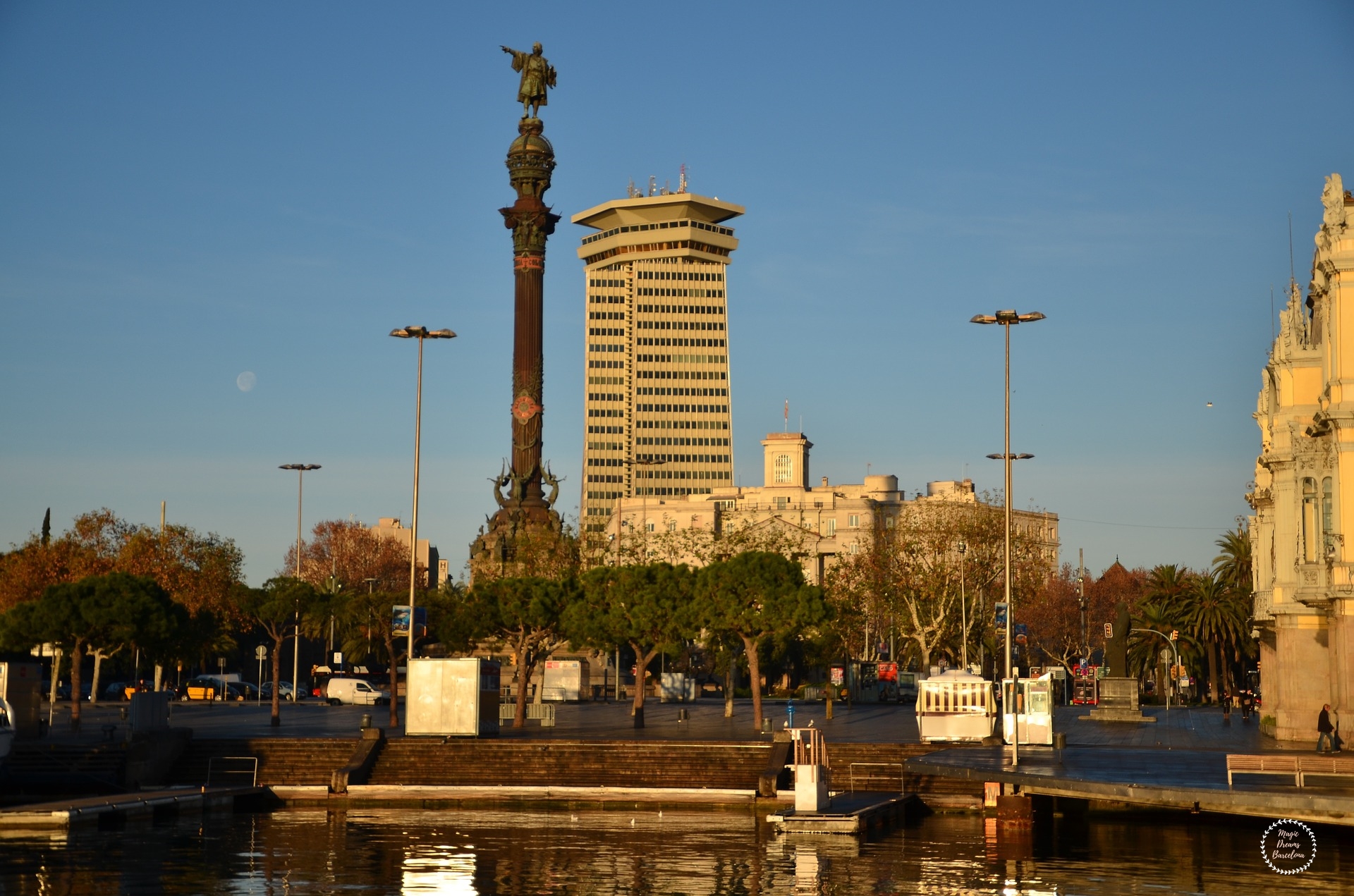
Built in tribute to the explorer Christopher Columbus, the Columbus Monument is one of the most recognized icons in Barcelona’s skyline. This impressive 60-meter-tall viewing monument is located near the port, at the exact point where Las Ramblas meets Passeig de Colón, facing Port Vell at Plaça del Portal de la Pau, s/n.
The monument consists of a large Corinthian column, designed by architect Cayetano Buigas, atop which stands the famous statue of Columbus, nearly 7 meters high. The figure dominates the Barcelona sky, holding a navigational chart in his left hand while symbolically pointing toward the New World with his right, representing exploration, discovery, and openness to the world.
At the base and pedestal lies one of the richest sculptural programs of 19th-century Barcelona. The lower part of the column features groups of sculptures dedicated to the discovery of America, blending history, allegory, and symbolism. Notable figures include Lluís de Santángel, Jaume Ferrer de Blanes, Pere de Margarit, and Fra Bernat de Boïl, along with indigenous figures representing cultural encounters. These works were created by prominent sculptors of the time, including Josep Gamot, Francesc Pagès, Eduard Batista Alentorn, and Manuel Fuxá.
The pedestal also houses four large allegorical female figures symbolizing the historical kingdoms of Catalonia, Aragon, Castile, and León, emphasizing the collective effort of the discovery. Surrounding the circular base are eight popular iron lions, symbols of strength and protection, which visitors traditionally climb for photographs, making them one of the monument’s most recognized and beloved elements.
Construction of the monument was approved in 1881 to honor Columbus’s selection of the Barcelona port after his return from America. After seven years of work, it was inaugurated in 1888, coinciding with the Universal Exposition, a key moment in the city’s international projection.
Inside the monument is a panoramic elevator that takes visitors to the viewing platform 60 meters above the ground, offering spectacular 360-degree views of Barcelona, the port, the Mediterranean, and the urban layout of the city.
Transportation and Accessibility
Metro: Drassanes (Line 3)
Bus: Lines 14, 59, 64, 91, 120, D20, and H14
All of this, and much more, can be discovered through the magical and profound perspective of Magic Dreams Barcelona, an experience designed so visitors do not have to worry about anything. We take care of every detail, ensuring a comfortable, guided, and inspiring experience from start to finish.
We offer private transportation, professional native guides in Spanish, Catalan, and English — with other languages available upon prior notice — always adapting to each visitor’s needs. The visit to the Columbus Monument is complemented by personalized Barcelona routes, architectural and artistic tours with deep knowledge of local symbolism, guided by experts revealing the most authentic aspects of the city.
We provide exclusive carefully selected accommodations and tailor-made experiences, including romantic getaways in Catalonia for a day or weekend, picnics in emblematic gardens with customizable tableware, on the beach or yacht, gourmet catering by our chef with sweet and savory options, and a curated selection of natural juices, wines, and non-alcoholic cava. We also offer personalized floristry, themed dinners, live music, and private evenings featuring Catalan and international gastronomy prepared by native and international chefs.
The experience is further enriched with a native guide specialized in emotional botany, intimately connected with the local territory. During the tour and especially at moments of rest and picnics, we offer sensitive readings of the environment, explain plant species, their symbolism, history, and relationship with the Mediterranean landscape, as well as observation and recognition of local birds. Every explanation becomes a living story that connects emotionally with nature, transforming the visit into a sensory, conscious, and memorable journey.
Our goal is simple yet profound: to make visitors feel cared for, inspired, and free to discover the magic and secrets of Barcelona, experiencing the city not just as a destination but as an unforgettable adventure.
Homenaje a Cristóbal Colón en Portal de la Pau.
Detalle monumento homenaje a Cristóbal Colón en Portal de la Pau.
Detalle monumento homenaje a Cristóbal Colón en Portal de la Pau.
Perspectiva a pie monumento homenaje a Cristóbal Colón en Portal de la Pau.
Perspectiva a pie monumento homenaje a Cristóbal Colón en Portal de la Pau.
Perspectiva a pie de figura escultórica en forma de león en Portal de la Pau.
Perspectiva superior aérea al atardecer del monumento homenaje a Cristóbal Colón en Portal de la Pau.
Perspectiva a pie monumento homenaje a Cristóbal Colón en Portal de la Pau.
Detalle monumento homenaje a Cristóbal Colón en Portal de la Pau.
Detalle figura escultórica en forma de león en Portal de la Pau.
Detalle figura escultórica en forma de ángeles en Portal de la Pau.
Perspectiva superior aérea del monumento homenaje a Cristóbal Colón en Portal de la Pau.
For collaborations, projects or professional inquiries – Reservations and quotes
Please leave your details and phone number, and we will get in touch with you as soon as possible, within the same day.