Route guide for visitors throughout Catalonia – Barcelona – Costa Brava – Catalan Pyrenees – Personalized experiences – Customized tour guide services – A small tribute to the wonderful city and land that saw us born – Transforming experiences into unforgettable memories - Magic Dreams Collection: exclusive universes inspired by Salvador Dalí and Gaudí. Niche perfumes, jewelry, lithographs, and collectible items celebrating the Mediterranean spirit.
At the foot of Plaza de España stands Arenas de Barcelona, an icon of urban transformation — a space where past and present engage in dialogue through architecture, culture, and emotion. Built in 1900 by architect August Font i Carreras in Neo-Mudéjar style and promoted …
Discover the History and Charm of Passeig de Gràcia and Plaça Cinc d’Oros Plaça Cinc d’Oros, located at the heart of Passeig de Gràcia, is far more than a simple urban meeting point—it is a living testament to Barcelona’s history and memory. From an elevated …
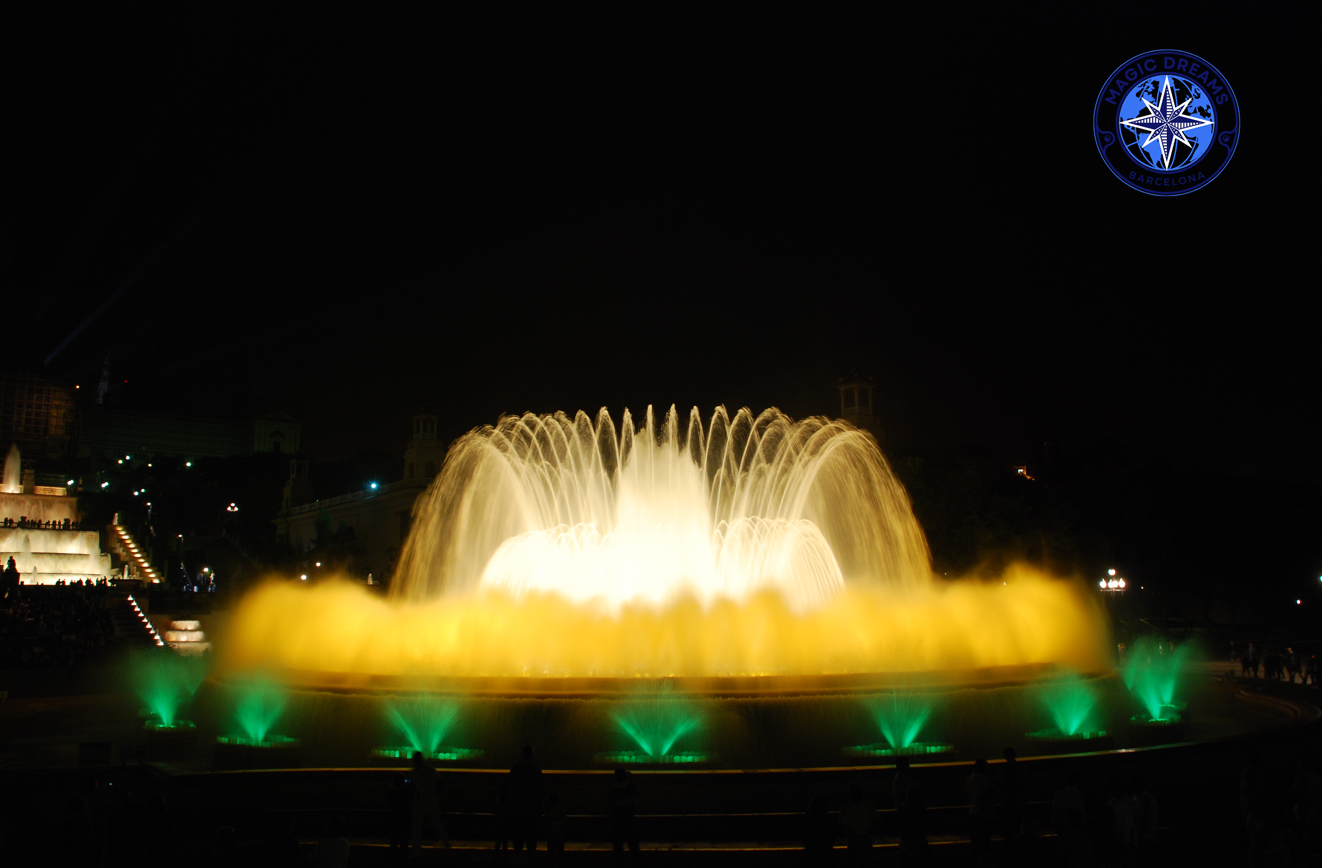
Where water, light and music come together to create one of Barcelona’s great icons
Among Barcelona’s monumental landmarks, few places bring together history, architecture, engineering, art and spectacle as powerfully as the Magic Fountain of Montjuïc.
Located at the foot of Montjuïc Mountain, beside Maria Cristina Avenue and opposite the majestic National Palace, the Magic Fountain is one of the city’s most recognisable landmarks.
Its history is closely linked to one of the great events in Barcelona’s 20th-century history: the 1929 International Exposition.
Since then, generations of Barcelona residents and visitors have watched water transform into movement, light into colour and music into emotion.
The Magic Fountain is not simply a monumental fountain.
It is a true representation of Barcelona’s ability to combine innovation, creativity and urban space.
The History of the Magic Fountain
A project created to transform Montjuïc
The Magic Fountain was conceived in the context of the 1929 Barcelona International Exposition, an event that profoundly transformed Montjuïc Mountain and its surroundings.
Barcelona wanted to present itself internationally as a modern, innovative and culturally advanced city.
Within this ambitious urban project came an extraordinary idea: to create a large fountain capable of transforming water into a visual spectacle.
The project was developed by engineer Carles Buïgas, who envisioned an installation in which water, light and movement could be combined in countless ways.
The proposal was particularly innovative for its time.
Construction was completed within an extremely short period and, despite the technical challenges, the fountain was inaugurated in 1929.
Its launch quickly became one of the major events of the International Exposition.
From that moment onwards, the Magic Fountain became part of Barcelona’s visual identity.
Carles Buïgas and the Engineering of Spectacle
When technology becomes art
The figure of Carles Buïgas is fundamental to understanding the Magic Fountain.
His vision was not simply to construct a large-scale fountain.
Buïgas wanted to create a spectacle based on the interaction between different elements.
Water would become movement.
Lighting would provide colour.
And the entire installation would acquire a theatrical dimension.
This concept transformed the fountain into one of the great expressions of engineering applied to public space during the 20th century.
The installation demonstrated that urban infrastructure could go beyond its practical function and become an aesthetic experience.
That idea remains one of the defining characteristics of the Magic Fountain.
Water, Light and Music
A monumental choreography
The Magic Fountain functions as a vast hydraulic stage.
Its different jets allow numerous shapes, heights and movements of water to be created.
Added to this is a lighting system capable of continuously changing the perception of the spectacle.
The result is an authentic choreography in which every element plays its part.
Water provides movement.
Light creates atmosphere.
Music establishes the rhythm.
And the architecture of Montjuïc provides the stage.
During the shows, these elements are synchronised to create a multisensory experience.
The fountain then ceases to be a static structure and becomes a work of art in motion.
An Icon of Barcelona
An image inseparable from the Montjuïc landscape
Over the decades, the Magic Fountain became one of Barcelona’s great tourism symbols.
Its location played a major role in this transformation.
The fountain stands along one of the city’s most important monumental axes, between Plaça d’Espanya and the National Palace, today home to the Museu Nacional d’Art de Catalunya.
From this point, the view towards Montjuïc reveals the urban importance of the monumental complex created for the 1929 International Exposition.
The Magic Fountain forms part of a landscape in which architecture, gardens, stairways, museums and public spaces come together around the mountain.
For this reason, visiting it can become a much broader experience than simply attending a show.
It is an opportunity to discover an essential part of Barcelona’s urban history.
The Magic Fountain and Montjuïc
A gateway to the mountain
The Magic Fountain can serve as the starting point for exploring some of the most important cultural and monumental sites in Montjuïc.
From here, visitors can continue towards the Museu Nacional d’Art de Catalunya, explore the landscaped areas, visit the Fundació Joan Miró or ascend towards Montjuïc Castle.
The visit can also be combined with a walk along Maria Cristina Avenue, Plaça d’Espanya and other areas connected to Barcelona’s urban transformation during the 20th century.
In this way, the fountain becomes more than an isolated attraction and instead forms part of a cultural itinerary through Montjuïc.
A Spectacle for Every Generation
Barcelona from a different perspective
One of the reasons the Magic Fountain has remained popular for decades is its ability to connect with very different audiences.
Children discover the spectacle through movement and colour.
Adults can appreciate its engineering and design.
Architecture enthusiasts encounter an exceptional monumental setting.
And those looking for a romantic experience find an especially captivating setting during the evening.
The Magic Fountain demonstrates how the same experience can take on different meanings depending on who is watching it.
The Magic Fountain at Night
When Montjuïc is transformed
The experience changes completely when night falls.
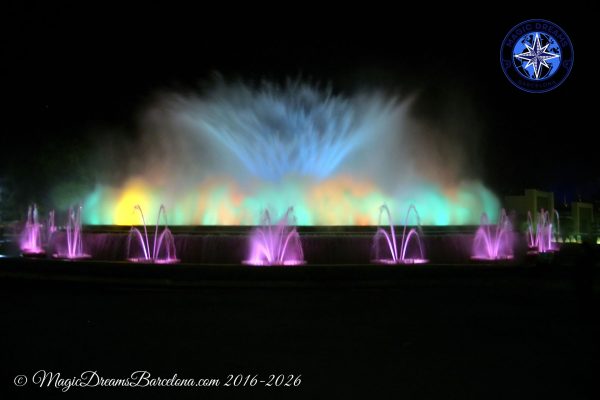
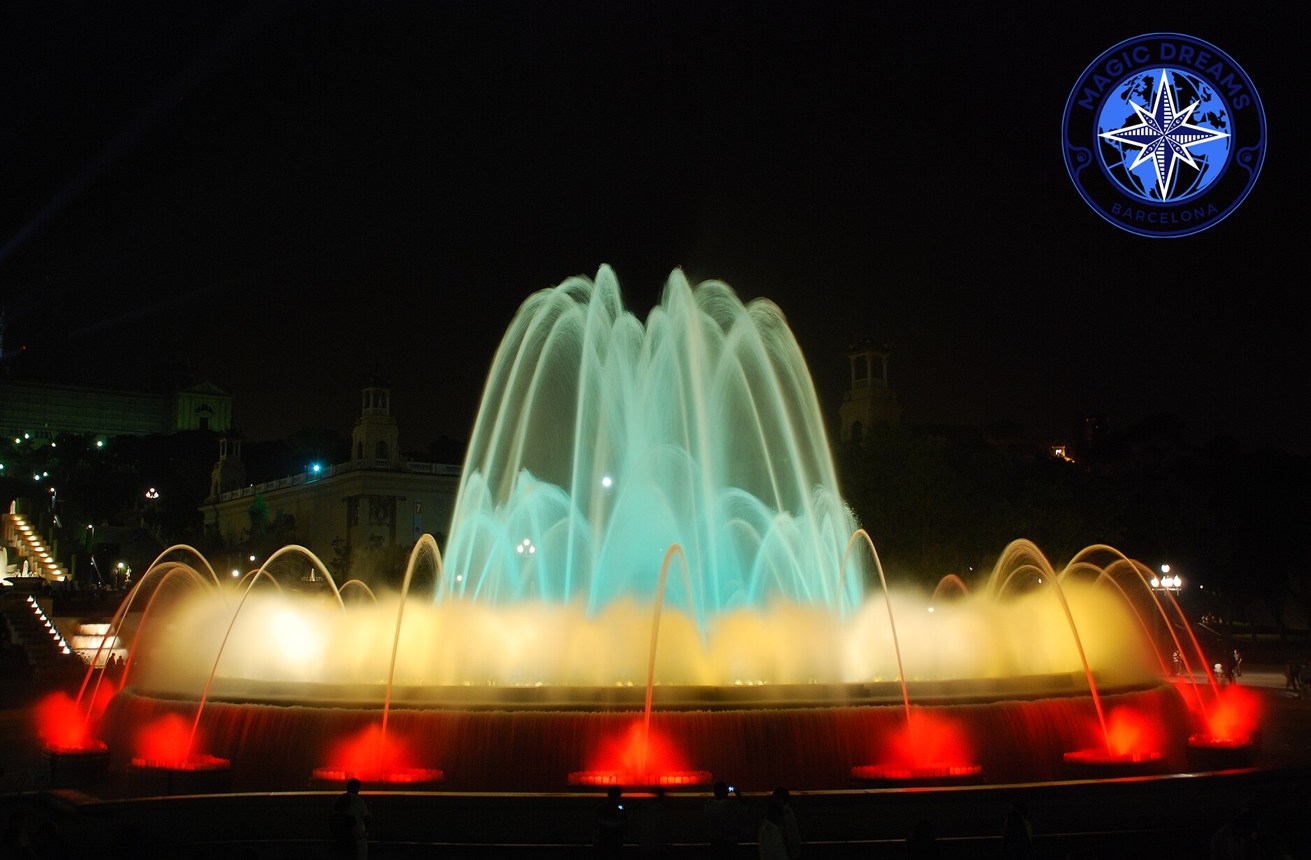
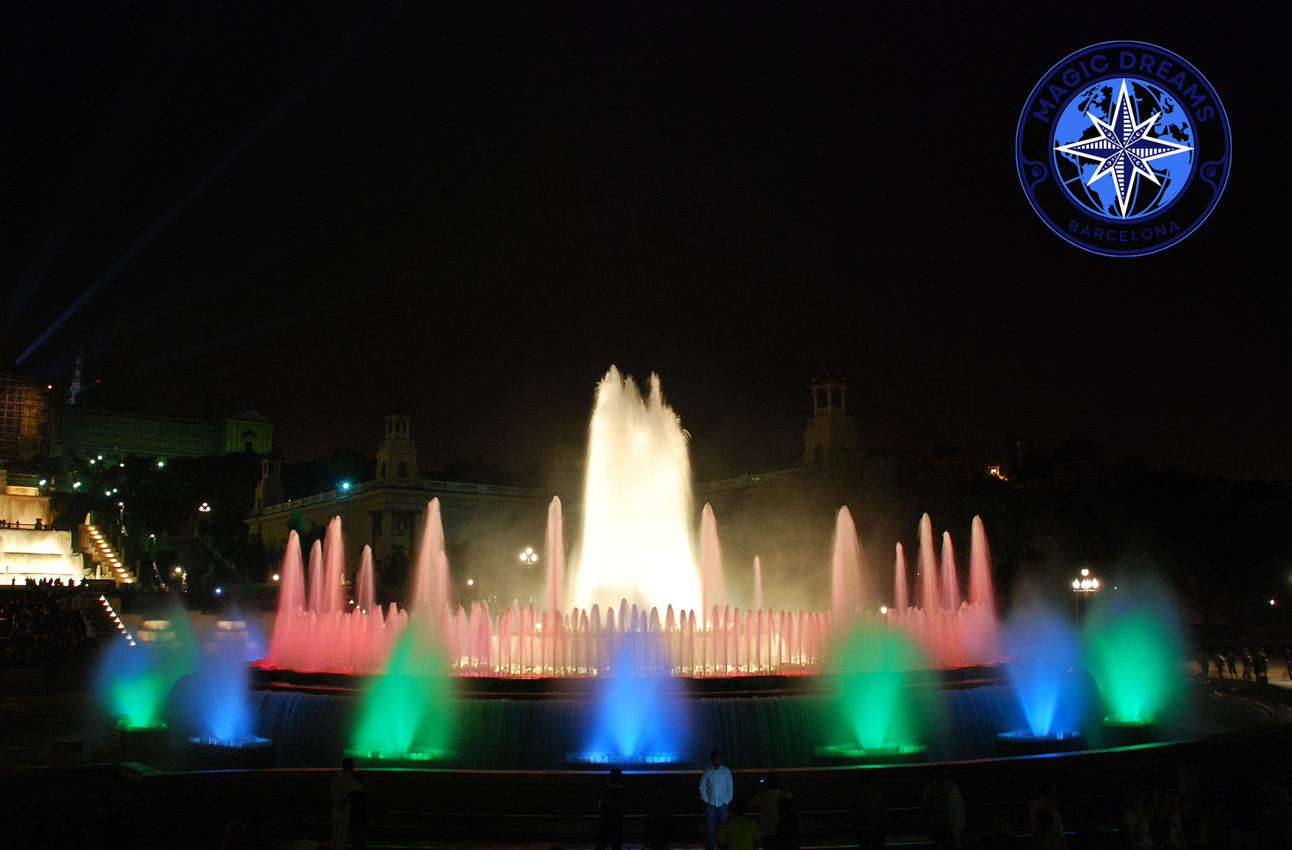
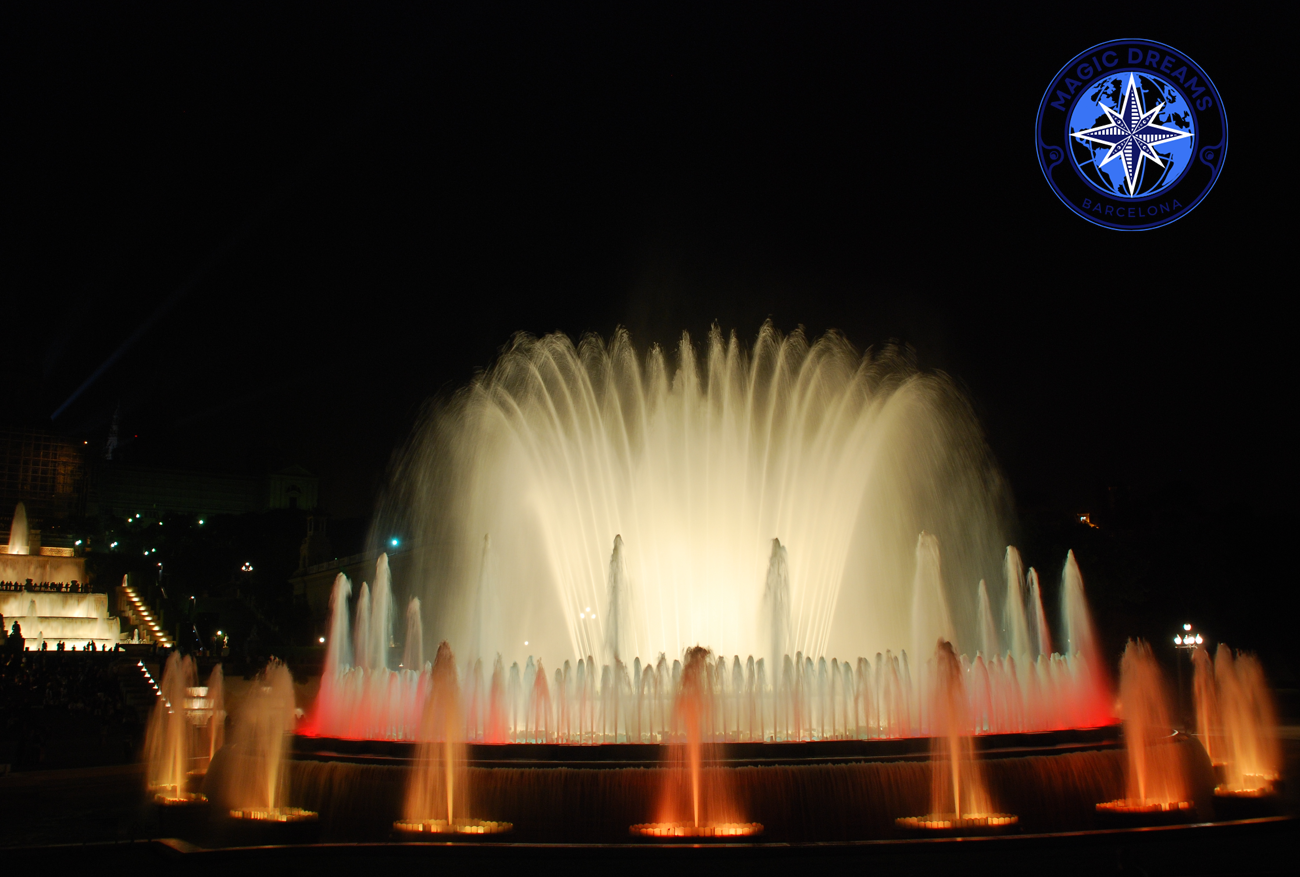
The lighting transforms the water into a succession of shapes and colours that contrast with the darkness of the surrounding landscape.
The National Palace appears in the background as a monumental stage set.
The stairways fill with visitors.
And Montjuïc takes on an entirely different atmosphere.
It is during these hours that the Magic Fountain most clearly reveals its theatrical character.
Barcelona then appears as a city of light, architecture and movement.
The Magic Fountain and the 1929 International Exposition
The birth of a new Barcelona
The history of the Magic Fountain cannot be separated from the 1929 International Exposition.
That event transformed Montjuïc and helped create some of the monumental spaces that remain part of Barcelona’s landscape today.
The exposition sought to showcase the technological, industrial and cultural advances of its time.
The Magic Fountain fitted perfectly into this spirit.
It was modern.
It was technological.
It was spectacular.
And at the same time, it was integrated into a monumental architectural composition.
More than nine decades later, that vision continues to form part of the identity of the city.
The Evolution of the Magic Fountain
A heritage landmark that has adapted over time
Like many major urban infrastructures, the Magic Fountain has gone through different stages throughout its history.
The passage of time, periods of deterioration and technical requirements have made various maintenance and restoration interventions necessary.
One of the most important moments in its recent history was connected to Barcelona’s transformation in preparation for the 1992 Olympic Games.
The renewal of the Montjuïc area helped restore and update different elements of the monumental complex.
The Magic Fountain therefore continued to play its role as one of Barcelona’s great public spaces.
An Engineering Masterpiece Turned Heritage
When infrastructure becomes culture
The Magic Fountain represents a particularly interesting concept within the history of urban development.
An infrastructure originally designed as part of an international event eventually became a cultural landmark and a major visitor experience.
Its importance lies not only in its dimensions or technical systems.
It also lies in the collective memory it has created.
For decades, the fountain has been the setting for celebrations, family gatherings, first visits to Barcelona and special moments.
Its value therefore combines material heritage and emotional memory.
What to Do Around the Magic Fountain
An experience that goes far beyond the show
A visit to the Magic Fountain can be combined with a wide range of activities in Montjuïc and its surroundings.
Possibilities include:
Visiting the Museu Nacional d’Art de Catalunya.
Exploring Montjuïc Mountain.
Discovering the Fundació Joan Miró.
Visiting Montjuïc Castle.
Walking through the mountain’s historic gardens.
Discovering Plaça d’Espanya.
Walking along Maria Cristina Avenue.
Enjoying panoramic views of Barcelona.
Combining Montjuïc with the Gothic Quarter.
Enjoying a private gastronomic experience.
Arranging a professional photography session.
Designing a personalised cultural itinerary.
In this way, the Magic Fountain can become part of a complete Barcelona experience.
The Magic Fountain as a Romantic Experience
Barcelona beneath the lights of Montjuïc
The combination of water, music, lighting and architecture makes this one of the most captivating settings for a romantic experience.
A visit can form part of a day designed for couples, combining Montjuïc with a private dinner, a photography session, a Barcelona itinerary or an exclusive Mediterranean experience.
The objective is not simply to watch the fountain.
It is to create a moment around it.
A moment that can remain in the memory long after leaving Montjuïc.
A Family Experience
Discovering Barcelona through wonder
The Magic Fountain is also an excellent experience for families.
The spectacle introduces younger visitors to concepts such as water, light, music, architecture and engineering in an engaging and entertaining way.
Its location also makes it possible to combine the visit with other Montjuïc attractions and design a day adapted to different ages.
Barcelona thus becomes a truly educational stage.
Montjuïc and the Identity of Barcelona
A mountain that tells the story of the city
Montjuïc is much more than the place where the Magic Fountain is located.
The mountain brings together an extraordinary variety of historical, artistic, sporting and cultural heritage.
The Magic Fountain occupies a particularly symbolic position within this landscape because it represents the modern Barcelona that emerged during the major urban transformations of the 20th century.
It is a landmark that connects past and present.
The Magic Fountain in Contemporary Barcelona
Tradition, innovation and new ways of experiencing the city
Barcelona continues to evolve, and so does the way visitors and residents discover its landmarks.
The Magic Fountain retains its historic character, but today it forms part of a tourism model increasingly focused on experiences.
It is no longer simply about arriving, taking a photograph and leaving.
Visitors want to understand.
To learn the history.
To discover the architecture.
To explore the surroundings.
To experience the city from a more personal perspective.
The Magic Fountain fits perfectly into this new way of travelling.
Discover the Magic Fountain with Magic Dreams Barcelona
An experience designed around every traveller
At Magic Dreams Barcelona, we believe that discovering Barcelona means much more than visiting its best-known landmarks.
It means understanding the stories behind them.
That is why we design private and personalised experiences around the Magic Fountain and Montjuïc.
We can create a cultural itinerary through the mountain, combine the visit with the Museu Nacional d’Art de Catalunya, explore the architecture of the 1929 International Exposition, incorporate gastronomy, photography or private transportation, or continue afterwards towards other iconic neighbourhoods and landmarks of Barcelona.
Every experience is adapted to the interests and pace of our clients.
For a couple, we can design a romantic experience.
For a family, an entertaining and cultural day.
For a private group, a complete itinerary through Montjuïc and the historic centre.
And for those seeking an exclusive experience, we can combine Montjuïc with gastronomy, art, private sailing and other premium services.
Barcelona Between Water, Light and Music
A city that knows how to turn engineering into emotion
The Magic Fountain of Montjuïc represents one of the most distinctive expressions of Barcelona’s identity.
It was born from a project of urban modernisation.
It was conceived as a demonstration of technological innovation.
It became a symbol of the city.
And over time, it became part of the collective memory of several generations.
Its true appeal lies precisely in this combination.
History, engineering, architecture, art, music and emotion.
Everything happens on a single stage.
Would You Like to Discover the Magic Fountain of Montjuïc with Us?
Barcelona from a cultural, private and personalised perspective
At Magic Dreams Barcelona, we design experiences that allow visitors to discover the city in depth and without rushing.
We can organise private visits to Montjuïc, cultural itineraries, gastronomic experiences, photography sessions, private transportation and personalised programmes combining heritage, art, nature and gastronomy.
We take care of the planning, logistics and every detail required to create an experience tailored to our clients.
Because the Magic Fountain can be visited.
But it can also be experienced.
And when the water begins to move, the music fills the space and the lights transform Montjuïc, Barcelona once again demonstrates why it is one of the Mediterranean’s most creative and fascinating cities.
Magic Dreams Barcelona transforms a visit to the Magic Fountain of Montjuïc into an experience where history, art, engineering and emotion come together beneath the lights of Barcelona.
Fuente Mágica de Montjuïc.
Fuente Mágica de Montjuïc.
Fuente Mágica de Montjuïc.
Fuente Mágica de Montjuïc.
Fuente Mágica de Montjuïc.
Magic Fountain in Barcelona – By Thingstodoinbarcelona – Own work, CC BY-SA 4.0, https://commons.wikimedia.org/w/index.php?curid=74862387.
Magic Fountain in Barcelona – By Artourbcn – Own work, CC BY-SA 4.0, https://commons.wikimedia.org/w/index.php?curid=103621418.
From bullring to a stage for music and culture At the intersection of Gran Via de les Corts Catalanes and Carrer de Marina stands one of Barcelona’s most distinctive buildings. The Monumental Bullring, known simply as La Monumental, has been part of the city’s architectural, …
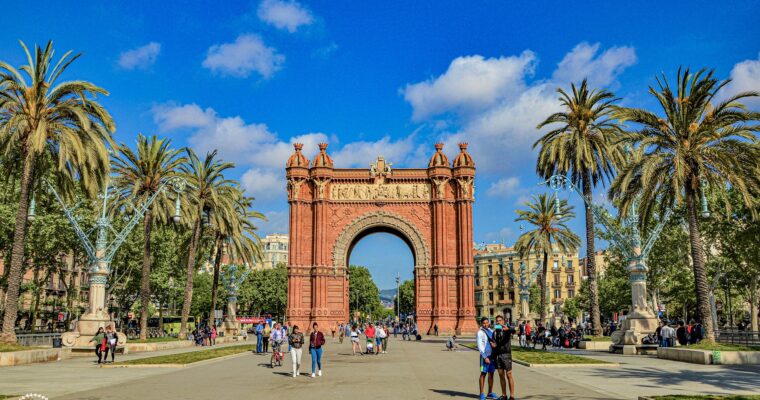
The Arc de Triomf of Barcelona is one of the city’s great monumental landmarks and one of the most important witnesses to the Barcelona that, at the end of the 19th century, was beginning to transform itself into a major European capital. Built in 1888 …
A Masterpiece of Catalan Gothic Architecture, Where History, Art and Spirituality Come Together
Barcelona Cathedral, officially known as the Cathedral of the Holy Cross and Saint Eulalia, is one of the most emblematic monuments of the Catalan capital and one of the finest expressions of Gothic art in Catalonia.
Located in the heart of the Gothic Quarter, its imposing architecture is the result of centuries of history, transformation and devotion. Its stone walls, pinnacles, vaults, sculptures and famous gargoyles form a monumental ensemble in which medieval architecture engages in a dialogue with the city’s collective memory.
Dedicated to the Holy Cross and Saint Eulalia, the patron saint of Barcelona, the cathedral is much more than a religious building. It bears witness to the city’s historical evolution, offers extraordinary artistic value and is a place where every detail seems to tell a story.
Among its most striking features are sculptures of fantastic animals, mythological figures and monstrous creatures. The gargoyles include unexpected figures such as a bull, a unicorn and an elephant. Its bells, traditionally identified by female names, add another intriguing detail to this symbolic world.
The cathedral invites visitors to slow down, discover its details and understand how architecture, religion, popular tradition and urban history intertwine in one of Barcelona’s most fascinating heritage sites.
The Origins of the Cathedral
From Roman Barcelona to the Great Gothic Architecture
The history of Barcelona Cathedral dates back to the earliest centuries of Christianity. Religious buildings once stood in this same area, reflecting the evolution of Barcino, the ancient Roman city.
Before the construction of the present Gothic cathedral, Barcelona had a Romanesque cathedral, consecrated in the eleventh century. The expansion of the medieval city, its growing political and commercial importance, and the development of new artistic forms encouraged the construction of a more ambitious building.
Work on the Gothic cathedral began in 1298, during the reign of James II of Aragon, at a time when medieval Barcelona was flourishing. The project unfolded over several generations, and the principal Gothic structures took shape during the fourteenth and fifteenth centuries.
However, the building we see today also reflects later interventions. The main façade, monumental in appearance and deeply inspired by medieval Gothic architecture, was completed between the late nineteenth and early twentieth centuries, following a design based on the Gothic style.
This evolution reveals one of the cathedral’s most interesting characteristics: its visual unity is not the result of a single construction campaign, but of a long historical process in which different periods left their mark.
Architecture That Reaches Towards the Sky
Verticality as an Expression of the Spiritual
Barcelona Cathedral embodies some of the essential principles of Gothic art: soaring spaces, the pursuit of light, structural complexity and the integration of sculpture into architecture.
Its main façade is dominated by a large rose window and features pointed arches, archivolts, pinnacles and abundant sculptural ornamentation. Saints, angels, botanical motifs and fantastic figures coexist in a decorative programme that invites visitors to pause and appreciate the details.
The exterior buttresses help distribute the building’s structural loads and form part of an architectural system characteristic of the Gothic style. Inside, the ribbed vaults transfer weight to the pillars and reinforce the sensation of height.
Light plays a fundamental role. It enters through the stained-glass windows, gradually transforming the appearance of the stone and creating contrasts between illuminated areas and more secluded corners.
The cathedral cannot be understood through its monumental scale alone. Its true richness emerges when we observe the relationships between structure, proportion, sculpture and light.
Every element reflects a conception of space in which construction techniques and spiritual experience form part of the same architectural vision.
The Crypt of Saint Eulalia
The Memory of a Young Martyr and Patron Saint of Barcelona
Beneath the presbytery lies one of the cathedral’s most significant spaces: the crypt of Saint Eulalia, which houses the saint’s tomb.
According to Christian tradition, Eulalia was a young martyr who was persecuted during Roman times for remaining faithful to her beliefs. Her martyrdom is traditionally dated to AD 304, although the accounts that have come down to us belong to a hagiographic tradition developed over many centuries.
Her story represents strength, fidelity to one’s convictions and resistance in the face of persecution. Over time, her cult acquired extraordinary importance in Barcelona, making her one of the city’s principal patron saints.
The tomb is a work of considerable artistic and historical interest. Its position beneath the high altar establishes a direct connection between the cathedral’s monumental architecture and the memory of Barcelona’s Christian community.
The crypt is also a place of retreat. In contrast to the height of the naves and the complexity of the exterior architecture, this space offers a more intimate experience, defined by silence and contemplation.
The Gothic Cloister
A Medieval Garden in the Heart of the Gothic Quarter
The cloister is one of the cathedral’s most distinctive and charming corners.
Built mainly between the fourteenth and fifteenth centuries, it consists of Gothic galleries arranged around an inner garden, where vegetation introduces a natural dimension into the monumental complex.
Palm trees, magnolias, an orange tree and other plant species help create a peaceful atmosphere. Water, present in the garden’s traditional features, reinforces the relationship between nature, architecture and spirituality.
The cloister was not merely decorative. It formed part of the daily organisation of the ecclesiastical community and provided passage between different areas of the cathedral complex.
Its galleries, with their arches and sculptural details, offer a different perspective on Gothic architecture: less monumental than the main façade, yet particularly rich in detail and subtlety.
The Thirteen Geese of Saint Eulalia
One of the cloister’s best-known features is the group of geese that live in its garden.
Tradition associates their number, thirteen, with the age Saint Eulalia was said to have been when she was martyred. It is also symbolically linked to the thirteen tortures that, according to hagiographic tradition, the young saint endured.
The presence of these birds makes the cloister especially beloved by visitors and adds a storytelling dimension to the experience.
Beyond their curious appeal, the geese form part of the cathedral’s popular memory. They remind us that heritage is made up of more than stone and works of art: it is also shaped by the stories, symbols and customs that a community passes down from one generation to the next.
The Organ and the Choir
Music as Part of Sacred Architecture
Music is another important dimension of Barcelona Cathedral.
Its historic organ, located in the upper gallery near the Portal of Sant Iu, is one of the most remarkable instruments in the cathedral’s musical heritage. Construction began between 1537 and 1539, and the instrument has undergone several transformations throughout its history.
The organ is more than a historical artefact. Its sound takes advantage of the Gothic space’s acoustic properties, as the vaulted ceilings and the dimensions of the naves allow the music to resonate throughout the building.
Concerts and musical events held at the cathedral offer a different way to experience the building: not only through sight, but also through sound.
The choir is another of the interior’s most valuable artistic spaces. Its carved wooden stalls, ornamental details and arrangement reflect the importance of liturgical life in the organisation of the cathedral.
Among the stone, wood and music, visitors discover how medieval and Renaissance art come together in an experience that unites architecture and spirituality.
The Cathedral Rooftop
Barcelona from a Privileged Perspective
Visiting the upper levels of the cathedral reveals a lesser-known dimension of the monument.
Access to the rooftop by lift, when available as part of the relevant visitor experience, offers privileged views of the bell towers, the lantern tower and the architectural features crowning the building.
From this vantage point, visitors can better appreciate the proportions of the upper structures and the complexity of the Gothic ornamentation. It is also possible to view the cloister from a different perspective and observe how the cathedral relates to the surrounding urban fabric of the Gothic Quarter.
The octagonal lantern tower, crowned by the Holy Cross and associated with the image of Saint Helena, is one of the most distinctive features of the cathedral’s silhouette.
From above, Barcelona reveals the overlapping historical layers that characterise its historic centre: medieval streets, later buildings and urban spaces that have evolved around the ancient city.
The rooftop helps visitors understand the cathedral not as an isolated building, but as an essential part of Barcelona’s historic landscape.
The Chapel of the Holy Christ of Lepanto
Devotion, Legend and Artistic Richness
The Chapel of the Holy Christ of Lepanto is one of the cathedral’s most important spaces in terms of religious devotion and historical interest.
Its architectural configuration is linked to the transformation of the medieval cathedral and to interventions carried out during the fifteenth century. The architect Arnau Bargués, associated with important works in Barcelona during that period, occupies a significant place in its history.
The chapel houses the revered image of the Holy Christ of Lepanto, which inspires deep popular devotion.
Tradition connects this image with the Battle of Lepanto in 1571 and associates it with the naval events of that historical episode. The stories surrounding the image form part of Barcelona’s religious memory and should be understood within the devotional traditions passed down through the centuries.
Its star-patterned ribbed vault and architectural ornamentation reflect the sophistication achieved by Catalan Gothic architecture. Another notable feature is the central vault boss depicting Pentecost, attributed to the sculptor Joan Claperós and dated to 1454.
The ensemble is completed by the Baroque tomb of Saint Olegarius, which adds another historical and artistic layer to this space.
The chapel illustrates how a single place can bring together different periods, styles and expressions of religious devotion, from Gothic architecture to Baroque artistic traditions.
The Cathedral’s Gargoyles
Fantastic Animals, Medieval Creatures and Symbolism
Among the cathedral’s most fascinating features are the gargoyles projecting from its walls and rooftops.
These sculptures served a practical purpose: to channel rainwater away from the building’s walls. However, their designs also made them part of one of the most imaginative sculptural repertoires in medieval architecture.
Their forms depict animals, fantastic creatures and monstrous figures that appear to watch over the building from above.
Among the figures popularly identified are an elephant, a bull and a unicorn. These representations contrast with the more familiar imagery of religious art and arouse the curiosity of those exploring the cathedral’s exterior.
In medieval culture, animals could carry moral, religious or symbolic meanings. Nevertheless, not every sculpted figure has a single, documented interpretation. Some reflect established iconographic traditions, while others can be understood as expressions of ornamental imagination.
The gargoyles reveal a less solemn side of Gothic art: a world in which the sacred coexists with the fantastic, morality with imagination, and practical construction with artistic expression.
Looking at them carefully allows visitors to discover details that might otherwise go unnoticed during a first visit.
The Cathedral’s Bells
Twenty-One Voices That Form Part of Barcelona’s Memory
For centuries, bells have played a fundamental role in the life of the city.
Their sounds announced religious celebrations, marked certain moments of the day and accompanied important events within the community.
The cathedral’s tradition highlights its twenty-one bells and the female names associated with them, a distinctive feature that arouses the curiosity of many visitors.
Beyond their acoustic role, the bells form part of the cathedral’s historical identity. Each belongs to an artisanal tradition involving metal casting, the shape of the instrument and the acoustic characteristics that determine its sound.
The bell towers, visible from various points throughout the Gothic Quarter, are also an essential element of the cathedral’s silhouette.
The relationship between architecture and sound offers a different way of understanding the building: as a monument that has also played an active role in Barcelona’s everyday life.
The Lantern Tower and Bell Towers
An Unmistakable Silhouette in the Urban Landscape
The cathedral’s exterior appearance is defined by its bell towers, pinnacles and the lantern tower rising above the roofline.
The lantern tower, with its octagonal design and crowning spire, is one of the ensemble’s most striking visual features.
Its verticality reflects the Gothic conception of the building, in which ascending lines reinforce the impression of height and establish a visual relationship between architecture and the sky.
The towers, meanwhile, are more than functional structures. They are landmarks within the historic landscape and help visitors recognise the cathedral from different streets and squares in the old town.
Stone, geometry and ornamental details combine to create a silhouette that captures much of the visual identity of medieval Barcelona.
The Cathedral and the Gothic Quarter
A Monument Inseparable from the City’s History
Barcelona Cathedral cannot be fully understood without exploring its surroundings.
The Pla de la Seu, the narrow streets of the Gothic Quarter and the nearby squares form part of an urban landscape where Roman remains, medieval architecture and buildings from later periods coexist.
The surrounding area reveals how the city developed around its principal religious, political and commercial institutions.
The proximity of other historic sites makes a visit an opportunity to understand Barcelona’s evolution from ancient Barcino to the contemporary metropolis.
In this setting, the cathedral serves as a cultural and architectural landmark. Its presence has accompanied the transformations of the historic centre and continues to form part of everyday life in the city.
One of the most rewarding ways to experience the area is to combine a visit to the cathedral’s interior with a leisurely walk through its surroundings, observing doorways, reliefs, courtyards and hidden corners that preserve the memory of different eras.
A Building Constructed Over the Centuries
From the Medieval Project to Its Present Monumental Appearance
Construction of the cathedral began in 1298, and its development continued over several centuries. The Gothic building took shape primarily during the fourteenth and fifteenth centuries, while some of its most visible features, such as the main façade, acquired their present appearance much later.
This chronology explains why the cathedral combines historical elements with later reconstructions.
The Neo-Gothic façade, completed between the late nineteenth and early twentieth centuries, draws inspiration from medieval architectural language and contributes to the monumental appearance that identifies the building today.
Rather than diminishing its interest, this evolution helps us understand how each generation interprets and transforms its heritage.
The cathedral is therefore a historical work in the broadest sense: it preserves the legacy of medieval Barcelona while reflecting later generations’ desire to preserve and complete one of the city’s principal symbols.
Barcelona Cathedral Today
Heritage, Worship and Cultural Life
Today, the Cathedral of the Holy Cross and Saint Eulalia continues to serve as a place of worship and remains a fundamental monument within Barcelona’s cultural heritage.
Its interior preserves chapels, tombs, sculptural works and liturgical objects that reveal different stages in Catalonia’s artistic history.
A visit offers the opportunity to explore Gothic art from multiple perspectives: architecture, sculpture, music, religious tradition and urban history.
The cathedral continues to fulfil its spiritual function, so visitors are encouraged to respect worship schedules and the rules established for visitors.
Preserving the building requires continuous maintenance and restoration. Stone, stained glass, metalwork and rooftops are all affected by the passage of time and environmental conditions, making conservation an essential part of the monument’s historical continuity.
Visiting the cathedral means discovering an exceptional work of art and architecture, but also recognising our collective responsibility to preserve it for future generations.
Fascinating Facts You May Not Know
The Small Details That Make the Cathedral Extraordinary
Thirteen geese in the cloister. Their number is traditionally associated with Saint Eulalia’s age at the time of her martyrdom and with the thirteen tortures attributed to her in tradition.
Fantastic animals among the gargoyles. Figures popularly identified include a bull, a unicorn and an elephant.
More than seven centuries of history. Work on the Gothic cathedral began in 1298, although its present monumental appearance incorporates much more recent interventions.
A historic organ. Initially constructed between 1537 and 1539, it forms part of the cathedral’s musical heritage.
A panoramic rooftop. When access is available, the rooftop offers privileged views of the towers, lantern tower and rooftops of the Gothic Quarter.
A cathedral dedicated to two sacred invocations. Its official name, Santa Creu i Santa Eulàlia, brings together devotion to the Holy Cross and the memory of Barcelona’s patron saint.
A cloister within the city. Just a short distance from the busiest streets of the historic centre, the inner garden offers a peaceful atmosphere that contrasts with the surrounding urban activity.
Practical Information for Visitors
Everything You Need to Know Before Planning Your Visit
Location
Pla de la Seu, 3, Barcelona.
The cathedral is situated in the Gothic Quarter, very close to Via Laietana and other points of interest in the historic centre.
Visiting Hours
As a general reference, the following tourist visiting hours have been provided:
Weekdays: 9:30 a.m.–6:30 p.m.
Saturdays and public holidays: 9:30 a.m.–5:30 p.m.
Sundays: 2:00 p.m.–5:00 p.m.
These hours may vary depending on the season, religious celebrations and scheduled activities. Visitors are advised to check the official information before travelling, particularly if they wish to access the rooftop or visit specific areas.
How to Get There
Metro: Line L4, the yellow line, getting off at Jaume I station.
Bus: Route 47, with a stop near Via Laietana and Plaça de Ramon Berenguer.
On foot: Walking from other parts of the Gothic Quarter allows visitors to combine the cathedral visit with a tour of the historic centre.
Things to Keep in Mind
Allow enough time to explore both the interior and exterior of the cathedral.
Check which areas are included in the chosen ticket option.
Confirm rooftop access availability and the conditions for visiting the cloister.
Respect areas reserved for worship and follow staff instructions.
Consider a guided tour to gain a deeper understanding of the sculptures’ symbolism and the building’s architectural evolution.
An Experience Best Discovered Slowly
Architecture Is Observed, History Is Understood and Beauty Is Felt
Visiting Barcelona Cathedral is about much more than admiring a monumental façade or walking through its naves.
It means pausing before a gargoyle, observing the light passing through a stained-glass window, listening to the organ’s resonance, discovering the silence of the cloister and understanding the historical significance of a chapel.
It also means looking up towards the pinnacles, recognising the different stages of construction and discovering how a building can become a witness to a city’s evolution.
The cathedral is a place to discover gradually, with an attentive eye for detail and an openness to the many layers of meaning it contains.
Would You Like to Discover Barcelona Cathedral with Us?
A Bespoke Cultural Experience with Magic Dreams Barcelona
At Magic Dreams Barcelona, we transform visits to the Gothic Cathedral and other emblematic sites across the city into personalised experiences designed to explore heritage from a cultural, sensory and deeply human perspective.
Our tours offer an opportunity to discover Catalan Gothic history, art and architecture through stories tailored to each visitor’s interests, pace and preferences.
We organise private experiences and personalised itineraries that can combine the cathedral with other historic sites in Barcelona, architectural routes, gardens, cultural venues and lesser-known corners of the historic centre.
We also design special experiences for those who wish to go beyond a conventional sightseeing visit:
Expert guides specialising in history, art and architecture, with explanations tailored to each visitor.
Private, personalised tours, designed around cultural interests, available time and individual pace.
Sensory experiences, incorporating music, literature and carefully selected aromas into the itinerary whenever conditions at the venue allow.
Signature gastronomy and exclusive picnics, arranged in suitable locations selected to complement the experience.
Creative workshops, including mosaic-making, trencadís art and activities inspired by Catalan traditions.
Getaways to the Costa Brava and the Catalan Pyrenees, featuring landscapes, heritage sites and carefully selected gastronomic experiences.
Personalised services throughout your stay, from romantic experiences to cultural activities and gastronomic tours.
We take care of the details to ensure that each day unfolds comfortably and seamlessly, with personalised attention throughout. Our experiences are designed according to each client’s preferences and the availability of venues and services.
Our goal is to transform heritage from a succession of dates and monuments into a memorable experience, combining historical knowledge with the excitement of discovery.
Barcelona Cathedral is much more than a masterpiece of Gothic architecture. It is a place where centuries of history, art, devotion and urban life come together.
With Magic Dreams Barcelona, every journey becomes a dialogue between past and present, where beauty can be experienced through all the senses.
La Catedral de la Santa Creu i Santa Eulàlia de Barcelona.
La Catedral de la Santa Creu i Santa Eulàlia de Barcelona.
La Catedral de la Santa Creu i Santa Eulàlia de Barcelona.
La Catedral de la Santa Creu i Santa Eulàlia de Barcelona.
La Catedral de la Santa Creu i Santa Eulàlia de Barcelona.
La Catedral de la Santa Creu i Santa Eulàlia de Barcelona.
La Catedral de la Santa Creu i Santa Eulàlia de Barcelona.
La Catedral de la Santa Creu i Santa Eulàlia de Barcelona.
La Casa Batlló es una de las obras maestras de Antoni Gaudí y uno de los edificios más famosos de Barcelona. Situada en pleno Passeig de Gràcia, en el corazón del Eixample, esta extraordinaria construcción es uno de los grandes referentes del modernismo catalán y …
Casa Batlló is one of the masterpieces of Antoni Gaudí and one of Barcelona’s most famous buildings. Located on Passeig de Gràcia, in the heart of the Eixample district, this extraordinary building is one of the great landmarks of Catalan Modernism and forms part of …