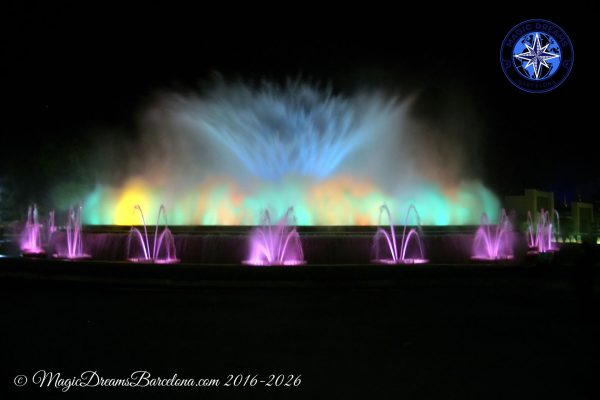
Where water, light and music come together to create one of Barcelona’s great icons
Among Barcelona’s monumental landmarks, few places bring together history, architecture, engineering, art and spectacle as powerfully as the Magic Fountain of Montjuïc.
Located at the foot of Montjuïc Mountain, beside Maria Cristina Avenue and opposite the majestic National Palace, the Magic Fountain is one of the city’s most recognisable landmarks.
Its history is closely linked to one of the great events in Barcelona’s 20th-century history: the 1929 International Exposition.
Since then, generations of Barcelona residents and visitors have watched water transform into movement, light into colour and music into emotion.
The Magic Fountain is not simply a monumental fountain.
It is a true representation of Barcelona’s ability to combine innovation, creativity and urban space.
The History of the Magic Fountain
A project created to transform Montjuïc
The Magic Fountain was conceived in the context of the 1929 Barcelona International Exposition, an event that profoundly transformed Montjuïc Mountain and its surroundings.
Barcelona wanted to present itself internationally as a modern, innovative and culturally advanced city.
Within this ambitious urban project came an extraordinary idea: to create a large fountain capable of transforming water into a visual spectacle.
The project was developed by engineer Carles Buïgas, who envisioned an installation in which water, light and movement could be combined in countless ways.
The proposal was particularly innovative for its time.
Construction was completed within an extremely short period and, despite the technical challenges, the fountain was inaugurated in 1929.
Its launch quickly became one of the major events of the International Exposition.
From that moment onwards, the Magic Fountain became part of Barcelona’s visual identity.
Carles Buïgas and the Engineering of Spectacle
When technology becomes art
The figure of Carles Buïgas is fundamental to understanding the Magic Fountain.
His vision was not simply to construct a large-scale fountain.
Buïgas wanted to create a spectacle based on the interaction between different elements.
Water would become movement.
Lighting would provide colour.
And the entire installation would acquire a theatrical dimension.
This concept transformed the fountain into one of the great expressions of engineering applied to public space during the 20th century.
The installation demonstrated that urban infrastructure could go beyond its practical function and become an aesthetic experience.
That idea remains one of the defining characteristics of the Magic Fountain.
Water, Light and Music
A monumental choreography
The Magic Fountain functions as a vast hydraulic stage.
Its different jets allow numerous shapes, heights and movements of water to be created.
Added to this is a lighting system capable of continuously changing the perception of the spectacle.
The result is an authentic choreography in which every element plays its part.
Water provides movement.
Light creates atmosphere.
Music establishes the rhythm.
And the architecture of Montjuïc provides the stage.
During the shows, these elements are synchronised to create a multisensory experience.
The fountain then ceases to be a static structure and becomes a work of art in motion.
An Icon of Barcelona
An image inseparable from the Montjuïc landscape
Over the decades, the Magic Fountain became one of Barcelona’s great tourism symbols.
Its location played a major role in this transformation.
The fountain stands along one of the city’s most important monumental axes, between Plaça d’Espanya and the National Palace, today home to the Museu Nacional d’Art de Catalunya.
From this point, the view towards Montjuïc reveals the urban importance of the monumental complex created for the 1929 International Exposition.
The Magic Fountain forms part of a landscape in which architecture, gardens, stairways, museums and public spaces come together around the mountain.
For this reason, visiting it can become a much broader experience than simply attending a show.
It is an opportunity to discover an essential part of Barcelona’s urban history.
The Magic Fountain and Montjuïc
A gateway to the mountain
The Magic Fountain can serve as the starting point for exploring some of the most important cultural and monumental sites in Montjuïc.
From here, visitors can continue towards the Museu Nacional d’Art de Catalunya, explore the landscaped areas, visit the Fundació Joan Miró or ascend towards Montjuïc Castle.
The visit can also be combined with a walk along Maria Cristina Avenue, Plaça d’Espanya and other areas connected to Barcelona’s urban transformation during the 20th century.
In this way, the fountain becomes more than an isolated attraction and instead forms part of a cultural itinerary through Montjuïc.
A Spectacle for Every Generation
Barcelona from a different perspective
One of the reasons the Magic Fountain has remained popular for decades is its ability to connect with very different audiences.
Children discover the spectacle through movement and colour.
Adults can appreciate its engineering and design.
Architecture enthusiasts encounter an exceptional monumental setting.
And those looking for a romantic experience find an especially captivating setting during the evening.
The Magic Fountain demonstrates how the same experience can take on different meanings depending on who is watching it.
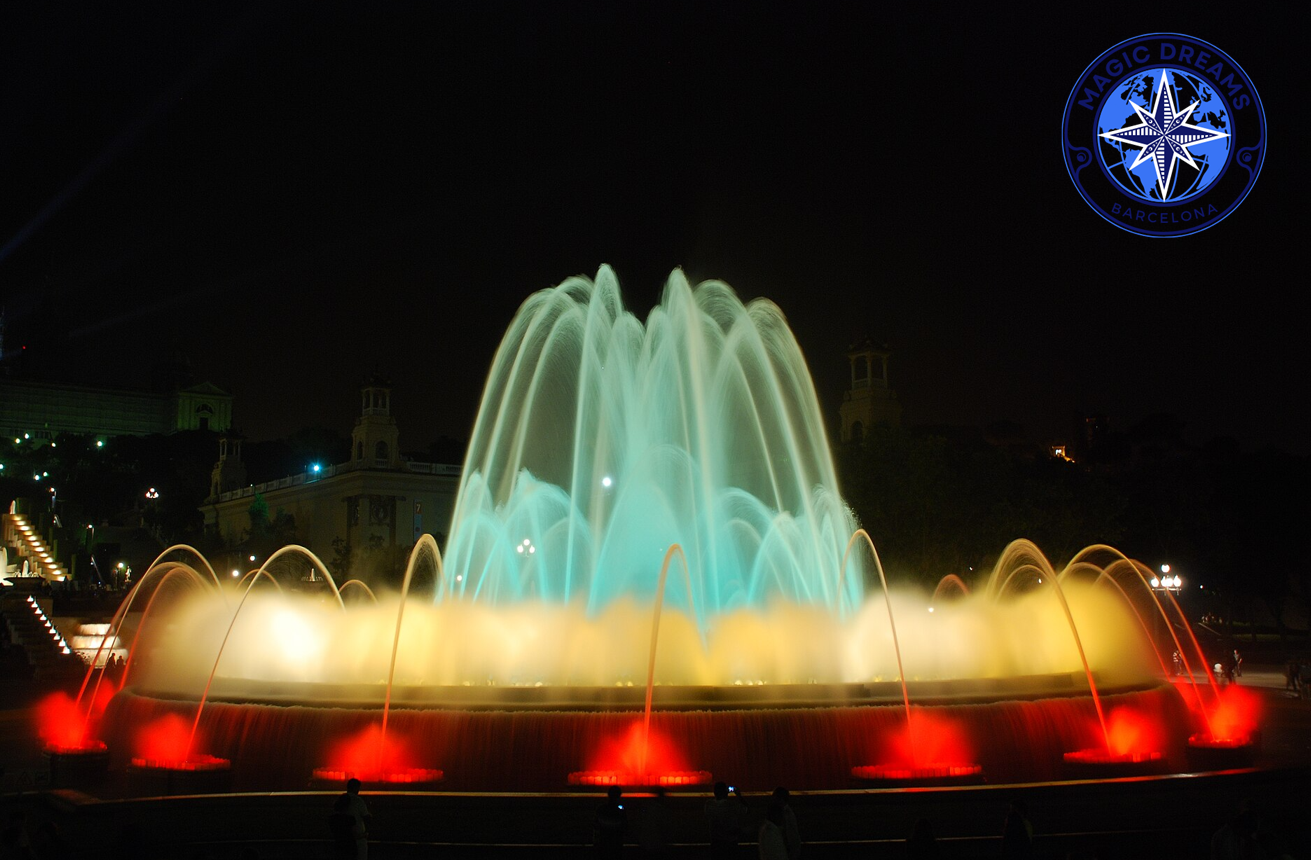
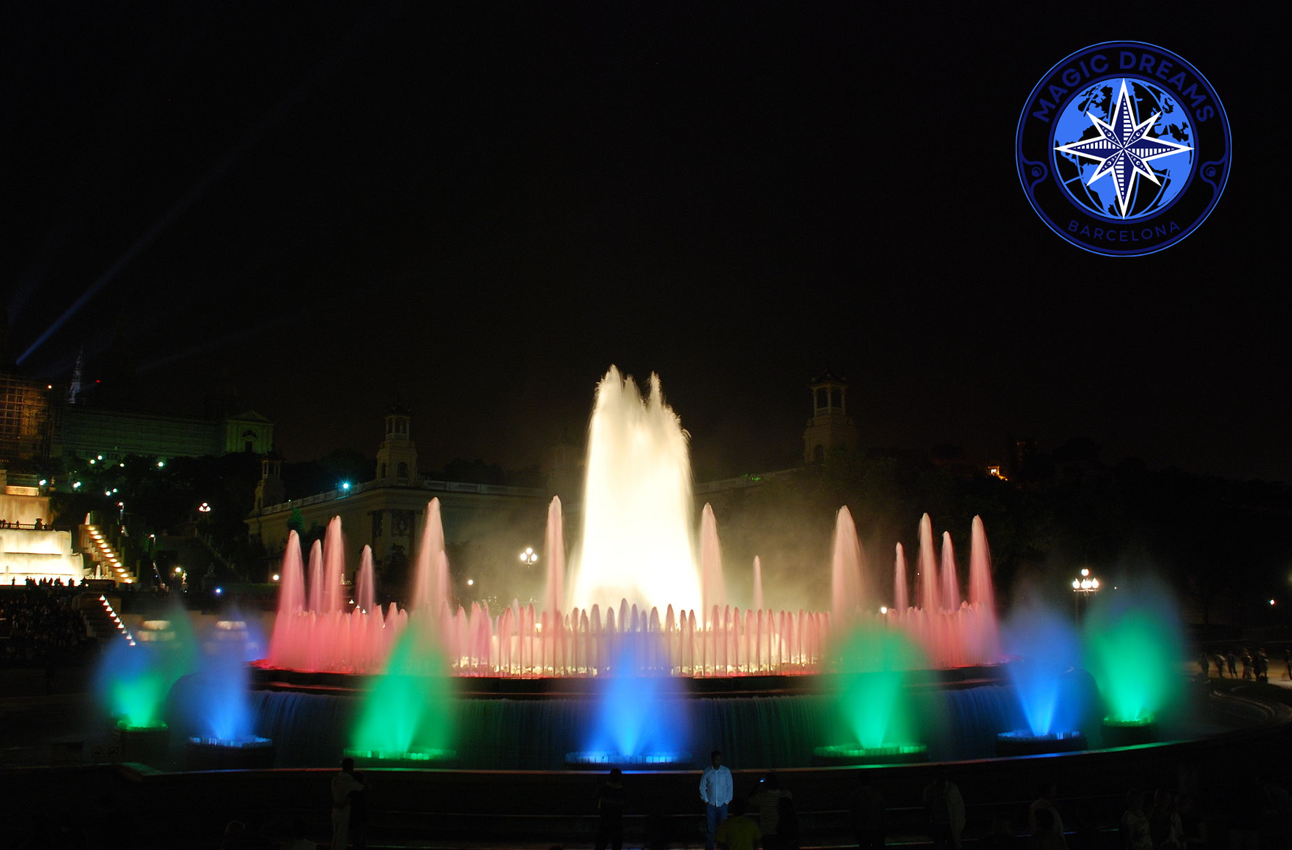
The Magic Fountain at Night
When Montjuïc is transformed
The experience changes completely when night falls.
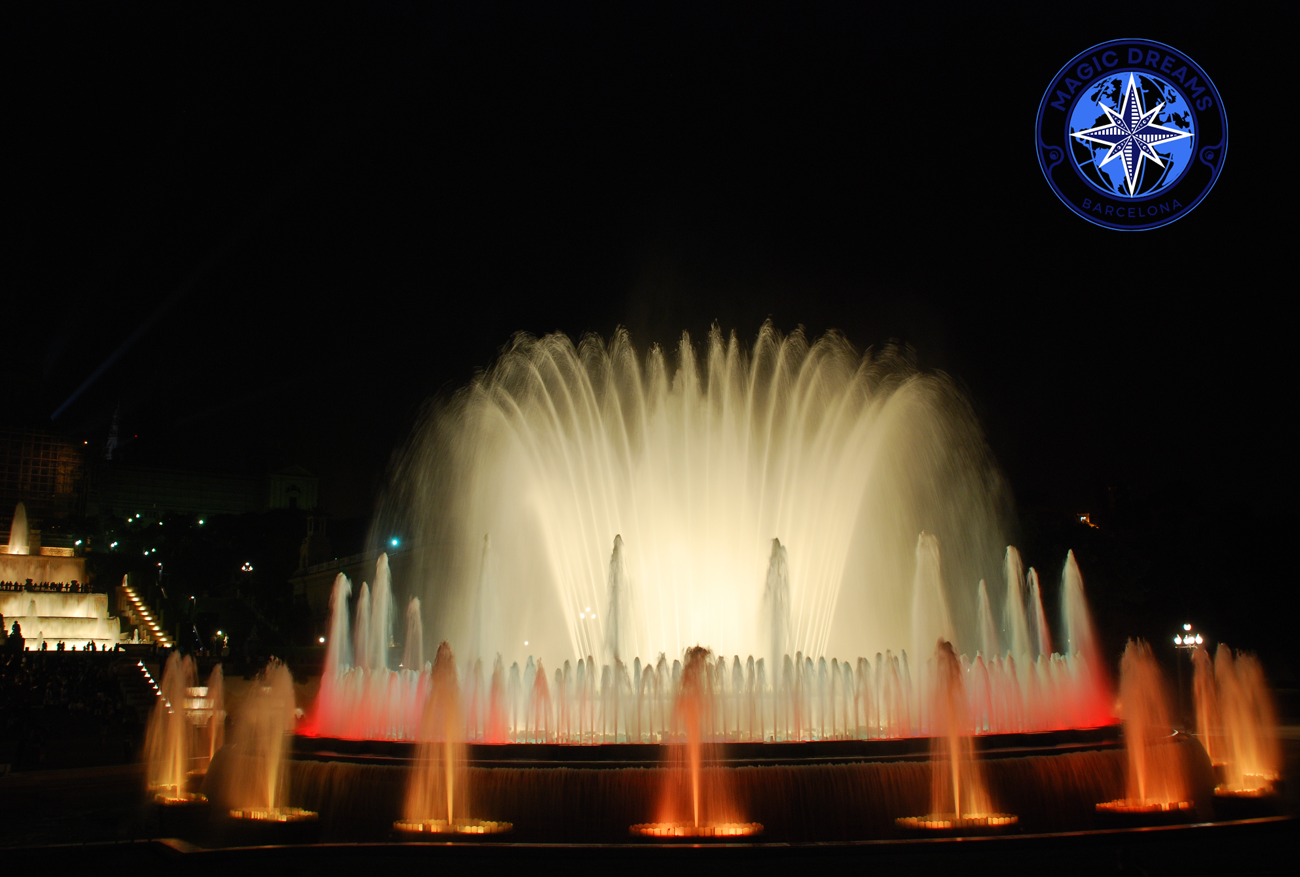
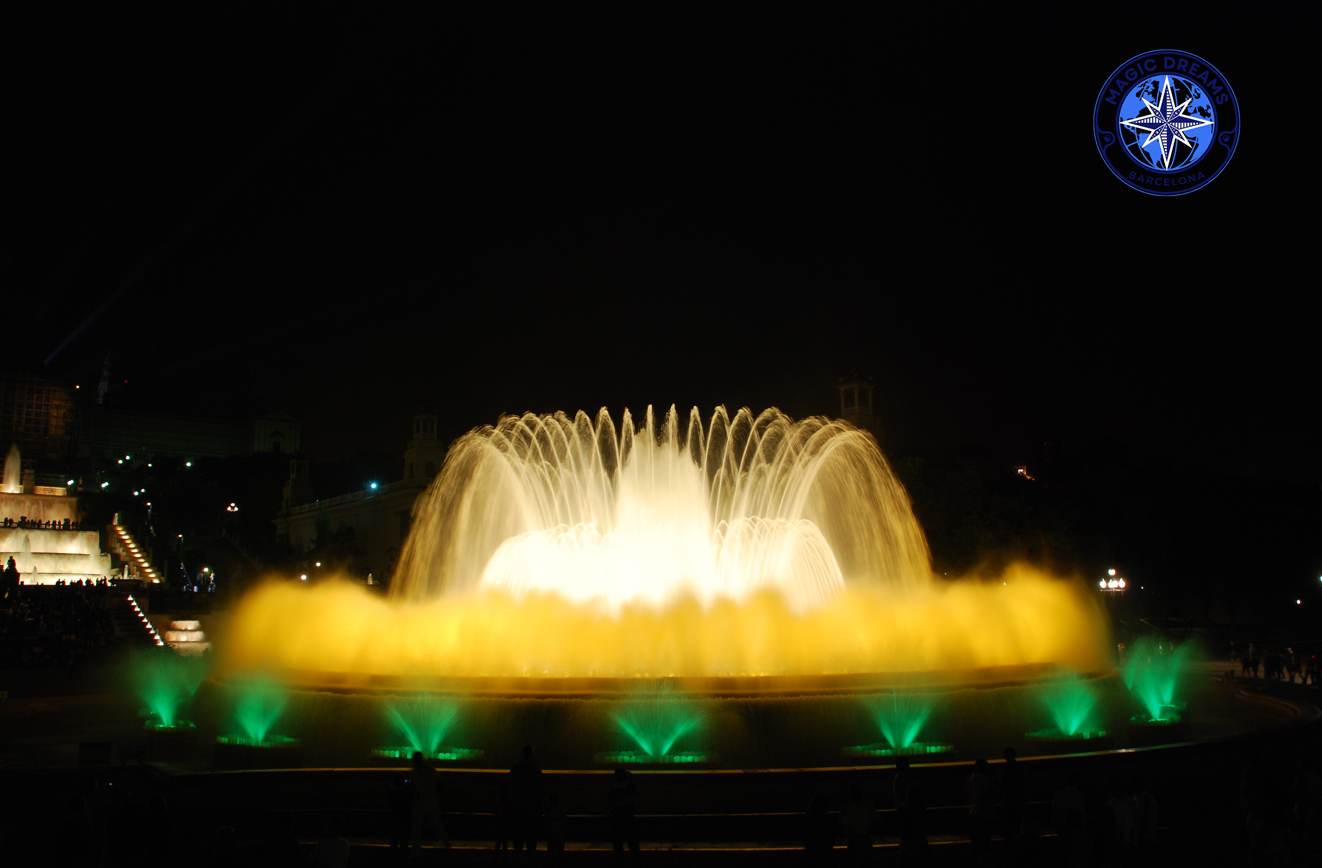
The lighting transforms the water into a succession of shapes and colours that contrast with the darkness of the surrounding landscape.
The National Palace appears in the background as a monumental stage set.
The stairways fill with visitors.
And Montjuïc takes on an entirely different atmosphere.
It is during these hours that the Magic Fountain most clearly reveals its theatrical character.
Barcelona then appears as a city of light, architecture and movement.
The Magic Fountain and the 1929 International Exposition
The birth of a new Barcelona
The history of the Magic Fountain cannot be separated from the 1929 International Exposition.
That event transformed Montjuïc and helped create some of the monumental spaces that remain part of Barcelona’s landscape today.
The exposition sought to showcase the technological, industrial and cultural advances of its time.
The Magic Fountain fitted perfectly into this spirit.
It was modern.
It was technological.
It was spectacular.
And at the same time, it was integrated into a monumental architectural composition.
More than nine decades later, that vision continues to form part of the identity of the city.
The Evolution of the Magic Fountain
A heritage landmark that has adapted over time
Like many major urban infrastructures, the Magic Fountain has gone through different stages throughout its history.
The passage of time, periods of deterioration and technical requirements have made various maintenance and restoration interventions necessary.
One of the most important moments in its recent history was connected to Barcelona’s transformation in preparation for the 1992 Olympic Games.
The renewal of the Montjuïc area helped restore and update different elements of the monumental complex.
The Magic Fountain therefore continued to play its role as one of Barcelona’s great public spaces.
An Engineering Masterpiece Turned Heritage
When infrastructure becomes culture
The Magic Fountain represents a particularly interesting concept within the history of urban development.
An infrastructure originally designed as part of an international event eventually became a cultural landmark and a major visitor experience.
Its importance lies not only in its dimensions or technical systems.
It also lies in the collective memory it has created.
For decades, the fountain has been the setting for celebrations, family gatherings, first visits to Barcelona and special moments.
Its value therefore combines material heritage and emotional memory.
What to Do Around the Magic Fountain
An experience that goes far beyond the show
A visit to the Magic Fountain can be combined with a wide range of activities in Montjuïc and its surroundings.
Possibilities include:
- Visiting the Museu Nacional d’Art de Catalunya.
- Exploring Montjuïc Mountain.
- Discovering the Fundació Joan Miró.
- Visiting Montjuïc Castle.
- Walking through the mountain’s historic gardens.
- Discovering Plaça d’Espanya.
- Walking along Maria Cristina Avenue.
- Enjoying panoramic views of Barcelona.
- Combining Montjuïc with the Gothic Quarter.
- Enjoying a private gastronomic experience.
- Arranging a professional photography session.
- Designing a personalised cultural itinerary.
In this way, the Magic Fountain can become part of a complete Barcelona experience.
The Magic Fountain as a Romantic Experience
Barcelona beneath the lights of Montjuïc
The combination of water, music, lighting and architecture makes this one of the most captivating settings for a romantic experience.
A visit can form part of a day designed for couples, combining Montjuïc with a private dinner, a photography session, a Barcelona itinerary or an exclusive Mediterranean experience.
The objective is not simply to watch the fountain.
It is to create a moment around it.
A moment that can remain in the memory long after leaving Montjuïc.
A Family Experience
Discovering Barcelona through wonder
The Magic Fountain is also an excellent experience for families.
The spectacle introduces younger visitors to concepts such as water, light, music, architecture and engineering in an engaging and entertaining way.
Its location also makes it possible to combine the visit with other Montjuïc attractions and design a day adapted to different ages.
Barcelona thus becomes a truly educational stage.
Montjuïc and the Identity of Barcelona
A mountain that tells the story of the city
Montjuïc is much more than the place where the Magic Fountain is located.
The mountain brings together an extraordinary variety of historical, artistic, sporting and cultural heritage.
Museums, gardens, Olympic facilities, monuments, natural spaces and viewpoints coexist here.
The Magic Fountain occupies a particularly symbolic position within this landscape because it represents the modern Barcelona that emerged during the major urban transformations of the 20th century.
It is a landmark that connects past and present.
The Magic Fountain in Contemporary Barcelona
Tradition, innovation and new ways of experiencing the city
Barcelona continues to evolve, and so does the way visitors and residents discover its landmarks.
The Magic Fountain retains its historic character, but today it forms part of a tourism model increasingly focused on experiences.
It is no longer simply about arriving, taking a photograph and leaving.
Visitors want to understand.
To learn the history.
To discover the architecture.
To explore the surroundings.
To experience the city from a more personal perspective.
The Magic Fountain fits perfectly into this new way of travelling.
Discover the Magic Fountain with Magic Dreams Barcelona
An experience designed around every traveller
At Magic Dreams Barcelona, we believe that discovering Barcelona means much more than visiting its best-known landmarks.
It means understanding the stories behind them.
That is why we design private and personalised experiences around the Magic Fountain and Montjuïc.
We can create a cultural itinerary through the mountain, combine the visit with the Museu Nacional d’Art de Catalunya, explore the architecture of the 1929 International Exposition, incorporate gastronomy, photography or private transportation, or continue afterwards towards other iconic neighbourhoods and landmarks of Barcelona.
Every experience is adapted to the interests and pace of our clients.
For a couple, we can design a romantic experience.
For a family, an entertaining and cultural day.
For a private group, a complete itinerary through Montjuïc and the historic centre.
And for those seeking an exclusive experience, we can combine Montjuïc with gastronomy, art, private sailing and other premium services.
Barcelona Between Water, Light and Music
A city that knows how to turn engineering into emotion
The Magic Fountain of Montjuïc represents one of the most distinctive expressions of Barcelona’s identity.
It was born from a project of urban modernisation.
It was conceived as a demonstration of technological innovation.
It became a symbol of the city.
And over time, it became part of the collective memory of several generations.
Its true appeal lies precisely in this combination.
History, engineering, architecture, art, music and emotion.
Everything happens on a single stage.
Would You Like to Discover the Magic Fountain of Montjuïc with Us?
Barcelona from a cultural, private and personalised perspective
At Magic Dreams Barcelona, we design experiences that allow visitors to discover the city in depth and without rushing.
We can organise private visits to Montjuïc, cultural itineraries, gastronomic experiences, photography sessions, private transportation and personalised programmes combining heritage, art, nature and gastronomy.
We take care of the planning, logistics and every detail required to create an experience tailored to our clients.
Because the Magic Fountain can be visited.
But it can also be experienced.
And when the water begins to move, the music fills the space and the lights transform Montjuïc, Barcelona once again demonstrates why it is one of the Mediterranean’s most creative and fascinating cities.
Magic Dreams Barcelona transforms a visit to the Magic Fountain of Montjuïc into an experience where history, art, engineering and emotion come together beneath the lights of Barcelona.