Route guide for visitors throughout Catalonia – Barcelona – Costa Brava – Catalan Pyrenees – Personalized experiences – Customized tour guide services – A small tribute to the wonderful city and land that saw us born – Transforming experiences into unforgettable memories - Magic Dreams Collection: exclusive universes inspired by Salvador Dalí and Gaudí. Niche perfumes, jewelry, lithographs, and collectible items celebrating the Mediterranean spirit.
Among the mountains of Alt Empordà and the first foothills of Alta Garrotxa lies a landscape where rivers, forests, old churches and mountain paths create an especially attractive setting for a nature getaway. Here we find Albanyà, beside the upper Muga River, and Terrades, further …
In the far northeastern corner of Alt Empordà, where the Mediterranean landscape begins to give way to the mountains, lies Maçanet de Cabrenys. The municipality is surrounded by forests, streams, old farmhouses, mountain paths and peaks that form part of the landscape along the border …
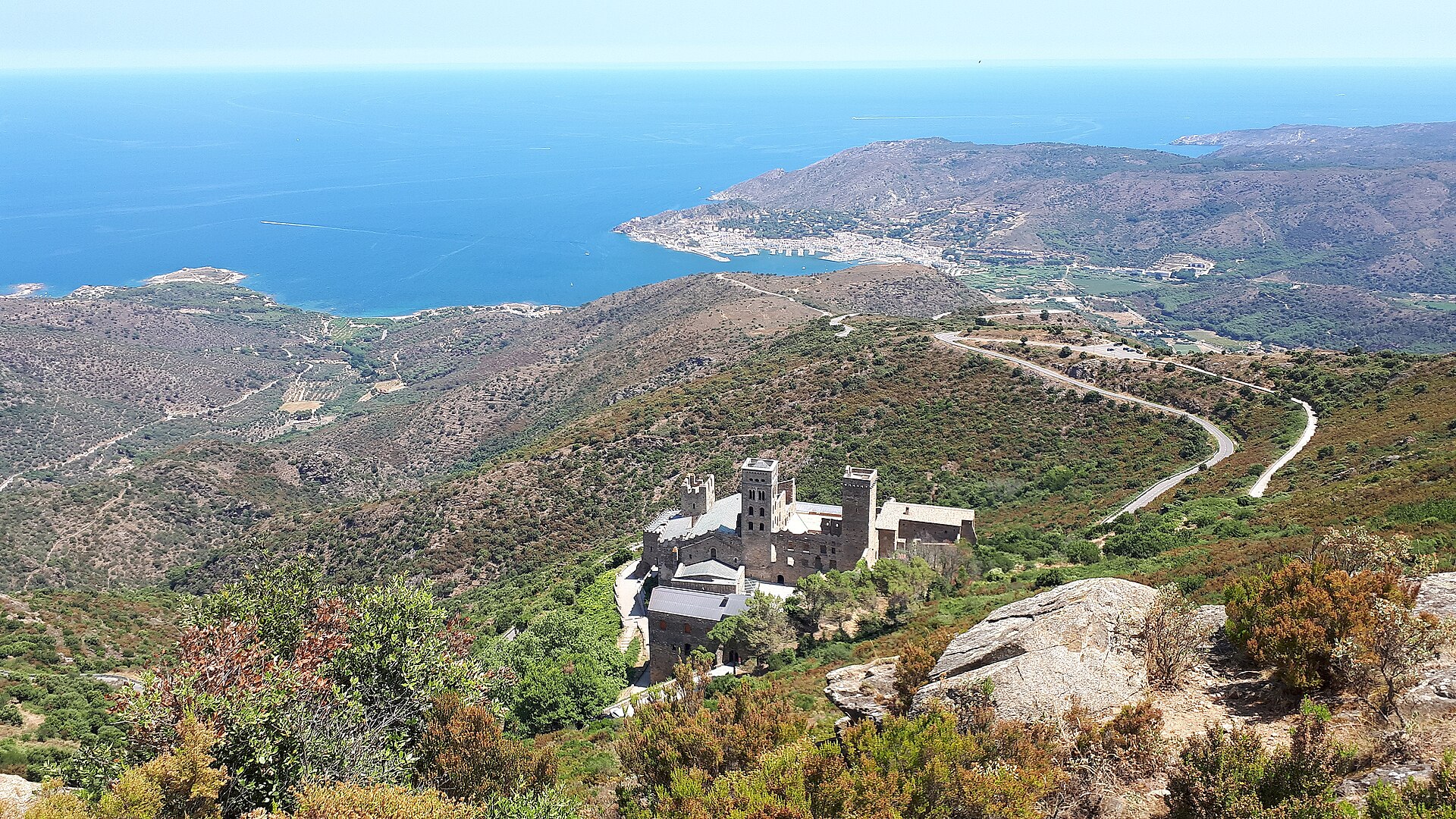
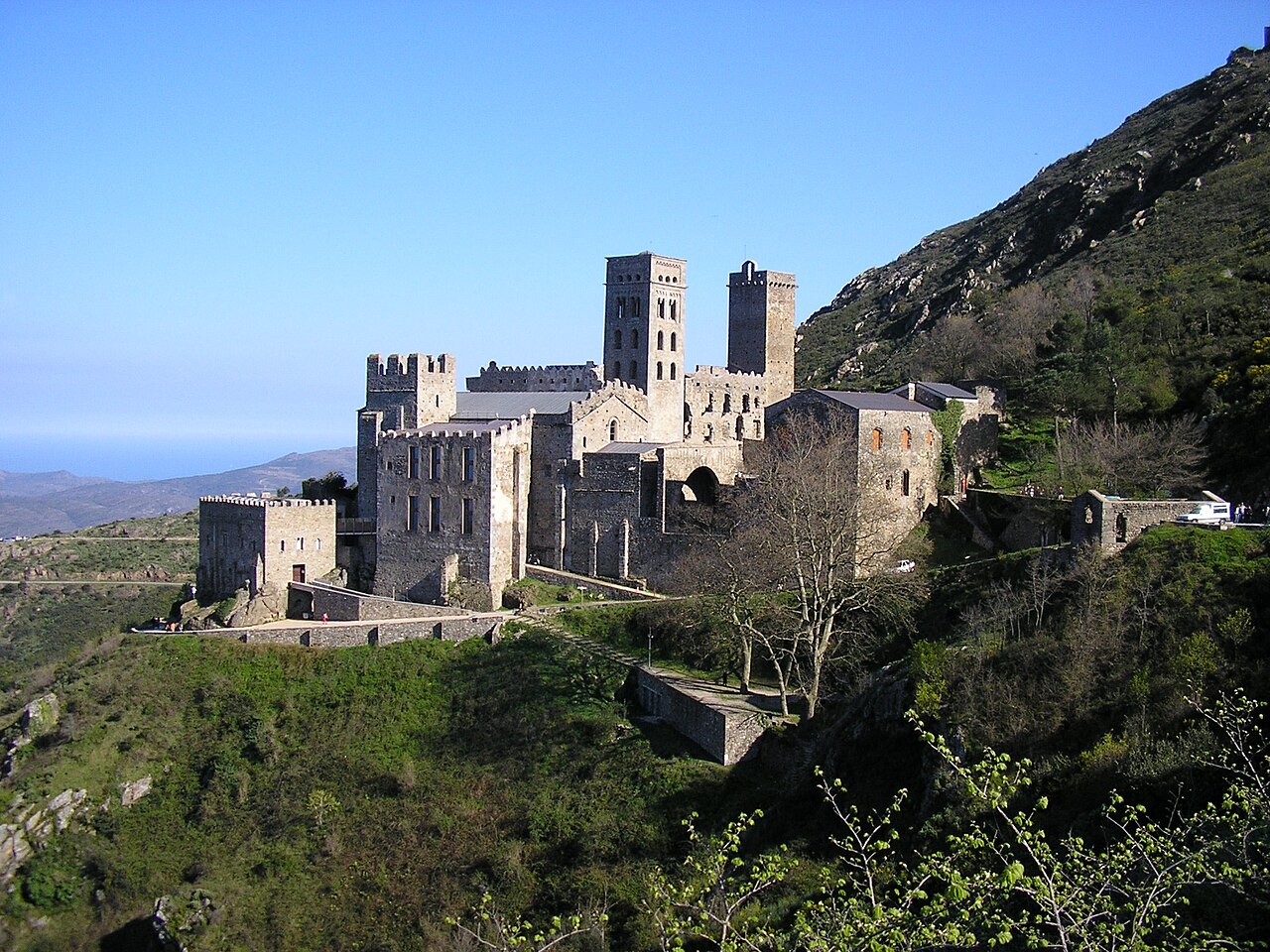
Perched on the eastern slopes of the Serra de Rodes, overlooking the Mediterranean and the spectacular landscape of Cap de Creus, Sant Pere de Rodes is one of the most extraordinary Romanesque monuments in Catalonia. Its isolated location, monumental architecture, centuries of history and fascinating legends make it a particularly interesting destination for anyone wishing to discover the cultural and natural heritage of the Empordà region.
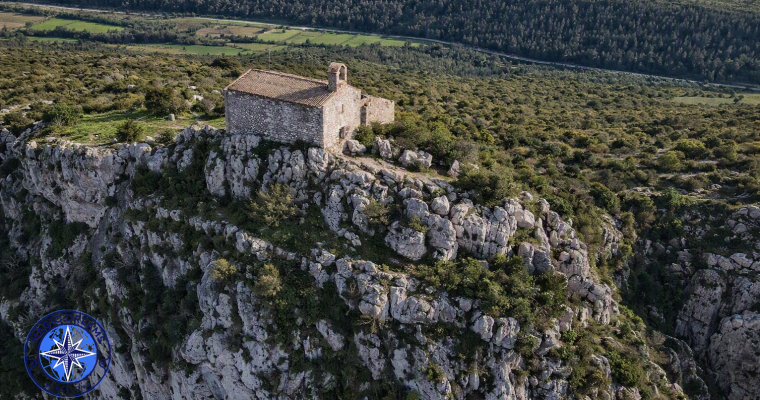
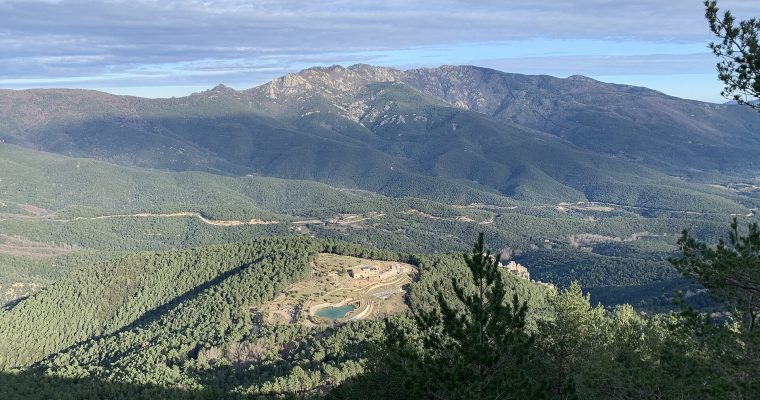
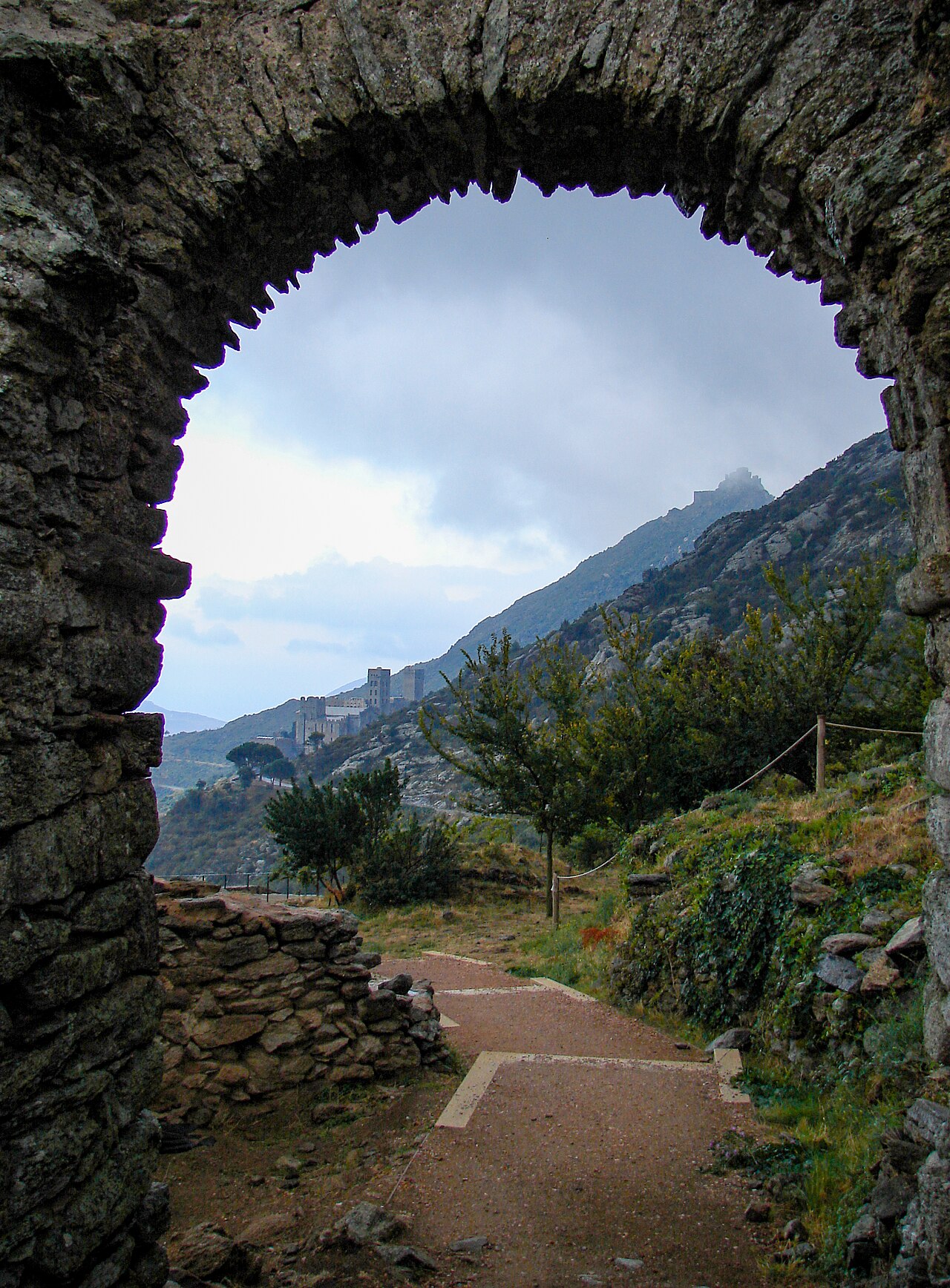
The monastery stands at an altitude of around 520 metres, in a privileged position overlooking the Gulf of Lion and the coastline stretching northwards towards the French border. Nearby are the remains of the medieval village of Santa Creu de Rodes and the castle of Sant Salvador de Verdera, adding even greater historical and landscape interest to the visit.
Where is Sant Pere de Rodes Monastery?
Sant Pere de Rodes is located in the municipality of El Port de la Selva, in the Alt Empordà region of Girona province, within the spectacular surroundings of Cap de Creus.
Its address is Camí del Monestir, s/n, 17489 El Port de la Selva.
The monastery can be reached by road from Vilajuïga or from El Port de la Selva. The final section of the journey climbs through the Serra de Rodes, with increasingly impressive views over the surrounding landscape.
Its position is one of the great attractions of the site: the monastery is not simply an isolated historic monument, but part of a wider cultural landscape in which mountains, Mediterranean vegetation, medieval settlements and the sea come together.
How far is Sant Pere de Rodes from Barcelona?
From Barcelona, the monastery is approximately 160 kilometres by road, with a driving time of around two hours, depending on traffic and the exact starting point.
A convenient route is to take the AP-7 north towards Girona and Figueres, leave the motorway in the Figueres area and continue towards Llançà and El Port de la Selva. From there, the road climbs towards the monastery.
The journey itself is worthwhile because the landscape changes considerably as you approach the northern Costa Brava and Cap de Creus.
How can you get there without a car?
Although travelling by car is the easiest option, Sant Pere de Rodes can also be incorporated into a journey using public transport.
The R11 railway line connects Barcelona with Figueres and Llançà. Since El Port de la Selva does not have a railway station, Llançà is one of the most useful railway connections, approximately eight kilometres away.
There are also bus connections linking Figueres, Llançà and El Port de la Selva. From El Port de la Selva, a taxi is the most practical option for reaching the monastery without a private vehicle.
For those who enjoy walking, there are also routes connecting the monastery with the surrounding villages and landscapes, although the terrain should not be underestimated.
Can Sant Pere de Rodes be visited?
Yes. Sant Pere de Rodes is open to visitors throughout the year, although opening times vary according to the season.
From 1 October to 30 April, it generally opens from Tuesday to Saturday between 10:00 and 17:30.
From 1 May to 30 September, opening hours are generally extended until 19:00, from Tuesday to Saturday.
On Sundays and public holidays, the usual opening hours are 10:00 to 15:00.
The monument is normally closed on non-holiday Mondays, as well as on 25 and 26 December, 1 January and 6 January. Special opening hours may apply during Holy Week.
Admission generally costs around €7, with reduced admission available in certain cases and free entry for children under 16.
The ticket office closes approximately 30 minutes before the monument itself.
Guided tours are also available on certain dates and can be particularly worthwhile if you would like to understand the architecture, history and legends surrounding the monastery in greater depth.
How much time should you allow for the visit?
We recommend allowing at least two hours for the monastery and its immediate surroundings.
If you wish to explore the architecture carefully, visit the different spaces, admire the views and take photographs, two to three hours is a more comfortable amount of time.
Those who enjoy hiking or wish to combine the visit with Santa Creu de Rodes or the castle of Sant Salvador de Verdera should allow considerably longer.
The location deserves to be enjoyed without rushing.
What architectural style is Sant Pere de Rodes?
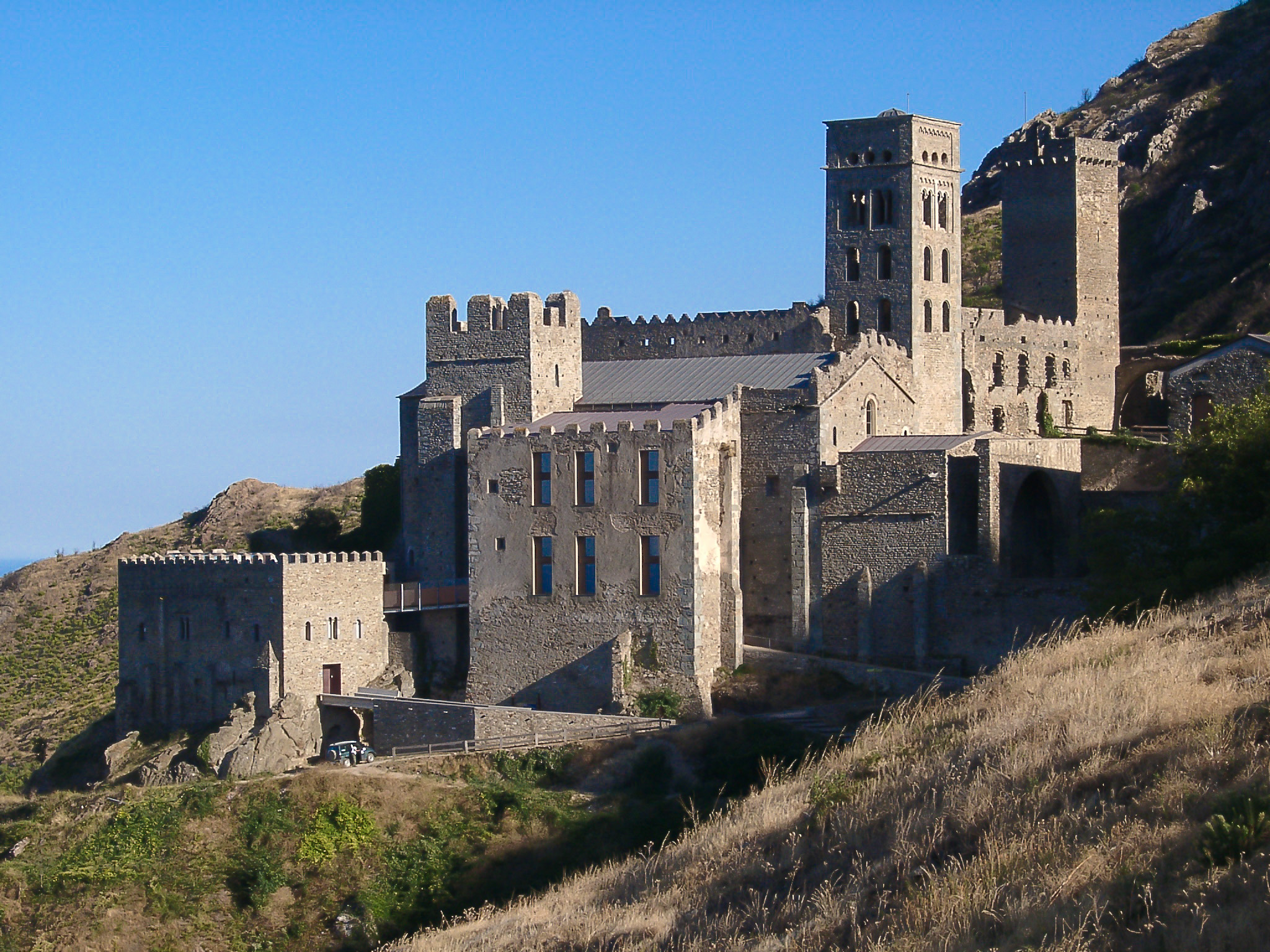
Sant Pere de Rodes is considered one of the great masterpieces of Catalan Romanesque architecture.
Its church, constructed mainly during the 10th and 11th centuries, has exceptionally monumental proportions. The architecture reflects the evolution of the monastery over several centuries, with construction and modifications continuing from the 10th through the 13th centuries and additional service buildings added later.
The church is particularly remarkable for its sophisticated spatial organisation, imposing central nave, columns, capitals and monumental architectural forms.
The original entrance portal was attributed to the Master of Cabestany, one of the most fascinating sculptors of the Romanesque period. Fragments of the original white-marble sculpture have survived and provide an indication of the artistic importance of the medieval monastery.
What is inside the monastery?
The complex is much more than a church.
The visit allows you to discover different spaces associated with medieval monastic life, including:
the Romanesque church;
the bell tower;
the cloisters;
the crypt;
the ambulatory;
the chapter house;
the sacristies;
the refectory;
the cellars;
the monastic living and service areas;
the Abbot’s Palace;
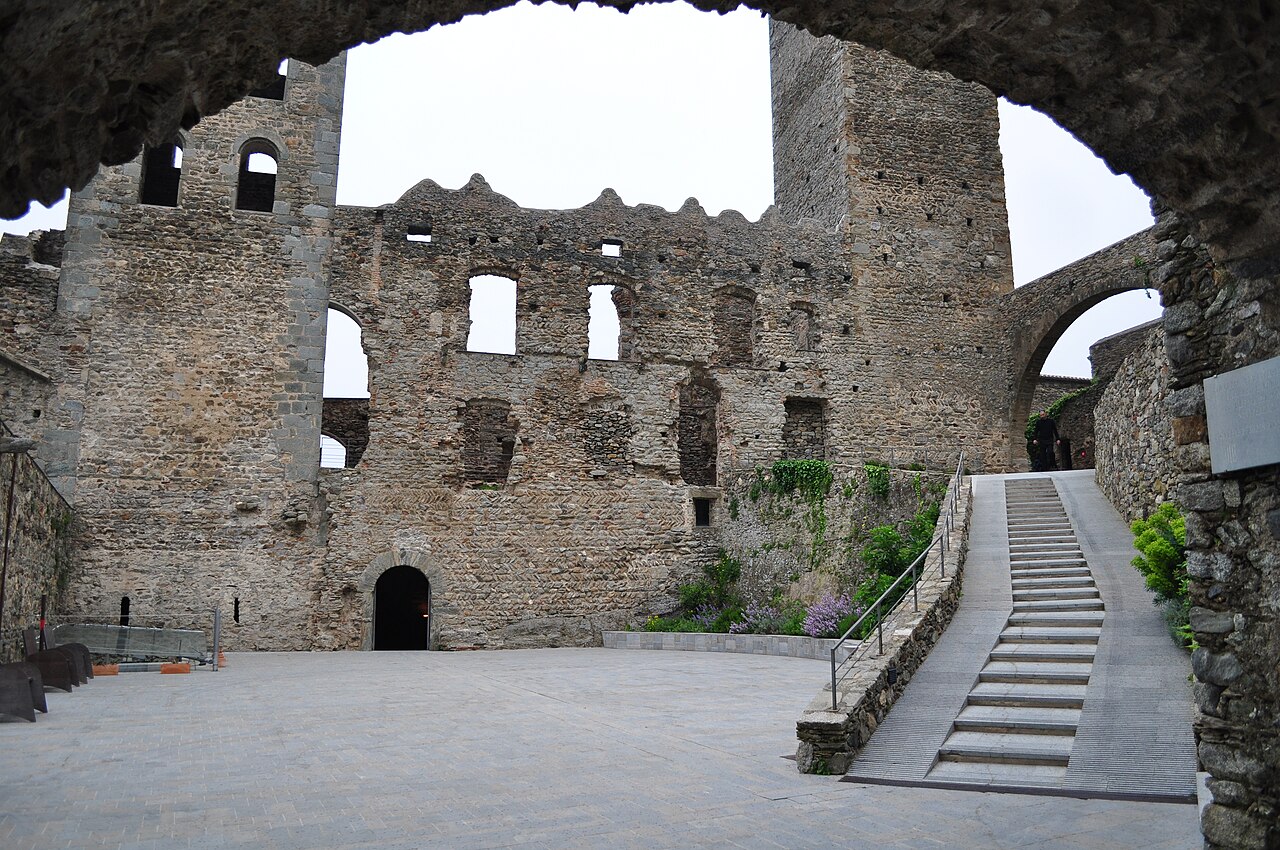
the entrance and defensive structures;
and the area known as the galilee.
One of the most interesting features is that the monastery had two cloisters, although they were not used simultaneously.
The earlier lower cloister was eventually buried beneath the later upper cloister and was rediscovered during archaeological investigations.
This makes the monastery particularly interesting from an archaeological perspective, as different periods of its history remain physically visible within the same complex.
The views from Sant Pere de Rodes
The panoramic views are one of the main reasons to visit.
From the monastery, the landscape opens towards the Gulf of Lion, the Mediterranean coastline and the rugged terrain of Cap de Creus.
On clear days, the combination of mountains, sea and small coastal settlements creates one of the most spectacular viewpoints in the region.
The monastery’s position also helps explain its historical importance. Its elevated location provided a strategic and symbolic position overlooking the surrounding territory.
For photography, early morning and late afternoon can be especially attractive, when the Mediterranean light changes the appearance of the mountains and coastline.
The history of Sant Pere de Rodes
The origins of Sant Pere de Rodes are surrounded by uncertainty, tradition and legend.
The earliest documentary reference dates from 878, when the site is mentioned as a monastic cell dependent on Sant Esteve de Banyoles.
Over the following centuries, however, the monastery grew considerably in importance.
Between the 11th and 14th centuries, Sant Pere de Rodes became the principal spiritual centre of the County of Empúries and one of the most important religious institutions in the region.
Its relationship with the papacy also contributed to its prestige.
In the 10th century, Abbot Hildesindo obtained a papal bull in 974 protecting the monastery, followed by another in 979 which helped establish it as a pilgrimage destination.
The monastery subsequently developed a religious tradition of its own, including jubilees intended to give pilgrims a spiritual experience comparable, in certain respects, to pilgrimage to Rome.
The complex continued to evolve over the centuries, although its importance eventually declined and the monastery was abandoned by the monastic community in the 19th century.
Today, its surviving architecture allows visitors to understand the scale and importance that the monastery once possessed.
Did Saint Peter’s relics really arrive here?
This is one of the most fascinating questions surrounding Sant Pere de Rodes.
According to the traditional foundation legend, during a period of danger in Rome, three clerics — Felix, Ponce or Pontius, and Epicinius or Epitacius — were entrusted with taking relics associated with Saint Peter away from the city.
Among these relics were supposedly the head and right arm of Saint Peter, together with other sacred remains.
The three clerics travelled towards the Mediterranean and eventually reached a place referred to in the tradition as Armen Rodes.
They hid the relics in a cave before leaving the area.
When they later returned, however, they could no longer find the cave because vegetation had covered the site.
According to the legend, a church was eventually built at the location, giving rise to the monastery.
But is this story historically true?
There is no historical evidence proving that Saint Peter’s relics were actually brought to Sant Pere de Rodes.
The existence of the monastery itself, however, is historically documented from the 9th century onwards. In addition, medieval documentation demonstrates that the monastery possessed an important collection of relics.
A 15th-century inventory, for example, refers to numerous relics and specifically mentions the head and right arm of Saint Peter.
Therefore, there are two different levels that should not be confused: the possession of relics at the monastery is documented, while the story explaining how those relics supposedly arrived there belongs to the realm of religious tradition and legend.
The Font dels Monjos
Near the monastery is the Font dels Monjos, the Monks’ Fountain.
An inscription dated 1588 reads:
“Qui biberit ex aqua sitiet iterum.”
The phrase refers to the Gospel of Saint John and can be translated approximately as:
“Whoever drinks this water will thirst again.”
It is another small detail that reveals how deeply religious symbolism was incorporated into the landscape surrounding the monastery.
Where to stay near Sant Pere de Rodes?
If you would like to spend the night in the area, El Port de la Selva is one of the most attractive choices.
The coastal village is relatively close to Sant Pere de Rodes and provides a pleasant combination of sea, mountains, traditional architecture and Mediterranean atmosphere.
It is also a convenient base for exploring other parts of Cap de Creus.
The municipality offers several hotels, guesthouses and small accommodation establishments, making it possible to choose between a traditional guesthouse, a hotel overlooking the sea or a more comfortable establishment with additional services.
Staying overnight also allows you to experience the area outside the busiest hours of the day.
What should you eat in the area?
The gastronomy of the northern Costa Brava is closely linked to the Mediterranean and to the fishing traditions of the Empordà.
One of the dishes that should not be missed is suquet de peix, a traditional fishermen’s stew originally prepared with potatoes and the fish available to local fishermen.
Today, versions of suquet may include monkfish, sea bass, squid, prawns, mussels and other seafood.
The local cuisine also includes:
grilled or baked fish;
sardines;
anchovies;
sea bream;
grouper;
scorpionfish;
mussels;
lobster;
seafood rice;
seafood paella;
sea urchins, known locally as garotes;
bread with tomato;
and alioli.
The cuisine of the area is particularly enjoyable when accompanied by local products and, naturally, views of the Mediterranean.
The vegetation around Sant Pere de Rodes
The natural environment surrounding the monastery forms part of the extraordinary ecosystem of Cap de Creus.
The vegetation has been shaped by both human activity and the area’s demanding climate.
For centuries, terraces, dry-stone walls, vineyards, grazing and fires transformed the landscape. At the same time, the powerful Tramuntana wind contributes to the area’s dry and salty conditions.
Among the trees found in the wider area are:
Aleppo pine (Pinus halepensis);
cork oak (Quercus suber);
holm oak;
downy oak;
elm;
ash;
alder;
hazel;
and willows in more sheltered and humid areas.
The Mediterranean scrubland includes lentisk, juniper, heather, rockroses and black broom.
Closer to the coast, the flora becomes even more specialised.
Among the remarkable species are Armeria ruscinonensis, Limonium tremolsii and Seseli farreny, a particularly notable botanical species associated with Cap de Creus.
The area also contains other rare or protected plants, including Euphorbia dendroides, Cneorum tricoccon and Astragalus massiliensis.
This botanical diversity is one of the reasons why Cap de Creus is so interesting for nature lovers.
Fauna around Cap de Creus
The fauna is equally diverse.
Among the terrestrial invertebrates are species such as the beetle Pseudochlamys raholai, the heteropteran Campylosteia serena and the endemic snail Mastigophallus rangianus.
Amphibians include the Mediterranean tree frog and the common toad.
Among reptiles, the area is home to species such as the Mediterranean tortoise, although it is relatively scarce, the Spanish pond turtle, the ocellated lizard and the Moorish gecko.
But birds are undoubtedly among the most spectacular elements of the local fauna.
Birdwatching at Cap de Creus
The cliffs and coastal landscapes of Cap de Creus provide excellent conditions for observing birds, particularly during spring and autumn migration.
Depending on the season and conditions, species associated with the cliffs include:
Bonelli’s eagle;
peregrine falcon;
Eurasian eagle-owl;
European shag;
gulls;
shearwaters;
terns;
and northern gannets.
The combination of cliffs, open Mediterranean terrain and coastline creates an important variety of habitats.
For anyone interested in ornithology, visiting outside the busiest tourist periods can provide a much more rewarding experience.
Butterflies and lepidoptery
Cap de Creus is also an interesting destination for butterfly enthusiasts.
A butterfly monitoring route in the Montjoi area has recorded 54 butterfly species in recent monitoring years, demonstrating the diversity of Lepidoptera found in the region.
Among the species recorded in the area are:
Swallowtail (Papilio machaon), one of Europe’s most recognisable butterflies;
Two-tailed Pasha (Charaxes jasius), the largest day-flying butterfly in Europe;
Peacock butterfly (Inachis io);
Red Admiral (Vanessa atalanta);
Painted Lady (Vanessa cardui);
and Cleopatra (Gonepteryx cleopatra).
The Swallowtail is particularly interesting because its caterpillars feed on plants from the carrot family, including fennel, which is abundant in suitable Mediterranean habitats.
The Two-tailed Pasha is also characteristic of Mediterranean environments and is strongly associated with the strawberry tree, Arbutus unedo.
The area’s lepidopterological interest extends beyond butterflies to moths and other nocturnal Lepidoptera. Surveys in the wider Albera–Cap de Creus region have revealed considerable diversity, including uncommon records, although this fauna remains less thoroughly studied than the area’s daytime butterfly populations.
The legends of Sant Pere de Rodes
Sant Pere de Rodes is a place where history and legend are almost impossible to separate.
One of the most charming local stories is the legend of Sant Pere and Sant Peret de Roda.
According to the tale, a pirate known as Cor de Pedra — “Stone Heart” — captured prisoners in the area of Roses. Among them was a seven-year-old boy named Pere.
The child showed remarkable compassion and comforted the other prisoners.
The pirate was deeply affected by the boy’s behaviour and eventually abandoned his former life, converted to Christianity and took the name Pere.
According to the legend, he and his followers settled near Verdera, and the former pirate became the monastery’s first abbot. The young Pere later succeeded him.
It is a beautiful story, but it belongs to local tradition rather than documented history.
The legend of Barbarossa’s treasure
Another popular legend involves the famous pirate Barbarossa.
According to tradition, papal ships were travelling towards Catalonia carrying gold, precious stones and other treasures.
Barbarossa supposedly ambushed them near Cap de Creus and seized the treasure.
Later, while fleeing from the papal fleet, he is said to have thrown part of the treasure into the sea.
Local tradition claims that on nights with a full moon, the lost treasure — and even the pirate’s sword — can still be seen shining beneath the waters.
There is, of course, no historical evidence proving that the treasure can actually be seen.
Nevertheless, these stories contribute to the extraordinary atmosphere of Cap de Creus.
Charlemagne and the monastery
Another local tradition claims that Charlemagne stayed at Sant Pere de Rodes.
As with many medieval traditions connecting famous rulers with important religious sites, there is no solid documentary evidence proving that Charlemagne actually stayed at the monastery.
The persistence of the story, however, illustrates the symbolic importance that Sant Pere de Rodes acquired over the centuries.
Sant Pere de Rodes: history, nature and legend in one place
A visit to Sant Pere de Rodes is much more than a trip to a Romanesque monastery.
It is an opportunity to discover a landscape in which medieval history, Romanesque architecture, religious traditions, legends, Mediterranean vegetation, wildlife and the sea all come together.
The monastery itself deserves time and attention, but so does its setting.
The views towards Cap de Creus and the Gulf of Lion, the remains of Santa Creu de Rodes, the nearby castle of Sant Salvador de Verdera, the dry-stone landscapes, Mediterranean flora and exceptional bird and butterfly diversity make this one of the most fascinating cultural destinations in northern Catalonia.
And perhaps that is what makes Sant Pere de Rodes so special: here, documented history and centuries-old legends coexist in a landscape that still retains much of the sense of isolation and mystery that has surrounded the monastery for centuries.
If you are looking for a destination where heritage, nature, architecture, gastronomy and legends can be experienced in the same visit, Sant Pere de Rodes is undoubtedly one of the places worth discovering in the Cap de Creus region.
Monasterio de Sant Pere de Rodes – By Photo: Eckhard Henkel / Wikimedia Commons / CC BY-SA 3.0 DE, CC BY-SA 3.0 de, https://commons.wikimedia.org/w/index.php?curid=44585716.
Monasterio de Sant Pere de Rodes – By David Chacobo – Flickr: Sant Pere de Rodes i Castell de Sant Salvador de Verdera, Port de la Selva, CC BY-SA 2.0, https://commons.wikimedia.org/w/index.php?curid=16770826.
Monasterio de Sant Pere de Rodes – By Igor González Martín from Madrid, Spain – IMG_5863, CC BY-SA 2.0, https://commons.wikimedia.org/w/index.php?curid=16972868.
Monasterio de Sant Pere de Rodes – Perspectiva del Conjunto – By Borjaanimal – Own work, CC BY-SA 3.0 es, https://commons.wikimedia.org/w/index.php?curid=16464590.
Monasterio de Sant Pere de Rodes – By Aurica – Own work, CC BY-SA 3.0 es, https://commons.wikimedia.org/w/index.php?curid=16715585.
Monestir de Sant Pere de Rodes – By SBA73 – Flickr: El monestir sobre el mar / The abbey above the sea, CC BY-SA 2.0, https://commons.wikimedia.org/w/index.php?curid=16713847.
Monasterio de Sant Pere de Rodes desde la ermita de Santa Helena – By Pedro José Ponce Asensio – Own work, CC BY-SA 4.0, https://commons.wikimedia.org/w/index.php?curid=152862769.
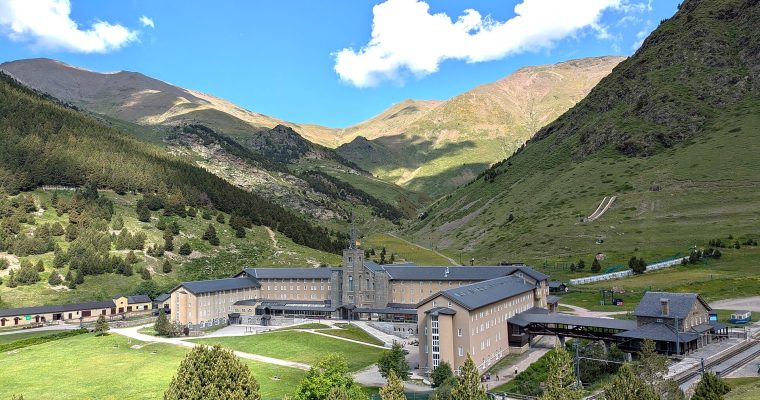
Discover Vall de Núria Vall de Núria is one of those places that surprises you from the very first moment. Located in the heart of the Eastern Pyrenees, within the municipality of Queralbs, the valley is surrounded by mountains, forests, alpine meadows and peaks rising …