Route guide for visitors throughout Catalonia – Barcelona – Costa Brava – Catalan Pyrenees – Personalized experiences – Customized tour guide services – A small tribute to the wonderful city and land that saw us born – Transforming experiences into unforgettable memories - Magic Dreams Collection: exclusive universes inspired by Salvador Dalí and Gaudí. Niche perfumes, jewelry, lithographs, and collectible items celebrating the Mediterranean spirit.
Some places surprise us with their history, others with their beauty, and some with their ability to convey a sense of calm even when they are located right in the heart of the city. Turó Park combines all three qualities. Located in the Sarrià-Sant Gervasi …
Barcelona has places that are famous all over the world, but it also has corners that remain surprisingly unknown despite their historical and natural importance. One of them is the Parc del Laberint d’Horta, a historic garden located at the foot of the Collserola mountain …
The Jardins de Vil·la Amèlia (Vil·la Amèlia Gardens) are one of those green spaces in Barcelona that can easily go unnoticed by many visitors, despite being located in one of the city’s most elegant neighbourhoods.
Situated in Sarrià-Sant Gervasi, these gardens preserve part of the atmosphere of an old stately estate and combine landscape architecture, large mature trees, unusual botanical species, sculptures, a pond, and different areas for walking.
They are also public gardens with free admission, making them an interesting alternative to some of Barcelona’s more tourist-oriented parks and gardens.
Where are Vil·la Amèlia Gardens?
The gardens are located in the Sarrià-Sant Gervasi district, in the Sarrià neighbourhood.
The reference address is:
Carrer d’Eduardo Conde, 22, 08034 Barcelona
The garden is located next to the Jardins de Vil·la Cecília, separated by Carrer de Santa Amèlia. In fact, both spaces are part of the same historic area of former stately gardens in Sarrià.
The location is particularly interesting because you can combine a visit to Vil·la Amèlia with a stroll through Vil·la Cecília and the streets of the old Sarrià neighbourhood.
Are the gardens public?
Yes.
Vil·la Amèlia Gardens are now a public green space in Barcelona. The garden originated as a private estate associated with the Girona family and was later transformed into a public park.
Therefore, you normally do not need to buy a ticket or make a reservation to enter the gardens.
How much does admission cost?
Admission: free.
There is no tourist admission fee to enter the garden.
A garden with history
The gardens originated as the former Quinta Amèlia, an estate belonging to the Girona family in Sarrià.
Ignasi Girona commissioned the garden, and the estate was named after his wife, Amèlia de Vilanova.
For many years it was used as the family’s summer residence. As Barcelona expanded, the estate eventually became part of Sarrià’s urban transformation.
The former residence disappeared, but an important part of the vegetation and structure of the garden was preserved.
During the transformation into a public park, elements of the old garden were retained and new plantings were added. The remodelling project carried out in the 1970s was designed by Joaquim Casamor, who was associated with the management of Barcelona’s Parks and Gardens.
Garden architecture and design
Vil·la Amèlia has a landscape design inspired by French gardens, with a fairly regular layout and large flowerbeds.
The garden offers a particularly interesting combination of geometry and mature vegetation.
The paths allow visitors to explore different areas and discover large trees, flowerbeds, gentle changes in elevation and more open spaces.
One of the most important features is the circular pond, located in a central area of the garden.
Around the pond there are flowerbeds and carefully trimmed myrtle hedges, creating an ornamental composition reminiscent of historic European gardens.
The Vil·la Amèlia pond
Yes, there is a pond inside the gardens.
It is one of the park’s most distinctive features.
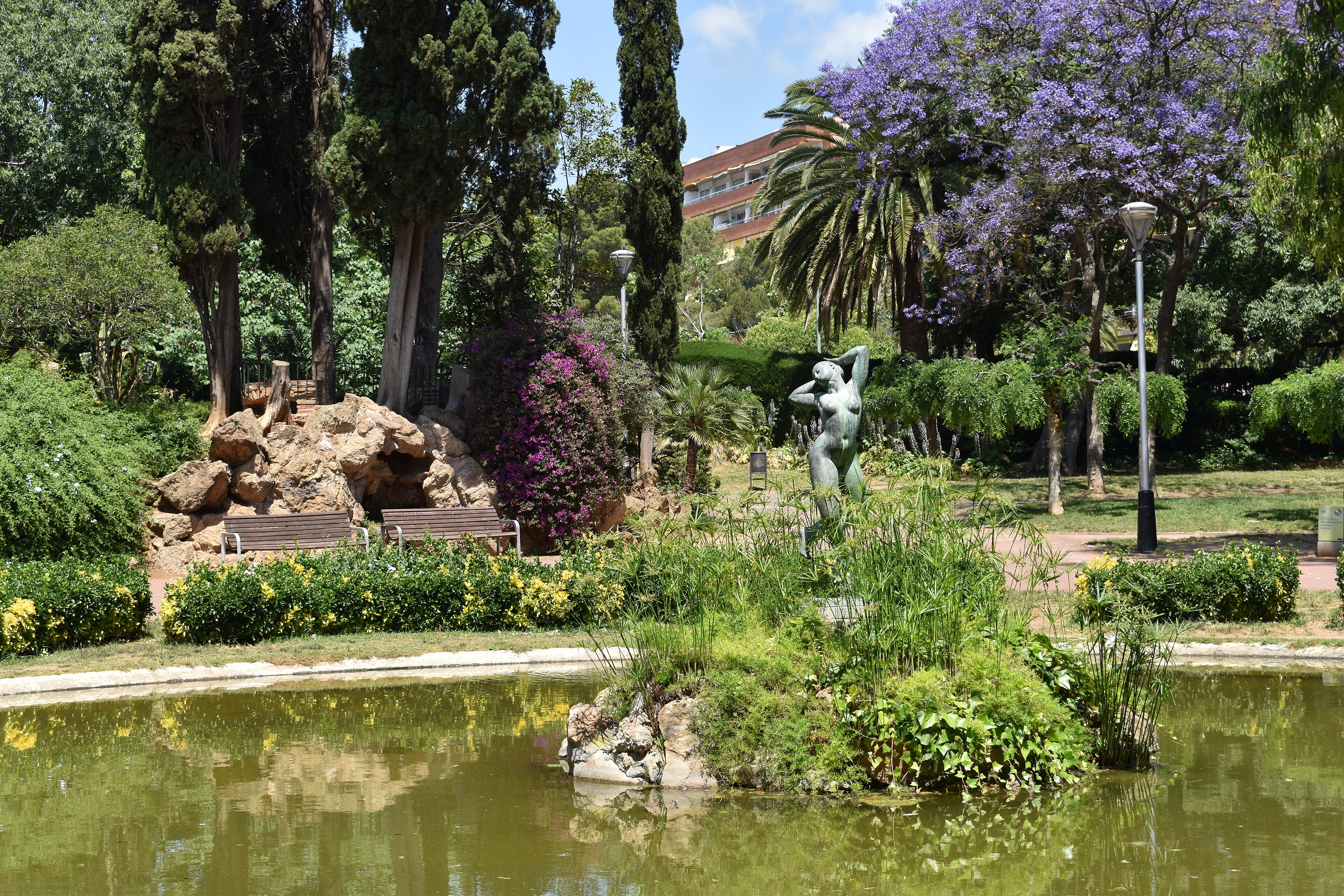
The pond is circular and has a small island in the centre. On the island stands the sculpture Dríade, a bronze figure representing a nymph who protects the forests.
The water is surrounded by aquatic vegetation, and the whole setting is one of the best places for taking photographs in Vil·la Amèlia.
It is not a large natural lake, but rather an ornamental pond integrated into the landscape design of the garden.
The Dríade sculpture
At the centre of the pond stands Dríade, a work by sculptor Ricard Sala.
The figure represents a nymph who protects the forests and is positioned on the small central island.
It is one of the garden’s main artistic features and reinforces the relationship between nature and art that characterises Vil·la Amèlia.
The Snake Charmer
Another interesting work found within the garden is L’Encantador de Serpents (The Snake Charmer), a bronze sculptural group by Belgian artist Jules Anthone.
The work depicts a young ephebe playing a flute in front of a basket containing snakes.
It is a different piece from the sculpture in the pond and adds an unexpected artistic element to a space that, at first glance, might seem like an ordinary urban park.
One of its greatest treasures: the trees
If there is one feature that distinguishes Vil·la Amèlia from many urban parks, it is the number and variety of mature trees.
Biodiversity sources for the garden mention around fifty different plant species, including specimens that are uncommon in Barcelona.
Among the documented species are:
Plane trees
Eucalyptus
Stone pines
Aleppo pines
Magnolias
Holm oaks
Cedars
Cypresses
Lime trees
Ginkgo trees
Jacarandas
Tipu trees
Judas trees
Pepper trees
Canary Island date palms
Mediterranean fan palms
Trachycarpus palms
Mulberry trees
Laurel trees
Pittosporum
Fig trees and other ornamental species
There is also a wide variety of tree, shrub, ornamental plant and ground-cover species throughout Vil·la Amèlia.
Trees of local interest
Some of the trees at Vil·la Amèlia are particularly important and are included in Barcelona’s Catalogue of Trees of Local Interest.
Among them are:
The large plane tree
One of the most impressive specimens is a Platanus × hispanica approximately 22 metres tall.
Its estimated date of origin is around 1920, and it is particularly notable because it has developed with very little pruning.
There are also listed specimens of:
Eucalyptus
Pepper tree
Gymnocladus dioicus
Canary Island date palms
Other remarkable trees
The eucalyptus is particularly interesting because it was planted at the end of the 19th century, while the 15 Canary Island date palms also date back to the late 19th century.
A particularly interesting garden for botany lovers
Vil·la Amèlia is not simply a garden with grass and a few trees.
Its interest lies precisely in the combination of Mediterranean species with ornamental trees originating from different parts of the world.
Jacarandas, magnolias, cedars, cypresses, palms, pines, plane trees and other species create different environments within a relatively compact space.
During spring and summer, some of these species produce particularly striking blooms.
For anyone who enjoys identifying trees, the garden can be much more interesting than it initially appears.
Are there birds at Vil·la Amèlia?
Yes.
The gardens provide a small biodiversity refuge within the urban fabric of Sarrià.
In a space of this kind, visitors may particularly spot small urban birds and species associated with wooded areas, although the exact species present can vary depending on the season and the conditions in the garden.
For this reason, if you are interested in birdwatching, early morning is often a good time to explore the gardens quietly.
What other animals are there?
In addition to birds and insects, the garden’s urban biodiversity includes small animals associated with the vegetation and pond.
The Barcelona + Sostenible platform specifically identifies the site as a fauna area and also records the presence of reptiles in the surroundings.
Naturally, this is not a zoo or wildlife park: the animals live freely, and their presence may vary.
The former viewpoint and waterfall
Another interesting detail is the small rise located near the cypress area.
Today it functions as a landscape feature and viewpoint, but originally the site was associated with a waterfall.
The area is surrounded by cypress trees and provides one of the most interesting changes in elevation within the garden.
The cypress garden
Near the entrance from Carrer de Santa Amèlia is the so-called cypress roundabout.
It is located on a small stone elevation that once formed part of the waterfall.
It is one of the places that best preserves the character of the historic garden and offers a different perspective of the flowerbeds and trees in the park.
Are there areas for children?
Yes.
The gardens have a children’s playground, making them a good option for families looking for a quiet park in Sarrià.
The children’s area is integrated with the landscaped areas and paths of the park.
Is it a good place for a quiet walk?
Yes.
One of Vil·la Amèlia’s defining characteristics is its relatively peaceful atmosphere.
The paths allow visitors to take a short walk among trees, flowerbeds, sculptures and the pond.
It is not a monumental park of great size, so a normal visit can be completed in approximately 30–45 minutes.
If you combine it with the Jardins de Vil·la Cecília and a walk through Sarrià, it can easily become a one- or two-hour outing.
What are the opening hours?
We recommend checking the opening hours before travelling there, as opening times for enclosed parks in Barcelona can vary seasonally.
Current sources for the gardens of the same Vil·la Cecília complex indicate opening hours of 8:00 a.m. to 7:00 p.m. during winter and 8:00 a.m. to 9:00 p.m. during summer, with closing approximately around sunset in winter.
How do you get there from central Barcelona?
From central Barcelona, one of the most convenient options is to use public transport towards Sarrià.
Option 1: FGC from Plaça Catalunya
From Plaça Catalunya, you can take the Ferrocarrils de la Generalitat de Catalunya (FGC) towards Sarrià and get off at Sarrià.
From Sarrià station, continue on foot towards the Eduardo Conde area.
This is one of the most practical options if you are travelling from central Barcelona.
Option 2: Metro L3
Another possibility is to take Metro Line 3 (green line) and get off at Maria Cristina.
From there, you can continue on foot towards the Sarrià area.
Option 3: Bus
Several bus routes serve the surrounding area.
Among the routes serving the Eduardo Conde and Centre Cívic Sarrià area are 6, 34, 63, 66, 70, 78, 130, V3 and V5.
The best route will depend on your exact starting point.
Can you get there by car?
Yes.
You can easily reach the Sarrià neighbourhood by car.
However, it is important to bear in mind that Vil·la Amèlia Gardens do not have a large dedicated visitor car park.
Parking is mainly available on the street or in private car parks in the area.
Therefore, if you are specifically visiting the gardens, it is not advisable to rely on finding a free parking space directly outside the entrance.
Where can you park nearby?
One option is to use one of the private car parks located around Sarrià-Sant Gervasi.
Among the car parks in the area is Parking BSM Cotxeres de Sarrià, at Carrer de Francesc Carbonell, 45B, which is open 24 hours. Parking BSM Cotxeres de Sarrià
Another option is Parking Saba Clínica CIMA, at Passeig de Manuel Girona, 29–30, also open 24 hours. Parking Saba Clínica CIMA
There is also Parking BSM Flos i Calcat, on Carrer de Flos i Calcat, with 24-hour service. Parking BSM Flos i Calcat
Private car park prices may change depending on the time, reservation and length of stay, so it is advisable to check the current rate before parking.
Is it possible to park for free on the street?
There may be parking spaces on the surrounding streets, but you should not assume that they are free.
Barcelona has regulated parking areas and different parking conditions depending on the street.
Therefore, if you find a space on the street, always check the signs and parking conditions before leaving your vehicle.
For a tourist visit lasting several hours, a private car park may be easier than trying to find a free space on the street.
How much time do you need to visit Vil·la Amèlia?
To see the main features of the garden, we recommend allowing approximately 30–45 minutes.
A more leisurely visit, taking time to observe the trees, sculptures and pond, can take around an hour.
A good option is to combine:
Jardins de Vil·la Amèlia – Jardins de Vil·la Cecília – Sarrià
This allows you to discover two former stately gardens and finish with a walk through the historic centre of Sarrià.
What is especially worth seeing?
If you have limited time, these are the highlights you should not miss:
The circular pond
The Dríade sculpture
The large plane tree
The historic eucalyptus trees and palms
The cypress roundabout
The former waterfall area
The Snake Charmer
The large French-style flowerbeds
The listed trees of local interest
The connection with the Jardins de Vil·la Cecília
Are Vil·la Amèlia Gardens worth visiting?
Vil·la Amèlia offers an experience that differs from Barcelona’s major tourist parks.
You will not find large monuments or an enormous expanse of land, but you will find history, remarkable trees, botany, sculptures, a pond and a much quieter residential atmosphere.
Admission is also free, and the garden is located in an area where it is easy to combine nature, architecture and the historic atmosphere of Sarrià.
For those who enjoy historic gardens, botany, photography, monumental trees or simply looking for a peaceful place to walk, Vil·la Amèlia is one of the interesting hidden corners of western Barcelona.
And one of its greatest attractions is precisely that, despite being located within Barcelona, it still preserves part of the atmosphere of the former stately estates that once existed in Sarrià.
Jardines de Villa Amelia – By Enric – Own work, CC BY-SA 4.0, https://commons.wikimedia.org/w/index.php?curid=137486910.
Jardines de Villa Amelia – By Pere López Brosa – Own work, CC BY-SA 4.0, https://commons.wikimedia.org/w/index.php?curid=129146037.
Jardines de Villa Amelia – By Pere López Brosa – Own work, CC BY-SA 4.0, https://commons.wikimedia.org/w/index.php?curid=129146040.
Jardines de Villa Amelia – By Canaan – Own work, CC BY-SA 3.0, https://commons.wikimedia.org/w/index.php?curid=29958963.
El encantador de serpientes, de Jules Anthone, 1887 – Por Pere López – Trabajo propio, CC BY-SA 3.0, https://commons.wikimedia.org/w/index.php?curid=25871423.