Route guide for visitors throughout Catalonia – Barcelona – Costa Brava – Catalan Pyrenees – Personalized experiences – Customized tour guide services – A small tribute to the wonderful city and land that saw us born – Transforming experiences into unforgettable memories - Magic Dreams Collection: exclusive universes inspired by Salvador Dalí and Gaudí. Niche perfumes, jewelry, lithographs, and collectible items celebrating the Mediterranean spirit.
Casa Verdú – Modernism in Barcelona’s Eixample District We are standing in front of the building known as Casa Verdú, located at 103 Rambla de Cataluña, at the intersection with Provenza Street, in the emblematic Eixample district of Barcelona. This property is a remarkable example …
The summit of Barcelona where history, nature and entertainment come together Tibidabo, the highest part of the city of Barcelona, stands at 575 metres above sea level, offering an incomparable perspective of the city, the Mediterranean Sea and the surrounding hills. This remarkable place combines …
Located in the heart of the Costa Brava, Palamós is a destination that seamlessly combines history, culture, gastronomy, and beaches of unparalleled beauty. Its coastline, with a spectacular contrast between rocky cliffs and hidden coves, offers a unique experience for those seeking relaxation or adventure.
History and Tradition of Palamós
Palamós boasts a rich historical heritage dating back to the Middle Ages, shaped by Catalan maritime culture. Its streets and squares retain the charm of the past, while ancient ruins and remnants of the medieval port remind visitors of the town’s historical importance as a commercial and fishing hub. Local traditions—from artisanal fishing to patron saint festivals—keep the community spirit and authenticity alive.
Local Customs and Culture
Life in Palamós revolves around the sea and its resources. Popular festivals, markets, and culinary celebrations reflect the locals’ connection to fishing and Mediterranean cuisine. The rocky coast, trails, and coastal paths (Camí de Ronda) are integrated into daily life, inviting visitors to explore nature leisurely, breathe in the sea air, and enjoy breathtaking views.
Beaches and Coves: Something for Everyone
Palamós’ coastline offers wide sandy beaches and secret, tranquil coves—perfect for discovering the most authentic Costa Brava:
Playa Gran de Palamós: Spacious, golden sand, easy access, ideal for families.
Playa de La Fosca: Soft sand, calm waters, fully serviced.
Playa de Castell: A natural reserve surrounded by pine forests and cliffs, perfect for hiking and birdwatching.
Cala Estreta & Cala dels Canyers: Small mixed coves where sand and rock blend.
Cala del Morro de Vedell & Cala dels Pots: Ideal for those seeking privacy and tranquility.
Cala Senia & Sa Tamardia: Notable for natural beauty and crystal-clear waters.
The Camí de Ronda connects all these beaches and coves, offering panoramic views of pine forests, cliffs, and the sea.
Our Favorite Spots in Palamós
Playa de Castell
One of Palamós’ jewels, the Playa de Castell is surrounded by pines and cliffs, preserving a nearly untouched environment within a protected natural park. Fine golden sand mixes with small rocky areas, and crystal-clear waters invite swimming and snorkeling.
History and Heritage: Nearby ruins of ancient settlements testify to centuries of human activity.
Access: Reachable via a forest trail or by car to a nearby parking area, though much of its charm lies in its pristine natural surroundings.
Services: Minimal services to preserve the environment, ideal for those seeking disconnection, nature, and breathtaking landscapes.
Playa de La Fosca
Located close to Palamós town, Playa de La Fosca is one of our favorites for its combination of comfort and natural beauty. Soft sand, shallow waters, and easy access make it perfect for families.
History and Ruins: Surrounding areas include remnants of ancient settlements and fortifications, some dating back to the medieval era.
Environment: Surrounded by cliffs and pine forests, with spectacular panoramic views from the Camí de Ronda.
Services: Wide range of chiringuitos, restaurants, sunbed rentals, and water sports equipment.
Cala S’Alguer
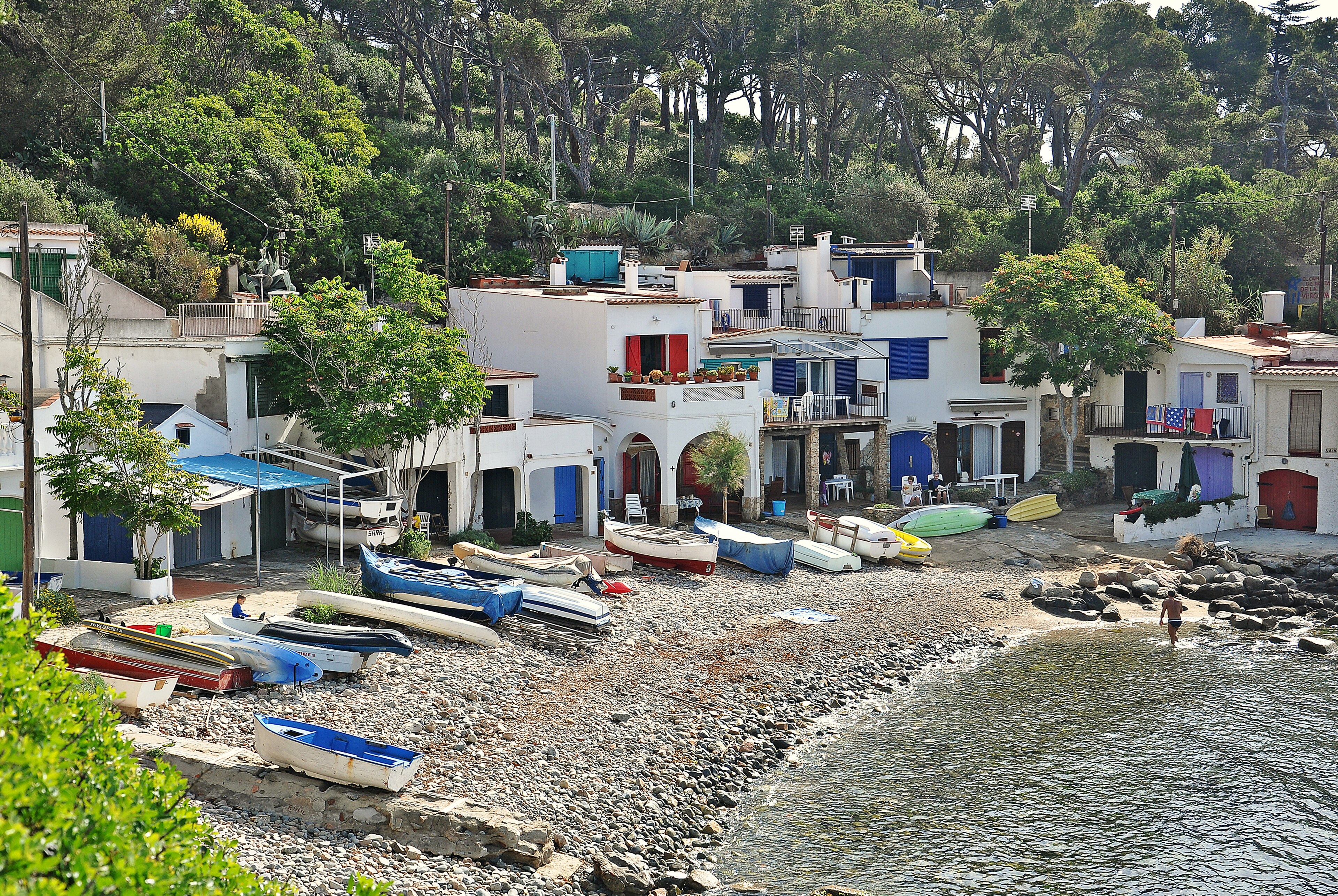
Cala S’Alguer is a small rocky cove, one of the most authentic and picturesque in Palamós. Access is on foot via coastal paths, ensuring a peaceful and exclusive experience.
Features: A mix of rock and sand, crystal-clear waters perfect for snorkeling and observing marine life.
Virgin Environment: Retains its natural character, with traditional fishermen’s houses preserving the essence of old Palamós.
History: Historically a fishermen’s refuge, still featuring traditional nets and small boats.
Access and Services: Minimal infrastructure, ensuring privacy and a direct connection with nature.
Access and Services
All beaches and coves are easily accessible by foot, car, or public transport. Palamós provides nearby parking, chiringuito services, sunbed rentals, and sports equipment, making every visit comfortable. Trails and cycling routes allow active exploration of the coastline.
Gastronomy in Palamós
No visit to Palamós is complete without tasting its internationally renowned prawns and seafood. Local restaurants and beach bars offer fresh seafood, from rice dishes and fideuás to seasonal tapas. Dining is enhanced by stunning sea views, making every meal a memorable experience.
Personalized Costa Brava Experiences
Our approach allows visitors to enjoy the Costa Brava with all senses, attending to every detail:
Gastronomy and Authenticity
Access to the finest local restaurants and private themed dinners with live music.
Wine pairings from the region (alcohol-free options) and fresh seafood tastings.
Sensory experiences combining Mediterranean products and traditional techniques.
Wellness and Relaxation
Seaside spas and personalized massages.
Meditation sessions in secluded coves, with fresh fruit platters and natural juices.
Total disconnection in privileged natural environments.
Private Accommodation
Boutique hotels, apartments, and villas with panoramic views.
Absolute comfort and attentive service for a memorable stay.
Premium Transport
Private transfers and boat excursions.
Scenic Costa Brava routes, combining comfort with unforgettable vistas.
Native Expert Guide
A native guide specialized in botany, ornithology, lepidopterology, architecture, art, symbolism, and history is available for personalized tours throughout the region.
Fluent in Spanish, Catalan, English, and other languages upon request, each tour is adapted to visitors’ interests. Every route becomes an exclusive and enriching experience, revealing the most fascinating corners and the historical and artistic depth of the area.
A Typical Day
Morning: Explore the medieval village, castle, and historical sites.
Midday: Lunch at a local restaurant featuring fresh Mediterranean products.
Afternoon: Relax in hidden coves and stroll along the Camí de Ronda.
Sunset & Evening: Alcohol-free cocktails and gourmet dinner on panoramic terraces, with the Mediterranean breeze.
Every moment becomes a sensory experience, connecting culture, gastronomy, nature, and comfort for an unforgettable journey.
Cala S’ Alguer Palamós – Costa Brava, Spain – Europe.
Cala S’ Alguer Palamós – Costa Brava, Spain – Europe.
Cala S’Alguer – By Jorge Franganillo, CC BY 3.0, https://commons.wikimedia.org/w/index.php?curid=59222560.
Cala Salguer – Alberto-g-rovi, CC BY-SA 4.0 , via Wikimedia Commons.
Puerto de Palamós – By Alberto-g-rovi – Own work, CC BY 3.0, https://commons.wikimedia.org/w/index.php?curid=124366110.
Gambas de Palamós – By Paputx – Own work, CC0, https://commons.wikimedia.org/w/index.php?curid=45256710.
Playa de la Fossca, Palamós – By Alan Mattingly – Own work, CC0, https://commons.wikimedia.org/w/index.php?curid=176292392.
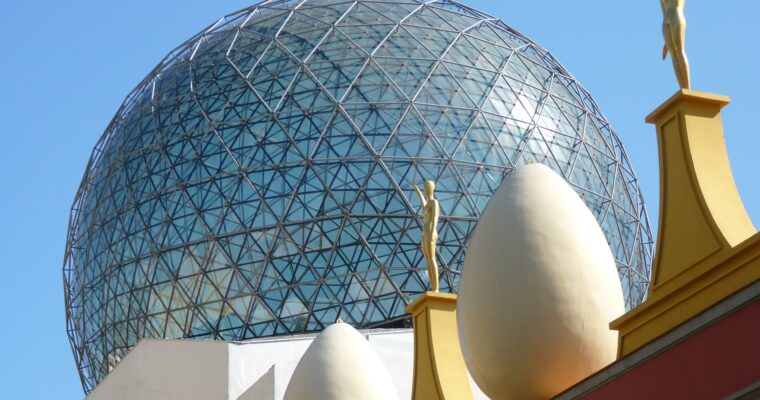
Salvador Dalí’s great surrealist universe The Dalí Theatre-Museum in Figueres is one of the most extraordinary museums in Catalonia and one of the most iconic places associated with Salvador Dalí. Conceived as a total work of art, the museum invites visitors to enter the artist’s …
A Getaway to Montserrat Abbey and its Magical Mountain There are places you visit. And there are places you feel. Montserrat is one of them. Just over an hour from Barcelona, among extraordinary rock formations, forests and mountain trails, lies one of Catalonia’s most unique …
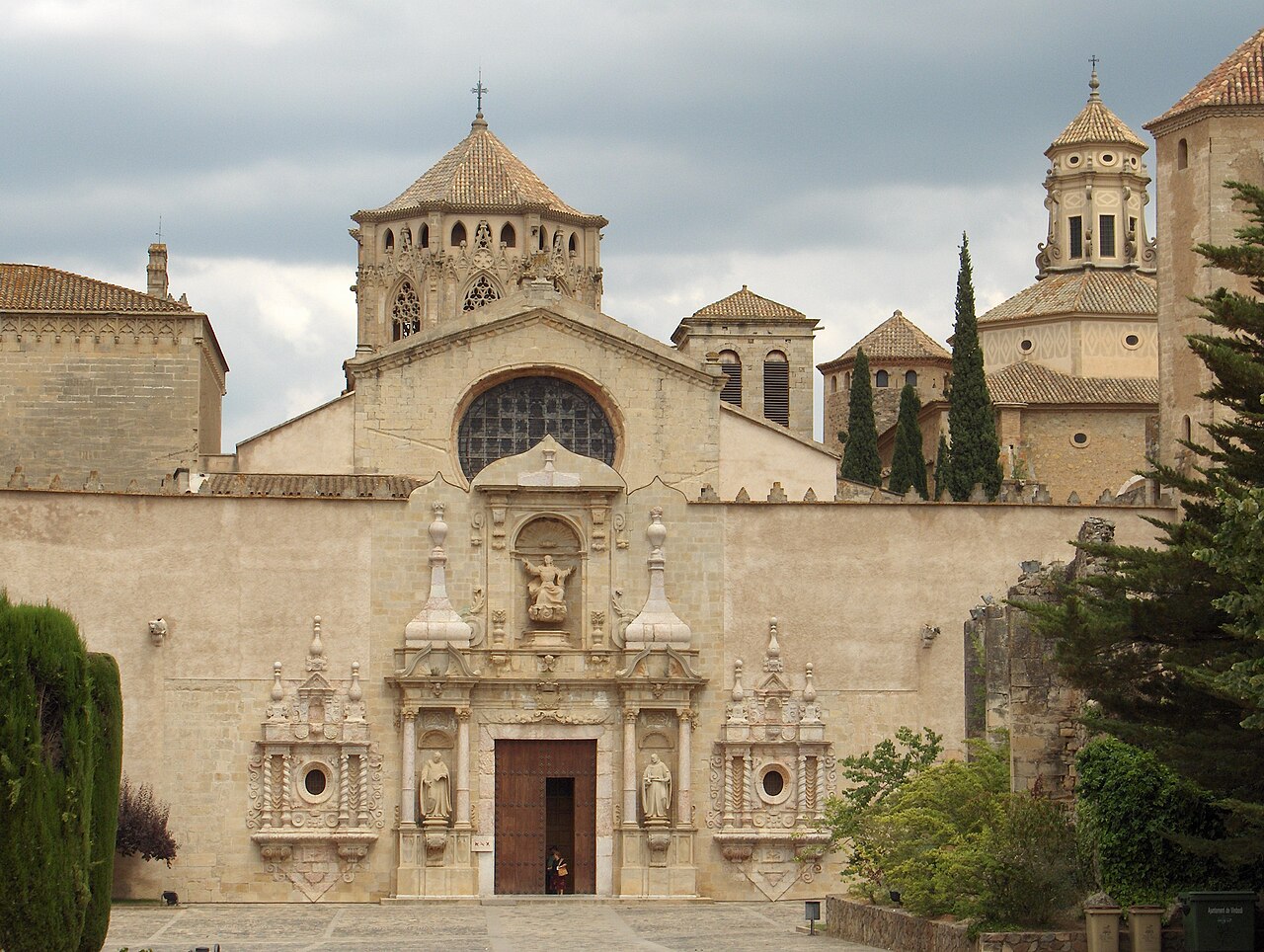
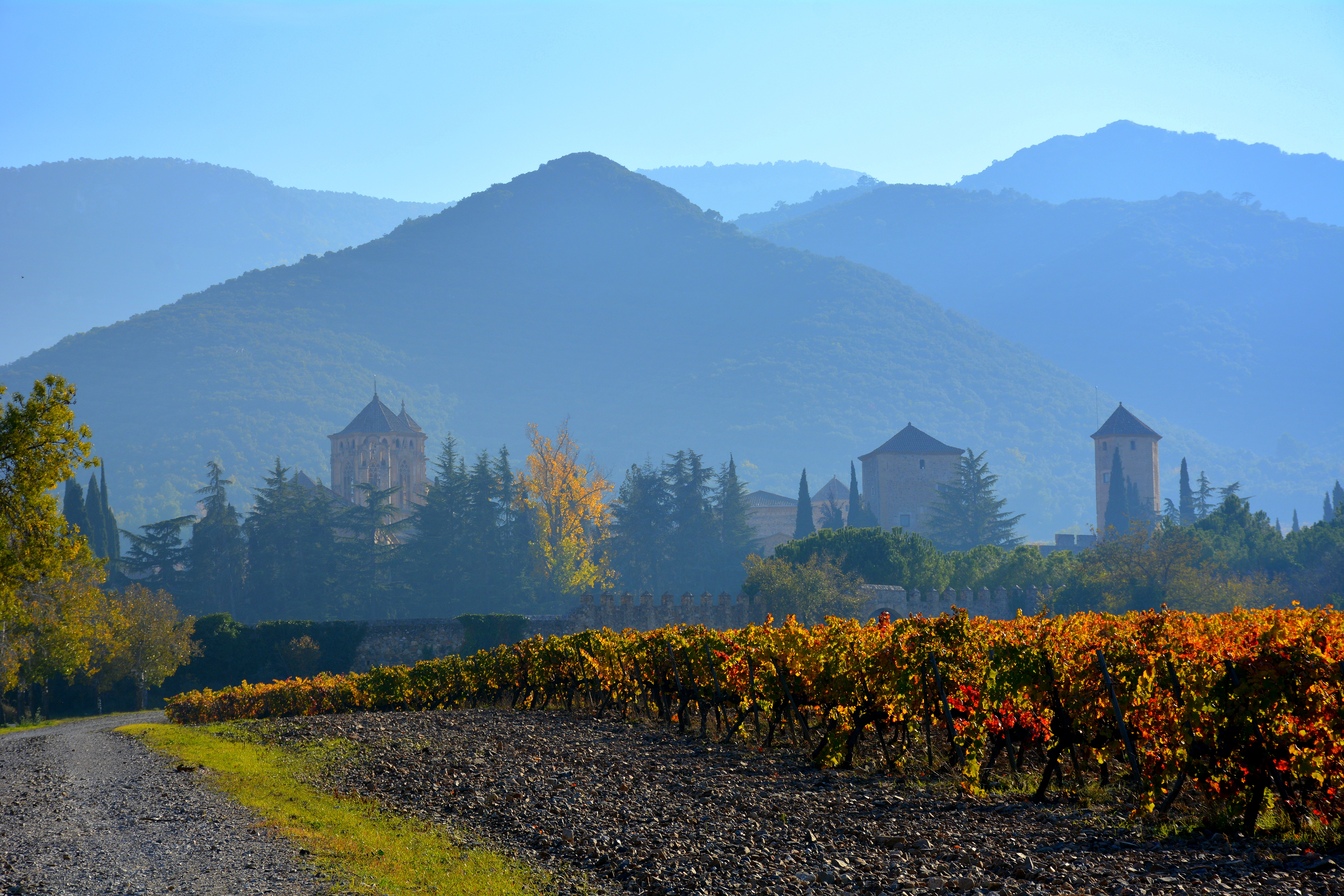
Hidden among the landscapes of the Conca de Barberà, in the province of Tarragona, stands one of Catalonia’s most extraordinary historical treasures: the Royal Monastery of Santa Maria de Poblet.
This impressive Cistercian monastery is much more than a beautiful medieval building. It is a place connected to the history of the Crown of Aragon, the Catalan royal dynasty, medieval monastic life and some of the most remarkable architectural traditions of Catalonia.
Declared a UNESCO World Heritage Site in 1991, Poblet is considered one of the largest and most complete Cistercian abbeys in the world.
If you are staying in Barcelona and would like to discover a different side of Catalonia, we highly recommend including Poblet in your itinerary.
Where is the Royal Monastery of Poblet?
The monastery is located in the municipality of Vimbodí i Poblet, in the Conca de Barberà region of Tarragona.
Its surroundings make the journey particularly attractive. The monastery is surrounded by forests, mountains and historic villages, creating an atmosphere that feels very different from the urban environment of Barcelona.
The location also makes Poblet an excellent destination for a cultural day trip from Barcelona.
How far is Poblet from Barcelona?
By car, the journey from Barcelona to Poblet is approximately 120 kilometres, depending on the exact route.
Under normal traffic conditions, the drive takes around 1 hour and 20 minutes to 1 hour and 30 minutes.
The usual route is via the AP-7 and AP-2, followed by the exit towards L’Espluga de Francolí and Poblet.
For visitors who prefer not to drive, there are also public transport options, although they require considerably more planning.
The nearest railway station is L’Espluga de Francolí, approximately 3 kilometres from the monastery.
A Brief History of Poblet
The history of Poblet begins in 1150, when the Cistercian monastery was founded in the context of the Christian expansion of the Crown of Aragon.
Over the following centuries, the monastery grew in importance and became one of the principal religious and political centres of the region.
Its relationship with the royal house became particularly significant.
Poblet eventually became the royal pantheon of the Crown of Aragon, and several kings and queens were buried here.
This royal connection transformed the monastery into much more than a religious institution. It became a powerful symbol of the medieval Crown of Aragon and an important centre of culture, administration and spirituality.
The Royal Pantheon
One of the most fascinating parts of Poblet is the Royal Pantheon, where members of the royal dynasties of Catalonia and Aragon were buried.
The tombs are located inside the monastery church, above the passageways between the columns.
Among the monarchs associated with the pantheon are Peter the Ceremonious, Martin the Humanist, Alfonso the Magnanimous and James II of Aragon, among others.
For visitors interested in medieval history, this is one of the most important highlights of the entire complex.
Walking through the church and seeing the royal tombs provides a direct connection with centuries of European history.
The Architecture of Poblet
Poblet is particularly interesting because it combines several architectural periods.
Its construction developed over centuries, and visitors can identify Romanesque, Gothic, Renaissance and Baroque elements throughout the complex.
However, Gothic architecture is particularly prominent in some of the monastery’s most important spaces.
The monastery was designed according to the principles of Cistercian architecture, which traditionally emphasized simplicity, functionality, light and spiritual contemplation.
At the same time, Poblet developed into an extraordinarily complex architectural ensemble.
The Three Enclosures of the Monastery
One of the most distinctive characteristics of Poblet is its organization into three main enclosures.
The complex is surrounded by defensive walls and towers, giving the monastery an imposing fortified appearance.
The First Enclosure
The first enclosure contains historic spaces that were connected with practical and everyday activities.
Among them are former stores, workshops and housing dating from later periods.
One of the most notable buildings is the Chapel of Saint George, a Gothic chapel dating from the 15th century.
This area provides an interesting introduction to the monastery before visitors reach its principal monumental spaces.
The Second Enclosure
The second enclosure leads visitors further into the historical heart of the complex.
Here you can find the Plaça Major, remains associated with the former hospital for the poor, the Romanesque Chapel of Santa Catherine and other historic spaces.
The architecture gradually becomes more monumental as you approach the main monastic enclosure.
The Third Enclosure
The third enclosure contains the heart of Poblet.
This is where visitors find the monastery church, the great cloister and many of the rooms associated with monastic life.
The cloister is particularly impressive and is one of the best places to appreciate the Gothic character of the monastery.
The Royal Gate and Defensive Walls
The monastery’s defensive character is impossible to miss.
The surrounding wall is approximately 11 metres high and extends for around 608 metres.
The fortifications were commissioned during the reign of Peter the Ceremonious, reflecting the political and strategic importance that Poblet had acquired.
The impressive Royal Gate was commissioned in the 14th century from the military engineer Guillem de Guimerà.
It is one of the most striking entrances to the monastery.
The Monastery Church
The church is at the centre of the monumental complex.
Its architecture follows the Cistercian tradition while incorporating Gothic elements.
The church has three naves, a transept and an ambulatory around the main altar.
The central nave is covered by a pointed vault, while the side aisles feature ribbed vaulting.
Inside, visitors can also admire the royal tombs and the impressive Renaissance alabaster altarpiece.
For many visitors, the combination of monumental architecture, royal history and religious symbolism makes the church one of the highlights of Poblet.
The Great Cloister
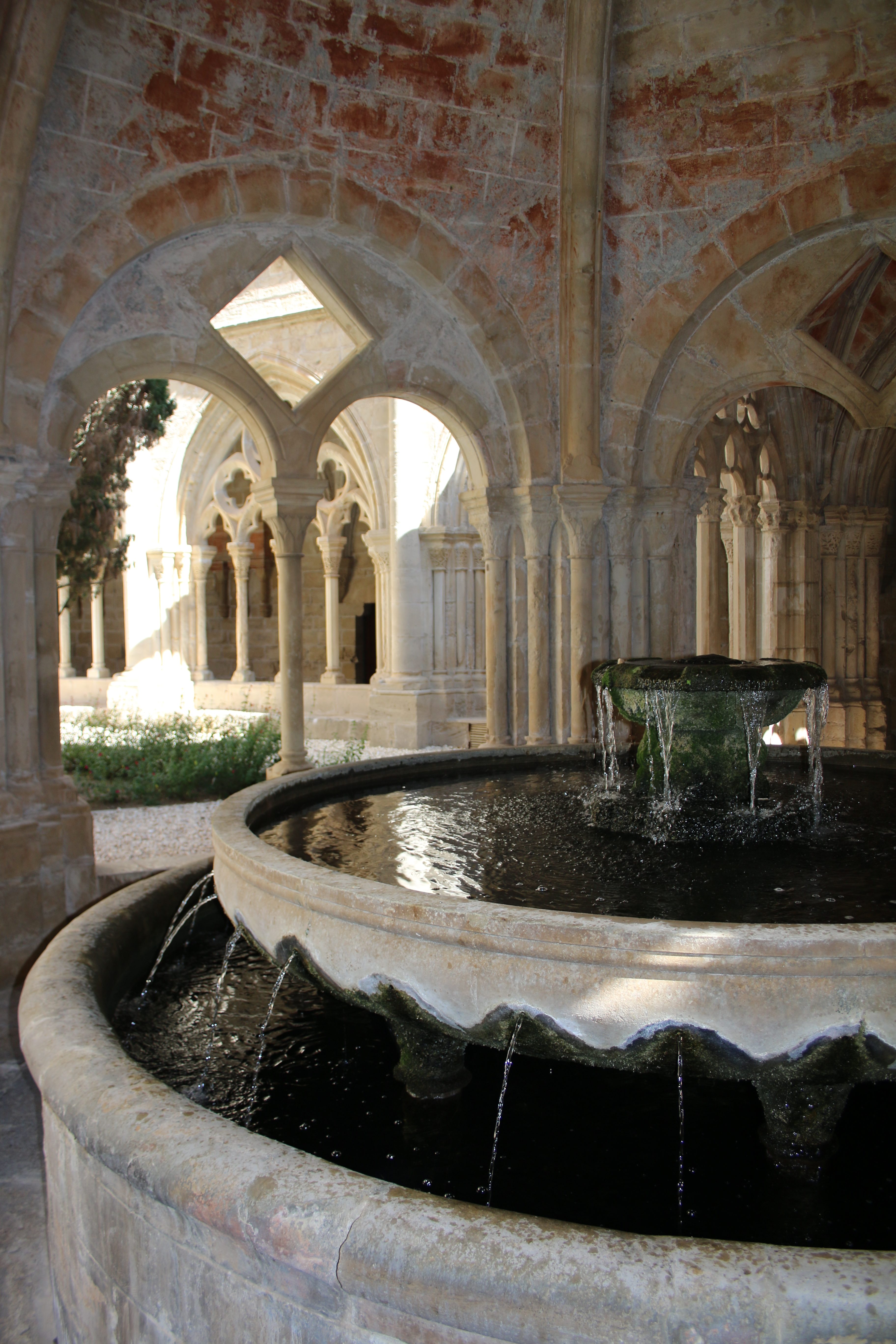
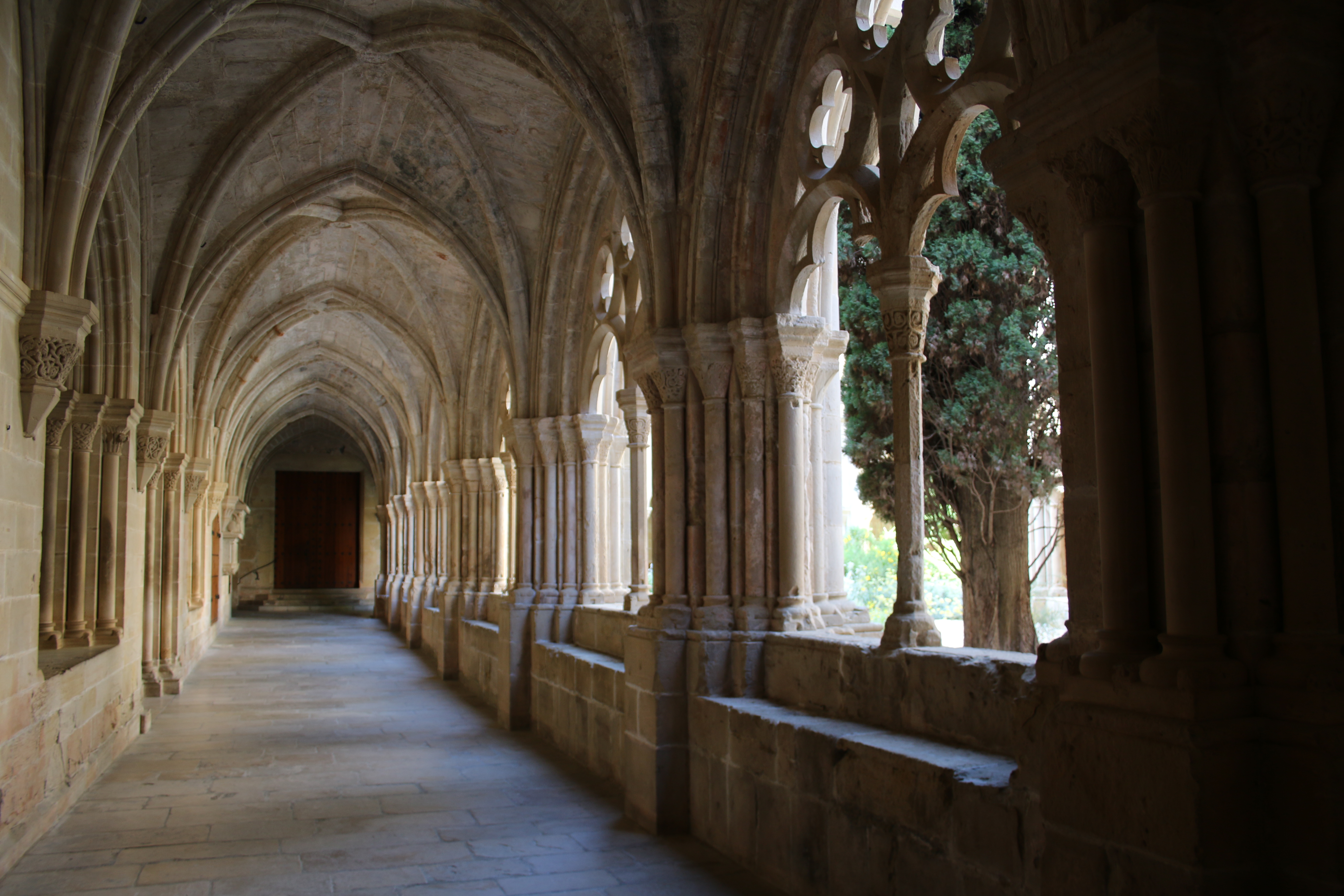
The great cloister is one of the most beautiful spaces in the monastery.
Its Gothic architecture creates a peaceful environment that contrasts with the defensive character of the exterior walls.
The cloister connected many of the monastery’s principal rooms and played an essential role in the daily life of the monks.
It is also one of the best places to appreciate the proportions, stonework and architectural details of Poblet.
The Chapter House
The Chapter House was one of the most important spaces in the daily life of the Cistercian community.
The monks gathered here to discuss matters concerning the monastery, listen to readings and deal with the administration of their community.
Its architecture reflects the importance of the space within monastic life.
The Refectory and Kitchen
The monastery also preserves spaces associated with the everyday life of the monks.
The refectory was where the community took its meals.
Nearby were the kitchen and other service areas required to support the monastic community.
These spaces help visitors understand that Poblet was not simply a monumental or religious building. It was a complete community designed around prayer, work, study and communal life.
The Scriptorium and Library
Poblet also became an important centre of learning.
The monastery had a library and scriptorium, where manuscripts were copied, preserved and studied.
The monks contributed to the transmission of knowledge, particularly in areas such as law and history.
This intellectual dimension is another reason why Poblet is so significant.
Its importance goes beyond architecture: it was also a centre of culture and knowledge.
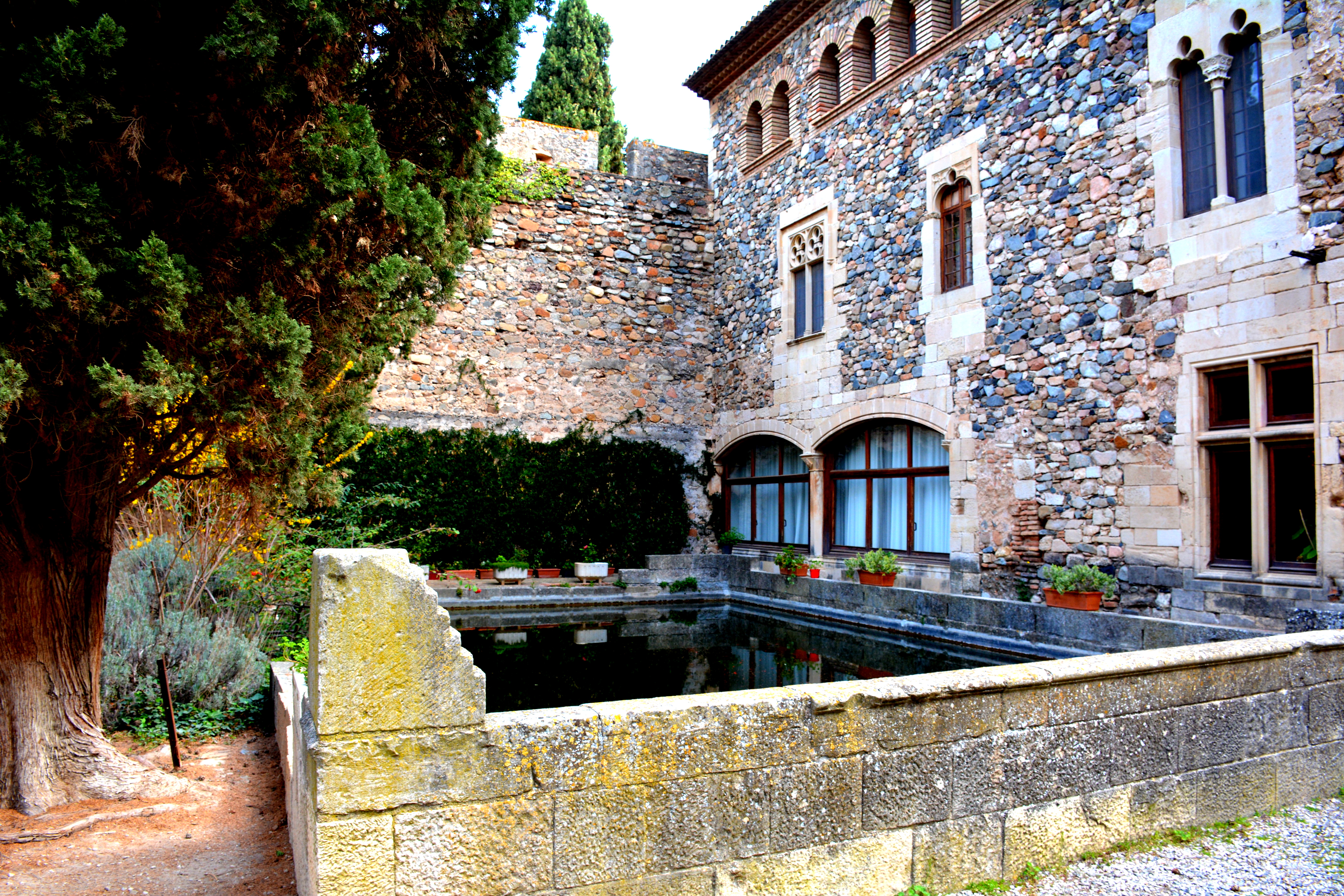
The Palace of King Martin
One of the most fascinating structures within the complex is the Palace of King Martin.
Construction began towards the end of the 14th century, although the building was never completely finished after the death of King Martin in 1410.
Its Gothic windows are particularly distinctive.
The interiors were later completed and reconstructed during the 20th century to accommodate historical collections.
The palace is an excellent example of the connection between the monastery and the royal court.
What Happened to Poblet?
The monastery experienced a dramatic period of decline during the 19th century.
In 1835, following the confiscation of church property in Spain, the monks were forced to leave Poblet.
The abandoned monastery suffered looting and deterioration, and many of its buildings were seriously damaged.
For decades, Poblet remained in a state of ruin.
Fortunately, restoration efforts eventually began, and monastic life returned in 1940.
The restoration of Poblet became one of the most important heritage projects in Catalonia.
Poblet and UNESCO
The Royal Monastery of Santa Maria de Poblet was declared a UNESCO World Heritage Site in 1991.
UNESCO recognizes Poblet as one of the largest and most complete Cistercian abbeys in the world.
Its importance lies not only in its architecture but also in its historical relationship with the Crown of Aragon, its royal pantheon and its extraordinary preservation as a complete monastic complex.
How Do You Visit the Monastery?
The tourist visit to Poblet can be completed independently using the official “Poblet, guía oficial” application.
We recommend bringing headphones so that you can comfortably follow the information during the visit.
In addition to the monumental area, the visit includes the museum and interpretation centre, providing further information about the history and significance of the monastery.
We recommend preparing your visit in advance and checking the opening times before travelling, particularly during public holidays and special dates.
Would you prefer to discover Poblet without worrying about the organization?
If you would like to experience the monastery in a more comfortable and personalized way, Magic Dreams Barcelona can organize the entire experience for you.
We can arrange a private excursion from Barcelona including private transportation, guide services, scheduling, gastronomy and all the essential details required for a relaxed and enjoyable day.
You will not have to worry about how to get there, where to park, how to organize your time or where to enjoy a good meal.
We take care of the logistics so that you can concentrate on discovering Poblet and enjoying its history.
For visitors looking for a private and carefully planned experience, we highly recommend combining culture, heritage, gastronomy and the beautiful landscapes surrounding the monastery.
If you are considering visiting the Royal Monastery of Poblet from Barcelona, Magic Dreams Barcelona can design the complete experience for you, adapting the itinerary to your interests, preferred pace and requirements.
Opening Hours
The official tourist opening hours vary according to the season.
Winter season
15 September – 14 June
Monday to Saturday: 10:00–12:30 and 15:00–18:00
Sundays and public holidays: 10:30–12:30 and 15:00–18:00
Summer season
15 June – 14 September
Monday to Saturday: 10:00–12:30 and 15:00–18:30
Sundays and public holidays: 10:30–12:30 and 15:00–18:30
Tickets are normally sold until 30 minutes before closing.
The monastery is closed all day on certain public holidays, including 1 January, 6 January, 25 December and 26 December.
We strongly recommend checking the official schedule before travelling because special opening times may apply on specific dates.
Ticket Prices
Current general admission prices include:
General admission: €10.50
Reduced admission: €7.50
School and university groups: €6
Combined Cistercian Route ticket: €18
The combined ticket includes Poblet, Santes Creus and Vallbona de les Monges.
Reduced admission applies to several categories, including seniors, children from 7 years old, students and certain other groups with the appropriate documentation.
How to Get to Poblet from Barcelona
By Car
Driving is the most convenient option, particularly if you would like to combine Poblet with other destinations in the area.
The journey from Barcelona takes approximately 1 hour and 20–30 minutes, depending on traffic and the route.
By Train
You can travel by train from Barcelona towards the Tarragona/Lleida area and reach L’Espluga de Francolí.
The station is approximately 3 kilometres from the monastery, meaning that you will need to arrange the final part of the journey.
By Bus
Bus connections are possible, but they generally require more planning and transfers.
For this reason, visitors who want to make the most of a single day often find private transportation considerably more comfortable.
Where to Eat Near Poblet
A visit to Poblet can easily be combined with lunch in the surrounding area.
Among the nearby options are:
Restaurant Hostatgeria de Poblet — located very close to the monastery and a convenient option for combining the visit with lunch.
Restaurant El Grèvol — located in Vimbodí and offering a more informal local dining option.
Restaurant Dels Torrents — another nearby choice for enjoying a meal during your visit.
Opening times can change according to the season, so we recommend checking availability before travelling.
For a private excursion with Magic Dreams Barcelona, we can also help coordinate the gastronomic part of your experience so that your day is organized smoothly from beginning to end.
What Can You Do Around Poblet?
A visit to the monastery can be extended into a broader cultural excursion.
The surrounding area offers opportunities to discover:
Historic villages in the Conca de Barberà
The Cistercian heritage of Catalonia
Forest landscapes surrounding Poblet
L’Espluga de Francolí
Montblanc and its medieval heritage
Other historic monasteries in the region
Local gastronomy and traditional Catalan cuisine
One particularly interesting option is the Cistercian Route, which connects Poblet with the monasteries of Santes Creus and Vallbona de les Monges.
7 Fascinating Facts About Poblet
1. It is a royal burial place
Poblet became the royal pantheon of the Crown of Aragon, making it one of the most important royal burial sites in Catalonia.
2. It is a UNESCO World Heritage Site
Poblet has been recognized by UNESCO since 1991 because of its exceptional historical and architectural value.
3. It is a fortified monastery
Unlike many monasteries, Poblet has imposing defensive walls and towers, reflecting its historical importance.
4. It combines different architectural periods
Romanesque, Gothic, Renaissance and Baroque elements can all be found throughout the complex.
5. Monastic life returned in the 20th century
After decades of abandonment following the events of 1835, the monastic community returned in 1940.
6. It was an important centre of knowledge
The monastery developed an important library and scriptorium, contributing to the preservation and transmission of historical knowledge.
7. It remains one of Catalonia’s great historical landmarks
Today, Poblet is one of the most important examples of Cistercian heritage in Europe and one of the most remarkable cultural destinations in Catalonia.
Why Visit Poblet from Barcelona?
If you are staying in Barcelona, Poblet offers the opportunity to experience a completely different side of Catalonia.
Instead of focusing only on Barcelona’s urban attractions, you can discover medieval architecture, royal history, monastic traditions and spectacular landscapes in a single day.
We highly recommend Poblet for travelers interested in history, architecture, culture and authentic Catalan heritage.
And if you would rather enjoy the experience without worrying about transportation, reservations or logistics, Magic Dreams Barcelona can take care of the entire journey for you.
From the moment you leave Barcelona until your return, we can coordinate the vehicle, guide, itinerary, gastronomy and the details that make the difference between simply visiting a monument and enjoying a truly memorable cultural experience.
We invite you to discover the Royal Monastery of Poblet and experience one of Catalonia’s most fascinating historical treasures.
Iglesia del monasterio, parte de la Epístola. Sepulcros reconstruidos por Federico Marés Deulovol en 1944 – José Luis Filpo Cabana, CC BY 3.0 , via Wikimedia Commons.
Arcos del claustro – Francis Raher, CC BY 2.0 , via Wikimedia Commons.
Monestir de Poblet, Vimbodí – Angela Llop de España, CC BY-SA 2.0 , via Wikimedia Commons.
Monasterio, otoño, viñas, cisterna – By Angela Llop – https://www.flickr.com/photos/angela_llop/26730740849/, CC BY-SA 2.0, https://commons.wikimedia.org/w/index.php?curid=91000669.
Monasterio de Poblet – By FrDr – Own work, CC BY-SA 4.0, https://commons.wikimedia.org/w/index.php?curid=109229564.
Monasterio de Poblet – By FrDr – Own work, CC BY-SA 4.0, https://commons.wikimedia.org/w/index.php?curid=109229889.
Alrededores del Real Monasterio de Poblet – By LBM1948 – Own work, CC BY-SA 4.0, https://commons.wikimedia.org/w/index.php?curid=120602240.
History, architecture, legends and one of the Maresme’s most extraordinary fortresses There are places that seem to belong to another era. Places where towers, battlements, courtyards and medieval galleries blend with stained glass, mosaics, sculptures and Modernist details. Santa Florentina Castle, in Canet de Mar, …
A Pyrenean paradise that awakens all the senses At an altitude of 1,539 metres, in the heart of Cerdanya, lies Meranges, the municipal capital located at the highest elevation in Catalonia. This small mountain village is a place where stone houses, slate roofs and wooden …
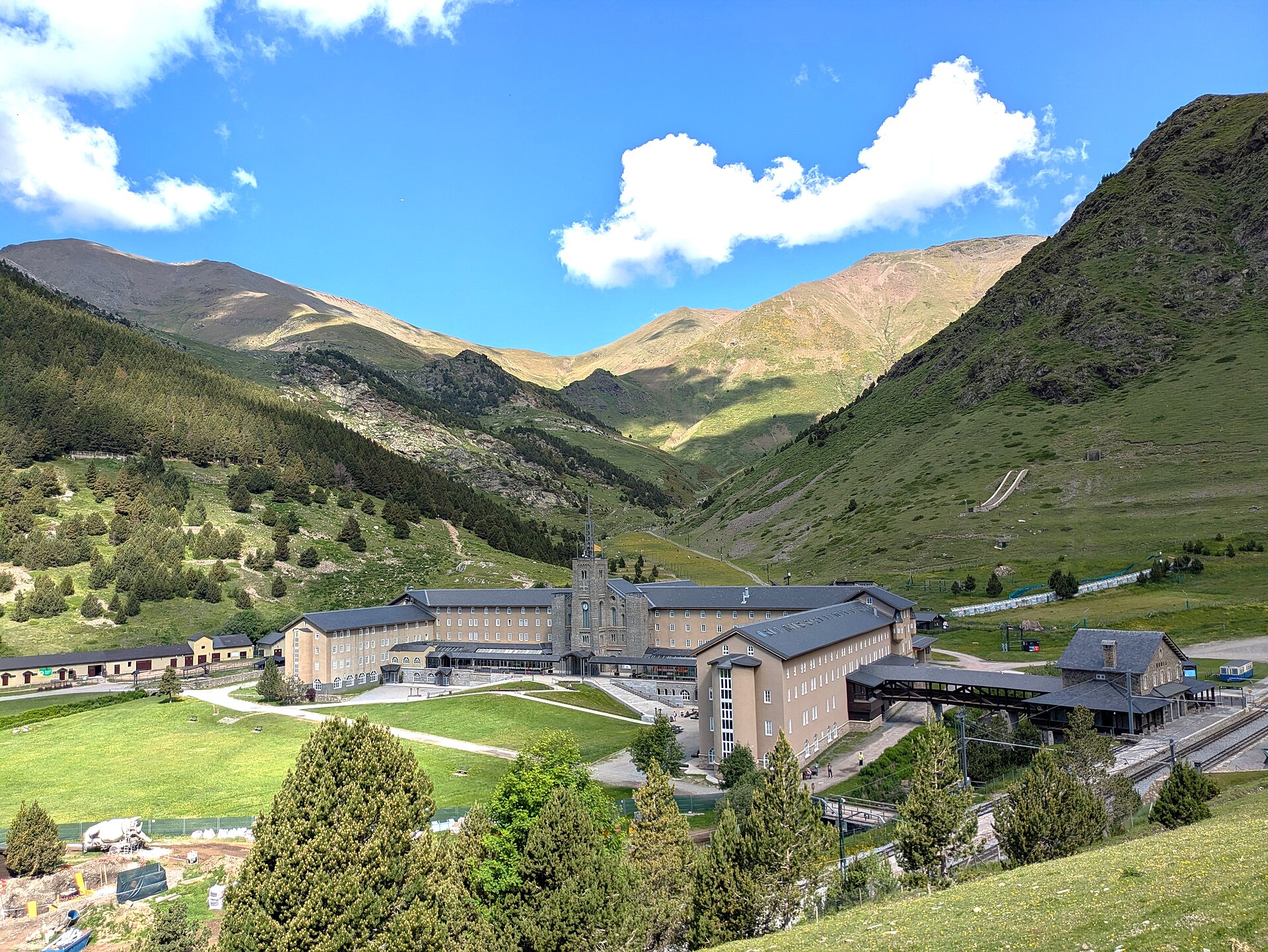
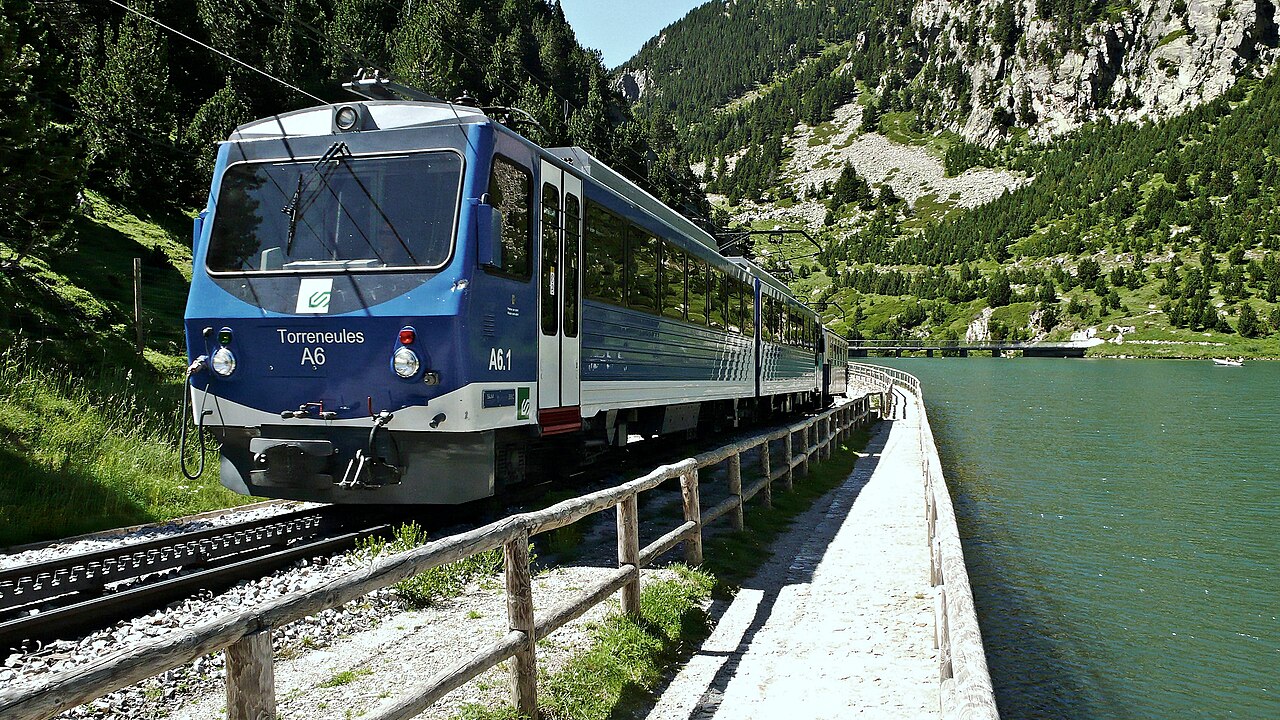
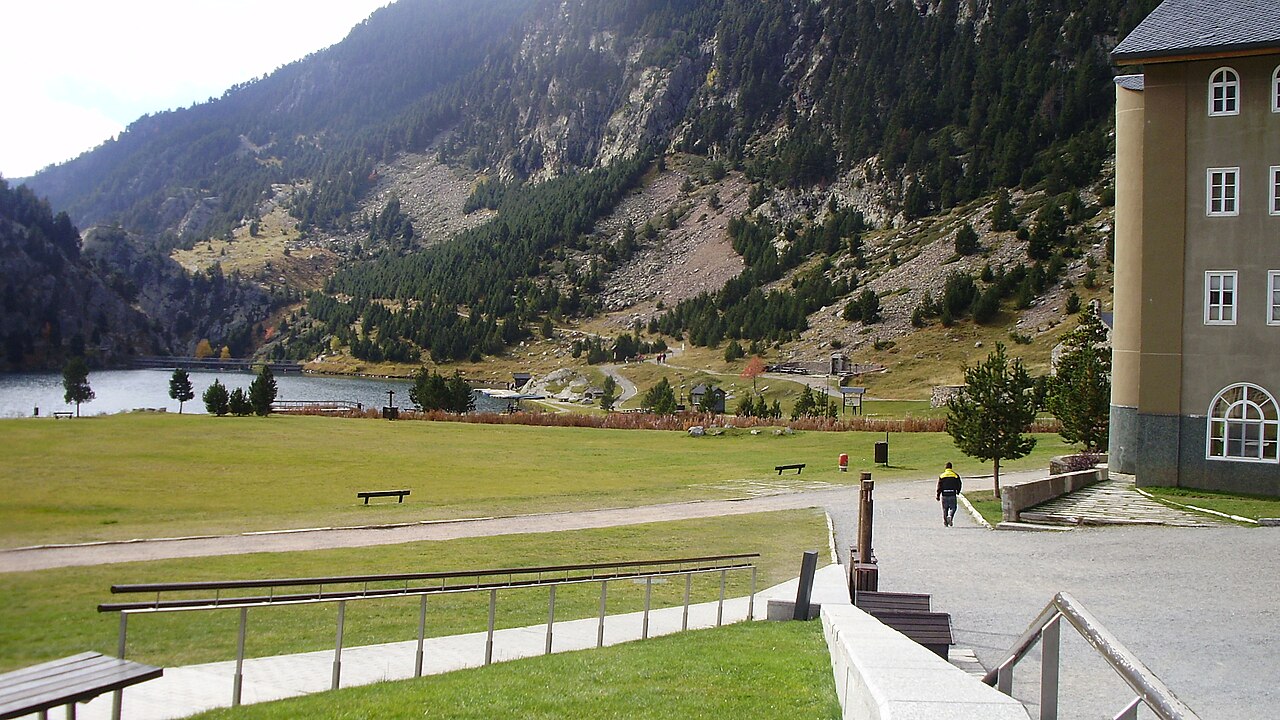
Vall de Núria is one of those places that surprises you from the very first moment. Located in the heart of the Eastern Pyrenees, within the municipality of Queralbs, the valley is surrounded by mountains, forests, alpine meadows and peaks rising above 2,500 metres.
At almost 2,000 metres above sea level, Núria offers an exceptional combination of nature, history, spirituality and mountain activities. It also has a feature that makes it even more special: you cannot reach the valley by car. To get there, you have to take the historic Núria Rack Railway or walk along one of the paths connecting the valley with Queralbs and other points in the mountains.
This means that the journey begins long before you reach your destination.
Where is Vall de Núria?
Vall de Núria is located in the Catalan Pyrenees, within the municipality of Queralbs, in the Ripollès region.
The valley lies at approximately 1,964 metres above sea level and is surrounded by some of the most characteristic mountains of the Eastern Pyrenees, including Puigmal, which reaches 2,913 metres.
The landscape changes considerably depending on the season. In winter, snow covers the meadows and mountains, transforming Núria into a completely white landscape. During spring and summer, alpine flowers appear and the meadows regain their colour, while autumn offers a spectacular combination of changing hues.
How to get to Vall de Núria from Barcelona
From Barcelona to Queralbs, the journey is approximately 125 kilometres by road and can take around one hour and forty-five minutes, although the travel time depends on traffic and your starting point.
The usual route is:
Barcelona – Granollers – Vic – Ripoll – Ribes de Freser – Queralbs
Once you reach Queralbs, the most special part of the journey begins: travelling to Núria by rack railway.
It is also possible to travel from Barcelona by public transport, taking the train to Ribes de Freser and then connecting with the Núria Rack Railway.
The Núria Rack Railway
The Rack Railway is much more than a means of transport. It is one of the defining experiences of the journey.
The route is approximately 12.4 kilometres long and climbs almost 1,000 metres in elevation before reaching the valley. Along the way, you can watch the landscape gradually change as the train climbs higher into the mountains.
The railway was inaugurated in 1931 and has been an inseparable part of Núria’s history ever since.
For many visitors, arriving by rack railway is one of the most memorable moments of the trip.
How much does it cost to get to Núria?
Prices depend on the departure point, the visitor’s age, the season and the type of ticket.
As a general reference, a return ticket between Queralbs and Núria costs around €31 per adult, while the price from Ribes is somewhat higher.
There are also different ticket options and combinations that may include activities or additional services.
For this reason, if you are planning a specific getaway, it is advisable to check the price for your chosen dates before organising your trip.
The History of Vall de Núria
Núria’s history is closely linked to shepherding, ancient mountain routes and pilgrimage.
For centuries, shepherds used the valley’s meadows for grazing, and the area eventually also became an important pilgrimage destination.
But if there is one story that has remained particularly closely associated with Núria, it is the legend of Saint Gil and the Virgin of Núria.
The Legend of Saint Gil
According to tradition, Saint Gil arrived in the valley around the year 700.
This saint, who was of Athenian origin, is said to have lived in Núria for several years. Legend has it that he carved an image of the Virgin and also made a cross, a cooking pot and a bell.
When he had to leave the valley, he hid these objects inside a cave.
Centuries later, a pilgrim named Amadeus is said to have reached Núria following a revelation telling him to search for the image of the Virgin.
Tradition dates the discovery to 1079.
The cross, cooking pot and bell were also found alongside the image. These four objects have remained closely associated with the identity of the sanctuary ever since.
The Virgin of Núria
The image currently venerated is a Romanesque wooden carving generally dated to between the 12th and 13th centuries.
The Virgin is depicted seated as a Virgin in Majesty, with the Child resting on her left knee.
One of the most curious features of the statue is its dark appearance, traditionally associated over the centuries with candle smoke, humidity and the passage of time. This colouring gave rise to the traditional nickname Moreneta del Pirineu, meaning “Little Dark Virgin of the Pyrenees”.
The statue also displays some unusual characteristics, such as uncovered hair and ears, as well as clothing associated with the figure of a shepherdess.
The Tradition of the Cooking Pot and Bell
One of Núria’s best-known traditions is associated with fertility.
According to popular tradition, women who wished to have children would place their heads beneath the Pot of Saint Gil while the bell was rung.
Each ring symbolically represented a child.
Over time, this ritual has become one of the most famous and curious traditions associated with the sanctuary.
Beyond its religious significance, it forms part of Núria’s cultural and popular heritage and continues to attract the interest of visitors.
The Sanctuary of Núria
The present-day sanctuary originated from a group of buildings that evolved over the centuries.
The current church was inaugurated in 1911, and additional buildings and spaces were subsequently added.
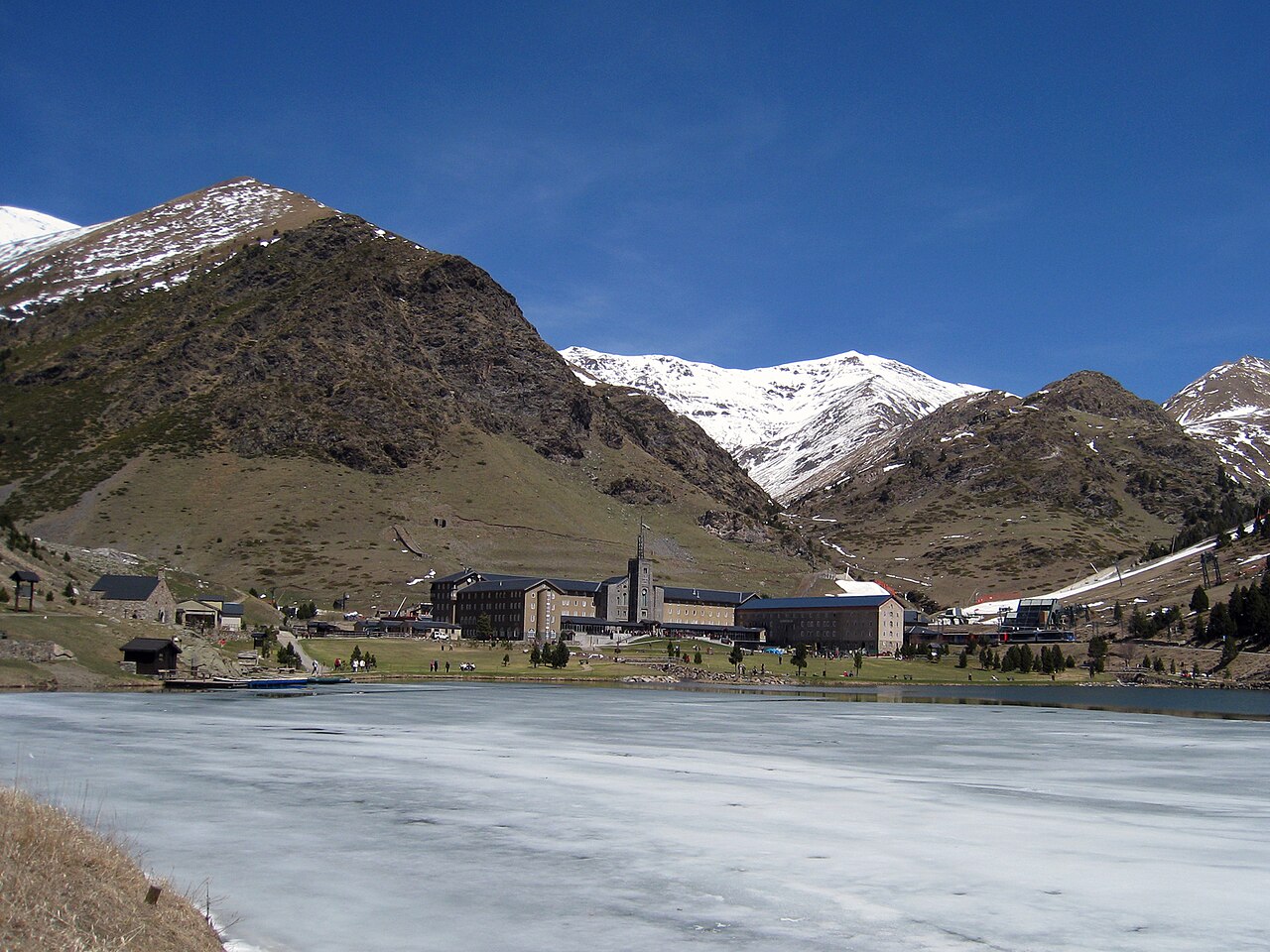
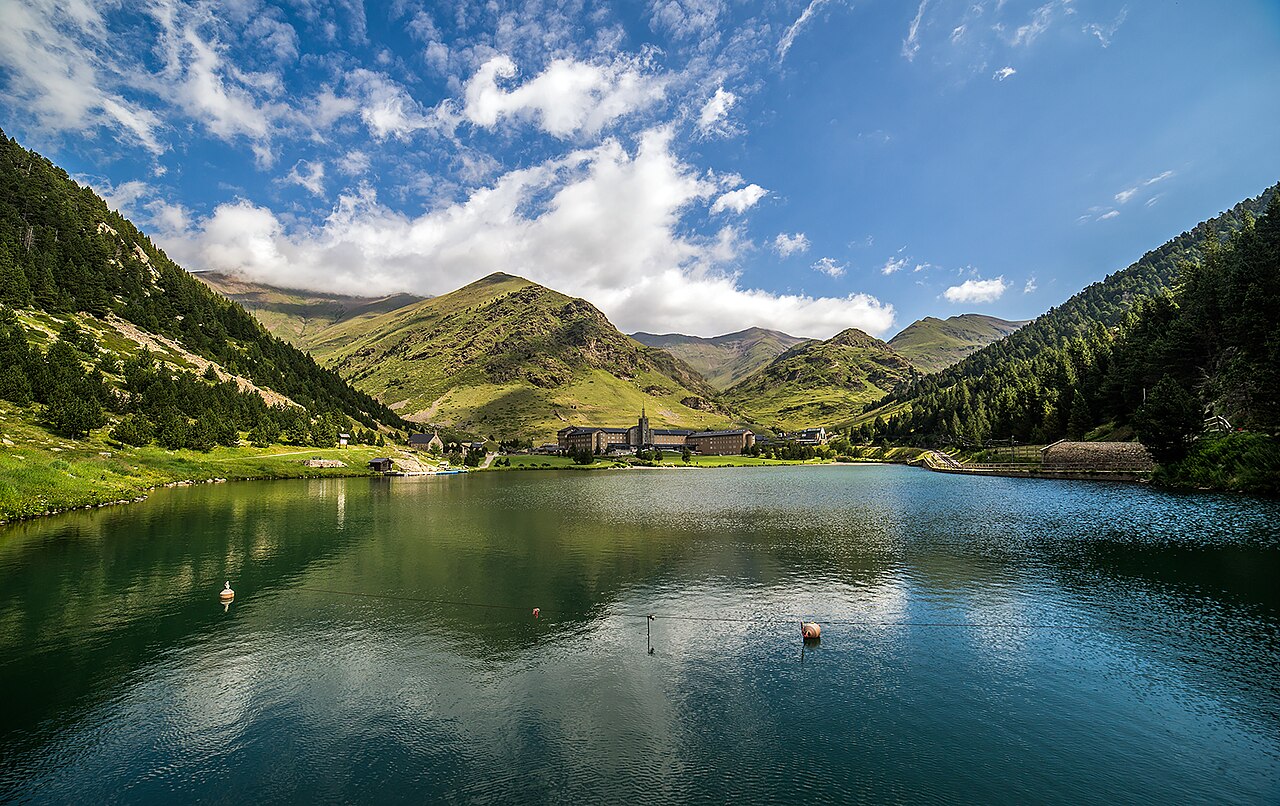
Today, the complex forms the heart of the valley and stands beside the lake, surrounded by mountains.
The combination of the sanctuary, lake and surrounding peaks creates one of the most recognisable landscapes in the Catalan Pyrenees.
Núria and the 1931 Statute
Núria’s history is not exclusively connected with religion and the mountains.
In 1931, the preliminary draft known as the Statute of Núria was drawn up in this valley, becoming one of the significant episodes in Catalonia’s political history during the 20th century.
The fact that such an isolated mountain location became the setting for this event adds another historical dimension to the valley.
Skiing in Vall de Núria
Yes, you can ski in Núria.
During winter, the valley becomes a mountain resort specialising in snow-related activities.
It has approximately 7 kilometres of marked ski runs, distributed across different levels of difficulty:
3 green runs.
3 blue runs.
3 red runs.
2 black runs.
There is also a dedicated sledging area and various other snow-related activities.
The resort is particularly appealing to beginners, families and people looking to combine outdoor sports with spectacular mountain scenery.
How much does skiing cost?
Prices vary depending on the day and the type of pass selected.
As a general reference, combined passes are available that include the return rack railway journey and access to the ski slopes, with prices that can be around €38 per adult under certain conditions.
There are also options for beginners and various family packages.
Ski equipment, lessons and other services can be booked separately.
Things to Do in Vall de Núria
One of Núria’s greatest attractions is that it is not exclusively a winter destination.
During the snow-free months, the valley becomes an excellent starting point for hiking and mountain activities.
Options include:
Hiking.
High-mountain excursions.
Family-friendly routes.
Nature photography.
Wildlife watching.
Birdwatching.
Botany.
Excursions along historic mountain paths.
Cable car rides.
Family activities.
Fishing and water activities during certain periods.
Skiing and snowshoeing in winter.
Sledging.
The Camí Vell de Núria
One of the most iconic routes is the Camí Vell de Núria, the old path connecting Queralbs with the valley before the rack railway was built.
It is particularly interesting because it allows visitors to experience how people used to reach Núria in the past.
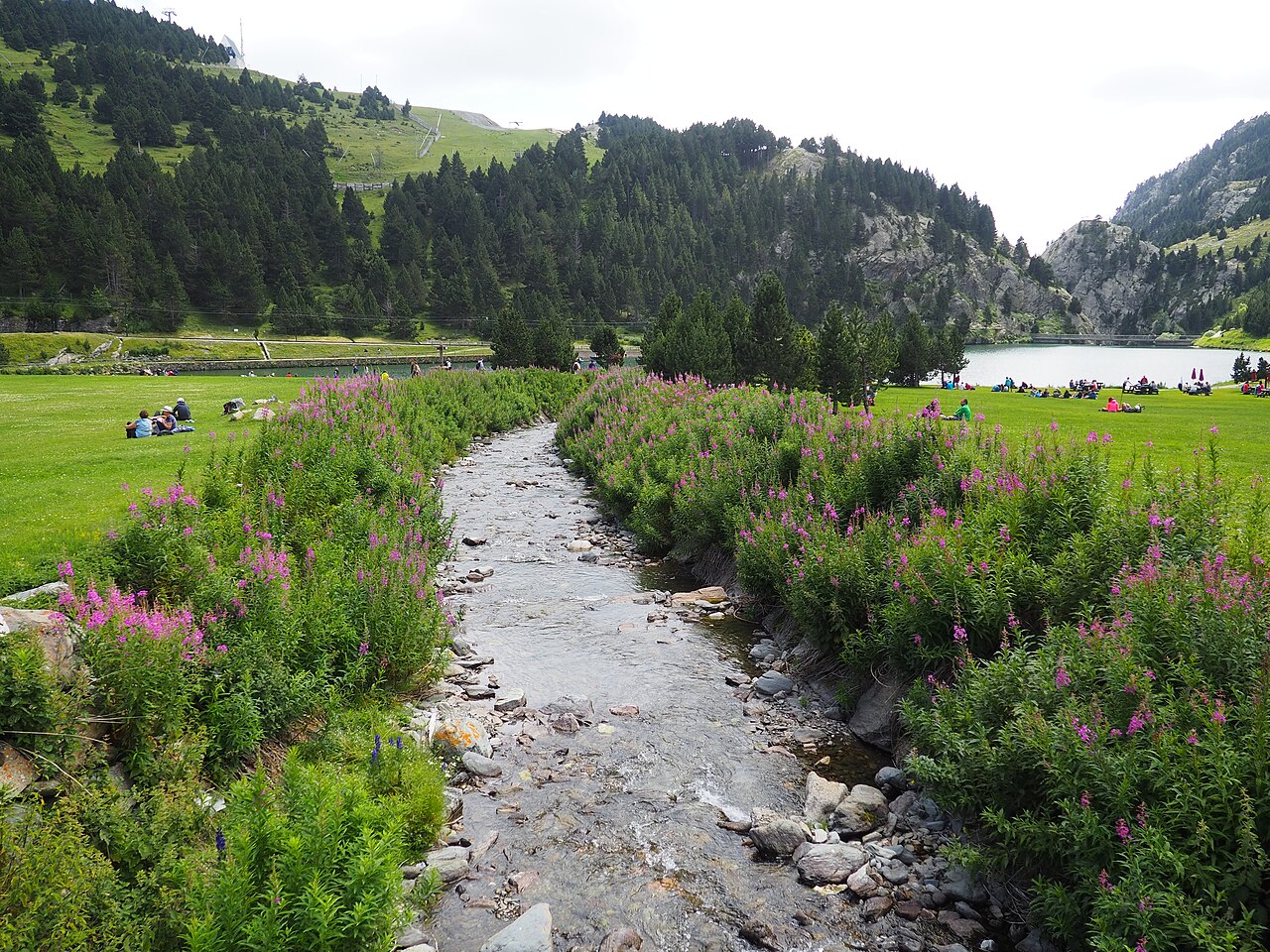
The path passes through different mountain environments and offers views of waterfalls, forests, rocky walls and the river.
For those who want to experience Núria at a slower pace, hiking up and then returning by rack railway can make for an excellent day trip.
The Olla de Núria
For mountain enthusiasts, one of the major routes is the Olla de Núria.
This is a high-mountain traverse following the peaks surrounding the valley.
It is a demanding route requiring good physical fitness and mountain experience. The difficulty increases considerably in snow, ice or adverse weather conditions.
This is not a route to undertake without preparation: before setting out, it is important to check the weather forecast and current ground conditions.
Puigmal
At 2,913 metres, Puigmal is one of the great peaks of the Eastern Pyrenees.
Climbing it from Núria is one of the usual objectives for mountaineers visiting the valley.
From the summit, in good visibility, you can enjoy an impressive panorama of the Pyrenean mountains.
In winter, however, the ascent changes completely and may require specific high-mountain skills and equipment.
Flora: An Alpine Garden
Nature is one of the great protagonists of Núria.
As you climb higher, different vegetation zones appear, progressing from forests to subalpine and alpine meadows.
Species found in the area include:
Black pine.
Scots pine.
Birch.
Ash.
Oak.
Rhododendron.
Gentians.
Fescues.
Rampions.
Pasque flowers.
Yellow martagon lilies.
One of the most spectacular flowers is the yellow martagon lily, a yellow-flowered lily that stands out particularly during its blooming season.
Spring and summer are the most interesting months for those who enjoy botany.
Wildlife in Vall de Núria
Wildlife is another of the valley’s great attractions.
One of the most emblematic animals is the chamois, perfectly adapted to the rocky terrain and steep slopes of the high mountains.
It is also possible to spot marmots, particularly during the warmer months.
Their distinctive whistles can often be heard before the animals themselves are located.
Other animals found in the area include:
Foxes.
Roe deer.
Wild boar.
Hares.
Stoats.
Various small mammals.
Wildlife watching requires patience and respect. Wild animals should never be fed or chased in order to obtain a photograph.
Birdwatching in Vall de Núria
Núria also offers excellent opportunities for birdwatching enthusiasts.
The landscape combines forests, meadows, rocky areas, streams and high mountain terrain, providing a variety of habitats within a relatively small area.
The species found in the area include different forest birds, meadow birds and large birds of prey.
Some particularly interesting species for birdwatchers include:
Black woodpecker.
Tengmalm’s owl.
Red crossbill.
Northern wheatear.
Skylark.
Grey wagtail.
White-throated dipper.
Various corvids and birds of prey.
Spring and summer offer greater activity for many species, although sightings always depend on weather conditions and animal behaviour.
Butterflies and Other Small Mountain Creatures
When warm weather arrives, Núria’s meadows fill with flowers, bringing with them an enormous variety of insects.
Butterflies are particularly noticeable during the summer months.
You may also encounter:
Bees.
Bumblebees.
Grasshoppers.
Crickets.
Beetles.
Different species of pollinators.
The relationship between flowers, insects and birds is essential to understanding how high-mountain ecosystems function.
For nature photographers, Núria’s meadows can offer excellent opportunities during the flowering season.
Where to Stay in Vall de Núria
One of the advantages of spending the night in the valley is being able to enjoy Núria after the main influx of visitors has left.
The accommodation options include several possibilities.
Hotel Vall de Núria
The hotel is located next to the sanctuary and allows you to stay literally in the heart of the valley.
It is particularly appealing to those who want to enjoy several activities without having to travel in and out of the valley every day.
Apartments
The apartments offer greater independence and can be practical for families or groups.
Having a kitchen and private space makes it easier to organise a multi-day stay with greater flexibility.
Hostel
There is also mountain accommodation in the area of Pic de l’Àliga, suitable for those looking for a simpler experience closely connected with the mountains.
How Much Does It Cost to Stay in Núria?
Prices vary considerably depending on the season.
Staying:
during the week is different from staying at the weekend;
in summer is different from winter;
during the snow season is different from the low season;
in a room is different from an apartment;
on an accommodation-only basis is different from a package including activities.
For this reason, the actual price needs to be checked for the specific dates.
For a budget-friendly getaway, it may be worthwhile comparing accommodation, transport and activities as a single package rather than booking each service separately.
Mountain Cuisine
After a day of hiking or skiing, food becomes even more important.
In Núria, you will find options inspired by Catalan and mountain cuisine, as well as more informal alternatives.
Options may include:
Hot dishes.
Meat dishes.
Grilled food.
Burgers.
Sandwiches.
Salads.
Pasta.
Homemade-style cuisine.
Local products.
Food is a great way to complete the mountain experience and discover some of the characteristic products of the region.
Vall de Núria in Spring, Summer, Autumn and Winter
Spring: Water and Flowers
The melting snow feeds streams and waterfalls, while vegetation begins to awaken.
It is a wonderful time for landscape photography and observing the first flowers of the season.
Summer: Hiking and Nature
The summer months are ideal for hiking, climbing peaks, watching marmots, looking for birds and discovering alpine flora.
It is also the most interesting season for observing butterflies and other insects.
Autumn: Colours and Tranquillity
The changing colours of the vegetation transform the landscape.
It also tends to offer a quieter atmosphere than the height of the summer season.
Winter: Snow and Skiing
Núria completely changes its appearance.
The mountains, trees and lake become surrounded by snow, and activities focus on skiing, sledging, snowshoeing and other winter experiences.
Vall de Núria with Children
Núria is also an interesting destination for a family getaway.
The rack railway journey itself often becomes an adventure for younger visitors.
Once in the valley, families can enjoy easy walks, visit the sanctuary, explore the lake, watch birds and marmots, or take part in snow activities during winter.
The key is to choose routes and activities according to the children’s age and the weather conditions.
How Many Days Do You Need to Discover Núria?
For a first visit, one full day is enough to see the main highlights.
However, staying for one or two nights considerably changes the experience.
With two days, you can combine:
Day 1: Rack Railway + sanctuary + lake + walk through the valley.
Day 2: Hiking route + wildlife and flora watching + return journey.
During winter, a two-day stay allows you to combine skiing with other snow activities.
For mountain enthusiasts, the valley can easily become the base for a multi-day adventure.
Why Is Vall de Núria Worth Visiting?
Núria offers something that few mountain destinations can.
It is not simply somewhere you arrive at, take a photograph and leave.
The rack railway journey, the sanctuary, the story of Saint Gil, the legend of the Virgin, the historic paths, the landscape, the peaks, wildlife and mountain activities all form part of the same experience.
In summer, you can follow the tracks of marmots and chamois, watch birds, discover alpine flowers and walk along historic mountain paths.
In winter, the landscape is transformed and snow turns the valley into a completely different setting.
And throughout the year, one unique feature remains: there is no road leading into the valley.
We Design Your Vall de Núria Experience
Would you like to discover Vall de Núria but prefer to have someone organise the experience for you?
We can help you create a personalised proposal tailored to your interests, dates and budget.
We can design experiences for:
Day trips.
Weekend getaways.
Family trips.
Hiking routes.
Nature experiences.
Landscape and wildlife photography.
Birdwatching.
Botany and butterfly experiences.
Winter getaways.
Skiing and snow activities.
Gastronomic experiences.
Couples’ getaways.
Group programmes.
Special proposals and tailor-made experiences.
Romantic getaways.
Not every visitor is looking for the same thing. That is why we create every proposal from scratch, taking into account what you would like to do, how much time you have and what kind of experience you are looking for.
Would you like us to prepare your proposal?
Fill in our contact form and tell us what you have in mind.
Let us know your preferred date, number of people, interests and approximate budget, and we will organise a tailor-made proposal for you.
You choose how you want to experience Vall de Núria. We design the experience.
El Tren Cremallera de la Vall de Núria circulando junto al embalse en la Vall de Núria – By Alberto-g-rovi – Own work, CC BY-SA 3.0, https://commons.wikimedia.org/w/index.php?curid=26966978.
Plano de pistas de la estación de esquí de Vall de Núria – By Valldenuria Ferrocarils de la Generalitat de Catalunya – Own work, Public Domain, https://commons.wikimedia.org/w/index.php?curid=11886788.
Camino por la Vall de Núria – By Pere López – Own work, CC BY-SA 3.0, https://commons.wikimedia.org/w/index.php?curid=32628271.
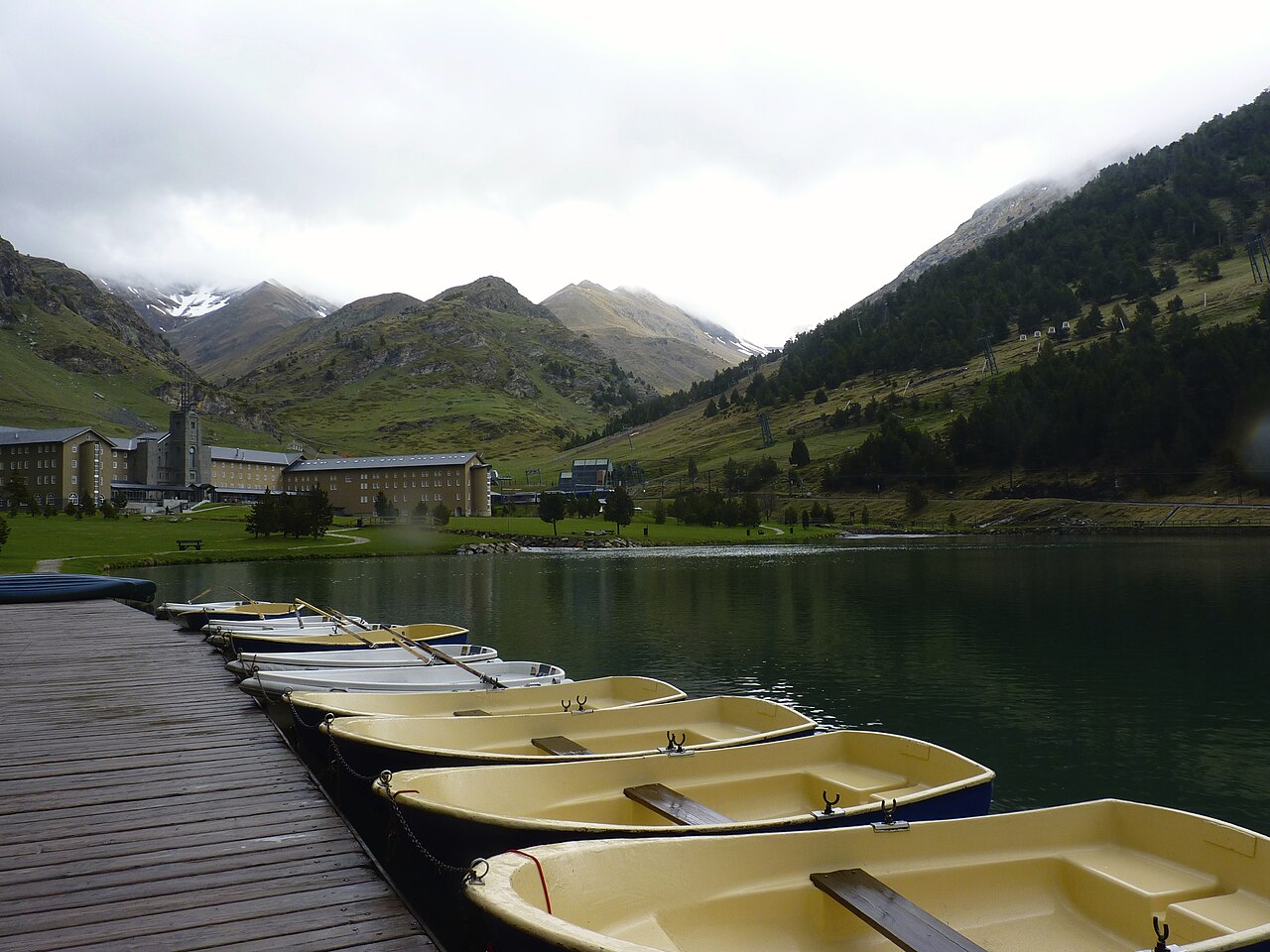
La estación de montaña con el santuario y el embalse de la Vall de Núria – By Till F. Teenck – Own work, CC BY-SA 3.0, https://commons.wikimedia.org/w/index.php?curid=3951140.
«El Santuario de la Virgen de Núria en recuerdo y agradecimiento al Papa Francisco por su encíclica sobre la ecología humana integral «Alabado seas, Mi Señor»» – By Jordi Gili – Own work, CC BY 4.0, https://commons.wikimedia.org/w/index.php?curid=154433465.
Perspectiva desde el Lago de la Vall de Núria – By Carmemolistvidal – Own work, CC BY-SA 4.0, https://commons.wikimedia.org/w/index.php?curid=122922921
Perspectiva a pie en la Vall de Núria – By Teresa Grau Ros from Barcelona, Catalunya – La vall de Núria_Queralbs_P8090091, CC BY-SA 4.0, https://commons.wikimedia.org/w/index.php?curid=177911098.
Perspectiva a pie en la Vall de Núria – By klimmanet, CC BY 3.0, https://commons.wikimedia.org/w/index.php?curid=57401465.
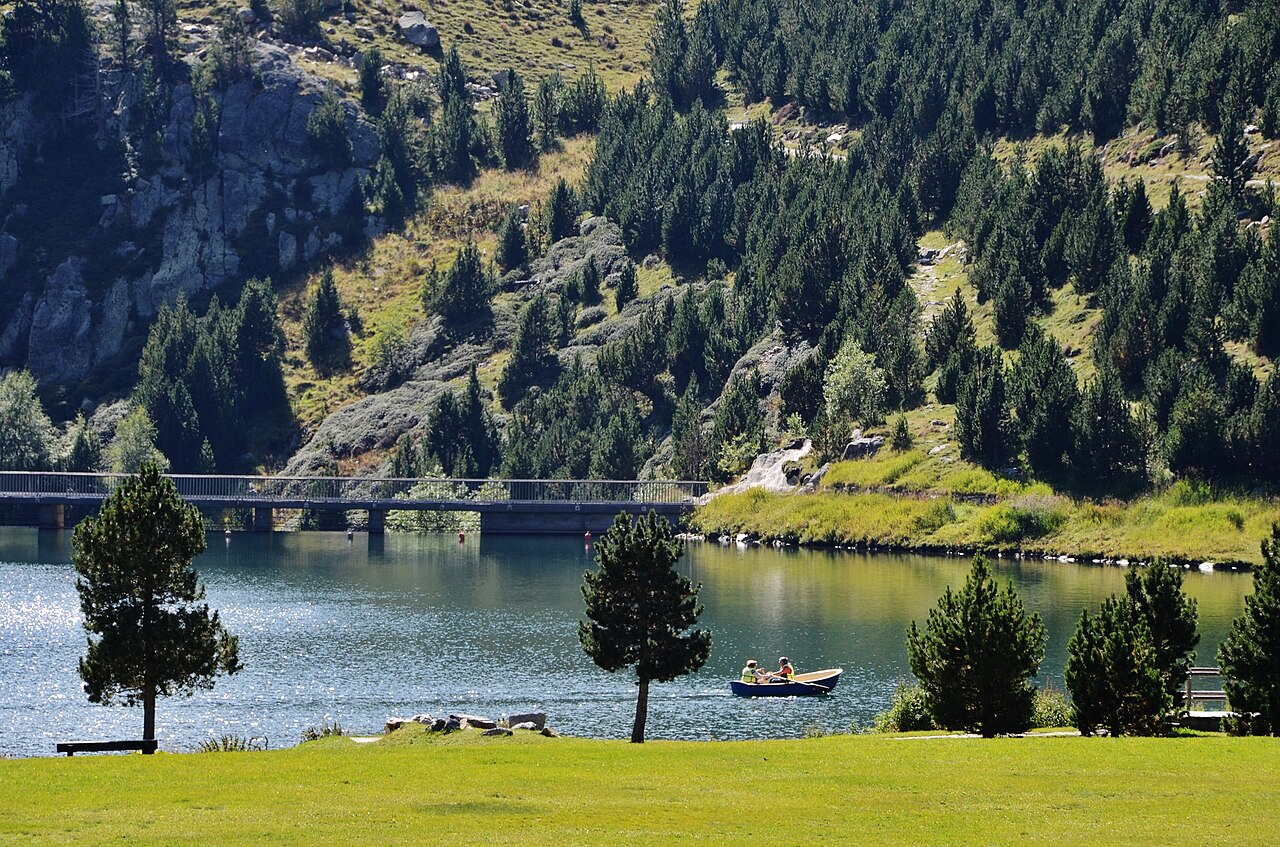
Perspectiva del Lago en la Vall de Núria – By Reimeu1 – Own work, CC BY-SA 4.0, https://commons.wikimedia.org/w/index.php?curid=73296226.
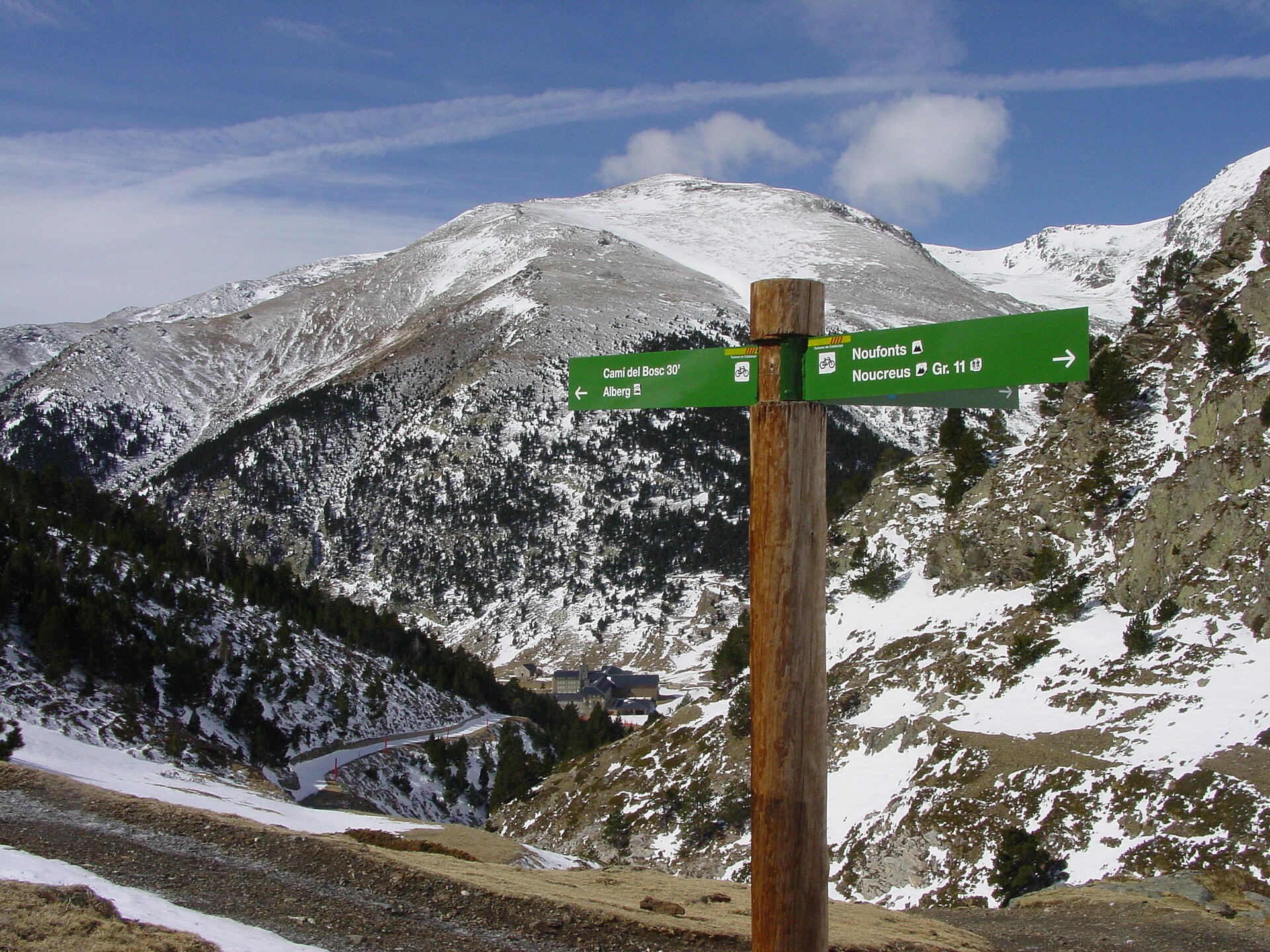
Señalización de caminos en el valle de Noucreus, cerca de Núria – By Otto Hundsdorfer – Self-photographed, CC BY-SA 2.0 de, https://commons.wikimedia.org/w/index.php?curid=7277515.
Vall de Núria – By MARIA ROSA FERRE ✿ – Flickr: Vall de Núria, CC BY-SA 2.0, https://commons.wikimedia.org/w/index.php?curid=33140718.
Perspectiva desde el Lago de la Vall de Núria – By Victor Molas – Own work, CC BY-SA 3.0, https://commons.wikimedia.org/w/index.php?curid=32682032.
La Vall de Núria – By Kent Wang – Own work, CC BY-SA 4.0, https://commons.wikimedia.org/w/index.php?curid=153621948.
Albergue Pic de l’Àliga – By Jorge Franganillo – Alberg Pic de l’Àliga, CC BY 2.0, https://commons.wikimedia.org/w/index.php?curid=121249247.
A Masterpiece of Catalan Gothic Architecture, Where History, Art and Spirituality Come Together Barcelona Cathedral, officially known as the Cathedral of the Holy Cross and Saint Eulalia, is one of the most emblematic monuments of the Catalan capital and one of the finest expressions of …
Where History Sails Towards the Mediterranean Future Port Vell is one of the oldest and most symbolic spaces in Barcelona’s relationship with the sea and remains, in 2026, one of the great places where the city meets the Mediterranean. It was Barcelona’s first major permanent …
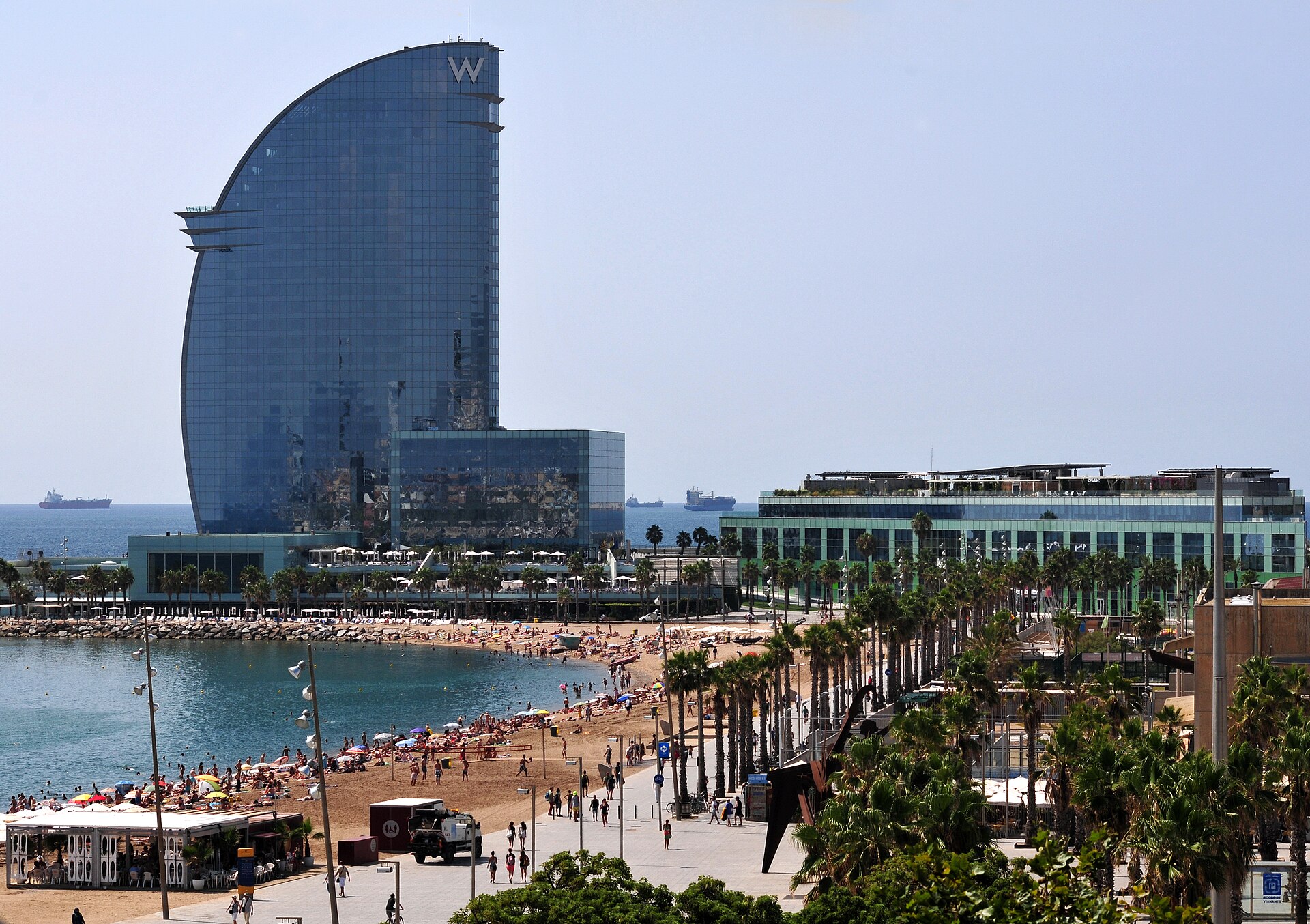
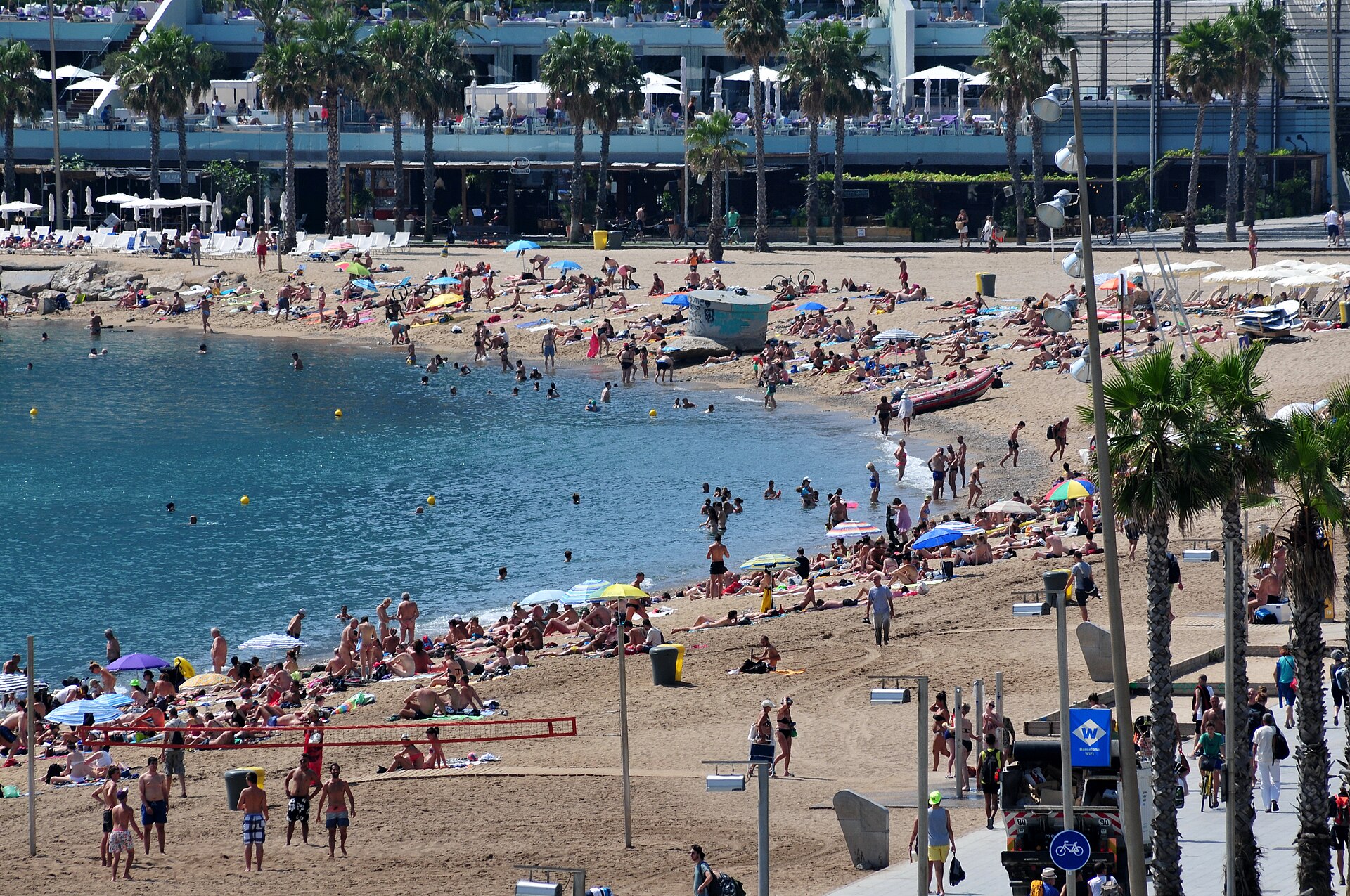
San Sebastián Beach, also known as Platja de Sant Sebastià, is one of the most traditional spots along Barcelona’s coastline. Located at the western end of Barceloneta, next to the port and at the foot of the iconic W Barcelona Hotel, it is a beach with a long-standing connection to the city’s maritime history.
Long before Barcelona became one of the Mediterranean’s major tourist destinations, this area was already a meeting point between the city and the sea. Some of the first establishments dedicated to sea bathing were developed here, and over time the beach became one of the most popular places to enjoy Barcelona’s coastline.
Today, San Sebastián combines tradition with an urban atmosphere. It offers bathing facilities, sports areas, restaurants, promenades and convenient connections with central Barcelona. Its proximity to Barceloneta also makes it easy to combine a visit to the beach with a meal, a walk through the neighborhood or a visit to Port Vell.
If you are planning to visit this beach, below you will find all the information you need.
Where is San Sebastián Beach?
San Sebastián Beach is located in the Ciutat Vella district, in the Barceloneta neighborhood, at the western end of Barcelona’s coastline.
Its official address is Passeig Marítim de la Barceloneta – Oriol Bohigas, 2.
It is the westernmost of Barcelona’s beaches and is located next to Sant Miquel Beach and Barceloneta Beach. Together, they form almost one continuous stretch of sand, making it difficult for many visitors to notice exactly where one beach ends and the next begins.
The beach is approximately 645 meters long and covers more than 32,000 m².
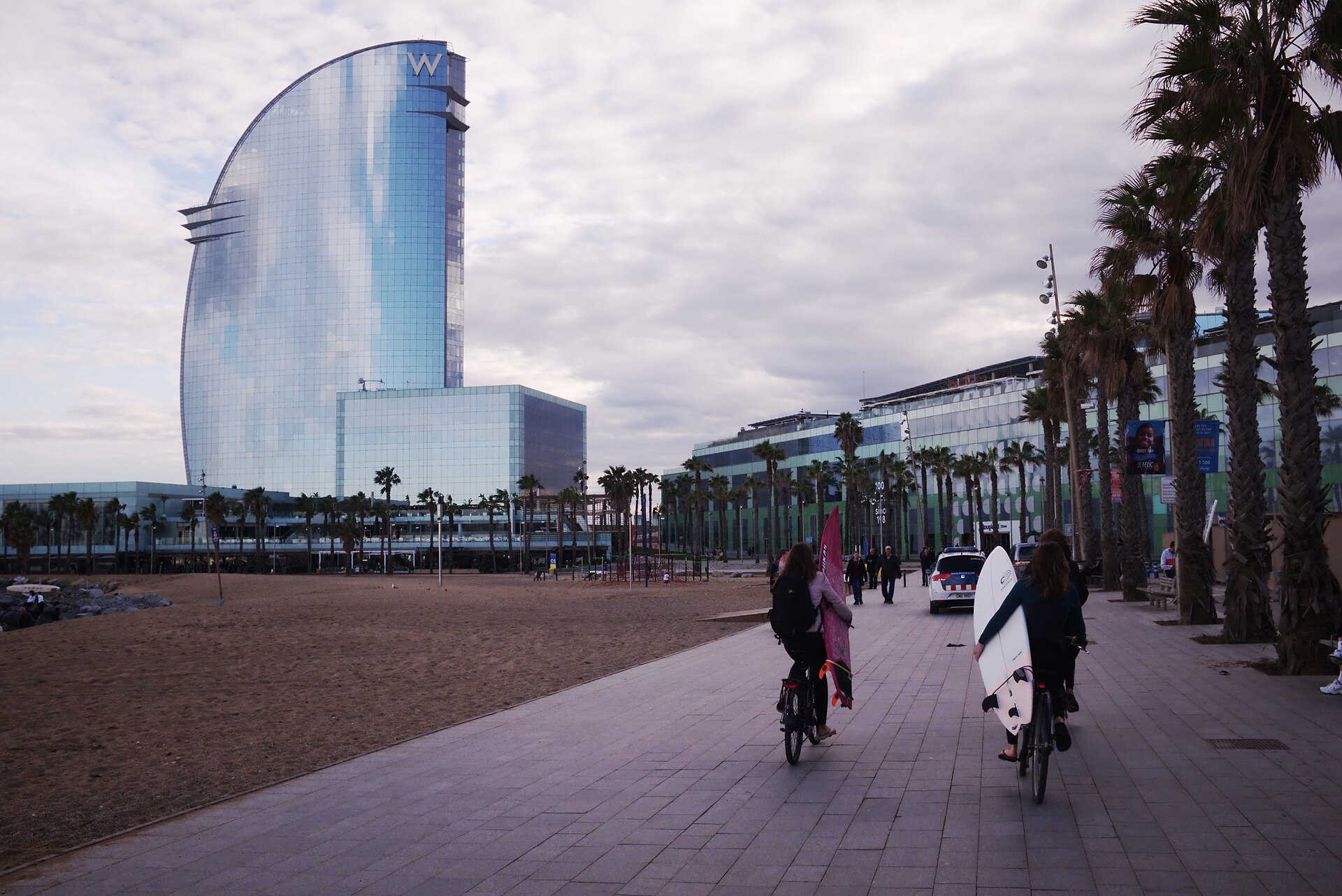
At one of its ends stands the famous W Barcelona Hotel, popularly known as the Hotel Vela because of its distinctive sail-shaped silhouette.
Its location is one of its greatest attractions: from the sand, you can enjoy views of the Mediterranean while, just a few minutes away on foot, you can reach the streets of Barceloneta, Port Vell and some of Barcelona’s main tourist attractions.
A beach with more than a century of history
Barcelona’s relationship with sea bathing began long before the city’s transformation into a major tourist destination during the 20th century.
During the 19th century, various bathing establishments began appearing along the beaches of Barceloneta. These facilities allowed Barcelona residents to get closer to the sea at a time when bathing in open waters was not yet part of everyday life for most of the population.
The bathing establishments were particularly associated with the wealthier classes and offered a combination of bathing, leisure and additional services.
Among the historic bathing establishments in Barceloneta were La Deliciosa, La Sirena, Astillero, Orientales and San Sebastián.
The history of the San Sebastián Baths reached one of its most important moments in 1928, when a large bathing complex designed by architect Antoni Millàs was inaugurated.
The building was inspired by the grand bathing establishments of the French Riviera and offered swimming pools, water slides and various leisure facilities. It also included a café-restaurant, a large ballroom and concert hall, and even a garage.
The baths played an important role in Barcelona’s leisure culture at the time and helped establish this part of the city as one of its main areas associated with the sea.
Over the decades, Barcelona’s urban development completely transformed the coastline. The major redevelopment of the waterfront that began in the 1980s restored the beaches for public use and turned the seafront into one of the city’s most important public spaces.
What is San Sebastián Beach like today?
San Sebastián is a large urban beach that is very popular with both residents and visitors.
Its character is different from that of a natural beach far from the city. Here, the Mediterranean directly meets buildings, sports facilities, restaurants, promenades and the port.
Available facilities include:
Showers and foot-washing stations.
Public toilets.
Accessible toilets.
Access ramps.
A designated bathing area.
Breakwater safety markers.
Information signage.
Lifeguard stations.
Children’s play areas.
Volleyball nets.
Benches and litter bins.
Lifeguard and rescue services.
Environmental information.
Public-address system.
Bicycle parking.
Restaurants and bars.
It is therefore a particularly convenient beach for anyone looking to have a wide range of services within easy reach.
How to get to San Sebastián Beach from central Barcelona
One of San Sebastián’s main advantages is that you do not need a car to get there.
From Plaça de Catalunya
From Plaça de Catalunya, you can head towards Via Laietana and continue in the direction of Barceloneta. From there, walk towards the seafront.
Depending on your exact starting point, the walk can take approximately 25–30 minutes.
From the Gothic Quarter
If you are in the Gothic Quarter, you can head towards Port Vell and continue along the seafront towards Barceloneta.
It is one of the most pleasant routes, particularly at sunset.
By metro
The most convenient metro station for reaching this area is Barceloneta, on Line L4.
From the station, you will need to continue on foot towards the seafront. The route is straightforward and allows you to walk through the Barceloneta neighborhood before reaching the sea.
Another option is to use public transport connections around Port Vell and continue walking.
By bicycle
Barcelona has cycle lanes and bicycle parking facilities around the beaches. San Sebastián Beach itself provides bicycle parking among its services.
For sightseeing, cycling can be particularly convenient if you also want to explore the entire waterfront afterwards.
By car
You can also reach the beach by car, although we would not recommend this option if your sole purpose is to visit the beach.
Barceloneta is a busy area and finding street parking can be difficult, particularly during the summer months.
If you need to use a car, it is preferable to use a parking facility.
Where to park near San Sebastián Beach?
One of the closest options is Saba Bamsa Barceloneta car park, located at Carrer del Baluard, 27.
It has 272 spaces, is open 24 hours a day and provides accessible parking spaces, a lift and electric vehicle charging points. The currently published rate for a car is €4.20 per hour.
Another option is BSM Hospital del Mar car park, with access from Passeig Marítim de la Barceloneta, 23–31. The currently published rate for cars is €3.90 per hour.
There are also other parking facilities around the city center and El Born.
Tip: If you are visiting Barcelona during the high season, planning or locating a parking facility in advance can save you considerable time. For a stay of several hours, public transport is usually more practical and economical than looking for parking close to the waterfront.
Are there restaurants at San Sebastián Beach?
Yes. The area has restaurants, bars and establishments located directly on the beach or just a few meters from the sand.
One of the establishments most directly associated with the beach is La Deliciosa beach bar, located at Passeig de Joan de Borbó, 81, practically on San Sebastián Beach.
Its menu includes tapas, Mediterranean cuisine and dishes designed for sharing. Some prices include:
Mediterranean gilda: €3.
Cantabrian anchovies: €6.50.
Coca bread: €4.50.
Croquettes: €12.
Calamari: €16.50.
Prawns: €15.50.
Salads: around €16.
Burgers: €18.
Desserts: approximately €6.50–8.
Cocktails: around €15.
Its current opening hours are approximately 10:00 a.m. to 10:00 p.m. every day, although it is always advisable to confirm the opening hours before visiting, particularly outside the high season.
If you are looking for a more affordable option or would prefer to move a few minutes away from the sand, Barceloneta offers a wide range of Mediterranean restaurants, tapas bars and seafood restaurants.
For example, Mesón Barceloneta, on Passeig de Joan de Borbó, offers Mediterranean cuisine and is open from Wednesday to Sunday.
You can also find options such as Mar Beach Restaurant Bar, in Plaça del Mar, which combines dining with a beach atmosphere, or Arenal Restaurante, located on Passeig Marítim.
For a more casual meal and a moderate budget, La Deliciosa allows you to eat tapas and sharing dishes. For a full meal directly by the sea, the budget can be considerably higher.
How much does it cost to eat?
As a general guide, you can expect to spend:
Budget meal: €15–25 per person.
Mediterranean meal with several dishes: €25–40 per person.
Seafront meal with drinks, starters and main courses: €35–50 or more per person.
At establishments located directly opposite the beach, the views and location can increase the price.
Are the restaurants open all year round?
The Barceloneta area remains active throughout the twelve months of the year, so you will find restaurants open outside the summer season as well.
However, it is important to distinguish between permanent restaurants in the neighborhood and seasonal beach bars or establishments located directly on the sand.
These seasonal businesses may have different opening calendars and hours depending on the time of year.
Therefore, if you visit the beach in autumn or winter, it is best to check the opening hours of your chosen establishment in advance.
Is San Sebastián Beach a nudist beach?
The answer requires a small clarification.
San Sebastián is not an exclusively nudist beach, but the area closest to the W Barcelona Hotel has traditionally been frequented by people who practice nudism.
If you prefer a conventional bathing environment, you can use the areas closer to Barceloneta.
If you practice nudism, however, you should be aware that this is an area integrated into an urban beach rather than an isolated naturist beach.
Is smoking allowed on the beach?
No.
Barcelona’s beaches are smoke-free areas, and smoking on the beach has been prohibited since July 30, 2022. The regulations provide an exception for the areas occupied by seasonal beach bars, known as guinguetes.
The measure aims particularly to reduce cigarette-butt litter and improve the environmental quality of the coastline.
Are dogs allowed?
San Sebastián Beach is not Barcelona’s designated dog-friendly beach.
The city provides a specific dog area at Llevant Beach during the period and under the conditions established by the City Council.
Therefore, if you are travelling with your pet, it is important to check the current regulations in advance and not assume that dogs can freely access Sant Sebastià.
Is the beach accessible?
Yes.
Barcelona’s beaches have various accessibility measures, and San Sebastián offers access ramps, adapted showers and accessible toilets.
The municipal network also provides reserved parking spaces and accessible routes from the parking area to the dry beach. Wooden walkways allow visitors to get closer to the water.
In addition, during the bathing season, assistance services are available for people with disabilities and diverse functional needs.
The availability of specific resources may depend on the season and service hours.
What wildlife can be found at San Sebastián Beach?
Although this is a completely urban beach, the Mediterranean waters surrounding Barcelona are home to a notable variety of marine life.
In the coastal waters, you may encounter small fish, mollusks, crustaceans and different organisms associated with the seabed.
Barcelona’s beaches have also been used for marine biodiversity monitoring and educational projects. Species have been documented at Sant Sebastià Beach through marine wildlife observation initiatives.
Coastal fish such as white seabream and mullet can be found along Barcelona’s coastline, together with small crustaceans and other invertebrates.
Jellyfish may also appear, particularly during certain periods of the year.
Their presence depends on currents, wind, temperature and Mediterranean conditions, so it is impossible to predict whether jellyfish will be present on a particular day.
If you notice a concentration of jellyfish, the safest option is to check the beach signage and follow the lifeguards’ instructions.
Water quality
The sanitary quality of Barcelona’s beach water is monitored.
Between April and September, the Barcelona Public Health Agency carries out weekly sampling of bathing water and sand at the city’s ten beaches, including Sant Sebastià.
This allows different parameters related to water quality to be monitored and possible incidents to be detected.
Water quality can change following periods of heavy rain or other circumstances, so it is always advisable to check the latest conditions before swimming.
Which flag does the beach have?
The bathing flag is not fixed throughout the year.
Its color depends on sea conditions and the safety recommendations at the time:
Green flag: swimming permitted and favorable conditions.
Yellow flag: swimming with caution.
Red flag: swimming prohibited.
For this reason, it would not be correct to state that San Sebastián permanently has a particular flag.
The best option is to check the signage displayed at the beach before entering the water.
You can also check the latest information about Barcelona’s beaches.
Does San Sebastián Beach have a Blue Flag?
This is another point where it is important not to confuse different concepts.
The Metropolitan Area of Barcelona provides information about Sant Sebastià’s services, facilities and characteristics, while Barcelona Sostenible currently indicates “Blue Flag: No” for this beach.
Therefore, San Sebastián should not be described as a Blue Flag beach without specifying the relevant year and award.
Can you visit the beach all year round?
Yes.
The beach itself, as a public space, can be enjoyed throughout the year. What changes depending on the season is the range of services available.
During the bathing season, lifeguard services, information, cleaning, showers, sun loungers, umbrellas and seasonal establishments are expanded.
Outside the summer months, the beach remains a pleasant place to walk, exercise, enjoy the sea or visit the restaurants in Barceloneta.
A sign that Sant Sebastià remains active even in winter is the traditional First Swim of the Year, organized by Club Natació Atlètic-Barceloneta every January 1. In 2026, the event celebrated its 27th edition.
What can you do near San Sebastián Beach?
A visit to Sant Sebastià can easily be combined with other iconic places in Barcelona.
Barceloneta
The old fishing neighborhood is perfect for walking through its narrow streets, discovering small shops and relaxing at one of its terraces.
Port Vell
From the beach, you can walk towards Port Vell and continue along the waterfront to Maremagnum.
Sant Sebastià Tower
Nearby is the historic tower associated with Barcelona’s former aerial transport system over the port.
The Port Cable Car departs from this area, connecting the port surroundings with Montjuïc and offering one of Barcelona’s most interesting panoramic views.
W Barcelona Hotel
The building, popularly known as the Hotel Vela, has become one of the architectural icons of Barcelona’s coastline.
Its presence visually marks one end of the beach.
Sports clubs
San Sebastián also maintains an important sporting tradition linked to the sea.
Nearby are Club Natació Atlètic-Barceloneta and Club Natació Barcelona, both of which offer sports facilities and activities related to swimming and water sports.
What is the best time to visit San Sebastián Beach?
It depends on the type of experience you are looking for.
Spring
A pleasant time for walking, having a drink on a terrace and enjoying the coastline without the heavy crowds of summer.
Summer
The ideal time if your main goal is swimming and enjoying all the beach services, although this is also the busiest season.
Autumn
The weather is often still pleasant and visitor numbers decrease. It is a good season for combining the beach with gastronomy.
Winter
Although temperatures do not always allow for swimming, the beach remains an excellent place to walk beside the Mediterranean, take photographs and discover Barceloneta from a different perspective.
San Sebastián Beach: Barcelona’s Most Historic Mediterranean Shore
San Sebastián Beach represents one of the oldest connections between Barcelona and the Mediterranean.
This is where sea bathing began to become popular, where some of the city’s great bathing establishments were built, and where much of the maritime and sporting tradition that still characterizes Barceloneta developed.
Today, more than a century later, the setting is very different, but the essence remains.
The sea is still the main attraction, now accompanied by the seafront promenade, sports clubs, restaurants, the W Barcelona Hotel and the everyday life of one of Barcelona’s best-known neighborhoods.
For this reason, Sant Sebastià is more than just an urban beach. It is a place where Barcelona’s maritime history, Barceloneta’s local life and the Mediterranean come together.
A visit can begin with a swim, continue with a walk through the old fishing neighborhood and end with a Mediterranean meal overlooking the sea.
Playa de San Sebastián – By Ralf Roletschek – Own work, GFDL 1.2, https://commons.wikimedia.org/w/index.php?curid=34883111.
Playa de San Sebastián – By Nicolas Vigier from Spain – Barcelona, CC0, https://commons.wikimedia.org/w/index.php?curid=132065451.
La Casa Batlló es una de las obras maestras de Antoni Gaudí y uno de los edificios más famosos de Barcelona. Situada en pleno Passeig de Gràcia, en el corazón del Eixample, esta extraordinaria construcción es uno de los grandes referentes del modernismo catalán y …
The Spiritual Vision of Antoni Gaudí, Presented by Magic Dreams Barcelona Discover the Basilica of the Expiatory Temple of the Sagrada Família, the architectural soul of Barcelona and the most significant work of the Modernist genius Antoni Gaudí. More than a monument, this temple is …
Some places surprise you with their landscapes, others with their history, and some because of the unique circumstances that make them truly exceptional destinations. Llívia combines all three.
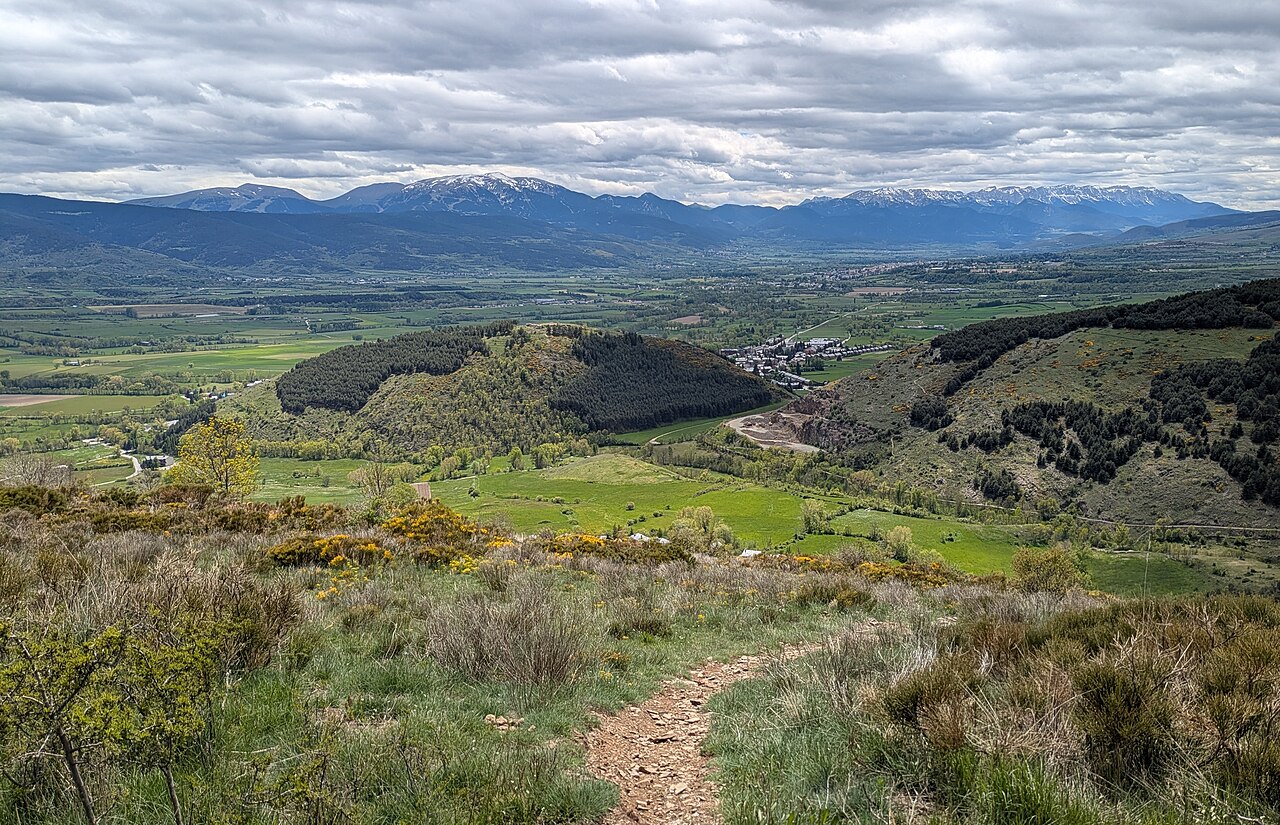
Located in the heart of Cerdanya, at an altitude of around 1,224 metres, Llívia is a Catalan village completely surrounded by French territory. Its unusual geographical situation makes it one of the most fascinating enclaves in the Pyrenees and an ideal destination for those wishing to discover history, architecture, nature, gastronomy and traditions all in one journey.
A Catalan Village Surrounded by France
Llívia’s history is closely connected to the Treaty of the Pyrenees of 1659. Following the agreement, it was established that certain territories in Cerdanya would become part of France. However, Llívia was excluded from the transfer because it held the title of town, granted in 1528 by Emperor Charles I.
The subsequent Treaty of Llívia, signed on 12 November 1660, confirmed this situation and gave rise to the unique enclave we know today: a Catalan town geographically separated from the rest of Catalonia and surrounded by French territory.
This historical circumstance has profoundly shaped Llívia’s identity. For centuries, its inhabitants have maintained social, economic and cultural relationships with communities on both sides of the border.
Today, this geographical peculiarity should not be understood merely as a curiosity. It is also an opportunity to understand how political borders can coexist with a deeply rooted culture, language, traditions and way of life.
Llívia and Ancient Iulia Libica
Long before becoming a border enclave, Llívia was already of considerable strategic importance.
The town is associated with Iulia Libica, a Roman settlement linked to Cerdanya. The Roman presence left important archaeological remains and represents one of the key periods in understanding the history of the town.
The location chosen for the settlement was no coincidence. From Llívia, much of the Cerdanya plain could be surveyed, making it a strategic location throughout different historical periods.
Today, walking through its streets means travelling through a landscape where different historical layers overlap: Roman, medieval, modern and contemporary.
Llívia Castle: History on the Mountain
One of the town’s great landmarks is Llívia Castle, located on Puig del Castell.
The hill was occupied from very ancient times, and there are indications of a Roman presence. The first documentary reference to the castle dates back to the year 672, when it was mentioned as Castrum Libyae. The fortress subsequently became highly important during the Middle Ages.
The castle was rebuilt and strengthened during medieval times, becoming a strategically significant stronghold. During the Catalan Civil War, it endured a long siege and was eventually conquered in 1479, after which its destruction was ordered.
Today, visitors can explore the restored remains and enjoy magnificent panoramic views of Cerdanya and the surrounding Pyrenean mountains from the top.
Depending on visibility conditions, some of the area’s major peaks can be seen from here, including Puigmal, Tosa d’Alp, Moixeró, Cadí, Puigpedrós and Carlit.
The Church of Mare de Déu dels Àngels
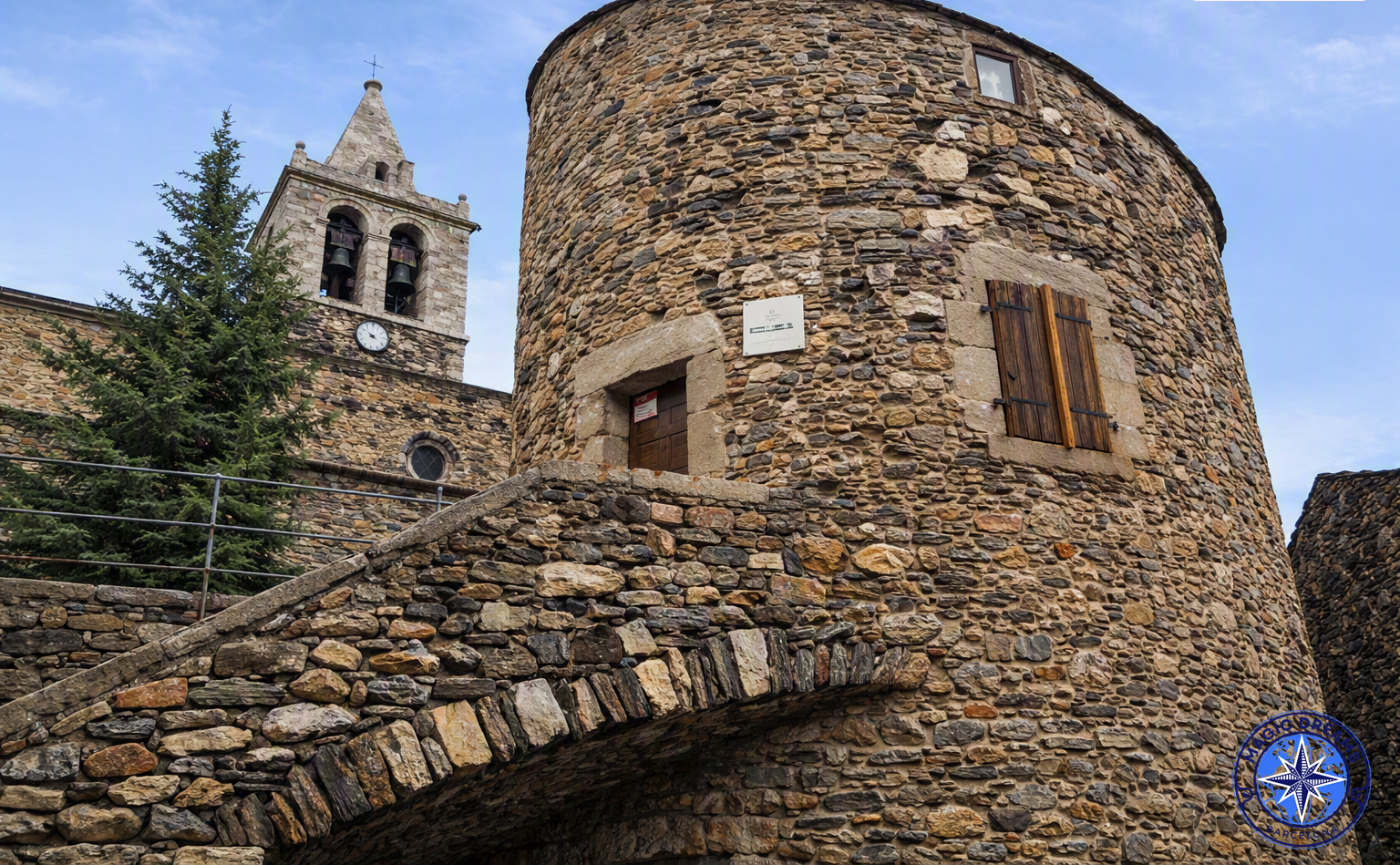
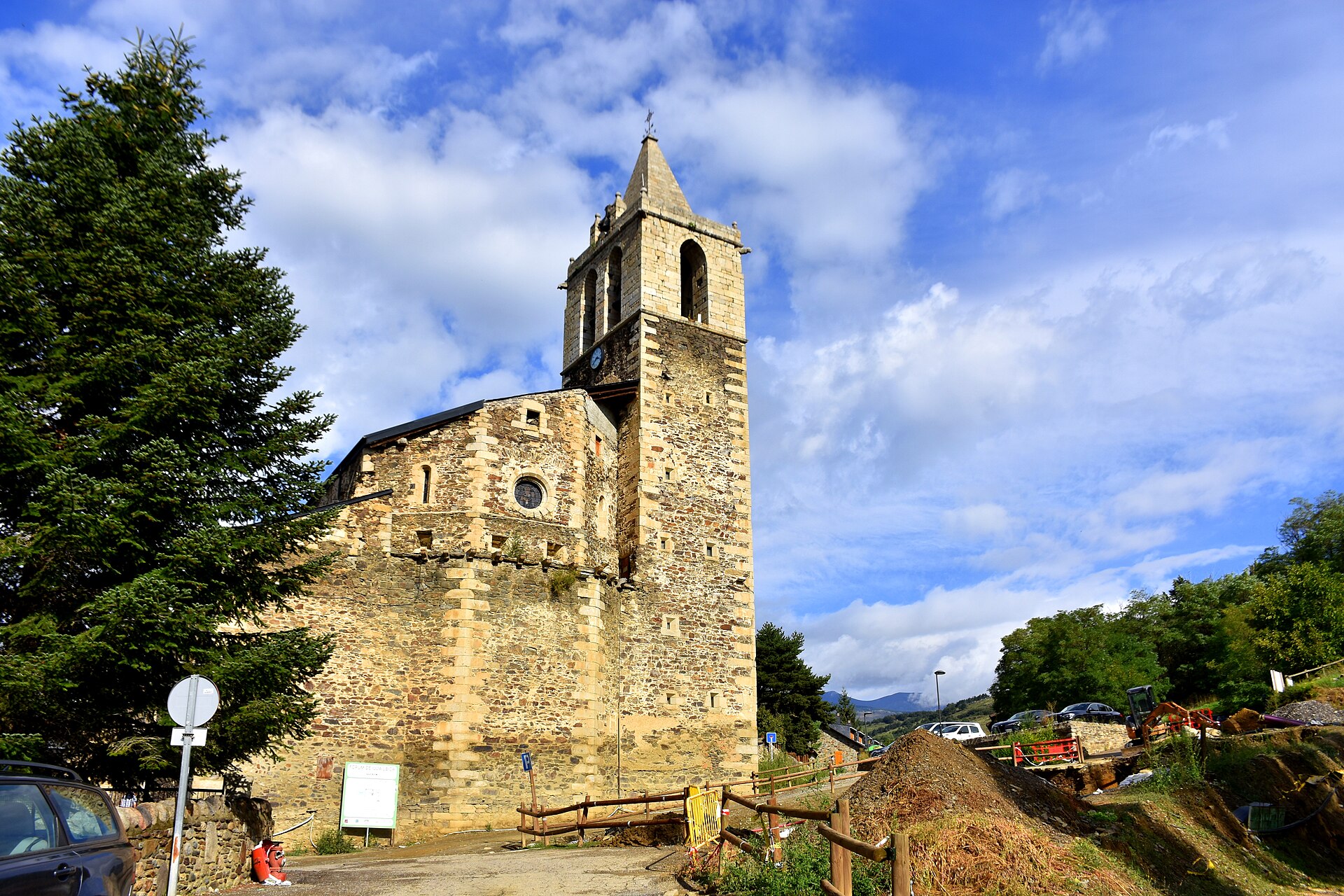
In the historic centre stands the Church of Mare de Déu dels Àngels, one of the buildings that best represents Llívia.
The present church was completed in 1617 and has a solid, almost fortified appearance, reflecting the strategic character of the town during different periods of its history.
Its interior contains several elements of artistic and historical interest, including a Renaissance doorway, medieval ironwork, a Baroque altarpiece, a baptismal font and funerary stones from different centuries. A particularly notable feature is a polychrome Christ dating from the transition between the Romanesque and Gothic periods.
Bernat de So Tower
Another essential architectural landmark is the Bernat de So Tower.
The present tower was built between 1584 and 1585 and was associated with the defensive needs of the town. It subsequently served various purposes and was used as a prison from 1834 onwards.
Over time, the building acquired a new role and today forms part of Llívia’s historical and cultural heritage.
Its presence is a reminder that Llívia was not simply a place of passage, but a community that for centuries had to protect its territory and strategic position.
Strolling Through the Old Town
One of the best ways to discover Llívia is simply to walk through its streets.
The historic centre preserves characteristic elements of traditional Cerdanya architecture: stone façades, slate roofs, granite doorways and wooden balconies and features.
The lintels of many houses also reveal part of the history of the families who once lived there. Some date from the 17th, 18th and 19th centuries and reflect the social and economic position of their former owners.
Farmàcia Esteva: A Treasure in the History of Medicine
One of Llívia’s most remarkable attractions is the Municipal Museum, located in the Town Hall building.
Its best-known collection is the Farmàcia Esteva, considered one of Europe’s oldest preserved pharmacies open to the public, with origins dating back to the beginning of the 17th century.
The collection preserves furniture, containers, instruments and various objects related to the history of pharmacy. The museum also offers an insight into local history, archaeology, ethnology and botany.
Life Between Two Territories
Llívia’s unique geographical situation has created a close relationship over the centuries with the communities of French Cerdanya.
Families in the area have historically maintained commercial, educational, family and social ties on both sides of the border. This reality remains visible today.
Children in Llívia can attend school locally within the Catalan education system, while relations with nearby French communities form a natural part of everyday life.
The Escola Jaume I provides education from the age of three through the sixth year of primary school and, among other activities, offers French and English language learning together with various cultural and educational initiatives.
In terms of employment and economic activity, Llívia currently combines tourism, hospitality, commerce, services, agriculture and livestock farming. Its proximity to communities on both sides of the border also facilitates a cross-border economic dynamic that forms part of everyday life in Cerdanya.
However, working on one side or the other of the border involves different tax, employment and social security obligations, meaning that each situation depends on the individual circumstances of the worker.
Nature: Mountains, Forests and Meadows
Llívia is surrounded by an exceptional natural environment.
Cerdanya combines a broad plain situated at around 1,200 metres above sea level with mountains, forests, rivers, meadows and high-mountain landscapes. This setting provides opportunities for excursions throughout almost the entire year.
The Pyrenean forests around Llívia include different pine species as well as areas of deciduous vegetation, while open landscapes are home to meadows and a wide variety of mountain flora.
For nature lovers, the area also offers countless opportunities for hiking, photography, wildlife watching and outdoor activities.
A Paradise for Birdwatching
Cerdanya is also a particularly interesting destination for birdwatching.
Around 220 bird species have been recorded in the region, including resident, summer, migratory and high-mountain species. Among them are ducks, booted eagles, yellow wagtails, rock thrushes and other species associated with different habitats.
In the nearby mountain and forest areas, it is also possible to encounter species such as the wallcreeper, rock ptarmigan, black woodpecker, boreal owl and capercaillie, although sightings depend on the season, habitat and terrain conditions.
For nature photographers, Llívia and Cerdanya offer an extraordinary setting: mountains, open skies, forests, meadows and wildlife that changes with the seasons.
Mountain Wildlife
The surrounding Pyrenean environment is also home to a fascinating variety of mammals.
In the mountain areas of Cerdanya and nearby natural spaces, visitors may encounter chamois, deer, roe deer, wild boar, marmots and other animals adapted to the area’s diverse landscapes and vegetation.
Observing wild animals always requires respect for the environment. Keeping a safe distance, remaining quiet and being patient are essential to avoid disturbing their natural behaviour.
Mountain Gastronomy
After walking, exploring and discovering the region, one of the great pleasures of visiting Llívia is undoubtedly its gastronomy.
Cerdanya’s cuisine is deeply connected to the mountains and to the products traditionally available in the region.
Potatoes, cabbage, meats, cured sausages, cheeses, mushrooms and hearty stews form part of a robust and comforting cuisine, particularly appealing during the colder months.
One of the region’s most representative dishes is trinxat de Cerdanya, traditionally prepared with potatoes, cabbage and bacon or crispy pork. It is a simple recipe, yet one that is deeply connected to the gastronomic identity of the region.
Other traditional dishes include escudella, mountain stews, meats and various preparations using local products.
Festivals and Traditions
Llívia maintains a calendar of celebrations that offers an insight into an important part of the town’s local identity.
Among them is Pasqüetes, Llívia’s main spring festival, which welcomes the arrival of spring with activities for all ages, an artisan fair, games, workshops, gastronomic events, music and traditional sardana dancing.
The festival of Sant Guillem, the town’s patron saint, is held during the third weekend of June and includes religious celebrations, a procession to the hermitage and sardanas.
Another particularly interesting tradition is the Transhumance Festival, revived in 2000. During the celebration, livestock is accompanied towards the mountain pastures, reviving a traditional practice closely associated with livestock farming and Pyrenean life.
On 15 August, activities connected with local flora are also held, including the creation of floral arrangements and botanical photography competitions.
Music also plays an important role thanks to the Cerdanya Music Festival, whose connection with Llívia dates back to 1982.
How to Get to Llívia from Barcelona
From Barcelona, the journey to Llívia is approximately 155–160 kilometres by road and can take around two hours, although actual travel time can vary considerably depending on traffic, weather conditions and congestion around the Cadí Tunnel.
One of the usual routes is to leave Barcelona via the C-16, travel through the Cadí Tunnel and continue towards Cerdanya. From Puigcerdà, travellers then take the N-154 to reach Llívia.
The road connecting Puigcerdà with Llívia is approximately seven kilometres long and crosses French territory before reaching the enclave.
For an organised excursion, particularly in winter or during weekends and holiday periods, it is advisable to plan the journey in advance.
What to Visit Around Llívia
One of the advantages of choosing Llívia as a destination is that it can easily be combined with other places of great interest in Cerdanya and the Pyrenees.
Depending on the time available, you can extend your experience by visiting:
Puigcerdà, with its historic centre, lake and lively commercial atmosphere.
Bourg-Madame, a French town located practically next to Puigcerdà.
Font-Romeu, known for its mountain surroundings and outdoor activities.
Mont-Louis, a fortified town of great historical interest.
Les Angles, particularly attractive for mountain activities.
Les Bulloses and the Carlit area, offering some of the most spectacular natural landscapes in the region.
In this way, a visit to Llívia can easily become a much broader experience across Cerdanya and the Pyrenees.
Llívia: A Destination to Discover at Your Own Pace
Llívia is not a destination that should be visited simply to take a photograph beside a sign or to experience a geographical curiosity.
Its true appeal emerges when you walk through its streets, admire its architecture, discover its history, visit its historic pharmacy, climb to the castle, take in the landscape and enjoy the local cuisine.
It is precisely this combination of history, culture, nature and everyday life that makes Llívia such a special destination.
Here, the border ceases to be merely a line on a map and becomes part of the history of a community that has managed to preserve its identity for centuries.
Discover Llívia with Magic Dreams Barcelona
Discovering Llívia can be much more than simply taking a day trip.
It can become an experience in which you disconnect, breathe, learn, discover, share and enjoy one of the most special corners of Catalonia and the Pyrenees.
At Magic Dreams Barcelona, we take care of every detail so that you do not have to worry about anything.
We design private and personalised experiences so that you can discover Llívia, Cerdanya, its villages, history, gastronomy and landscapes in a truly special way, adapting each experience to your preferences, interests and desired pace.
We take care of the organisation, transportation, visits, gastronomic experiences, activities, the small details and everything else that can make your journey genuinely memorable.
Because we want you to forget about the organisation and concentrate on what really matters:
enjoying, discovering and being happy.
For us, travelling is not simply about arriving at a destination.
It is about how a place is experienced, what you feel, what you discover and which memories remain long after you return home.
Let us show you Llívia in a different, thoughtful and personalised way.
Magic Dreams Barcelona
Unique experiences to discover extraordinary places, enjoy nature, explore our culture and create memories that last a lifetime.
Torre de Bernat de So de Llívia.
Por Bernard-Boehne, CC BY-SA 3.0, https://commons.wikimedia.org/w/index.php?curid=23423.
Marmota alpina – Fauna del entorno – Por François Trazzi. – François Trazzi., CC BY-SA 3.0, https://commons.wikimedia.org/w/index.php?curid=178597.
Perspectiva general de Llívia desde el Turó del Castell – Marcbel, Public domain, via Wikimedia Commons.
Museo Municipal (Farmacia antigua) – By Marcbel – Own work, Public Domain, https://commons.wikimedia.org/w/index.php?curid=7586288.
Detalle interior del Museo Farmacia Esteva – Alberto-g-rovi, CC BY 3.0 , via Wikimedia Commons.
Detalle interior del Retablo Mayor de la Iglesia de la Mare de Déu dels Àngels en Llívia,
Perspectiva exterior de la Iglesia de la Mare de Déu dels Àngels en Llívia – By Angela Llop – https://www.flickr.com/photos/angela_llop/52335262067/, CC BY-SA 2.0, https://commons.wikimedia.org/w/index.php?curid=122911019.
Águila Real, fauna del entorno – Juan Lacruz, CC BY 3.0 , via Wikimedia Commons.
Perspectiva de la distancia entre Llívia y Puigcerdà – https://en.wikipedia.org/wiki/User:Alan_Mattingly.
Situado en el corazón de Barcelona, junto a la Avinguda de Gaudí y a pocos minutos de la Sagrada Família, este extraordinario conjunto arquitectónico fue concebido como un hospital, pero también como una auténtica ciudad dentro de la ciudad. Pabellones de ladrillo visto, mosaicos, cerámica, …