San Sebastián Beach: Barcelona’s Most Historic Corner of Barceloneta.
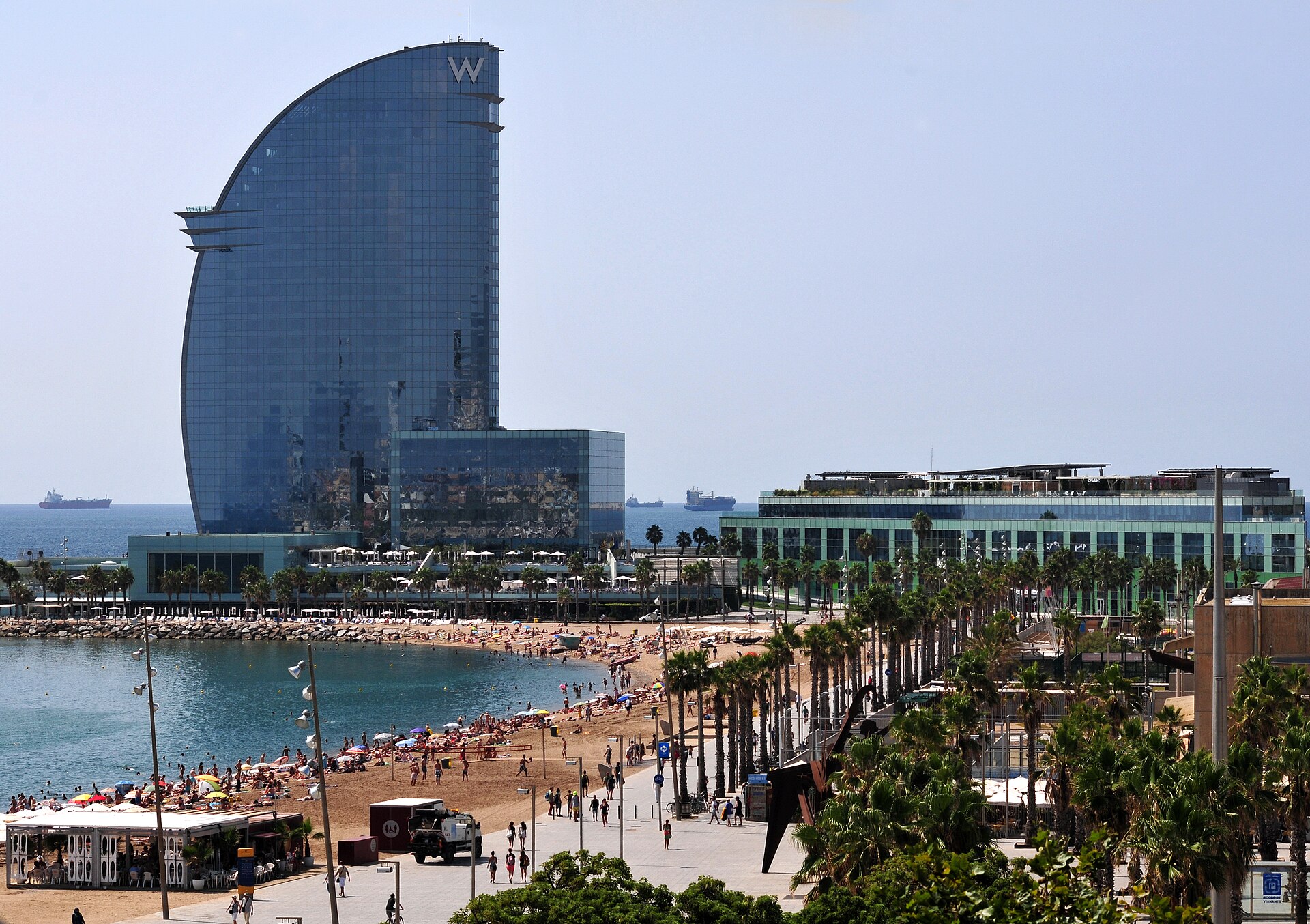
San Sebastián Beach, also known as Platja de Sant Sebastià, is one of the most traditional spots along Barcelona’s coastline. Located at the western end of Barceloneta, next to the port and at the foot of the iconic W Barcelona Hotel, it is a beach with a long-standing connection to the city’s maritime history.
Long before Barcelona became one of the Mediterranean’s major tourist destinations, this area was already a meeting point between the city and the sea. Some of the first establishments dedicated to sea bathing were developed here, and over time the beach became one of the most popular places to enjoy Barcelona’s coastline.
Today, San Sebastián combines tradition with an urban atmosphere. It offers bathing facilities, sports areas, restaurants, promenades and convenient connections with central Barcelona. Its proximity to Barceloneta also makes it easy to combine a visit to the beach with a meal, a walk through the neighborhood or a visit to Port Vell.
If you are planning to visit this beach, below you will find all the information you need.
Where is San Sebastián Beach?
San Sebastián Beach is located in the Ciutat Vella district, in the Barceloneta neighborhood, at the western end of Barcelona’s coastline.
Its official address is Passeig Marítim de la Barceloneta – Oriol Bohigas, 2.
It is the westernmost of Barcelona’s beaches and is located next to Sant Miquel Beach and Barceloneta Beach. Together, they form almost one continuous stretch of sand, making it difficult for many visitors to notice exactly where one beach ends and the next begins.
The beach is approximately 645 meters long and covers more than 32,000 m².
At one of its ends stands the famous W Barcelona Hotel, popularly known as the Hotel Vela because of its distinctive sail-shaped silhouette.
Its location is one of its greatest attractions: from the sand, you can enjoy views of the Mediterranean while, just a few minutes away on foot, you can reach the streets of Barceloneta, Port Vell and some of Barcelona’s main tourist attractions.
A beach with more than a century of history
Barcelona’s relationship with sea bathing began long before the city’s transformation into a major tourist destination during the 20th century.
During the 19th century, various bathing establishments began appearing along the beaches of Barceloneta. These facilities allowed Barcelona residents to get closer to the sea at a time when bathing in open waters was not yet part of everyday life for most of the population.
The bathing establishments were particularly associated with the wealthier classes and offered a combination of bathing, leisure and additional services.
Among the historic bathing establishments in Barceloneta were La Deliciosa, La Sirena, Astillero, Orientales and San Sebastián.
The history of the San Sebastián Baths reached one of its most important moments in 1928, when a large bathing complex designed by architect Antoni Millàs was inaugurated.
The building was inspired by the grand bathing establishments of the French Riviera and offered swimming pools, water slides and various leisure facilities. It also included a café-restaurant, a large ballroom and concert hall, and even a garage.
The baths played an important role in Barcelona’s leisure culture at the time and helped establish this part of the city as one of its main areas associated with the sea.
Over the decades, Barcelona’s urban development completely transformed the coastline. The major redevelopment of the waterfront that began in the 1980s restored the beaches for public use and turned the seafront into one of the city’s most important public spaces.
What is San Sebastián Beach like today?
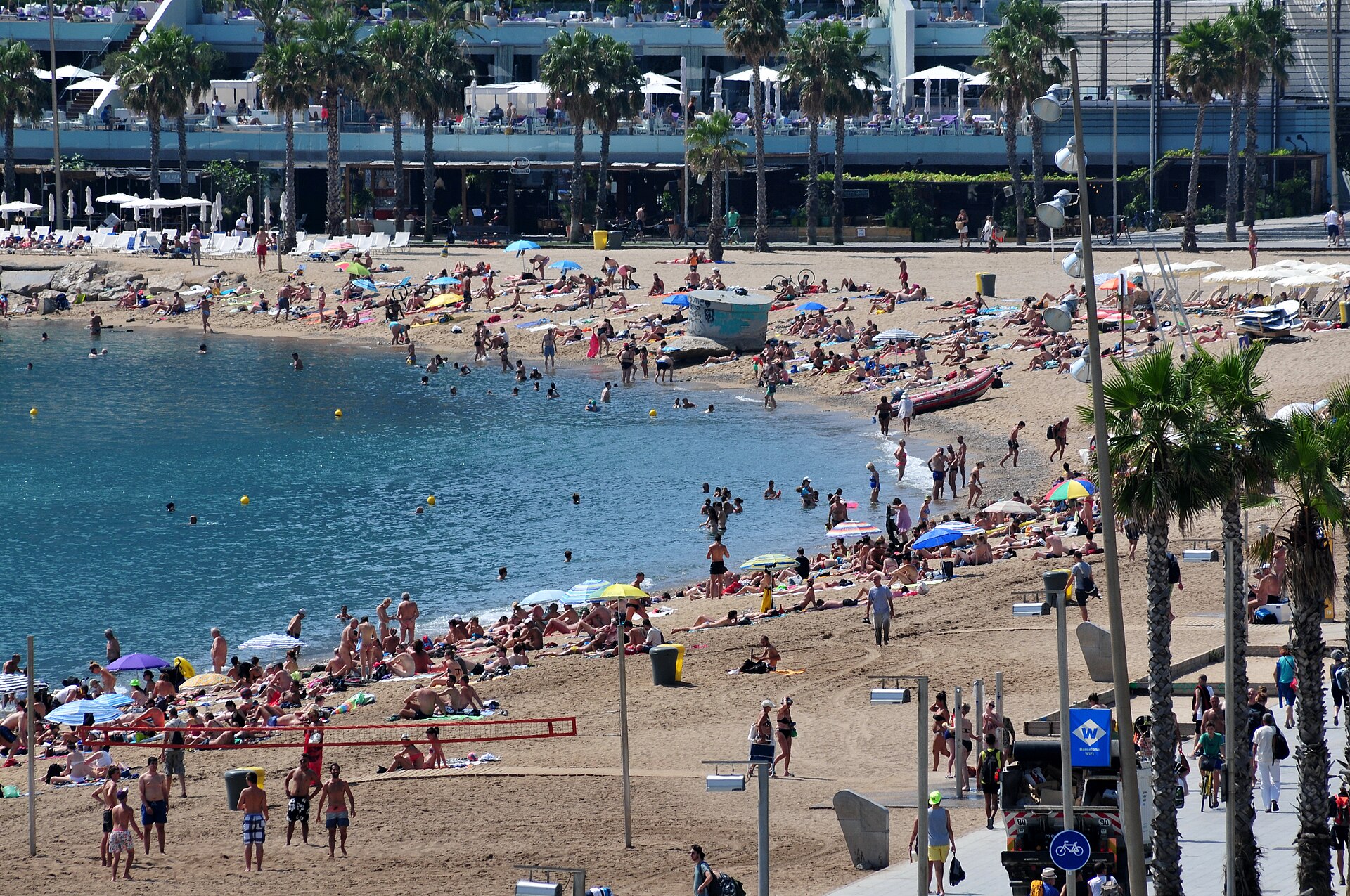
San Sebastián is a large urban beach that is very popular with both residents and visitors.
Its character is different from that of a natural beach far from the city. Here, the Mediterranean directly meets buildings, sports facilities, restaurants, promenades and the port.
Available facilities include:
- Showers and foot-washing stations.
- Public toilets.
- Accessible toilets.
- Access ramps.
- A designated bathing area.
- Breakwater safety markers.
- Information signage.
- Lifeguard stations.
- Children’s play areas.
- Volleyball nets.
- Benches and litter bins.
- Lifeguard and rescue services.
- Environmental information.
- Public-address system.
- Bicycle parking.
- Restaurants and bars.
It is therefore a particularly convenient beach for anyone looking to have a wide range of services within easy reach.
How to get to San Sebastián Beach from central Barcelona
One of San Sebastián’s main advantages is that you do not need a car to get there.
From Plaça de Catalunya
From Plaça de Catalunya, you can head towards Via Laietana and continue in the direction of Barceloneta. From there, walk towards the seafront.
Depending on your exact starting point, the walk can take approximately 25–30 minutes.
From the Gothic Quarter
If you are in the Gothic Quarter, you can head towards Port Vell and continue along the seafront towards Barceloneta.
It is one of the most pleasant routes, particularly at sunset.
By metro
The most convenient metro station for reaching this area is Barceloneta, on Line L4.
From the station, you will need to continue on foot towards the seafront. The route is straightforward and allows you to walk through the Barceloneta neighborhood before reaching the sea.
Another option is to use public transport connections around Port Vell and continue walking.
By bicycle
Barcelona has cycle lanes and bicycle parking facilities around the beaches. San Sebastián Beach itself provides bicycle parking among its services.
For sightseeing, cycling can be particularly convenient if you also want to explore the entire waterfront afterwards.
By car
You can also reach the beach by car, although we would not recommend this option if your sole purpose is to visit the beach.
Barceloneta is a busy area and finding street parking can be difficult, particularly during the summer months.
If you need to use a car, it is preferable to use a parking facility.
Where to park near San Sebastián Beach?
One of the closest options is Saba Bamsa Barceloneta car park, located at Carrer del Baluard, 27.
It has 272 spaces, is open 24 hours a day and provides accessible parking spaces, a lift and electric vehicle charging points. The currently published rate for a car is €4.20 per hour.
Another option is BSM Hospital del Mar car park, with access from Passeig Marítim de la Barceloneta, 23–31. The currently published rate for cars is €3.90 per hour.
There are also other parking facilities around the city center and El Born.
Tip: If you are visiting Barcelona during the high season, planning or locating a parking facility in advance can save you considerable time. For a stay of several hours, public transport is usually more practical and economical than looking for parking close to the waterfront.
Are there restaurants at San Sebastián Beach?
Yes. The area has restaurants, bars and establishments located directly on the beach or just a few meters from the sand.
One of the establishments most directly associated with the beach is La Deliciosa beach bar, located at Passeig de Joan de Borbó, 81, practically on San Sebastián Beach.
Its menu includes tapas, Mediterranean cuisine and dishes designed for sharing. Some prices include:
- Mediterranean gilda: €3.
- Cantabrian anchovies: €6.50.
- Coca bread: €4.50.
- Croquettes: €12.
- Calamari: €16.50.
- Prawns: €15.50.
- Salads: around €16.
- Burgers: €18.
- Desserts: approximately €6.50–8.
- Cocktails: around €15.
Its current opening hours are approximately 10:00 a.m. to 10:00 p.m. every day, although it is always advisable to confirm the opening hours before visiting, particularly outside the high season.
https://www.panteabeach.com/en/la-deliciosa/
If you are looking for a more affordable option or would prefer to move a few minutes away from the sand, Barceloneta offers a wide range of Mediterranean restaurants, tapas bars and seafood restaurants.
For example, Mesón Barceloneta, on Passeig de Joan de Borbó, offers Mediterranean cuisine and is open from Wednesday to Sunday.
You can also find options such as Mar Beach Restaurant Bar, in Plaça del Mar, which combines dining with a beach atmosphere, or Arenal Restaurante, located on Passeig Marítim.
For a more casual meal and a moderate budget, La Deliciosa allows you to eat tapas and sharing dishes. For a full meal directly by the sea, the budget can be considerably higher.
How much does it cost to eat?
As a general guide, you can expect to spend:
- Budget meal: €15–25 per person.
- Mediterranean meal with several dishes: €25–40 per person.
- Seafront meal with drinks, starters and main courses: €35–50 or more per person.
At establishments located directly opposite the beach, the views and location can increase the price.
Are the restaurants open all year round?
The Barceloneta area remains active throughout the twelve months of the year, so you will find restaurants open outside the summer season as well.
However, it is important to distinguish between permanent restaurants in the neighborhood and seasonal beach bars or establishments located directly on the sand.
These seasonal businesses may have different opening calendars and hours depending on the time of year.
Therefore, if you visit the beach in autumn or winter, it is best to check the opening hours of your chosen establishment in advance.
Is San Sebastián Beach a nudist beach?
The answer requires a small clarification.
San Sebastián is not an exclusively nudist beach, but the area closest to the W Barcelona Hotel has traditionally been frequented by people who practice nudism.
If you prefer a conventional bathing environment, you can use the areas closer to Barceloneta.
If you practice nudism, however, you should be aware that this is an area integrated into an urban beach rather than an isolated naturist beach.
Is smoking allowed on the beach?
No.
Barcelona’s beaches are smoke-free areas, and smoking on the beach has been prohibited since July 30, 2022. The regulations provide an exception for the areas occupied by seasonal beach bars, known as guinguetes.
The measure aims particularly to reduce cigarette-butt litter and improve the environmental quality of the coastline.
Are dogs allowed?
San Sebastián Beach is not Barcelona’s designated dog-friendly beach.
The city provides a specific dog area at Llevant Beach during the period and under the conditions established by the City Council.
Therefore, if you are travelling with your pet, it is important to check the current regulations in advance and not assume that dogs can freely access Sant Sebastià.
Is the beach accessible?
Yes.
Barcelona’s beaches have various accessibility measures, and San Sebastián offers access ramps, adapted showers and accessible toilets.
The municipal network also provides reserved parking spaces and accessible routes from the parking area to the dry beach. Wooden walkways allow visitors to get closer to the water.
In addition, during the bathing season, assistance services are available for people with disabilities and diverse functional needs.
The availability of specific resources may depend on the season and service hours.
What wildlife can be found at San Sebastián Beach?
Although this is a completely urban beach, the Mediterranean waters surrounding Barcelona are home to a notable variety of marine life.
In the coastal waters, you may encounter small fish, mollusks, crustaceans and different organisms associated with the seabed.
Barcelona’s beaches have also been used for marine biodiversity monitoring and educational projects. Species have been documented at Sant Sebastià Beach through marine wildlife observation initiatives.
Coastal fish such as white seabream and mullet can be found along Barcelona’s coastline, together with small crustaceans and other invertebrates.
Jellyfish may also appear, particularly during certain periods of the year.
Their presence depends on currents, wind, temperature and Mediterranean conditions, so it is impossible to predict whether jellyfish will be present on a particular day.
If you notice a concentration of jellyfish, the safest option is to check the beach signage and follow the lifeguards’ instructions.
Water quality
The sanitary quality of Barcelona’s beach water is monitored.
Between April and September, the Barcelona Public Health Agency carries out weekly sampling of bathing water and sand at the city’s ten beaches, including Sant Sebastià.
This allows different parameters related to water quality to be monitored and possible incidents to be detected.
Water quality can change following periods of heavy rain or other circumstances, so it is always advisable to check the latest conditions before swimming.
Which flag does the beach have?
The bathing flag is not fixed throughout the year.
Its color depends on sea conditions and the safety recommendations at the time:
- Green flag: swimming permitted and favorable conditions.
- Yellow flag: swimming with caution.
- Red flag: swimming prohibited.
For this reason, it would not be correct to state that San Sebastián permanently has a particular flag.
The best option is to check the signage displayed at the beach before entering the water.
You can also check the latest information about Barcelona’s beaches.
Does San Sebastián Beach have a Blue Flag?
This is another point where it is important not to confuse different concepts.
The Metropolitan Area of Barcelona provides information about Sant Sebastià’s services, facilities and characteristics, while Barcelona Sostenible currently indicates “Blue Flag: No” for this beach.
Therefore, San Sebastián should not be described as a Blue Flag beach without specifying the relevant year and award.
Can you visit the beach all year round?
Yes.
The beach itself, as a public space, can be enjoyed throughout the year. What changes depending on the season is the range of services available.
During the bathing season, lifeguard services, information, cleaning, showers, sun loungers, umbrellas and seasonal establishments are expanded.
Outside the summer months, the beach remains a pleasant place to walk, exercise, enjoy the sea or visit the restaurants in Barceloneta.
A sign that Sant Sebastià remains active even in winter is the traditional First Swim of the Year, organized by Club Natació Atlètic-Barceloneta every January 1. In 2026, the event celebrated its 27th edition.
What can you do near San Sebastián Beach?
A visit to Sant Sebastià can easily be combined with other iconic places in Barcelona.
Barceloneta
The old fishing neighborhood is perfect for walking through its narrow streets, discovering small shops and relaxing at one of its terraces.
Port Vell
From the beach, you can walk towards Port Vell and continue along the waterfront to Maremagnum.
Sant Sebastià Tower
Nearby is the historic tower associated with Barcelona’s former aerial transport system over the port.
The Port Cable Car departs from this area, connecting the port surroundings with Montjuïc and offering one of Barcelona’s most interesting panoramic views.
W Barcelona Hotel
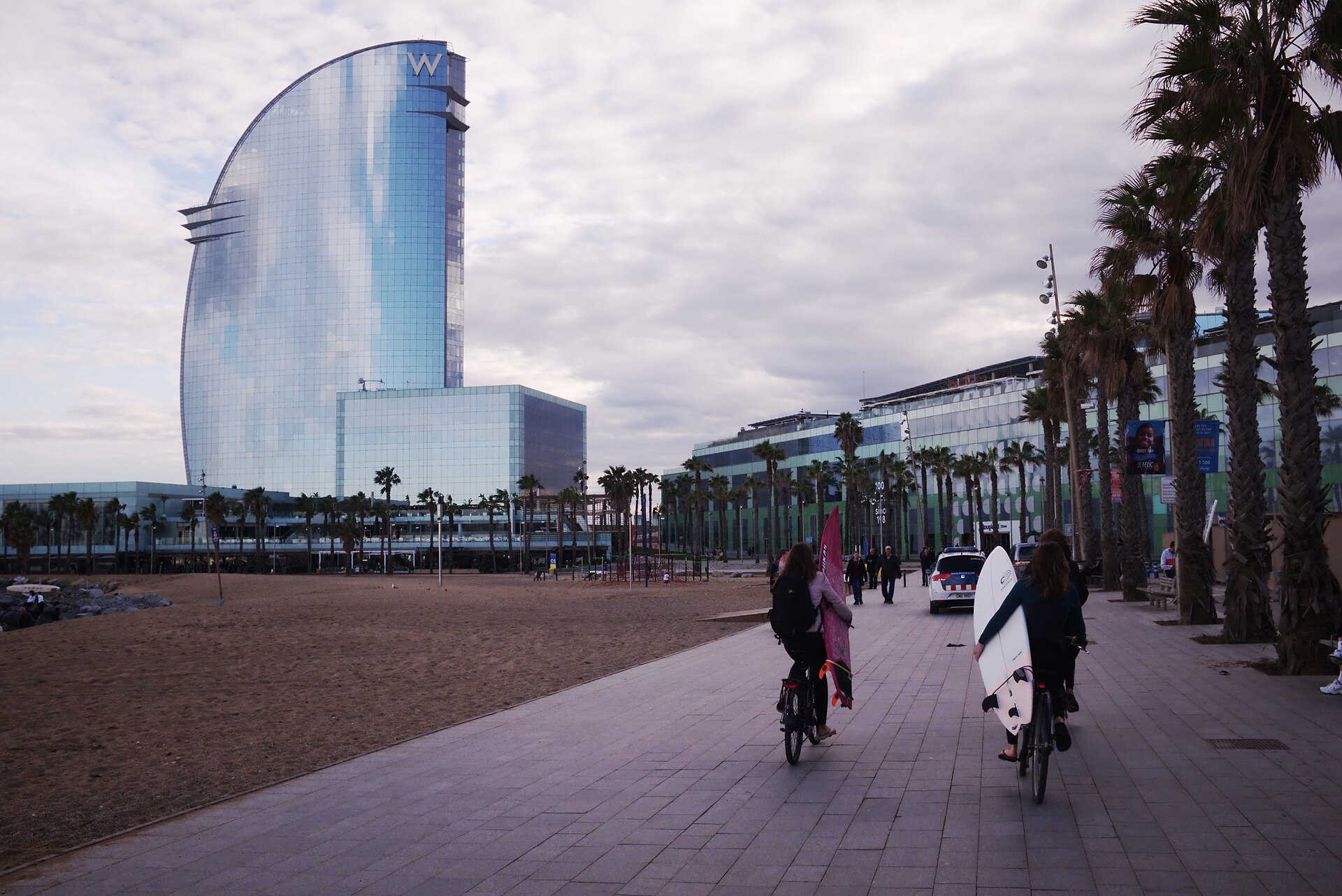
The building, popularly known as the Hotel Vela, has become one of the architectural icons of Barcelona’s coastline.
Its presence visually marks one end of the beach.
Sports clubs
San Sebastián also maintains an important sporting tradition linked to the sea.
Nearby are Club Natació Atlètic-Barceloneta and Club Natació Barcelona, both of which offer sports facilities and activities related to swimming and water sports.
What is the best time to visit San Sebastián Beach?
It depends on the type of experience you are looking for.
Spring
A pleasant time for walking, having a drink on a terrace and enjoying the coastline without the heavy crowds of summer.
Summer
The ideal time if your main goal is swimming and enjoying all the beach services, although this is also the busiest season.
Autumn
The weather is often still pleasant and visitor numbers decrease. It is a good season for combining the beach with gastronomy.
Winter
Although temperatures do not always allow for swimming, the beach remains an excellent place to walk beside the Mediterranean, take photographs and discover Barceloneta from a different perspective.
San Sebastián Beach: Barcelona’s Most Historic Mediterranean Shore
San Sebastián Beach represents one of the oldest connections between Barcelona and the Mediterranean.
This is where sea bathing began to become popular, where some of the city’s great bathing establishments were built, and where much of the maritime and sporting tradition that still characterizes Barceloneta developed.
Today, more than a century later, the setting is very different, but the essence remains.
The sea is still the main attraction, now accompanied by the seafront promenade, sports clubs, restaurants, the W Barcelona Hotel and the everyday life of one of Barcelona’s best-known neighborhoods.
For this reason, Sant Sebastià is more than just an urban beach. It is a place where Barcelona’s maritime history, Barceloneta’s local life and the Mediterranean come together.
A visit can begin with a swim, continue with a walk through the old fishing neighborhood and end with a Mediterranean meal overlooking the sea.
Copyright © 2016-2026 Magic Dreams Barcelona.