Orange and Chocolate Torrijas.
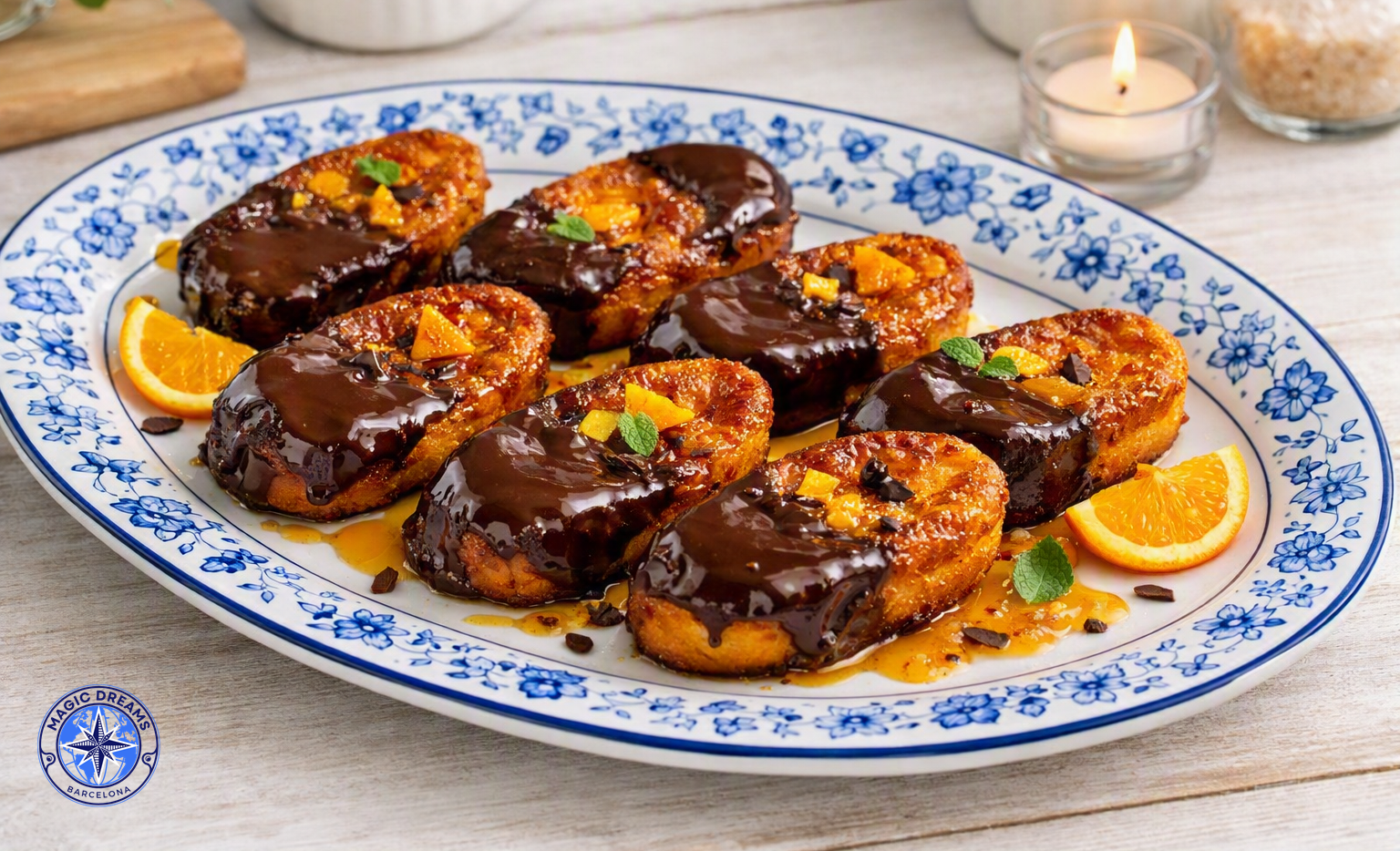
Torrijas are one of the most traditional desserts in Spanish cuisine. Originally created as a way to make the most of stale bread, they have become an iconic sweet, especially associated with Easter and Holy Week.
This version combines the comforting character of traditional torrijas with the freshness and fragrance of orange and the intensity of dark chocolate. The result is a dessert with a crisp exterior, a tender and creamy centre, and a sophisticated finish that elevates a simple traditional recipe into a gourmet creation.
A little history of torrijas
Recipes based on soaking bread in milk or wine, sweetening it and then frying it have existed in different forms throughout Europe for centuries. In Spain, torrijas became particularly associated with Lent and Holy Week, when traditional cooking favoured simple, nourishing ingredients.
Their original purpose was also practical: making use of bread that was no longer fresh. Over time, this humble preparation evolved into one of Spain’s best-loved traditional desserts, with countless regional and contemporary variations.
The combination of orange and chocolate brings a more modern pastry character to the recipe. The citrus notes provide freshness and balance, while chocolate adds depth, bitterness and a luxurious finish.
Ingredients
For the torrijas
- 1 loaf of day-old bread, preferably a soft crumb bread
- 1 litre of whole milk
- 4 tablespoons of sugar
- 1 cinnamon stick
- The peel of ½ orange
- 2 eggs
- Extra virgin olive oil for frying
For the orange syrup
- Zest of ½ orange
- 125 ml fresh orange juice
- 125 g sugar
- 2 tablespoons honey
For the chocolate coating
- 180 g couverture chocolate
Step-by-step preparation
1. Prepare the orange syrup
Place the orange juice, sugar, orange zest and honey in a saucepan.
Heat gently, stirring until the sugar has completely dissolved. Allow the mixture to simmer for a few minutes until it develops a light syrupy consistency.
Remove from the heat and set aside.
The aim is to achieve an aromatic syrup without allowing the orange flavour to become excessively bitter.
2. Infuse the milk
Pour the milk into a saucepan and add the cinnamon stick and orange peel.
Heat gently without bringing it to a vigorous boil. Once the milk is hot and infused with the aromas of cinnamon and orange, remove it from the heat.
Allow it to rest for several minutes so that the flavours develop fully.
Strain the milk before using it.
3. Soak the bread
Cut the bread into thick slices, approximately 2–3 cm thick.
Arrange the slices in a shallow dish and pour the warm infused milk over them.
Leave them to soak until the bread has absorbed enough milk to become tender, but remains firm enough to handle without falling apart.
This is one of the most important stages of the recipe: the perfect torrija must be creamy inside without losing its structure.
4. Dip in egg and fry
Beat the eggs in a bowl.
Carefully lift each soaked slice and coat it in beaten egg.
Heat the extra virgin olive oil in a frying pan and fry the torrijas until golden brown on both sides.
Once ready, transfer them to a plate lined with kitchen paper to remove any excess oil.
The frying temperature is essential. The oil should be hot enough to create a golden crust while allowing the centre to remain soft and creamy.
5. Add the orange syrup
While the torrijas are still warm, place them in the orange syrup for a brief moment, allowing them to absorb its fragrance and sweetness.
The syrup should complement the torrija rather than overwhelm it.
The result should be a delicate balance between the richness of the milk-soaked bread, the freshness of the orange and the sweetness of the syrup.
6. Finish with chocolate
Melt the couverture chocolate gently, preferably using a bain-marie or short intervals of low heat.
Dip one side of each torrija into the chocolate or drizzle the chocolate over the surface, depending on the desired presentation.
Allow the chocolate to set slightly before serving.
For a more refined finish, you can add a little freshly grated orange zest just before serving.
The nutritional value of the ingredients
Although torrijas are, above all, a traditional dessert to be enjoyed in moderation, several of their ingredients provide interesting nutritional qualities.
Orange contributes vitamin C, water and dietary fibre, while its peel contains aromatic essential oils responsible for its characteristic fragrance.
Milk provides protein, calcium, phosphorus and vitamin B12, making it an important source of several essential nutrients.
Eggs provide high-quality protein as well as nutrients such as vitamin B12, choline and selenium.
Extra virgin olive oil is rich in monounsaturated fatty acids and naturally occurring phenolic compounds. Its use also connects this dessert with one of the fundamental ingredients of Mediterranean cuisine.
Cinnamon, although used in a small quantity, contributes intense aroma and allows the recipe to achieve greater complexity without adding excessive sweetness.
Dark chocolate can provide cocoa polyphenols and minerals, although its nutritional composition varies considerably according to the percentage of cocoa and the amount of added sugar.
Honey is primarily a source of sugars, but its aromatic character allows a small amount to contribute considerable flavour to the orange syrup.
The secret to perfect torrijas
The key lies in achieving the right balance between moisture, structure and caramelisation.
The bread must absorb enough milk to become wonderfully tender, but not so much that it breaks apart. The egg creates the delicate golden exterior, while controlled frying provides the characteristic contrast between the crisp outside and creamy centre.
The orange syrup then adds acidity and fragrance, helping to balance the richness of the dessert. Finally, chocolate provides a deeper, slightly bitter note that completes the combination.
A gourmet presentation
For an elegant presentation, serve the torrija individually on a flat plate, with the chocolate positioned as a clean coating or delicate drizzle.
A little freshly grated orange zest can add colour and fragrance, while a few thin slices of fresh orange can introduce a natural visual contrast.
For a more contemporary dessert presentation, the torrija can be accompanied by a small amount of lightly sweetened whipped cream, vanilla ice cream or a delicate citrus cream.
The important thing is to maintain the balance of the original recipe and allow the three principal flavours to remain clearly identifiable: milk and cinnamon, orange and chocolate.
Tradition with a contemporary touch
Orange and chocolate torrijas demonstrate how a simple traditional recipe can be transformed through careful technique and a thoughtful combination of flavours.
The softness of the bread, the fragrance of cinnamon and orange, the sweetness of the syrup and the intensity of chocolate create a dessert that remains unmistakably Spanish while embracing a more contemporary gourmet style.
Spanish tradition, simple ingredients and careful technique: a timeless recipe presented with a gourmet spirit.
Copyright © 2016-2026 Magic Dreams Barcelona.