Bagergue: A Village Filled with Flowers.

History, architecture, nature, culture, language, gastronomy and traditions of one of the most remarkable villages in the Pyrenees
High in the Val d’Aran, surrounded by mountains, alpine meadows and spectacular high-mountain landscapes, lies Bagergue, a small village that has preserved much of the traditional character of the Aranese mountains.
At an altitude of 1,419 metres, Bagergue is the highest inhabited village in the Val d’Aran. Its cobbled streets, stone houses, slate roofs and wooden balconies create a beautiful traditional setting, while flowers add colour to windows, balconies and streets during the warmer months.
Yet Bagergue is much more than a picturesque mountain village. It is a place where traditional architecture, history, Aranese culture, language, gastronomy and mountain life continue to form part of the local identity.
Bagergue, among the mountains of the Val d’Aran
Bagergue is located in the southern part of the Unhòla valley, within the municipality of Naut Aran.
At 1,419 metres above sea level, the village is home to around one hundred inhabitants. From here, the landscape opens towards the mountains surrounding the upper valley, including the lakes of Liat, Montoliu and Mauberme.
The Tuc de Mauberme, rising to 2,880 metres, is one of the most impressive peaks in the surrounding landscape.
Bagergue’s elevated position has played an important role in shaping its character. For centuries, life here was closely connected to livestock farming, agriculture, forests and the natural resources of the mountains.
A village of stone, wood, slate and flowers
One of Bagergue’s greatest attractions is its traditional architecture.
The historic centre preserves the characteristic appearance of an Aranese mountain village: stone houses, slate roofs, wooden balconies and narrow cobbled streets adapted to the slope of the terrain.
The architecture seems to grow naturally out of the mountain landscape.
During the warmer months, flowers add another distinctive feature to the village. Balconies, windows, façades and small corners are decorated with colourful plants, creating a striking contrast with the stone walls and dark slate roofs.
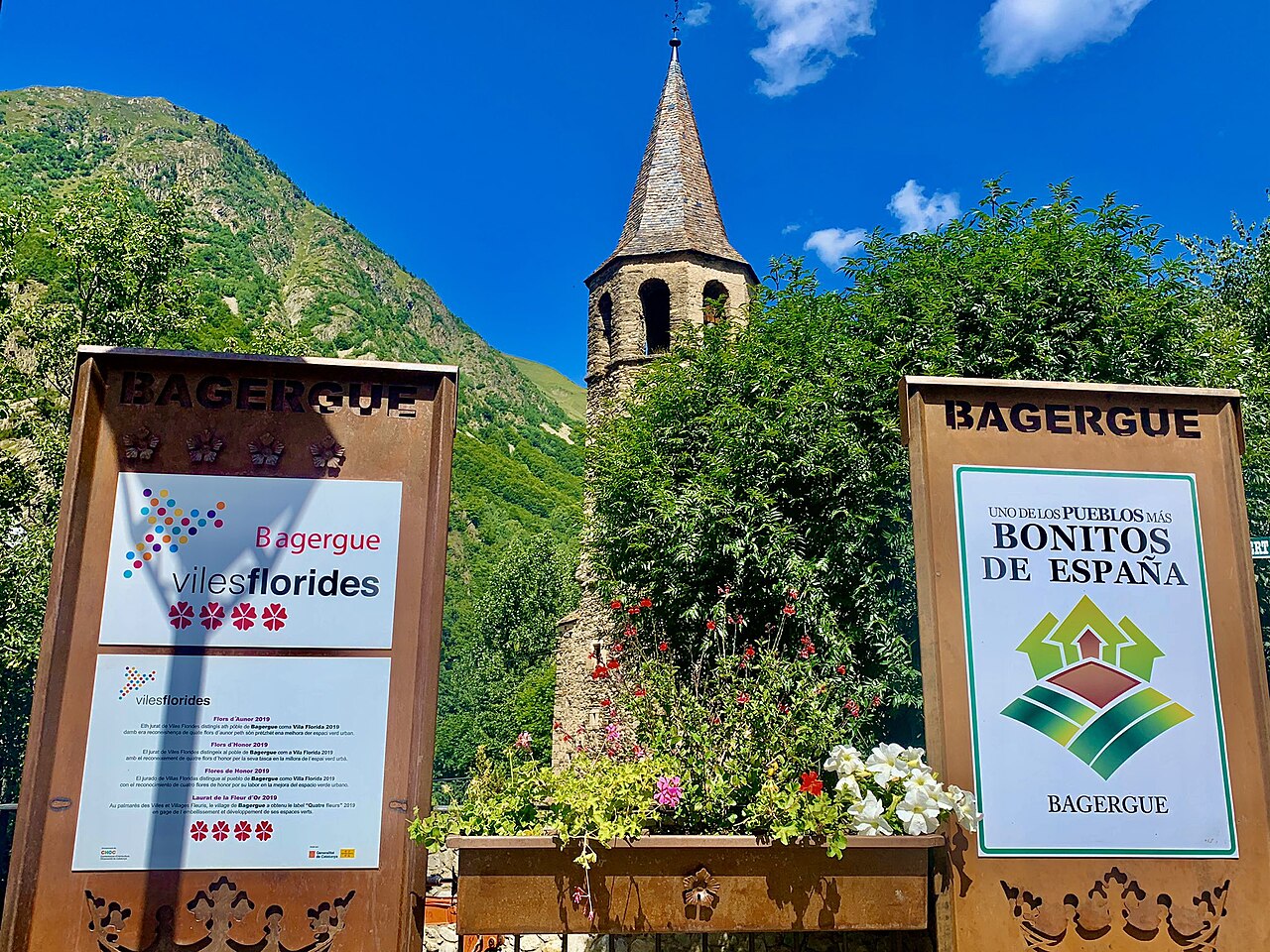
The care provided by local residents has played an important role in maintaining this appearance. Bagergue belongs to the Viles Florides initiative and has received four Flores de Honor in recognition of the care given to its public spaces.
This combination of architecture and vegetation is one of the reasons why Bagergue is so photogenic and why even a simple walk through its streets can become one of the highlights of a visit.
The Aranese language: a living part of Bagergue’s identity
One of the most fascinating aspects of Bagergue is its connection with the Aranese language.
Aranese, or aranés, is the traditional variety of Occitan spoken in the Val d’Aran. It belongs to the Occitan linguistic family and is one of the defining cultural elements of the valley.
Aranese has official status in Catalonia together with Catalan and Spanish, with specific recognition and protection within the Val d’Aran.
The history of the language is closely connected with the Occitan cultural world of the Pyrenees and southern France. The geographical position of the valley, surrounded by mountains, contributed to the development and preservation of a distinctive linguistic and cultural identity.
In Bagergue, this heritage can still be seen in the names of places, buildings, traditions and elements of the landscape.
Names such as Eth Corrau, Sant Fèlix, Santa Margarida, Unhòla, Mauberme and Saut deth Pish are not simply geographical names. They are part of the linguistic and cultural heritage of the valley.
For anyone interested in languages and European cultural diversity, the Val d’Aran offers something particularly special: a small territory where Occitan has survived as a living language.
The history of Bagergue
The history of Bagergue is closely connected with traditional mountain life in the Val d’Aran.
For generations, the inhabitants depended on livestock farming, agriculture, forestry and the resources provided by the surrounding mountains.
The landscape was not merely a backdrop to everyday life. It was the foundation of the local economy and community.
This relationship with the land can still be seen in the architecture of the houses, traditional tools, household objects and customs preserved in the village.
The relative isolation of the Val d’Aran also helped maintain its distinctive cultural character and its close links with the Occitan world.
Today, much of that history can still be discovered simply by walking through Bagergue.
Sant Fèlix: the religious heart of Bagergue
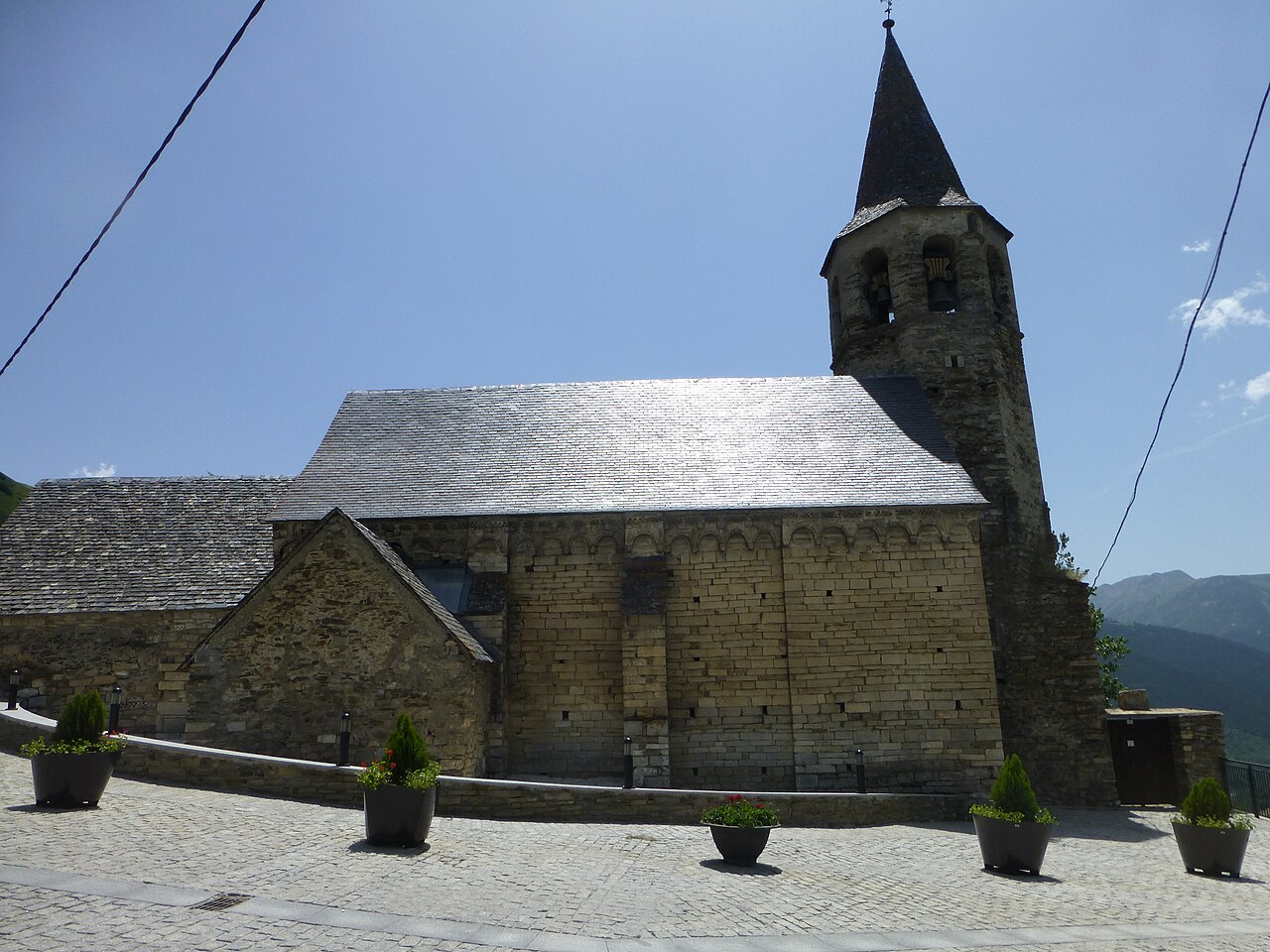
Among the village’s most important historic buildings is the parish church of Sant Fèlix.
Its origins are Romanesque, and the church dates back to the medieval period, although it was subsequently modified and enlarged over the centuries.
The building therefore brings together elements from different historical periods. Among its features are the square-based bell tower and several architectural elements associated with its Romanesque origins.
Inside, visitors can find a Gothic transitional Christ, as well as a significant pre-Romanesque funerary stele.
The church is an excellent example of how Bagergue’s heritage evolved over time, with a medieval foundation that continued to adapt to the needs of the local community.
Eth Corrau: a journey into traditional Aranese life
Another essential place to discover is Eth Corrau, a private museum containing around 2,500 objects associated with traditional life in the Val d’Aran.
The collection provides an insight into the everyday world of the inhabitants of the valley before modern tourism transformed the region.
Tools, household objects and items connected with agriculture, livestock farming and traditional occupations help visitors understand how communities once lived in these mountains.
A visit to Eth Corrau is therefore much more than a museum experience. It is an opportunity to step into the memory of a traditional mountain community.
Santa Margarida and the Unhòla landscape
A little more than one kilometre from the village stands the small hermitage of Santa Margarida.
The route follows the Unhòla valley and gradually leaves the houses behind, opening onto meadows and mountain landscapes.
Every 20 July, a traditional pilgrimage is held here in honour of Santa Margarida, preserving one of the local traditions that connects the community with its religious and territorial heritage.
The surrounding area also provides access to some of the most spectacular high-mountain landscapes in the region.
Bagergue’s spectacular natural surroundings
Nature is one of the main reasons to visit Bagergue.
The Val d’Aran contains extensive forests, alpine and subalpine meadows, rivers, streams and high-mountain lakes.
Among the most remarkable places around Bagergue are:
- Estanh de Liat
- Estanh de Montoliu
- Estanh de Mauberme
- Tuc de Mauberme, 2,880 metres
- Còth de Varradòs
- Saut deth Pish
- The Liat valley
- The Unhòla valley
These landscapes are particularly attractive for hiking, photography and anyone wishing to experience the more remote side of the Pyrenees.
Botany: alpine flowers, forests and meadows
The vegetation of the Val d’Aran is strongly influenced by altitude, rainfall and the Atlantic character of the valley.
The region contains forests of beech, fir and oak, together with extensive alpine and subalpine meadows and a remarkable variety of mountain plants.
Among the botanical species found in the Val d’Aran are mountain arnica, daffodils, liverworts, sundews and several species of orchids.
The sundew is particularly fascinating. It is a carnivorous plant that can be found in certain wet mountain habitats.
The botanical richness of the region becomes especially spectacular during spring and summer, when the meadows are transformed into colourful carpets of alpine vegetation.
Wildlife: life in the Pyrenees
The natural environment surrounding Bagergue forms part of one of the most biodiverse mountain regions of the Pyrenees.
The wider Val d’Aran is home to numerous species of mammals, birds, amphibians, reptiles and insects.
Among the wildlife associated with the valley are the brown bear, bearded vulture, golden eagle, capercaillie and marmot, together with numerous smaller mammals and mountain birds.
Wildlife observation requires patience and respect. Some species are extremely elusive, while others are protected. The best way to enjoy them is always from a safe distance and without disturbing their natural behaviour.
Herpetology: amphibians and reptiles
The Val d’Aran is also of interest to those fascinated by herpetology, the study of amphibians and reptiles.
Mountain streams, ponds and wet habitats provide important environments for amphibians. Among the species associated with the region is the Pyrenean brook salamander, a species strongly linked to cold, clean mountain waters.
The combination of high-altitude streams, forests, meadows and wetlands creates a diverse range of habitats for amphibians and reptiles.
For nature lovers, these smaller forms of wildlife offer another fascinating dimension to the biodiversity of the Pyrenees.
Sports and outdoor activities
Bagergue is an excellent base for enjoying mountain activities throughout much of the year.
The GR 211, a long-distance hiking route that crosses the Val d’Aran, passes through Bagergue before continuing towards the high mountains.
The area is suitable for:
- Hiking.
- High-mountain trekking.
- Mountain biking.
- E-bike routes.
- Skiing and winter sports.
- Landscape photography.
- Wildlife observation.
- Botanical excursions.
- Routes to high-mountain lakes and valleys.
In winter, snow completely transforms the landscape. During summer, the trails reveal meadows, forests, streams and spectacular mountain panoramas.
Bagergue and Baqueira Beret
One of Bagergue’s advantages is its proximity to Baqueira Beret, one of the most important ski resorts in the Pyrenees.
This makes it possible to combine the atmosphere of a traditional mountain village with the extensive range of activities available at the resort.
In winter, the area is especially popular for skiing and snow sports. During the warmer months, the surrounding mountains become a destination for hiking, cycling and other outdoor activities.
Gastronomy: the flavours of the mountains
Bagergue’s gastronomy is deeply connected with the traditional cuisine of the Val d’Aran.
This is mountain cuisine, historically based on ingredients capable of providing energy during long and demanding winters: meats, potatoes, vegetables, pulses, dairy products and game.
One of the best-known traditional dishes of the region is the olla aranesa, a hearty preparation that has become part of the gastronomic heritage of the Val d’Aran.
Local dairy production is another important part of the culinary identity of Bagergue.
Hormatges Tarrau: Bagergue’s traditional cheese
One of the village’s best-known gastronomic names is Hormatges Tarrau, an artisan cheese producer founded by two brothers from Bagergue.
Located at 1,419 metres above sea level, the dairy specialises in traditional Aranese mountain cheeses, combining traditional methods with modern production techniques.
Its cheeses include several varieties, including hard cheeses and blue cheeses.
The work of Hormatges Tarrau is a good example of how traditional mountain products can be preserved and developed while maintaining their local identity.
Mushrooms and products from the forest
The forests of the Val d’Aran are also rich in mushrooms.
More than 200 species have been recorded in the forests of the valley, including varieties highly valued in mountain cuisine, such as porcini mushrooms, saffron milk caps and black trumpets.
Autumn is therefore an especially interesting season for discovering the relationship between the forests and the gastronomy of the region.
Bagergue’s festivals and traditions
Religious and popular traditions continue to play an important role in local life.
Santa Margarida pilgrimage
Every 20 July, the traditional pilgrimage to the hermitage of Santa Margarida takes place.
It is an opportunity to experience one of the customs that have connected the community with its landscape and religious heritage for generations.
Sant Fèlix Festival
At the beginning of August, Bagergue celebrates its Fiesta Major in honour of Sant Fèlix, the village’s patron saint.
During these celebrations, the streets become a meeting place for residents and visitors, offering a glimpse into the community life of this small mountain village.
Bagergue throughout the four seasons
One of Bagergue’s great attractions is that every season offers a completely different landscape.
Winter: snow covers the slate roofs, streets and surrounding mountains, creating an almost Alpine atmosphere.
Spring: meadows begin to fill with flowers and the landscape gradually returns to vibrant colours.
Summer: flowers reach their greatest splendour throughout the village, while the mountain trails become ideal for hiking and cycling.
Autumn: the forests turn golden, red and ochre, creating a beautiful contrast with the stone houses.
Bagergue is therefore not a destination reserved for one particular season.
How far is Bagergue from Barcelona?
From Barcelona, Bagergue is approximately 265–270 kilometres by road, depending on the starting point and route.
By car, the journey takes approximately four hours, although actual travel time depends on traffic, weather and road conditions.
The route takes you towards the Val d’Aran and then into the upper part of the valley until reaching Bagergue.
It is a considerable journey, but the distance is also part of what gives the village its sense of tranquillity and remoteness.
The places you should not miss in Bagergue
If you visit Bagergue, these are some of the places and experiences you should not miss:
1. The historic centre
Walk through the cobbled streets and admire the traditional stone houses, wooden balconies and flowers.
2. Sant Fèlix church
Discover one of the village’s most important historic and artistic landmarks.
3. Eth Corrau
Explore the remarkable collection of around 2,500 objects related to traditional Aranese life.
4. Santa Margarida
Walk to the small hermitage surrounded by the landscape of the Unhòla valley.
5. Hormatges Tarrau
Discover the traditional cheese-making heritage of Bagergue.
6. The Unhòla valley
Enjoy a peaceful walk through one of the most beautiful natural settings around the village.
7. The lakes of Liat, Montoliu and Mauberme
For those who wish to venture deeper into the high mountains.
8. Baqueira Beret
A short drive away, offering activities in both winter and summer.
A small village with a remarkable identity
Bagergue is proof that the size of a village has nothing to do with the richness of its heritage.
Within a very small area, you will find traditional architecture, medieval history, religious art, a distinctive language, mountain gastronomy, popular traditions, museums and extraordinary natural surroundings.
Here, stone, wood, slate, flowers and mountains become part of the same landscape.
But perhaps the most fascinating aspect of Bagergue is that its charm does not feel manufactured for tourism. Much of its appeal comes from the fact that it remains what it has always been: a mountain village of the Val d’Aran, with its own language, traditions and deep connection with the surrounding landscape.
And when spring and summer arrive and its streets become filled with flowers, that unique character becomes even more apparent.
Bagergue is one of those places where the landscape does not end at the mountains. It continues through its streets, its houses, its cuisine, its language and the memory of its people.


Copyright © 2016-2026 Magic Dreams Barcelona.