Dante, the Journey Toward the Light.
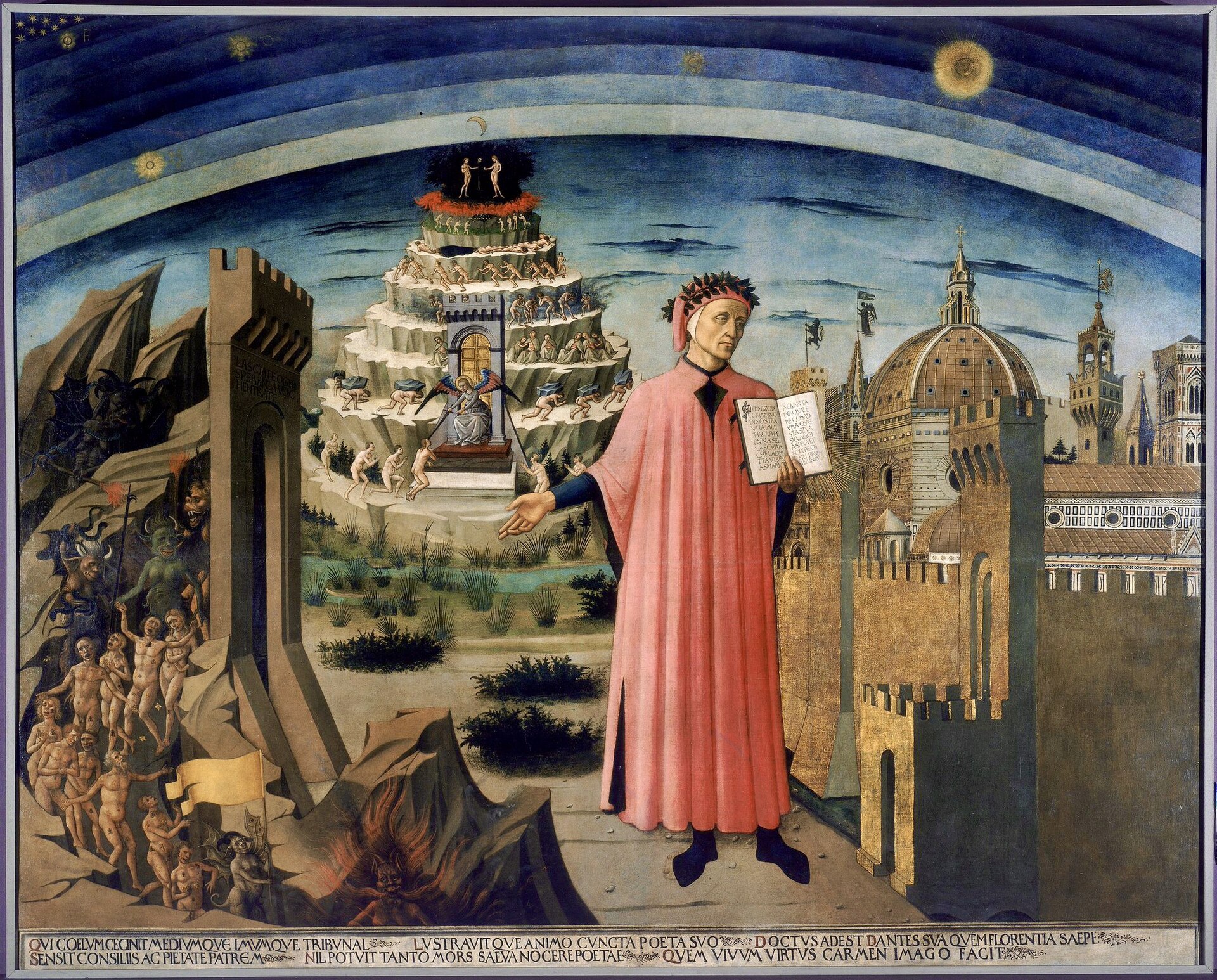
Few works in the history of Western literature have had the lasting impact of Dante Alighieri’s Divine Comedy. Written more than seven centuries ago, the poem continues to speak to readers because its journey is both cosmic and deeply human: a journey through darkness, suffering, purification, knowledge, love, and finally light.
Centuries later, Salvador Dalí created one of the most extraordinary visual interpretations of Dante’s poem. Between 1960 and 1964, Dalí produced a series of 100 illustrations corresponding to the 100 cantos of the Divine Comedy. Among them is The Triumph of Christ and the Virgin, inspired by Paradiso, Canto XXIII.
To understand Dalí’s image, however, it is necessary to understand Dante’s journey first.
1. The Darkness Before the Light
The Divine Comedy begins with one of the most famous images in literature: Dante has lost his way in a dark forest.
He is not simply lost geographically. He is spiritually and morally disoriented.
At the age of thirty-five, Dante imagines himself in the middle of life’s journey, unable to find the correct path. The forest becomes a symbol of confusion, sin, fear, political disorder, and the loss of direction.
From this point, the entire poem becomes a journey toward understanding.
Dante will descend into Hell, climb the mountain of Purgatory, and finally rise through Paradise.
The movement is therefore not simply from one place to another. It is a movement:
from darkness to light,
from confusion to knowledge,
from sin to purification,
from fear to love.
2. Dante Alighieri: The Man Behind the Myth
Dante Alighieri was born in Florence in 1265 and died in Ravenna in 1321.
He lived during a period of intense political, religious, and social conflict in medieval Italy. Florence was divided by struggles between factions, while the relationship between political power and the Church was deeply contentious.
Dante himself became involved in Florentine politics.
In 1289, he fought in the Battle of Campaldino. Later, he held political office in Florence.
His political involvement would ultimately change his life.
In 1302, Dante was condemned to exile. He never returned permanently to Florence.
Exile became one of the defining experiences of his life.
The poet who travels through Hell, Purgatory, and Paradise is therefore also a man who has personally experienced loss, injustice, political conflict, separation, and displacement.
This helps explain why the Divine Comedy is never simply an abstract theological poem. It is also a profoundly personal work.
Dante places historical figures, politicians, popes, friends, enemies, poets, philosophers, and ordinary human weaknesses inside his cosmic vision.
3. Beatrice: From Love to Revelation
No figure is more important to Dante’s spiritual journey than Beatrice.
Historically, Beatrice is associated with Beatrice Portinari, the woman Dante encountered in Florence and transformed into one of the great figures of Western literature.
She appears prominently in Dante’s earlier work, especially the Vita nuova.
But in the Divine Comedy, Beatrice becomes much more than the object of romantic love.
She becomes a guide.
When Virgil can no longer accompany Dante, Beatrice takes his place.
This transition is deeply symbolic.
Virgil represents reason, classical wisdom, and human intellectual understanding.
Beatrice represents a higher form of knowledge: revelation, grace, divine wisdom, and spiritual love.
Dante’s love for Beatrice therefore evolves from earthly desire into a force that leads him toward the divine.
4. Dante’s Other Major Works
Although the Divine Comedy is his masterpiece, Dante wrote many other important works.
Vita nuova
The Vita nuova (The New Life) combines poetry and prose and focuses on Dante’s love for Beatrice.
It is essential for understanding how the figure of Beatrice developed in Dante’s imagination.
Convivio
The Convivio (The Banquet) is a philosophical work in which Dante discusses knowledge, morality, philosophy, and human existence.
De vulgari eloquentia
In De vulgari eloquentia, Dante explores the possibilities of writing serious literature in the vernacular rather than exclusively in Latin.
This was a revolutionary linguistic and cultural question.
Monarchia
Monarchia addresses political philosophy and the relationship between temporal and spiritual authority.
It reflects Dante’s belief that humanity requires both political order and spiritual guidance.
Epistole and Rime
His letters and lyric poems reveal another side of Dante: the political thinker, intellectual, poet, and deeply emotional human being.
5. The Architecture of the Divine Comedy
The Divine Comedy consists of 100 cantos:
- Inferno: 34 cantos
- Purgatorio: 33 cantos
- Paradiso: 33 cantos
The structure itself reflects Dante’s fascination with numerical symbolism.
The number three is particularly important because of its association with the Trinity.
The poem is written in terza rima, a poetic form based on interlocking groups of three rhymes.
The architecture of the poem therefore reinforces one of its central ideas:
the universe is not chaos. It possesses order, proportion, and meaning.
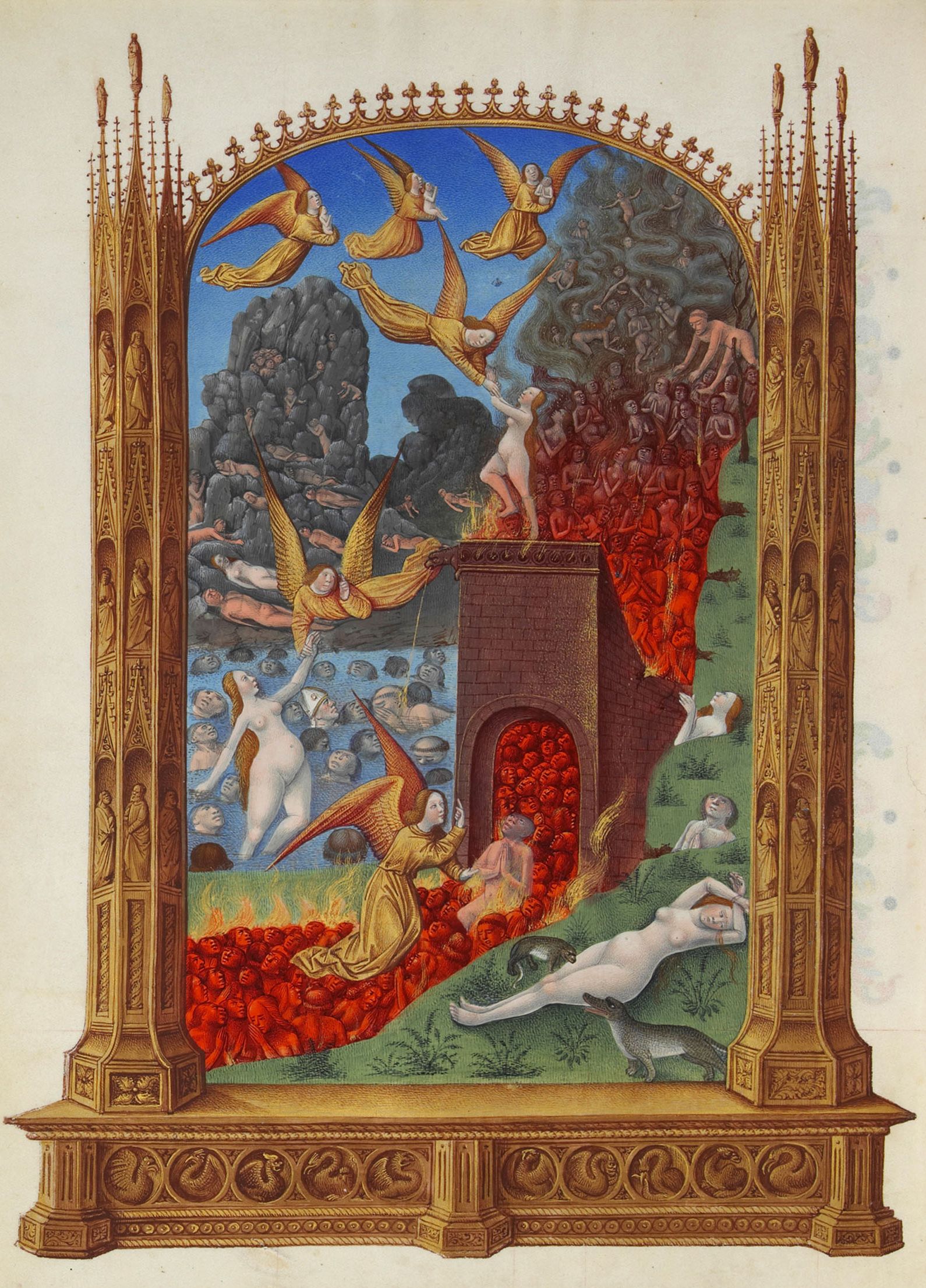
6. Inferno: The Consequences of Human Choice
Hell is the first stage of Dante’s journey.
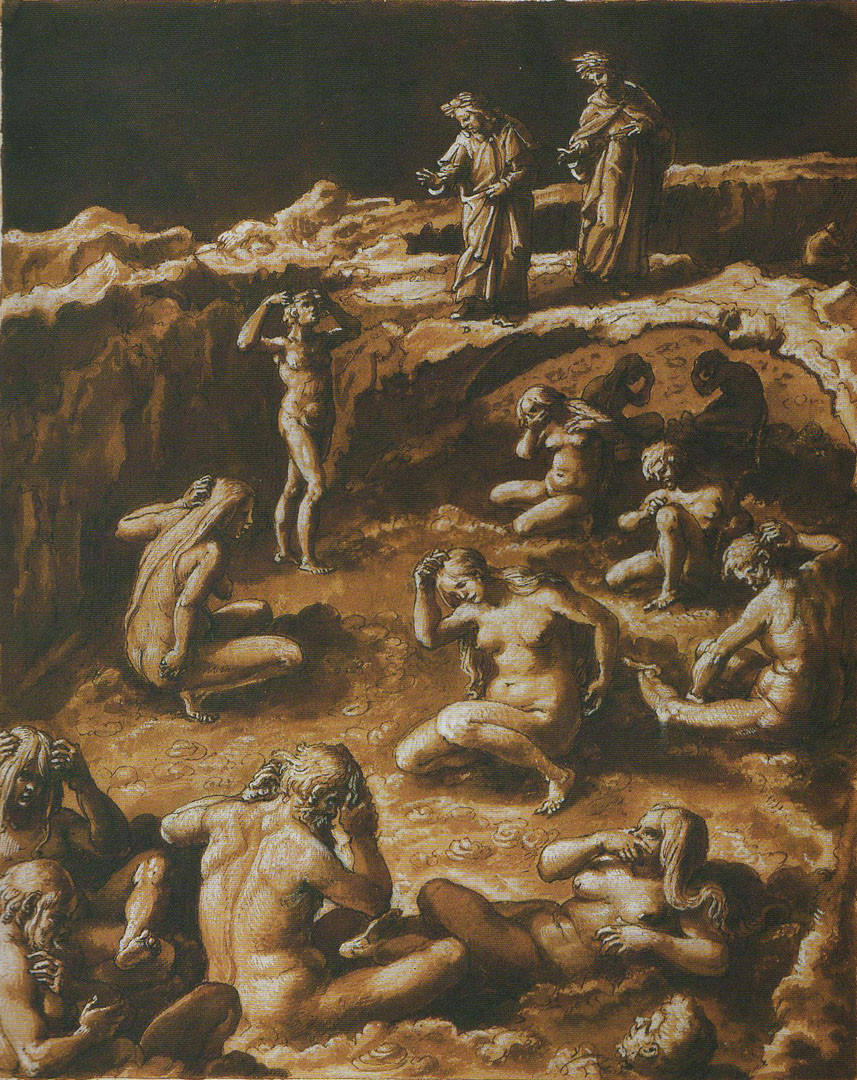
Virgil guides Dante through increasingly terrible circles, where souls experience the consequences of the choices they made during their lives.
One of the fundamental principles of the Inferno is contrapasso: the punishment reflects, symbolically or literally, the nature of the sin.
But Hell is not merely a catalogue of punishments.
It is a study of human beings who have become trapped inside their own choices.
Dante asks a disturbing question:
What happens when a human being repeatedly chooses desire, violence, fraud, pride, or hatred over reason and moral responsibility?
The answer is Hell.
7. Purgatorio: The Possibility of Change
Purgatory is fundamentally different.
Hell offers no possibility of transformation.
Purgatory does.
The souls Dante encounters there are suffering, but their suffering has a purpose.
They are changing.
The mountain of Purgatory therefore becomes a symbol of moral and spiritual education.
Human beings are not defined only by their mistakes.
They can recognize them.
They can change.
They can become something different.
This makes Purgatorio perhaps the most hopeful section of the poem.
8. Paradiso: The World of Light
If Inferno is dominated by darkness and Purgatorio by transformation, Paradiso is dominated by light.
Dante travels through the celestial spheres of the medieval cosmos.
But Paradise is not simply a beautiful place.
It is a world of increasing intellectual and spiritual complexity.
As Dante rises, physical imagery becomes increasingly difficult to describe.
The poet repeatedly admits that human language is inadequate to express what he sees.
Light becomes the central metaphor.
It represents:
- divine presence
- knowledge
- truth
- love
- intelligence
- spiritual illumination
The further Dante travels, the more the distinction between seeing and understanding begins to disappear.
To see the divine is also to understand.
9. The Meaning of Light
Light is one of the great visual ideas of the Paradiso.
Dante’s Paradise is not simply brighter than Earth.
It represents a different mode of existence.
Human knowledge is limited.
Divine knowledge is complete.
As Dante approaches the final vision, light becomes almost impossible to describe.
This is precisely what makes Dalí’s interpretation so interesting.
Dalí was not simply illustrating a medieval story.
He was confronting the same problem Dante faced:
How can something infinite and spiritual be represented visually?
10. Was Dante Really a Believer?
Yes.
Dante was a Christian believer, and the Divine Comedy is deeply rooted in Christian theology.
Its universe is structured according to medieval Christian ideas about sin, salvation, judgment, angels, saints, Christ, the Virgin Mary, and God.
However, this does not mean that the poem is meaningful only to Christians.
A modern reader can approach it through several different perspectives:
- literature
- philosophy
- psychology
- politics
- ethics
- history
- symbolism
- the study of human nature
The important qualification is that Dante’s moral framework is fundamentally Christian.
His ideas about sin, redemption, justice, and salvation cannot be completely separated from his faith.
Yet the questions he asks are universal.
Why do people destroy themselves?
Why do societies become corrupt?
Can human beings change?
What is justice?
What is love?
What does it mean to live a meaningful life?
These questions remain relevant whether or not the reader shares Dante’s religious beliefs.
11. Dante’s Criticism of Society and Power
The Divine Comedy is also a political work.
Dante does not hesitate to condemn corruption.
He criticizes political leaders, factions, individuals, and even members of the Church.
This is particularly important because Paradise is not a place where Dante suddenly stops thinking about earthly society.
Even while contemplating the divine, he continues to judge the world he left behind.
For Dante, spirituality and politics are not completely separate.
A corrupt society is a moral problem.
A corrupt Church is a spiritual problem.
A corrupt political system is a human problem.
12. Virgil, Beatrice, and Dante
The three central figures of Dante’s journey can be understood symbolically.
Dante is humanity: the individual searching for meaning.
Virgil is reason: intelligence, philosophy, and human wisdom.
Beatrice is revelation and divine wisdom.
The sequence matters.
Reason helps Dante begin the journey.
But reason alone cannot take him all the way.
Eventually, he needs another kind of knowledge.
That is where Beatrice enters.
The journey therefore becomes a dialogue between reason, revelation, love, and knowledge.
13. Paradiso, Canto XXIII: The Triumph of Christ and the Virgin
This brings us to Salvador Dalí’s work.
The Triumph of Christ and the Virgin corresponds to Paradiso, Canto XXIII.
Dante is now in the Heaven of the Fixed Stars.
He is approaching the highest stages of his journey.
The canto is filled with extraordinary imagery.
Dante sees the triumph of Christ and the Virgin Mary.
The apostles and heavenly figures appear within an overwhelming vision of divine glory.
The archangel Gabriel is associated with Mary.
The atmosphere is one of revelation, celebration, light, and spiritual intensity.
This is a crucial moment in Dante’s journey because he is no longer simply climbing toward Paradise.
He is approaching the deepest mysteries of Christian faith.
14. Why This Canto Is So Important
Canto XXIII is not the end of the Divine Comedy.
It is a major threshold.
The following cantos focus on the theological virtues:
- Canto XXIV — Faith
- Canto XXV — Hope
- Canto XXVI — Charity/Love
Dante is therefore being prepared for the final stages of his journey.
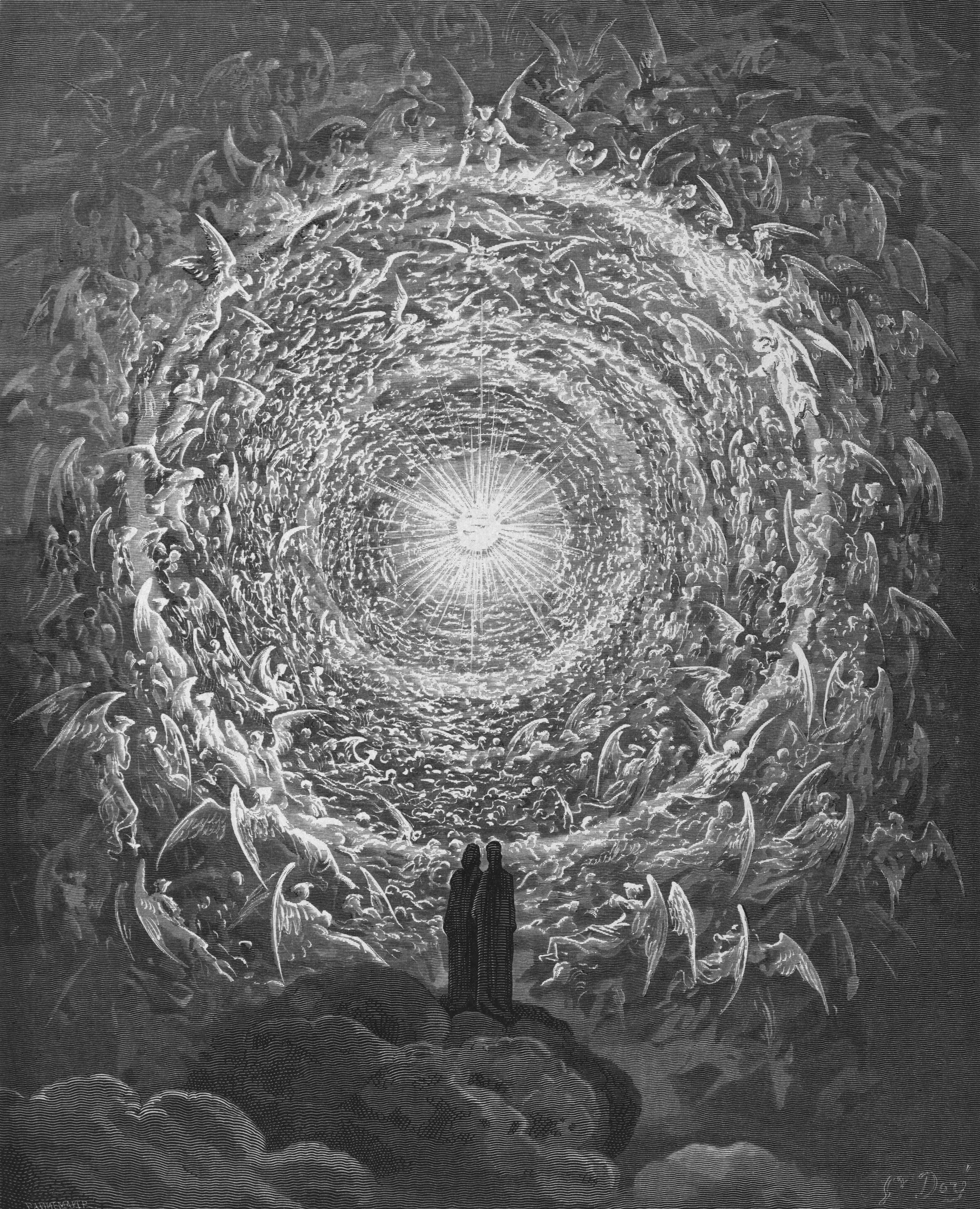
After this come the higher celestial spheres, the Primum Mobile, the Empyrean, the celestial rose, Saint Bernard, and finally the supreme vision of God.
Canto XXIII is therefore best understood as a moment of triumphant revelation before the final ascent.
15. Christ as Light
Christ’s appearance in this section can be understood as the culmination of Dante’s search for truth.
The light surrounding Christ is not simply visual.
It represents the ultimate source of knowledge and love.
Dante has travelled through darkness.
He has witnessed the consequences of sin.
He has climbed through purification.
Now he encounters a reality in which knowledge and love are united.
The journey has reached the point where intellectual understanding alone is no longer enough.
The final truth must be experienced.
16. The Virgin Mary
Mary occupies a unique position in the Paradiso.
She is associated with grace, compassion, purity, and intercession.
Her presence is particularly important because Dante’s final approach to God is not presented as an exclusively intellectual achievement.
There is also grace.
Mary therefore becomes an important mediator between humanity and the divine.
Her role helps explain why the Virgin appears so prominently in the imagery of Canto XXIII.
17. Is This the End of the Divine Comedy?
No.
This is an important point.
Canto XXIII is not the final canto.
There are still ten cantos to go.
Dante continues through the examination of faith, hope, and charity, ascends toward the Primum Mobile, enters the Empyrean, encounters the celestial rose and Saint Bernard, and finally reaches the ultimate vision.
The true ending comes in Paradiso, Canto XXXIII.
18. The True Ending
At the end of the poem, Dante attempts to describe his vision of God.
He cannot fully do so.
Language reaches its limit.
Memory itself begins to fail.
Yet Dante retains one fundamental understanding.
The universe is moved by love.
The poem concludes with the famous words:
“l’amor che move il sole e l’altre stelle”
“the love that moves the sun and the other stars.”
This is one of the most extraordinary endings in world literature.
The journey that began in a dark forest ends with love as the force governing the cosmos.
19. What Was Dante Trying to Say?
The Divine Comedy can be understood as Dante’s answer to a fundamental question:
How can a lost human being find his way back to meaning?
His answer is not simple.
We need reason.
We need moral responsibility.
We need transformation.
We need love.
And, for Dante, we ultimately need divine grace.
The journey is therefore simultaneously personal, ethical, political, philosophical, and spiritual.
20. Dante and Dalí: Two Visions of the Same Journey
More than six centuries separate Dante and Dalí.
Yet the two artists share an important concern.
Both are interested in the boundary between the visible and the invisible.
Dante uses words to describe realities that exceed human language.
Dalí uses images to represent realities that exceed ordinary perception.
Dalí’s Divine Comedy project consists of 100 illustrations corresponding to Dante’s 100 cantos.
His surreal visual language was particularly suited to Dante’s extraordinary universe.
But Dalí was not simply decorating the poem.
He was creating a new visual interpretation of it.
The result is a dialogue between medieval theology and twentieth-century surrealism.
21. Dalí’s The Triumph of Christ and the Virgin
In Dalí’s interpretation of Canto XXIII, the viewer encounters a world that seems suspended between dream, revelation, and religious vision.
The composition transforms Dante’s theological imagery into a visual experience.
Christ and the Virgin become the center of a celestial drama.
The surrounding light suggests transcendence.
The vertical movement evokes Dante’s ascent.
And the dreamlike quality of the image reminds us that Paradise cannot be understood simply as a physical location.
It is another state of perception.
This is where Dalí’s surrealism and Dante’s medieval imagination unexpectedly meet.
Both attempt to represent something beyond ordinary reality.
22. Why Dalí Chose Dante
Dalí’s interest in Dante is particularly revealing.
Surrealism was fascinated by dreams, subconscious imagery, transformation, symbolism, and the irrational.
Dante’s universe contains all of these elements, although within a completely different intellectual and religious framework.
Monsters, angels, demons, transformations, cosmic landscapes, impossible architecture, spiritual beings, and visions appear throughout the Divine Comedy.
Dalí found in Dante an enormous visual universe.
But he also found something more profound:
a journey through the human psyche.
23. The Influence of the Divine Comedy
Few literary works have influenced Western culture as profoundly as Dante’s poem.
Its imagery has shaped:
- literature
- painting
- sculpture
- music
- theatre
- cinema
- philosophy
- political thought
- popular culture
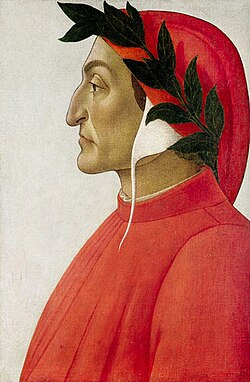
Artists from Botticelli to William Blake, Gustave Doré, Salvador Dalí, and many others have created visual interpretations of Dante.
Writers, filmmakers, composers, and philosophers have repeatedly returned to his vision of Hell, Purgatory, and Paradise.
The poem has survived because every generation can reinterpret its symbols.
Hell can be read as a psychological landscape.
Purgatory can represent transformation.
Paradise can represent transcendence.
The journey can belong to Dante.
But it can also belong to us.
24. Why Dante Still Matters
Dante matters because he understood something fundamental about human beings:
We are constantly trying to understand where we are, where we have gone wrong, and where we should go next.
The dark forest is therefore more than a medieval metaphor.
It remains recognizable.
We can all become lost.
We can all make destructive choices.
We can all encounter moments when the path forward becomes unclear.
And Dante proposes that being lost does not necessarily mean being condemned to remain lost.
There can be a journey.
There can be knowledge.
There can be transformation.
There can be light.
Conclusion: From Darkness to Love
Dante’s journey begins in darkness and ends in light.
But light is not the final idea.
Love is.
That is why the final line of the Divine Comedy is so powerful.
After travelling through Hell, Purgatory, and Paradise, after confronting sin, politics, philosophy, theology, death, beauty, and the limits of language, Dante arrives at a simple conclusion:
love is what moves the universe.
Centuries later, Salvador Dalí looked at Dante’s journey and transformed it into images.
His The Triumph of Christ and the Virgin, inspired by Paradiso, Canto XXIII, captures one of the great thresholds of that journey: the moment when Dante’s search for truth becomes a vision of divine triumph.
Dante gave the West a journey through words.
Dalí gave that journey another language: the language of images.
And both ultimately point toward the same mystery:
the passage from darkness toward light, and from light toward love.

Copyright © 2016-2026 Magic Dreams Barcelona.