King’s Cake with Vanilla Pastry Cream.
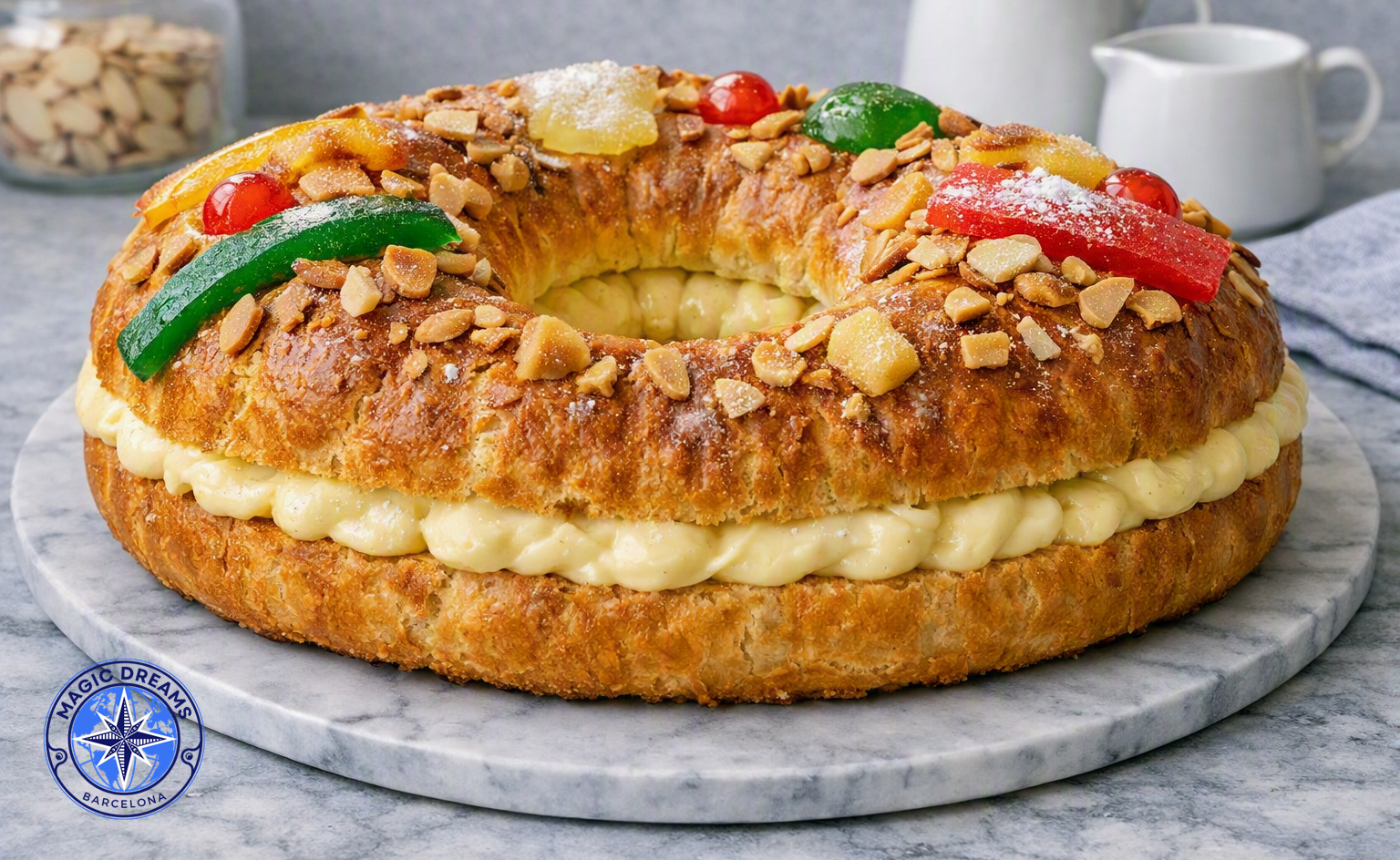
An aromatic brioche crown, silky vanilla pastry cream and the sweetest spirit of tradition
The Roscón de Reyes, or Spanish King’s Cake, is much more than one of the most eagerly awaited treats of the Christmas season. Its distinctive crown shape, fragrant citrus and orange blossom aroma, and the surprise hidden inside are all part of a ritual passed down from generation to generation.
Although today it is primarily associated with the celebration of the Three Kings, its history appears to stretch much further back, to the ancient Roman celebrations of the Saturnalia. During these festivities, round cakes made with nuts, honey or fruit were prepared, with a broad bean hidden inside. Whoever found it was symbolically proclaimed a figure of authority for a short period.
Over the centuries, this tradition evolved into the roscón we know today: a crown of soft, fragrant dough decorated with candied fruit, almonds and sugar and, in this version, generously filled with a smooth, silky and delicately aromatic vanilla pastry cream.
The result is a majestic-looking cake with a light texture and a perfect balance of brioche, citrus, vanilla and the delicate crunch of almonds.
Ingredients
For the King’s Cake
- 500 g strong white bread flour
- 100 g caster sugar
- 100 ml whole milk
- 2 large eggs
- 80 g unsalted butter, at room temperature
- 20 g fresh baker’s yeast
- 25 ml orange blossom water
- Finely grated zest of 1 orange
- Finely grated zest of 1 lemon
- 1 teaspoon vanilla extract
- 5 g salt
For the Vanilla Pastry Cream
- 500 ml whole milk
- 4 egg yolks
- 100 g caster sugar
- 40 g cornflour
- 1 vanilla pod or 2 teaspoons natural vanilla extract
- Finely pared zest of ½ lemon
- 1 small piece of orange peel
To Decorate
- Candied fruit, to taste
- 60 g flaked or chopped almonds
- 2 tablespoons sugar
- A few drops of water
- 1 beaten egg, for brushing
- Icing sugar, optional
For the Finish
- 1 dried broad bean, suitably wrapped or protected
- 1 traditional figurine, optional and also suitably protected for food use
Method
1. Prepare the Aromatic Dough
Warm the milk gently, taking care not to let it boil. Dissolve the fresh yeast in the milk and leave to stand for a few minutes.
In a large bowl, combine the strong white bread flour with the sugar and salt.
Add the eggs, milk and yeast mixture, orange blossom water, vanilla and the orange and lemon zest.
Begin kneading until a smooth, homogeneous dough forms.
The dough should be slightly sticky at first. Avoid adding excessive flour, as this will result in a heavier, less airy King’s Cake.
2. Incorporate the Butter
Add the butter gradually, working the dough until it is completely incorporated.
Continue kneading until the dough becomes elastic, smooth and glossy, and can be stretched without tearing easily.
This stage is essential for developing the gluten and achieving the light, airy structure characteristic of a good King’s Cake.
Shape the dough into a ball, cover and leave to prove in a warm place for approximately 1½–2 hours, or until doubled in volume.
3. Shape the Crown
Turn the dough out on to a lightly floured work surface and gently knock back.
Shape it into a ball and make a hole in the centre with your fingers.
Gradually widen the circle until you have a large, evenly shaped crown.
Place on a baking tray lined with baking parchment.
Tip: Make the central hole slightly larger than you think necessary, as the dough will tend to close up during the second rise.
At this stage, insert the broad bean and figurine into the dough, ensuring that both are properly protected and positioned safely.
Cover loosely and leave to prove again for 45–75 minutes, until the cake looks noticeably puffed and feels light.
4. Traditional Decoration
Preheat the oven to 180°C, with conventional top and bottom heat.
Carefully brush the entire surface of the King’s Cake with beaten egg.
Arrange the candied fruit in an elegant, balanced pattern, alternating green, red and yellow tones.
Add the flaked or chopped almonds.
To achieve the characteristic sugar topping, mix the two tablespoons of sugar with a few drops of water until small clumps form. Scatter them over the surface.
5. Baking
Bake for approximately 18–25 minutes, depending on the size of the cake.
It should develop a golden, glossy and even colour, while remaining soft and light inside.
If the surface begins to brown too quickly, loosely cover it with aluminium foil for the final few minutes.
Remove from the oven and leave to cool completely on a wire rack.
6. Vanilla Pastry Cream
While the King’s Cake is cooling, prepare the pastry cream.
Heat the milk with the vanilla and the lemon and orange peels. Just before it reaches boiling point, remove from the heat and leave to infuse for a few minutes.
In a separate bowl, whisk the egg yolks and sugar until creamy.
Add the cornflour and mix until completely smooth and free of lumps.
Gradually pour the hot milk into the mixture, whisking continuously.
Return everything to the saucepan and cook over a medium heat, stirring constantly with a whisk.
When the cream thickens and becomes silky and glossy, remove it from the heat immediately.
Transfer to a clean container and cover directly with cling film, pressing it against the surface of the cream to prevent a skin from forming.
Leave to cool completely.
7. Assembling the King’s Cake
Once the King’s Cake is completely cool, cut it horizontally using a serrated knife.
Transfer the chilled pastry cream to a piping bag fitted with a plain or star-shaped nozzle.
Pipe generously over the bottom half, creating neat and elegant waves.
Carefully place the top half of the King’s Cake over the cream.
Finish, if desired, with a light dusting of icing sugar.
The finished cake should have a golden, glossy and colourful crown, with a generous layer of beautifully defined pastry cream inside.
Gourmet Presentation
Present the whole King’s Cake on a large serving platter, allowing its crown shape to take centre stage.
For a more sophisticated presentation, cut a clean slice and reveal the contrast between the golden brioche, vanilla cream and decoration of candied fruit and almonds.
Serve at room temperature so that the dough regains all its softness and the pastry cream reaches its silkiest texture.
An espresso, hot chocolate or a glass of 0.0% alcohol-free cava makes the perfect accompaniment to complete the experience.
The Secrets to a Perfect King’s Cake
1. Do not add excessive flour.
A slightly sticky dough during kneading will result in a much softer King’s Cake.
2. Respect the proving times.
Patience is one of the essential ingredients. The volume and lightness of the cake depend directly on proper fermentation.
3. Keep the orange blossom water balanced.
Its aroma is distinctive, but it should complement the citrus notes rather than overpower the whole cake.
4. Use natural vanilla in the pastry cream.
The tiny black seeds provide a deeper aroma and an especially attractive visual finish.
5. Do not overload the decoration.
The candied fruit, almonds and sugar should create contrast without concealing the elegance of the crown.
6. Only cut the King’s Cake once it has cooled completely.
This will help it retain its structure and allow you to fill it precisely.
The Gourmet Premium Touch
To take this King’s Cake to a pâtisserie level, add a small amount of butter to the pastry cream at the end of cooking, stirring until fully incorporated to create an even silkier, glossier texture.
You can also flavour the dough with a small amount of aged rum, adding depth without competing with the orange blossom water and citrus notes.
The result is a delicate and aromatic King’s Cake with a light crumb, an exceptionally creamy vanilla filling and a decoration that combines colour, shine and texture.
A Three Kings’ classic transformed into a truly exquisite pâtisserie experience.
Golden brioche, silky vanilla cream, citrus, orange blossom water and toasted almonds: Roscón de Reyes taken to its most elegant and gourmet expression.
Copyright © 2016–2026 Magic Dreams Barcelona.