Route guide for visitors throughout Catalonia – Barcelona – Costa Brava – Catalan Pyrenees – Personalized experiences – Customized tour guide services – A small tribute to the wonderful city and land that saw us born – Transforming experiences into unforgettable memories - Magic Dreams Collection: exclusive universes inspired by Salvador Dalí and Gaudí. Niche perfumes, jewelry, lithographs, and collectible items celebrating the Mediterranean spirit.
Portal de l’Àngel is much more than one of Barcelona’s main shopping streets. Its history reveals several layers of the city’s past: the memory of the former city walls, the transformation of the urban centre, the development of commercial architecture in the early twentieth century, …
In the heart of Barcelona’s Eixample district, along the prestigious Rambla de Catalunya, stands a building that embodies history, style, and distinction: Cases Godó‑Lallana. Located at numbers 112–114, on the corner with Carrer Rosselló, this residence is not only a testament to early 20th-century architecture …
Casa Verdú – Modernism in Barcelona’s Eixample District
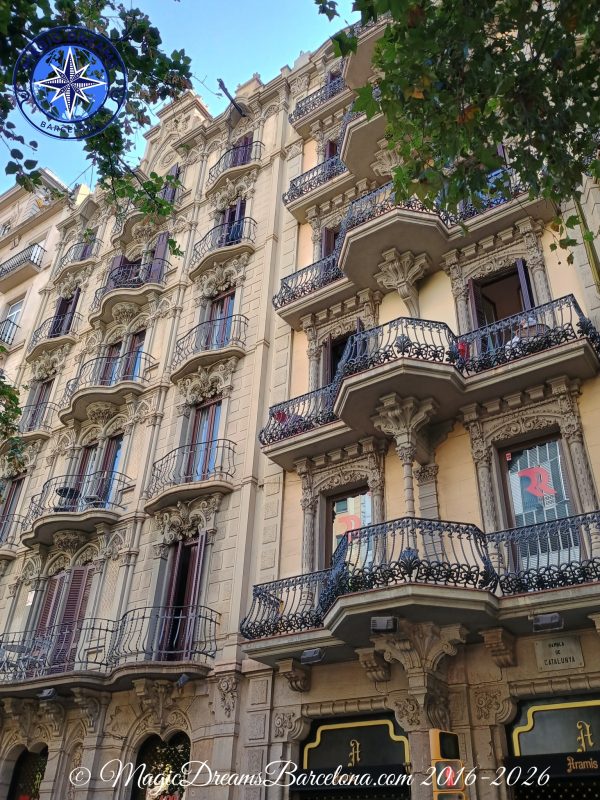
We are standing in front of the building known as Casa Verdú, located at 103 Rambla de Cataluña, at the intersection with Provenza Street, in the emblematic Eixample district of Barcelona.
This property is a remarkable example of Barcelona’s Modernist architecture. It was designed between 1903 and 1904 by architect Maurici Augé i Robert, with later contributions by Melcior Viñals and Salvador Viñals, which further enriched its artistic and architectural value.
The chamfered façade reflects the characteristic layout of Barcelona’s urban expansion, yet it stands out for its refined ornamental composition. Among its most notable features are the wrought iron balconies, showcasing organic and flowing forms inspired by nature; the glazed ceramic elements, introducing a subtle polychromy typical of the Modernist style; and the window and lintel moldings, decorated with delicate floral and geometric motifs.
Particularly noteworthy is the vertical axis at the corner, conceived as the main compositional element, which visually organizes the entire building and gives it a distinguished urban presence.
For collaborations, projects or professional inquiries – Reservations and quotes
Please leave your details and phone number, and we will get in touch with you as soon as possible, within the same day.
Avinguda de Pau Casals is one of the most emblematic and elegant avenues in Barcelona, located next to the historic Turó Park in the Sant Gervasi-Galvany neighborhood, within the Sarrià-Sant Gervasi district. This avenue combines cultural history, distinguished residential architecture, and one of the city’s …
Architecture, design, art, and innovation converge at Mirador Torre Glòries, one of the most iconic cultural and sensory experiences in contemporary Barcelona. Located at the intersection of Avinguda Diagonal and Carrer de Badajoz, near Plaça de les Glòries, Torre Glòries marks the gateway to the …
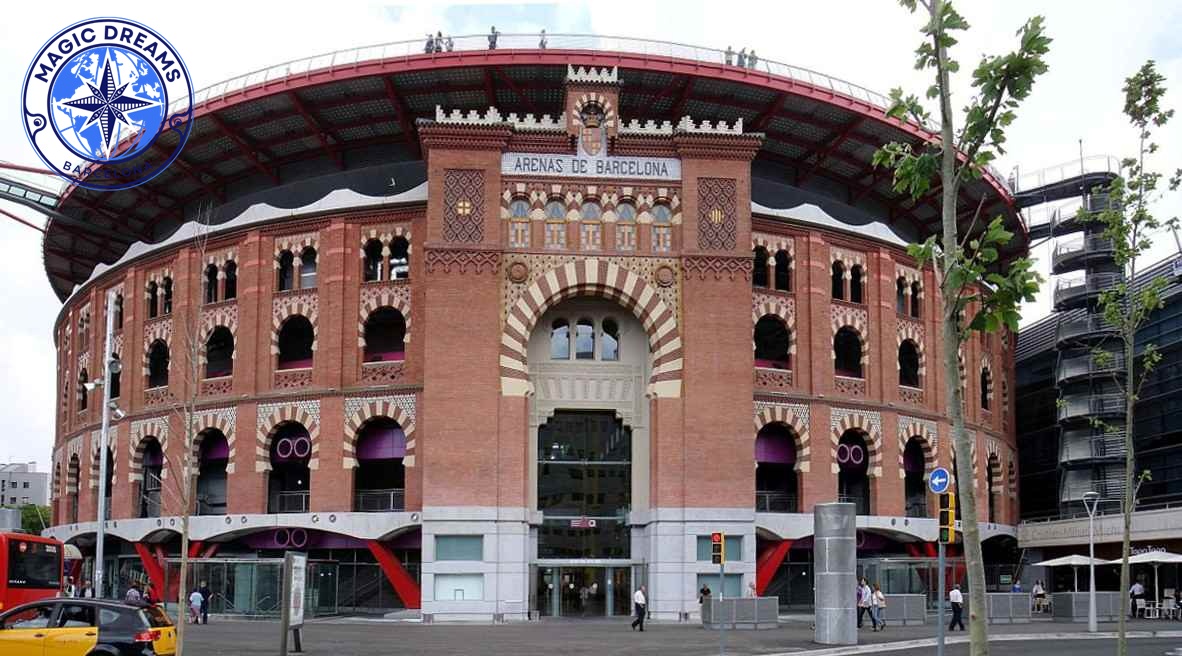
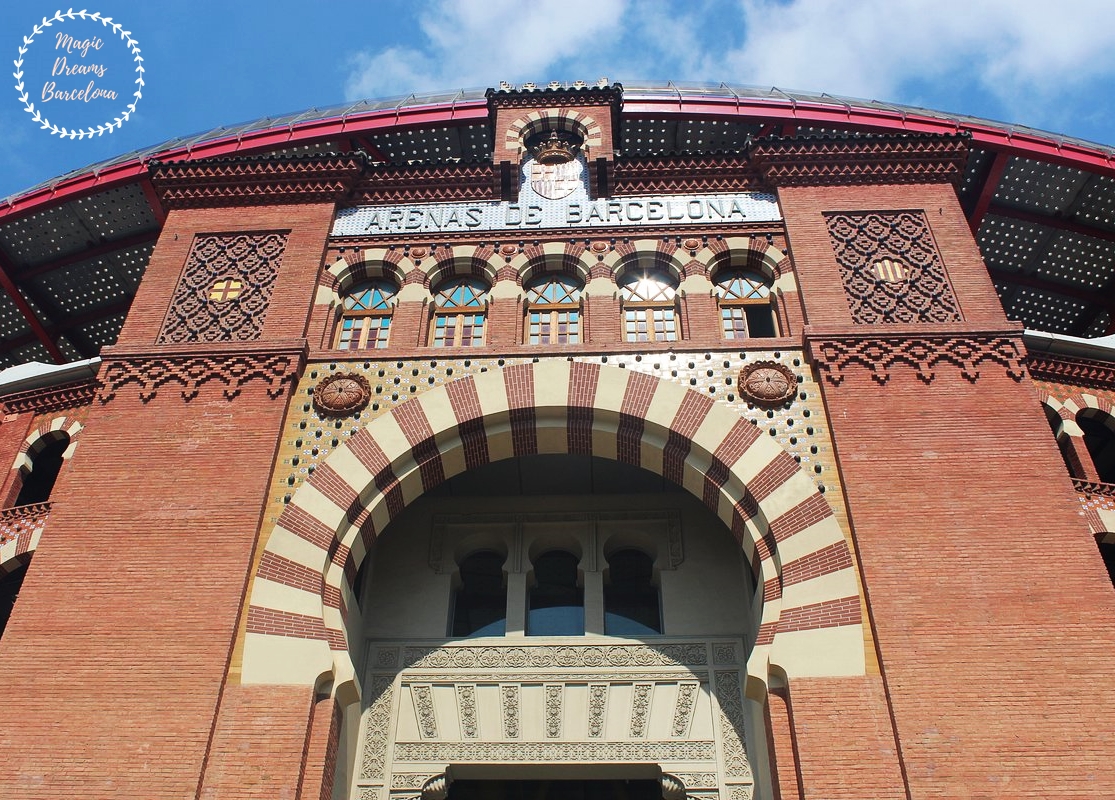
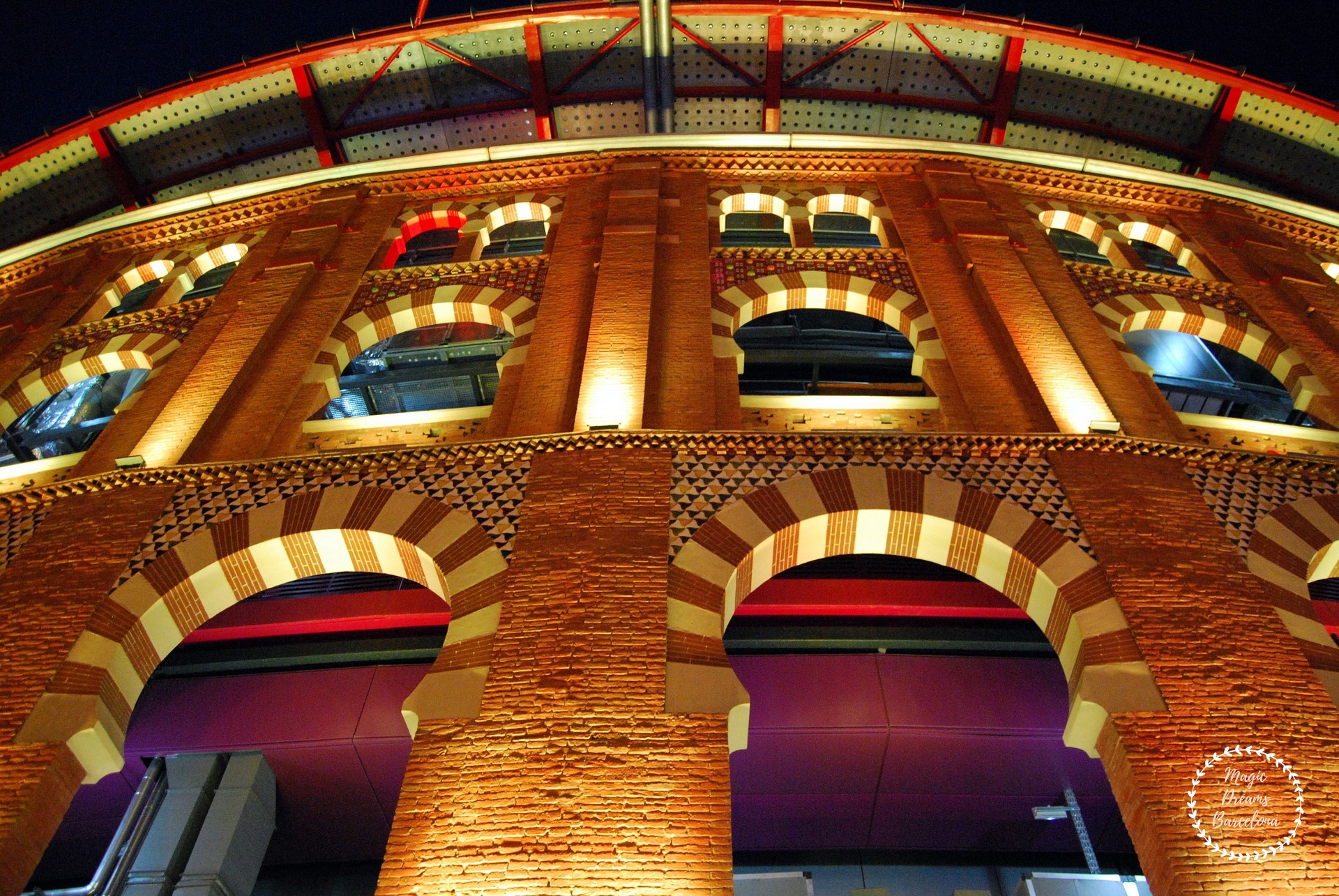
At the foot of Plaza de España stands Arenas de Barcelona, an icon of urban transformation — a space where past and present engage in dialogue through architecture, culture, and emotion.
Built in 1900 by architect August Font i Carreras in Neo-Mudéjar style and promoted by Josep Marsans, a prominent figure of Barcelona’s bourgeoisie, the former bullring hosted bullfights, circus performances, sporting events, and unforgettable concerts by artists such as Santana and Paco de Lucía. For decades, it was a vibrant cultural stage in the life of the city.
After bullfighting ceased in 1977, the building entered a long period of silence until its ambitious rebirth at the turn of the 21st century. The Sanahuja family (Sacresa) entrusted its transformation to British architect Richard Rogers, in collaboration with Alonso Balaguer Arquitectos, in one of Barcelona’s most daring architectural interventions.
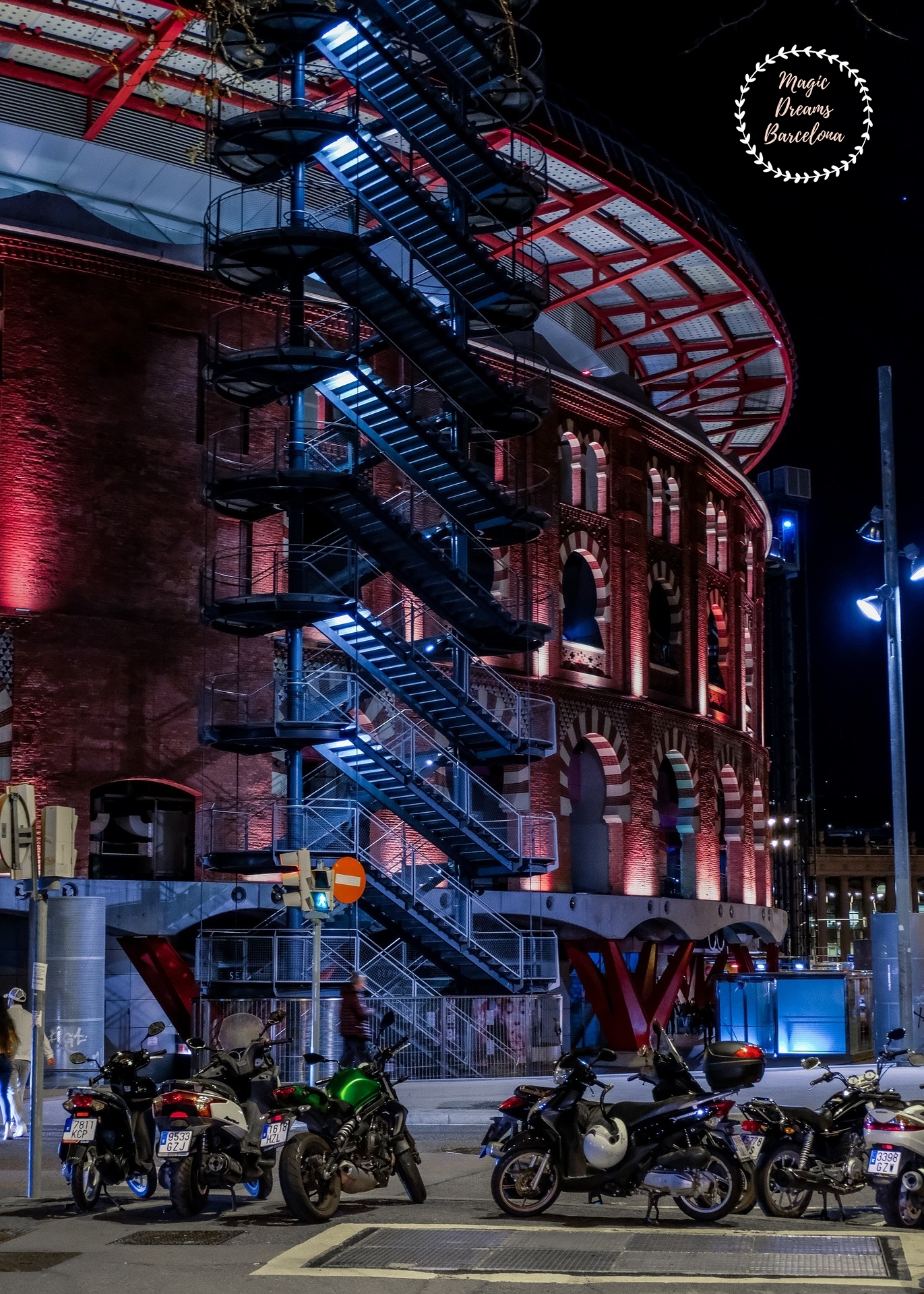
The restoration was an engineering feat: the historic façade was elevated and temporarily supported by steel towers to allow excavation beneath it for a vast underground parking structure. A reinforced concrete ring was later introduced, creating a double architectural skin that preserved the original exterior while constructing an entirely new interior life.
Reopened in March 2011, Las Arenas now features a luminous central atrium, more than 100 retail stores, twelve cinema screens, fitness facilities, signature restaurants, and cultural spaces such as the Rock Museum showcasing the Jordi Tardà collection.
Above, a floating steel-and-glass dome spanning over 70 meters crowns the structure, leading to a 360° panoramic rooftop terrace — one of Barcelona’s finest urban viewpoints. From there, the city unfolds serene, majestic, and deeply inspiring.
Las Arenas is not merely a shopping center. It is an urban landmark — a symbol of Barcelona’s ability to reinvent itself without renouncing its memory.
Practical Information
Location: Gran Via de les Corts Catalanes, 373–385 · Plaça d’Espanya · Barcelona
Transport: Metro: Espanya (L1 – Red Line / L3 – Green Line) Bus: 13, 23, 30, 37, 46, 50, 65, 79, 91, 109, H12, H16, 150
Centro Comercial Las Arenas.
Centro Comercial Las Arenas.
Perspectiva exterior a pie del centro comercial «Las Arenas» de Barcelona.
Centro Comercial Las Arenas.
Centro Comercial Las Arenas.
Perspectiva exterior a pie del centro comercial «Las Arenas» de Barcelona.
Where History, Art, and the Mediterranean Lifestyle Converge Plaça de Catalunya is the epicentre of Barcelona, a vibrant meeting point where the historic district of Ciutat Vella meets the modern Eixample neighbourhood. Considered one of the city’s most iconic public spaces, the square connects some …
Introduction In Barcelona, beyond the major modernist icons, there are lesser-known buildings with significant architectural value. One of these is the Ramon Servent House, a unique work located in the Gràcia neighborhood that stands out for its modernist composition and a singular element: the four …
The Güell Pavilions: Elegance, Symbolism, and the Beginnings of Gaudí’s Universe
In the upper part of Barcelona, in the historic surroundings of Pedralbes, stands one of Antoni Gaudí’s most fascinating architectural ensembles: the Güell Pavilions.
Less internationally renowned than the Sagrada Família, Park Güell, or Casa Batlló, the Güell Pavilions possess extraordinary value: they were among the first major works Gaudí created for Eusebi Güell, the entrepreneur, patron, and key figure in the architect’s career.
Built between 1884 and 1887, the pavilions formed part of the monumental entrance to the former Güell family country estate. Gaudí worked not only on the two pavilions, but also on the gardens, perimeter wall, and various gates providing access to the property.
This was the beginning of a professional and patronage relationship that would have a profound influence on Catalan architecture: the collaboration between Antoni Gaudí and Eusebi Güell.
An Early Work That Already Announces the Great Gaudí
1884–1887: Nature, Geometry, and Craftsmanship
The Güell Pavilions belong to Gaudí’s early period, yet they already contain many of the principles that would later define his architecture.
Parabolic arches, vaults, domes, exposed brick, stone, ceramics, and wrought iron are combined with extraordinary formal freedom.
Gaudí did not conceive the buildings as merely functional constructions. Even in a complex intended for practical purposes such as security, stables, and access to a private estate, he introduced a visual universe filled with natural, geometric, and mythological references.
The Güell Pavilions therefore offer an opportunity to observe a young Gaudí experimenting with solutions that would later reach far greater complexity in his mature works.
The Former Güell Estate
The Setting for an Extraordinary Architecture
Eusebi Güell had considerably expanded an extensive property located in this part of Barcelona, then associated with the territory of Les Corts de Sarrià.
The estate served as a residence and recreational retreat for the family and included gardens, paths, entrances, and various buildings.
Gaudí was commissioned to intervene in this ensemble and created a monumental entrance capable of announcing the importance of the property from the outside.
The former estate no longer exists as it once did. The surroundings have changed profoundly, and part of the land is now associated with the university district and the area around the Palau Reial de Pedralbes.
Nevertheless, the pavilions preserve the memory of this great bourgeois estate and help us understand the relationship between architecture, landscape, and social representation in late nineteenth-century Barcelona.
Two Pavilions, Two Functions
The Gatehouse and the Stables
The complex preserves two principal buildings.
One was intended as the gatekeeper’s house or porter’s lodge, while the other served as the stables, associated with the estate’s horses and carriages. The complex also included a riding arena and other elements connected with the entrance and operation of the property.
The gatehouse stands out for its compact composition, geometric form, and dome.
The stables feature an especially interesting structural solution, with parabolic arches supporting the brick vaults.
These solutions are not merely decorative.
Gaudí uses geometry as a construction tool, allowing the structure itself to become an essential part of the building’s beauty.
The Dragon Gate
Ladon, Guardian of the Garden of the Hesperides
If there is one element that has made the Güell Pavilions such an iconic image of Gaudí, it is their spectacular wrought-iron gate.
At its centre appears an enormous dragon with outstretched wings, an open mouth, and an extended tongue.
But this dragon is not a generic representation, nor does it correspond to the traditional dragon of Saint George.
It is identified with Ladon, the dragon who, according to classical mythology, guarded the Garden of the Hesperides, famous for containing a tree bearing golden apples that granted immortality.
The reference is also connected with L’Atlàntida, the celebrated epic poem by Jacint Verdaguer, a work that held particular importance within the cultural imagination of the period.
Gaudí thus transforms a functional gate into an authentic mythological scene.
The visitor does not simply encounter a gateway: symbolically, they pass into a garden protected by a fantastic creature.
A Dragon Transformed into Architecture
Iron, Movement, and Symbolism
The extraordinary iron gate demonstrates the importance Gaudí placed on craftsmanship.
The dragon is not positioned as an independent sculpture on the gate. The figure itself forms part of the structure and design of the entrance.
The composition has also been associated with the constellation of Draco, reinforcing the connection between mythology, astronomy, and nature.
The result is a piece in which engineering and imagination cease to be separate disciplines.
The iron acquires movement.
The wings seem to extend above the visitor.
The head guards the entrance.
And the entire composition transforms a carriage gate into one of the most singular elements of Gaudí’s architecture.
Ceramics, Brick, and Colour
Material as an Integral Part of Architecture
At the Güell Pavilions, Gaudí experimented with a combination of materials that would later become enormously important throughout his career.
Exposed brick, stone, ceramics, and metal elements create a visual language in which structure and ornamentation are deeply integrated.
The roofs and various architectural elements incorporate ceramic pieces in different colours, creating vibrant surfaces that change according to the light.
Geometric decoration coexists with vegetal references and forms inspired by nature.
The work demonstrates that Gaudí did not understand a building as a box to which decoration was subsequently added.
For him, construction and ornamentation could form a single, unified whole.
The Parabolic Arches
One of Gaudí’s Great Architectural Keys
One of the most fascinating elements of the Güell Pavilions is the use of parabolic arches.
This solution allows loads to be distributed efficiently while simultaneously creating interiors of extraordinary visual power.
In the stables, the arches and brick vaults create architecture of remarkable expressiveness.
This combination of calculation, structure, and beauty anticipates some of the principles Gaudí would later develop on a much larger scale.
The Güell Pavilions are therefore a particularly interesting place to understand Gaudí the architect before the mature period of works such as Park Güell, Casa Batlló, and Casa Milà.
The Garden and Nature
Gaudí Before Park Güell
One of the lesser-known characteristics of the complex is that Eusebi Güell’s commission was not limited to the buildings.
Gaudí also intervened in the gardens of the estate, designing elements related to circulation, entrances, and the organisation of the exterior space.
This relationship between architecture and landscape is particularly interesting because it reveals one of the principles that would later become fundamental to Park Güell.
Architecture does not end at the walls.
The building forms part of a landscape, and the landscape participates in the architectural experience.
The Hercules Fountain
Another Symbolic Element of the Former Estate
Within the historic complex of the Güell Estate, the Hercules Fountain is also preserved, linked to the mythological programme that characterises different elements of the site.
Its presence reinforces the relationship between the complex and the classical world, particularly with the story of Hercules and the Garden of the Hesperides.
The dragon, the references to Hercules, and Verdaguer’s literary tradition transform this area of the former estate into a space where architecture, literature, and mythology are closely intertwined.
The Beginning of a Decisive Relationship
Gaudí and Eusebi Güell
The Güell Pavilions possess an importance that extends far beyond their dimensions.
They represent the beginning of a professional relationship between Gaudí and Eusebi Güell that would subsequently give rise to some of the most important works of Catalan architecture.
Projects such as Palau Güell, Park Güell, and the Crypt of Colònia Güell, among other collaborations, would follow.
Eusebi Güell was not simply a client.
He was a patron who gave Gaudí the opportunity to experiment, develop new ideas, and take architecture into increasingly personal territories.
Historical Heritage
A Protected Monument Since 1969
The Güell Pavilions were declared a National Historic-Artistic Monument in 1969, a recognition confirming their importance within Catalonia’s architectural heritage.
The complex has undergone various restoration and conservation works over the years.
The municipal intervention carried out in 1999 formed part of the efforts to preserve this heritage and maintain its architectural and decorative elements.
A Different Way of Experiencing Gaudí
A Place for Observing the Details
The Güell Pavilions do not offer the monumental scale of the Sagrada Família or the dimensions of Park Güell.
Their appeal is different.
Here, the experience lies in observing.
Looking at the dragon.
Discovering how iron is transformed into a mythological creature.
Observing the parabolic arches.
Recognising the combination of brick and ceramics.
Understanding how a gate can become a work of art.
And discovering how, behind a relatively small complex, we can already see the language of an architect who would forever transform the image of Barcelona.
Where Are the Güell Pavilions?
Pedralbes, Barcelona
The Güell Pavilions are located on Avinguda de Pedralbes, in the area around the university district and the Palau Reial.
It is a particularly interesting location for combining the visit with other places of interest in Barcelona, such as the Palau Reial de Pedralbes, the Pedralbes Gardens, and various university and Modernist sites in the area.
How to Get There
A Well-Connected Area
Metro: L3, Palau Reial station.
Tram: T1, T2, and T3, Palau Reial stop.
Bus: various routes operate along Avinguda Diagonal and throughout the Pedralbes area.
On foot: the site can easily be combined with a walk along Diagonal Avenue and through the Pedralbes Gardens.
By bicycle: the area has cycling connections and is convenient for exploring the surrounding neighbourhood.
Before travelling, we recommend checking access arrangements for the site, as visiting conditions and opening hours may vary due to conservation works or cultural programming.
Completing the Experience
Gastronomy After Discovering Gaudí
Santa Clara
Located in the Pedralbes area, Santa Clara offers a Mediterranean gastronomic experience with international influences, based on fresh, seasonal produce.
Its menu combines a variety of sharing dishes with fish, meat, rice dishes, and proposals designed for a relaxed meal in an elegant setting.
Specialities include oysters, Cantabrian anchovies, steak tartare, ceviche, grilled octopus, fish, rice dishes, and various cuts of meat.
As a general reference, the average price is around €34 per person, while some set-menu options may be available for around €32, depending on the conditions and season.
Thanks to its atmosphere and location, Santa Clara can be an appealing choice for completing a day dedicated to discovering the architecture and heritage of Pedralbes.
Just a few minutes from the Güell Pavilions, Aspic, located at Carrer del Doctor Ferran, 23, is a long-established gastronomic venue in the Les Corts and Pedralbes area.
Aspic combines a restaurant with a specialised gastronomic offering, featuring Mediterranean cuisine and particular attention to the quality of its ingredients. In addition to its restaurant service, the brand offers a gourmet and catering line, with preparations designed for celebrations and private experiences.
Its offering is particularly interesting for those looking for a relaxed meal after visiting the Güell Pavilions, as it is located in the same Pedralbes area.
As a general reference, it currently appears to be in the approximately €30–40 per-person price range.
Aspic also offers restaurant service during different time periods, with lunch and dinner service on certain days of the week. Opening hours may vary, so we recommend checking availability before visiting.
For an experience with Magic Dreams Barcelona, both restaurants can be incorporated into a personalised day combining architecture, gastronomy, history, and heritage, adapting the itinerary and gastronomic experience to each visitor’s preferences.
Experiences with Magic Dreams Barcelona
Our tour guides are native speakers of Spanish, Catalan, English, and other languages upon request. They are experts in history, architecture, art, symbolism, and botany, including lepidopterology, ornithology, floriculture, and arboriculture, and specialise in experiences connected with Antoni Gaudí and Salvador Dalí.
With Magic Dreams Barcelona, you can discover the secrets of Barcelona from a different perspective: cultural, artistic, and sensory.
We organise one-day experiences, weekend escapes, and personalised stays throughout Barcelona, the Costa Brava, and the Catalan Pyrenees, adapting each experience to your preferences.
We can take care of the complete logistics, including:
Private chef offering national, Catalan, and international cuisine at your accommodation.
Breakfasts, lunches, and dinners inspired by different periods and cultures.
Live music, including piano, violin, or opera, upon request.
Floristry services.
Professional photography sessions.
Exclusive gastronomic routes.
Premium tickets to museums and events.
Sensory picnics in gardens, by the sea, or aboard a yacht.
Specialised sensory guides.
Exclusive workshops in Trencadís, Surrealism, gastronomy, floral art, and fragrances.
Hawaiian Lomi Lomi massages by the sea, accompanied by fruit baskets and gifts.
Spas, thermal circuits, and saunas.
Excursions and hiking.
Private vehicles and personalised logistics.
Our accommodations are carefully selected to create a comfortable, elegant experience that is coherent with the overall style of the journey.
We also design personalised themed experiences after learning about your preferences, from a day dedicated to Gaudí to a complete escape through the Costa Brava or the Catalan Pyrenees.
The Güell Pavilions: A Gateway into Gaudí’s Universe
The Güell Pavilions do not need monumental dimensions to make an impression.
Their power lies in the details.
In the iron dragon.
In the parabolic arches.
In the ceramics.
In the geometry.
In the relationship between architecture and nature.
And, above all, in the opportunity to contemplate one of the earliest great manifestations of Antoni Gaudí’s personal architectural language.
Here, at the former entrance to the Güell Estate, one of the most important collaborations in Catalan architecture begins.
A gate guarded by a mythological dragon thus becomes more than an entrance.
It becomes the gateway to a creative universe that would forever transform Barcelona.
With Magic Dreams Barcelona, we invite you to discover it from a different perspective: through history, architecture, art, nature, and emotion.
Pabellones de la Finca Güell – By Enric – Own work, CC BY-SA 4.0, https://commons.wikimedia.org/w/index.php?curid=62605211.
For collaborations, projects or professional inquiries – Reservations and quotes
Please leave your details and phone number, and we will get in touch with you as soon as possible, within the same day.
Discover one of Barcelona’s historic avenues, its landmark buildings, and the best places to eat while exploring the city’s historic centre. Via Laietana is one of Barcelona’s most distinctive avenues. Located in the heart of Ciutat Vella, it connects the area around Plaça d’Urquinaona with …
Descubra una de las avenidas históricas de Barcelona, sus edificios emblemáticos y los mejores lugares donde comer durante un paseo por el centro histórico. Vía Layetana es una de las avenidas más singulares de Barcelona. Situada en el corazón de Ciutat Vella, conecta el entorno …
A masterpiece of engineering that transformed Barcelona’s skyline
The Torre Sant Sebastià is one of the most distinctive metal structures along Barcelona’s maritime landscape. Located in the Barceloneta district, next to Moll Nou, this impressive steel construction rises approximately 78.4 metres above the harbour, making it one of the most prominent landmarks along Barcelona’s waterfront.
Its silhouette, formed by a complex metal lattice structure and diagonal bracing, evokes the aesthetic of the great European engineering works of the early twentieth century. However, its significance extends far beyond its architectural presence: the tower serves as the terminal station of the historic Transbordador Aeri del Port, the suspended cable transport system that crosses Barcelona Harbour and offers extraordinary views of the city.
Conceived in connection with the 1929 Barcelona International Exposition and inaugurated in 1931, the tower represents a decisive moment in the city’s technological and urban development.
Over almost a century, it has witnessed the transformation of the harbour, the conflicts that shaped Spanish history, and Barcelona’s evolution from a predominantly industrial and maritime city into one of the Mediterranean’s leading cultural capitals.
Torre Sant Sebastià is, at once, an engineering feat, a monument to industrial heritage, and a privileged window onto Barcelona’s maritime history.
The Origins of Torre Sant Sebastià
The dream of connecting the harbour with Montjuïc Mountain
The history of the tower is closely linked to one of Barcelona’s major modernisation projects during the first decades of the twentieth century.
In 1929, the city hosted the International Exposition, an event intended to project an image of modernity, progress, and innovation. The main exhibition grounds extended across Montjuïc Mountain, while maritime and port-related activities occupied another important area of the city.
The idea emerged of establishing an aerial connection between these two sectors, taking advantage of the possibilities offered by cable transport technology.
The project was conceived in 1926 by engineer Carles Buïgas, also known for his contribution to the development of the celebrated illuminated fountains of Montjuïc. Ramón Calzada and Josep Maria Roda also collaborated on the initiative, playing important roles in its development.
The proposal aimed to create a direct link between the waterfront and the mountain, avoiding the need to travel overland around the port facilities while offering an unprecedented panoramic experience.
However, the project encountered significant financial difficulties. The necessary private investment was not secured until 1928, too late for construction to be completed before the opening of the International Exposition.
Buïgas eventually withdrew from the initiative, and Josep Maria Roda took responsibility for continuing the project.
Construction finally progressed between 1929 and 1931, producing an infrastructure that would permanently transform Barcelona’s harbour skyline.
A Steel Structure Facing the Mediterranean
The elegance of industrial engineering
Torre Sant Sebastià stands out for its metal lattice structure, a construction method characteristic of major engineering projects from the late nineteenth and early twentieth centuries.
Its framework consists of steel sections that distribute loads and provide stability through a combination of vertical, horizontal, and diagonal elements.
Unlike traditional buildings, whose mass is supported by stone or brick walls, the tower visually expresses its own structural system.
The eye can follow its framework, understand the arrangement of its components, and appreciate how each element contributes to the stability of the whole.
The structure has a square plan and rests on concrete foundations designed to ensure stability in terrain affected by its proximity to the sea and the former coastal sandbanks.
The characteristics of the subsoil required careful foundation planning, with considerable depth needed to reach suitable supporting ground.
At the top, a larger structure houses the cable car station and the spaces associated with the tower’s installations.
This arrangement creates a particularly interesting contrast: a slender, open base supports a more compact upper section, where the cable transport system’s activity is concentrated.
The tower reaches approximately 78.4 metres in height, allowing it to dominate the surrounding harbour area and stand out above the urban fabric of Barceloneta.
Its design reflects an era when industrial engineering was beginning to acquire aesthetic value in its own right.
Torre Sant Sebastià and the Transbordador Aeri del Port
A suspended journey between the sea and the mountain
The tower was not conceived as an isolated monument, but as part of an aerial transport system that remains one of Barcelona’s most distinctive examples of technological heritage.
The Transbordador Aeri del Port, also known as the Port Cable Car, connects the Barceloneta area with Montjuïc Mountain by crossing the harbour.
The system has three main points:
Torre Sant Sebastià, located in Barceloneta, next to Moll Nou.
Torre Jaume I, built at Moll de Barcelona, near the present-day World Trade Center.
Miramar Station, located on the slopes of Montjuïc.
The complete route covers approximately 1,292 metres, offering views of the harbour from a perspective that is difficult to experience from the ground.
The cabins travel suspended from the cables, providing changing views of the docks, ships, beaches, and Barcelona’s urban skyline.
The complete journey typically takes around ten minutes, although the duration may vary depending on operating conditions.
Torre Sant Sebastià forms one end of this system and, through its location, establishes a direct connection between the urban fabric of Barceloneta and the maritime environment.
From this vantage point, the city can be perceived differently: the harbour becomes more than a transport and commercial infrastructure, revealing itself as a vast and visually compelling landscape.
Torre Jaume I
The great suspended pillar at the heart of the harbour
To understand the full scale of the Transbordador Aeri del Port, it is necessary to examine its intermediate structure: Torre Jaume I.
Located at Moll de Barcelona, this metal tower reaches approximately 107 metres in height and forms the central element of the route between Barceloneta and Montjuïc.
Its presence serves a strictly technical purpose. The distance between the two endpoints made an intermediate structure necessary to support and organise the cable system.
Torre Jaume I shares the architectural language of early twentieth-century metal engineering with Torre Sant Sebastià, although its silhouette is more slender and its upper section has a different composition.
Its height makes it one of the most prominent features of the harbour landscape.
For decades, the two towers have formed inseparable visual landmarks on Barcelona’s skyline, particularly when viewed from the beaches, the seafront promenade, and the harbour’s open spaces.
The relationship between these structures demonstrates that the project involved much more than building a tall tower. It required the design of an integrated system in which architecture, engineering, and transport had to work together.
The Inauguration of 1931
A new way to admire Barcelona
The cable car was inaugurated on 11 September 1931, two years after the International Exposition for which it had originally been conceived.
Its opening marked the culmination of a project that had required substantial investment, complex technical planning, and several years of work.
The journey between Torre Sant Sebastià and Miramar Station offered an innovative experience for its time. Passengers could travel above the harbour and admire a landscape that had previously been seen mainly from the docks, vessels, or elevated areas of Montjuïc.
In its early years, the system operated in two separate sections, with Torre Jaume I serving as the intermediate point.
The cabins operating along each section allowed passengers to travel between the waterfront and the mountain, although a transfer at the central station was necessary.
The installation incorporated engineering solutions that were advanced for its time and demonstrated the potential of aerial cable transport in an urban environment.
The inauguration in 1931 thus established one of the most original infrastructures of modern Barcelona.
The Spanish Civil War
When the towers became witnesses to conflict
The history of Torre Sant Sebastià is also marked by one of the most dramatic episodes of twentieth-century Spanish history.
During the Spanish Civil War, the Transbordador Aeri del Port ceased operating. The cables were removed, and the installations were taken out of service.
The strategic position of the towers, overlooking the harbour and providing extensive views of the maritime surroundings, meant that they acquired a role associated with Barcelona’s defence.
The civilian infrastructure thus became connected with the military needs of a harbour that was of fundamental importance to the city.
Bombing and the circumstances of the conflict prevented the service from being restored once the war had ended.
For years, the towers stood as isolated structures in the harbour landscape, reminders of a technological project interrupted by history.
Nevertheless, their presence retained considerable symbolic value. Although the cable car no longer operated, its structures remained part of Barcelona’s skyline.
The Return of the Cable Car
From abandoned infrastructure to a restored landmark
Following the end of the Spanish Civil War, restoring the system was not an immediate priority.
The installations remained closed for years, and uncertainty surrounded their future. Deterioration, repair costs, and the difficulties involved in resuming operations even led to the possibility of dismantling the towers.
The situation began to change in the late 1950s, when Teleféricos de Barcelona, S. A., took over the installations.
Finally, on 20 May 1963, the cable car resumed operations, restoring its role as an aerial connection between Barceloneta and Montjuïc.
The reopening brought new life to an infrastructure that had remained inactive for more than two decades.
The panoramic journey once again became part of Barcelona’s tourist offering, while the towers returned to their original function.
However, the passage of time once again raised questions concerning conservation and maintenance.
In 1995, the service was suspended once more to allow the installations to undergo rehabilitation.
The Restoration of the Towers
The restoration of the Transbordador Aeri del Port was an important undertaking in the preservation of Barcelona’s industrial heritage.
The Sant Sebastià and Jaume I towers, together with the rest of the installations, underwent restoration work intended to recover their structural condition and original appearance.
The interventions took place during the second half of the 1990s and around the turn of the century, as part of a process that restored prominence to these historic structures.
Restoring a metal structure exposed to the marine environment for decades requires particular care.
Humidity, salinity, and atmospheric conditions accelerate steel corrosion, making regular inspections of joints, structural sections, protective coatings, and mechanically stressed components essential.
For structures of this kind, preserving the exterior appearance is not enough. Their stability and the safety of their installations must also be ensured.
The restoration of the towers helped preserve a complex that forms part of Barcelona’s historic and artistic heritage.
It also serves as a reminder that heritage is not limited to churches, palaces, or residential buildings. Industrial and transport infrastructures are equally important elements of a city’s cultural history.
A Station Elevated Above the Mediterranean
Architecture in the service of a panoramic experience
One of Torre Sant Sebastià’s most distinctive features is its relationship with the surrounding landscape.
From its position beside the sea, the tower creates a visual dialogue between the city, the beaches, and the harbour facilities.
Its height makes it possible to understand the layout of Barcelona’s coastline and observe the relationship between the urban fabric of Barceloneta, the docks, and the harbour’s opening towards the Mediterranean.
The experience changes depending on the viewpoint.
From the ground, the tower appears as a monumental structure rising above its urban surroundings.
From the sea, its silhouette forms part of the collection of infrastructures that define Barcelona’s waterfront.
From the cable car cabins, the landscape gradually unfolds between different parts of Barcelona, from the activity of the harbour to the green spaces of Montjuïc.
This variety of perspectives makes the tower particularly interesting for understanding the relationship between architecture, engineering, and landscape.
Barceloneta and the Birth of Maritime Barcelona
A neighbourhood between seafaring traditions and urban transformation
Torre Sant Sebastià stands in an area whose history is deeply connected with the sea.
Barceloneta was established in the eighteenth century as a planned neighbourhood associated with port activity, fishing, and Barcelona’s expansion towards the coastline.
For generations, its streets were linked to maritime life, port-related occupations, and a popular culture closely connected with the Mediterranean.
Over time, the neighbourhood underwent significant changes. Fishing activities coexisted with the expansion of port infrastructure, the emergence of new industrial facilities, and the development of a city increasingly open to tourism.
Torre Sant Sebastià forms part of this evolution.
Its construction introduced a new scale to Barceloneta’s landscape and established a physical and visual connection with Montjuïc.
Today, its presence helps explain how Barcelona has historically used its coastline not only as a place of economic activity, but also as a space for communication, innovation, and urban representation.
The tower is therefore a testament to the evolution of a city that has always maintained an essential relationship with the sea.
The Tower and Barcelona’s Industrial Heritage
When engineering becomes collective memory
Torre Sant Sebastià belongs to a form of heritage that is less immediately recognisable than Barcelona’s Modernista architecture, yet equally important for understanding the city’s identity.
Its value lies in the combination of several elements.
First, it represents a period of great confidence in technology and in engineering’s ability to transform urban space.
Second, it preserves the memory of a project associated with the 1929 International Exposition, an event that helped redefine Barcelona’s modern image.
Third, it provides tangible evidence of the conflicts and transformations that affected the city during the twentieth century.
Finally, its continued existence demonstrates how infrastructure originally designed for a functional purpose can gradually acquire historical, scenic, and cultural significance.
The cable car towers are more than supports for cables. They are steel documents preserving the memory of an era and explaining how technical innovation can also become heritage.
The Landscape from Above
A different view of the harbour and the city
The Transbordador Aeri del Port offers a privileged perspective on some of Barcelona’s most significant settings.
During the journey, passengers can take in the docks, vessels, beaches, and waterfront, while the outline of Montjuïc becomes increasingly prominent as the cabin approaches the mountain.
In the opposite direction, the urban skyline unfolds above the Mediterranean.
The experience offers a better understanding of the harbour’s scale and the relationship between maritime infrastructure and the city’s growth.
It also provides an opportunity to observe Barcelona from a viewpoint different from its streets and squares.
The city then appears as an interconnected composition of neighbourhoods, open spaces, port installations, and architectural landmarks.
Torre Sant Sebastià serves as the starting or finishing point of this journey, but its significance extends beyond the ride itself.
It is an invitation to discover the city from another perspective.
Torre Sant Sebastià Today
Between heritage conservation and maritime identity
In contemporary Barcelona, Torre Sant Sebastià remains one of the most prominent features of the harbour landscape.
Its silhouette recalls the period when the city embraced major engineering projects to improve its connections and project an image of modernity.
At the same time, it forms part of an environment that has undergone profound transformation, particularly since the redevelopment of the waterfront and the restoration of spaces associated with the historic harbour.
The tower retains its significance as an architectural, historical, and tourist landmark, as well as being a fundamental component of the Transbordador Aeri del Port system.
Preserving this complex presents an ongoing challenge: protecting historic infrastructure while meeting the technical and safety requirements of a transport installation.
For this reason, before planning a journey on the cable car, visitors should consult official information to confirm whether it is operating, along with current schedules, access conditions, and the availability of each section.
Regardless of its operational status, Torre Sant Sebastià retains one essential quality: it continues to form part of Barcelona’s visual memory.
What to Look for at Torre Sant Sebastià
A visit to discover the details of engineering
Although the tower can be appreciated particularly well from the outside, closer observation reveals numerous architectural and historical details.
During a visit to Barceloneta and the surrounding harbour area, it is worth taking time to examine the following features:
The metal structure: its steel sections and diagonal elements illustrate how loads are distributed and the stability of the structure is achieved.
The steel bracing: the diagonal components reinforce the structure and form part of its characteristic geometry.
The foundations: their relationship with the ground highlights the challenges of constructing a tall structure near the former coastal sandbanks.
The upper section: this houses the cable car station and concentrates the functional elements of the transport system.
The relationship with Torre Jaume I: observing both structures helps explain the organisation of the cable car and its route across the harbour.
The maritime landscape: the tower’s location offers a privileged perspective on the harbour surroundings and Barcelona’s historic relationship with the Mediterranean.
Taking the time to observe these elements transforms a simple stop beside the harbour into an opportunity to discover architectural and engineering heritage.
How to Reach Torre Sant Sebastià
In the heart of maritime Barcelona
Torre Sant Sebastià is located next to Moll Nou, in the Barceloneta area.
Reference address: Moll Nou, Barcelona.
Its location makes it easy to combine a visit with a walk through Barceloneta, along the seafront promenade, or around the Port Vell area.
On Foot
From the Barceloneta seafront promenade, visitors can approach the tower by following the available pedestrian routes and signs towards the harbour.
Access conditions may vary depending on the route and which port areas are open to the public.
By Metro
Barceloneta station, on Metro line L4, is one of the nearest public transport options for reaching the area.
From there, the journey continues on foot.
By Bus
Several bus routes connect Barceloneta with other parts of Barcelona. It is advisable to check current stops and routes before setting out.
Combining the Visit with Montjuïc
The tower can be included in a day devoted to discovering Barcelona’s maritime heritage and the historic sites of Montjuïc.
If the cable car is operating, the aerial journey offers a particularly attractive connection between these two areas.
An Experience That Goes Beyond a Tower
History, architecture, and emotion beside the Mediterranean
Discovering Torre Sant Sebastià means exploring a part of Barcelona that often goes unnoticed alongside the popularity of the city’s great Modernista monuments.
Here, beauty does not come from carved stone or ornamental façades, but from the precision of a metal structure, the boldness of an engineering solution, and the relationship between a human creation and the maritime landscape.
Would You Like to Discover Maritime Barcelona with Us?
Torre Sant Sebastià from a different perspective
Barcelona’s history does not end with its great monuments. It can also be found in its historic paths, gardens, seafaring neighbourhoods, industrial infrastructure, and the landscapes that have accompanied the city’s evolution.
At Magic Dreams Barcelona, we see every visit as an opportunity to discover the less obvious connections that allow us to understand a place in all its depth.
Our native guide, specialising in architecture, botany, and ornithology, accompanies each experience with an informed, approachable, and sensitive perspective on cultural and natural heritage.
We organise day trips, weekend getaways, multi-day stays, and personalised tours of Barcelona, the Catalan Pyrenees, and the Costa Brava.
We can combine maritime heritage with walks through Barceloneta, explorations of Port Vell, visits to Montjuïc, and experiences dedicated to architecture, nature, and the history of the city.
We also design gastronomic itineraries, picnics in exceptional settings, private cultural experiences, and activities tailored to each visitor’s interests.
Every itinerary is carefully planned around your preferences, desired pace, and the kind of experience you are looking for.
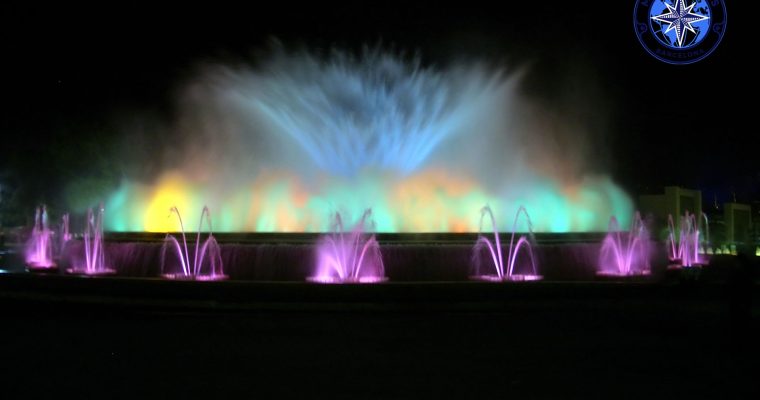
Where water, light and music come together to create one of Barcelona’s great icons Among Barcelona’s monumental landmarks, few places bring together history, architecture, engineering, art and spectacle as powerfully as the Magic Fountain of Montjuïc. Located at the foot of Montjuïc Mountain, beside Maria …
These unbaked tiles were first presented at the 1867 Paris Universal Exhibition by the company Garret, Rivet & Co. The simplicity of the technique and the low cost of materials led to this type of flooring becoming very popular in homes and buildings throughout the …
The Moll de la Fusta is one of the most emblematic spaces along Barcelona’s waterfront.
Located opposite the historic city centre, next to Port Vell, this promenade represents much more than a pleasant area by the sea.
It is the result of one of the great urban transformations of contemporary Barcelona.
For centuries, this area was closely connected to port activity, trade and the movement of goods.
Today, it is an open civic space where the Mediterranean, architecture, gastronomy, culture and urban life come together.
Walking along the Moll de la Fusta means discovering a fundamental part of Barcelona’s history.
It means seeing the place where the city began to look towards the sea once again.
And it also means understanding how Barcelona transformed a former port area into a new urban landscape.
What is the Moll de la Fusta?
The former Bosch i Alsina Wharf
The official name of the area is Moll de Bosch i Alsina, although virtually everyone knows it as Moll de la Fusta.
The nickname is connected to the activity that historically took place here, particularly the storage and distribution of timber.
The wharf forms part of the historic Port Vell, Barcelona’s old port.
Today, the area is one of the places where the city and the sea are most closely integrated.
Palm trees, promenades, terraces, boats and broad views towards the Mediterranean create an urban landscape very different from the one that existed only a few decades ago.
Barcelona’s Maritime Origins
A city born looking towards the Mediterranean
Barcelona’s relationship with the sea is much older than the present-day promenade.
The area of today’s Port Vell lies around the site of the ancient port of the Roman city.
For centuries, the waterfront was fundamental to Barcelona’s trade and economic activity.
The development of the port accompanied the growth of the city.
With the commercial and industrial expansion of the eighteenth, nineteenth and twentieth centuries, port facilities became increasingly important.
Wharves, warehouses, railway lines and cargo areas progressively occupied this waterfront.
For a long time, the port was primarily a place of work.
Citizens were physically close to the sea, but they could not necessarily enjoy it.
This separation between city and port would change radically during the final decades of the twentieth century.
The Moll de la Fusta Before Its Transformation
When the Port Was a Place of Work
For much of the twentieth century, the area we now know as the Moll de la Fusta looked completely different.
Large port warehouses occupied much of the space.
The movement of goods, railway transport and industrial activity defined the landscape.
Until the early 1980s, public access was highly restricted.
The old port warehouses gradually disappeared during the 1960s, but the port area remained separated from urban life.
The transformation that followed would aim precisely to break down this barrier.
It was not simply a question of beautifying the port.
It was about returning the sea to the city.
1981: Barcelona Opens Up to the Sea Again
The Beginning of a New Relationship Between City and Port
One of the decisive moments came in 1981.
On the occasion of Armed Forces Day, the Autonomous Port allowed citizens to access the Bosch i Alsina wharf.
It was the first time in more than seventy years that the port had opened to the city in this way.
That gesture was far more significant than it might initially appear.
Barcelona was beginning to physically recover its relationship with the Mediterranean.
The port was no longer exclusively a space for economic activity and was beginning to become a civic space as well.
The following year, the port and the City Council commissioned architect Manuel de Solà-Morales to develop a plan for the wharf and its urban surroundings.
The project also included the reorganisation of traffic along Passeig de Colom.
Manuel de Solà-Morales and the New Image of the Moll de la Fusta
Architecture Designed to Look Towards the Sea Again
Manuel de Solà-Morales’ project was much more than an aesthetic intervention.
The idea was to create a new public space beside the water while also resolving the complex relationship between the port, traffic and the historic city centre.
The works took place between 1983 and 1985.
The result was an open waterfront promenade lined with palm trees and visually connected to the city.
The intervention became one of the first major examples of waterfront regeneration in Barcelona.
The Moll de la Fusta project is considered one of the starting points for the subsequent transformation of Port Vell.
The Great Olympic Transformation
Barcelona 1992 Changes the City’s Relationship with the Sea
Barcelona’s bid and subsequent selection as host city of the 1992 Olympic Games accelerated an urban transformation that had already begun.
The city needed to recover degraded areas, improve its infrastructure and project itself towards the Mediterranean.
The Moll de la Fusta became a key element of this process.
The experience of regenerating the wharf helped drive a much broader transformation of Port Vell.
In 1988, the Port 2000 Urban Management Office was created and, the following year, the Special Plan for Port Vell was approved.
The aim was to preserve the area’s port character while introducing new commercial, tourist, cultural and civic uses.
The Moll de la Fusta had shown that it was possible.
From Industrial Port to Port Vell
A New Way of Understanding the Waterfront
The transformation of the Moll de la Fusta was not an isolated project.
It formed part of a much broader strategy to regenerate the old port.
New urban spaces and facilities were developed throughout the surrounding area.
Moll d’Espanya introduced new commercial and leisure uses.
Rambla de Mar created a new pedestrian connection over the water.
Maremagnum became one of the new activity hubs.
The Barcelona Aquarium added an educational and tourism dimension.
At Moll de Barcelona, the World Trade Center strengthened the relationship between the port and international business activity.
Barcelona was creating a new waterfront.
The Moll de la Fusta and the Olympic Games
The Sea as the Setting for the New Barcelona
The 1992 Olympic Games consolidated the transformation of the waterfront.
The renewal was not limited to Port Vell.
Barcelona created new beaches, reclaimed former industrial areas and developed the Olympic Port and other sections of the waterfront.
The result was a new urban geography.
A city that had spent decades turning its back on the sea began to use the waterfront as one of its principal public spaces.
The Moll de la Fusta was one of the first chapters in this transformation.
The Famous Chiringuitos of the Moll de la Fusta
A New Life Beside the Sea
The transformation also had a gastronomic and social dimension.
In the 1980s, five small establishments were built along the promenade.
In 1987, the City Council organised a competition to allocate these spaces, conceived as new dining venues.
The proposals included a champagne bar, a restaurant, a croissanterie, a beer bar and a seafood restaurant.
The establishments began operating in 1988.
These venues quickly became part of the new image of the Moll de la Fusta.
Barcelona was discovering a new way of enjoying its port.
Gastronomy, terraces, architecture and views of the sea were becoming part of the urban experience.
Barcelona’s Famous Prawn
A Sculpture Turned into an Icon
Among the best-remembered elements from that period is the famous Prawn, designed by Javier Mariscal.
The sculpture stood above the Gambrinus restaurant and quickly became one of the popular symbols of Barcelona’s new waterfront.
The enormous prawn belongs to the visual memory of pre-Olympic and Olympic Barcelona.
Its playful aesthetic fitted perfectly with the international image the city was creating.
The sculpture remains one of the most recognisable elements associated with the Moll de la Fusta and the Port Vell landscape.
A Transformation That Was Not Perfect
The Evolution of an Urban Space
The history of the Moll de la Fusta also demonstrates that major urban transformations take time.
The original project sought to turn the area into a large promenade dedicated to leisure and dining.
However, in subsequent years, various problems emerged concerning nightlife, commercial establishments and the relationship between the promenade and major road infrastructure.
For a period, the space lost some of the prominence it had initially enjoyed.
The opening of new facilities in other parts of Port Vell also changed visitor flows.
The city intervened once again.
A New Renovation
More Shade, More Vegetation and More Space to Walk
At the beginning of the twenty-first century, the Moll de la Fusta underwent another transformation.
The former restaurants were removed and the promenade acquired a quieter character.
New trees, paving, pergolas, shaded areas and benches facing the sea were introduced.
The aim was to reinforce its role as a place for walking and relaxation.
The intervention restored certain elements of the area’s recent history while seeking to make the space more pleasant for pedestrians.
Its evolution demonstrates how Barcelona has progressively adapted its waterfront to the needs of its citizens.
The Moll de la Fusta Today
A Place Where Barcelona Meets the Mediterranean
Today, the Moll de la Fusta is one of the great public spaces of Port Vell.
Its location is privileged.
From here, visitors can contemplate the Mediterranean while enjoying an extraordinary perspective of the historic city centre.
On one side lies the profile of Ciutat Vella.
On the other, the port and its boats.
Beyond them stretches Barcelona’s maritime horizon.
The promenade offers opportunities for walking, relaxing, enjoying activities, attending events and observing the life of the port.
The Port of Barcelona notes that the area currently hosts major public events and activities, including La Mercè celebrations and other large-scale events.
A Balcony Overlooking the Mediterranean
One of Barcelona’s Finest Urban Perspectives
One of the great virtues of the Moll de la Fusta is its ability to offer different perspectives of the city.
From the promenade, visitors can look towards:
La Rambla
The great pedestrian artery of the historic centre leads towards the port and connects the heart of Barcelona with the Mediterranean.
The Columbus Monument
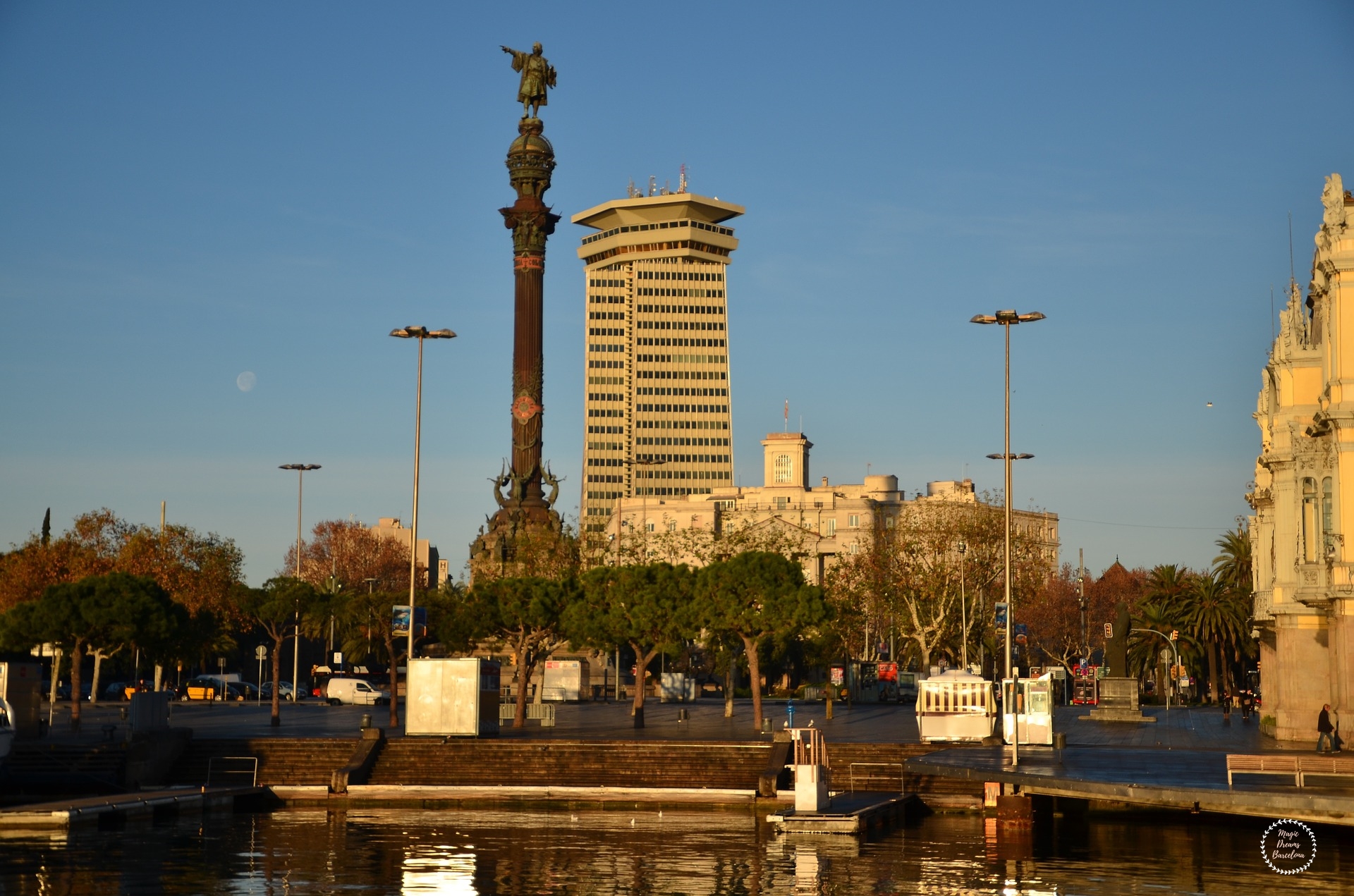
The column dedicated to Christopher Columbus has become one of the great visual landmarks of Barcelona’s waterfront.
Montjuïc
Towards the southwest, the mountain rises as a dramatic backdrop to the city.
Barceloneta
In the opposite direction stretches the maritime landscape leading towards the former fishermen’s district and the beaches.
Port Vell
The boats and marinas constantly remind visitors that this remains a living and active port.
The Architecture of the Moll de la Fusta
Infrastructure Transformed into Urban Landscape
The architecture of the Moll de la Fusta has a particular quality.
It does not seek to compete with the city’s great historic monuments.
Its value lies precisely in the way it organises space.
The relationship between different levels, the promenade, road infrastructure, palm trees, street furniture and water creates a highly distinctive spatial experience.
Manuel de Solà-Morales’ project introduced a new way of understanding the waterfront.
Infrastructure ceased to be exclusively functional and also became public space.
This idea would have an enormous influence on the subsequent transformation of Barcelona’s waterfront.
The Moll de la Fusta and the Contemporary City
One of Barcelona’s Great Examples of Urban Transformation
The importance of the Moll de la Fusta lies not only in its present-day beauty.
Its true value lies in what it represents.
Before its transformation, the port operated primarily as an industrial infrastructure separated from the city.
Afterwards, it began to become a civic space.
This transformation forms part of one of the great urban stories of Barcelona during the final decades of the twentieth century.
The city progressively reclaimed its waterfront.
New public spaces were created.
Neighbourhoods were connected.
Beaches were recovered.
Former industrial areas were transformed.
And the Mediterranean came to occupy a central place in Barcelona’s contemporary identity.
A Walk Through History and Everyday Life
Where the Port’s Past Remains Present
Despite its transformation, the Moll de la Fusta has not completely lost its past.
Traces of its former port activity can still be perceived.
Port structures.
Historic buildings.
Boats.
Former warehouses.
Major infrastructure.
All remind us that this was once a place of work.
The difference is that today this heritage is experienced from a completely different perspective.
No longer as a port worker.
But as a citizen, traveller, photographer or visitor.
Dining Beside the Sea
The Mediterranean Can Also Be Savoured
Gastronomy is an inseparable part of the Port Vell experience.
Around the Moll de la Fusta, visitors will find restaurants, terraces and places where they can enjoy Mediterranean cuisine while looking out over the harbour.
It is an especially attractive area for those who wish to combine a cultural visit with a gastronomic experience.
Fish.
Seafood.
Rice dishes.
Tapas.
Catalan cuisine.
Mediterranean produce.
And a glass of wine overlooking the sea.
Barcelona offers one of its most characteristic combinations here:
history, architecture, gastronomy and the Mediterranean.
The Moll de la Fusta at Sunset
When the City Changes Colour
One of the best times to discover the promenade is during the final hours of the afternoon.
The light begins to soften.
The façades of the historic centre take on warm tones.
The Mediterranean reflects the sky.
The boats begin to light up.
And the promenade takes on a much calmer atmosphere.
It is an especially rewarding time for photography.
And for walking without hurry.
Or simply sitting down and contemplating Barcelona.
The Moll de la Fusta at Night
Barcelona Illuminated by the Sea
At night, the promenade takes on a different personality.
The lights of Port Vell create reflections on the water and the urban skyline is transformed.
Its proximity to the historic centre makes it easy to continue towards La Rambla, the Gothic Quarter or Barceloneta.
For those looking for a more relaxed evening experience, the Moll de la Fusta offers an interesting alternative to some of the city’s busier areas.
Events and Cultural Life
An Active Space Throughout the Year
The Moll de la Fusta is not simply a place for walking.
Its large open area allows it to host major events, celebrations and large-scale activities.
Throughout the year, Port Vell becomes the setting for cultural, festive, gastronomic and maritime events.
Celebrations such as La Mercè and various port-related events form part of the programme that makes use of this civic space.
The port also maintains a strong relationship with nautical activity.
In 2026, for example, the Moll de la Fusta and Marina Port Vell are among the venues associated with the Barcelona International Boat Show, a historic event in the city’s nautical calendar.
The Moll de la Fusta and Port Vell
Two Names for Understanding the Same Transformation
It is important to distinguish between the Moll de la Fusta and Port Vell.
Port Vell is the broader area of the old port located opposite Ciutat Vella.
The Moll de la Fusta, officially Moll de Bosch i Alsina, is one of its central spaces.
From here, visitors can continue their journey towards different areas of the port.
Towards Rambla de Mar.
Towards Moll d’Espanya.
Towards Maremagnum.
Towards Moll de Barcelona.
Or towards Barceloneta.
This makes the Moll de la Fusta an excellent starting point for exploring Barcelona’s waterfront.
What to See Near the Moll de la Fusta
A Route Through Barcelona’s Maritime Centre
A visit to the Moll de la Fusta can easily be combined with other emblematic places.
01 · Columbus Monument
One of the great symbols of Barcelona’s port.
02 · La Rambla
The historic avenue connecting the city centre with the sea.
03 · Gothic Quarter
A labyrinth of medieval streets, squares and historic buildings.
04 · Port Vell
The former port transformed into one of Barcelona’s great public spaces.
05 · Maremagnum
A shopping and leisure centre located at the end of Rambla de Mar.
06 · Barcelona Aquarium
One of the city’s major facilities dedicated to marine life.
07 · Barceloneta
The former fishermen’s neighbourhood and one of the most characteristic areas of Barcelona’s waterfront.
08 · Palau de Mar
A former port commercial building that now houses, among other institutions, the Museu d’Història de Catalunya.
A Historic Route Along the Waterfront
From Ancient Barcino to Contemporary Barcelona
The Moll de la Fusta can be understood as a kind of summary of Barcelona’s evolution.
Here we can imagine the ancient Roman port.
Then the commercial port.
Later, the industrial port.
Afterwards, the port area closed to the public.
And finally, the contemporary waterfront promenade.
Few places in the city allow visitors to understand so clearly the transformation of the relationship between Barcelona and the Mediterranean.
Photography at the Moll de la Fusta
A Privileged Setting for Discovering Barcelona
The promenade offers countless possibilities for urban photography.
Palm trees create strong lines of perspective.
The water provides reflections.
Historic buildings form the backdrop.
Boats add movement.
And Mediterranean light transforms the landscape throughout the day.
Among the most interesting images are:
The Columbus Monument from the promenade.
The boats of Port Vell.
Rambla de Mar.
The profile of Ciutat Vella.
Montjuïc at sunset.
Night-time reflections on the water.
The Prawn sculpture.
The palm trees along the promenade.
The maritime activity of the port.
The Moll de la Fusta as a Mediterranean Experience
Much More Than a Waterfront Promenade
The true appeal of the Moll de la Fusta lies in the experience.
Walking beside the sea.
Feeling the Mediterranean breeze.
Watching the boats.
Discovering historic architecture.
Sitting on a terrace.
Watching the sunset.
Listening to the movement of the city.
And understanding that this same place was, for generations, a working port.
The transformation is particularly fascinating because it allows visitors to physically experience Barcelona’s evolution.
One of Barcelona’s Great Urban Stories
When a City Reclaimed Its Sea
The story of the Moll de la Fusta is, in reality, a story about Barcelona’s transformation.
For decades, the port and the city lived separately.
From the 1980s onwards, that relationship began to change.
The Moll de la Fusta was one of the first places where Barcelona experimented with a new way of relating to the Mediterranean.
Then came the renewed Port Vell, the Olympic beaches, the Olympic Port and the subsequent transformations of the waterfront.
The result is the maritime Barcelona we know today.
That is why walking along the Moll de la Fusta means much more than enjoying a beautiful promenade.
It means walking through one of the most important chapters in Barcelona’s recent urban history.
Would You Like to Discover the Moll de la Fusta with Us?
Barcelona Through the Sea, History and Architecture
At Magic Dreams Barcelona, we believe that the most fascinating places in a city are not always the ones that appear first in the guidebooks.
Sometimes, to truly understand Barcelona, you need to observe how its streets relate to the sea, how its buildings connect with history, and how its public spaces interact with everyday life.
Our native guide, specialising in history, architecture, art, botany and ornithology, can accompany you on a private experience through the Moll de la Fusta and Port Vell, tailoring the itinerary to your interests.
We can design an experience that combines the waterfront with the Gothic Quarter, La Rambla, Barceloneta, Montjuïc or Modernist architecture, creating a completely personalised day.
We can also incorporate gastronomic experiences, carefully selected restaurants, professional photography, private picnics with table settings and catering, yacht outings, floristry, musicians, romantic proposals and other experiences designed especially for each visitor.
For those who wish to discover Barcelona from a deeper perspective, we also offer itineraries focused on the city’s port history, architecture, art, gastronomy, nature and urban evolution.
Each experience is designed around the visitor’s interests, from a Premium proposal to a completely bespoke experience.
The Moll de la Fusta is not simply a promenade by the sea. It is the place where Barcelona found its way back to the Mediterranean.
Perspectiva superior del Port Vell, con el paseo del Moll de la Fusta en la parte izquierda – By Diliff – Treball propi, CC BY-SA 3.0, https://commons.wikimedia.org/w/index.php?curid=5952307.
From bullring to a stage for music and culture At the intersection of Gran Via de les Corts Catalanes and Carrer de Marina stands one of Barcelona’s most distinctive buildings. The Monumental Bullring, known simply as La Monumental, has been part of the city’s architectural, …
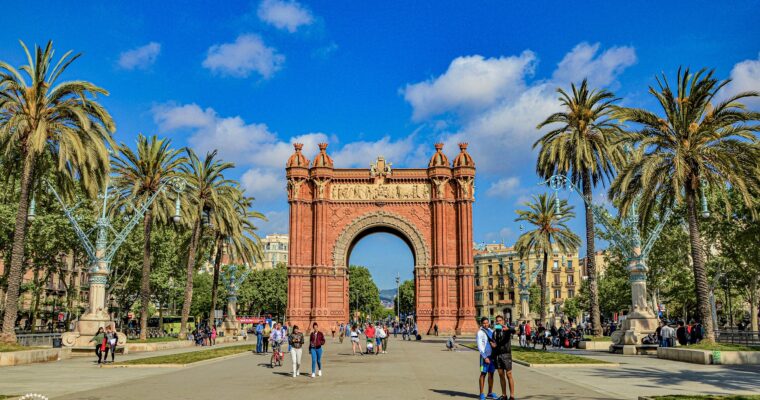
The Arc de Triomf of Barcelona is one of the city’s great monumental landmarks and one of the most important witnesses to the Barcelona that, at the end of the 19th century, was beginning to transform itself into a major European capital. Built in 1888 …
Construido en homenaje al descubridor Cristóbal Colón, el Monumento a Colón es uno de los iconos más reconocidos del skyline de Barcelona. Se trata de un imponente mirador de 60 metros de altura, situado junto al puerto, en el punto exacto donde Las Ramblas se encuentran con el Paseo de Colón, frente al Port Vell, en la Plaça del Portal de la Pau, s/n.
El monumento está compuesto por una gran columna de estilo corintio, diseñada por el arquitecto Cayetano Buigas, sobre la cual se eleva la célebre estatua de Colón, de casi 7 metros de altura. La figura domina el cielo de Barcelona, sujetando una carta de navegación con la mano izquierda y señalando simbólicamente con el brazo derecho la ruta hacia el Nuevo Mundo, convirtiéndose en un potente símbolo de exploración, descubrimiento y apertura al mundo.
En la base y el pedestal se despliega uno de los programas escultóricos más ricos del siglo XIX en Barcelona. En la parte inferior de la columna encontramos conjuntos escultóricos dedicados al descubrimiento de América, que combinan historia, alegoría y simbolismo. Destacan las esculturas de personajes históricos vinculados a la empresa colombina, como Lluís de Santángel, Jaume Ferrer de Blanes, Pere de Margarit y Fra Bernat de Boïl, junto a figuras indígenas que representan el encuentro entre culturas. Estas obras fueron realizadas por destacados escultores de la época, incluyendo a Josep Gamot, Francesc Pagès, Eduard Batista Alentorn y Manuel Fuxá.
El pedestal también alberga cuatro grandes figuras femeninas alegóricas que simbolizan los reinos históricos de Cataluña, Aragón, Castilla y León, subrayando el carácter colectivo de la empresa del descubrimiento. Rodeando la base circular se sitúan los populares ocho leones de hierro, símbolos de fuerza y protección, sobre los que tradicionalmente se suben los visitantes para fotografiarse, convirtiéndolos en uno de los elementos más reconocidos y queridos del monumento.
La construcción del monumento fue aprobada en 1881, como homenaje a la elección del puerto de Barcelona por parte de Colón tras su regreso de América. Tras siete años de trabajos, fue inaugurado en 1888, coincidiendo con la celebración de la Exposición Universal, un momento clave en la proyección internacional de la ciudad.
En su interior hay un ascensor panorámico que nos eleva hasta el mirador situado a 60 metros de altura. Desde allí, el visitante puede disfrutar de unas espectaculares vistas de 360 grados sobre Barcelona, el puerto, el Mediterráneo y el entramado urbano de la ciudad.
Transporte y accesibilidad
Metro: Drassanes (Línea 3)
Autobús: Líneas 14, 59, 64, 91, 120, D20 y H14
Todo ello, y mucho más, puede descubrirse de la mano de la mirada mágica y profunda de Magic Dreams Barcelona, una experiencia creada para que los visitantes no tengan que preocuparse de nada. Nos encargamos de cada detalle, cuidando la experiencia de principio a fin para que se sientan acompañados, cómodos e inspirados en todo momento.
Ofrecemos transporte privado, guía turístico profesional nativo en castellano, catalán e inglés —y en otros idiomas bajo aviso previo—, adaptándonos siempre a las necesidades de cada visitante. Complementamos la visita al Monumento a Colón con rutas personalizadas por Barcelona, visitas arquitectónicas y artísticas con profundo conocimiento del simbolismo local, acompañados por guías locales que muestran la Barcelona más auténtica.
Disponemos de un exclusivo servicio de alojamientos cuidadosamente seleccionados y experiencias a medida, incluyendo escapadas románticas por Cataluña de un día o fin de semana, picnics en jardines emblemáticos con mantelería a elegir, en la playa o yate, catering de autor elaborado por nuestro chef con propuestas dulces y saladas, y una cuidada selección de zumos naturales, vinos y cavas sin alcohol. También ofrecemos servicio de floristería personalizada, cenas temáticas, música en vivo y veladas privadas ambientadas con gastronomía catalana e internacional de nuestra carta, de la mano de chefs nativos e internacionales.
La experiencia se enriquece con un guía nativo especializado en botánica emocional, profundamente vinculado al territorio. Durante el recorrido y especialmente en los momentos de descanso y picnic, ofrecemos una lectura sensible del entorno, explicando las especies vegetales, su simbolismo, historia y relación con el paisaje mediterráneo, así como la observación y reconocimiento de aves locales. Cada explicación se convierte en un relato vivo que conecta emocionalmente con la naturaleza, transformando la visita en un viaje sensorial, consciente y memorable.
Nuestro objetivo es simple y profundo: que los visitantes se sientan cuidados, inspirados y libres para descubrir la magia y secretos de Barcelona, viviendo la ciudad no solo como un destino, sino como una experiencia inolvidable.
El Monumento a Colón de Barcelona
El Monumento a Colón de Barcelona
Perspectiva superior aérea del monumento homenaje a Cristóbal Colón en Portal de la Pau.
Detalle monumento homenaje a Cristóbal Colón en Portal de la Pau.
Detalle figura escultórica en forma de león en Portal de la Pau.
Detalle figura escultórica en forma de ángeles en Portal de la Pau.
Perspectiva a pie monumento homenaje a Cristóbal Colón en Portal de la Pau.
Perspectiva superior aérea al atardecer del monumento homenaje a Cristóbal Colón en Portal de la Pau.
Perspectiva a pie de figura escultórica en forma de león en Portal de la Pau.
Perspectiva a pie monumento homenaje a Cristóbal Colón en Portal de la Pau.
Perspectiva a pie monumento homenaje a Cristóbal Colón en Portal de la Pau.
Detalle monumento homenaje a Cristóbal Colón en Portal de la Pau.
Perspectiva a pie monumento homenaje a Cristóbal Colón en Portal de la Pau.
Detalle monumento homenaje a Cristóbal Colón en Portal de la Pau.
Para colaboraciones, proyectos o consultas profesionales – Reservas y presupuestos
Por favor, deje sus datos y su número de teléfono, y nos pondremos en contacto con usted a la mayor brevedad, a lo largo del día.
La Casa Batlló es una de las obras maestras de Antoni Gaudí y uno de los edificios más famosos de Barcelona. Situada en pleno Passeig de Gràcia, en el corazón del Eixample, esta extraordinaria construcción es uno de los grandes referentes del modernismo catalán y …
Casa Batlló is one of the masterpieces of Antoni Gaudí and one of Barcelona’s most famous buildings. Located on Passeig de Gràcia, in the heart of the Eixample district, this extraordinary building is one of the great landmarks of Catalan Modernism and forms part of …
Casa Vicens is more than an architectural masterpiece: it is the starting point of Antoni Gaudí’s creative universe. Built between 1883 and 1885 in the then-independent town of Gràcia, this summer residence marked the architect’s first major commission and the moment when he was able to fully apply his studies, intuitions and radically innovative vision of the family home.
At Casa Vicens, Gaudí began to develop an approach to architecture in which beauty, functionality, craftsmanship and nature formed a unified language. Long before reaching the full maturity of his later masterpieces, the architect was already experimenting with construction techniques, colour combinations and ornamental motifs that anticipated a completely different way of understanding space.
From the very beginning, Gaudí was ahead of his time, adopting an approach that today can be associated with the principles of sustainability. The house was designed to make the most of natural light and encourage ventilation, integrating the architecture with the environmental conditions of its surroundings. Its relationship with the garden, the choice of materials and the use of natural resources reflect a sensitivity that remains remarkably relevant today.
Located in the heart of the Gràcia neighbourhood, Casa Vicens represents one of the earliest expressions of an idea that would accompany Gaudí throughout his career: architecture should not merely imitate nature superficially, but learn from its forms, structures and ability to generate beauty.
The Origins of Casa Vicens
Manuel Vicens, a Summer Residence and the Birth of a New Architecture
The project was commissioned by Manuel Vicens i Montaner, a stockbroker who entrusted a young Gaudí with the design of a summer residence in Gràcia, which was then an independent town outside Barcelona.
The construction, carried out between 1883 and 1885, allowed the architect to explore his own distinctive language by blending Oriental, Mudéjar and naturalistic influences.
In this first major work, Gaudí had not yet fully developed the Modernisme style that would characterise his later creations. Nevertheless, the building already reveals an extraordinary artistic personality, capable of transforming a residence into an architectural composition of remarkable visual richness.
Polychrome ceramics, exposed brick, stone, wood and wrought iron come together to create an ensemble in which every material serves both a practical and an expressive purpose.
The house was conceived not merely as a place to live, but as a space where architecture could become a complete artistic experience.
Nature Transformed into Architecture
A Leaf Becomes Iron, a Flower Becomes Ceramic
What if we told you that one of Antoni Gaudí’s first major works conceals a garden transformed into architecture?
At Casa Vicens, nature is much more than a source of decorative inspiration. It becomes ceramics, wrought iron, colour and geometry.
While studying the site, Gaudí was fascinated by the plant forms he encountered, particularly fan palm leaves and yellow flowers. These species offered him a repertoire of shapes, rhythms and colours that he translated into the ornamental elements of the house.
Botanical motifs appear in the ironwork, ceramic cladding and various interior spaces, creating an ongoing dialogue between the building and the landscape.
Green and yellow tones evoke the vegetation that originally grew on the site, while floral compositions transform architectural surfaces into an artistic extension of the garden.
Gaudí’s genius lies precisely in this ability to observe: a leaf can become an iron structure, a flower can become a ceramic motif, and an entire garden can inspire an architectural language.
Ten Botanical Elements in the World of Casa Vicens
A Journey Through the Forms, Colours and Symbolism of Nature
The relationship between Casa Vicens and the plant world reveals a particularly fascinating dimension of Gaudí’s work. Some plants are directly associated with the building’s original ornamental motifs, while others belong to the vegetation of the garden as it has been recreated today.
This distinction is important: not every species currently found in the garden is documented as a direct source of inspiration for the architect. Nevertheless, all of them offer an opportunity to explore the relationship between botany, artistic perception and architecture.
1. The Mediterranean Dwarf Palm
The Power of a Leaf Transformed into Iron
The Mediterranean dwarf palm, a low-growing palm characteristic of Mediterranean vegetation, is one of the most significant botanical references at Casa Vicens.
Its fan-shaped leaves inspired the celebrated wrought-iron grille that Gaudí designed for the garden entrance and enclosure.
Here, the plant form becomes an architectural element combining function, strength and beauty. The iron reproduces the structure of the leaves, demonstrating how the study of nature can provide solutions of extraordinary expressive power.
The dwarf palm evokes resilience, adaptability and the natural elegance of Mediterranean vegetation. At Casa Vicens, its presence also symbolises the connection between the site, its plant species and the building’s artistic identity.
2. Yellow Carnations and Warm-Coloured Flowers
Light, Vitality and Colour on the Façade
The yellow flowers that grew on the site caught Gaudí’s attention and helped shape part of the residence’s colour palette and ornamental vocabulary.
The floral and botanical motifs found in the façade’s ceramic decoration establish a direct relationship between natural forms and architectural composition.
Yellow evokes sunlight, vitality and joy, while orange tones intensify the sense of energy and chromatic richness.
Polychrome ceramics thus acquire a significance that goes beyond ornamentation: they transform the façade into a surface full of life, where colours and shapes seem to extend the vegetation of the garden.
Nature is not merely represented as an image; it becomes part of the house’s visual identity.
3. Yellow and Red Roses
Floral Richness in the Interiors
The floral motifs found in the interior ceramic coverings expand the botanical world of Casa Vicens.
Yellow and red roses allow us to interpret the decoration from a symbolic and sensory perspective, in which colour plays a fundamental role.
Yellow is associated with light, happiness and vitality, while red evokes passion, intensity and love.
This symbolic interpretation enriches the visitor’s experience, although it is important to distinguish between the cultural meanings we may attribute to flowers and any specific intention documented on the part of the architect.
In any case, the floral motifs demonstrate the extent to which Gaudí understood ornamentation as an essential component of architectural space.
4. Palm Leaves and Clusters of Dates
An Oriental Atmosphere in the Smoking Room
In the smoking room, botanical motifs help create an exotic atmosphere evocative of Oriental gardens and the ornamental traditions that influenced Gaudí’s early creative period.
Palm leaves and shapes reminiscent of clusters of dates expand the botanical dimension of the decoration and reinforce the distinctive character of this space.
The palm can be interpreted as a symbol of vitality, elevation and continuity, while dates evoke abundance and fertility.
These associations help us understand how vegetation can acquire different meanings depending on the cultural and artistic context in which it appears.
The smoking room exemplifies Gaudí’s ability to transform a functional interior into a space with a strong personality, where materials, botanical motifs and cultural references combine to create a unified sensory experience.
5. The Holm Oak
Longevity, Resilience and the Garden’s Memory
The centuries-old holm oak preserved in the present-day garden is one of the most significant botanical features of Casa Vicens.
Its presence introduces a dimension of time that extends beyond the architecture itself. While the building has undergone transformations over the years, the tree represents the continuity of plant life and the memory of the place.
The holm oak is traditionally associated with longevity, strength and resilience. Its adaptation to the Mediterranean climate further reinforces its value as a symbol of permanence.
Although it should not automatically be considered a direct source of inspiration for Gaudí, its presence helps preserve the botanical memory of the historic garden and illustrates the importance of the landscape in the original conception of the estate.
6. The Magnolia
Elegance, Serenity and Renewal
The monumental magnolia in the present-day garden stands out for its stature and the beauty of its large flowers.
Its presence introduces a contemplative dimension to the visitor’s journey, creating a contrast between the solidity of the architecture and the delicacy of plant forms.
The magnolia can evoke beauty, serenity and renewal. Its broad, elegant flowers seem to establish a natural dialogue with the ornamental richness of Casa Vicens.
Together with the holm oak, it helps preserve the garden’s botanical memory and reinforces the sense of continuity between the historic landscape and the restored space we can visit today.
7. The Camellia
Floral Perfection and Ornamental Delicacy
Camellias form part of the vegetation in the recreated garden at Casa Vicens, bringing a distinctive ornamental elegance to the space.
Their flowers, with their orderly petals and carefully structured forms, invite us to observe nature from an almost geometric perspective.
In an artistic interpretation, the camellia can be associated with perfection, beauty and elegance.
Its presence allows us to draw a parallel with Gaudí’s world, in which observing natural forms opened up new possibilities for composition and design.
However, its inclusion in the present-day garden does not imply that it was one of the species that directly inspired the house’s original features.
8. The Monstera
Tropical Exuberance and Freedom of Form
The monstera, distinguished by its large leaves and deep splits, introduces a tropical note to the present-day garden.
Its expansive growth and irregular shapes evoke exuberance, freedom and botanical diversity.
The structure of its leaves reveals how nature develops forms that combine visual impact with adaptation to the surrounding environment.
During a visit to Casa Vicens, the monstera enriches the botanical experience and reinforces the garden’s exotic character.
Its relationship with Gaudí should be understood as a contemporary interpretative association, rather than as a documented source of original inspiration.
9. The Japanese Aralia or Fatsia
Plant Geometry as an Artistic Language
The Japanese aralia, also known as fatsia, is distinguished by its large, palmate leaves with deeply divided lobes.
Its forms offer an interesting parallel with the plant geometry that so fascinated Gaudí.
The arrangement of the lobes and the structure of the leaves reveal how nature organises forms through rhythm, proportion and repetition.
Symbolically, fatsia can evoke harmony, growth and botanical diversity.
As part of the recreated garden, it helps visitors discover new relationships between organic forms and architectural language, although it should not necessarily be regarded as having directly influenced the original project.
10. Jasmine
Fragrance, Sensitivity and Serenity
Jasmine introduces a sensory dimension that extends beyond the visual.
Its small white flowers and delicate fragrance evoke purity, sensitivity and serenity, turning the garden into a space that can be experienced through several senses.
The scent, the texture of the leaves and the presence of the flowers enrich the visitor’s journey, allowing nature to be understood as a complete sensory experience.
This sensory dimension connects particularly well with the experience of discovering Casa Vicens: a place that invites us to pause, observe, breathe and become aware of our surroundings.
As with other species in the present-day garden, its presence should be understood within the context of the garden’s contemporary layout, rather than as evidence of direct inspiration for Gaudí’s original design.
The Wrought-Iron Grille
When Art, Craftsmanship and Nature Become One
One of the most distinctive features of Casa Vicens is the wrought-iron grille designed by Gaudí and inspired by dwarf palm leaves.
More than a simple enclosure, it represents a declaration of principles. The architect transforms a plant form into a functional element, demonstrating that nature can provide models for both aesthetics and construction.
The grille establishes a dialogue between the garden and the house, between the exterior and the interior, and between industrial material and organic forms.
Its design is an early example of the importance Gaudí would place on artisanal details and the integration of different architectural elements.
Here, iron does more than provide structure or protection: it becomes an artistic form that conveys movement and vitality.
Polychrome Ceramics
Colour as an Extension of the Garden
The façade of Casa Vicens is one of the most striking expressions of Gaudí’s sensitivity to colour.
Ceramic tiles, botanical motifs and a combination of green, yellow and white tones create a composition reminiscent of a garden transferred onto the walls.
Ceramics offer a particularly expressive way of working with colour. Light changes how the surfaces are perceived, producing variations throughout the day and allowing the façade to respond to changing environmental conditions.
The botanical motifs reinforce this sense of continuity between architecture and landscape.
It is important, however, to distinguish between the presence of polychrome ceramics in Gaudí’s work and their participation in international exhibitions. Catalan ceramics already had a long-standing tradition, and the 1878 Paris Universal Exposition was an important historical precedent, taking place before Casa Vicens was built, rather than serving as an exhibition of the house itself.
What is truly extraordinary is how Gaudí incorporated traditional craftsmanship into an innovative composition, making the cladding an essential part of the building’s identity.
The Garden of Casa Vicens
An Urban Oasis in the Heart of Gràcia
The original garden of Casa Vicens was considerably larger than the space we can see today. It formed part of a summer estate designed for enjoying vegetation, fresh air and tranquillity in an environment that still retained the characteristics of a town independent from Barcelona.
Over time, urban growth and changes in ownership significantly altered the layout of the property.
Today, a visit reveals three major elements in the site’s historical evolution: Gaudí’s original building, the extension completed in 1925 by the architect Joan Baptista Serra de Martínez, and the garden that accompanies the ensemble.
The present-day garden, covering approximately 300 square metres, provides a contemplative space where Mediterranean species coexist with exotic plants.
The centuries-old holm oak and monumental magnolia stand out for their presence, while camellias, monsteras, fatsias and other species enrich the botanical diversity.
The result is a space where the floral motifs of the architecture seem to come to life, as if the plants depicted on the walls had escaped from the ceramics and taken root in the earth.
The garden invites visitors to observe the relationship between leaves, colours, botanical textures and architectural materials, making it an essential part of the Casa Vicens experience.
Architecture Ahead of Its Time
Light, Ventilation and a Relationship with the Environment
The innovation of Casa Vicens extends beyond its exterior appearance.
Gaudí designed the house with careful consideration of spatial organisation, natural light and the relationship between interior rooms and the garden.
The orientation, openings and arrangement of the spaces contribute to a domestic experience shaped by the surrounding environment.
Ventilation and the use of natural light form part of an architectural approach that prioritises comfort without sacrificing artistic expression.
From a contemporary perspective, these decisions encourage us to reflect on the importance of designing buildings that respond to climate, materials and landscape.
We should not automatically attribute every sustainability feature found in contemporary architecture to Casa Vicens. Its value lies precisely in understanding how, at an early stage in his career, Gaudí explored the relationship between design, nature and the quality of inhabited space.
From Private Residence to World Heritage
The Historical Evolution of Casa Vicens
Casa Vicens has undergone several transformations since its construction in the nineteenth century.
The 1925 extension, designed by Joan Baptista Serra de Martínez, changed the layout of the property to accommodate new residential needs.
Over the decades, the estate became integrated into Barcelona’s urban fabric, while the house gained increasing recognition as a fundamental work from the early career of Gaudí.
In 2005, Casa Vicens was included on the UNESCO World Heritage List as part of the group of works by Antoni Gaudí recognised for their Outstanding Universal Value.
The building subsequently underwent a restoration and adaptation process that enabled it to open to the public in 2017 as a house museum.
This opening made it possible to discover in greater depth a work that had remained a private residence for many years.
Today, Casa Vicens is an essential destination for understanding how the creative universe of one of the most distinctive architects in history began to take shape.
Casa Vicens Today
Heritage, Architecture and Cultural Experience
Visiting Casa Vicens means stepping into a fundamental period of Gaudí’s career and discovering a work that preserves an extraordinary wealth of detail.
The visit offers the opportunity to admire the ceramic façade, the wrought-iron grille, the ornamented interiors, the different rooms of the house and the garden.
Each element helps us understand how the architect began to develop his own language by integrating cultural references, traditional craftsmanship and forms inspired by nature.
The visit also reveals the building’s historical evolution and its relationship with the Gràcia neighbourhood, whose urban transformation has made the former independent town an essential part of Barcelona.
Casa Vicens is not simply an early work that anticipates Gaudí’s better-known creations. It is a masterpiece in its own right, containing many of the ideas and concerns that would accompany him throughout his career.
What You Can Discover During Your Visit
A Journey Through Gaudí’s Creative Universe
A visit to Casa Vicens offers insight into several aspects of the architect’s work:
The façade and its extraordinary combination of ceramics, brickwork and botanical motifs.
The wrought-iron grille inspired by dwarf palm leaves.
The interior spaces and their rich ornamentation.
The smoking room and its references to Oriental decorative traditions.
The floral and geometric motifs found in the decorative coverings.
The present-day garden and its botanical diversity.
The building’s architectural evolution from the nineteenth century to the present day.
Each of these spaces offers a different perspective on Gaudí’s understanding of the relationship between architecture, craftsmanship and nature.
For visitors with an interest in botany, the experience takes on an additional dimension: it reveals how plant forms can be transformed into artistic resources and how a garden can become a tool for interpreting architecture.
A House to Be Discovered Slowly
Gaudí’s Genius Begins with the Smallest Details
Casa Vicens cannot be fully appreciated by looking at its façade alone.
It is worth pausing to study the shape of a leaf, observing how the ceramic motifs are arranged, appreciating the variations in colour and discovering the relationship between ornamental elements and the garden.
Gaudí’s true genius lies in teaching us to see nature from a different perspective. A leaf can become iron, a flower can become ceramic, and an entire garden can become architecture.
Casa Vicens is the origin of an extraordinary creative universe: a work in which nature begins to reveal its potential as an architectural language.
Would You Like to Discover Casa Vicens with Us?
A Botanical, Architectural and Sensory Experience with Magic Dreams Barcelona
Discovering Casa Vicens from a deeper, more emotional and magical perspective allows you to appreciate the building beyond its exterior beauty.
With Magic Dreams Barcelona, every visit becomes a journey into the soul of the city, where architecture, nature, history and emotion intertwine to create a personalised experience.
Our team consists of local professionals with years of experience, capable of sharing an intimate, knowledgeable and authentic perspective on Barcelona and its heritage.
We take care of everything:
Comprehensive logistics and personalised planning, tailored to your preferences and the pace of your experience.
Unique cultural and sensory experiences, designed to explore heritage from a different perspective.
Specialised botanical tours, with explanations of plant species, their history, characteristics and symbolism.
Architectural and artistic itineraries through museums, historic buildings and creative spaces.
Local and international gastronomy, with recommendations for authentic establishments and themed private dining experiences at selected accommodations.
Private concerts and exclusive experiences, designed to turn a stay into an unforgettable memory.
Private, themed and personalised accommodation, carefully selected for comfort, character and attention to detail.
Our team speaks Spanish, Catalan and English and, with advance notice, can accommodate other languages.
We organise day trips, weekend escapes, week-long stays and personalised itineraries throughout Barcelona, the Catalan Pyrenees and the Costa Brava.
We also design gastronomic experiences, cultural encounters and private activities tailored to each visitor’s interests.
With our professionals specialising in architecture and botany, every journey becomes an opportunity to discover details that often go unnoticed: the geometry of a leaf, the history of a ceramic tile, the meaning of an ornamental motif or the memory of a garden.
Magic Dreams Barcelona: a journey into the depths of discovery, where architecture, nature and emotion go hand in hand.
The Spiritual Vision of Antoni Gaudí, Presented by Magic Dreams Barcelona Discover the Basilica of the Expiatory Temple of the Sagrada Família, the architectural soul of Barcelona and the most significant work of the Modernist genius Antoni Gaudí. More than a monument, this temple is …