Vía Layetana, Barcelona: History, Architecture and Restaurants.
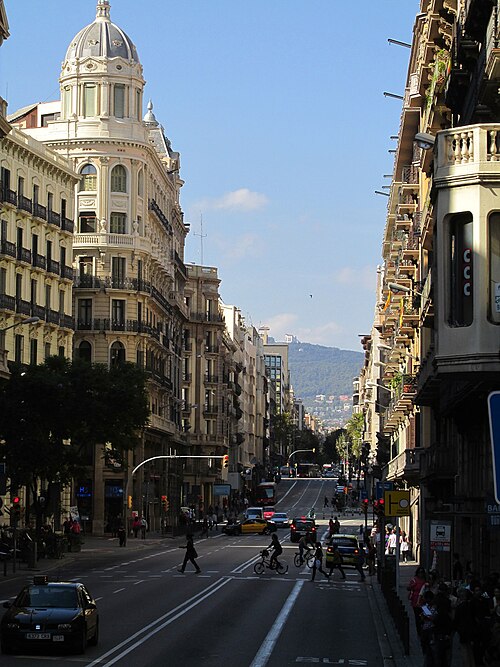
Discover one of Barcelona’s historic avenues, its landmark buildings, and the best places to eat while exploring the city’s historic centre.
Via Laietana is one of Barcelona’s most distinctive avenues. Located in the heart of Ciutat Vella, it connects the area around Plaça d’Urquinaona with Passeig de Colom and the old port, crossing an area where medieval history, twentieth-century architecture, and everyday city life come together.
Approximately one kilometre long, this avenue is much more than a thoroughfare. Its layout reflects an urban transformation that profoundly reshaped Barcelona’s historic centre and left a lasting mark on its neighbourhoods, buildings, and architectural landscape.
Along Via Laietana, you will find monumental buildings, former bank headquarters, institutional buildings, and restaurants catering to different tastes and budgets. Just a few minutes’ walk away, you can also discover the Gothic Quarter, the Palau de la Música Catalana, Mercat de Santa Caterina, and the historic streets of El Born.
For those wishing to discover Barcelona beyond its most famous landmarks, a walk along Via Laietana offers an opportunity to understand the city’s evolution while enjoying its cultural and gastronomic heritage.
Where Is Via Laietana?
Via Laietana is located in the Ciutat Vella district, Barcelona’s historic centre, in Catalonia.
The avenue connects Plaça d’Urquinaona to the north with Passeig de Colom to the south, near the waterfront. Its location provides easy access to several of the city’s most important neighbourhoods and cultural attractions.
- The Gothic Quarter: Located to the west of the avenue, it preserves medieval streets, historic squares, and Barcelona Cathedral.
- Sant Pere, Santa Caterina i la Ribera: To the east, these areas contain former artisan and commercial neighbourhoods, as well as the well-known El Born district.
- The Cathedral and Plaça de Sant Jaume: These landmarks bring together some of Barcelona’s most important religious, political, and institutional heritage.
- The waterfront: From the southern end of the avenue, you can continue towards the old port and Passeig de Colom.
Thanks to its location, Via Laietana is an excellent starting point for exploring Barcelona’s historic centre on foot.
The History of Via Laietana: From the Medieval City to Modern Barcelona
The Origins of a Major Urban Project
To understand the history of Via Laietana, we must look back to Barcelona in the late nineteenth century.
At that time, much of the historic centre consisted of narrow streets, densely populated neighbourhoods, artisan workshops, markets, religious buildings, and old residential properties. Although this urban fabric had developed over centuries, some areas suffered from overcrowding and poor living conditions.
Barcelona’s expansion beyond its former city walls encouraged new approaches to urban planning. The Eixample project, designed by Ildefons Cerdà, envisioned a city with wide streets, regular city blocks, and improved traffic circulation.
However, the old town retained a street layout that was difficult to adapt to modern transport needs and the commercial ambitions of a rapidly transforming Barcelona.
During the nineteenth century, several proposals emerged to renovate the historic centre. One of the most significant was Àngel Baixeras’s urban redevelopment plan, approved in 1889, which proposed opening major avenues to improve urban connections.
The future Via Laietana would become one of the most important interventions of that period.
1908: Construction Begins
On 10 March 1908, work officially began on the opening of Via Laietana, at a ceremony presided over by King Alfonso XIII.
The transformation was not immediate. The project unfolded over several decades, and construction of the avenue as a whole continued until 1958.
The consequences for the city were enormous. Between 1908 and 1913, nearly 300 buildings were demolished, and more than 2,000 families were affected by the works.
Old streets, homes, and historically significant buildings disappeared, profoundly altering the urban fabric of several medieval neighbourhoods.
The opening of the avenue therefore had two important dimensions.
On the one hand, it improved connections between central Barcelona and the port, created a new traffic artery, and encouraged the arrival of banks, businesses, and institutions. On the other, it led to the loss of part of the city’s architectural heritage and disrupted the lives of countless residents.
This tension between modernisation and heritage conservation is essential to understanding Via Laietana.
From Commercial Avenue to Contemporary Urban Space
During the first half of the twentieth century, Via Laietana developed a monumental and commercial character. Its buildings reflected the ambitions of a Barcelona seeking to establish itself as an economic centre and project an image of modernity.
Today, the avenue continues to evolve. The urban transformation completed in 2025 strengthened its role as a connection between neighbourhoods, with improvements for pedestrians and sustainable mobility.
Via Laietana is therefore an example of how cities reassess their past and adapt public spaces to the needs of each new era.
The Landmark Buildings of Via Laietana and Its Surroundings
The Historic Post Office Building
At the southern end of the avenue, near Passeig de Colom, stands the historic Post Office building, a representative example of institutional architecture from the first third of the twentieth century.
Its monumental scale and prominent urban presence reflect the importance that public services acquired during Barcelona’s modernisation.
The building illustrates how new avenues were conceived not merely as traffic routes but also as settings for institutions expected to convey stability, prestige, and modernity.
The Palau de la Música Catalana
Just a few minutes’ walk from Via Laietana stands the Palau de la Música Catalana, one of the finest examples of Catalan Modernisme.
Designed by architect Lluís Domènech i Montaner and inaugurated in 1908, the building stands out for its mosaics, sculptures, stained-glass windows, and extraordinary floral decoration.
One of its most impressive features is the glass skylight above the concert hall, which allows natural light to become an integral part of the architectural experience.
The Palau de la Música Catalana was designated a UNESCO World Heritage Site in 1997. Its history is closely linked to Catalonia’s cultural development and the importance of choral societies and musical associations in the early twentieth century.
We recommend admiring both the façade and the interior on a guided tour if you would like to appreciate all its architectural details.
Barcelona Cathedral
Barcelona Cathedral, officially known as the Cathedral of the Holy Cross and Saint Eulalia, is located in the Gothic Quarter, west of Via Laietana.
Construction began in the thirteenth century and continued over several centuries. The cathedral is one of the most important surviving examples of medieval Barcelona and offers insight into the role of religion, civic institutions, and guilds in the city’s development.
Its cloister, chapels, and surrounding streets provide a journey through different periods of Barcelona’s history.
Plaça de Sant Jaume
Plaça de Sant Jaume is one of Catalonia’s most important political and institutional centres.
It is home to the Palau de la Generalitat de Catalunya and Barcelona City Hall. Over the centuries, the square has hosted political events, public celebrations, and civic demonstrations.
Its proximity to Via Laietana makes it easy to include in a tour of the historic centre.
Mercat de Santa Caterina
East of Via Laietana lies Mercat de Santa Caterina, a historic market that combines traditional commerce with contemporary architecture.
Its undulating roof, decorated with ceramic tiles in a multitude of colours, is one of its most distinctive features. The renovation was designed by the architectural team of Enric Miralles and Benedetta Tagliabue.
The market represents the continuation of a deeply rooted Barcelona tradition: markets as places for shopping, neighbourhood interaction, and the preservation of gastronomic culture.
It is an especially worthwhile stop if you want to discover fresh local produce and everyday life in the historic neighbourhoods.
El Born and the Medieval Streets
East of Via Laietana, the streets of Sant Pere and La Ribera lead towards El Born, an area where historic buildings, former commercial streets, independent shops, restaurants, and cultural venues coexist.
The contrast with Via Laietana’s monumental scale is particularly interesting. Just a few metres away, you will find a narrower, more irregular network of streets that preserves part of medieval Barcelona’s character.
4. The Architecture of Via Laietana: An Avenue That Tells Barcelona’s Story
The architecture of Via Laietana is one of its main attractions.
Many of its buildings feature symmetrical façades, stone ornamentation, monumental entrances, decorative cornices, and balconies carefully integrated into the overall design.
Together, they reflect the ambition to create a new commercial and financial avenue within the historic centre, with an urban identity distinct from the surrounding medieval street pattern.
Along the route, you will find buildings from different periods of the twentieth century. Some feature historicist and decorative elements, while others reflect a more functional and monumental approach to commercial architecture.
To appreciate the avenue, we recommend paying attention to façade details, entrances, reliefs, and building proportions. It is also worth comparing the width of Via Laietana with the narrow medieval streets branching off on either side.
The avenue does not represent a single architectural style. Instead, it reflects several decades of urban transformation and changing ideas about modernity.
The Ongoing Transformation of Via Laietana
In recent years, Via Laietana has undergone a major redevelopment aimed at improving public space and making walking more convenient.
The transformation seeks to strengthen the connection between the Gothic Quarter and the neighbourhoods of Sant Pere, Santa Caterina, and La Ribera, while promoting sustainable mobility and supporting local businesses.
The project’s objectives include improving pedestrian crossings and creating more pleasant spaces for walking, resting, and meeting others.
The avenue’s new layout, completed in 2025, forms part of an urban vision that places greater emphasis on the quality of public space.
For visitors, these changes make it easier to incorporate Via Laietana into a walking tour focused on culture and history. However, if you need specific information about traffic conditions or accessibility, we recommend checking the latest municipal updates before setting out.
Where to Eat on Via Laietana: Restaurants for Different Tastes and Budgets
Via Laietana and its surroundings offer a range of options, from casual meals and Italian or Mexican cuisine to Mediterranean dishes and fine dining experiences.
La Central Hamburguesería
Reference address: Via Laietana, 45, Barcelona.
Indicative budget: €10–20 per person.
Speciality: Burgers and casual dining.
La Central is a convenient option for anyone looking to enjoy a burger while exploring Barcelona’s historic centre.
Its menu focuses on artisan burgers made with fresh ingredients and bread prepared according to the restaurant’s own recipe.
For updated information, visit the official La Central Hamburguesería website.
Macchina Pasta Bar
Reference address: Via Laietana, 55, Barcelona.
Indicative budget: €10–20 per person.
Speciality: Italian cuisine and pasta.
Macchina Pasta Bar is an alternative for those looking to enjoy pasta in a central location.
It is a convenient choice for a break while visiting the Gothic Quarter or nearby cultural attractions.
Find the restaurant and its location on Google Maps.
Xurreria Layetana
Reference address: Via Laietana, 46, Barcelona.
Budget: Check the current menu.
Speciality: Churros and hot chocolate.
A traditional churro shop is an ideal stop for breakfast or an afternoon snack while exploring the historic centre on foot.
Churros with hot chocolate are part of Spain’s popular culinary tradition. They are commonly enjoyed at breakfast, as an afternoon treat, or during informal gatherings, particularly in the colder months.
Find its location on Google Maps.
Luigi Ristorante
Reference address: Via Laietana, 41, Barcelona.
Indicative budget: €20–30 per person.
Speciality: Italian cuisine.
Luigi Ristorante is an option for those who prefer a sit-down meal in a central setting.
Its location makes it easy to combine lunch or dinner with a walk past Via Laietana’s commercial architecture and the historic streets of Ciutat Vella.
Find the restaurant on Google Maps.
Rosa Negra
Reference address: Via Laietana, 46, Barcelona.
Indicative budget: €20–30 per person.
Speciality: Mexican cuisine.
Rosa Negra offers Mexican cuisine for those looking for an informal meal with international flavours in central Barcelona.
Visit the Rosa Negra Barcelona website for information about the menu and reservations.
La Cuina de Laietana
Address: Via Laietana, 71, Barcelona.
Indicative reference budget: €20–30 per person.
Speciality: Mediterranean cuisine, rice dishes, and paella.
La Cuina de Laietana is an option for those looking to enjoy Mediterranean food in the historic centre.
Its menu includes rice dishes, paella, tapas, salads, meat, fish, and seafood.
Visit the official La Cuina de Laietana website to check the menu, opening hours, and reservation options.
Caelis: A Fine-Dining Experience
Address: Via Laietana, 49, Hotel Ohla Barcelona.
Budget: Depends on the menu and drinks; check the current offering.
Speciality: Contemporary fine dining.
Caelis is the choice in this selection best suited to a special gastronomic experience.
The restaurant is associated with chef Romain Fornell, whose contemporary cuisine combines tradition, technique, and innovation.
Caelis represents Barcelona’s evolution as an international fine-dining destination, offering an experience in which gastronomy takes centre stage.
Visit the official Caelis website to explore the menus, reservation conditions, and opening hours.
A Walking Route Along Via Laietana: History, Architecture, and Gastronomy
A Half-Day Itinerary Through the Historic Centre
You can explore Via Laietana and its surroundings in a morning or afternoon, adapting the route to your available time and interests.
Stop 1. Plaça d’Urquinaona
Start at the northern end of the avenue. From here, you can observe the connection between the modern city centre and the historic neighbourhoods.
Stop 2. An Architectural Walk Along Via Laietana
Walk south along the avenue. Admire the façades, monumental entrances, cornices, and decorative details that reflect Barcelona’s twentieth-century urban transformation.
Stop 3. Palau de la Música Catalana
Spend some time discovering one of the finest examples of Catalan Modernisme. If you would like to explore the interior, check the available guided tours.
Stop 4. Barcelona Cathedral and Plaça de Sant Jaume
Head into the Gothic Quarter to discover medieval architecture and the historic centre of Catalonia’s political institutions.
Stop 5. Mercat de Santa Caterina
Continue east to admire the market’s colourful roof and explore the surrounding streets.
Stop 6. Lunch or a Gastronomic Break
Return to Via Laietana and choose a restaurant from our selection, checking its address, opening hours, and menu in advance.
Stop 7. Continue Towards the Waterfront
Finish your walk by heading towards Passeig de Colom and the old port, where the historic centre opens onto Barcelona’s maritime landscape.
You can extend this route with cultural visits or shorten it if you prefer to focus on architecture and gastronomy.
Discover Barcelona with Magic Dreams Barcelona
At Magic Dreams Barcelona, we believe the best way to discover a city is to go beyond its best-known landmarks.
Our personalised experiences bring together cultural heritage, architecture, botany, history, art, local gastronomy, and the discovery of details that often go unnoticed.
We organise tailor-made experiences in Barcelona and its surroundings, as well as day trips, weekend getaways, and longer stays in the Catalan Pyrenees and along the Costa Brava.
Our experiences can include historical walking tours, visits to gardens and natural spaces, gastronomic experiences, personalised picnics, and itineraries designed around your interests.
We offer activities in Spanish, Catalan, and English, with other languages available on request.
Discover Via Laietana with Magic Dreams Barcelona and experience the city through its stories, architecture, flavours, and the small details that so often go unnoticed.
Copyright © 2016-2026 Magic Dreams Barcelona.