The Glòries Green Meadow.
A new green lung in Barcelona at the foot of Torre Glòries
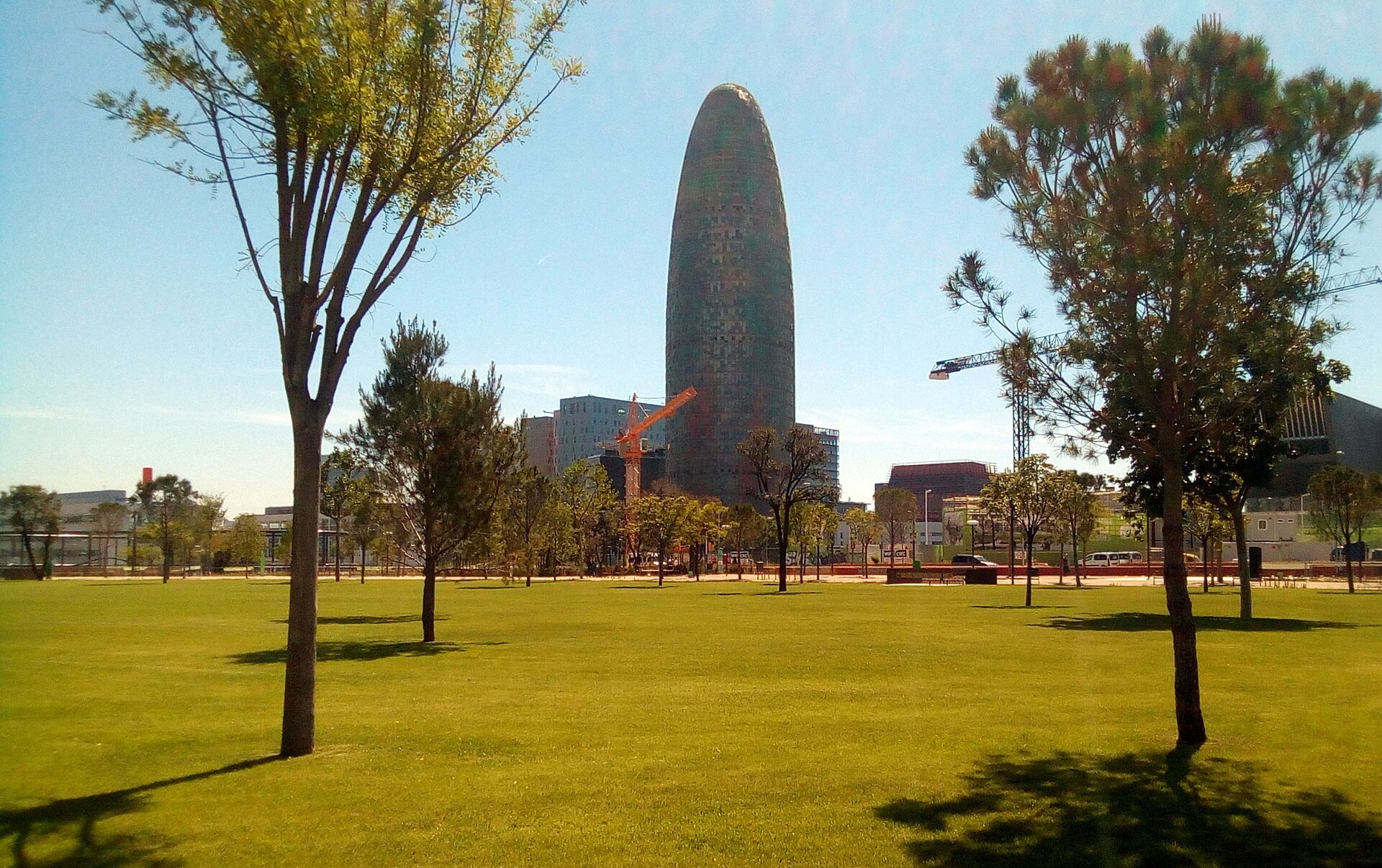
To admire Torre Glòries from the Gran Clariana is to discover one of the most iconic images of the new Barcelona. Facing the vertical silhouette of one of the city’s most remarkable buildings lies a vast expanse of grass, open to the sky, where the pace of urban life seems to slow down for a few moments.
We are in the heart of the new Parc de les Glòries, a space that symbolises one of the most significant urban transformations Barcelona has undergone in recent decades.
For many years, this area was one of the city’s major traffic hubs, dominated by cars, flyovers and concrete structures. It has gradually been transformed into a green landscape designed with people in mind.
The Clariana perfectly represents this change: reclaiming public space, introducing nature into one of Barcelona’s busiest areas and giving residents back a place where they can stroll, relax, meet and enjoy outdoor life.
A Square with a History of Major Transformations
From Ildefons Cerdà’s Vision to Barcelona’s Great Traffic Hub
To understand the significance of the Clariana today, we need to go back more than a century.
Plaça de les Glòries Catalanes was born from the urban planning vision of Ildefons Cerdà, the creator of Barcelona’s Eixample expansion plan in 1859.
Cerdà envisioned this space as one of the city’s main structural centres, located at the meeting point of three of its major avenues: Gran Via de les Corts Catalanes, Avinguda Diagonal and Avinguda Meridiana.
Its location was strategic. Glòries was intended to become a connecting hub between the Eixample, the industrial districts and the new urban developments that would expand towards the coastline and the Besòs River.
However, that vision would take many decades to materialise.
The arrival of the railway, the growth of industrial activity and Barcelona’s expansion profoundly transformed the surrounding area. Railway tracks, infrastructure and, later, motor vehicles progressively occupied a space that Cerdà had conceived as an urban centre.
The square thus became a place to pass through rather than a place to spend time.
Glòries 50 Years Ago
The Car Takes Over Urban Space
During the 1970s, Plaça de les Glòries underwent a particularly significant transformation.
Barcelona was experiencing a period of urban growth and increasing road traffic. Connecting the city’s main entry and exit routes required new infrastructure, and Glòries became one of the main settings for this transformation.
Overpasses, traffic ramps and road structures gradually took centre stage.
The square progressively lost its role as a prominent pedestrian space and became a major traffic interchange.
Cars dominated the landscape. Noise, emissions and the difficulty of crossing from one side to the other affected the relationship between neighbouring districts.
Despite this, Glòries remained a key area for Barcelona’s future. Its geographical position and connections to the city’s main avenues made its urban potential impossible to ignore.
The Great Transformation of the 1992 Olympic Games
The Road Ring and a City Focused on Cars
In preparation for the 1992 Barcelona Olympic Games, the square underwent another major transformation.
The elevated road ring, popularly known as the Tambor de Glòries, was built to organise the different flows of traffic.
The new structure made it possible to distribute traffic across different levels and improve connections between the city’s major thoroughfares.
However, it also created a large physical and visual barrier.
Inside the ring, there were landscaped areas and parking spaces, but the urban experience continued to be dominated by infrastructure.
For pedestrians, Glòries remained a complex, fragmented and difficult place to cross.
As Barcelona prepared to enter the 21st century, however, a new question began to emerge: could this vast traffic-dominated space one day become a genuine urban park?
The Beginning of a New Barcelona
From the Demolition of the Road Ring to the Recovery of Public Space
From the early 2000s onwards, a new vision for Glòries began to take shape.
The city needed to restore connections between neighbourhoods, improve sustainable mobility and transform an area dominated by traffic into a place for people to share and enjoy.
In 2007, a public participation process was launched, helping to define residents’ aspirations for the future of the square.
In 2008, work began on dismantling the perimeter structures of the former road ring. This was a lengthy and complex process that continued for several years.
The transformation required the reorganisation of underground infrastructure, changes to road access and the construction of a new mobility system.
One of the major milestones came in 2022, when the traffic tunnels opened, allowing much of the traffic to be moved underground.
The surface area could finally begin to recover its true purpose: becoming an open public space, accessible and designed for people.
The New Parc de les Glòries
Nine Hectares of Nature in the Heart of the City
On 26 April 2025, the new Parc de les Glòries was inaugurated, marking one of Barcelona’s major urban transformation projects.
The project created approximately nine hectares of public space, including around 30,000 square metres of green areas and more than 1,000 trees.
The park provides an important connection between the surrounding neighbourhoods while also serving as a new environmental asset for the city.
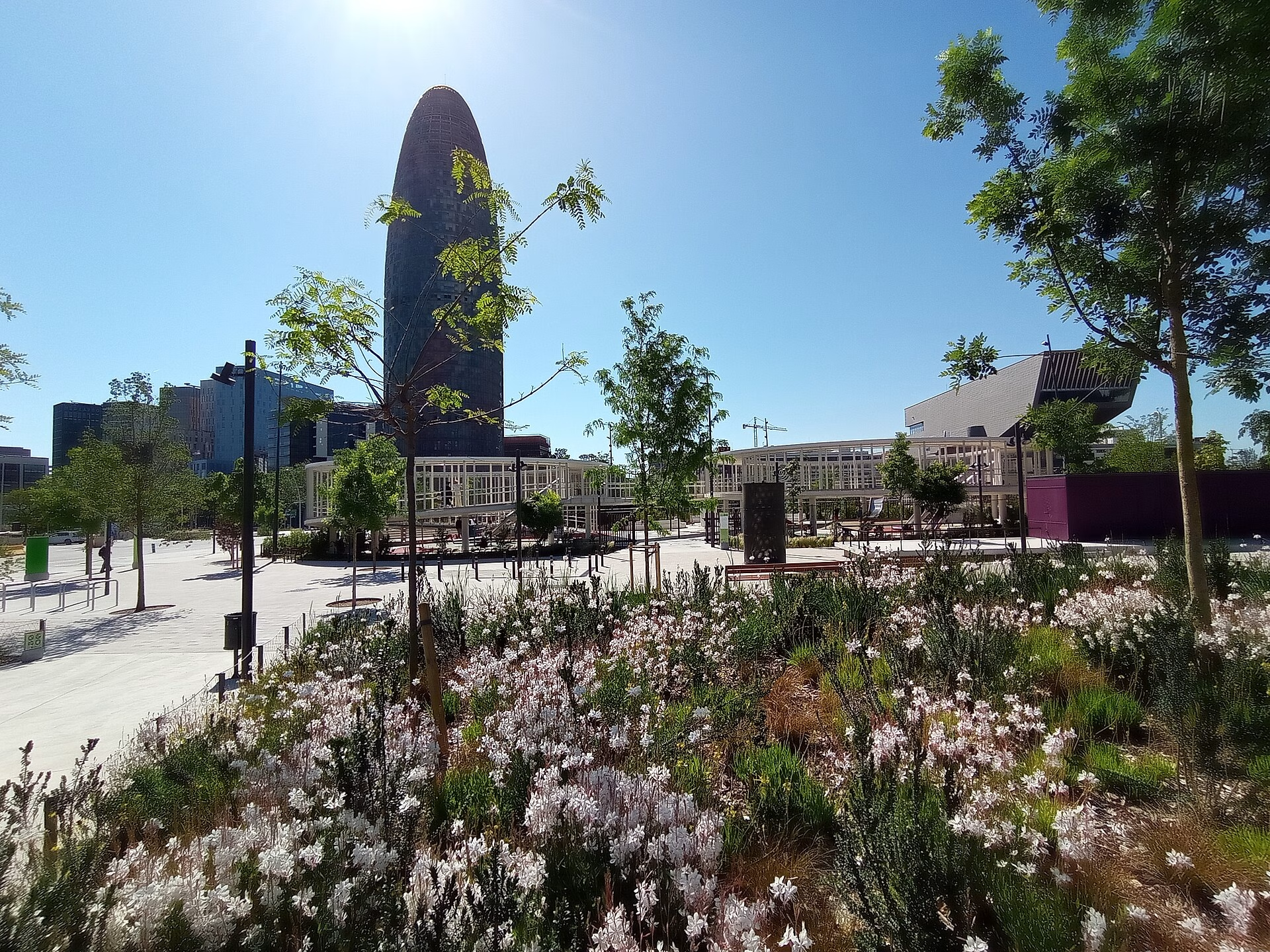
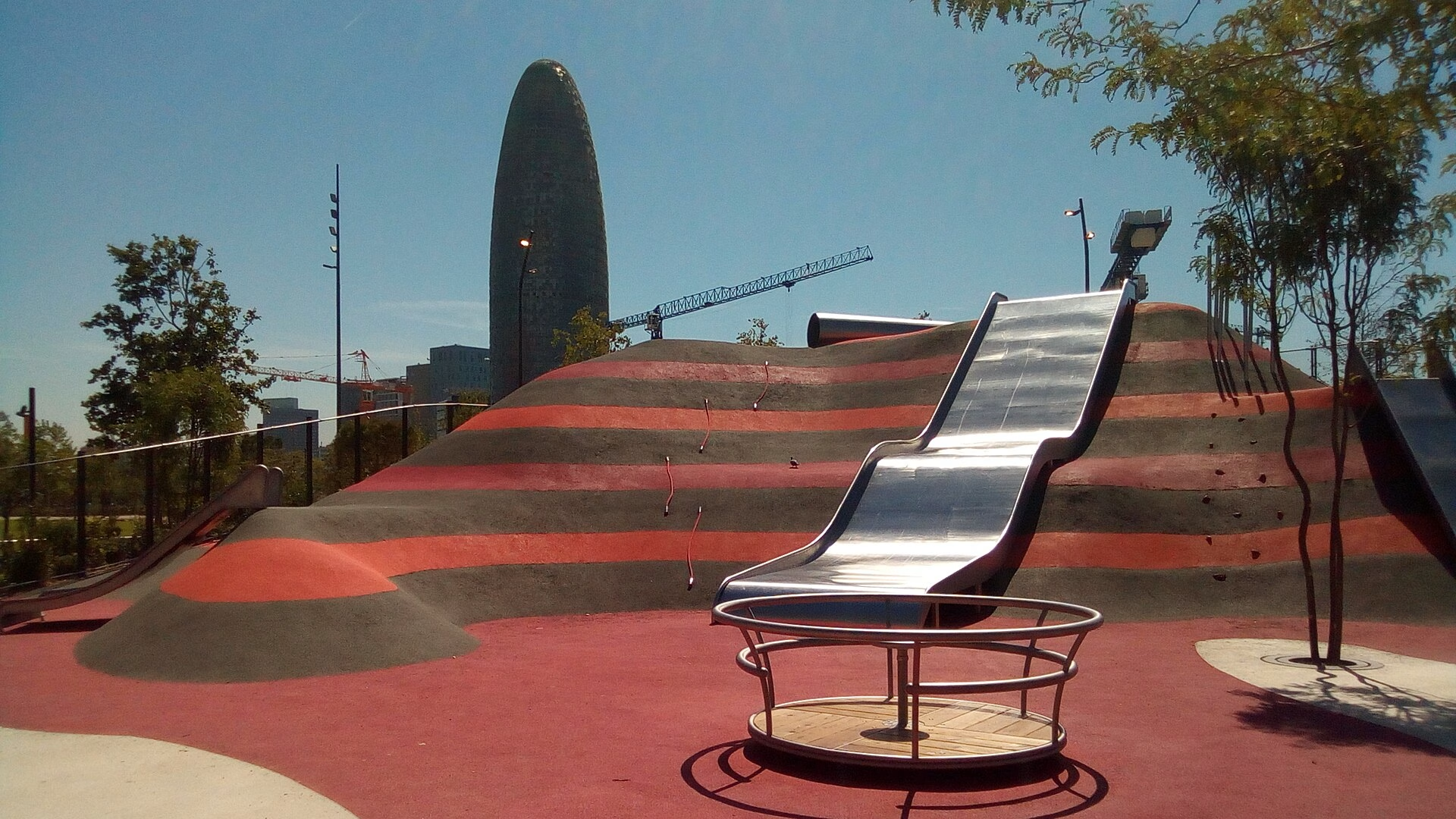
Its paths, landscaped areas, recreational spaces and biodiversity zones offer a different way of experiencing the urban landscape.
The aim is not simply to introduce more vegetation, but to create an urban ecosystem that encourages plant and animal life and helps improve environmental quality.
At the heart of this new landscape lies one of its most distinctive spaces: the Gran Clariana.
The Gran Clariana
A One-Hectare Lawn to Enjoy Nature
At the centre of the park is a vast open lawn covering approximately one hectare.
The Clariana is an open, bright and versatile space, designed to accommodate different ways of enjoying public space.
Its generous dimensions offer visitors an unusual perspective of the city, with Torre Glòries rising directly ahead on the horizon.
The contrast between the horizontal green expanse of the lawn and the tower’s vertical architecture creates a particularly striking visual composition.
Here, two images of Barcelona coexist: the contemporary city, represented by architecture and major infrastructure, and the natural city, which is reclaiming spaces for relaxation and everyday life.
The Clariana invites visitors to sit on the grass, take a leisurely walk, read, chat or simply observe the city from a different perspective.
It is a space designed for people of all ages and different activities, where nature is no longer merely decorative but becomes an essential part of the urban experience.
A Place to Relax, Read and Spend Time Together
Sun Loungers, Tables, Chairs and Parasols
One of the Clariana’s distinctive features is its relaxation area, equipped with sun loungers, tables, chairs and parasols.
This service allows visitors to enjoy the space in greater comfort, transforming the lawn into a kind of outdoor urban living room.
Visitors can stop to read a book, work on their laptops, chat with friends, relax after a walk or simply enjoy a peaceful moment.
The service is managed in association with a social employment organisation, adding an important social dimension to the park’s operation.
The initiative is not simply about providing furniture, but also about creating employment opportunities and offering visitors a welcoming service.
It reflects an approach to public space in which environmental sustainability and community life are part of the same vision.
Activities for All Ages
The Clariana as a Cultural and Community Meeting Place
The Gran Clariana is much more than a place to sit and admire the surroundings.
Throughout the week, it hosts a variety of free activities and events aimed at different audiences.
One of its main attractions is Tai Chi, with sessions held on Tuesday and Thursday mornings.
The practice of this Eastern discipline finds a particularly suitable setting in the park’s green surroundings, helping participants develop balance, breathing, concentration and physical movement.
It offers a different way to start the day, combining physical activity with contact with nature.
Another highlight is Joc 0-99, an intergenerational initiative that encourages people to rediscover the pleasure of playing together.
Its name perfectly expresses its philosophy: play has no age limit.
The space offers board games and recreational activities that encourage participation, interaction between generations and encounters between people who might otherwise never have met.
The project has become a community meeting point, particularly appealing to families, young people and older residents.
Culture, History and Environmental Activities
Discovering Glòries Beyond Its Gardens
The Clariana’s programme also includes cultural, educational and environmental activities.
Guided tours offer the opportunity to explore the area’s history, understand its urban development and discover the different elements that make up the new park.
Family activities include storytelling sessions, workshops, games and cultural entertainment.
Local cultural institutions, such as Biblioteca El Clot – Josep Benet and Centre Cultural La Farinera del Clot, contribute to the area’s cultural life through initiatives and activities connected to the neighbourhood.
These events help ensure that the park is not simply a place to pass through, but a space that belongs to the neighbourhoods and the people who live there.
The educational and environmental dimension is equally interesting. The new park provides an opportunity to observe how vegetation, biodiversity areas and recreational spaces can be integrated into a single urban project.
Torre Glòries and Barcelona’s New Urban Landscape
Vertical Architecture Against a Green Horizon
From the Clariana, Torre Glòries takes centre stage.
Designed by architect Jean Nouvel in collaboration with b720 Arquitectos, it opened in 2005 and has become one of the defining landmarks of Barcelona’s contemporary skyline.
Its silhouette, inspired by natural and geological forms, is distinguished by its curved volume and exterior cladding of glass and aluminium.
The tower reaches approximately 144 metres in height and serves as a visual landmark at the eastern entrance to the Eixample district.
Its presence across the lawn creates an interesting dialogue between architecture and landscape.
The tower’s verticality contrasts with the horizontal expanse of greenery. The built city stands opposite a space reclaimed for nature.
It is precisely this combination that makes the view from the Clariana one of the most attractive images of the new Barcelona.
A New Space for the Neighbourhoods
Glòries Rediscovers Its Human Dimension
The transformation of the square should not be understood solely as a major landscaping project.
Its importance also lies in restoring urban continuity between the neighbourhoods surrounding the area: El Clot, Camp de l’Arpa del Clot, Poblenou and Fort Pienc, among other nearby districts.
For decades, major road infrastructure had affected pedestrian connections and the relationships between these areas.
The new park creates more pleasant walking routes, introduces meeting places and encourages closer connections between the different neighbourhoods.
Glòries is therefore recovering part of the central role that Cerdà had envisioned in the 19th century, albeit from a completely different perspective.
The aim is no longer simply to organise the city’s traffic, but to create a space where people can come together.
What to Do During a Visit to the Clariana
An Experience to Discover on Foot
A visit to the Gran Clariana can begin with a walk along the paths of the new Parc de les Glòries.
From there, the central lawn offers one of the best views of Torre Glòries, making it an ideal place to stop, admire the architecture and take photographs.
Afterwards, it is worth exploring the relaxation areas and discovering how the available furniture is arranged.
If your visit coincides with one of the scheduled activities, you can join a Tai Chi session, explore the Joc 0-99 area or enjoy one of the cultural and family events.
It is also worth walking through the landscaped areas and observing the park’s different plant environments.
How to Get to the Gran Clariana
At the Heart of Barcelona’s Urban Transport Network
The Clariana is located within Parc de les Glòries, in the area surrounding Plaça de les Glòries Catalanes, next to Torre Glòries.
Its location makes it easy to reach by public transport, bicycle or on foot from different parts of Barcelona.
Metro
– Line L1: Glòries station.
Tram
– Trambesòs: Glòries and La Farinera stops, depending on your approach.
Bus
– Several urban bus routes stop in the vicinity of the square and Gran Via.
Bicycle
– The area is connected to Barcelona’s network of cycle lanes.
On Foot
-
From El Clot and Camp de l’Arpa, the park can be reached via the surrounding pedestrian routes.
-
Poblenou and Fort Pienc also have pedestrian connections to the park.
Glòries metro station is one of the most convenient access points.
Would You Like to Discover the New Barcelona with Us?
Glòries and Its Transformation Through a Different Perspective
Discovering the Clariana and the new Parc de les Glòries offers an opportunity to explore one of Barcelona’s major urban transformations from a historical, architectural, environmental and social perspective.
The experience becomes even more interesting when combined with a walk through the surrounding areas of El Clot, Poblenou and other locations that tell the story of the city’s evolution from its industrial past to contemporary Barcelona.
At Magic Dreams Barcelona, we invite you to discover these places through a sensitive and expert perspective, paying attention to architecture, botany, landscape and the stories hidden behind every urban transformation.
Copyright © 2016-2026 Magic Dreams Barcelona.