Route guide for visitors throughout Catalonia – Barcelona – Costa Brava – Catalan Pyrenees – Personalized experiences – Customized tour guide services – A small tribute to the wonderful city and land that saw us born – Transforming experiences into unforgettable memories - Magic Dreams Collection: exclusive universes inspired by Salvador Dalí and Gaudí. Niche perfumes, jewelry, lithographs, and collectible items celebrating the Mediterranean spirit.
In the heart of Barcelona’s Eixample district, along the prestigious Rambla de Catalunya, stands a building that embodies history, style, and distinction: Cases Godó‑Lallana. Located at numbers 112–114, on the corner with Carrer Rosselló, this residence is not only a testament to early 20th-century architecture …
Casa Verdú – Modernism in Barcelona’s Eixample District We are standing in front of the building known as Casa Verdú, located at 103 Rambla de Cataluña, at the intersection with Provenza Street, in the emblematic Eixample district of Barcelona. This property is a remarkable example …
Avinguda de Pau Casals is one of the most emblematic and elegant avenues in Barcelona, located next to the historic Turó Park in the Sant Gervasi-Galvany neighborhood, within the Sarrià-Sant Gervasi district. This avenue combines cultural history, distinguished residential architecture, and one of the city’s most elegant urban parks.
The Origin of the Name: The Legacy of Pau Casals
The avenue is named in honor of Pau Casals (1876–1973), considered one of the most influential cellists in the history of classical music.
Casals revolutionized cello performance and played a decisive role in popularizing Bach’s Cello Suites, which had previously been rarely performed. His career took him to the world’s major stages, where he was recognized for his musical sensitivity, exceptional technique, and deep respect for European musical traditions.
However, his legacy goes beyond music. After the Spanish Civil War, Casals went into exile and became a staunch advocate for peace, democracy, and human rights. For years, he refused to perform in countries that recognized Francisco Franco’s regime. In 1971, he delivered a famous speech at the United Nations, where he performed “El cant dels ocells”, a symbol of peace and freedom for Catalonia.
Because of this combination of artistic excellence and humanitarian commitment, various Spanish cities have named avenues and squares in his honor.
Turó Park: From Amusement Park to Urban Oasis
The current Turó Park, located at the end of the avenue, has a little-known but fascinating history. At the beginning of the 20th century, the area hosted a small amusement park opened in 1912. The park included:
Carousels and mechanical rides
An artificial lake
Cafés and walking areas
Leisure spaces popular with Barcelona families
During the 1920s, the park was one of the main entertainment centers of Barcelona’s upscale neighborhoods. However, it eventually became unprofitable and closed permanently in 1929.
Later, the area was transformed into a public park and gradually urbanized. Over time, it became an elegant green space surrounded by high-end residential buildings.
Today, the park stands out for:
Shaded and peaceful walking paths
Centenary trees
A pond with water lilies
Sculptures and landscaped gardens
Reading and relaxation areas
This environment makes the park one of the calmest and most refined spaces in Barcelona.
The Avenue and Its Urban Environment
Avinguda de Pau Casals is very close to Plaça de Francesc Macià and Avinguda Diagonal, placing it in a strategic location within the city.
The area is characterized by:
Residential buildings with distinguished architecture
Exclusive boutiques and shops
Elegant restaurants and cafés
Proximity to one of the city’s most tranquil parks
For these reasons, the Turó Park area is considered one of the most prestigious residential zones in Barcelona.
Bars and Notable Spots Near Turó Park
Around the avenue and the park, there are several well-known establishments in Barcelona’s gastronomic scene. One of the most iconic in the area is:
Velódromo, a historic café-restaurant nearby that combines Barcelona tradition with contemporary cuisine and a classic atmosphere appreciated by residents and visitors alike.
It is also common to find small cafés, terraces, and elegant restaurants around the park, contributing to the sophisticated character of the neighborhood.
A Space Where History, Culture, and Urban Life Converge
The combination of Pau Casals’ cultural legacy, the urban transformation of the former amusement park, and the tranquility of the current Turó Park make this avenue a unique place in Barcelona.
Today, Avinguda de Pau Casals and Turó Park represent a perfect synthesis of cultural heritage, quality of life, and urban elegance.
In the heart of Sant Gervasi, at 282 Muntaner Street, lies a green treasure of the city of Barcelona: the gardens of the Fundación Julio Muñoz Ramonet. Originally designed in 1916 by the French landscape architect Jean-Claude Nicolas Forestier, who introduced the concept of the …
The Jardins del Doctor Pla i Armengol occupy a former estate in the Guinardó district of Barcelona, a space where history, architecture, art, nature and biodiversity now coexist. The site was originally connected to the Institut Ravetllat-Pla, founded by doctors Ramon Pla i Armengol and …
The Güell Pavilions: Elegance, Symbolism, and the Beginnings of Gaudí’s Universe
In the upper part of Barcelona, in the historic surroundings of Pedralbes, stands one of Antoni Gaudí’s most fascinating architectural ensembles: the Güell Pavilions.
Less internationally renowned than the Sagrada Família, Park Güell, or Casa Batlló, the Güell Pavilions possess extraordinary value: they were among the first major works Gaudí created for Eusebi Güell, the entrepreneur, patron, and key figure in the architect’s career.
Built between 1884 and 1887, the pavilions formed part of the monumental entrance to the former Güell family country estate. Gaudí worked not only on the two pavilions, but also on the gardens, perimeter wall, and various gates providing access to the property.
This was the beginning of a professional and patronage relationship that would have a profound influence on Catalan architecture: the collaboration between Antoni Gaudí and Eusebi Güell.
An Early Work That Already Announces the Great Gaudí
1884–1887: Nature, Geometry, and Craftsmanship
The Güell Pavilions belong to Gaudí’s early period, yet they already contain many of the principles that would later define his architecture.
Parabolic arches, vaults, domes, exposed brick, stone, ceramics, and wrought iron are combined with extraordinary formal freedom.
Gaudí did not conceive the buildings as merely functional constructions. Even in a complex intended for practical purposes such as security, stables, and access to a private estate, he introduced a visual universe filled with natural, geometric, and mythological references.
The Güell Pavilions therefore offer an opportunity to observe a young Gaudí experimenting with solutions that would later reach far greater complexity in his mature works.
The Former Güell Estate
The Setting for an Extraordinary Architecture
Eusebi Güell had considerably expanded an extensive property located in this part of Barcelona, then associated with the territory of Les Corts de Sarrià.
The estate served as a residence and recreational retreat for the family and included gardens, paths, entrances, and various buildings.
Gaudí was commissioned to intervene in this ensemble and created a monumental entrance capable of announcing the importance of the property from the outside.
The former estate no longer exists as it once did. The surroundings have changed profoundly, and part of the land is now associated with the university district and the area around the Palau Reial de Pedralbes.
Nevertheless, the pavilions preserve the memory of this great bourgeois estate and help us understand the relationship between architecture, landscape, and social representation in late nineteenth-century Barcelona.
Two Pavilions, Two Functions
The Gatehouse and the Stables
The complex preserves two principal buildings.
One was intended as the gatekeeper’s house or porter’s lodge, while the other served as the stables, associated with the estate’s horses and carriages. The complex also included a riding arena and other elements connected with the entrance and operation of the property.
The gatehouse stands out for its compact composition, geometric form, and dome.
The stables feature an especially interesting structural solution, with parabolic arches supporting the brick vaults.
These solutions are not merely decorative.
Gaudí uses geometry as a construction tool, allowing the structure itself to become an essential part of the building’s beauty.
The Dragon Gate
Ladon, Guardian of the Garden of the Hesperides
If there is one element that has made the Güell Pavilions such an iconic image of Gaudí, it is their spectacular wrought-iron gate.
At its centre appears an enormous dragon with outstretched wings, an open mouth, and an extended tongue.
But this dragon is not a generic representation, nor does it correspond to the traditional dragon of Saint George.
It is identified with Ladon, the dragon who, according to classical mythology, guarded the Garden of the Hesperides, famous for containing a tree bearing golden apples that granted immortality.
The reference is also connected with L’Atlàntida, the celebrated epic poem by Jacint Verdaguer, a work that held particular importance within the cultural imagination of the period.
Gaudí thus transforms a functional gate into an authentic mythological scene.
The visitor does not simply encounter a gateway: symbolically, they pass into a garden protected by a fantastic creature.
A Dragon Transformed into Architecture
Iron, Movement, and Symbolism
The extraordinary iron gate demonstrates the importance Gaudí placed on craftsmanship.
The dragon is not positioned as an independent sculpture on the gate. The figure itself forms part of the structure and design of the entrance.
The composition has also been associated with the constellation of Draco, reinforcing the connection between mythology, astronomy, and nature.
The result is a piece in which engineering and imagination cease to be separate disciplines.
The iron acquires movement.
The wings seem to extend above the visitor.
The head guards the entrance.
And the entire composition transforms a carriage gate into one of the most singular elements of Gaudí’s architecture.
Ceramics, Brick, and Colour
Material as an Integral Part of Architecture
At the Güell Pavilions, Gaudí experimented with a combination of materials that would later become enormously important throughout his career.
Exposed brick, stone, ceramics, and metal elements create a visual language in which structure and ornamentation are deeply integrated.
The roofs and various architectural elements incorporate ceramic pieces in different colours, creating vibrant surfaces that change according to the light.
Geometric decoration coexists with vegetal references and forms inspired by nature.
The work demonstrates that Gaudí did not understand a building as a box to which decoration was subsequently added.
For him, construction and ornamentation could form a single, unified whole.
The Parabolic Arches
One of Gaudí’s Great Architectural Keys
One of the most fascinating elements of the Güell Pavilions is the use of parabolic arches.
This solution allows loads to be distributed efficiently while simultaneously creating interiors of extraordinary visual power.
In the stables, the arches and brick vaults create architecture of remarkable expressiveness.
This combination of calculation, structure, and beauty anticipates some of the principles Gaudí would later develop on a much larger scale.
The Güell Pavilions are therefore a particularly interesting place to understand Gaudí the architect before the mature period of works such as Park Güell, Casa Batlló, and Casa Milà.
The Garden and Nature
Gaudí Before Park Güell
One of the lesser-known characteristics of the complex is that Eusebi Güell’s commission was not limited to the buildings.
Gaudí also intervened in the gardens of the estate, designing elements related to circulation, entrances, and the organisation of the exterior space.
This relationship between architecture and landscape is particularly interesting because it reveals one of the principles that would later become fundamental to Park Güell.
Architecture does not end at the walls.
The building forms part of a landscape, and the landscape participates in the architectural experience.
The Hercules Fountain
Another Symbolic Element of the Former Estate
Within the historic complex of the Güell Estate, the Hercules Fountain is also preserved, linked to the mythological programme that characterises different elements of the site.
Its presence reinforces the relationship between the complex and the classical world, particularly with the story of Hercules and the Garden of the Hesperides.
The dragon, the references to Hercules, and Verdaguer’s literary tradition transform this area of the former estate into a space where architecture, literature, and mythology are closely intertwined.
The Beginning of a Decisive Relationship
Gaudí and Eusebi Güell
The Güell Pavilions possess an importance that extends far beyond their dimensions.
They represent the beginning of a professional relationship between Gaudí and Eusebi Güell that would subsequently give rise to some of the most important works of Catalan architecture.
Projects such as Palau Güell, Park Güell, and the Crypt of Colònia Güell, among other collaborations, would follow.
Eusebi Güell was not simply a client.
He was a patron who gave Gaudí the opportunity to experiment, develop new ideas, and take architecture into increasingly personal territories.
Historical Heritage
A Protected Monument Since 1969
The Güell Pavilions were declared a National Historic-Artistic Monument in 1969, a recognition confirming their importance within Catalonia’s architectural heritage.
The complex has undergone various restoration and conservation works over the years.
The municipal intervention carried out in 1999 formed part of the efforts to preserve this heritage and maintain its architectural and decorative elements.
A Different Way of Experiencing Gaudí
A Place for Observing the Details
The Güell Pavilions do not offer the monumental scale of the Sagrada Família or the dimensions of Park Güell.
Their appeal is different.
Here, the experience lies in observing.
Looking at the dragon.
Discovering how iron is transformed into a mythological creature.
Observing the parabolic arches.
Recognising the combination of brick and ceramics.
Understanding how a gate can become a work of art.
And discovering how, behind a relatively small complex, we can already see the language of an architect who would forever transform the image of Barcelona.
Where Are the Güell Pavilions?
Pedralbes, Barcelona
The Güell Pavilions are located on Avinguda de Pedralbes, in the area around the university district and the Palau Reial.
It is a particularly interesting location for combining the visit with other places of interest in Barcelona, such as the Palau Reial de Pedralbes, the Pedralbes Gardens, and various university and Modernist sites in the area.
How to Get There
A Well-Connected Area
Metro: L3, Palau Reial station.
Tram: T1, T2, and T3, Palau Reial stop.
Bus: various routes operate along Avinguda Diagonal and throughout the Pedralbes area.
On foot: the site can easily be combined with a walk along Diagonal Avenue and through the Pedralbes Gardens.
By bicycle: the area has cycling connections and is convenient for exploring the surrounding neighbourhood.
Before travelling, we recommend checking access arrangements for the site, as visiting conditions and opening hours may vary due to conservation works or cultural programming.
Completing the Experience
Gastronomy After Discovering Gaudí
Santa Clara
Located in the Pedralbes area, Santa Clara offers a Mediterranean gastronomic experience with international influences, based on fresh, seasonal produce.
Its menu combines a variety of sharing dishes with fish, meat, rice dishes, and proposals designed for a relaxed meal in an elegant setting.
Specialities include oysters, Cantabrian anchovies, steak tartare, ceviche, grilled octopus, fish, rice dishes, and various cuts of meat.
As a general reference, the average price is around €34 per person, while some set-menu options may be available for around €32, depending on the conditions and season.
Thanks to its atmosphere and location, Santa Clara can be an appealing choice for completing a day dedicated to discovering the architecture and heritage of Pedralbes.
Just a few minutes from the Güell Pavilions, Aspic, located at Carrer del Doctor Ferran, 23, is a long-established gastronomic venue in the Les Corts and Pedralbes area.
Aspic combines a restaurant with a specialised gastronomic offering, featuring Mediterranean cuisine and particular attention to the quality of its ingredients. In addition to its restaurant service, the brand offers a gourmet and catering line, with preparations designed for celebrations and private experiences.
Its offering is particularly interesting for those looking for a relaxed meal after visiting the Güell Pavilions, as it is located in the same Pedralbes area.
As a general reference, it currently appears to be in the approximately €30–40 per-person price range.
Aspic also offers restaurant service during different time periods, with lunch and dinner service on certain days of the week. Opening hours may vary, so we recommend checking availability before visiting.
For an experience with Magic Dreams Barcelona, both restaurants can be incorporated into a personalised day combining architecture, gastronomy, history, and heritage, adapting the itinerary and gastronomic experience to each visitor’s preferences.
Experiences with Magic Dreams Barcelona
Our tour guides are native speakers of Spanish, Catalan, English, and other languages upon request. They are experts in history, architecture, art, symbolism, and botany, including lepidopterology, ornithology, floriculture, and arboriculture, and specialise in experiences connected with Antoni Gaudí and Salvador Dalí.
With Magic Dreams Barcelona, you can discover the secrets of Barcelona from a different perspective: cultural, artistic, and sensory.
We organise one-day experiences, weekend escapes, and personalised stays throughout Barcelona, the Costa Brava, and the Catalan Pyrenees, adapting each experience to your preferences.
We can take care of the complete logistics, including:
Private chef offering national, Catalan, and international cuisine at your accommodation.
Breakfasts, lunches, and dinners inspired by different periods and cultures.
Live music, including piano, violin, or opera, upon request.
Floristry services.
Professional photography sessions.
Exclusive gastronomic routes.
Premium tickets to museums and events.
Sensory picnics in gardens, by the sea, or aboard a yacht.
Specialised sensory guides.
Exclusive workshops in Trencadís, Surrealism, gastronomy, floral art, and fragrances.
Hawaiian Lomi Lomi massages by the sea, accompanied by fruit baskets and gifts.
Spas, thermal circuits, and saunas.
Excursions and hiking.
Private vehicles and personalised logistics.
Our accommodations are carefully selected to create a comfortable, elegant experience that is coherent with the overall style of the journey.
We also design personalised themed experiences after learning about your preferences, from a day dedicated to Gaudí to a complete escape through the Costa Brava or the Catalan Pyrenees.
The Güell Pavilions: A Gateway into Gaudí’s Universe
The Güell Pavilions do not need monumental dimensions to make an impression.
Their power lies in the details.
In the iron dragon.
In the parabolic arches.
In the ceramics.
In the geometry.
In the relationship between architecture and nature.
And, above all, in the opportunity to contemplate one of the earliest great manifestations of Antoni Gaudí’s personal architectural language.
Here, at the former entrance to the Güell Estate, one of the most important collaborations in Catalan architecture begins.
A gate guarded by a mythological dragon thus becomes more than an entrance.
It becomes the gateway to a creative universe that would forever transform Barcelona.
With Magic Dreams Barcelona, we invite you to discover it from a different perspective: through history, architecture, art, nature, and emotion.
Pabellones de la Finca Güell – By Enric – Own work, CC BY-SA 4.0, https://commons.wikimedia.org/w/index.php?curid=62605211.
For collaborations, projects or professional inquiries – Reservations and quotes
Please leave your details and phone number, and we will get in touch with you as soon as possible, within the same day.
The summit of Barcelona where history, nature and entertainment come together Tibidabo, the highest part of the city of Barcelona, stands at 575 metres above sea level, offering an incomparable perspective of the city, the Mediterranean Sea and the surrounding hills. This remarkable place combines …
An iconic promenade between two of Barcelona’s landmarks Avinguda Gaudí is one of Barcelona’s most distinctive, elegant, and harmonious promenades. Located in the Eixample district, this pedestrian avenue connects two of the great masterpieces of Catalan Modernism: the Sagrada Família and the Hospital de Sant …
Located next to the Mediterranean Sea, at the northern edge of the city, Port Fòrum is also a very particular place from an administrative point of view: this is where Barcelona ends and the municipality of Sant Adrià de Besòs begins.
Although geographically it is located next to Barcelona and forms part of its metropolitan area, the port’s official address is Carrer de la Pau, 12, 08930 Sant Adrià de Besòs.
The result is a unique area where a marina, beach, restaurants, water activities, large vessels and open spaces overlooking the sea all come together.
Where is Port Fòrum?
Port Fòrum is located around Parc del Fòrum, right on the northern boundary of Barcelona.
This is an area that changed dramatically as a result of the 2004 Universal Forum of Cultures, when this part of the coastline was redeveloped and connected to new urban and leisure spaces.
From central Barcelona, the port is approximately 15 minutes by car, although the actual journey time can vary considerably depending on traffic.
By road, access is very easy from the Ronda Litoral. Port Fòrum indicates direct access via Exit 25.
How do you get to Port Fòrum from central Barcelona?
One of the main advantages of Port Fòrum is that you do not need a car to get there.
By metro
The easiest option is to take Barcelona Metro Line 4 (L4) and get off at El Maresme | Fòrum.
From the station, it is approximately a 10-minute walk to the port.
You can also use Besòs Mar station, depending on the specific part of the area you want to reach.
By tram
Another very convenient option is the T4 tram, which stops at Fòrum, practically next to the port.
For tourists, the tram is particularly useful because it provides an easy way to travel along the coastline without having to worry about parking.
By bus
The Fòrum area is served by several bus routes, including 7, 136, H16, B20, B23, V29, V31 and V33.
There are also night services such as N6 and N7.
By bicycle or scooter
You can also reach the port by bicycle or scooter using the network of cycle lanes. Port Fòrum has cycle-lane access right up to the entrance to the port.
Is there parking at Port Fòrum?
Yes. This is one of the main advantages if you decide to travel by car.
Port Fòrum currently has around 1,200 parking spaces, distributed across two areas, as well as 24 spaces with electric vehicle charging points.
There is a main car park that can be accessed from the port entrance and from the Ronda Litoral, as well as another car park with an entrance via Parc de la Pau. The latter is also connected to the port and offers special rates.
How much does parking cost?
A clarification is important here.
Parking rates can change, and the current price is not publicly displayed on Port Fòrum’s official website. The port regulations establish that vehicle parking is subject to the applicable rate and that current rates are approved and displayed at the Harbour Master’s Office.
For this reason, we recommend checking the price at the car park itself before leaving your vehicle, especially if you plan to stay for several hours.
Is the parking area monitored?
Yes. The port has security systems in place.
Port Fòrum states that there is 24-hour security in the parking area, while its facilities also have CCTV systems and a security control room.
In the marina area, there is also a 24-hour closed-circuit video surveillance system, electronic access to the pontoons and a 24/7 nautical service.
However, there is an important distinction between general security and individual protection. The port’s own regulations warn that general security does not constitute a guarantee against possible theft or burglary and that owners should take their own protective measures.
Is the area safe?
Port Fòrum has security staff, CCTV, access control and 24-hour surveillance in certain facilities, providing its own security infrastructure within the site.
As in any tourist and waterfront area, it is advisable to take the usual precautions: do not leave valuables visible inside your vehicle and keep a close eye on your belongings.
It would not be accurate to describe the entire surrounding area of Barcelona or Sant Adrià as either completely safe or unsafe based solely on the security measures within the port.
A large marina
Port Fòrum is not a small marina for strolling around.
It currently offers 270 berths for boats ranging from 10 to 80 metres in length, distributed between an inner and an outer basin.
It also has a dedicated superyacht area, with an independent private pontoon for vessels of up to 80 metres.
As a result, during a visit you can expect to see everything from small boats and sailing yachts to large yachts and catamarans.
Dry marina and technical area
One of the most specialised aspects of Port Fòrum is its nautical infrastructure.
The port has a large Dry Marina for storing boats and personal watercraft, as well as a technical area and a dry dock of more than 9,000 m² dedicated to boat maintenance and repairs.
The dry marina operates throughout the year and allows owners to access their boats on demand, while the technical area provides specialised maintenance and repair services.
Security and services for boats
For owners and crews, Port Fòrum offers extensive infrastructure: electronic access to the pontoons, 24-hour video surveillance, 24/7 nautical services, Wi-Fi, changing rooms, laundry facilities, storage, waste collection, a 24-hour self-service fuel station, and dry-dock and technical-area services.
Water and electricity are also available at the berths.
What shops are there at Port Fòrum?
Port Fòrum has a large commercial and restaurant area. The port itself states that it has around 16,500 m² of commercial space, with an offering focused on restaurants, leisure activities, water sports and retail.
This is not a traditional shopping centre like those you will find in central Barcelona.
Instead, the offer is more closely connected with the nautical world, gastronomy, leisure, sports and experiences by the sea.
Among the activities and businesses associated with the port are nautical services, maintenance and repair companies, water activities, sailing and diving, as well as restaurants and other food and beverage establishments.
For this reason, Port Fòrum is particularly interesting if you are looking for an experience different from Barcelona’s traditional shopping areas.
Restaurants and dining by the sea
Gastronomy is an important part of Port Fòrum’s new offering.
There are currently several restaurants and food concepts, including La Cantina del Puerto, El Racó del Mariner, MUAMUA, L’Anxova Divina and Lora, offering everything from Mediterranean cuisine and traditional dishes to more contemporary options.
The port is also developing new spaces around the concept of an urban oasis, combining gastronomy, music, leisure and views of the Mediterranean.
It is an especially pleasant place in the late afternoon, when the light over the sea completely transforms the atmosphere.
Is there a beach at Port Fòrum?
Yes. The port is located next to the coastline and provides access to the beach areas around the Fòrum.
However, the marina should not be confused with the beach: they are different areas, although they are practically next to each other.
From the port, you can access the waterfront and the open spaces around the Fòrum, with pedestrian connections leading towards the coastline.
The combination of marina, beach, seafront promenade and large open spaces makes this area different from other waterfront districts of Barcelona.
A place for water sports
If you enjoy the sea, Port Fòrum offers many more possibilities than simply looking at boats.
The port hosts activities related to sailing, water sports, diving and motorised water activities. The site is also home to the Barcelona International Sailing Center, a centre dedicated to high-performance sailing training.
As a result, at certain times of the year you may see considerable sporting activity on the water.
The Barcelona International Sailing Center
Located within the Fòrum area, the Barcelona International Sailing Center (BISC) is dedicated to the training and preparation of sailing athletes.
The presence of the BISC reinforces the area’s connection with high-performance sailing and makes Port Fòrum one of the important locations on Barcelona’s coastline for the sport.
BISC — Barcelona International Sailing Center
What can you do when visiting Port Fòrum?
A visit does not have to be limited to the marina.
You can start by walking among the boats, continue towards the coastline and beach, stop for a drink overlooking the sea, and finish by watching the sunset.
You can also combine your visit with Parc del Fòrum, the Barcelona International Convention Centre, Diagonal Mar or the nearby waterfront areas.
And if you arrive by public transport, you can turn the journey into a short route along the northern Barcelona coastline.
Port Fòrum and the northern boundary of Barcelona
When you arrive at Port Fòrum, Barcelona practically ends in front of you and another municipality begins: Sant Adrià de Besòs.
The administrative boundary can easily go unnoticed because the urban landscape continues without an obvious dividing line. There is no gate or spectacular sign announcing the change, but legally you are moving from Barcelona into Sant Adrià de Besòs.
It is one of those details that helps explain how Greater Barcelona works: a city that ends administratively but continues physically into a fully connected urban area.
Panorámica del puerto, la playa del Fòrum y Barcelona – By Pf2019 – Own work, CC BY-SA 4.0, https://commons.wikimedia.org/w/index.php?curid=76836812.
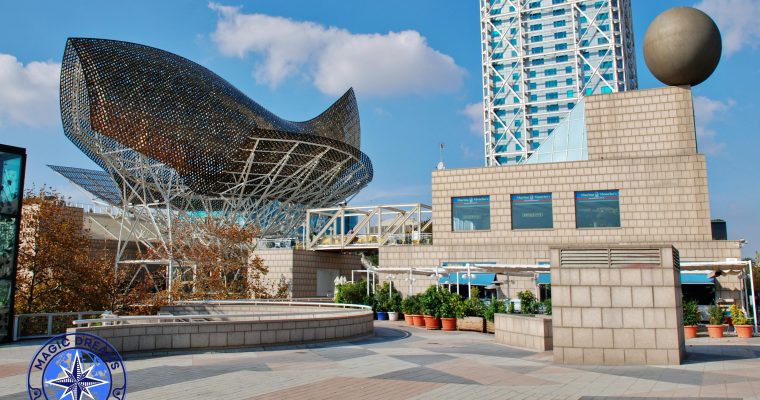
Introduction The sculpture known as The Fish, also called the Golden Fish, is one of the most iconic works along Barcelona’s waterfront. It was designed by the renowned architect Frank Gehry as part of the urban transformation for the 1992 Olympic Games. Located beside Port …
In the Pedralbes neighborhood, away from the urban bustle and immersed in a tranquil and beautifully serene atmosphere, stands the Real Monastery of Santa María de Pedralbes, one of the most elegant expressions of Catalan Gothic architecture. Founded in 1327 by Queen Elisenda de Montcada, …
Where water, light and music come together to create one of Barcelona’s great icons
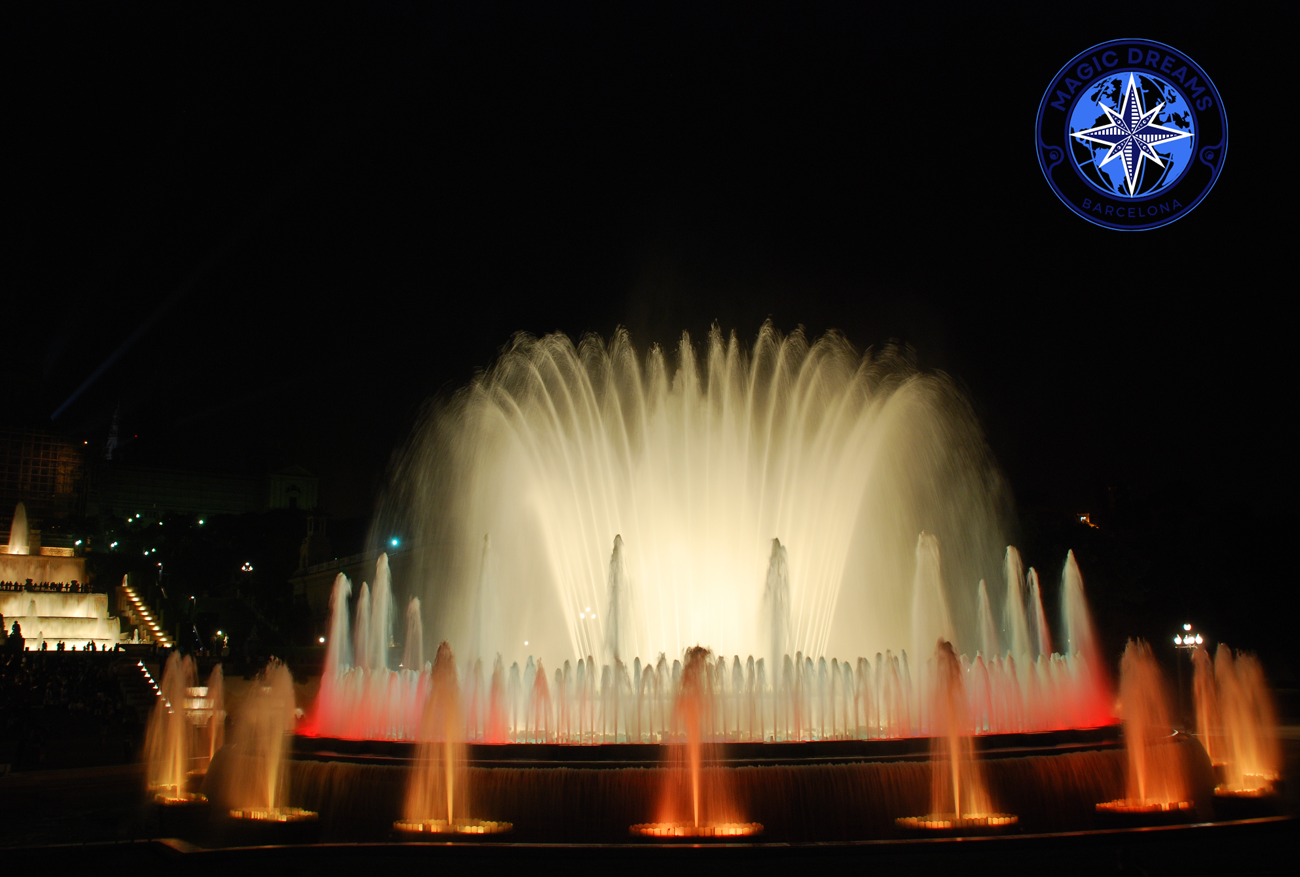
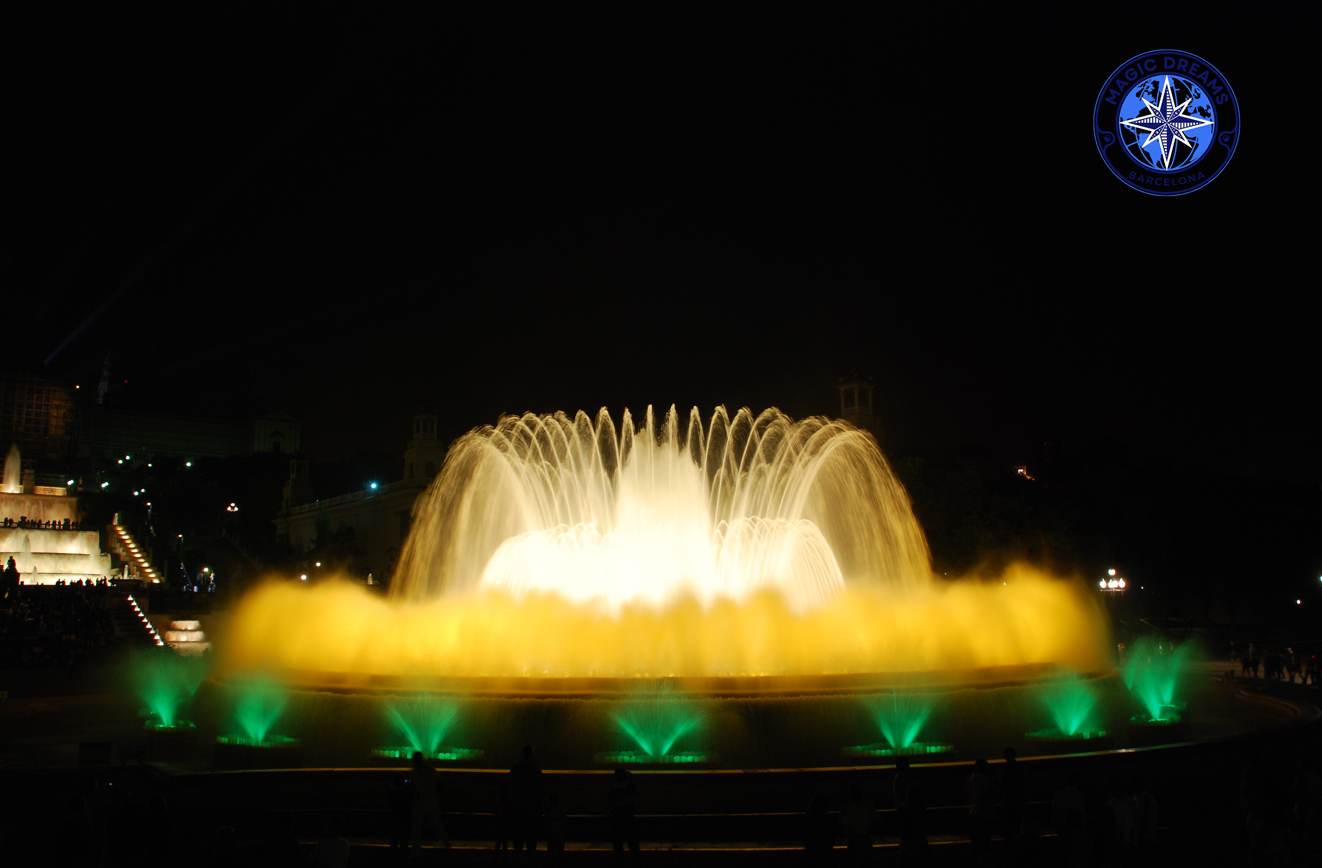
Among Barcelona’s monumental landmarks, few places bring together history, architecture, engineering, art and spectacle as powerfully as the Magic Fountain of Montjuïc.
Located at the foot of Montjuïc Mountain, beside Maria Cristina Avenue and opposite the majestic National Palace, the Magic Fountain is one of the city’s most recognisable landmarks.
Its history is closely linked to one of the great events in Barcelona’s 20th-century history: the 1929 International Exposition.
Since then, generations of Barcelona residents and visitors have watched water transform into movement, light into colour and music into emotion.
The Magic Fountain is not simply a monumental fountain.
It is a true representation of Barcelona’s ability to combine innovation, creativity and urban space.
The History of the Magic Fountain
A project created to transform Montjuïc
The Magic Fountain was conceived in the context of the 1929 Barcelona International Exposition, an event that profoundly transformed Montjuïc Mountain and its surroundings.
Barcelona wanted to present itself internationally as a modern, innovative and culturally advanced city.
Within this ambitious urban project came an extraordinary idea: to create a large fountain capable of transforming water into a visual spectacle.
The project was developed by engineer Carles Buïgas, who envisioned an installation in which water, light and movement could be combined in countless ways.
The proposal was particularly innovative for its time.
Construction was completed within an extremely short period and, despite the technical challenges, the fountain was inaugurated in 1929.
Its launch quickly became one of the major events of the International Exposition.
From that moment onwards, the Magic Fountain became part of Barcelona’s visual identity.
Carles Buïgas and the Engineering of Spectacle
When technology becomes art
The figure of Carles Buïgas is fundamental to understanding the Magic Fountain.
His vision was not simply to construct a large-scale fountain.
Buïgas wanted to create a spectacle based on the interaction between different elements.
Water would become movement.
Lighting would provide colour.
And the entire installation would acquire a theatrical dimension.
This concept transformed the fountain into one of the great expressions of engineering applied to public space during the 20th century.
The installation demonstrated that urban infrastructure could go beyond its practical function and become an aesthetic experience.
That idea remains one of the defining characteristics of the Magic Fountain.
Water, Light and Music
A monumental choreography
The Magic Fountain functions as a vast hydraulic stage.
Its different jets allow numerous shapes, heights and movements of water to be created.
Added to this is a lighting system capable of continuously changing the perception of the spectacle.
The result is an authentic choreography in which every element plays its part.
Water provides movement.
Light creates atmosphere.
Music establishes the rhythm.
And the architecture of Montjuïc provides the stage.
During the shows, these elements are synchronised to create a multisensory experience.
The fountain then ceases to be a static structure and becomes a work of art in motion.
An Icon of Barcelona
An image inseparable from the Montjuïc landscape
Over the decades, the Magic Fountain became one of Barcelona’s great tourism symbols.
Its location played a major role in this transformation.
The fountain stands along one of the city’s most important monumental axes, between Plaça d’Espanya and the National Palace, today home to the Museu Nacional d’Art de Catalunya.
From this point, the view towards Montjuïc reveals the urban importance of the monumental complex created for the 1929 International Exposition.
The Magic Fountain forms part of a landscape in which architecture, gardens, stairways, museums and public spaces come together around the mountain.
For this reason, visiting it can become a much broader experience than simply attending a show.
It is an opportunity to discover an essential part of Barcelona’s urban history.
The Magic Fountain and Montjuïc
A gateway to the mountain
The Magic Fountain can serve as the starting point for exploring some of the most important cultural and monumental sites in Montjuïc.
From here, visitors can continue towards the Museu Nacional d’Art de Catalunya, explore the landscaped areas, visit the Fundació Joan Miró or ascend towards Montjuïc Castle.
The visit can also be combined with a walk along Maria Cristina Avenue, Plaça d’Espanya and other areas connected to Barcelona’s urban transformation during the 20th century.
In this way, the fountain becomes more than an isolated attraction and instead forms part of a cultural itinerary through Montjuïc.
A Spectacle for Every Generation
Barcelona from a different perspective
One of the reasons the Magic Fountain has remained popular for decades is its ability to connect with very different audiences.
Children discover the spectacle through movement and colour.
Adults can appreciate its engineering and design.
Architecture enthusiasts encounter an exceptional monumental setting.
And those looking for a romantic experience find an especially captivating setting during the evening.
The Magic Fountain demonstrates how the same experience can take on different meanings depending on who is watching it.
The Magic Fountain at Night
When Montjuïc is transformed
The experience changes completely when night falls.
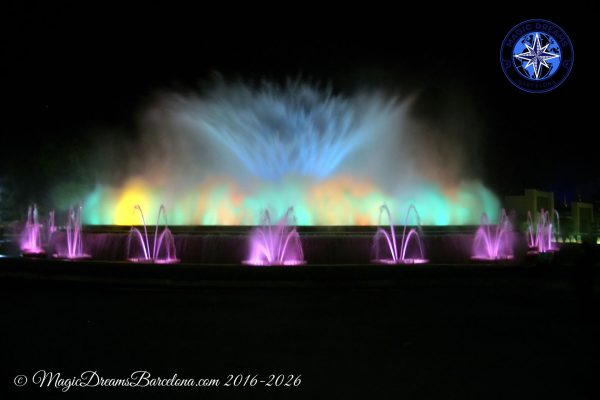
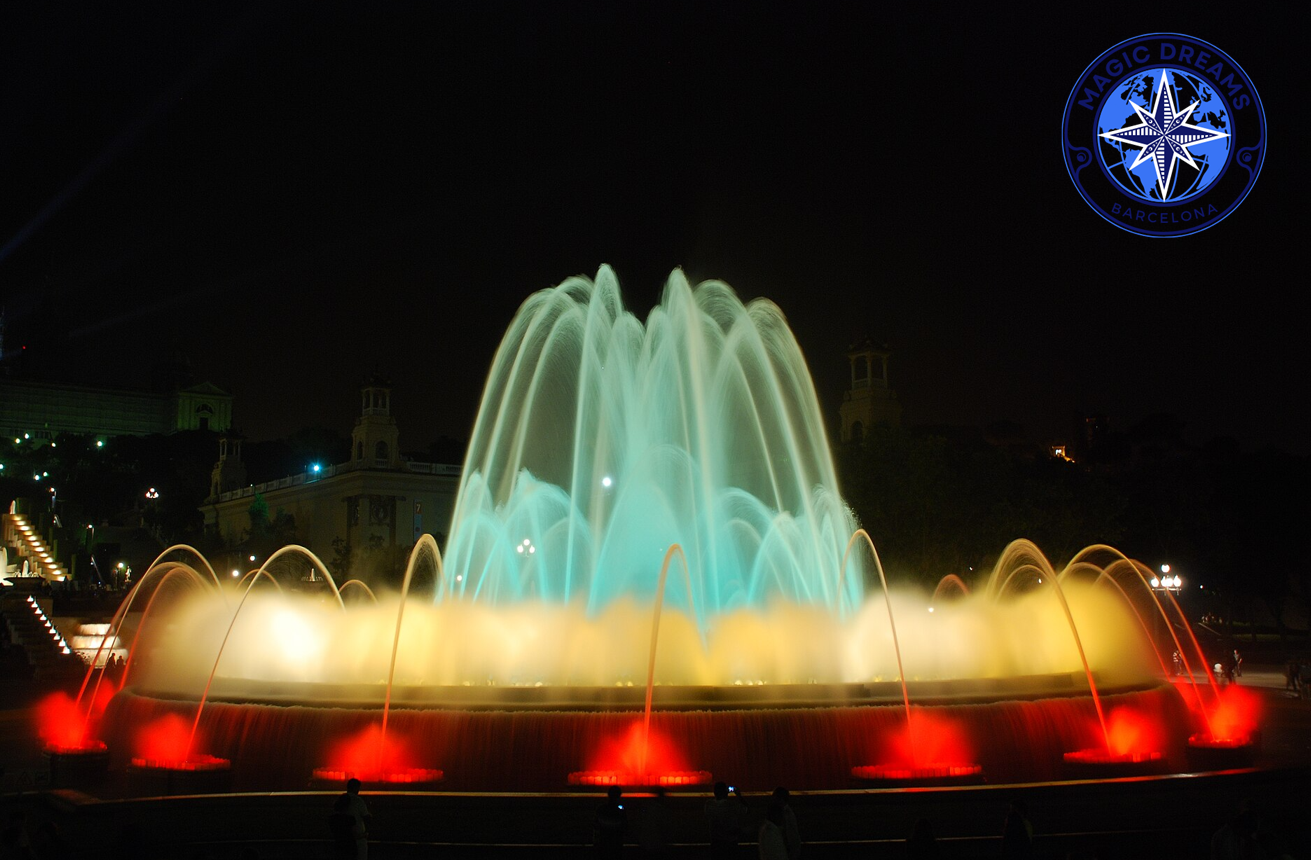
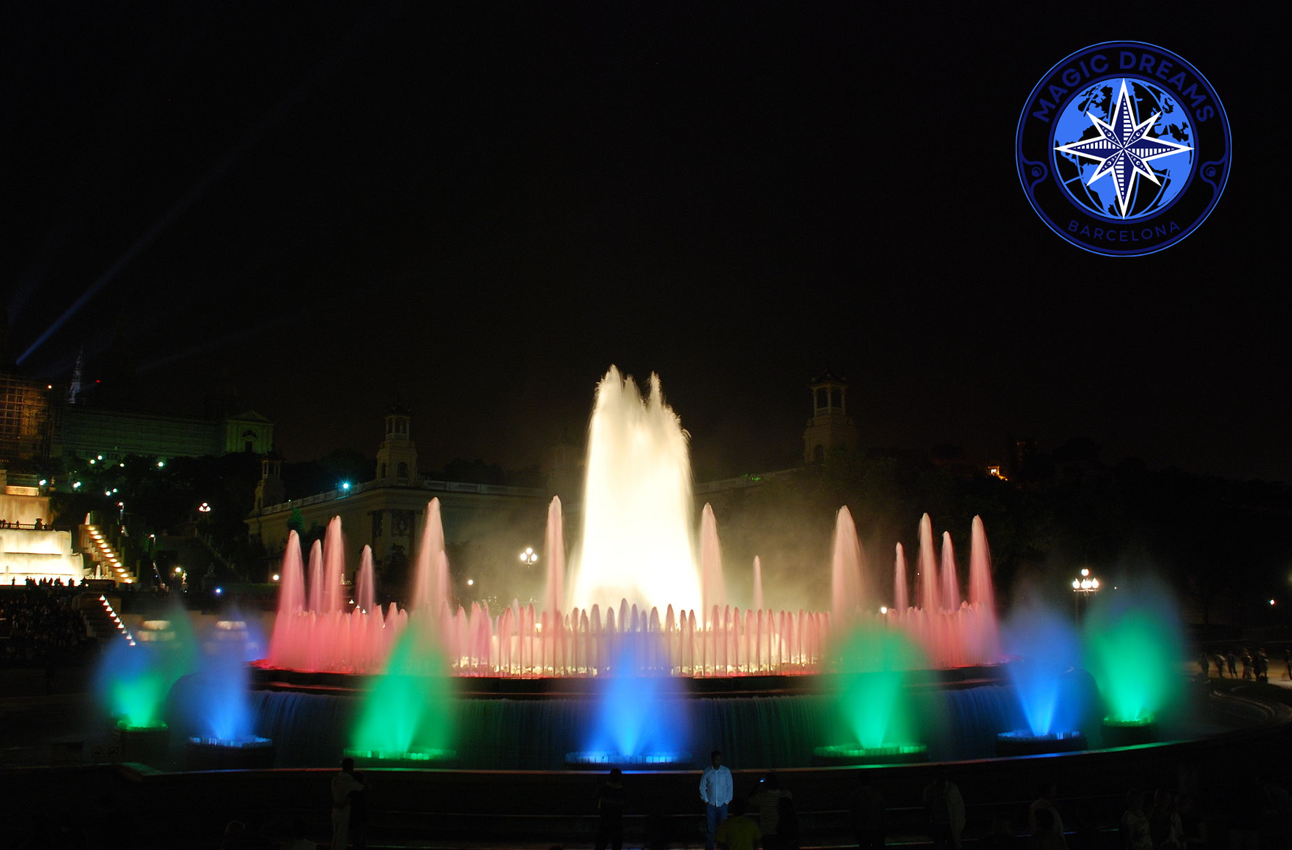
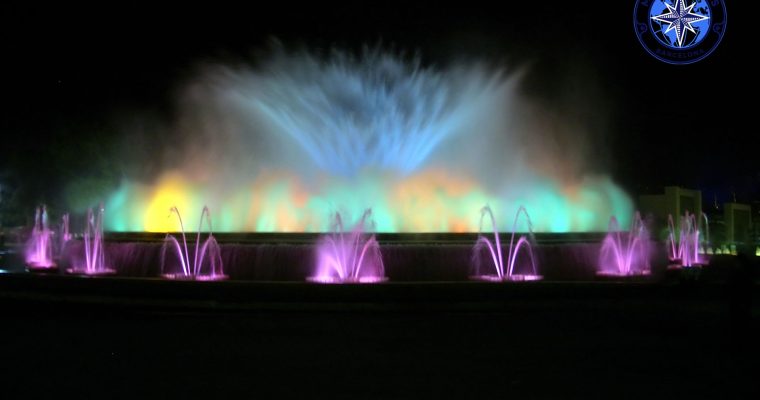
The lighting transforms the water into a succession of shapes and colours that contrast with the darkness of the surrounding landscape.
The National Palace appears in the background as a monumental stage set.
The stairways fill with visitors.
And Montjuïc takes on an entirely different atmosphere.
It is during these hours that the Magic Fountain most clearly reveals its theatrical character.
Barcelona then appears as a city of light, architecture and movement.
The Magic Fountain and the 1929 International Exposition
The birth of a new Barcelona
The history of the Magic Fountain cannot be separated from the 1929 International Exposition.
That event transformed Montjuïc and helped create some of the monumental spaces that remain part of Barcelona’s landscape today.
The exposition sought to showcase the technological, industrial and cultural advances of its time.
The Magic Fountain fitted perfectly into this spirit.
It was modern.
It was technological.
It was spectacular.
And at the same time, it was integrated into a monumental architectural composition.
More than nine decades later, that vision continues to form part of the identity of the city.
The Evolution of the Magic Fountain
A heritage landmark that has adapted over time
Like many major urban infrastructures, the Magic Fountain has gone through different stages throughout its history.
The passage of time, periods of deterioration and technical requirements have made various maintenance and restoration interventions necessary.
One of the most important moments in its recent history was connected to Barcelona’s transformation in preparation for the 1992 Olympic Games.
The renewal of the Montjuïc area helped restore and update different elements of the monumental complex.
The Magic Fountain therefore continued to play its role as one of Barcelona’s great public spaces.
An Engineering Masterpiece Turned Heritage
When infrastructure becomes culture
The Magic Fountain represents a particularly interesting concept within the history of urban development.
An infrastructure originally designed as part of an international event eventually became a cultural landmark and a major visitor experience.
Its importance lies not only in its dimensions or technical systems.
It also lies in the collective memory it has created.
For decades, the fountain has been the setting for celebrations, family gatherings, first visits to Barcelona and special moments.
Its value therefore combines material heritage and emotional memory.
What to Do Around the Magic Fountain
An experience that goes far beyond the show
A visit to the Magic Fountain can be combined with a wide range of activities in Montjuïc and its surroundings.
Possibilities include:
Visiting the Museu Nacional d’Art de Catalunya.
Exploring Montjuïc Mountain.
Discovering the Fundació Joan Miró.
Visiting Montjuïc Castle.
Walking through the mountain’s historic gardens.
Discovering Plaça d’Espanya.
Walking along Maria Cristina Avenue.
Enjoying panoramic views of Barcelona.
Combining Montjuïc with the Gothic Quarter.
Enjoying a private gastronomic experience.
Arranging a professional photography session.
Designing a personalised cultural itinerary.
In this way, the Magic Fountain can become part of a complete Barcelona experience.
The Magic Fountain as a Romantic Experience
Barcelona beneath the lights of Montjuïc
The combination of water, music, lighting and architecture makes this one of the most captivating settings for a romantic experience.
A visit can form part of a day designed for couples, combining Montjuïc with a private dinner, a photography session, a Barcelona itinerary or an exclusive Mediterranean experience.
The objective is not simply to watch the fountain.
It is to create a moment around it.
A moment that can remain in the memory long after leaving Montjuïc.
A Family Experience
Discovering Barcelona through wonder
The Magic Fountain is also an excellent experience for families.
The spectacle introduces younger visitors to concepts such as water, light, music, architecture and engineering in an engaging and entertaining way.
Its location also makes it possible to combine the visit with other Montjuïc attractions and design a day adapted to different ages.
Barcelona thus becomes a truly educational stage.
Montjuïc and the Identity of Barcelona
A mountain that tells the story of the city
Montjuïc is much more than the place where the Magic Fountain is located.
The mountain brings together an extraordinary variety of historical, artistic, sporting and cultural heritage.
The Magic Fountain occupies a particularly symbolic position within this landscape because it represents the modern Barcelona that emerged during the major urban transformations of the 20th century.
It is a landmark that connects past and present.
The Magic Fountain in Contemporary Barcelona
Tradition, innovation and new ways of experiencing the city
Barcelona continues to evolve, and so does the way visitors and residents discover its landmarks.
The Magic Fountain retains its historic character, but today it forms part of a tourism model increasingly focused on experiences.
It is no longer simply about arriving, taking a photograph and leaving.
Visitors want to understand.
To learn the history.
To discover the architecture.
To explore the surroundings.
To experience the city from a more personal perspective.
The Magic Fountain fits perfectly into this new way of travelling.
Discover the Magic Fountain with Magic Dreams Barcelona
An experience designed around every traveller
At Magic Dreams Barcelona, we believe that discovering Barcelona means much more than visiting its best-known landmarks.
It means understanding the stories behind them.
That is why we design private and personalised experiences around the Magic Fountain and Montjuïc.
We can create a cultural itinerary through the mountain, combine the visit with the Museu Nacional d’Art de Catalunya, explore the architecture of the 1929 International Exposition, incorporate gastronomy, photography or private transportation, or continue afterwards towards other iconic neighbourhoods and landmarks of Barcelona.
Every experience is adapted to the interests and pace of our clients.
For a couple, we can design a romantic experience.
For a family, an entertaining and cultural day.
For a private group, a complete itinerary through Montjuïc and the historic centre.
And for those seeking an exclusive experience, we can combine Montjuïc with gastronomy, art, private sailing and other premium services.
Barcelona Between Water, Light and Music
A city that knows how to turn engineering into emotion
The Magic Fountain of Montjuïc represents one of the most distinctive expressions of Barcelona’s identity.
It was born from a project of urban modernisation.
It was conceived as a demonstration of technological innovation.
It became a symbol of the city.
And over time, it became part of the collective memory of several generations.
Its true appeal lies precisely in this combination.
History, engineering, architecture, art, music and emotion.
Everything happens on a single stage.
Would You Like to Discover the Magic Fountain of Montjuïc with Us?
Barcelona from a cultural, private and personalised perspective
At Magic Dreams Barcelona, we design experiences that allow visitors to discover the city in depth and without rushing.
We can organise private visits to Montjuïc, cultural itineraries, gastronomic experiences, photography sessions, private transportation and personalised programmes combining heritage, art, nature and gastronomy.
We take care of the planning, logistics and every detail required to create an experience tailored to our clients.
Because the Magic Fountain can be visited.
But it can also be experienced.
And when the water begins to move, the music fills the space and the lights transform Montjuïc, Barcelona once again demonstrates why it is one of the Mediterranean’s most creative and fascinating cities.
Magic Dreams Barcelona transforms a visit to the Magic Fountain of Montjuïc into an experience where history, art, engineering and emotion come together beneath the lights of Barcelona.
Fuente Mágica de Montjuïc.
Fuente Mágica de Montjuïc.
Fuente Mágica de Montjuïc.
Fuente Mágica de Montjuïc.
Fuente Mágica de Montjuïc.
Magic Fountain in Barcelona – By Thingstodoinbarcelona – Own work, CC BY-SA 4.0, https://commons.wikimedia.org/w/index.php?curid=74862387.
Magic Fountain in Barcelona – By Artourbcn – Own work, CC BY-SA 4.0, https://commons.wikimedia.org/w/index.php?curid=103621418.
Donde el agua, la luz y la música se fusionan para crear uno de los grandes iconos de Barcelona En el panorama monumental de Barcelona, pocos lugares consiguen reunir con tanta fuerza historia, arquitectura, ingeniería, arte y espectáculo como la Fuente Mágica de Montjuïc. Situada …
In the heart of the vibrant Gràcia neighborhood, Astúries Street stands as a living testament to Barcelona’s urban history and cosmopolitan spirit. The street was opened approximately between 1827 and 1830, thanks to the initiative of landowner Àgata Badia i Puigrodon de Trilla. Over the …
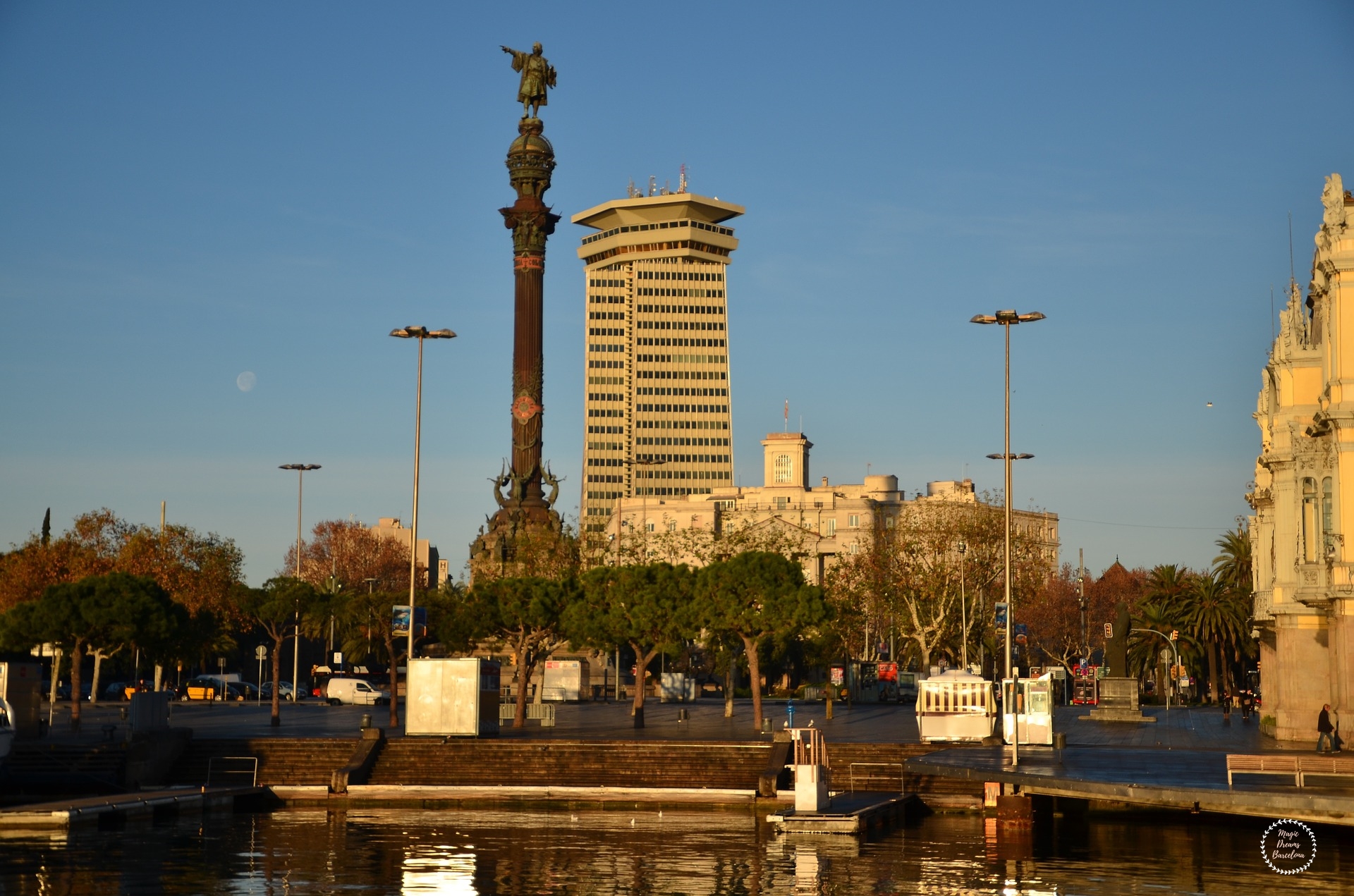
Built in tribute to the explorer Christopher Columbus, the Columbus Monument is one of the most recognized icons in Barcelona’s skyline. This impressive 60-meter-tall viewing monument is located near the port, at the exact point where Las Ramblas meets Passeig de Colón, facing Port Vell at Plaça del Portal de la Pau, s/n.
The monument consists of a large Corinthian column, designed by architect Cayetano Buigas, atop which stands the famous statue of Columbus, nearly 7 meters high. The figure dominates the Barcelona sky, holding a navigational chart in his left hand while symbolically pointing toward the New World with his right, representing exploration, discovery, and openness to the world.
At the base and pedestal lies one of the richest sculptural programs of 19th-century Barcelona. The lower part of the column features groups of sculptures dedicated to the discovery of America, blending history, allegory, and symbolism. Notable figures include Lluís de Santángel, Jaume Ferrer de Blanes, Pere de Margarit, and Fra Bernat de Boïl, along with indigenous figures representing cultural encounters. These works were created by prominent sculptors of the time, including Josep Gamot, Francesc Pagès, Eduard Batista Alentorn, and Manuel Fuxá.
The pedestal also houses four large allegorical female figures symbolizing the historical kingdoms of Catalonia, Aragon, Castile, and León, emphasizing the collective effort of the discovery. Surrounding the circular base are eight popular iron lions, symbols of strength and protection, which visitors traditionally climb for photographs, making them one of the monument’s most recognized and beloved elements.
Construction of the monument was approved in 1881 to honor Columbus’s selection of the Barcelona port after his return from America. After seven years of work, it was inaugurated in 1888, coinciding with the Universal Exposition, a key moment in the city’s international projection.
Inside the monument is a panoramic elevator that takes visitors to the viewing platform 60 meters above the ground, offering spectacular 360-degree views of Barcelona, the port, the Mediterranean, and the urban layout of the city.
Transportation and Accessibility
Metro: Drassanes (Line 3)
Bus: Lines 14, 59, 64, 91, 120, D20, and H14
All of this, and much more, can be discovered through the magical and profound perspective of Magic Dreams Barcelona, an experience designed so visitors do not have to worry about anything. We take care of every detail, ensuring a comfortable, guided, and inspiring experience from start to finish.
We offer private transportation, professional native guides in Spanish, Catalan, and English — with other languages available upon prior notice — always adapting to each visitor’s needs. The visit to the Columbus Monument is complemented by personalized Barcelona routes, architectural and artistic tours with deep knowledge of local symbolism, guided by experts revealing the most authentic aspects of the city.
We provide exclusive carefully selected accommodations and tailor-made experiences, including romantic getaways in Catalonia for a day or weekend, picnics in emblematic gardens with customizable tableware, on the beach or yacht, gourmet catering by our chef with sweet and savory options, and a curated selection of natural juices, wines, and non-alcoholic cava. We also offer personalized floristry, themed dinners, live music, and private evenings featuring Catalan and international gastronomy prepared by native and international chefs.
The experience is further enriched with a native guide specialized in emotional botany, intimately connected with the local territory. During the tour and especially at moments of rest and picnics, we offer sensitive readings of the environment, explain plant species, their symbolism, history, and relationship with the Mediterranean landscape, as well as observation and recognition of local birds. Every explanation becomes a living story that connects emotionally with nature, transforming the visit into a sensory, conscious, and memorable journey.
Our goal is simple yet profound: to make visitors feel cared for, inspired, and free to discover the magic and secrets of Barcelona, experiencing the city not just as a destination but as an unforgettable adventure.
Homenaje a Cristóbal Colón en Portal de la Pau.
Detalle monumento homenaje a Cristóbal Colón en Portal de la Pau.
Detalle monumento homenaje a Cristóbal Colón en Portal de la Pau.
Perspectiva a pie monumento homenaje a Cristóbal Colón en Portal de la Pau.
Perspectiva a pie monumento homenaje a Cristóbal Colón en Portal de la Pau.
Perspectiva a pie de figura escultórica en forma de león en Portal de la Pau.
Perspectiva superior aérea al atardecer del monumento homenaje a Cristóbal Colón en Portal de la Pau.
Perspectiva a pie monumento homenaje a Cristóbal Colón en Portal de la Pau.
Detalle monumento homenaje a Cristóbal Colón en Portal de la Pau.
Detalle figura escultórica en forma de león en Portal de la Pau.
Detalle figura escultórica en forma de ángeles en Portal de la Pau.
Perspectiva superior aérea del monumento homenaje a Cristóbal Colón en Portal de la Pau.
For collaborations, projects or professional inquiries – Reservations and quotes
Please leave your details and phone number, and we will get in touch with you as soon as possible, within the same day.
At the top of Montjuïc Mountain, overlooking the port, the sea, and much of the city of Barcelona, stands one of the most important and historically significant fortresses in Catalonia: Montjuïc Castle. Situated approximately 173 metres above sea level, this impressive defensive complex occupies a …
En la parte alta de la montaña de Montjuïc, dominando el puerto, el mar y buena parte de la ciudad de Barcelona, encontramos una de las fortalezas más importantes y cargadas de historia de Cataluña: el Castillo de Montjuïc. Situado a unos 173 metros sobre …
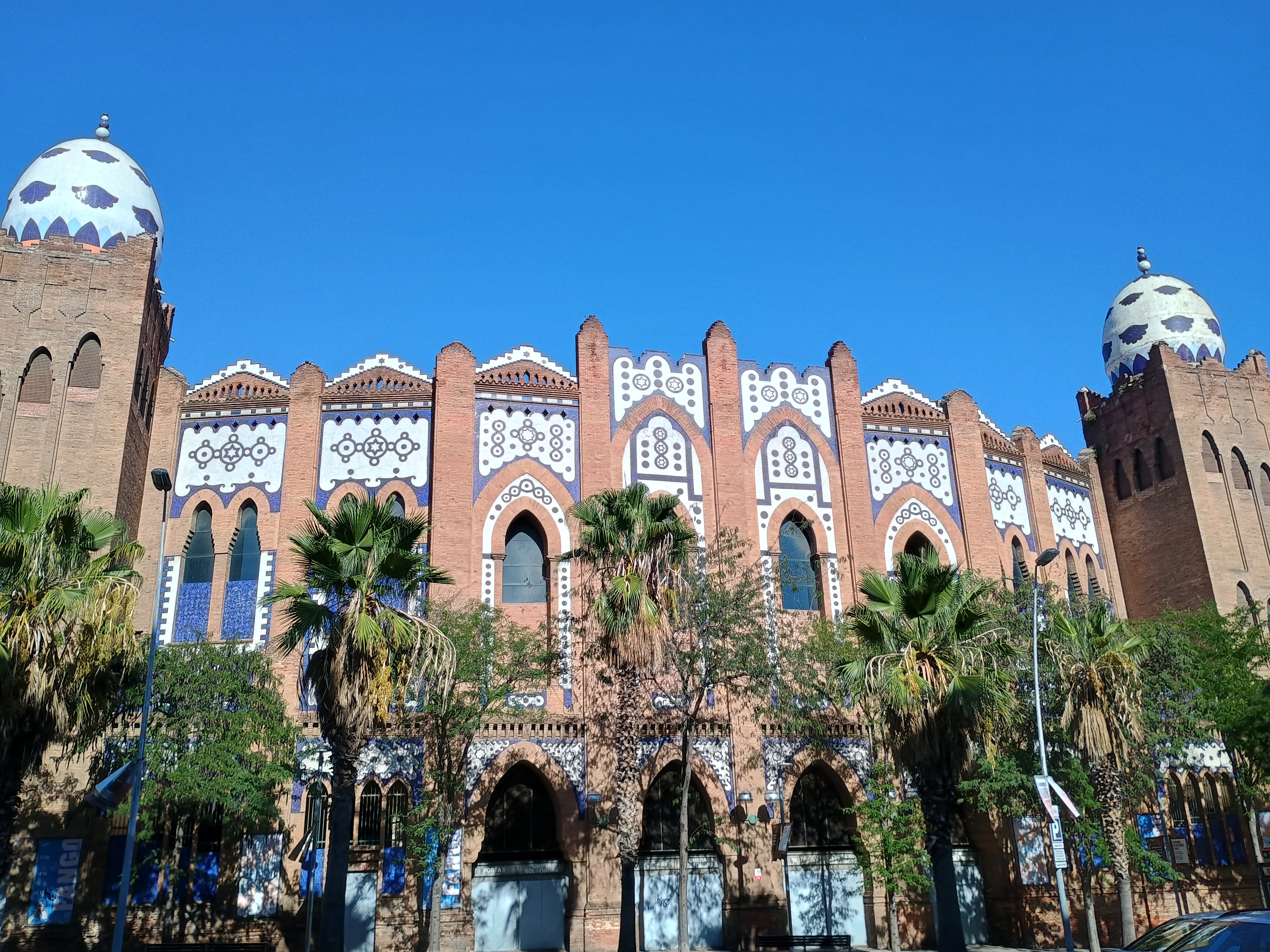
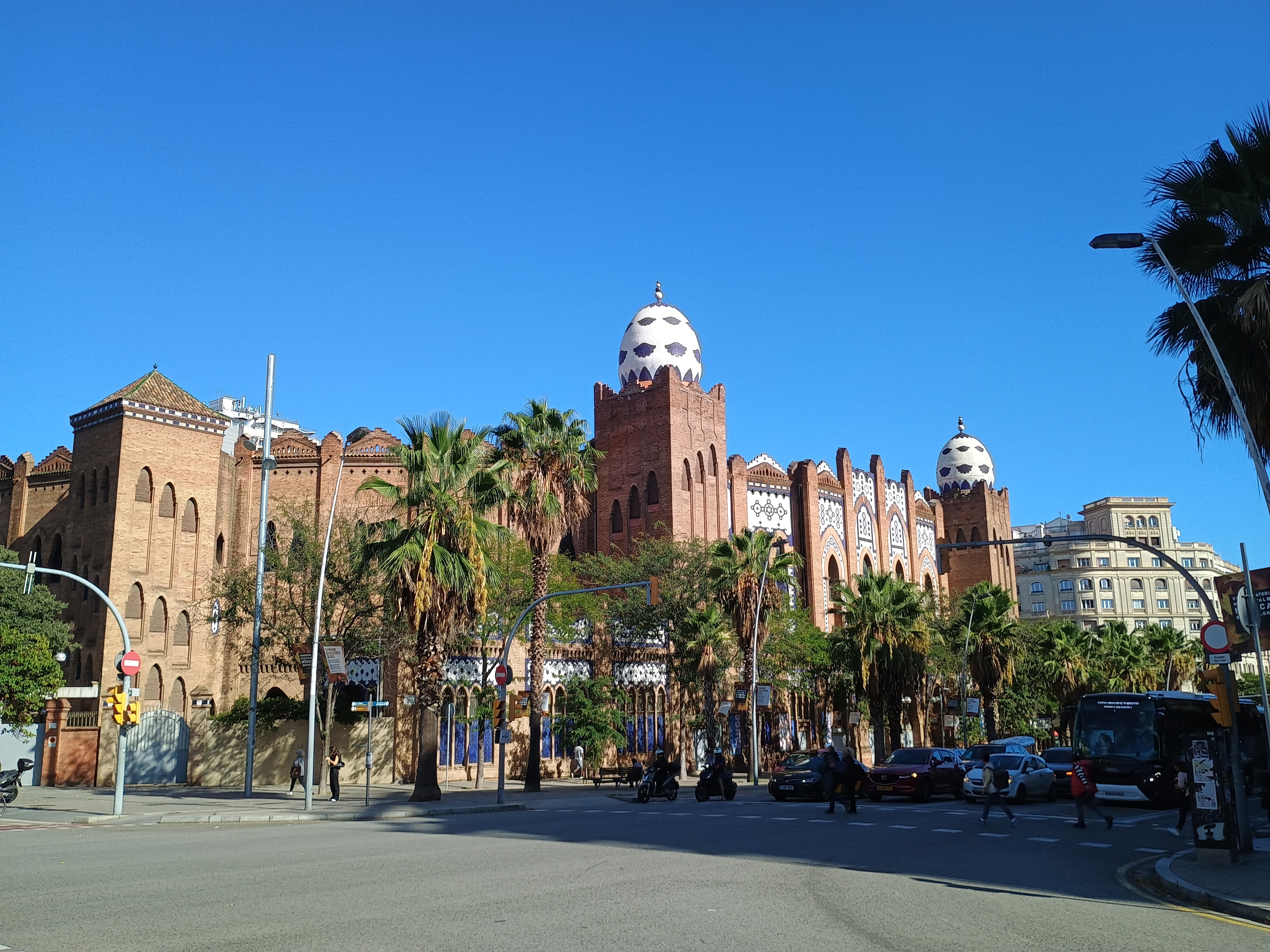
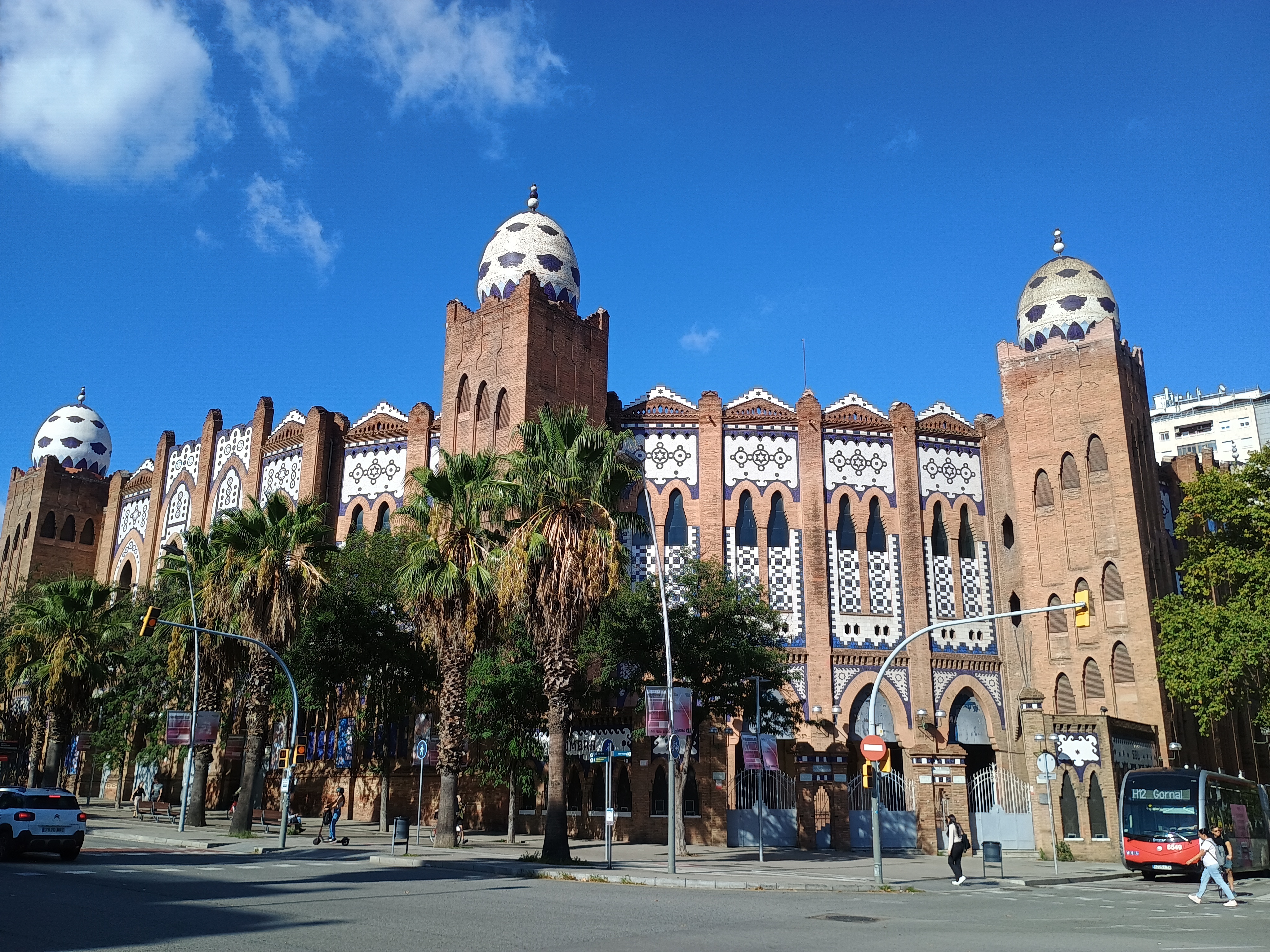
At the intersection of Gran Via de les Corts Catalanes and Carrer de Marina stands one of Barcelona’s most distinctive buildings.
The Monumental Bullring, known simply as La Monumental, has been part of the city’s architectural, social, and cultural memory for more than a century.
Its history began in 1914 as a bullring.
For decades, it was one of Barcelona’s major venues for bullfighting, but it also hosted boxing, circus performances, public events, political rallies, and, especially from the 1960s onward, some of the most important concerts held in the city.
Today, it is no longer an operating bullring.
The arena that for almost a century welcomed bullfighters and spectators has been transformed into a venue for music, festivals, and a wide range of cultural events.
La Monumental has changed its purpose, but not its prominence.
The Origins of La Monumental
When Barcelona was building a new city
At the beginning of the 20th century, Barcelona was undergoing a profound urban transformation.
The Eixample had become one of the city’s main areas of expansion, and its new avenues were beginning to fill with buildings, theatres, cafés, shops, and entertainment venues serving a rapidly changing society.
It was in this context that La Monumental was born.
The building was inaugurated on 12 April 1914 under the name El Sport.
The original structure was designed by architect Manuel Joaquim Raspall, one of the figures associated with Catalan Modernisme and Noucentisme.
Its initial appearance, however, was different from the one we know today.
The growing popularity of bullfighting soon led to plans for an expansion.
1916: La Monumental is Born
A transformation that completely changed its appearance
Just two years after its inauguration, the building was expanded and renovated.
The project was taken over by Ignasi Mas i Morell, in collaboration with Domènec Sugranyes, and the bullring acquired the monumental appearance that has survived to the present day.
It was then that it definitively adopted the name La Monumental.
The renovation added a spectacular exterior crown featuring Neo-Mudéjar and Neo-Byzantine influences, combined with decorative elements characteristic of Catalan Modernisme.
Ceramics, mosaics, arches, and ornamental motifs transformed the building into something much more complex than a simple bullring.
The architecture itself became an essential part of the spectacle.
Architecture Between the East and Barcelona
Ceramics, brick, and geometry
La Monumental has an architectural personality very different from that of Barcelona’s other major buildings.
Its façades combine brick, ceramics, arches, and decorative elements inspired by Eastern traditions.
The result is a richly visual architecture in which different artistic languages coexist.
Neo-Mudéjar architecture contributes its Arab-inspired motifs.
Neo-Byzantine influence can be seen in certain decorative and compositional solutions.
And the Catalan context of the early 20th century introduces a Modernist and Noucentista sensibility that makes the complex a unique feature of the Eixample landscape.
The towers marking the entrances, the mosaics, and the ceramic ornamentation are among the elements that make La Monumental recognisable even from a distance.
One of Barcelona’s Great Bullrings
The age of bullfighting
When La Monumental began operating, Barcelona already had a strong bullfighting tradition.
The city had previously had other major bullrings.
The first was El Torín, inaugurated in 1834 in Barceloneta.
Later came Las Arenas, inaugurated in 1900 in what is now Plaça d’Espanya.
La Monumental joined this history in 1914 and would eventually become the last of Barcelona’s major bullrings to remain active.
For decades, it hosted major bullfights and some of the most prominent figures in bullfighting.
Following the 1916 expansion, the bullring reached a capacity of approximately 24,000 spectators. After subsequent alterations, its current capacity is around 19,500 seats.
A Bullring That Survived the War
La Monumental during the Spanish Civil War
The building’s history is also connected to one of the most difficult periods in Barcelona’s contemporary history.
During the Spanish Civil War, La Monumental temporarily ceased to operate as a bullring.
The venue was used as a garage and scrap-metal warehouse.
Some of the old wooden benches were even removed to allow vehicles to move through the building and to create concrete ramps.
For a time, the building ceased to be a place of entertainment and became a practical facility within a city profoundly affected by war.
1946: A Change of Ownership
The Balañà family and a new era
In 1946, Pere Milà’s widow sold the bullring to the businessman and bullfighting promoter Pedro Balañà.
La Monumental then entered a new era associated with one of Barcelona’s most important entertainment-business families.
During the following decades, the building continued to host bullfights, but its enormous capacity allowed it to take on a much broader role.
La Monumental could transform itself.
And that ability to transform would prove fundamental to its future.
A Venue for Much More Than Bullfighting
Boxing, circuses, celebrations, and major events
The history of La Monumental was never limited exclusively to bullfighting.
Its large central arena and tiered seating allowed it to accommodate many different types of events.
The venue hosted boxing matches, circus performances, festivals, public events, and political rallies, as well as cultural activities.
The circular architecture of the bullring offered an extraordinary advantage: it could adapt to different types of audiences and performances.
But it was music that would ultimately make La Monumental famous far beyond the world of bullfighting.
1965: The Beatles Arrive
The concert that forever changed the history of La Monumental
On 3 July 1965, Barcelona experienced one of the most important musical events in its history.
The Beatles performed at La Monumental in the only concert they ever gave in Barcelona.
The British group was at the height of its worldwide explosion, and its arrival in Spain was an extraordinary event.
La Monumental was filled with young people eager to see John Lennon, Paul McCartney, George Harrison, and Ringo Starr up close.
The concert took place under Franco’s dictatorship and was surrounded by enormous public excitement and official surveillance.
The performance lasted just over half an hour, but it left an extraordinary mark on Barcelona’s collective memory.
Sixty years later, in 2025, previously unseen colour footage of the concert even emerged, later preserved by the Filmoteca de Catalunya.
La Monumental had definitively entered the history of rock music.
The Golden Age of Music
When the biggest stars filled the arena
After The Beatles, La Monumental began to establish itself as one of Barcelona’s great music venues.
Before the construction and development of large venues such as the Palau Sant Jordi, Barcelona needed spaces capable of accommodating thousands of spectators.
La Monumental could do exactly that.
During the 1970s, 1980s, and 1990s, the bullring welcomed major names from both international and Spanish music.
They included:
The Beatles, in 1965.
The Rolling Stones, in 1976, during their first concert in Spain.
Bob Marley, in 1980.
Luis Miguel, in 1985.
Tina Turner, in 1990.
Dire Straits, in 1992.
Bruce Springsteen, in 1992.
Sau, in 1992.
The bullring thus became an enormous open-air concert venue.
Bob Marley at La Monumental
An unforgettable night of reggae
On 30 June 1980, La Monumental welcomed Bob Marley & The Wailers.
More than 18,000 people attended the concert, one of the most memorable performances in the venue’s musical history.
Marley was on his Uprising tour, and Barcelona was one of the stops on that international tour.
The concert was particularly significant because it was one of the artist’s final major performances before his death in 1981.
That night, Marley’s music filled a venue that until then had been primarily associated with bullfighting.
Once again, the arena demonstrated that it could become almost anything.
Bruce Springsteen and the Great Concerts
La Monumental becomes an international stage
In the 1990s, the relationship between La Monumental and music entered another major phase.
Bruce Springsteen performed at the bullring in July 1992.
One of those concerts attracted around 16,500 people, transforming the arena into a gigantic rock stage.
La Monumental was completely full, with the audience surrounding the stage.
The bullring was no longer merely a venue for bullfighting.
It had become one of Barcelona’s great popular stages.
La Monumental as a Venue in Transition
From major spectacle to a changing city
The 1990s also marked the beginning of a profound transformation in the way Barcelona organised its major events.
The construction of new venues and the evolution of the city following the 1992 Olympic Games provided new alternatives for large-scale concerts.
The Palau Sant Jordi, the Olympic Stadium, and other major venues began to take on many of the city’s largest musical events.
La Monumental, however, retained something that modern arenas could not reproduce:
its architecture.
A concert at La Monumental was not simply a concert.
It was a performance inside a historic building.
2011: The Final Bullfighting Chapter
The last bullfight in Catalonia
On 25 September 2011, La Monumental hosted the last bullfight held in Catalonia.
The bill featured José Tomás, Juan Mora, and Serafín Marín.
The event attracted enormous attention and was accompanied by protests from both supporters and opponents of bullfighting.
Tickets sold out rapidly.
That afternoon brought an end to almost a century of bullfighting history at La Monumental.
From 1 January 2012, the ban on bullfighting in Catalonia approved by the Catalan Parliament in 2010 came into effect.
Although the Spanish Constitutional Court overturned that ban in 2016, bullfighting did not resume at La Monumental.
Life After Bullfighting
A new life for an old arena
The end of bullfighting did not mean the end of La Monumental.
On the contrary.
The building began to develop a new identity as a venue for music, festivals, and other events.
The arena once again filled with spectators, but now for completely different reasons.
Concerts.
Festivals.
Electronic music events.
Family activities.
Performances.
Cultural events.
The transformation did not erase its previous history.
It added to it.
Monumental Club
Music returns to the arena
One of the projects that has contributed to this new chapter is Monumental Club.
The former bullring is periodically transformed into a music and leisure venue where concerts, DJ sets, food offerings, and activities for different audiences come together.
Its programme has included independent music, electronic music, indie, rumba, and other contemporary styles.
The image is almost poetic:
where once the sounds of bullfighting trumpets and cheers filled the arena, guitars, bass lines, synthesizers, and thousands of voices can now be heard again.
La Monumental in 2026
A historic building full of life
La Monumental is not a building frozen in the past.
In 2026, it continues to operate as a venue for musical and cultural events.
During autumn 2026, for example, the venue is once again part of the SOUNDIT programme, with several electronic music events taking place between October and December.
The programme includes names such as Marcel Dettmann, Paranoid London, Joy Orbison, Aurora Halal, Jeff Mills, and Surgeon & Nørbak, among others.
Monumental Club also continues to offer new music and cultural events.
The former bullring therefore maintains a direct connection with contemporary Barcelona.
Would You Like to Discover La Monumental With Us?
A place where history can still be felt
Discovering La Monumental means exploring more than a century of Barcelona’s history through extraordinary architecture and the stories of the people who once filled its stands.
From the early days of El Sport to the Monumental of the great concerts.
From Joselito and the great figures of bullfighting to The Beatles and Bob Marley.
From legendary nights of rock to contemporary festivals.
Each era has left its own memory.
At Magic Dreams Barcelona, we believe that Barcelona’s great places should not only be seen.
They should be understood through their history.
Our guide, a native expert specialising in architecture, botany, art, history, and ornithology, accompanies every experience with a knowledgeable, engaging, and deeply human narrative.
We take care of absolutely everything so that you do not have to worry about a thing.
We organise day trips, weekend getaways, week-long stays, excursions through the Catalan Pyrenees and the Costa Brava, as well as completely personalised experiences.
Our services are available in Spanish, Catalan, and English and, with sufficient advance notice, we can accommodate other languages.
We combine heritage, architecture, nature, gastronomy, music, and private experiences to discover Barcelona from a different perspective.
Because Barcelona is not only what appears in a guidebook.
It is also what remains hidden behind its buildings.
From the Great Roman Road to the Heart of the Contemporary City There are streets in Barcelona that simply cross the city. And there are others that, when we walk along them, seem to contain several cities at once. Via Augusta belongs to the second …
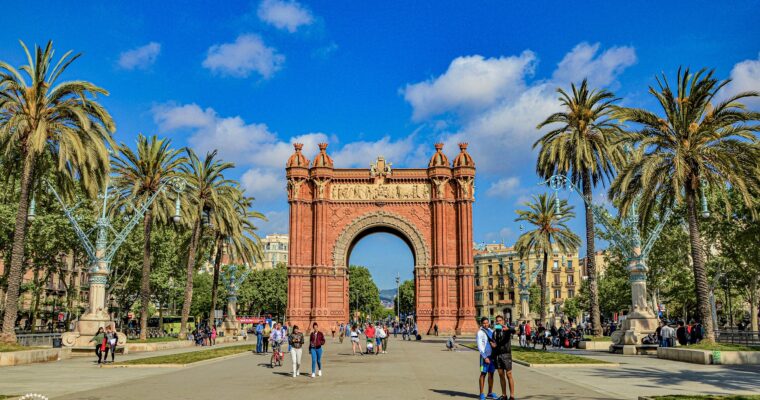
The Arc de Triomf of Barcelona is one of the city’s great monumental landmarks and one of the most important witnesses to the Barcelona that, at the end of the 19th century, was beginning to transform itself into a major European capital. Built in 1888 …
A Masterpiece of Catalan Gothic Architecture, Where History, Art and Spirituality Come Together
Barcelona Cathedral, officially known as the Cathedral of the Holy Cross and Saint Eulalia, is one of the most emblematic monuments of the Catalan capital and one of the finest expressions of Gothic art in Catalonia.
Located in the heart of the Gothic Quarter, its imposing architecture is the result of centuries of history, transformation and devotion. Its stone walls, pinnacles, vaults, sculptures and famous gargoyles form a monumental ensemble in which medieval architecture engages in a dialogue with the city’s collective memory.
Dedicated to the Holy Cross and Saint Eulalia, the patron saint of Barcelona, the cathedral is much more than a religious building. It bears witness to the city’s historical evolution, offers extraordinary artistic value and is a place where every detail seems to tell a story.
Among its most striking features are sculptures of fantastic animals, mythological figures and monstrous creatures. The gargoyles include unexpected figures such as a bull, a unicorn and an elephant. Its bells, traditionally identified by female names, add another intriguing detail to this symbolic world.
The cathedral invites visitors to slow down, discover its details and understand how architecture, religion, popular tradition and urban history intertwine in one of Barcelona’s most fascinating heritage sites.
The Origins of the Cathedral
From Roman Barcelona to the Great Gothic Architecture
The history of Barcelona Cathedral dates back to the earliest centuries of Christianity. Religious buildings once stood in this same area, reflecting the evolution of Barcino, the ancient Roman city.
Before the construction of the present Gothic cathedral, Barcelona had a Romanesque cathedral, consecrated in the eleventh century. The expansion of the medieval city, its growing political and commercial importance, and the development of new artistic forms encouraged the construction of a more ambitious building.
Work on the Gothic cathedral began in 1298, during the reign of James II of Aragon, at a time when medieval Barcelona was flourishing. The project unfolded over several generations, and the principal Gothic structures took shape during the fourteenth and fifteenth centuries.
However, the building we see today also reflects later interventions. The main façade, monumental in appearance and deeply inspired by medieval Gothic architecture, was completed between the late nineteenth and early twentieth centuries, following a design based on the Gothic style.
This evolution reveals one of the cathedral’s most interesting characteristics: its visual unity is not the result of a single construction campaign, but of a long historical process in which different periods left their mark.
Architecture That Reaches Towards the Sky
Verticality as an Expression of the Spiritual
Barcelona Cathedral embodies some of the essential principles of Gothic art: soaring spaces, the pursuit of light, structural complexity and the integration of sculpture into architecture.
Its main façade is dominated by a large rose window and features pointed arches, archivolts, pinnacles and abundant sculptural ornamentation. Saints, angels, botanical motifs and fantastic figures coexist in a decorative programme that invites visitors to pause and appreciate the details.
The exterior buttresses help distribute the building’s structural loads and form part of an architectural system characteristic of the Gothic style. Inside, the ribbed vaults transfer weight to the pillars and reinforce the sensation of height.
Light plays a fundamental role. It enters through the stained-glass windows, gradually transforming the appearance of the stone and creating contrasts between illuminated areas and more secluded corners.
The cathedral cannot be understood through its monumental scale alone. Its true richness emerges when we observe the relationships between structure, proportion, sculpture and light.
Every element reflects a conception of space in which construction techniques and spiritual experience form part of the same architectural vision.
The Crypt of Saint Eulalia
The Memory of a Young Martyr and Patron Saint of Barcelona
Beneath the presbytery lies one of the cathedral’s most significant spaces: the crypt of Saint Eulalia, which houses the saint’s tomb.
According to Christian tradition, Eulalia was a young martyr who was persecuted during Roman times for remaining faithful to her beliefs. Her martyrdom is traditionally dated to AD 304, although the accounts that have come down to us belong to a hagiographic tradition developed over many centuries.
Her story represents strength, fidelity to one’s convictions and resistance in the face of persecution. Over time, her cult acquired extraordinary importance in Barcelona, making her one of the city’s principal patron saints.
The tomb is a work of considerable artistic and historical interest. Its position beneath the high altar establishes a direct connection between the cathedral’s monumental architecture and the memory of Barcelona’s Christian community.
The crypt is also a place of retreat. In contrast to the height of the naves and the complexity of the exterior architecture, this space offers a more intimate experience, defined by silence and contemplation.
The Gothic Cloister
A Medieval Garden in the Heart of the Gothic Quarter
The cloister is one of the cathedral’s most distinctive and charming corners.
Built mainly between the fourteenth and fifteenth centuries, it consists of Gothic galleries arranged around an inner garden, where vegetation introduces a natural dimension into the monumental complex.
Palm trees, magnolias, an orange tree and other plant species help create a peaceful atmosphere. Water, present in the garden’s traditional features, reinforces the relationship between nature, architecture and spirituality.
The cloister was not merely decorative. It formed part of the daily organisation of the ecclesiastical community and provided passage between different areas of the cathedral complex.
Its galleries, with their arches and sculptural details, offer a different perspective on Gothic architecture: less monumental than the main façade, yet particularly rich in detail and subtlety.
The Thirteen Geese of Saint Eulalia
One of the cloister’s best-known features is the group of geese that live in its garden.
Tradition associates their number, thirteen, with the age Saint Eulalia was said to have been when she was martyred. It is also symbolically linked to the thirteen tortures that, according to hagiographic tradition, the young saint endured.
The presence of these birds makes the cloister especially beloved by visitors and adds a storytelling dimension to the experience.
Beyond their curious appeal, the geese form part of the cathedral’s popular memory. They remind us that heritage is made up of more than stone and works of art: it is also shaped by the stories, symbols and customs that a community passes down from one generation to the next.
The Organ and the Choir
Music as Part of Sacred Architecture
Music is another important dimension of Barcelona Cathedral.
Its historic organ, located in the upper gallery near the Portal of Sant Iu, is one of the most remarkable instruments in the cathedral’s musical heritage. Construction began between 1537 and 1539, and the instrument has undergone several transformations throughout its history.
The organ is more than a historical artefact. Its sound takes advantage of the Gothic space’s acoustic properties, as the vaulted ceilings and the dimensions of the naves allow the music to resonate throughout the building.
Concerts and musical events held at the cathedral offer a different way to experience the building: not only through sight, but also through sound.
The choir is another of the interior’s most valuable artistic spaces. Its carved wooden stalls, ornamental details and arrangement reflect the importance of liturgical life in the organisation of the cathedral.
Among the stone, wood and music, visitors discover how medieval and Renaissance art come together in an experience that unites architecture and spirituality.
The Cathedral Rooftop
Barcelona from a Privileged Perspective
Visiting the upper levels of the cathedral reveals a lesser-known dimension of the monument.
Access to the rooftop by lift, when available as part of the relevant visitor experience, offers privileged views of the bell towers, the lantern tower and the architectural features crowning the building.
From this vantage point, visitors can better appreciate the proportions of the upper structures and the complexity of the Gothic ornamentation. It is also possible to view the cloister from a different perspective and observe how the cathedral relates to the surrounding urban fabric of the Gothic Quarter.
The octagonal lantern tower, crowned by the Holy Cross and associated with the image of Saint Helena, is one of the most distinctive features of the cathedral’s silhouette.
From above, Barcelona reveals the overlapping historical layers that characterise its historic centre: medieval streets, later buildings and urban spaces that have evolved around the ancient city.
The rooftop helps visitors understand the cathedral not as an isolated building, but as an essential part of Barcelona’s historic landscape.
The Chapel of the Holy Christ of Lepanto
Devotion, Legend and Artistic Richness
The Chapel of the Holy Christ of Lepanto is one of the cathedral’s most important spaces in terms of religious devotion and historical interest.
Its architectural configuration is linked to the transformation of the medieval cathedral and to interventions carried out during the fifteenth century. The architect Arnau Bargués, associated with important works in Barcelona during that period, occupies a significant place in its history.
The chapel houses the revered image of the Holy Christ of Lepanto, which inspires deep popular devotion.
Tradition connects this image with the Battle of Lepanto in 1571 and associates it with the naval events of that historical episode. The stories surrounding the image form part of Barcelona’s religious memory and should be understood within the devotional traditions passed down through the centuries.
Its star-patterned ribbed vault and architectural ornamentation reflect the sophistication achieved by Catalan Gothic architecture. Another notable feature is the central vault boss depicting Pentecost, attributed to the sculptor Joan Claperós and dated to 1454.
The ensemble is completed by the Baroque tomb of Saint Olegarius, which adds another historical and artistic layer to this space.
The chapel illustrates how a single place can bring together different periods, styles and expressions of religious devotion, from Gothic architecture to Baroque artistic traditions.
The Cathedral’s Gargoyles
Fantastic Animals, Medieval Creatures and Symbolism
Among the cathedral’s most fascinating features are the gargoyles projecting from its walls and rooftops.
These sculptures served a practical purpose: to channel rainwater away from the building’s walls. However, their designs also made them part of one of the most imaginative sculptural repertoires in medieval architecture.
Their forms depict animals, fantastic creatures and monstrous figures that appear to watch over the building from above.
Among the figures popularly identified are an elephant, a bull and a unicorn. These representations contrast with the more familiar imagery of religious art and arouse the curiosity of those exploring the cathedral’s exterior.
In medieval culture, animals could carry moral, religious or symbolic meanings. Nevertheless, not every sculpted figure has a single, documented interpretation. Some reflect established iconographic traditions, while others can be understood as expressions of ornamental imagination.
The gargoyles reveal a less solemn side of Gothic art: a world in which the sacred coexists with the fantastic, morality with imagination, and practical construction with artistic expression.
Looking at them carefully allows visitors to discover details that might otherwise go unnoticed during a first visit.
The Cathedral’s Bells
Twenty-One Voices That Form Part of Barcelona’s Memory
For centuries, bells have played a fundamental role in the life of the city.
Their sounds announced religious celebrations, marked certain moments of the day and accompanied important events within the community.
The cathedral’s tradition highlights its twenty-one bells and the female names associated with them, a distinctive feature that arouses the curiosity of many visitors.
Beyond their acoustic role, the bells form part of the cathedral’s historical identity. Each belongs to an artisanal tradition involving metal casting, the shape of the instrument and the acoustic characteristics that determine its sound.
The bell towers, visible from various points throughout the Gothic Quarter, are also an essential element of the cathedral’s silhouette.
The relationship between architecture and sound offers a different way of understanding the building: as a monument that has also played an active role in Barcelona’s everyday life.
The Lantern Tower and Bell Towers
An Unmistakable Silhouette in the Urban Landscape
The cathedral’s exterior appearance is defined by its bell towers, pinnacles and the lantern tower rising above the roofline.
The lantern tower, with its octagonal design and crowning spire, is one of the ensemble’s most striking visual features.
Its verticality reflects the Gothic conception of the building, in which ascending lines reinforce the impression of height and establish a visual relationship between architecture and the sky.
The towers, meanwhile, are more than functional structures. They are landmarks within the historic landscape and help visitors recognise the cathedral from different streets and squares in the old town.
Stone, geometry and ornamental details combine to create a silhouette that captures much of the visual identity of medieval Barcelona.
The Cathedral and the Gothic Quarter
A Monument Inseparable from the City’s History
Barcelona Cathedral cannot be fully understood without exploring its surroundings.
The Pla de la Seu, the narrow streets of the Gothic Quarter and the nearby squares form part of an urban landscape where Roman remains, medieval architecture and buildings from later periods coexist.
The surrounding area reveals how the city developed around its principal religious, political and commercial institutions.
The proximity of other historic sites makes a visit an opportunity to understand Barcelona’s evolution from ancient Barcino to the contemporary metropolis.
In this setting, the cathedral serves as a cultural and architectural landmark. Its presence has accompanied the transformations of the historic centre and continues to form part of everyday life in the city.
One of the most rewarding ways to experience the area is to combine a visit to the cathedral’s interior with a leisurely walk through its surroundings, observing doorways, reliefs, courtyards and hidden corners that preserve the memory of different eras.
A Building Constructed Over the Centuries
From the Medieval Project to Its Present Monumental Appearance
Construction of the cathedral began in 1298, and its development continued over several centuries. The Gothic building took shape primarily during the fourteenth and fifteenth centuries, while some of its most visible features, such as the main façade, acquired their present appearance much later.
This chronology explains why the cathedral combines historical elements with later reconstructions.
The Neo-Gothic façade, completed between the late nineteenth and early twentieth centuries, draws inspiration from medieval architectural language and contributes to the monumental appearance that identifies the building today.
Rather than diminishing its interest, this evolution helps us understand how each generation interprets and transforms its heritage.
The cathedral is therefore a historical work in the broadest sense: it preserves the legacy of medieval Barcelona while reflecting later generations’ desire to preserve and complete one of the city’s principal symbols.
Barcelona Cathedral Today
Heritage, Worship and Cultural Life
Today, the Cathedral of the Holy Cross and Saint Eulalia continues to serve as a place of worship and remains a fundamental monument within Barcelona’s cultural heritage.
Its interior preserves chapels, tombs, sculptural works and liturgical objects that reveal different stages in Catalonia’s artistic history.
A visit offers the opportunity to explore Gothic art from multiple perspectives: architecture, sculpture, music, religious tradition and urban history.
The cathedral continues to fulfil its spiritual function, so visitors are encouraged to respect worship schedules and the rules established for visitors.
Preserving the building requires continuous maintenance and restoration. Stone, stained glass, metalwork and rooftops are all affected by the passage of time and environmental conditions, making conservation an essential part of the monument’s historical continuity.
Visiting the cathedral means discovering an exceptional work of art and architecture, but also recognising our collective responsibility to preserve it for future generations.
Fascinating Facts You May Not Know
The Small Details That Make the Cathedral Extraordinary
Thirteen geese in the cloister. Their number is traditionally associated with Saint Eulalia’s age at the time of her martyrdom and with the thirteen tortures attributed to her in tradition.
Fantastic animals among the gargoyles. Figures popularly identified include a bull, a unicorn and an elephant.
More than seven centuries of history. Work on the Gothic cathedral began in 1298, although its present monumental appearance incorporates much more recent interventions.
A historic organ. Initially constructed between 1537 and 1539, it forms part of the cathedral’s musical heritage.
A panoramic rooftop. When access is available, the rooftop offers privileged views of the towers, lantern tower and rooftops of the Gothic Quarter.
A cathedral dedicated to two sacred invocations. Its official name, Santa Creu i Santa Eulàlia, brings together devotion to the Holy Cross and the memory of Barcelona’s patron saint.
A cloister within the city. Just a short distance from the busiest streets of the historic centre, the inner garden offers a peaceful atmosphere that contrasts with the surrounding urban activity.
Practical Information for Visitors
Everything You Need to Know Before Planning Your Visit
Location
Pla de la Seu, 3, Barcelona.
The cathedral is situated in the Gothic Quarter, very close to Via Laietana and other points of interest in the historic centre.
Visiting Hours
As a general reference, the following tourist visiting hours have been provided:
Weekdays: 9:30 a.m.–6:30 p.m.
Saturdays and public holidays: 9:30 a.m.–5:30 p.m.
Sundays: 2:00 p.m.–5:00 p.m.
These hours may vary depending on the season, religious celebrations and scheduled activities. Visitors are advised to check the official information before travelling, particularly if they wish to access the rooftop or visit specific areas.
How to Get There
Metro: Line L4, the yellow line, getting off at Jaume I station.
Bus: Route 47, with a stop near Via Laietana and Plaça de Ramon Berenguer.
On foot: Walking from other parts of the Gothic Quarter allows visitors to combine the cathedral visit with a tour of the historic centre.
Things to Keep in Mind
Allow enough time to explore both the interior and exterior of the cathedral.
Check which areas are included in the chosen ticket option.
Confirm rooftop access availability and the conditions for visiting the cloister.
Respect areas reserved for worship and follow staff instructions.
Consider a guided tour to gain a deeper understanding of the sculptures’ symbolism and the building’s architectural evolution.
An Experience Best Discovered Slowly
Architecture Is Observed, History Is Understood and Beauty Is Felt
Visiting Barcelona Cathedral is about much more than admiring a monumental façade or walking through its naves.
It means pausing before a gargoyle, observing the light passing through a stained-glass window, listening to the organ’s resonance, discovering the silence of the cloister and understanding the historical significance of a chapel.
It also means looking up towards the pinnacles, recognising the different stages of construction and discovering how a building can become a witness to a city’s evolution.
The cathedral is a place to discover gradually, with an attentive eye for detail and an openness to the many layers of meaning it contains.
Would You Like to Discover Barcelona Cathedral with Us?
A Bespoke Cultural Experience with Magic Dreams Barcelona
At Magic Dreams Barcelona, we transform visits to the Gothic Cathedral and other emblematic sites across the city into personalised experiences designed to explore heritage from a cultural, sensory and deeply human perspective.
Our tours offer an opportunity to discover Catalan Gothic history, art and architecture through stories tailored to each visitor’s interests, pace and preferences.
We organise private experiences and personalised itineraries that can combine the cathedral with other historic sites in Barcelona, architectural routes, gardens, cultural venues and lesser-known corners of the historic centre.
We also design special experiences for those who wish to go beyond a conventional sightseeing visit:
Expert guides specialising in history, art and architecture, with explanations tailored to each visitor.
Private, personalised tours, designed around cultural interests, available time and individual pace.
Sensory experiences, incorporating music, literature and carefully selected aromas into the itinerary whenever conditions at the venue allow.
Signature gastronomy and exclusive picnics, arranged in suitable locations selected to complement the experience.
Creative workshops, including mosaic-making, trencadís art and activities inspired by Catalan traditions.
Getaways to the Costa Brava and the Catalan Pyrenees, featuring landscapes, heritage sites and carefully selected gastronomic experiences.
Personalised services throughout your stay, from romantic experiences to cultural activities and gastronomic tours.
We take care of the details to ensure that each day unfolds comfortably and seamlessly, with personalised attention throughout. Our experiences are designed according to each client’s preferences and the availability of venues and services.
Our goal is to transform heritage from a succession of dates and monuments into a memorable experience, combining historical knowledge with the excitement of discovery.
Barcelona Cathedral is much more than a masterpiece of Gothic architecture. It is a place where centuries of history, art, devotion and urban life come together.
With Magic Dreams Barcelona, every journey becomes a dialogue between past and present, where beauty can be experienced through all the senses.
La Catedral de la Santa Creu i Santa Eulàlia de Barcelona.
La Catedral de la Santa Creu i Santa Eulàlia de Barcelona.
La Catedral de la Santa Creu i Santa Eulàlia de Barcelona.
La Catedral de la Santa Creu i Santa Eulàlia de Barcelona.
La Catedral de la Santa Creu i Santa Eulàlia de Barcelona.
La Catedral de la Santa Creu i Santa Eulàlia de Barcelona.
La Catedral de la Santa Creu i Santa Eulàlia de Barcelona.
La Catedral de la Santa Creu i Santa Eulàlia de Barcelona.
Where History Sails Towards the Mediterranean Future Port Vell is one of the oldest and most symbolic spaces in Barcelona’s relationship with the sea and remains, in 2026, one of the great places where the city meets the Mediterranean. It was Barcelona’s first major permanent …
San Sebastián Beach, also known as Platja de Sant Sebastià, is one of the most traditional spots along Barcelona’s coastline. Located at the western end of Barceloneta, next to the port and at the foot of the iconic W Barcelona Hotel, it is a beach …
La Casa Batlló es una de las obras maestras de Antoni Gaudí y uno de los edificios más famosos de Barcelona. Situada en pleno Passeig de Gràcia, en el corazón del Eixample, esta extraordinaria construcción es uno de los grandes referentes del modernismo catalán y forma parte del conjunto de obras de Gaudí declarado Patrimonio Mundial por la UNESCO.
Más que un edificio, Casa Batlló es una experiencia arquitectónica en la que la luz, el color, la naturaleza, la geometría y la imaginación se combinan para crear un espacio único.
Su fachada parece cambiar dependiendo de la luz del día, mientras que el interior nos introduce en un universo de formas curvadas, cerámica, madera, vidrio y detalles inspirados en la naturaleza.
Y aunque a menudo se habla de Casa Batlló como la casa del dragón, su arquitectura es mucho más compleja. Gaudí convirtió un edificio preexistente en una auténtica obra de arte, sin renunciar a aspectos fundamentales como la iluminación, la ventilación y la funcionalidad.
¿Dónde está Casa Batlló?
Casa Batlló está situada en el número 43 del Passeig de Gràcia, una de las avenidas más importantes y elegantes de Barcelona.
Su localización es especialmente interesante porque forma parte de la conocida Manzana de la Discordia, un tramo del Passeig de Gràcia donde se concentran varias obras destacadas del modernismo catalán.
En pocos metros podemos contemplar edificios diseñados por algunos de los arquitectos más importantes de la época:
Casa Batlló, de Antoni Gaudí.
Casa Amatller, de Josep Puig i Cadafalch.
Casa Lleó Morera, de Lluís Domènech i Montaner.
Casa Mulleras, de Enric Sagnier.
Casa Josefina Bonet, de Marcel·lí Coquillat.
El resultado es uno de los conjuntos arquitectónicos más singulares de Barcelona.
La historia de Casa Batlló
Aunque hoy conocemos el edificio como Casa Batlló, su historia se inció antes de la intervención de Gaudí.
El inmueble original fue construido en 1877 por el arquitecto Emili Sala Cortés, que además había sido uno de los profesores de arquitectura de Gaudí. En aquel momento, Passeig de Gràcia todavía estaba desarrollándose como uno de los grandes ejes urbanos de la Barcelona moderna.
En 1903, el empresario textil Josep Batlló i Casanovas adquirió el edificio.
Inicialmente, el proyecto contemplaba incluso la posibilidad de derribarlo y levantar una nueva construcción. Sin embargo, Gaudí consiguió transformar completamente el edificio existente y finalmente se optó por una reforma integral, realizada entre 1904 y 1906.
Josep Batlló concedió a Gaudí una gran libertad creativa, algo que permitió al arquitecto transformar prácticamente todos los aspectos esenciales del inmueble.
Gaudí modificó la fachada, redistribuyó los espacios interiores, amplió el patio de luces y convirtió elementos funcionales de la vivienda en auténticos recursos arquitectónicos.
Gaudí y la transformación del edificio
Uno de los aspectos más interesantes de Casa Batlló es que Gaudí no partió de un solar vacío.
Trabajó sobre una construcción existente y consiguió darle una identidad completamente nueva.
La intervención afectó especialmente a:
la fachada principal;
la planta noble;
el patio de luces;
las escaleras;
los espacios interiores;
el desván;
y la azotea.
El resultado demuestra una de las características fundamentales de la arquitectura de Gaudí: la decoración y la funcionalidad no tienen por qué estar separadas.
En Casa Batlló, elementos que cumplen una función práctica también forman parte de la composición artística del edificio.
La ventilación, la entrada de luz, la circulación por las diferentes plantas y la distribución de los espacios fueron estudiadas cuidadosamente.
Una arquitectura inspirada en la naturaleza
La naturaleza es uno de los grandes protagonistas de Casa Batlló.
Gaudí rechazaba las líneas rígidas y buscaba inspiración en las formas que encontraba en el mundo natural.
Por eso encontramos curvas, formas orgánicas, elementos vegetales, referencias marinas y estructuras que recuerdan a huesos, escamas o caparazones.
La arquitectura parece estar viva.
No encontramos prácticamente ninguna superficie que resulte completamente convencional.
Las paredes se ondulan, los techos adquieren formas sinuosas y los elementos decorativos parecen formar parte de un organismo único.
Esta manera de diseñar convierte la visita en una experiencia diferente a la de un edificio histórico tradicional.
La espectacular fachada de Casa Batlló
La fachada es probablemente el elemento más conocido del edificio.
Gaudí utilizó diferentes materiales y técnicas para crear una superficie extraordinariamente dinámica.
Encontramos piedra arenisca, cerámica, vidrio y hierro, combinados para crear una composición llena de movimiento.
La superficie parece cambiar de aspecto dependiendo de cómo incide la luz.
Los fragmentos de cerámica y vidrio producen reflejos y colores que recuerdan al agua y al Mediterráneo.
Los balcones, por su parte, presentan formas que han generado infinidad de interpretaciones.
Algunos recuerdan a máscaras, otros a calaveras y otros a formas marinas.
Las columnas de la planta baja y de la tribuna también presentan formas orgánicas que refuerzan la sensación de que el edificio pertenece a un mundo natural.
La Casa de los Huesos
Uno de los sobrenombres más conocidos de Casa Batlló es Casa dels Ossos, o Casa de los Huesos.
El nombre hace referencia a la apariencia de algunos elementos de la fachada.
Las columnas parecen estructuras óseas y los balcones recuerdan, según algunas interpretaciones, a máscaras o calaveras.
Esta apariencia fantástica ha contribuido a que Casa Batlló sea uno de los edificios más fotografiados de Barcelona.
Sin embargo, es importante entender que muchas de las interpretaciones simbólicas de la fachada son lecturas posteriores y no siempre pueden atribuirse de manera documental a una intención concreta de Gaudí.
El dragón de Sant Jordi
La imagen del dragón es una de las interpretaciones más populares de Casa Batlló.
La cubierta del edificio recuerda al lomo de un enorme animal recubierto de escamas.
Las piezas de cerámica de diferentes tonalidades crean un efecto que hace que la cubierta parezca estar viva.
Según la interpretación tradicional, el tejado representa al dragón de Sant Jordi, mientras que la cruz situada en la parte superior simbolizaría la espada del santo.
Esta lectura conecta la arquitectura de Gaudí con una de las leyendas más conocidas de Cataluña: la historia de Sant Jordi y el dragón.
Es precisamente esta mezcla de arquitectura, tradición y simbolismo la que ha convertido Casa Batlló en uno de los grandes iconos culturales de Barcelona.
La cruz de cuatro brazos
En la parte superior del edificio encontramos una de las características más reconocibles de la Casa Batlló: la cruz de cuatro brazos.
La cruz corona una pequeña torre y se convierte en uno de los puntos visuales más importantes de la fachada.
La localización de este elemento también estuvo condicionada por el contexto arquitectónico de la Manzana de la Discordia y por la presencia de Casa Amatller, obra de Josep Puig i Cadafalch.
De esta manera, Gaudí no diseñó Casa Batlló de manera aislada, sino teniendo en cuenta los edificios que la rodeaban.
El patio de luces: una lección de luz y color
Uno de los espacios más interesantes del interior es el patio de luces.
Gaudí lo diseñó para mejorar la distribución de la luz y la ventilación en el interior del edificio.
Las piezas de cerámica presentan diferentes tonalidades de azul, más intensas en las zonas superiores y progresivamente más claras hacia las plantas inferiores.
Este recurso permite crear una sensación de continuidad y profundidad.
La distribución del color no es solamente decorativa: forma parte de la estrategia arquitectónica para aprovechar la iluminación natural.
Es uno de los mejores ejemplos de cómo Gaudí combinaba estética y funcionalidad.
La planta noble
La planta noble era el espacio principal de la familia Batlló.
Aquí encontramos algunos de los elementos más espectaculares del interior, como grandes ventanales, formas curvadas, carpinterías trabajadas y detalles decorativos diseñados específicamente para el edificio.
Los espacios principales están concebidos para aprovechar al máximo la entrada de luz y crear una relación continua entre arquitectura y mobiliario.
La sensación es muy diferente de la que encontramos en una vivienda tradicional de principios del siglo XX.
El desván y los arcos de Gaudí
El desván es otro de los espacios imprescindibles.
Aquí aparecen los famosos arcos catenarios, una solución estructural característica de Gaudí.
Las formas recuerdan a las costillas de un gran animal y han contribuido también a reforzar la interpretación de Casa Batlló como una especie de organismo vivo.
El propio espacio del desván crea una experiencia muy diferente a la de las plantas nobles.
Es más sobrio, pero al mismo tiempo profundamente expresivo.
Actualmente, la visita permite recorrer este espacio y experimentar la arquitectura de una manera especialmente cercana.
La azotea y las chimeneas
La azotea es uno de los lugares más fotografiados de Casa Batlló.
Aquí encontramos el famoso tejado con aspecto de dragón, además de un conjunto de chimeneas y elementos arquitectónicos que Gaudí convirtió en parte fundamental de la composición.
Las chimeneas no fueron tratadas simplemente como elementos técnicos.
Gaudí las agrupó y diseñó de manera que contribuyeran a crear un paisaje arquitectónico propio.
Desde la azotea también podemos disfrutar de vistas sobre el centro de Barcelona y observar de cerca algunos de los detalles que desde la calle pasan desapercibidos.
La experiencia actual de visita incluye el acceso a la azotea en determinadas modalidades de entrada.
¿Por qué Casa Batlló es tan importante?
Casa Batlló representa una de las etapas más maduras de la arquitectura de Gaudí.
En ella encontramos varias de sus grandes obsesiones:
la naturaleza, la luz, el color, la geometría, la estructura y la funcionalidad.
Pero también encontramos algo que diferencia especialmente esta obra: la capacidad de Gaudí para convertir una vivienda privada en una experiencia artística completa.
No diseñó únicamente habitaciones.
Diseñó puertas, ventanas, techos, escaleras, patios, chimeneas, barandillas, iluminación y elementos decorativos como partes de un mismo universo.
Por eso, recorrer Casa Batlló permite comprender mejor la idea de Gaudí de que la arquitectura debía ser una experiencia global.
Casa Batlló y el Patrimonio Mundial de la UNESCO
Casa Batlló forma parte del conjunto de obras de Antoni Gaudí inscritas en la lista del Patrimonio Mundial de la UNESCO.
Este reconocimiento incluye otras obras fundamentales del arquitecto, entre ellas Park Güell, Palacio Güell, Casa Milà, Casa Vicens, la fachada del Nacimiento y la cripta de la Colonia Güell.
La inclusión reconoce el valor universal de estas obras y su importancia dentro de la evolución de la arquitectura moderna.
La Casa Batlló actual
La historia de Casa Batlló no terminó con Gaudí.
El edificio dejó de pertenecer a la familia Batlló durante la década de 1950 y posteriormente tuvo diferentes usos.
Desde la década de 1990, la propiedad está en manos de la familia Bernat, que llevó a cabo un importante proceso de restauración.
En 1995, la casa abrió sus puertas al público y comenzó una nueva etapa como espacio cultural. Desde 2002 se incorporaron también las visitas culturales, que han ido evolucionando con el tiempo.
Actualmente, Casa Batlló combina patrimonio, arquitectura, tecnología, arte y experiencias inmersivas.
Una visita mucho más que arquitectónica
La visita actual está diseñada para acercarnos a la obra de Gaudí a través de diferentes recursos.
La experiencia general incluye una audioguía disponible en 15 idiomas y diferentes espacios del edificio, como la planta principal, el patio, el desván, las escaleras, el atrio y la azotea según el tipo de entrada.
También encontramos recursos tecnológicos que permiten descubrir el universo creativo de Gaudí desde una perspectiva contemporánea.
Entre ellos destaca el Gaudí Cube, una experiencia audiovisual de 360 grados creada por el artista digital Refik Anadol, además de experiencias de realidad aumentada en determinadas modalidades de visita.
Casa Batlló de noche
La experiencia también puede disfrutarse durante la noche.
Las visitas nocturnas incorporan una iluminación especial que transforma la percepción de los espacios interiores.
Según la modalidad disponible, la experiencia puede incluir además una bebida de bienvenida y otros elementos especiales. La programación y los horarios pueden variar, por lo que es recomendable consultar la información oficial antes de planificar la visita.
Arte, música y nuevas experiencias
Casa Batlló también funciona como espacio cultural y acoge diferentes propuestas a lo largo del año.
Entre ellas encontramos experiencias musicales, exposiciones temporales y actividades especiales.
En 2026, por ejemplo, el programa oficial incluye Magical Nights, con visita, bebida y concierto, además de nuevas propuestas expositivas.
También se puede visitar actualmente la exposición “Gaudí-Miró-Gomis: Deconstructed”, una propuesta que conecta la obra de Gaudí con Joan Miró y Josep Gomis a través de piezas originales e intervenciones digitales.
¿Cuánto dura la visita?
La visita general tiene una duración aproximada de 1 hora y 15 minutos.
Si elegimos una experiencia que incluya exposiciones adicionales, el recorrido puede prolongarse. Por ejemplo, la visita combinada con la exposición “Gaudí-Miró-Gomis: Deconstructed” tiene una duración aproximada de 1 hora y 45 minutos.
Nuestra recomendación es reservar al menos una hora y media si queremos visitar Casa Batlló tranquilamente y dedicar tiempo a observar los detalles.
¿Cuándo visitar Casa Batlló?
Casa Batlló abre durante todo el año, aunque los horarios pueden variar según la experiencia elegida.
Actualmente horarios de visita general desde las 9:00 hasta las 19:15, mientras que la última entrada puede variar según el tipo de visita.
Para disfrutar de la fachada con diferentes condiciones de luz, la mañana y las últimas horas de la tarde ofrecen experiencias visuales muy diferentes.
Si queremos una experiencia especial, también podemos consultar las visitas nocturnas y la programación cultural.
¿Cuánto cuesta visitar Casa Batlló?
El precio depende del tipo de entrada y de la experiencia seleccionada.
La web oficial ofrece diferentes modalidades y actualmente anuncia entradas generales desde 29 €, mientras que determinadas experiencias tienen precios superiores. Los niños de 0 a 12 años tienen entrada gratuita en las modalidades indicadas por el sitio oficial.
Como los precios, descuentos y experiencias pueden cambiar, recomendamos consultar la web oficial antes de comprar las entradas.
¿Cómo llegar a Casa Batlló?
La localización de Casa Batlló permite llegar fácilmente utilizando transporte público.
Metro
Las estaciones más cercanas son:
Passeig de Gràcia, con las líneas L2, L3 y L4.
Diagonal, con las líneas L3 y L5.
Tren
La estación de Passeig de Gràcia permite conectar con diferentes servicios ferroviarios y de cercanías.
Autobús
Infinidad de líneas de autobús circulan por Passeig de Gràcia y las calles próximas.
La dirección exacta es:
Passeig de Gràcia, 43
08007 Barcelona
Casa Batlló y el Passeig de Gràcia
Una visita a Casa Batlló puede combinarse fácilmente con un paseo por Passeig de Gràcia.
Esta avenida es una de las mejores zonas de Barcelona para descubrir la arquitectura modernista.
Podemos comenzar en Casa Batlló y continuar hacia Casa Amatller, Casa Lleó Morera y otras obras modernistas.
También podemos continuar hacia La Pedrera – Casa Milà, otra de las grandes obras de Gaudí.
De esta manera podemos dedicar varias horas a descubrir una de las concentraciones más importantes de arquitectura modernista de Barcelona.
Consejos para visitar Casa Batlló
Si es nuestra primera visita, recomendamos:
Comprar las entradas con antelación.
Reservar aproximadamente 1–1,5 horas para la visita.
No limitarse a fotografiar la fachada: el interior es una parte fundamental de la experiencia.
Observar especialmente el patio de luces, el desván y la azotea.
Comparar Casa Batlló con Casa Amatller y Casa Lleó Morera.
Consultar las experiencias especiales disponibles durante nuestra fecha.
Revisar los horarios y precios oficiales antes de acudir.
Magic Dreams Barcelona: descubrir Casa Batlló de una manera diferente
En Magic Dreams Barcelona creemos que Barcelona no se descubre únicamente visitando monumentos.
Se descubre comprendiendo sus historias, observando sus detalles y conectando cada espacio con la cultura, la arquitectura y la vida de la ciudad.
Por eso podemos diseñar experiencias personalizadas alrededor de Casa Batlló y del universo de Gaudí.
Nuestro servicio incluye:
Organización y logística personalizada.
Itinerarios arquitectónicos y culturales.
Rutas por el modernismo de Barcelona.
Experiencias privadas y exclusivas.
Rutas botánicas y de naturaleza vinculadas al universo de Gaudí.
Gastronomía privada y experiencias culinarias.
Conciertos y experiencias culturales.
Selección de alojamientos y servicios personalizados.
Nuestro equipo trabaja en castellano, catalán e inglés, adaptándose a otros idiomas bajo petición previa.
La idea es sencilla: convertir una visita turística en una experiencia más profunda, cuidada y personalizada.
Casa Batlló: una obra que hay que mirar dos veces
Quizá una de las mejores formas de entender Casa Batlló sea verla primero desde la calle y después entrar.
Desde fuera descubrimos el dragón, los balcones, los colores y las formas ondulantes.
Pero cuando entramos descubrimos otra Casa Batlló.
Aparecen la luz, los patios, las puertas, los arcos, las texturas, las curvas y todos aquellos pequeños detalles que demuestran hasta qué punto Gaudí diseñó el edificio como un conjunto.
Casa Batlló no es solamente uno de los lugares más fotografiados de Barcelona.
Es una obra que nos permite entender la manera en que Antoni Gaudí transformó la arquitectura y convirtió una vivienda del Eixample en uno de los grandes símbolos de la ciudad.
Y precisamente por eso, cuando caminemos por Passeig de Gràcia, merece la pena detenerse frente al número 43 y mirar hacía arriba.
Detalle exterior de Casa Batlló diseñada por el arquitecto Barcelonés Antoni Gaudí.
Perspectiva a pie de parte de Casa Amatller proyectada por el arquitecto Josep Puig i Cadafalch junto a la Casa Batlló de Antoni Gaudí.
Detalle interior de la Casa Batlló de Antoni Gaudí.
Detalle exterior de Casa Batlló de Antoni Gaudí.
Detalle mosaico diseño «Trencadís» terraza Casa Batlló de Antoni Gaudí.
Detalle exterior de Casa Batlló de Antoni Gaudí.
Detalle interior de la Casa Batlló de Antoni Gaudí.
Perspectiva exterior de Casa Batlló de Antoni Gaudí.
Detalle mosaico diseño «Trencadís» terraza Casa Batlló de Antoni Gaudí.
Detalle exterior de Casa Batlló diseñada por el arquitecto Barcelonés Antoni Gaudí.
Detalle exterior de Casa Batlló diseñada por el arquitecto Barcelonés Antoni Gaudí.
Detalle exterior de Casa Batlló diseñada por el arquitecto Barcelonés Antoni Gaudí.
Perspectiva a pie de la fachada de Casa Batlló de Antoni Gaudí.
Detalle mosaico diseño «Trencadís» terraza Casa Batlló de Antoni Gaudí.
Cruz Gaudí de Casa Batlló
Detalle exterior de Casa Batlló de Antoni Gaudí.
Detalle interior de la Casa Batlló de Antoni Gaudí.
Detalle interior de la Casa Batlló de Antoni Gaudí.
The Mercat de Sant Josep, popularly known as La Boquería — in Catalan, Mercat de Sant Josep or La Boqueria — is one of the landmarks that best represents Barcelona. Located in the heart of La Rambla, in the Ciutat Vella district, this municipal market …
Casa Batlló is one of the masterpieces of Antoni Gaudí and one of Barcelona’s most famous buildings. Located on Passeig de Gràcia, in the heart of the Eixample district, this extraordinary building is one of the great landmarks of Catalan Modernism and forms part of …
The Spiritual Vision of Antoni Gaudí, Presented by Magic Dreams Barcelona
Discover the Basilica of the Expiatory Temple of the Sagrada Família, the architectural soul of Barcelona and the most significant work of the Modernist genius Antoni Gaudí. More than a monument, this temple is a living creation, conceived as an act of faith, a collective offering inspired by the people, and a bridge between nature, spirituality, and architecture.
Located at Carrer de la Marina, 41 (Barcelona), the Sagrada Família is now one of the most visited monuments in Spain and the world. Its construction began in 1882, funded by private donations, and Gaudí took over the project in 1883, dedicating 43 years of his life to this work, fully aware that he would not live to see it completed.
As of October 13, 2026, the upper cross of the Tower of Jesus at the Sagrada Família has already been installed, marking a historic milestone. Standing 172.5 metres tall, the tower crowns the vertical composition of the temple and makes the Sagrada Família the tallest church in the world, surpassing Ulm Minster in Germany and finally fulfilling Gaudí’s vision.
This date carries special significance, as June 10, 2026, marked the centenary of Antoni Gaudí’s death. He passed away on June 10, 1926. For this reason, 2026 is dedicated to celebrating the architect’s legacy and honouring his architectural, cultural, and artistic achievements. Exhibitions, concerts, cultural events, and commemorative Masses are taking place throughout the year, highlighting the global importance of his work.
The installation of the cross atop the Tower of Jesus, the central tower of the temple and a symbol of Catalan Modernism, represents one of the most emblematic moments of Gaudí Year 2026. This element symbolises both the completion of a fundamental stage in the construction process and the universal reach of the architect’s influence. The Sagrada Família not only achieves a historic height record but also reaffirms its status as a cultural and spiritual icon connecting centuries of history, creativity, and devotion.
Antoni Gaudí and His Spiritual Vision
Architecture as a Mission of Faith
Antoni Gaudí did not view architecture as an aesthetic exercise, but as a spiritual mission. A deeply religious man who led an austere life during the later years of his life, he understood his work as a service to God and to the community. He is often associated with the phrase, “My client is not in a hurry,” referring to God and eternity.
Gaudí conceived the Sagrada Família as a Bible carved in stone, with each façade illustrating an essential chapter of the Christian faith:
The Nativity Façade (facing east): Celebrates life, nature, and hope. It is the only façade built almost entirely during Gaudí’s lifetime.
The Passion Façade (west): Austere, angular, and dramatic, it represents the suffering and crucifixion of Christ, featuring sculptures by Josep Maria Subirachs.
The Glory Façade (south): The main entrance, dedicated to death, the Last Judgement, Glory, and the path towards God.
The 18 Towers of the Sagrada Família
An Architectural Journey Towards the Divine
The temple’s design includes 18 towers:
12 dedicated to the Apostles, 4 to the Evangelists, 1 to the Virgin Mary, and the central tower dedicated to Jesus Christ. Together, they form the defining silhouette of the Sagrada Família, making it the tallest church in the world and the tallest building in Barcelona.
Nature as a Spiritual Language
Gaudí’s Organic Architecture
On the exterior of the temple, Gaudí drew direct inspiration from nature: mountains, trees, animals, flowers, and the cycles of life. Stone is not rigid but organic; it does not merely bear weight, it seems to blossom. Each façade expresses an essential moment in the life of Christ—Nativity, Passion, and Glory—through a symbolic language accessible to everyone, conceived as a visual catechism for the people.
The Interior of the Sagrada Família
A Sacred Forest of Light and Geometry
The interior represents the culmination of Gaudí’s vision: a sacred forest where columns rise like tree trunks and branch out towards the light. Gaudí studied natural geometry—including hyperboloids, helicoids, and spirals—to create a structure that is light, strong, and harmonious.
Sunlight, filtered through coloured stained-glass windows, changes throughout the day: cool tones at dawn and warm hues at sunset, transforming the space into a cosmic and spiritual clock. For Gaudí, light was a manifestation of the divine.
The Final Years of Antoni Gaudí
A Life of Humility, Faith, and Dedication
During his final years, Gaudí led a humble, almost monastic life, devoting himself entirely to the Sagrada Família. He dressed simply, ate frugally, and spent long hours in prayer and work. On June 7, 1926, he was struck by a tram on Barcelona’s Gran Via. Because of his modest appearance, he was not immediately recognised and was taken to the Hospital de la Santa Creu, where he died three days later.
He was subsequently buried in the crypt of the Sagrada Família. His death deeply moved the city. Today, the Catholic Church’s beatification process for Gaudí remains open, recognising his life of faith, humility, and service.
The Tower of Jesus
The Culmination of Gaudí’s Architectural Vision
The Tower of Jesus, located at the centre of the Sagrada Família complex, is the temple’s tallest and most emblematic feature. Crowned by a large four-armed cross, it represents Jesus Christ and completes the vertical composition envisioned by Antoni Gaudí.
Standing 172.5 metres tall, the tower makes the Sagrada Família the tallest church in the world and the tallest building in Barcelona, bringing Gaudí’s architectural and spiritual vision to life.
The installation of the upper cross was completed in February 2026, marking one of the most significant milestones in the temple’s history and in Gaudí Year, coinciding with the centenary of the architect’s death on June 10, 1926.
The Tower of Jesus symbolises the union of architecture, nature, and spirituality, rising above Barcelona as an expression of faith and of Antoni Gaudí’s universal legacy.
The Tower of Mary
The Light of the Virgin Over Barcelona
The Tower of Mary, part of the Sagrada Família complex, is a central emblem of devotion and spirituality. Dedicated to the Virgin Mary, it symbolises purity, grace, and maternal intercession before God, rising above the city of Barcelona as a beacon of faith.
Crowned by a twelve-pointed star, the tower stands out as one of the most distinctive features of the Sagrada Família skyline. Its light and presence reinforce the spiritual dimension of the temple and express the importance of Mary within Gaudí’s religious vision.
The Tower of Mary represents a path towards spiritual elevation, symbolising humanity’s aspiration towards the divine and the Virgin’s maternal presence along the journey of faith.
The Glory Façade
The Path Towards God and Spiritual Transcendence
The Glory Façade, facing south towards Carrer de Mallorca, is the main entrance and the most ambitious façade of the Sagrada Família. Conceived by Gaudí to represent the path towards God, it focuses on redemption and spiritual transcendence. Construction began in 2002, and its design is organised into three levels: earthly, spiritual, and celestial. A grand staircase is planned to lead worshippers towards contemplation of the divine.
This façade symbolises the journey towards Glory through virtue, redemption, and the grace of the Holy Spirit. Its design includes representations of the Holy Trinity, stone clouds depicting scenes from Genesis, and columns dedicated to the seven deadly sins and the heavenly virtues. The structure features four monumental bell towers dedicated to Saint Andrew, Saint Peter, Saint Paul, and Saint James the Greater, while the main portico is designed to incorporate sixteen hyperboloid-shaped lanterns.
Between 2025 and 2026, the first columns and structural elements above pavement level along Carrer de Mallorca have been erected. Artistic and sculptural work is expected to continue for at least another decade.
Magic Dreams Barcelona
Private Experiences of Art, Culture, and Spirituality
We are professional native-speaking guides with more than 10 years of experience, specialising in Gaudí, Catalonia, and high-end cultural tourism. We offer personalised, private, and worry-free experiences, taking care of every detail. We know the symbols, mysteries, and deeper history that are rarely found in conventional guidebooks.
Premium Services
Private guided tours, available daily or weekly.
Daily or weekly cultural, botanical, architectural, and gastronomic itineraries.
Art guidance and creative workshops inspired by Gaudí’s trencadís mosaic technique.
Emotionally enriching botanical walks with a choice of premium picnics.
Personalised accommodation and comprehensive logistical support.
Private dining experiences with a local chef, featuring Catalan, Spanish, and international cuisine, with themed menus to choose from.
Live music at your accommodation or a selected venue, artisan pastries, and floral decorations.
Gastronomic experiences aboard a private yacht.
Photography experiences in unique and hidden corners of Barcelona.
Romantic getaways, weekend escapes, and tailor-made experiences.
Barcelona from the Sea
A Gastronomic Experience on a Private Yacht
Discover Barcelona from the sea with our private yacht gastronomic experience.
Enjoy an exclusive journey along the Mediterranean coastline, with privileged views of the city skyline, a personalised menu prepared by our local chef, alcohol-free 0.0% wine pairings and fresh juices, live music, and premium service. A unique sensory experience in which art, the sea, and gastronomy come together.
Every detail is designed with sensitivity, excellence, and personalised attention. Our services are available in Spanish, Catalan, and English. Other languages can be accommodated upon request.
The Words of Antoni Gaudí
Nature, Beauty, and Spirituality
To conclude, discover the words of Antoni Gaudí.
Antoni Gaudí said:
“Create beauty! Seek the image of mystery in nature and transform it into architecture.”
“The great book, always open, is the book of Nature.”
“Nothing has been invented in this world; good fortune lies in seeing what God has placed before our eyes.”
“Life is a battle; strength lies in virtue, and virtue can only be sustained through spiritual cultivation.”
Basílica del Templo Expiatorio de la Sagrada Familia.
Basílica del Templo Expiatorio de la Sagrada Familia.
Basílica del Templo Expiatorio de la Sagrada Familia.
Basílica del Templo Expiatorio de la Sagrada Familia.
Basílica del Templo Expiatorio de la Sagrada Familia.
Basílica del Templo Expiatorio de la Sagrada Familia.
Basílica del Templo Expiatorio de la Sagrada Familia.
Basílica del Templo Expiatorio de la Sagrada Familia.
Basílica del Templo Expiatorio de la Sagrada Familia.
Basílica del Templo Expiatorio de la Sagrada Familia.
Basílica del Templo Expiatorio de la Sagrada Familia.
Basílica del Templo Expiatorio de la Sagrada Familia.
Basílica del Templo Expiatorio de la Sagrada Familia.
Basílica del Templo Expiatorio de la Sagrada Familia.
Basílica del Templo Expiatorio de la Sagrada Familia.
Basílica del Templo Expiatorio de la Sagrada Familia.
Basílica del Templo Expiatorio de la Sagrada Familia.
Basílica del Templo Expiatorio de la Sagrada Familia.
Basílica del Templo Expiatorio de la Sagrada Familia.
Basílica del Templo Expiatorio de la Sagrada Familia.
Basílica del Templo Expiatorio de la Sagrada Familia.
Basílica del Templo Expiatorio de la Sagrada Familia.
Located in the heart of Barcelona, next to Avinguda de Gaudí and just a few minutes from the Sagrada Família, this extraordinary architectural complex was conceived as a hospital, but also as a genuine city within the city. Pavilions made of exposed brick, mosaics, ceramics, …