Aitona in bloom, The pink sea of the Segrià.

The pink sea of the Segrià, where fruit trees, history and rural tradition come together
There are places that transform completely for a few weeks each year.
Aitona is one of them.
Located in the western part of the Segrià, in the province of Lleida, this agricultural town becomes a spectacular landscape of colour every spring, when thousands of fruit trees burst into bloom.
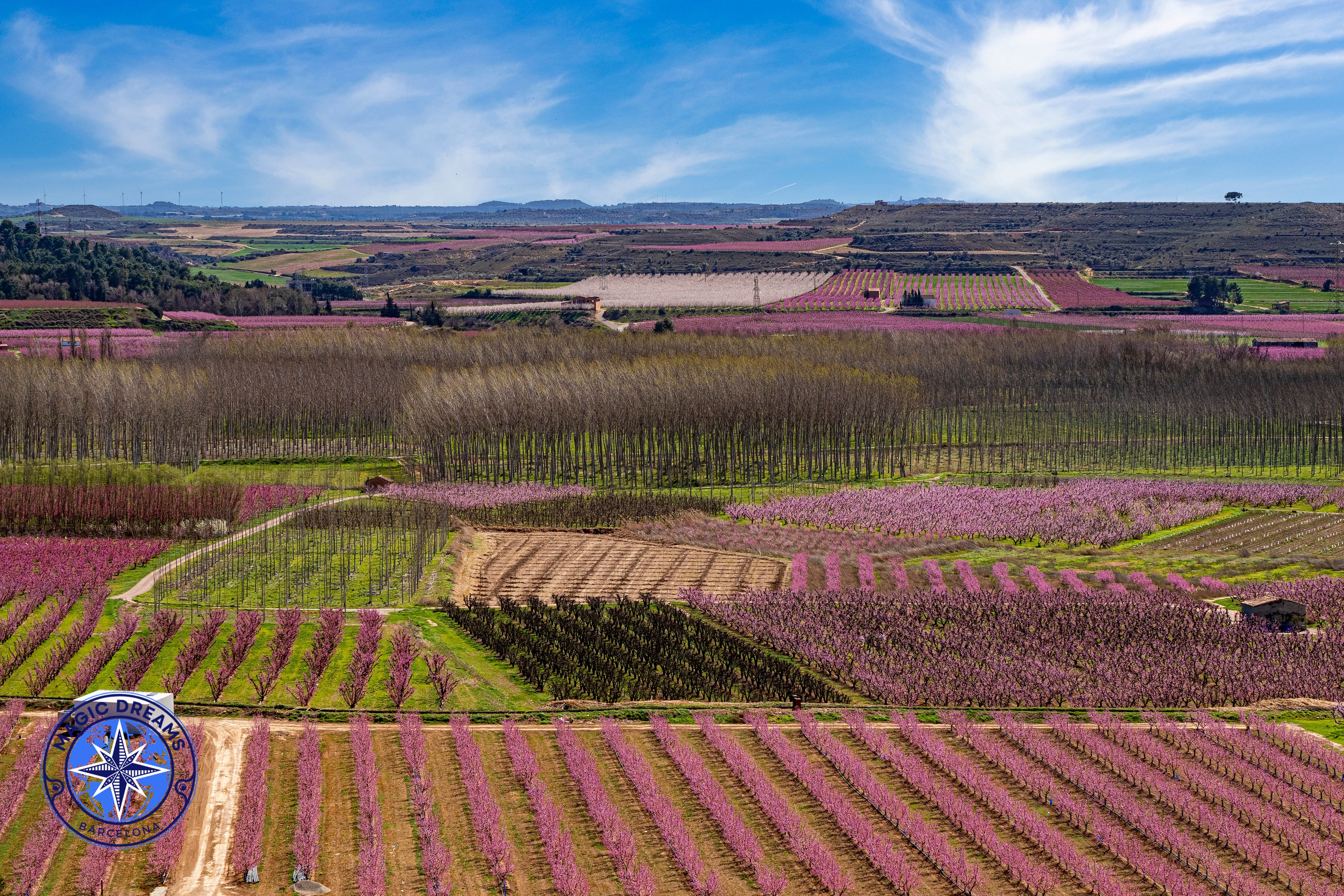
The most recognisable are the peach trees, whose pink flowers create the extraordinary scenery that has made Aitona one of Catalonia’s most famous blossom destinations.
But Aitona is much more than a beautiful photograph.
Behind every flowering tree lies a story of water, agriculture, family farming, local traditions and the transformation of the rural landscape.
And this is precisely what makes the experience so special.
Where Is Aitona?
A rural landscape shaped by the River Segre
Aitona is located in the Segrià comarca, in western Catalonia, approximately 25 kilometres southwest of the city of Lleida.
The municipality lies along the River Segre, whose water has historically played a fundamental role in the development of local agriculture.
The landscape combines irrigated farmland, dryland areas, orchards, small elevations and wide agricultural horizons.
Today, fruit farming is one of the defining features of the area.
When spring arrives, those orchards become one of the most extraordinary natural spectacles in Catalonia.
How Far Is Aitona from Barcelona?
A perfect day trip into the Catalan countryside
Aitona is approximately 180 kilometres from Barcelona by road, and the journey generally takes around two hours by car, depending on traffic and the route chosen.
That makes it an excellent destination for a day trip from Barcelona.
A typical experience can begin early in the morning, allowing enough time to explore the flowering orchards, discover the local heritage, enjoy lunch and return to Barcelona in the evening.
During the blossom season, travelling early is particularly recommended.
The light is softer, the landscape is quieter and the experience is generally more peaceful.
The History of Aitona
A territory shaped by water, agriculture and different cultures
Aitona has a long history closely connected to the River Segre and irrigation agriculture.
Its historical development is associated with an Islamic-period castle, with documentation dating back to at least the early 12th century.
After the Christian conquest during the 12th century, the Muslim population remained an important part of local society for generations, contributing knowledge and practices related to agriculture and irrigation.
This heritage is essential to understanding the region.
Water did not simply make farming possible.
It helped shape the entire landscape.
Irrigation channels, canals and agricultural systems transformed the surrounding land and established a farming tradition that continues today.
Aitona Castle
History overlooking the orchards
The remains of Aitona Castle stand on the hill overlooking the town.
The fortress originated during the Islamic period and occupied a strategic position over the surrounding territory.
Its elevated location provides a particularly interesting perspective over the agricultural landscape.
During blossom season, the contrast is striking:
medieval ruins above a horizon filled with flowering fruit trees.
It is one of the best ways to appreciate how history and agriculture coexist in Aitona.
Aitona and Its Fruit Trees
An economy built around the orchard
Aitona is deeply agricultural.
Irrigated land is dominated by stone-fruit orchards, while dryland areas include olive trees, almond trees and cereals.
Among the characteristic fruit trees of Aitona and the surrounding area are:
- Peach trees
- Nectarine trees
- Flat peaches
- Flat nectarines
- Apricot trees
- Pear trees
- Quince trees
- Cherry trees
Peaches, nectarines and flat peaches are particularly important to the local agricultural economy.
During summer, the same trees that create the famous spring landscape produce the fruit that becomes one of the area’s agricultural signatures.
The flowers are only the beginning.
Aitona in Bloom
When the orchards become a sea of colour
The great spectacle usually begins between late February and March, although the exact timing changes from year to year according to temperatures, winter conditions and the development of each variety.
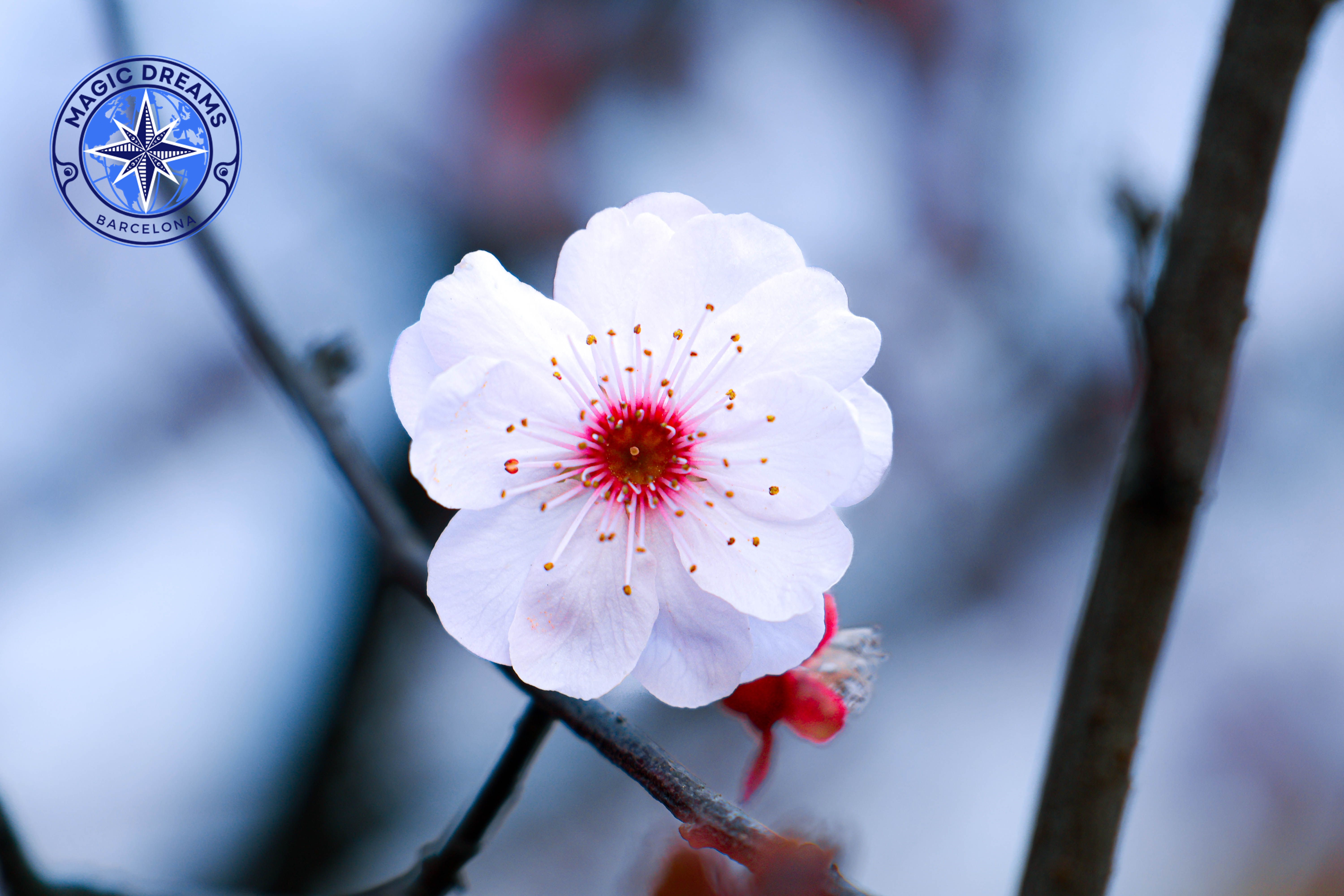
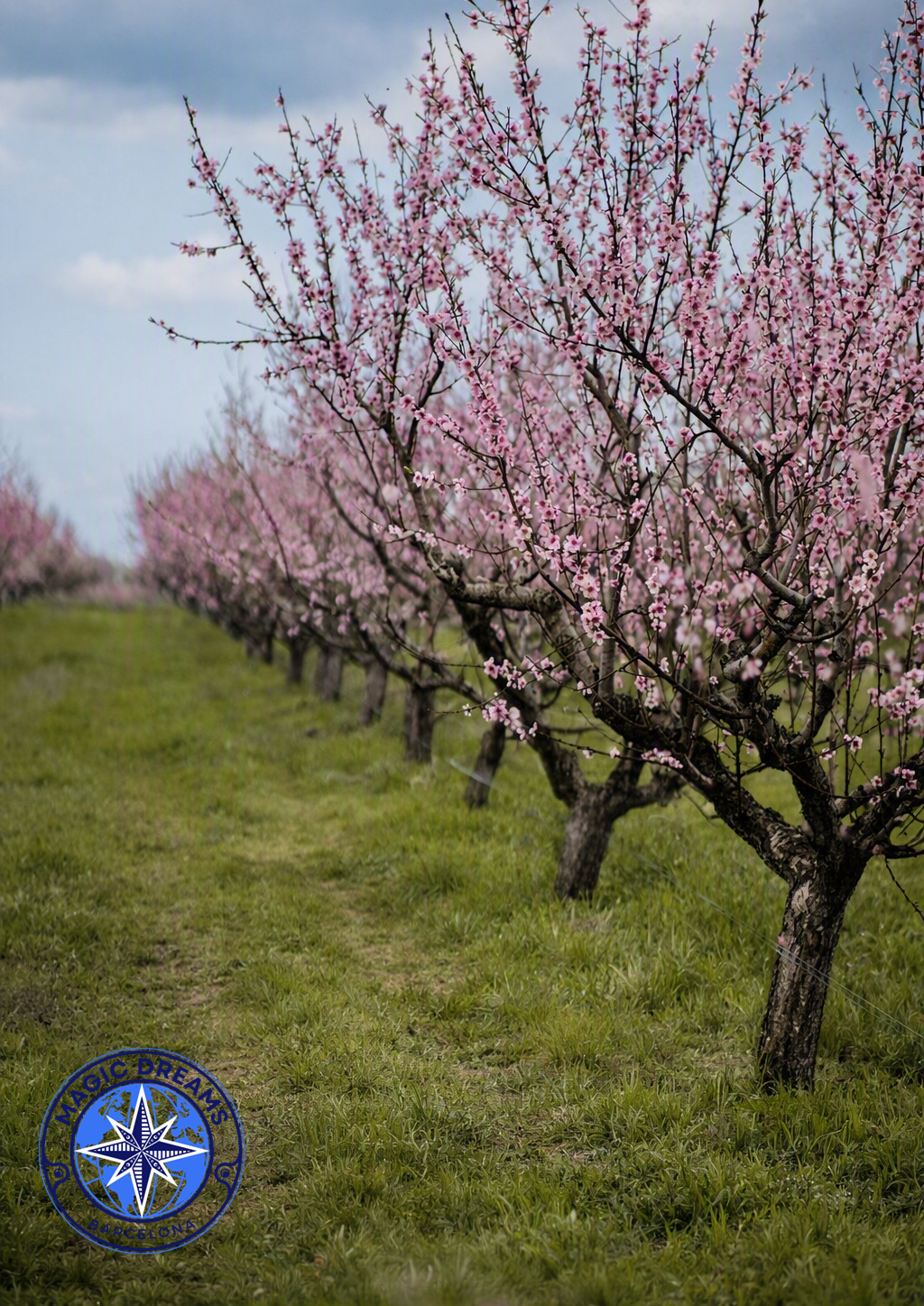
Peach trees are especially famous for their pink blossoms, which create the characteristic colour associated with Aitona.
Nectarines and other fruit trees contribute additional shades and create contrasts between different orchards.
The flowering period can last several weeks, but there is no single guaranteed date.
That is why checking the official Fruiturisme blossom updates before travelling is so important.
What Makes the Blossom So Special?
Different trees, different colours
One of the most fascinating aspects is that not every fruit tree blossoms in exactly the same way.
Peach trees, nectarines and flat peaches are especially recognisable for their pink flowers.
Other species produce paler blossoms, creating a more varied landscape as the season progresses.
But blossom is not simply a visual spectacle for local farmers.
It is a crucial stage in the agricultural cycle.
Temperature, wind, rain and frost can all affect the future harvest.
So behind the beauty of the orchards there is also a great deal of agricultural knowledge and work.
When Is the Best Time to Visit?
The perfect moment depends on the year
There is no fixed calendar date.
The blossom season usually falls between late February and March, but warmer or colder winters can bring flowering forward or delay it.
For visitors particularly interested in peach blossom, March is generally the key month.
The best approach is to check the current blossom conditions and Fruiturisme’s official programme before travelling.
This is especially important because a difference of just a few days can completely change the appearance of the orchards.
Fruiturisme
Much more than a blossom photo
Aitona developed Fruiturisme to turn its agricultural landscape and fruit-growing traditions into a genuine visitor experience.
The project helps visitors discover the orchards while learning about the local agricultural cycle.
During blossom season, guided experiences can include:
- Orchard visits.
- Guided walks.
- Agricultural explanations.
- Photography opportunities.
- Heritage visits.
- Nature experiences.
- Local gastronomy.
But Fruiturisme does not stop when the blossoms disappear.
Throughout the year, experiences focus on different stages of the fruit cycle, including apricots, cherries, peaches, nectarines and flat peaches, among other local products.
This is what makes the destination particularly interesting.
The blossom is only one chapter of the story.
The Route of the Flowering Tree
Walking among the orchards
One of the best-known experiences is the Ruta de l’Arbre Florit, or Route of the Flowering Tree.
The route combines the agricultural landscape with local heritage and natural surroundings.
Depending on the itinerary, visitors can discover:
- Fruit orchards.
- The River Segre.
- The historic centre.
- Sant Antolí Church.
- Sant Joan de Carratalà.
- The Cova del Pare Palau.
- Genó archaeological site.
- Sant Gaietà Chapel.
There are also routes that can be explored on foot or by bicycle.
During blossom season, organised tours can provide access to the orchards while avoiding the need to drive between different rural tracks.
Aitona by Bicycle
The countryside at a slower pace
Cycling is one of the best ways to appreciate Aitona’s agricultural landscape.
Quiet rural paths make it possible to travel among orchards, irrigation channels and open fields while experiencing the scale of the landscape without rushing.
Electric-bike experiences also offer a comfortable way to explore the area while learning about the different stages of fruit production.
For those looking for a more immersive experience, a bicycle tour can turn the visit into an entire morning or afternoon adventure.
The River Segre
The water behind the landscape
The River Segre is one of the essential elements of Aitona’s identity.
Its waters have supported local agriculture for centuries, together with the network of irrigation channels and agricultural infrastructure developed around the valley.
When you look across the flowering orchards, it is easy to focus only on the trees.
But the river explains why this agricultural landscape exists in the first place.
Water, soil and human work created the Aitona we see today.
Sant Joan de Carratalà
Heritage among the orchards
The Hermitage of Sant Joan de Carratalà is one of the heritage sites associated with the Fruiturisme experience.
Its setting is particularly attractive because it combines history with the agricultural landscape.
It is possible to move from flowering orchards to historic religious architecture within the same journey.
That combination of nature, agriculture and heritage is one of Aitona’s greatest strengths.
The Cova del Pare Palau
A quieter and more spiritual corner
The Cova del Pare Palau is associated with the Catalan religious figure Francesc Palau.
The site introduces a different dimension to the Aitona experience, combining landscape with spirituality and contemplation.
For visitors interested in the cultural side of the region, it is an interesting complement to the orchards and agricultural routes.
The Agricultural Landscape
Aitona is not only about flowers
Perhaps the most important thing to understand is that Aitona should not be seen simply as a spring photography destination.
The real interest lies in understanding the landscape.
Look at the carefully aligned trees.
Observe the irrigation systems.
Think about the work carried out by farmers throughout the year.
See the flowers in March.
Then imagine the fruit developing through spring.
Finally, return in summer and you will find an entirely different landscape filled with peaches, nectarines and other fruit.
The flower is only the beginning.
From Blossom to Harvest
One landscape, four seasons
Aitona offers something remarkable: the opportunity to observe an agricultural cycle almost in its entirety.
Spring
The trees blossom and the landscape turns pink and white.
Late Spring
The flowers disappear and the first fruits begin to develop.
Summer
The orchards become productive and the harvest begins.
Autumn and Winter
The trees rest, fields change, and preparations begin for the next agricultural cycle.
This continuity gives the landscape a meaning that goes far beyond its visual beauty.
Aitona Gastronomy
The fruit also reaches the table
Local fruit is not only part of the landscape.
It is also part of the area’s gastronomy.
Peaches, nectarines, apricots and other fruits can be incorporated into desserts, preserves and even savoury dishes.
Fruiturisme has also promoted culinary experiences built around locally grown fruit, highlighting the connection between agriculture and the local table.
The result is a cuisine that reflects its surroundings:
fresh, seasonal and strongly connected to the land.
Where to Eat
Aitona offers several local establishments where visitors can stop for a traditional meal, including restaurants and cafés in the municipality.
For a more complete experience, it is worth combining the blossom route with a local lunch based on traditional Catalan and Lleida cuisine.
During the flowering season, reservations are particularly advisable because visitor numbers can increase considerably.
Where to Stay
Experience Aitona beyond a day trip
Although Aitona is easily accessible as a day trip from Barcelona, staying overnight offers a completely different experience.
The surrounding area includes rural accommodation and country houses surrounded by orchards, allowing visitors to experience the agricultural landscape at a much slower pace.
Another practical option is staying in Lleida, which offers a wider selection of hotels while remaining close enough for a day visit to Aitona.
For a romantic or premium experience, rural accommodation surrounded by fruit trees is particularly attractive.
Waking up among the orchards allows you to experience the landscape before the day begins.
How to Get There
Car, public transport or organised experiences
The easiest option from Barcelona is by car, particularly if you want to combine several attractions.
Aitona is also connected with Lleida by public transport, while local taxis are another possibility.
During the blossom season, organised Fruiturisme excursions can be especially convenient for visitors who prefer not to navigate agricultural roads themselves.
The best option depends on whether the priority is flexibility, comfort or simply enjoying the landscape without worrying about driving.
Photography and the Light of Aitona
A landscape made for slow observation
Aitona is particularly beautiful during the early morning and late afternoon.
Soft light reveals the colour of the flowers and creates depth between the rows of trees.
At sunset, the pink blossoms can take on warmer tones, creating a completely different atmosphere.
But there is one essential rule:
these are working agricultural fields.
Visitors should remain on designated paths, avoid entering private orchards and follow local instructions.
The best way to preserve the landscape is to enjoy it without interfering with the farming activity.
Aitona Beyond Blossom Season
The flowers last weeks; the fruit lasts much longer
One of Fruiturisme’s greatest achievements has been turning the agricultural cycle into a year-round tourism experience.
Once the blossoms disappear, other experiences begin.
Fruit ripening.
Harvesting.
Tasting.
Cycling.
Walking.
Learning.
The landscape changes continuously, but its identity remains.
This makes Aitona a destination worth returning to in different seasons.
Responsible Tourism
A beautiful landscape that is also a workplace
The increasing popularity of blossom tourism has made responsible visitor behaviour especially important.
Aitona is not a public garden.
It is an active agricultural landscape.
Farmers work here throughout the year.
That means:
Do not enter private orchards.
Do not climb trees.
Do not break branches.
Do not leave rubbish.
Use designated paths.
Follow local signs and instructions.
Respecting the farmers is part of experiencing Aitona properly.
Aitona with Magic Dreams Barcelona
Discovering the countryside through a different lens
At Magic Dreams Barcelona, we believe that Aitona should be experienced rather than simply photographed.
We can design a private escape combining:
blossom + agriculture + heritage + gastronomy + nature.
A private departure from Barcelona.
A guided orchard experience.
Time for photography.
A visit to local heritage sites.
A traditional lunch.
And a relaxed return to Barcelona.
For a more complete experience, we can also organise an overnight stay in rural surroundings.
The Premium Magic Dreams Barcelona Touch
A Premium Magic Dreams Barcelona experience can include private transportation, personalised guidance, selected gastronomic experiences and a carefully designed itinerary adapted to your pace.
The objective is not simply to show you a field full of flowers.
We want you to understand the landscape, the farmers, the fruit cycle and the cultural identity behind what you see.
That is what turns a day trip into a genuine experience.
The Pink Sea of the Segrià
For a few weeks each year, Aitona becomes extraordinary.
Thousands of flowers.
Rows of trees stretching towards the horizon.
The River Segre.
The old castle.
The wide agricultural plain.
And the unmistakable colours of spring.
But when the flowers disappear, the magic does not disappear with them.
The flowers become fruit.
The fruit grows.
Summer arrives.
The harvest begins.
And the cycle starts again.
Perhaps that is the true beauty of Aitona.
It is not simply the place where the trees bloom.
It is a place where you can witness how a landscape becomes food, culture, work, memory and identity.
And that is why visiting Aitona in bloom is not simply about seeing flowers.
It is about witnessing the beginning of a story that continues throughout the year.





Copyright © 2016–2026 Magic Dreams Barcelona.