Calella de Palafrugell – Maritime Essence.

Maritime essence, beaches, heritage and Serrat’s Mediterranean
Calella de Palafrugell is one of the coastal settlements belonging to the municipality of Palafrugell, in the Baix Empordà region, in the province of Girona, in the heart of the Costa Brava.
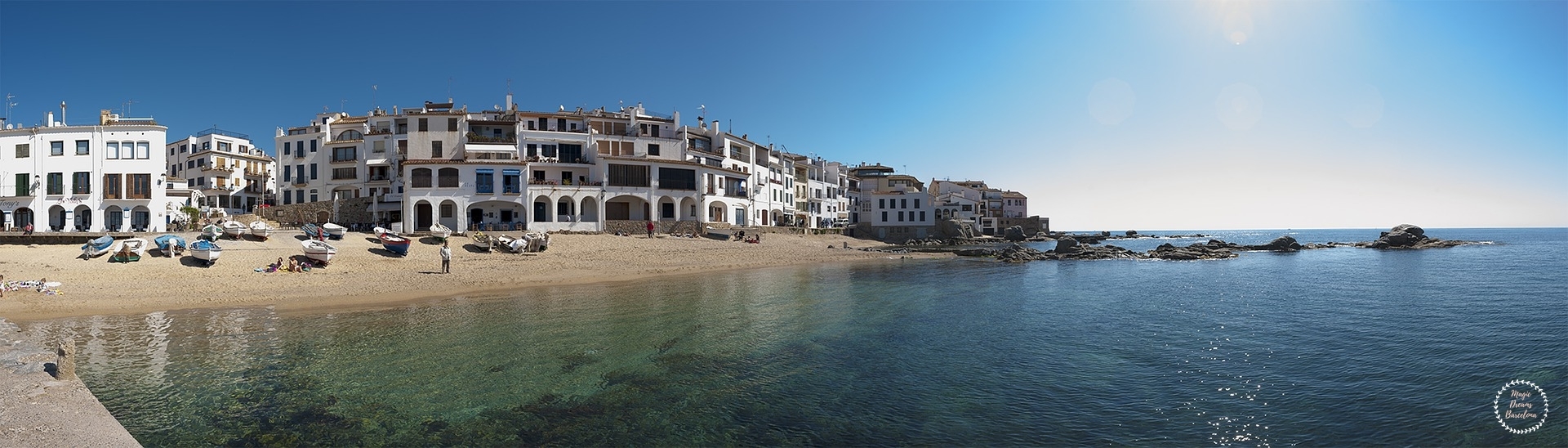
It is one of those places where the Mediterranean landscape, traditional architecture and maritime heritage continue to form a particularly distinctive setting. Its whitewashed houses, former fishermen’s buildings, small beaches, boats resting on the sand, seaside arcades and coastal paths create an image that has become one of the most recognisable landscapes of the Costa Brava.
The village stretches between Llafranc and the Cap Roig area, along a coastline made up of small coves, rocks, cliffs and beaches with coarse sand. The landscape is ideal for walking beside the sea, stopping at one of its viewpoints, enjoying the local cuisine or simply taking in the Mediterranean.
Calella also has a rather unusual characteristic: despite the transformation brought about by tourism along the Costa Brava since the mid-20th century, it has preserved an important part of its identity as a former fishing village.
How to Get There from Barcelona
Calella de Palafrugell from Barcelona
Calella de Palafrugell is approximately 125–130 kilometres from Barcelona, depending on the route chosen.
By car, the journey usually takes around 1 hour 30 minutes to 2 hours, although travel times can increase considerably at weekends and during the summer months.
The usual route follows the AP-7 motorway towards Girona and then continues along the roads leading to Palafrugell and the coast.
By Bus
There are bus connections between Barcelona and Palafrugell and, from there, different services allow you to continue to Calella, Llafranc and other coastal settlements.
During the tourist season, the Julivia Bus also operates, connecting Palafrugell with Tamariu, the Sant Sebastià lighthouse, Llafranc, Calella de Palafrugell, Cap Roig and El Golfet, allowing passengers to get on and off during the validity period of the ticket. Information and timetables should be checked for each season.
By Train
Calella de Palafrugell does not have a railway station. The alternative is to travel by train to a town with a road connection and continue by bus or car.
To discover the different beaches and coves along the coast, combining public transport with hiking is particularly interesting, while a car makes it easier to access the different points along the coastline.
A Former Fishing Village
The Maritime Essence of Calella
The history of Calella de Palafrugell is closely linked to the sea.
For centuries, the coast was associated with fishing, maritime trade and small boats. Fear of pirate and corsair attacks also influenced settlement along the coast, which gradually became more stable from the Early Modern Period onwards.
The fishing quarter we know today still preserves countless elements that allow visitors to imagine the Calella that was once closely connected to fishing activity.
One of the key places for understanding this history is Port Bo.
Port Bo
The Maritime Heart of Calella de Palafrugell
Port Bo, also known as Platja de les Barques, is probably the most emblematic place in Calella de Palafrugell.
The small beach is framed by the characteristic arcaded buildings known as Les Voltes, rocks and traditional boats resting on the sand.
Port Bo was originally a natural harbour belonging to Palafrugell and later developed commercial and fishing functions. During the 19th and early 20th centuries, it also served purposes related to coastal shipping, before becoming primarily associated with fishing.
Today, the former maritime buildings form one of the most distinctive architectural ensembles on the Costa Brava.
It is a place to stroll without rushing, watch the boats, admire the sea, photograph the façades and enjoy the relationship between architecture and landscape.
Les Voltes
Traditional Architecture Facing the Mediterranean
Les Voltes are the characteristic arcades that run along part of the waterfront of Port Bo and Platja d’en Calau.
Their architecture is directly connected to the former maritime way of life. At different times, these spaces were used for activities related to fishing, such as repairing nets, keeping watch, fishermen’s meetings and other functions associated with harbour life.
Over time, the tourist transformation of Calella changed their use, and today many of these spaces form part of terraces and establishments overlooking the sea.
Their value lies not only in the architecture, but also in the overall image they create together with the boats, sand and rocks.
The Palafrugell Town Council identifies Port Bo as one of Calella’s main heritage features and highlights its past as a natural harbour and centre of trade and fishing.
Sa Perola
The Memory of the Fishermen
Behind Port Bo is Sa Perola, a former building associated with fishing activity.
Today it retains its role as an interpretation space and offers an insight into the maritime history of Calella.
Its presence helps visitors understand that Port Bo was not created as a tourist setting, but as a genuine working environment connected to the sea.
The Beaches of Calella de Palafrugell
Small Beaches Between Rocks and Whitewashed Houses
The Calella coastline consists of a succession of small beaches and coves.
Among the main ones are:
- Port Bo.
- D’en Calau.
- La Platgeta.
- Port Pelegrí.
- El Canadell and Els Canyissos.
- Sant Roc.
- El Golfet.
Platja d’en Calau
A Small Beach Sheltered by the Maritime Quarter
Platja d’en Calau is located right on Calella’s waterfront.
Its small size and proximity to the village centre make it one of the most characteristic beaches in the area.
From here, you can continue walking along the coast towards Port Bo, Port Pelegrí and the rest of the waterfront.
La Platgeta
Small, Urban and Mediterranean
La Platgeta is one of the small beaches located in the centre of Calella.
It is approximately 75 metres long and forms part of the coastal route connecting the different beaches within the village.
Its small size makes it advisable to arrive early on the busiest days.
Port Pelegrí
A Cove Next to the Village Centre
Port Pelegrí is another of Calella’s small beaches.
It is approximately 75 metres long and can be accessed on foot via a flight of steps, with parking available nearby.
Its location makes it easy to combine swimming with a walk through the historic village and along the waterfront.
El Canadell and Els Canyissos
One of Calella’s Most Notable Beaches
El Canadell and Els Canyissos beach is one of the most popular areas of Calella’s coastline.
It is approximately 200 metres long and around 30 metres wide, with coarse sand. Access is on foot via a flight of steps, and parking is available nearby.
Opposite the beach is Passeig del Canadell, one of the best-known promenades in the area.
The area also preserves numerous historic homes associated with the development of the summer-residence district in the late 19th and early 20th centuries.
The Canadell Neighbourhood
The Arrival of Summer Tourism in Calella
The Canadell neighbourhood began to develop particularly during the final quarter of the 19th century.
At that time, wealthy families from Palafrugell began building their summer residences by the sea.
These houses helped create the architectural image that still characterises part of the coastline today.
Development subsequently continued towards Llafranc and Cap Roig, gradually transforming Calella from a small fishing village into a summer holiday destination.
Sant Roc
One of the Most Picturesque Corners
The Sant Roc area, also known as Els Canyers, forms part of Calella’s historic waterfront.
From here, one of the most interesting coastal walks can begin, following the coastal path towards Port Pelegrí, La Platgeta, D’en Calau and Port Bo.
The official route between Sant Roc and Els Tres Pins is approximately 1.35 kilometres long and crosses a large part of Calella’s waterfront.
The Coastal Path
Calella Facing the Mediterranean
One of Calella de Palafrugell’s great attractions is its coastal path.
The route follows the shoreline between small beaches, rocks, viewpoints and traditional houses.
From Sant Roc, you can walk beside the sea passing:
- Banys d’en Caixa.
- Port Pelegrí.
- Punta dels Burricaires.
- La Platgeta.
- D’en Calau.
- Port Bo.
- Es Còdol.
- Port de Malaespina.
- Mirador de Primitiu Guri.
- El Canadell.
- Els Canyissos.
- Els Tres Pins.
The route then continues towards Llafranc.
It is particularly pleasant outside the hottest hours of summer, when temperatures make it easier to walk in comfort and tranquillity.
The Calella Tower
The Memory of Piracy
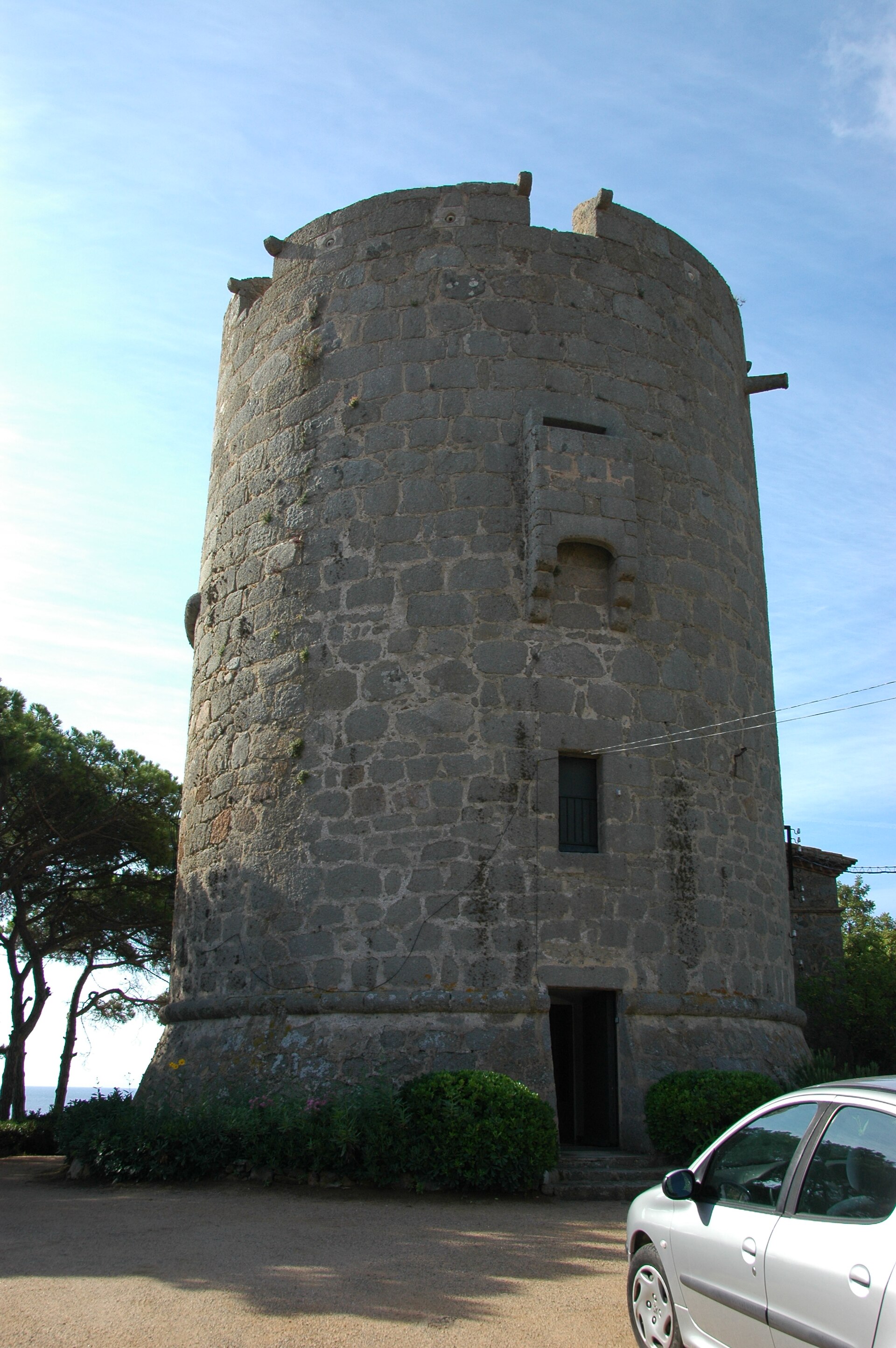
In the Els Tres Pins area stands the Torre de Calella, an old watchtower and defensive tower.
It was built at the end of the 16th century, specifically from 1597 onwards, as part of the defensive network created to protect the coast from pirate attacks. Municipal records confirm its strategic importance and chronology.
Its location makes it easy to understand the defensive logic of the period: from the tower, a significant stretch of coastline could be visually monitored.
Today, it is one of the most interesting heritage features along the coastal path.
Sant Pere Church
The Church of the Former Fishing Quarter
The church of Sant Pere de Calella de Palafrugell is located in Plaça de l’Església.
The current building was begun in 1884 and blessed on 19 October 1887. It was subsequently enlarged, particularly in 1958.
The building has a simple single-nave structure with side chapels, a polygonal apse and a pitched tiled roof.
The apse contains murals by the artist Raimon Roca, featuring religious scenes incorporating the coastal landscape of Calella.
The church is also an important landmark within the former village centre.
Calella and its Maritime Tradition
A Landscape that Still Preserves its Identity
Although tourism has profoundly transformed the Costa Brava, Calella maintains a particularly visible connection with its maritime past.
Traditional boats, small beaches, arcades, former fishermen’s buildings and houses facing the sea still reveal the structure of the old village.
This continuity is one of the reasons Calella has become one of the most recognisable images of the Costa Brava.
The Habaneras of Calella de Palafrugell
One of the Costa Brava’s Great Musical Traditions
The Cantada d’Havaneres de Calella de Palafrugell is one of the town’s best-known cultural events.
The event is usually held on the first Saturday of July on Port Bo beach and has become one of the major celebrations of the habanera genre in Catalonia.
The relationship between Calella and habaneras dates back to the second half of the 20th century. The first Cantada was held in 1967, as part of the cultural revival that accompanied the tourist transformation of the area.
At night, Port Bo becomes a huge stage overlooking the Mediterranean.
2026 Update
The 59th Cantada d’Havaneres was scheduled for 4 July 2026, but was cancelled by the organisers following guidance from Civil Protection and emergency services due to the forest-fire situation.
For this reason, visitors planning future trips should always check the official calendar before travelling.
Cap Roig Festival
Music by the Mediterranean
During the summer, the Cap Roig Gardens host one of Catalonia’s best-known music festivals.
The stage is set within a botanical environment overlooking the Mediterranean, offering a unique combination of music, nature and landscape.
The programme changes every year, so it is advisable to check the official dates before planning a visit.
Cap Roig Gardens
One of the Mediterranean’s Great Botanical Gardens
A few kilometres from Calella lies one of the Costa Brava’s most remarkable botanical spaces.
The Cap Roig Gardens were created from the 1920s onwards by the Russian colonel Nicolai Woevodsky and the British aristocrat Dorothy Webster.
The project combined landscape design, architecture and botany in an exceptional setting overlooking the Mediterranean.
The garden eventually brought together more than 500 plant species from different parts of the world.
Among paths, terraces, sculptures and Mediterranean vegetation, visitors can discover a landscape completely different from the beaches.
Cap Roig Castle
The Castle Among the Gardens
The so-called Cap Roig Castle forms part of the historic complex created by Woevodsky and Webster.
The building, with its historicist inspiration and medieval-style elements, is integrated into the garden landscape.
Rather than a traditional medieval fortress, it is a 20th-century residence conceived as part of a large-scale landscape project.
Its silhouette has become one of the characteristic features of Cap Roig.
El Golfet
Calella’s Wild Cove
El Golfet is the southernmost beach of Calella de Palafrugell and is located very close to the Cap Roig Gardens.
It is a cove approximately 75 metres long, made up of coarse sand and surrounded by vegetation and rocky formations. It can be reached on foot via the coastal path.
Its landscape is different from the urban beaches of Calella.
Here, houses virtually disappear and the sea, rocks, pine trees and cliffs take centre stage.
From certain points along the coast, visitors can see the Illes Formigues, a small archipelago located offshore from this part of the Costa Brava.
The Coastal Path to El Golfet
One of the Best Walks in the Area
The route from Calella towards El Golfet allows visitors to experience the gradual transition between the urban centre and the natural landscape.
As you leave Port Bo and move towards Cap Roig, buildings become less frequent and rocks, pine trees and small viewpoints over the Mediterranean begin to dominate.
It is an especially attractive walk for photography, landscape observation and enjoying the coastline.
Llafranc and Sant Sebastià
Another Perspective of the Coast
From Calella, it is also possible to continue towards Llafranc along the coastal path.
The route connects the two coastal settlements and reveals a coastline made up of small coves and rocky stretches.
From Llafranc, you can continue towards the lighthouse and sanctuary of Sant Sebastià, located high above the Mediterranean.
The Sant Sebastià hill also has a long defensive history. The tower was begun in 1441 and was later incorporated into the religious complex and accommodation for pilgrims.
Calella and Josep Pla
The Literary Costa Brava
Calella de Palafrugell is also part of the literary geography of the Empordà.
The writer and journalist Josep Pla was closely connected to this territory and the Palafrugell coastline.
Pla’s relationship with the Empordà landscape offers a different way of discovering Calella: that of the Mediterranean observed, described and transformed into literary material.
For those who enjoy literature, exploring the coast from this perspective can turn a walk into a cultural experience.
Joan Manuel Serrat and “Mediterráneo”
The Landscape Behind a Universal Song
Calella de Palafrugell is closely associated with Joan Manuel Serrat and his song “Mediterráneo”.
In 1971, Serrat stayed at the former Hotel Batlle, located opposite Port Bo, during the period when he was working on the songs for the album Mediterráneo. Sources such as RTVE and the artist’s own testimony have linked his stay in Calella with the creation of part of the album.
However, the story should be qualified: it would not be accurate to state that the entire song was composed exclusively in Calella. Serrat himself has explained that the song emerged from memories of the Mediterranean and that its composition developed in different places.
What is documented is the importance of Calella during that creative period and the connection between the landscape surrounding the former Hotel Batlle, Port Bo and Serrat’s Mediterranean universe.
Today, although the Hotel Batlle no longer exists as such, the landscape continues to speak for itself.
Calella in Winter
The More Peaceful Mediterranean
Calella de Palafrugell does not necessarily need summer to be attractive.
During winter, the beaches regain a much quieter atmosphere and the waterfront offers a different perspective on the landscape.
The boats, rocks and houses overlooking the sea acquire a particularly special character for photography on cloudy days or when the Tramontana wind is blowing.
It is also a good time to walk along the coastal path, always checking the weather conditions beforehand.
Calella in Spring
The Costa Brava Begins to Awaken
Spring brings milder temperatures and an especially pleasant combination of landscape, vegetation and tranquillity.
It is a good time to explore the coastline on foot, visit Cap Roig and discover the small beaches before the greater crowds arrive during the central summer months.
The coastal paths allow visitors to observe how the urban landscape gradually disappears until it becomes rocky coastline and Mediterranean vegetation.
Calella in Summer
The Fishing Village Transforms
During the summer months, Calella reaches its highest level of activity.
The small beaches welcome countless visitors, seaside terraces become a central feature and the cultural calendar includes various events.
The Cap Roig Festival adds an international musical dimension to summer, while the habaneras transform Port Bo into one of the most unique stages on the Catalan coast.
The high season is also the time when it is advisable to plan parking, travel and visits to the coves further in advance.
Gastronomy
The Sea on the Plate
The gastronomy of Palafrugell and its coastal settlements is deeply connected to the Mediterranean.
In Calella, you can find cuisine based on:
- Fresh fish.
- Seafood.
- Rice dishes.
- Suquet de peix.
- Traditional maritime cuisine.
- Seasonal produce.
- Olive oil.
- Products from the Empordà region.
Traditional gastronomy currently blends with contemporary culinary proposals in different restaurants in the area.
One of the best ways to understand Calella’s identity is precisely to observe the relationship between the harbour, fish, former fishermen’s houses and cuisine.
The Formigues Islands
A Small Archipelago off Cap Roig
Off this section of the Costa Brava lies the small archipelago known as the Illes Formigues.
Its islets and rocky outcrops form part of the maritime landscape visible from different points along the coast, particularly around Cap Roig and El Golfet.
The contrast between the blue waters, rocks and greenery of the coastal vegetation creates one of the most characteristic images of this part of the Baix Empordà.
Sea Activities
Discovering Calella from the Water
The Palafrugell coastline can also be explored from the sea.
Activities available in the area include:
- Boat excursions.
- Kayaking.
- Paddleboarding.
- Snorkelling.
- Sailing.
- Coastal excursions.
- Marine landscape observation.
From the water, you can also enjoy a different perspective of Port Bo, the white houses, Cap Roig, El Golfet and the rocky formations along the coast.
Calella de Palafrugell and its Heritage
A Landscape Preserved Through Memory
One of Calella’s most interesting characteristics is the coexistence of natural heritage, vernacular architecture and maritime memory.
Here, we do not find only beaches.
We also find:
- Port Bo.
- Les Voltes.
- Sa Perola.
- Sant Pere Church.
- Torre de Calella.
- The Canadell neighbourhood.
- Coastal paths.
- Cap Roig.
- Botanical gardens.
- Cap Roig Castle.
- El Golfet.
- The Illes Formigues.
- The coastline towards Llafranc.
The result is a destination that can be explored from the perspective of beach tourism as well as history, architecture, literature, music and nature.
A Route to Discover Calella
From the Fishing Village to Cap Roig
One of the most complete ways to discover the area is to begin in the centre and gradually follow the coastline.
First Stage
Sant Roc + Port Pelegrí + La Platgeta + D’en Calau + Port Bo
This is the most urban section and reveals the maritime essence of Calella.
Second Stage
Port Bo + Es Còdol + Malaespina + Mirador de Primitiu Guri + Canadell
Here, you can observe the relationship between the former houses overlooking the sea and the small bathing areas.
Third Stage
Canadell + Els Canyissos + Els Tres Pins + Torre de Calella
The route continues towards the historic area of the watchtower.
Fourth Stage
Calella + Cap Roig → El Golfet
This is the section where the landscape begins to take on a more natural and rugged character.
The route can be adapted according to the time available and the weather conditions.
What to See in Calella de Palafrugell
The Essentials
For a first visit, we recommend including:
- Port Bo and Les Voltes
- The traditional boats
- Platja d’en Calau
- La Platgeta
- Port Pelegrí
- El Canadell and Els Canyissos
- Sant Roc
- Sant Pere Church
- The coastal path
- Torre de Calella
- El Golfet
- Cap Roig Gardens
- Cap Roig Castle
- Views of the Illes Formigues
- Llafranc and Sant Sebastià
Calella de Palafrugell: A Mediterranean That Endures
History, Sea, Culture and Maritime Essence
Calella de Palafrugell is much more than a succession of beautiful beaches.
It is a former fishing village that has preserved an extraordinary part of its identity: whitewashed houses overlooking the sea, small boats resting on the sand, the arcades of Port Bo, former fishermen’s spaces and a coastline that continues to invite visitors to walk.
Here, you can follow the traces of fishing, discover former watchtowers, walk along coastal paths, visit a remarkable botanical garden, admire the Mediterranean from Cap Roig or sit opposite Port Bo while the boats sway gently on the water.
It is also a place connected with the literature of Josep Pla, with habaneras and with an important period in the creative career of Joan Manuel Serrat.
Perhaps this is one of the reasons why Calella continues to have such a distinctive personality.
It is not just the landscape.
It is the combination of sea, fishing, architecture, music, literature, gastronomy and memory.
And when the Mediterranean is viewed from Port Bo, from the coastal path towards El Golfet or from the gardens of Cap Roig, it is easy to understand why this small corner of the Baix Empordà has become one of the most emblematic landscapes of the Costa Brava.
Would You Like to Discover Calella de Palafrugell with Us?
Calella de Palafrugell and the Costa Brava
If you would like to enquire about any of our tourist services, excursions, experiences or activities in Calella de Palafrugell and the Costa Brava, please do not hesitate to contact us through our web form.
Our team will receive your enquiry and we will get back to you during the day with all the information you need and help you organise your experience.






Copyright © 2016-2026 Magic Dreams Barcelona.