Picasso Museum: Barcelona, the Genius’s Second Home.
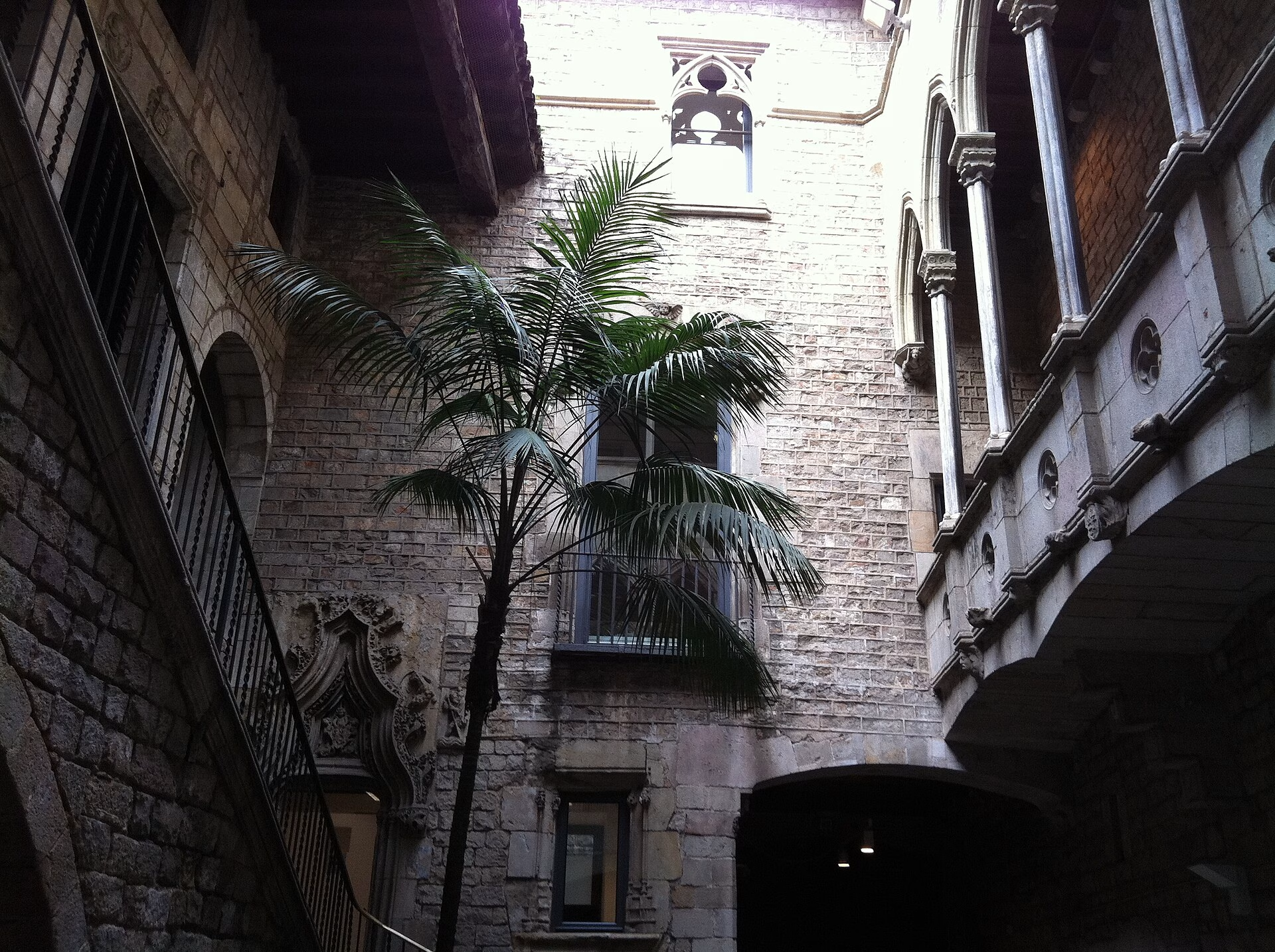
In the heart of El Born, surrounded by medieval palaces, Gothic courtyards and streets steeped in history, stands one of Barcelona’s most special museums: the Picasso Museum. A place where you can discover not only some of Pablo Picasso’s most important works, but also the story of the young artist who found in Barcelona a city that would prove decisive for his artistic education and future.
Picasso was much more than the creator of Cubism. He was a restless, innovative and extraordinarily prolific artist, capable of transforming his way of painting throughout his life. His works reflect his emotions, friendships, personal relationships, travels and the historical events that shaped his era.
Although he was born in Málaga and developed much of his career in France, Barcelona always held a very special place in his life. He spent a fundamental part of his youth here, met friends who would accompany him for decades, held his first exhibitions and began to build his own artistic identity.
We invite you to explore Picasso’s story with us and discover one of Barcelona’s must-see museums.
Picasso and Barcelona: Nine Years That Changed His Life
Pablo Ruiz Picasso was born on 25 October 1881 in Málaga. He was the son of José Ruiz Blasco, a painter and drawing teacher, and María Picasso López. From a very early age, he demonstrated extraordinary drawing skills, and his father quickly recognised his talent.
In September 1895, when Pablo was almost fourteen years old, he arrived in Barcelona with his family. His father had obtained a teaching position at the Llotja School of Fine Arts, and the city became the setting for his adolescence and his first major artistic discoveries.
Picasso remained connected to Barcelona until 1904, although during those years he travelled and spent time outside the city. These were approximately nine decisive years for his education, personality and artistic development.
At that time, Barcelona was experiencing a period of major transformation. The city was growing, industry was advancing, and Modernisme was reshaping its architecture and cultural life. Cafés, galleries, studios and intellectual gatherings brought together artists, writers and thinkers searching for new forms of expression.
In this environment, the young Picasso began meeting other creative minds and discovering an artistic world far broader than that of academic teaching.
Where Did Picasso Live in Barcelona?
Picasso’s life in Barcelona unfolded mainly around the neighbourhoods of La Ribera, El Born and the streets of the old town.
When the family first arrived in the city, they initially settled at Porxos d’en Xifré, on Passeig d’Isabel II. Later, they lived on Carrer Reina Cristina and at number 3 Carrer de la Mercè, where he spent a significant part of his youth.
He also had several studios where he worked and shared space with other artists.
Among the places connected with his life in Barcelona are:
- Porxos d’en Xifré: one of his first residences in Barcelona.
- Carrer Reina Cristina: another of the family homes during those early years.
- Carrer de la Mercè: the family residence where an important part of his youth unfolded.
- Carrer de la Plata: one of the places associated with his early work and studios.
- Carrer Riera de Sant Joan: connected with one of the studios he shared with Carles Casagemas.
- Carrer del Comerç: the area where he had one of his last studios in Barcelona.
Walking through these streets makes it possible to imagine Barcelona in the late nineteenth and early twentieth centuries, a city that witnessed his first steps as an artist.
La Llotja: His First Artistic Studies
Picasso entered the Llotja School of Fine Arts in 1895. There, he received academic training and developed his skills in drawing, composition, anatomy and traditional painting techniques.
His talent was exceptional. However, although he learned the foundations of academic art, his creative personality would soon lead him to question established rules.
In 1897, he painted Science and Charity, one of his first major works. This large-scale painting was submitted to a national exhibition, where it received an honourable mention.
The scene depicts a doctor attending to a sick woman while a nun holds a child. It is a realistic composition with a social theme, demonstrating the technical mastery Picasso had achieved while still very young.
This work is particularly important for understanding the Picasso Museum collection, as it allows visitors to appreciate the extraordinary evolution the artist underwent from his earliest academic works.
Els Quatre Gats: The Café Where a New Artistic Generation Was Born
One of the essential places for understanding the young Picasso is Els Quatre Gats, a brewery and café opened in 1897 on Carrer Montsió.
Inspired by the artistic cafés of Paris, it became a meeting place for painters, writers, musicians and intellectuals searching for new forms of expression.
Artists such as Ramon Casas, Santiago Rusiñol, Isidre Nonell and Miquel Utrillo frequented the establishment. Picasso began visiting it in 1899 and found an atmosphere perfectly suited to his restless and experimental personality.
In February 1900, he held his first solo exhibition there, a decisive moment in his career. He also designed the poster advertising the exhibition, demonstrating his interest in illustration and graphic design.
Els Quatre Gats was much more than a café for Picasso. It was a place for exchanging ideas, friendship and discovery. There, he came into contact with a generation of artists who were transforming Catalan culture.
The establishment still exists today and preserves part of its historical spirit. If you want to discover one of the most important settings of Picasso’s youth, it is well worth visiting and enjoying its atmosphere.
Picasso’s Friendships in Barcelona
Barcelona was also the place where Picasso built some of the most important friendships of his life.
One of the key figures was Jaume Sabartés, a writer, poet and close friend of the artist. They met in 1899 and maintained a close friendship for decades. Sabartés eventually became his personal secretary in 1935 and played an essential role in the creation of the Picasso Museum.
Another important figure was Carles Casagemas, a painter and close friend with whom he shared a studio and travelled. In 1900, they both travelled to Paris. Casagemas’s death in 1901 deeply affected Picasso and is associated with the atmosphere of sadness that characterises the beginning of his Blue Period.
Others in his circle included Manuel Pallarès, Joan Vidal Ventosa, the Reventós brothers, the Fernández de Soto brothers, Sebastià Junyer-Vidal and Manolo Hugué.
These relationships were not simply social encounters. Many of these friends accompanied the artist during different stages of his life and helped maintain his connection with Barcelona even after he moved to France.
The Places the Young Picasso Used to Visit
Picasso’s Barcelona was not limited to his studios and Els Quatre Gats. He wandered through the city streets, observed its inhabitants and found inspiration in everyday life.
Among the places associated with his walks and activities are:
- La Rambla: one of the main centres of urban life.
- Passeig de Colom: an area associated with his walks around the city.
- Ciutadella Park: one of the meeting and leisure places in Barcelona at the time.
- La Barceloneta: with its maritime and working-class atmosphere.
- El Paral·lel: known for its theatres, performances and nightlife.
- Sala Parés: one of Barcelona’s most important art galleries.
- Els Quatre Gats: his main meeting place with the artistic bohemian community.
Everything he saw could become material for his drawings: musicians, artists, workers, popular characters, café scenes and portraits of his friends.
The city was a true visual laboratory for the young Picasso.
Picasso’s Artistic Periods: A Lifetime of Transformation
Picasso’s body of work is so extensive that it is impossible to confine it to a single style. Throughout his life, he experimented with different techniques, colours, materials and artistic languages.
The Formative Years: Málaga, A Coruña and Barcelona
During his childhood and adolescence, he developed extraordinary skills in drawing and figurative painting.
His early works reflect the strong influence of the academic training he received from his father and his artistic studies.
In Barcelona, works such as Science and Charity demonstrate his mastery of realism and his interest in social themes.
The Blue Period (1901–1904)
Following the death of his friend Carles Casagemas, Picasso began developing a style dominated by blue, cold and dark tones.
During this period, he portrayed poor people, beggars, blind people, elderly individuals, mothers and lonely characters. His figures convey sadness, isolation, vulnerability and suffering.
Blue became a symbolic element, expressing melancholy, loneliness and a deeply human vision of life.
Among the works that best represent this period are La Vie, The Old Guitarist and The Frugal Repast.
The Rose Period (1904–1906)
After settling in Paris, his colour palette began to change. Pink, ochre and orange tones appeared, and his compositions acquired a different sensitivity.
Picasso became interested in the world of the circus, harlequins, acrobats and travelling performers.
Behind these seemingly cheerful characters lies a reflection on loneliness, identity and the human condition.
Proto-Cubism and the Birth of Cubism
From 1906 onwards, Picasso began simplifying forms and investigating new ways of representing the human body and space.
In 1907, he painted Les Demoiselles d’Avignon, a revolutionary work that broke with many traditional conventions of Western painting.
Together with Georges Braque, he developed Cubism, a movement that transformed visual representation.
Instead of showing objects from a single viewpoint, Cubist artists began representing several perspectives simultaneously, fragmenting forms and reorganising space.
Analytical Cubism mainly used restrained colours, ochres and greys. Later, Synthetic Cubism incorporated paper, letters, materials and collage techniques.
Neoclassicism and Surrealism
After the First World War, Picasso explored more classical forms, monumental figures and references to the Mediterranean tradition.
During the 1920s and 1930s, he also maintained connections with the Surrealist movement, although he never completely submitted to a single artistic school.
His paintings began to feature distorted figures, fragmented bodies and compositions filled with emotional tension.
Guernica: Art as a Form of Protest
In 1937, Picasso painted Guernica, one of the best-known works in the history of art.
The painting was created in response to the bombing of the Basque town of Gernika during the Spanish Civil War.
The work uses a palette of whites, blacks and greys. Its anguished figures, the horse, the bull, the mother and her child, and the wounded bodies convey the horror of war and the suffering of civilians.
Guernica became an international symbol against violence and destruction.
His Later Years: Ceramics, Printmaking, Sculpture and Painting
During his final decades, Picasso continued experimenting with extraordinary energy.
He worked with ceramics in Vallauris, produced sculptures, prints, drawings and paintings, and reinterpreted works by great masters such as Velázquez, Delacroix and Manet.
His ability to reinvent himself was one of the most remarkable characteristics of his career.
Picasso’s Women, Relationships and Four Children
Picasso’s romantic life was intense and complex. Throughout his life, he had important relationships with several women, some of whom were artists, photographers and models who directly influenced his work.
Among his best-known partners were:
- Fernande Olivier: one of his first important partners in Paris and a familiar figure in his works during the early years of the twentieth century.
- Eva Gouel: his relationship with her coincided with a transitional period towards Synthetic Cubism. Picasso portrayed her in several works.
- Olga Khokhlova: a Russian ballet dancer whom he married in 1918.
- Marie-Thérèse Walter: a fundamental figure in his paintings during the 1930s.
- Dora Maar: a photographer and Surrealist artist. She documented the creation of Guernica and was one of the most important figures in his artistic circle.
- Françoise Gilot: a painter with whom he had two children.
- Jacqueline Roque: his last wife, whom he married in 1961 and who remained by his side until his death.
There is no single definitive account of all Picasso’s romantic relationships. These are some of the women best known for their importance in his biography and artistic career.
Picasso had four children:
- Paulo Picasso, son of Olga Khokhlova.
- Maya Widmaier-Picasso, daughter of Marie-Thérèse Walter.
- Claude Picasso, son of Françoise Gilot.
- Paloma Picasso, daughter of Françoise Gilot, also known for her career as a designer.
The women who shared his life were not simply models. Some had artistic careers of their own, and all of them, in one way or another, form part of the painter’s personal and creative history.
When Did Picasso Leave Barcelona?
Picasso made his first trip to Paris in September 1900, accompanied by Carles Casagemas, on the occasion of the Universal Exhibition.
The French capital opened up a new world for him. There, he met gallery owners, artists, writers and collectors, and came into contact with new European artistic movements.
After several stays and returns to Barcelona, he settled permanently in Paris in April 1904.
He left behind the city where he had spent much of his youth, but never completely severed his ties with it.
The Cities and Places Where Picasso Lived
Although Paris was his main artistic centre for many years, Picasso developed his life in different locations throughout France and also spent periods in Spain and other countries.
Paris: It was his main centre of activity during the first decades of the twentieth century. He lived in Montmartre, in the famous building known as the Bateau-Lavoir, and later in other homes and studios in the French capital.
Horta de Sant Joan: In 1898, he spent several months in this town in Tarragona with his friend Manuel Pallarès. The landscape and experience of that period had a significant impact on his artistic development.
Rome: In 1917, he travelled to Italy to work with the Ballets Russes and became familiar with classical art and Mediterranean traditions.
Antibes: After the Second World War, he spent time on the French Riviera, where he worked and found inspiration in the Mediterranean light and landscape.
Vallauris: During the post-war years, he devoted himself intensively to ceramics, working at the Madoura studio.
Cannes: This was one of the places where he lived during his years in southern France.
Vauvenargues: In 1958, he purchased the Château de Vauvenargues, near Aix-en-Provence, a property in an impressive natural setting at the foot of Montagne Sainte-Victoire.
Mougins: He spent his final years at Notre-Dame-de-Vie, a property in this Provençal town, where he continued working until his death.
Château de Vauvenargues: Where Picasso Rests
In 1958, Picasso acquired the Château de Vauvenargues, a historic property located in the French region of Provence.
The castle is surrounded by a beautiful landscape, close to Montagne Sainte-Victoire, famously depicted in the paintings of Paul Cézanne.
Picasso was fascinated by the place and decided to make it one of his most special properties.
Although he later moved to Mougins, the Château de Vauvenargues retained great significance for him.
When Picasso died, he was buried in the castle gardens, where his grave can still be found today. It is a private property and should not be confused with his last residence.
Where Did Picasso Die?
Pablo Ruiz Picasso died on 8 April 1973 at Notre-Dame-de-Vie, his residence in Mougins, in southern France.
He was 91 years old and had dedicated virtually his entire life to creating art.
He was buried two days later in the gardens of the Château de Vauvenargues, where he rests in a place he had particularly loved and chosen.
His death did not mark the end of his influence. His work continues to be studied, exhibited and reinterpreted in museums around the world.
The Picasso Museum in Barcelona: The First Museum Dedicated to the Artist During His Lifetime
One of the most remarkable aspects of Picasso’s relationship with Barcelona is that the city is home to the first museum dedicated exclusively to the artist and the only one established during his lifetime.
The Picasso Museum opened its doors on 9 March 1963, initially under the name Sabartés Collection.
The museum’s history began thanks to the friendship between Picasso and Jaume Sabartés. In 1955, Sabartés began the process of donating his private collection of the artist’s works to Barcelona, with the intention of making it the foundation of a future museum.
Barcelona City Council supported the project and approved the creation of the Pablo Ruiz Picasso Monographic Museum in 1960.
The initial collection consisted of works donated by Sabartés and other pieces that already belonged to the city’s municipal museums.
However, Picasso personally wanted to contribute to the museum’s growth.
In 1968, following Sabartés’s death, he donated 59 paintings to Barcelona: a portrait of his great friend and the 58 works that make up his extraordinary series of Las Meninas, a reinterpretation of Diego Velázquez’s famous painting.
In 1970, he made another historic donation, giving the city an important collection of his early works that his family had kept in Barcelona. The donation included paintings, drawings, sketchbooks, prints and other materials that provide an insight into his formative years.
In this way, the museum became a testament to the extraordinary friendship between Picasso, Sabartés and Barcelona, as well as a reflection of the artist’s affection for the city.
A Museum Housed in Five Medieval Palaces
The Picasso Museum stands out not only for its artworks. Its architecture is also one of the main reasons to visit.
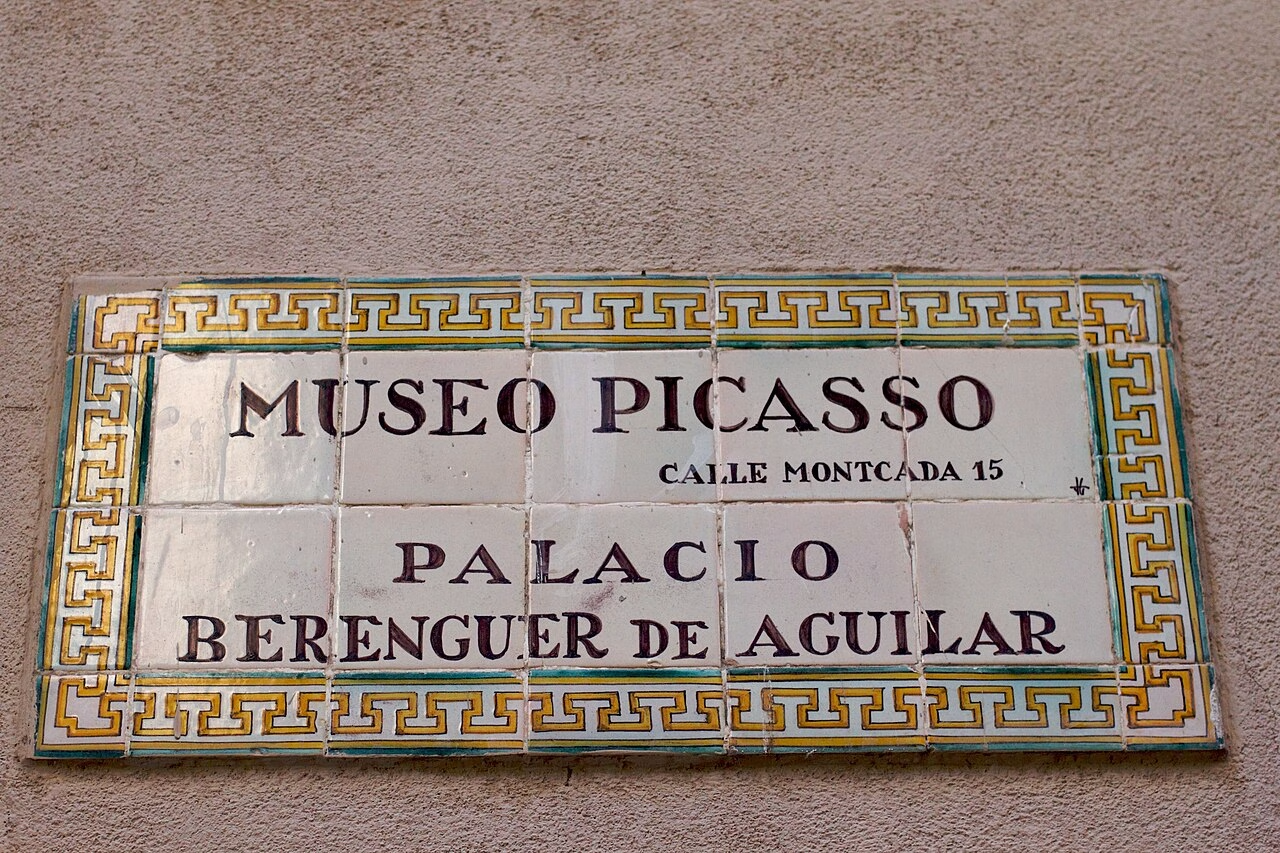
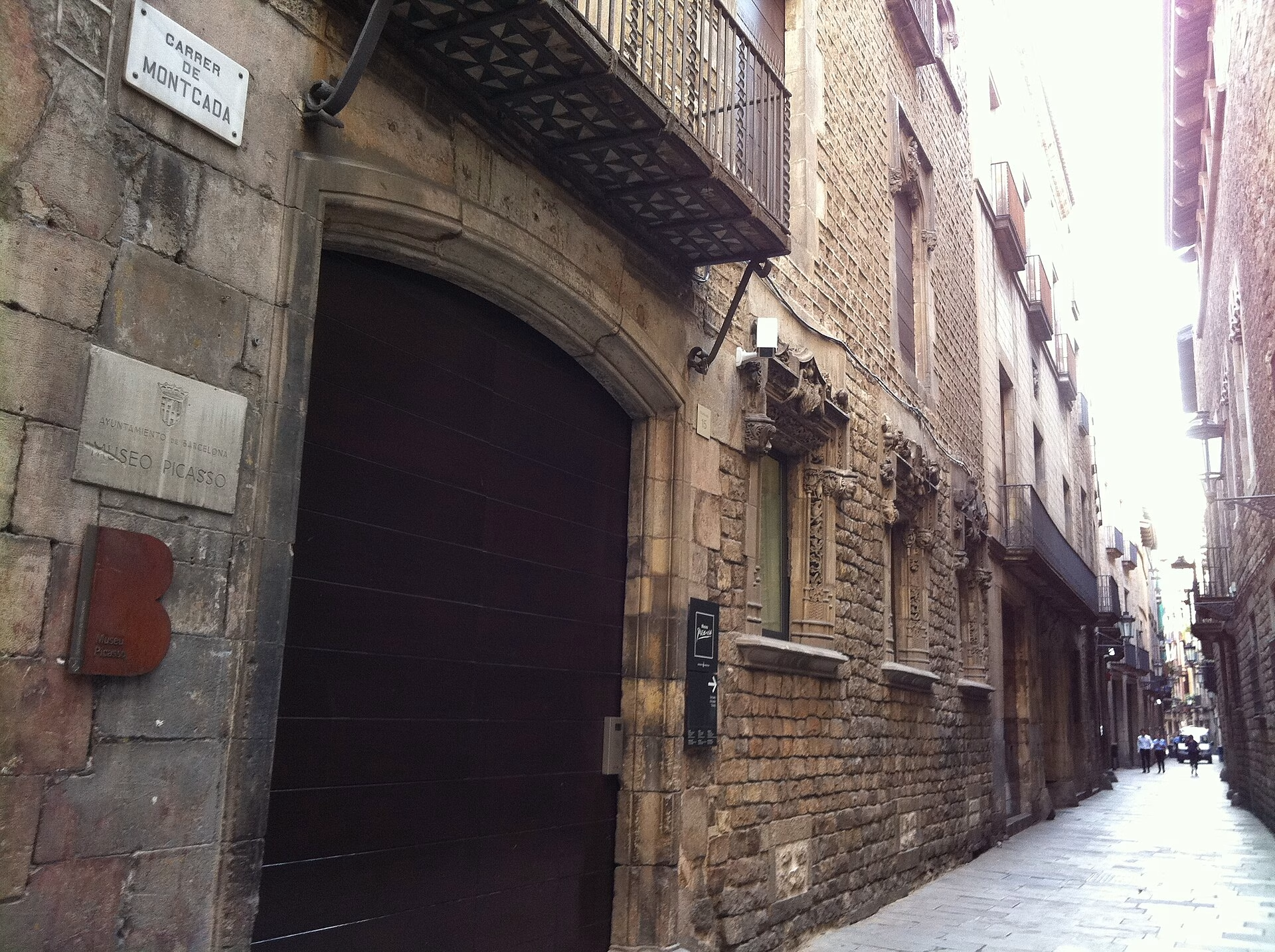
It is located on Carrer Montcada, in the La Ribera neighbourhood, and occupies five historic buildings: Palau Aguilar, Palau del Baró de Castellet, Palau Meca, Casa Mauri and Palau Finestres.
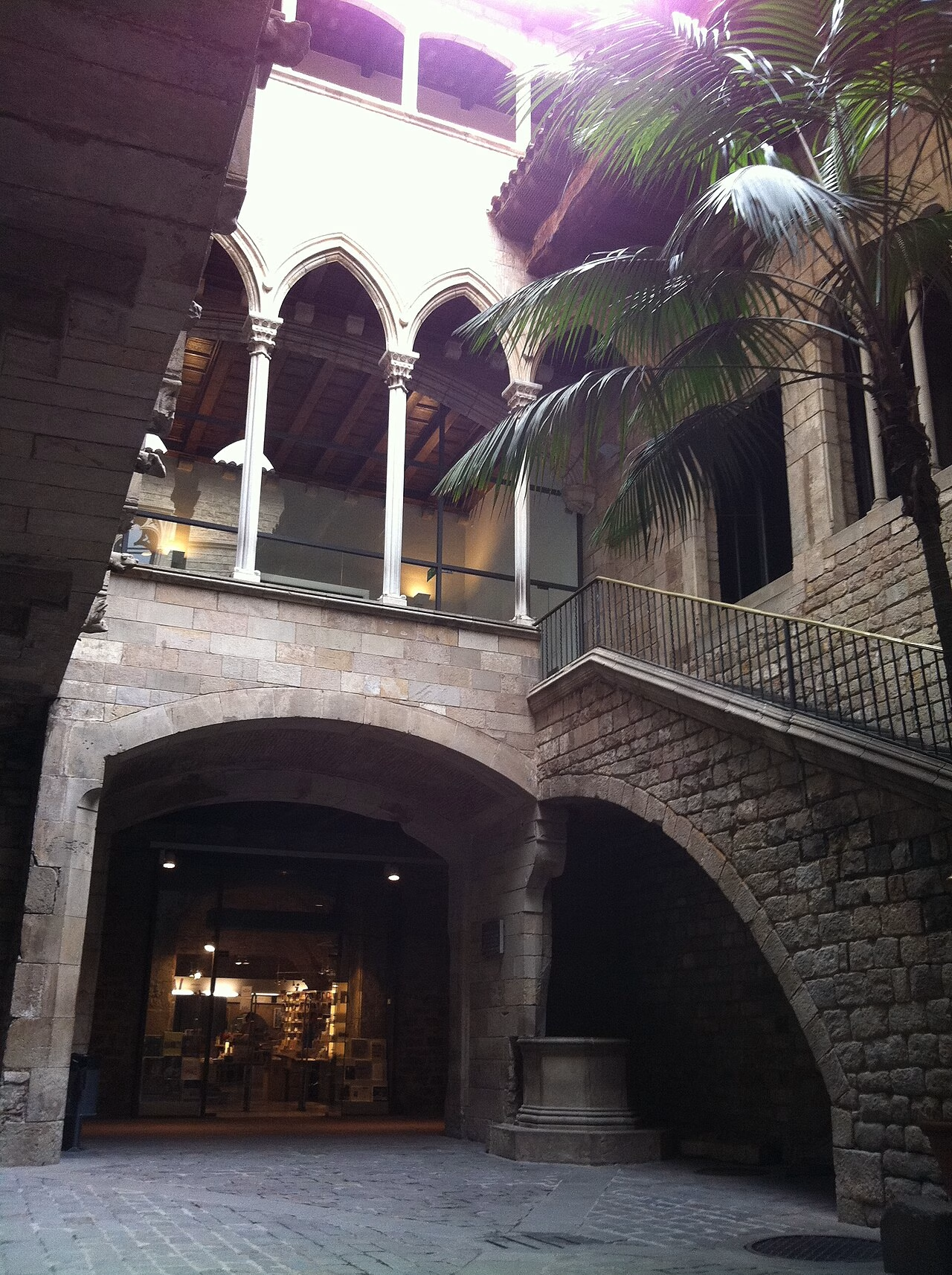
The original palaces date from the thirteenth to the fifteenth centuries, with important later renovations, particularly during the eighteenth century. They are magnificent examples of Catalan Gothic civil architecture.
Their interior courtyards, exterior staircases, galleries, arches and historic ceilings allow visitors to discover what the grand residences of medieval Barcelona were like.
The contrast between the historic architecture and Picasso’s modern artistic language makes the visit particularly interesting.
Walking through its galleries means exploring both the history of the city and the evolution of one of the most influential artists of the twentieth century.
Which Works Can You Find at the Picasso Museum?
The Picasso Museum houses more than 4,000 works and has one of the most important collections for understanding the artist’s formative and youthful years.
The collection allows visitors to follow his development from his earliest drawings and academic works to his later artistic experiments.
Among the most notable works and collections are:
- Science and Charity (1897): one of the great works of his youth, demonstrating his mastery of academic realism.
- First Communion (1896): an early work reflecting his ability to create complex figurative compositions.
- Man with a Beret: an example of his early work and development as a draughtsman.
- Works from the Blue Period: paintings dominated by melancholy, poverty and loneliness.
- Works from the Rose Period: circus characters and figures reflecting a different artistic sensitivity.
- Portraits and drawings of his friends: a window into his personal life and Barcelona’s artistic environment.
- Las Meninas (1957): a series of 58 paintings in which Picasso analyses and transforms Velázquez’s masterpiece.
The Las Meninas series is particularly fascinating. Picasso takes one of the most famous paintings in art history and breaks it down into multiple interpretations, experimenting with colour, composition, characters and viewpoints.
Rather than copying Velázquez, he enters into a dialogue with him from an entirely personal perspective.
One of the great particularities of the Picasso Museum is that it allows visitors to understand the artist’s evolution from his earliest years. It is an especially valuable journey for anyone wishing to discover how his artistic language developed.
What Activities Can You Enjoy During Your Visit?
The Picasso Museum offers different ways to explore the artist’s work, whether you are already familiar with his career or discovering it for the first time.
Some of the available activities include:
Guided tours of the collection: These tours introduce visitors to the main works, explain his artistic periods and reveal details about his life and relationship with Barcelona.
Tours in different languages: The museum organises guided tours in Spanish, Catalan, English and French, depending on the schedule.
Audio guides: These provide explanations of important works and help visitors understand the historical and artistic context of each piece.
Family and children’s activities: The museum organises educational activities and experiences adapted to different ages, bringing art closer to younger visitors.
Temporary exhibitions: The museum organises exhibitions and projects that offer new perspectives on Picasso, his era, his influences and his relationship with other artists.
Cultural activities, educational programmes and group visits are also available. We recommend checking the official programme before planning your visit, as activities, languages and schedules may vary.
Picasso Museum Barcelona Opening Hours
Opening hours change depending on the season.
From 29 September to 29 March:
- Tuesday to Sunday: 10:00 am to 7:00 pm.
From 31 March to 27 September:
- Tuesday, Wednesday and Sunday: 9:00 am to 8:00 pm.
- Thursday, Friday and Saturday: 9:00 am to 9:00 pm.
Closing days:
- Every Monday throughout the year.
- 1 January.
- 1 May.
- 24 June.
- 25 December.
Reduced opening hours:
- 24 and 31 December: 10:00 am to 2:00 pm.
The ticket office closes 30 minutes before the museum closes. Visitor capacity is limited, so we recommend booking your tickets in advance.
How Much Does It Cost to Visit the Picasso Museum?
The museum offers different admission options.
For entry to the collection, the prices are:
- General admission online: €12.
- General admission at the ticket office: €13.
- Reduced admission: €7.
Reduced admission applies, among other groups, to young people aged 18 to 25, accredited university students, visitors over 65 and holders of a Barcelona Libraries card.
Free admission is also available for certain groups, including visitors under 18 and people who meet the conditions established by the museum.
Free admission periods:
- First Sunday of each month, with prior reservation.
- Thursdays from 4:00 pm to 7:00 pm during the winter season.
- Thursdays, Fridays and Saturdays from 7:00 pm to 9:00 pm during the summer season.
- Special open-house days.
Reservations for free admission periods become available four days before the visit, starting at 10:00 am.
Prices may vary if you also wish to visit temporary exhibitions. Before visiting, check the relevant admission price for your preferred option on the official website.
Where Is the Picasso Museum in Barcelona?
The museum is located in the heart of the El Born neighbourhood, in the Ciutat Vella district, surrounded by medieval streets, historic squares and other places of great cultural interest.
Address:
Picasso Museum Barcelona
Carrer de Montcada, 15–23
08003 Barcelona, Spain.
It is just a few minutes’ walk from the Basilica of Santa Maria del Mar, El Born Market and Passeig del Born.
Its location makes it easy to combine a museum visit with a pleasant walk through one of Barcelona’s most historic and charming neighbourhoods.
How to Get There by Public Transport
Barcelona has an excellent public transport network, making it easy to reach the museum.
By Metro
- Line L4 (Yellow Line): Jaume I station. One of the closest stops. From there, you can walk to the museum in approximately 3–5 minutes.
- Line L1 (Red Line): Arc de Triomf station. From this station, you can reach the museum with a pleasant walk of approximately 10–15 minutes.
By Bus
These are some of the bus lines with stops near the museum:
- Via Laietana: lines 17, 40, 45 and 19.
- Passeig Picasso: lines 39 and 51.
- Pla de Palau: lines 14 and 59.
- Carrer Princesa: line 120.
The stops are within a comfortable walking distance of the museum. We recommend checking routes and possible service changes before setting off.
By Train
If you are travelling from other cities, you can use Barcelona-Sants railway station and continue by metro or bus to the El Born neighbourhood.
You can also arrive at Estació de França, which is relatively close to the museum. From there, you can continue on foot or use public transport, depending on your starting point.
How to Get There by Private Car and Where to Park
If you prefer to travel by private car, bear in mind that the Picasso Museum does not have its own car park.
The museum is located in Barcelona’s old town, where streets are narrow and some areas have traffic restrictions. For this reason, we recommend checking access conditions before setting off.
You can look for public parking in the following nearby areas:
- Passeig del Born and Plaça Comercial: one of the closest areas to the museum.
- Plaça de la Catedral: parking options are available in the area around Barcelona Cathedral.
- Avinguda de Francesc Cambó: an alternative near Santa Caterina Market.
- Via Laietana: there are car parks in the vicinity of this major city thoroughfare.
Availability, prices and access conditions may vary. We therefore recommend checking public car parks in advance and booking a space if possible.
Our recommendation: If you are in Barcelona, public transport is a very convenient way to visit the museum. If you arrive by car, the most practical option is to leave it in a public car park and continue on foot to Carrer Montcada.
Plan Your Visit to the Picasso Museum
Before visiting, we recommend checking the museum’s official website to confirm opening hours, admission prices, temporary exhibitions and available activities.
Picasso Museum Barcelona
Address: Carrer de Montcada, 15–23, 08003 Barcelona.
Telephone: +34 93 256 30 00.
Email: museupicasso@bcn.cat
Website: https://museupicassobcn.cat/
You can purchase tickets and check admission conditions through the official website.
Discover the Picasso Museum with Magic Dreams Barcelona
Visiting the Picasso Museum is much more than simply admiring famous paintings. It is a journey back to Barcelona in the late nineteenth century, an opportunity to discover the young artist who found his path here, learn about his friendships, explore the places he frequented and understand how his way of interpreting the world evolved.
It is also an opportunity to discover five historic palaces, learn about an extraordinary friendship and admire a collection that brings us closer to Picasso, from his earliest years to some of his most important artistic reinterpretations.
Barcelona was a decisive city in his artistic development, and this museum is one of the best places to understand that relationship.
If you would like to discover the Picasso Museum, learn about its history and explore with us one of Barcelona’s most fascinating cultural spaces, join us on this experience.
At Magic Dreams Barcelona, we want you to discover the city beyond its usual landmarks: its stories, secrets, heritage, personalities and those hidden corners that make Barcelona a truly unique destination.


Copyright © 2016-2026 Magic Dreams Barcelona.