Catalan Shrimp Suquet.
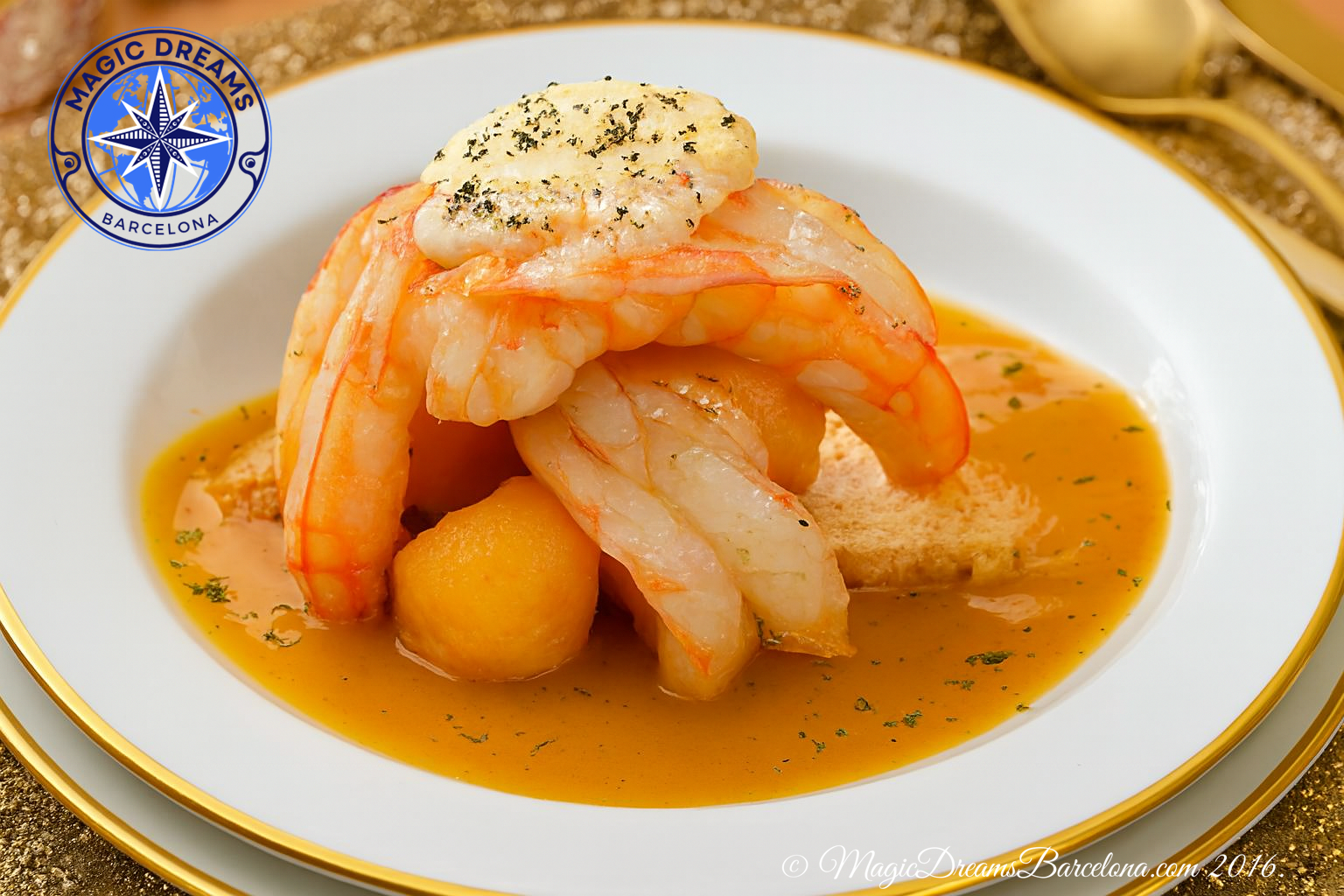
A timeless maritime tradition of Catalan cuisine
Suquet de Langostinos, or Catalan shrimp suquet, is an elegant interpretation of one of the most representative dishes of Catalonia’s maritime cuisine. Its name is associated with the Catalan word “suc”, meaning juice or cooking liquid, referring to the rich, concentrated broth that forms the soul of the dish.
Traditionally, suquet was a simple fishermen’s stew prepared aboard fishing boats with the fish available that day, potatoes, garlic, olive oil and other basic ingredients.
Over time, this humble preparation became one of the great classics of the Catalan Mediterranean table.
The secret lies in creating an intensely flavorful broth without making the dish unnecessarily complicated. Shrimp heads, fish stock and a traditional picada of almonds, garlic, bread and parsley provide depth and body.
The potatoes are cut using the traditional “chascado” technique, breaking them slightly at the end of the cut so that their starch naturally thickens the broth.
The result is a rich, aromatic and deeply Mediterranean seafood stew, where the delicate flavor of the shrimp combines with olive oil, tender potatoes and the intensity of the picada.
Ingredients
Serves 4
For the suquet
- 12 raw shrimp or prawns, preferably with heads and shells.
- 3 medium potatoes.
- 1 liter fish stock.
- 2 garlic cloves, finely chopped.
- 1 ripe tomato, grated.
- Extra virgin olive oil.
- Salt.
For the picada
- 1 garlic clove.
- 10 toasted almonds.
- 1 small slice of fried or toasted bread.
- Fresh parsley.
To finish
- Fresh parsley, optional.
- Extra virgin olive oil.
- Rustic bread.
Preparation
01 · Prepare the shrimp
Building the foundation of the seafood flavor
Peel the shrimp carefully, keeping the heads and shells.
For a more attractive presentation, you can leave the tails of some shrimp unpeeled.
Heat a generous drizzle of extra virgin olive oil in a wide, heavy-bottomed casserole.
Add the shrimp heads and shells and sauté for several minutes.
Press the heads gently with a wooden spoon to release their juices.
This step is essential because the juices inside the heads contain an enormous amount of seafood flavor and aroma.
Remove the heads and shells and reserve the infused oil.
02 · Prepare the sofrito
The Mediterranean heart of the stew
Using the same casserole and the shrimp-infused oil, add the chopped garlic.
Cook gently until fragrant, taking care not to burn it.
Add the grated ripe tomato and cook over medium-low heat until it becomes concentrated and thick.
The tomato should lose most of its water and develop a rich, aromatic flavor.
Do not rush this step.
A properly reduced sofrito gives the suquet its depth and natural sweetness.
03 · Add the potatoes
The ingredient that gives the suquet body
Peel the potatoes and cut them into irregular chunks.
Instead of making a completely clean cut, use the traditional chascado technique: cut into the potato with the knife and then break the final portion rather than slicing it completely.
This releases starch and naturally helps thicken the broth.
Add the potatoes to the sofrito and sauté gently for approximately 2–3 minutes.
04 · Add the fish stock
Slowly cooking the potatoes
Heat the fish stock separately.
Pour it into the casserole, making sure the potatoes are covered.
Bring the liquid to a gentle boil, then reduce the heat.
Cook for approximately 15 minutes, or until the potatoes are almost tender.
Avoid stirring with a spoon, as this could break the potatoes apart.
Instead, gently move the casserole in small circular motions.
05 · Prepare the picada
The traditional soul of the suquet
While the potatoes are cooking, prepare the picada.
Place the garlic, toasted almonds, fried or toasted bread and parsley in a mortar.
Crush everything together until you obtain a fragrant, fairly smooth paste.
If necessary, add a small spoonful of fish stock to help loosen the mixture.
The picada provides body, texture and aromatic depth to the broth.
06 · Add the picada
Thickening and enriching the broth
Once the potatoes are almost tender, add the picada to the casserole.
Gently move the casserole to distribute it throughout the broth.
Continue cooking for a few minutes so that the picada becomes fully incorporated.
The broth should begin to develop a slightly thicker and creamier consistency.
Taste and adjust the seasoning.
07 · Cook the shrimp
Add the seafood at the very end
Add the cleaned shrimp once the potatoes are completely tender.
Cook for approximately 2–3 minutes, depending on their size.
Do not overcook them.
The shrimp should remain tender, juicy and slightly firm.
Remember that they will continue cooking from the residual heat after the casserole is removed from the stove.
08 · Rest the suquet
Five minutes to bring everything together
Turn off the heat and allow the suquet to rest for approximately 5 minutes.
During this time, the flavors will settle and the broth will become even more harmonious.
Finish with a few drops of extra virgin olive oil just before serving.
Gourmet Suggestions
Magic Dreams Barcelona
For a more refined Catalan Shrimp Suquet:
- Use high-quality raw shrimp, preferably with heads and shells.
- Never discard the heads: they provide much of the dish’s seafood intensity.
- Sauté the heads and press them gently to extract their juices.
- Use homemade fish stock whenever possible.
- Cut the potatoes using the traditional chascado technique to naturally thicken the broth.
- Prepare the picada in a mortar for a more traditional texture.
- Add the shrimp only at the end to prevent them from becoming dry.
- Avoid stirring the stew with a spoon; gently move the casserole instead.
- Allow the dish to rest for a few minutes before serving.
- Always serve with rustic bread for dipping into the rich broth.
The Secret to a Great Suquet
The secret of a great suquet is achieving maximum flavor with a small number of ingredients.
The shrimp heads provide an intense marine character.
The tomato contributes sweetness and acidity.
The potato gives the broth texture and body.
The picada brings everything together while adding richness and aroma.
Extra virgin olive oil provides the fat needed to integrate all these flavors.
The finished broth should be rich, slightly thick and concentrated, but never excessively heavy.
Gourmet Presentation
Serve the suquet directly in a traditional clay casserole or a deep serving plate.
Arrange the potatoes as the base and place the shrimp on top.
Pour over plenty of the aromatic broth and finish with fresh parsley and a few drops of extra virgin olive oil.
For a more contemporary presentation, arrange three shrimp per person alongside the potatoes and pour the broth around them at the last moment.
You can also finish with a few lightly crushed toasted almonds to highlight the connection with the traditional picada.
The presentation should retain the spirit of the original maritime dish:
simple, generous and focused on the quality of the ingredients.
Serving
The Catalan Shrimp Suquet should be served immediately after resting.
It should reach the table hot, but without prolonged cooking that could toughen the shrimp.
Traditionally, it is served in the casserole and placed in the center of the table for everyone to share.
The essential accompaniment is good rustic bread, perfect for soaking up the concentrated broth.
Pairing
Suquet pairs particularly well with a Catalan 0.0% alcohol-free white wine, preferably fresh and with good acidity.
A white wine inspired by the Empordà or Penedès, in a 0.0% alcohol-free version, provides freshness and balances the richness of the seafood and broth.
For a completely refreshing alternative, serve with very cold sparkling water and a few drops of lemon.
Make-Ahead Preparation
The sofrito and picada can be prepared in advance.
The fish stock can also be made ahead and refrigerated.
However, we recommend cooking the potatoes and adding the shrimp as close to serving time as possible.
Shrimp require very little cooking and quickly lose their ideal texture if they remain in a hot broth for too long.
For professional service, the suquet base can be prepared in advance and the dish finished to order with the potatoes and shrimp.
Storage
Cooked suquet: Store refrigerated in an airtight container for approximately 1–2 days.
Fish stock: Can be refrigerated for approximately 2–3 days, provided it is cooled and stored correctly.
Cooked shrimp: Best consumed the same day for optimal texture.
When reheating, do so gently over low heat and avoid prolonged boiling.
We do not recommend repeatedly reheating the suquet, particularly after the shrimp have been added.
The Soul of Catalan Suquet
Catalan Shrimp Suquet perfectly captures the spirit of traditional Catalan maritime cuisine.
A handful of ingredients.
A good sofrito.
An intense fish stock.
A traditional picada.
And absolute respect for the seafood.
The result is a dish that transforms simple ingredients into something rich in history, character and depth.
Mediterranean, maritime and unmistakably Catalan.
A casserole that preserves the memory of Catalonia’s fishermen and brings that tradition to the modern table.
Copyright © 2016–2026 Magic Dreams Barcelona.