Sant Ferran Castle.
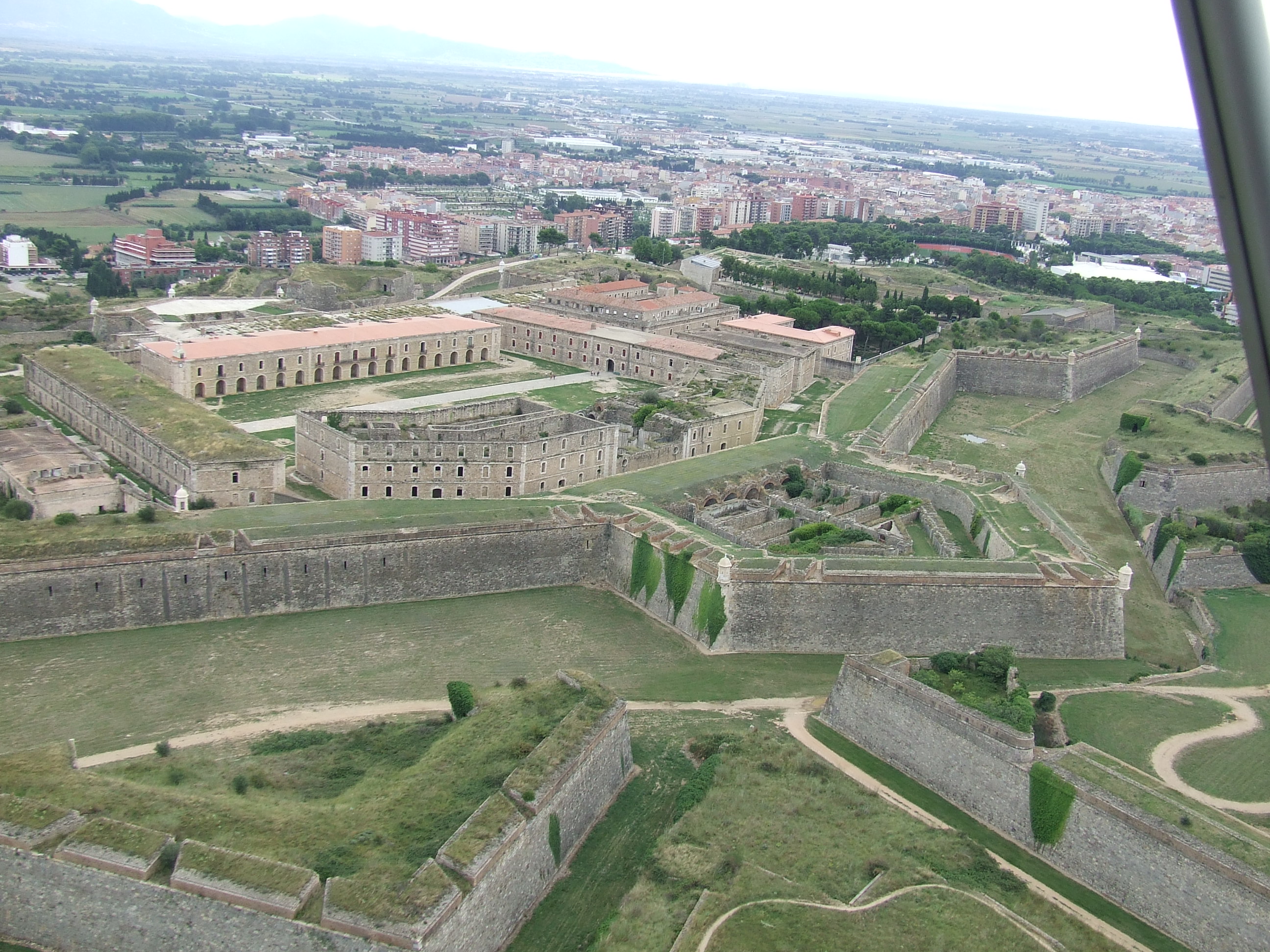
One of Europe’s Great Fortresses in the Heart of the Empordà
Just a few minutes from the centre of Figueres, on a hill overlooking much of the Alt Empordà, stands Sant Ferran Castle, one of the most extraordinary military constructions in Catalonia.
This is not a medieval castle. It is a huge 18th-century bastioned fortress, designed as a genuine military city and built to protect the border with France.
Its dimensions are impressive from the very first moment: approximately 550,000 m² of surface area, an outer perimeter of around 3,120 metres, large bastions, moats, stables, warehouses, pavilions, underground galleries and four large cisterns with a combined capacity of approximately nine million litres of water.
Today, in addition to preserving its extraordinary historical and architectural value, the castle offers several ways to visit it, from independent tours to guided visits through the exterior and underground areas.
WHERE IS SANT FERRAN CASTLE?
Sant Ferran Castle is located in Figueres, in the Alt Empordà region of the province of Girona.
From Barcelona, it is approximately 140 kilometres by road, a journey that normally takes around one and a half hours, depending on traffic.
Its location was chosen for strategic reasons. Figueres is close to the French border and has historically been an important communication route between Catalonia and France.
The fortress is also very close to the centre of Figueres and the Dalí Theatre-Museum, making it possible to combine both attractions during the same day.
HISTORY OF THE FORTRESS
Following the Treaty of the Pyrenees in 1659, Spain lost Roussillon and part of Cerdanya. The new border situation made it necessary to strengthen the defences of north-eastern Catalonia.
Figueres was considered a strategic position, and eventually the decision was made to build a major fortress there.
Construction began in 1753, under the direction of military engineer Juan Martín Zermeño, during the reign of Ferdinand VI, from whom the fortress originally took its name.
Construction was long and complex. The fortress was inaugurated in 1766, although work and modifications continued for decades.
The result was a fortress designed to withstand a prolonged siege and keep a large garrison supplied and operational even under extreme circumstances.
AN EXCEPTIONAL BASTIONED FORTRESS
Sant Ferran Castle is one of the most monumental examples of 18th-century military architecture.
Its layout is approximately pentagonal and organised around an east-west axis.
The complex consists of two large enclosures covering approximately 550,000 m².
The inner enclosure, measuring around 325,000 m², consists of six large bastions connected by curtain walls.
These include:
- Sant Narcís.
- Sant Jaume.
- Sant Damià.
- Sant Felip.
- Santa Bàrbara.
- Santa Tecla.
The defensive system is completed by hornworks, ravelins, counterguards, covered ways, galleries and a huge moat.
THE PARADE GROUND
At the centre of the fortress lies the enormous Parade Ground, approximately 149 metres long and 80 metres wide.
Around it, different pavilions were built to accommodate authorities, officers and their families.
The fortress was designed to function as a genuine military settlement, with the spaces required to house, feed and supply a large garrison.
The Generalitat states that the complex contains nine pavilions intended to accommodate authorities and their families.
A church was also built, although it was never completed.
But one of the greatest surprises lies beneath the parade ground itself.
THE CATHEDRAL OF WATER
Beneath the Parade Ground are four large cisterns, with a total capacity of approximately nine million litres of water.
This hydraulic system made it possible to guarantee the fortress’s water supply during a possible siege.
Today, one of the most unusual experiences available to visitors is the so-called Cathedral of Water, which allows visitors to enter the cisterns in an inflatable boat.
The tour lasts approximately half an hour.
It is one of the experiences we particularly recommend if you want to understand just how thoroughly the fortress was designed as a self-sufficient military infrastructure.
THE STABLES
The stables are attached to the fortress curtain walls and had capacity for approximately 500 horses.
Their function went far beyond simply providing accommodation for the animals.
They formed part of an enormous logistical infrastructure designed to maintain the garrison and its animals for long periods.
Nearby were warehouses capable of storing provisions for 10,000 people for one year.
These dimensions help explain why Sant Ferran can be regarded as a genuine fortified military city.
THE MOAT AND OUTER DEFENCES
One of the most impressive features during a visit is the enormous moat surrounding the fortress.
The outer enclosure has an approximate perimeter of 3,120 metres and consists of various defensive elements, including hornworks, ravelins and counterguards.
The moat covers approximately 10 hectares and can currently be visited, together with different underground galleries.
Walking through this area provides a much better understanding of how the defensive system worked and allows visitors to appreciate the true scale of the walls from outside.
DO MILITARY PERSONNEL STILL LIVE AROUND THE CASTLE?
The relationship between Sant Ferran and the military sphere still exists today.
This is an important point to clarify because the castle remains a property connected to the Ministry of Defence even though it is open to tourism.
The Ministry of Defence retains ownership of the entire property. In 2003, an agreement was established whereby the Ministry transferred the use of certain facilities to the Consortium for their conservation, restoration, revitalisation and cultural promotion. The same agreement expressly preserves the powers of the Ministry of Defence and certain military uses.
The Sant Ferran Castle Consortium consists of three institutions:
- Ministry of Defence.
- Government of Catalonia.
- Figueres City Council.
The Consortium is responsible for promoting and managing the conservation and cultural promotion of the fortress, but ownership remains with the Ministry of Defence.
The statutes subsequently amended maintain this assignment to the General State Administration, specifically the Ministry of Defence.
As a result, there is currently a rather unusual situation: a large part of the castle is open to the public and operates as a cultural and tourist attraction, while restricted areas and certain uses connected to the military sphere remain.
Around the road leading up to the castle there are also historic homes associated with military personnel.
This helps explain why Sant Ferran still has a much more direct relationship with military life than might be apparent to visitors who only experience the tourist route.
THE CANTEEN AND EVERYDAY LIFE OF THE SOLDIERS
The daily life of the military personnel has also left its mark on the fortress.
One of the former powder magazines was transformed during the 20th century into a canteen for soldiers, known as the Soldier’s Home.
These spaces played an important role in garrison life: they were places for rest, socialising and eating.
Today, café and restaurant services may vary depending on the season and the programme of activities, so if you wish to eat during your visit, it is advisable to check the available services beforehand.
For a special gastronomic experience, Figueres also offers excellent options just a few minutes from the castle.
IS THERE A MUSEUM INSIDE THE CASTLE?
The castle itself is the main object of the visit.
It does not function as a conventional museum based exclusively on a permanent collection. Here, the monument itself is the main exhibit.
The experience consists of exploring its courtyards, bastions, defensive structures, moats, galleries and hydraulic systems while understanding how a fortress of this scale operated.
There are currently two main ways to visit: independent tours of the inner enclosure and complementary guided tours of the exterior and underground areas.
SALVADOR DALÍ AND SANT FERRAN
There is a particularly interesting connection between the fortress and one of Figueres’ most famous figures: Salvador Dalí.
The celebrated artist carried out his military service at Sant Ferran Castle from 1927, remaining there for approximately nine months.
This was a youthful period before his international success and coincided with a time of intense artistic experimentation.
During these years he produced works such as Cenicitas, at a moment when his artistic language was beginning to develop some of the elements that would later characterise his surrealist universe.
For visitors interested in Dalí’s life and career, Sant Ferran therefore offers a different perspective on the artist’s youth.
THE CASTLE AS A PRISON
The fortress also has a long penitentiary history.
At the beginning of the 20th century, certain areas were used for prison purposes.
In 1904, King Alfonso XIII visited the castle, and the fortress subsequently incorporated penitentiary functions.
Its use as a civilian prison continued until 1933.
During the 20th century, the complex once again assumed various military functions and also served as a military prison.
This succession of uses explains the historical complexity of the monument and the existence of spaces that have served very different purposes over the centuries.
SANT FERRAN DURING THE SPANISH CIVIL WAR
The fortress also played an important role during the Spanish Civil War.
On 1 February 1939, Sant Ferran hosted the last meeting in Spain of the Cortes of the Spanish Republic.
During the final days of the war, the fortress became connected with the Republican retreat, and its strategic position once again became extremely important.
After the conflict, the complex continued to be associated with various military functions.
ANTONIO TEJERO AND THE MILITARY PRISON
The contemporary history of the castle is also connected with Antonio Tejero, a lieutenant colonel in the Spanish Civil Guard and one of the main figures responsible for the attempted coup d’état of 23 February 1981.
Following his conviction, Tejero was transferred in 1983 to the military prison at Sant Ferran Castle, where he served part of his sentence.
In 1991 he was transferred to Alcalá de Henares, where he continued serving his sentence.
His time at Sant Ferran forms part of the fortress’s contemporary history and its final period as a military penitentiary.
NATURE, BIRDS AND BUTTERFLIES
Despite its monumental character, Sant Ferran has a very extensive outdoor area where nature is also present.
The moats, slopes, green areas and open spaces provide shelter for different species of birds and small animals.
The Alt Empordà region also has considerable bird diversity, which is particularly interesting during migration periods.
The vegetation is mainly characteristic of the Mediterranean climate of the region, with species adapted to dry and sunny conditions.
During the warmer months, visitors may also spot different species of butterflies and other pollinating insects.
If you enjoy photography, the early morning and late afternoon offer particularly attractive light on the walls and surrounding landscape.
WHAT CAN YOU DO AT SANT FERRAN TODAY?
The fortress currently maintains considerable cultural and tourist activity.
Among the main possibilities are:
- Independent visits.
- Audio guides.
- Guided tours.
- Moat tours.
- Cathedral of Water visits.
- Access to underground galleries.
- Tours of the countermines.
- Educational activities.
- Family activities.
- Themed visits.
- Cultural activities.
- Gastronomic activities.
- Astronomical observation activities.
- Special programmes on certain dates.
- Space rental for activities and events.
The independent visit allows you to explore the inner enclosure at your own pace, while complementary tours provide access to areas that require specialised guidance.
VISITING HOURS
Opening hours vary depending on the time of year.
July, August and Easter
Monday to Sunday, 10:00 am to 8:00 pm.
April, May, June, September and October
Tuesday to Sunday, 10:00 am to 6:00 pm.
Open on public-holiday Mondays.
November to March
Tuesday to Sunday, 10:00 am to 4:00 pm.
Open on public-holiday Mondays.
Last admission is one hour before closing.
The site is closed on 25 and 26 December and from 1 to 6 January.
TICKETS AND VISIT OPTIONS
Prices depend on the type of visit you choose.
The independent visit is the simplest option for exploring the inner enclosure.
Complementary experiences, such as the moat tour or Cathedral of Water visit, have their own conditions and prices.
If you would like to experience several activities during the same day, it is advisable to plan your schedule in advance so that you can make the most of your visit.
CASTLE SERVICES
The available services and facilities include:
- Parking.
- Audio guides.
- Independent visits.
- Guided tours.
- Educational facilities.
- Educational activities.
- Bibliographic information.
- Publications.
- Shop and bookshop.
- Audiovisual room.
- Auditorium.
- Event spaces.
- Rental of certain spaces.
- Cultural activities.
- Family activities.
- Moat tours.
- Cistern visits.
- Group activities.
HOW MUCH TIME DO YOU NEED TO VISIT?
If you want to make a simple visit, you can allow approximately two hours.
However, to explore Sant Ferran at a relaxed pace, we recommend allowing half a day.
You can begin with the independent tour of the inner enclosure and complete the experience with a guided visit, the moat tour and the Cathedral of Water.
Afterwards, you can head into the centre of Figueres to enjoy the local cuisine and continue your day at the Dalí Theatre-Museum.
WHERE TO EAT AFTER VISITING SANT FERRAN
If you would like to round off your visit with a special meal, Figueres has several interesting gastronomic establishments.
One particularly elegant option is El Motel, a historic restaurant in the city known for cuisine based on seasonal and local products and for its interesting wine selection.
https://www.elmotelrestaurant.com/
It is a good choice if you want to combine heritage, gastronomy and culture during the same day.
WHERE TO STAY IN THE EMPORDÀ
If you would like to extend your stay, we recommend looking for accommodation in a country house or rural property in the Alt Empordà.
Masia Can Clotas, near Cistella, offers a peaceful atmosphere and an experience connected to the rural landscape.
Another option is Mas Jonquer Casa Rural, in Vilanant, suitable for those who want to enjoy a stay closer to nature and the traditional atmosphere of the region.
Staying in the countryside allows you to discover Sant Ferran without rushing and spend time exploring the villages, wineries, restaurants and landscapes of the Empordà.
A FORTRESS WORTH DISCOVERING
Sant Ferran Castle is one of those monuments whose true scale is difficult to understand until you explore it in person.
Its enormous bastions, moats, stables, warehouses, galleries and cisterns demonstrate the extraordinary engineering capacity required to build a fortress of such dimensions.
But Sant Ferran is also a place of memory.
Military personnel, prisoners, politicians, artists and generations of Figueres residents have passed through its facilities.
Salvador Dalí carried out his military service here. The last meeting in Spain of the Republican Cortes was held here. And Antonio Tejero served part of his sentence here.
At the same time, the castle maintains its current institutional relationship with the Ministry of Defence, which owns the property, while the Consortium formed by the Ministry of Defence, the Government of Catalonia and Figueres City Council participates in its conservation, management and cultural promotion.
This combination of military history, heritage, culture and institutional uses makes Sant Ferran a particularly unique place.
PLAN YOUR VISIT WITH US
If you would like to discover Sant Ferran Castle in a special way, we can help you organise a complete experience in the Alt Empordà.
We can combine your visit to the fortress with restaurants, rural accommodation, cultural experiences and other activities, adapting the itinerary to the amount of time you have and the type of trip you are looking for.
You can contact us through the form and we will be delighted to prepare a personalised proposal for you.
Copyright © 2016-2026 Magic Dreams Barcelona.