Montjuïc Communications Tower – Neo-Futurism in the Heart of the Olympic Ring.

Architecture Transformed into an Olympic Symbol of Barcelona
The Montjuïc Communications Tower, also known as the Montjuïc Telefónica Tower, is one of Barcelona’s most distinctive works of contemporary architecture and one of the most recognisable visual symbols of the 1992 Olympic Games.
Designed by Valencian architect and engineer Santiago Calatrava, this extraordinary structure was built between 1989 and 1992 as part of the major urban transformation Barcelona underwent in preparation for the Olympic Games.
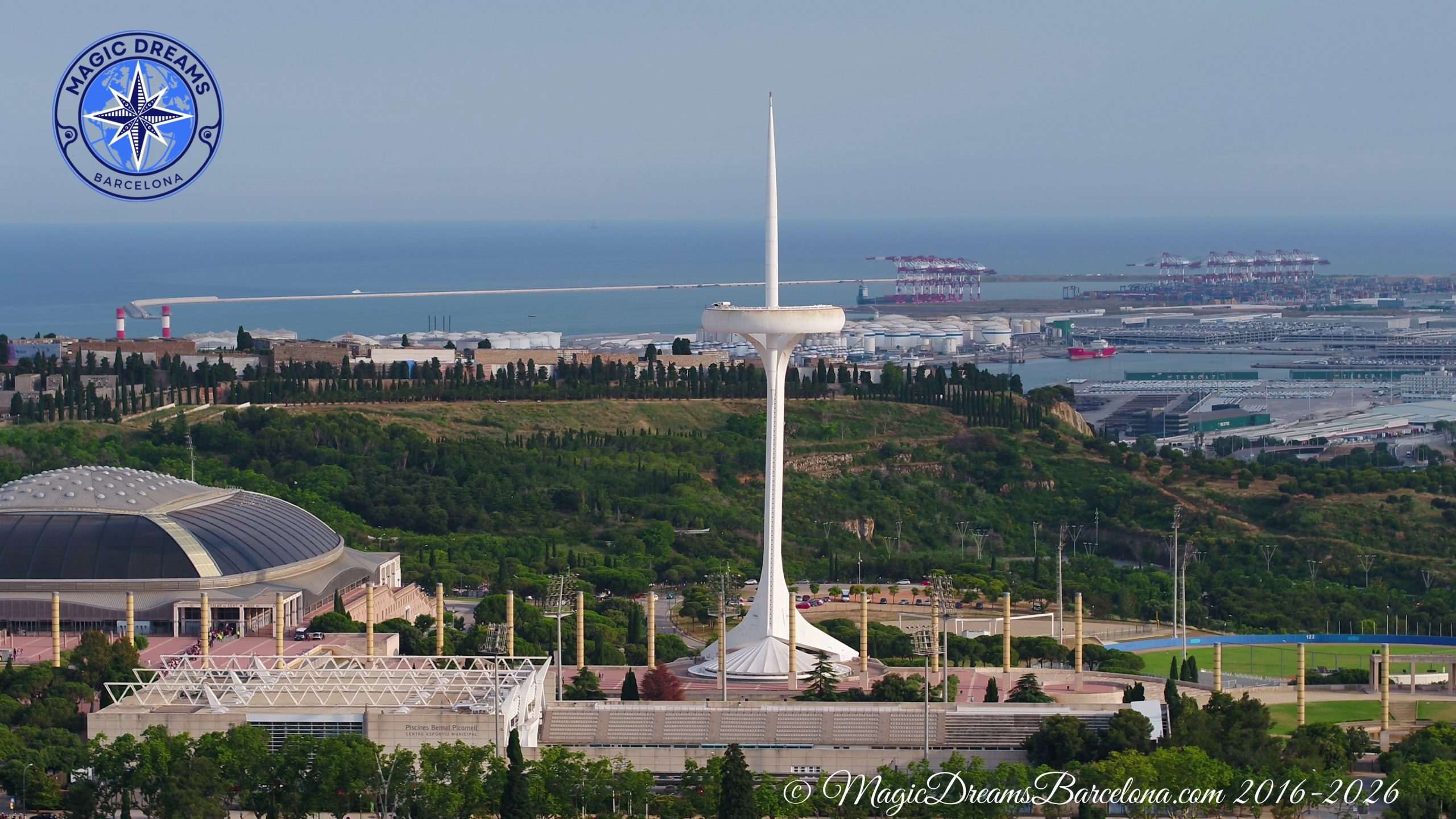
Standing 136 metres tall, the tower occupies a prominent position in the heart of the Montjuïc Olympic Ring, alongside some of the city’s most important sporting venues, including the Estadi Olímpic Lluís Companys, the Palau Sant Jordi and the Bernat Picornell Swimming Pools.
Its slender, white and slightly inclined silhouette stands out against the urban landscape and has become a distinctive architectural landmark visible from countless locations across Barcelona.
Beyond its function as a telecommunications facility, the tower represents one of the most characteristic expressions of late twentieth-century architecture: the union of engineering, technology, art and symbolism.
THE ORIGINS OF THE MONTJUÏC TOWER
Barcelona 1992: A City Determined to Transform Its Future
The construction of the tower was closely connected to the ambitious urban renewal project Barcelona undertook to host the 1992 Summer Olympic Games.
The city did not simply intend to organise an international sporting competition. The Games represented a historic opportunity to renew public spaces, improve infrastructure, regenerate urban areas and present a new image of Barcelona to the world.
Montjuïc played a particularly important role in this transformation.
Traditionally associated with culture, gardens, exhibitions and sporting facilities, the mountain became one of the main Olympic venues.
It was in this context that the project for a telecommunications tower emerged. In addition to fulfilling an essential technical function, the structure was intended to become an architectural landmark representing the new Barcelona.
The commission was awarded to Santiago Calatrava, whose proposal successfully integrated a communications facility into a highly distinctive sculptural composition.
SANTIAGO CALATRAVA AND AN ARCHITECTURE OF MOVEMENT
Engineering Inspired by the Human Body and Nature
Santiago Calatrava developed an architectural language deeply influenced by anatomy, geometry, movement and the structures found in nature.
His training as both an architect and an engineer enabled him to explore the expressive possibilities of materials and transform structural solutions into genuine artistic compositions.
In the Montjuïc Tower, this philosophy is expressed through a slender structure that appears to challenge the laws of balance.
The overall composition conveys a remarkable sense of lightness and movement, despite the enormous dimensions of the construction.
The tower is not merely a technological mast, but rather a vertical sculpture that establishes a dialogue between the Montjuïc landscape and Barcelona’s skyline.
Its design reflects one of the most distinctive characteristics of Calatrava’s work: the ambition to transform engineering into an aesthetic experience.
A SILHOUETTE RESEMBLING AN OLYMPIC ATHLETE
The Human Body Transformed into Architecture
One of the best-known interpretations of the tower associates its shape with the figure of an ancient Greek athlete holding an Olympic torch.
This symbolic interpretation establishes a direct connection between architecture and the spirit of the Olympic Games.
The inclination of the shaft and the arrangement of its structural elements create a composition reminiscent of the gesture of a human body in motion.
The tower thus becomes an architectural representation of effort, achievement and sporting celebration.
Its presence within the Olympic Ring reinforces the relationship between the classical heritage of sport and Barcelona’s technological modernity.
It is important to understand this image as a formal and symbolic interpretation of the structure rather than a literal figurative representation.
THE STRUCTURE AND ITS CONSTRUCTION SECRETS
Balance, Geometry and an Exceptional Engineering Solution
Behind the apparent simplicity of its silhouette lies a remarkably sophisticated structural solution.
The tower is organised around an inclined concrete shaft, externally clad in white metal panels and supported by three anchor points on a circular platform.
This arrangement allows the overall structure to remain balanced despite the inclination of its main shaft.
At the top, the shaft opens out to support a composition consisting of a semicircular element housing the telecommunications equipment and a vertical needle-like structure that appears to float in space.
This final, slender and lightweight element reinforces the sense of movement that characterises the entire composition.
The combination of concrete, steel, metal and geometric forms demonstrates the extent to which Calatrava regarded engineering as a discipline capable of creating beauty.
One of the most interesting details is that the structure does not rely on the conventional vertical configuration of a traditional tower to fulfil its technical purpose.
Its inclination is precisely one of the defining elements of its architectural identity.
THE MONTJUÏC SUNDIAL
When Architecture Enters into Dialogue with the Movement of the Planet
One of the most fascinating aspects of the Communications Tower is its ability to function as a gigantic sundial.
Its orientation and the inclination of the shaft are related to the angle of solar incidence corresponding to the summer solstice in Barcelona.
Thanks to this arrangement, the central needle casts its shadow across the neighbouring Plaça d’Europa, creating a relationship between architecture, astronomy and time.
The tower therefore becomes more than a telecommunications facility: it also functions as an instrument for observing the movement of the Sun.
This feature demonstrates Calatrava’s sensitivity to the physical laws of nature and his ability to incorporate them into architectural design.
The relationship between the Sun’s position, the inclination of the structure and the movement of shadows is one of the most original aspects of this work.
It is an extraordinary reminder that architecture can also engage with the natural cycles of our planet.
A TRIBUTE TO ANTONI GAUDÍ
White Trencadís: A Bridge Between Two Architectural Eras
At the base of the tower, we find one of the most interesting details of its composition: a circular reinforced-concrete platform accompanied by an organically shaped fountain covered in white trencadís.
This technique, particularly associated with the work of Antoni Gaudí, consists of covering surfaces with fragments of ceramic, tiles or other materials.
Calatrava revisits this decorative language and incorporates it into an entirely contemporary construction.
However, instead of using the rich colours commonly found in many Modernist compositions, he opts for a white surface that maintains the visual coherence of the entire tower.
The result is a dialogue between two great periods in Barcelona’s architectural history.
On the one hand, the organic and handcrafted universe of Gaudí.
On the other, Calatrava’s structural and technological experimentation.
The fountain is not merely an ornamental feature. It forms part of the architectural composition of the base and helps integrate the tower into its surrounding public space.
This tribute demonstrates how architectural traditions can be reinterpreted without having to reproduce their original forms literally.
THE HYDRAULIC DOOR
An Entrance That Opens Like an Eye
One of the tower’s lesser-known features can be found beneath its platform.
It is a hydraulically operated metal door which, when activated, performs a rotational movement of approximately 90 degrees.
Its mechanism creates a visual effect resembling an eyelid opening and closing.
This feature, characteristic of some of Calatrava’s formal investigations, transforms a functional component into a small mechanical performance.
The door provides access to the technical facilities and highlights another recurring aspect of the architect’s work: his desire to introduce movement even into components that would normally go unnoticed.
In this structure, engineering is not concealed behind architecture. It becomes part of its expressive language.
THE MONTJUÏC TOWER AND THE OLYMPIC RING
An Architectural Ensemble That Transformed the Mountain
The tower forms part of one of Barcelona’s most important urban and sporting complexes: the Montjuïc Olympic Ring.
This area brings together facilities that played a fundamental role during the 1992 Olympic Games and continue to be part of the city’s sporting and cultural life.
Its main buildings and spaces include:
Estadi Olímpic Lluís Companys: the venue for the Olympic ceremonies and numerous major international sporting competitions.
Palau Sant Jordi: designed by Japanese architect Arata Isozaki, this is one of Barcelona’s principal indoor venues for sporting events, concerts and cultural performances.
Bernat Picornell Swimming Pools: facilities associated with the Olympic swimming competitions.
INEFC Barcelona: a building designed by Ricard Bofill, featuring a classical architectural inspiration.
Plaça d’Europa and the Olympic Esplanades: open spaces that connect the complex and offer different perspectives of its architecture.
The tower acts as a visual landmark for this entire environment.
Its presence helps organise an architectural landscape in which different styles coexist, ranging from classical monumentality to contemporary technological architecture.
The Olympic Ring is also an excellent example of how a major sporting event can provide an opportunity to transform a city’s urban landscape in a lasting way.
BARCELONA 1992
The City That Opened Itself to the World
The Barcelona 1992 Olympic Games marked a turning point in the city’s contemporary history.
The transformation of Montjuïc was an essential part of a much broader project that included the regeneration of the waterfront, the construction of new infrastructure, improvements to transport connections and the renewal of several neighbourhoods.
The Communications Tower became one of the most recognisable images of this transformation.
Its technological function was particularly important for the broadcasting and telecommunications requirements of an event followed by audiences around the world.
However, its legacy has gone far beyond its original purpose.
More than three decades later, it remains one of Barcelona’s major architectural landmarks and an outstanding example of the architectural ambition that accompanied the Olympic Games.
CALATRAVA’S TOWER TODAY
An Architectural Icon That Continues to Define Barcelona
Today, the Communications Tower continues to serve as a telecommunications facility and remains one of the most photographed structures within the Olympic Ring.
It has also become an important reference point for understanding the evolution of contemporary architecture in Barcelona.
Its silhouette appears in countless city panoramas and provides a striking visual contrast with other major monuments and historic buildings.
Unlike Modernist buildings, whose richness is primarily discovered through their façades and interior spaces, Calatrava’s tower requires a more comprehensive perspective.
It is worth observing it from different distances, appreciating how its profile changes depending on the viewpoint and discovering the relationship it establishes with the sky and the Montjuïc landscape.
WHAT YOU CAN DISCOVER DURING YOUR VISIT
A Journey Through Architecture, Sport and Landscape
The tower is located in an open area integrated into the Olympic Ring complex.
It is important to remember that this is not a monument with regular tourist access to its interior. The experience consists primarily of admiring its architecture from the outside and exploring the surrounding public spaces.
During your visit, we recommend:
- Observing the tower from Plaça d’Europa to appreciate its relationship with the sundial.
- Approaching its base to discover the white trencadís and fountain.
- Admiring the inclination of the shaft from different perspectives.
- Photographing its silhouette alongside the Palau Sant Jordi.
- Exploring the Olympic esplanade and discovering the relationship between the different facilities.
- Taking time to examine the structural details and geometric composition of its upper section.
A leisurely visit makes it possible to discover details that are easily overlooked when the tower is viewed only from a distance.
HOW TO GET THERE FROM BARCELONA
Montjuïc: A Mountain Full of History and Architecture
The Communications Tower is located within the Olympic Ring complex on Montjuïc Mountain.
Location: Plaça d’Europa area, Olympic Ring, Barcelona.
From Plaça d’Espanya:
One of the most enjoyable ways to reach the area is to walk up Avinguda de la Reina Maria Cristina, passing through the monumental complex that leads towards the Palau Nacional and the Montjuïc area.
From there, you can continue towards the Olympic facilities.
Metro:
- Line L1 – Espanya.
- Line L3 – Espanya.
Bus:
Several bus routes connect Plaça d’Espanya with different parts of Montjuïc and its facilities.
Montjuïc Funicular:
From Paral·lel metro station, you can take the funicular up Montjuïc and then continue on foot or use other forms of transport.
Montjuïc Cable Car:
The cable car offers panoramic views of the mountain and Barcelona. It is a particularly interesting alternative for visitors who wish to make the journey itself part of the experience.
The best route will depend on the time available and the places you would like to discover during the day.
AN EXPERIENCE FOR PHOTOGRAPHY ENTHUSIASTS
Light, Geometry and Ever-Changing Perspectives
The Montjuïc Tower offers countless opportunities for architectural photography.
Its white colour makes it particularly easy to appreciate changes in light and the shadows projected across its structure.
During the early morning, the light often provides a clean and precise reading of its volumes and materials.
At sunset, the contrast between the tower and the sky can produce particularly striking images.
It is also worth experimenting with different focal lengths and perspectives to emphasise its inclination, supporting elements and the geometry of its upper section.
For enthusiasts of urban photography, it is an excellent location for exploring composition, converging lines and the relationship between architecture and landscape.
MONTJUÏC: NATURE, GARDENS AND BIODIVERSITY
A Mountain Where Architecture Coexists with Nature
One of the great advantages of visiting the tower is the opportunity to extend your day by discovering Montjuïc’s extraordinary natural heritage.
The mountain is home to historic gardens, botanical spaces, woodland areas and numerous hidden corners where Mediterranean vegetation takes centre stage.
Among the places particularly worth visiting are:
Barcelona Botanical Garden: dedicated primarily to Mediterranean flora from different regions of the world.
Jardins de Mossèn Costa i Llobera: famous for their extraordinary collection of cacti and succulent plants.
Jardins de Joan Brossa: a peaceful natural space with pleasant walking paths surrounded by vegetation.
Jardins de Laribal: one of Montjuïc’s most attractive historic gardens, with stairways, fountains and beautiful secluded corners.
Jardins de Mossèn Cinto Verdaguer: known for their collections of bulbous, aquatic and perennial plants.
For anyone interested in botany, the mountain offers an excellent opportunity to observe how plants adapt to the Mediterranean climate.
It is also an interesting environment for birdwatching and butterfly observation, particularly when exploring the gardens slowly and attentively.
The combination of architecture, landscape and biodiversity makes Montjuïc a far more complete destination than a simple sightseeing excursion.
A VISIT THAT CAN BE COMBINED WITH OTHER GREAT BARCELONA LANDMARKS
From Modernism to Contemporary Architecture
A visit to the Communications Tower can become the starting point for a day dedicated to discovering some of Barcelona’s greatest cultural treasures.
Among the most interesting possibilities are:
Fundació Joan Miró: an essential destination for discovering the creative universe of the artist.
National Art Museum of Catalonia (MNAC): one of Barcelona’s leading cultural institutions, housed in the magnificent Palau Nacional.
Poble Espanyol: a journey through different architectural styles and traditional Spanish crafts.
Estadi Olímpic and Palau Sant Jordi: two fundamental works for understanding Barcelona’s transformation in 1992.
Montjuïc Castle: a historic fortress offering magnificent views over the port and Barcelona’s coastline.
The mountain makes it possible to organise an itinerary combining architecture, history, art, gardens, gastronomy and photography.
It is precisely this variety that makes Montjuïc one of the most fascinating places to discover Barcelona from a different perspective.
WOULD YOU LIKE TO DISCOVER MONTJUÏC WITH US?
The Calatrava Tower Through a Different Perspective
Discovering the Montjuïc Communications Tower means entering a story in which engineering, architecture, nature and the Olympic spirit come together.
However, the experience can take on a much deeper dimension when explored through the sensitive, cultural and expert perspective of Magic Dreams Barcelona.
Our specialised, native guides, with extensive knowledge of history, architecture, botany and ornithology, accompany each experience with explanations tailored to the interests of every visitor.
It is not simply about discovering monuments, but about understanding what lies behind them: the ideas of their architects, the stories behind their materials, their relationship with the city and the details that often go unnoticed.
MAGIC DREAMS BARCELONA EXPERIENCES AND SERVICES
Private Tours and Architectural Experiences: personalised itineraries through Montjuïc, the Eixample district, Catalan Modernism and the major landmarks of contemporary Barcelona.
Gastronomic and Sensory Experiences: premium picnics in selected gardens and locations, personalised catering, Catalan and international cuisine, and tapas tours.
Nature and Biodiversity: guided experiences with specialists in botany, lepidopterology and ornithology, discovering the natural richness of Montjuïc.
Art and Creative Workshops: activities inspired by Gaudí, Calatrava and Dalí, including ceramics, mosaics, trencadís, music and floral art.
Professional Photography: private photography sessions for couples, families and groups, with architectural and urban photography experiences.
Musical and Cultural Experiences: private concerts, live musicians, artistic encounters and themed dinners.
Personalised Getaways: one-day experiences, weekend escapes and week-long stays in Barcelona, the Costa Brava, the Pyrenees and other destinations throughout Catalonia.
We take care of every detail: carefully selected accommodation, private transport, reservations, gastronomy, cultural activities and complementary services.
We can also arrange picnics with elegant table linen, floral decorations and bespoke catering in gardens, natural settings or beautiful locations overlooking the sea.
We provide services in Spanish, Catalan and English, and can accommodate other languages upon prior request.
Every experience is designed around our clients’ tastes, interests and preferences, whether for couples, families or private groups of up to four people.
Our aim is to ensure that you enjoy Barcelona without having to worry about the organisation.
The Montjuïc Tower with Magic Dreams Barcelona: discover Barcelona from a different perspective, with knowledge, sensitivity and emotion.


Copyright © 2016-2026 Magic Dreams Barcelona.