Francesc Macià Square.
A square between history, architecture and the everyday life of the city
One of the places that best represents Barcelona’s upper district, where Avinguda Diagonal opens up into wider perspectives and some of the city’s most important thoroughfares converge, is Plaça de Francesc Macià.
Elegant, monumental and permanently animated by traffic, this square is much more than a large urban roundabout. It is a place steeped in history, with an identity deeply connected to Barcelona’s political evolution, the architectural transformation of Diagonal Avenue and the social life of Barcelona’s bourgeoisie throughout much of the 20th century.
Located in the Sant Gervasi-Galvany area, on the border with Les Corts and Eixample, the square is one of the main connecting points between traditional Barcelona and the city’s expansion towards its western districts.
Its surroundings combine monumental residential buildings, modern architecture, offices, restaurants and terraces, which have turned this area into one of the most important meeting places in the upper part of the city.
Yet behind its contemporary appearance lies a much more interesting history: a square that has changed its name several times, preserves a small tribute to Menorca at its centre and was once home to some of Barcelona’s most memorable establishments of the 20th century.
The origins of the square
From the first urban planning projects to Barcelona in the 1930s
The history of today’s Plaça de Francesc Macià is closely linked to the development of Diagonal Avenue and Barcelona’s urban expansion towards the west.
The first urban development projects for this area date back to the 1920s. In 1927, the main guidelines for the square’s layout were established as part of the plans to organise the final stretch of what was then known as Avinguda d’Alfons XIII, the former name of today’s Diagonal Avenue.
The landscape design was commissioned to Nicolau Maria Rubió i Tudurí (1891–1981), an architect, urban planner and landscape designer born in Maó, Menorca, who played a fundamental role in transforming Barcelona’s green spaces.
The proposal envisaged a large circular roundabout with a landscaped central area, conceived as a transitional space between the different avenues and as a traffic distribution point.
The square gradually took shape during the 1930s, although its urban development and the construction of the surrounding buildings continued over several decades.
In those early years, this area still contained large undeveloped plots of land. The northern section, next to what is now Turó Park, was one of the first areas to acquire a clearly defined architectural identity.
The Barcelona we know today is therefore the result of a gradual transformation that turned an urban expansion area into one of the main centres of activity in the upper part of the city.
The four names of a square with a political history
Alcalá Zamora, Germans Badia, Calvo Sotelo and Francesc Macià
One of the most curious aspects of this square is the succession of its official names, directly reflecting the profound political changes that Spain experienced during the 20th century.
1932–1936 | Plaça d’Alcalá Zamora
In 1932, during the Second Spanish Republic, the square was named after Niceto Alcalá-Zamora, the first President of the Second Spanish Republic.
1936–1939 | Plaça dels Germans Badia
In 1936, its name was changed to honour brothers Josep and Miquel Badia, prominent Catalan nationalist activists and members of Estat Català, who were assassinated on 28 April of that year by gunmen linked to the Iberian Anarchist Federation (FAI).
1939–1979 | Plaça de Calvo Sotelo
Following the entry of Franco’s troops into Barcelona, on 7 March 1939 the square was renamed after José Calvo Sotelo, a conservative politician assassinated in Madrid in July 1936.
This name remained in use for forty years, and many older Barcelona residents still remember the square by its former name.
Since 20 December 1979 | Plaça de Francesc Macià
With the restoration of democracy and the revision of the municipal street-naming register, the square adopted its current name in honour of Francesc Macià i Llussà (1859–1933), military officer, politician and President of the Generalitat de Catalunya.
Macià was a fundamental figure in Catalan political nationalism and in the restoration of Catalonia’s self-governing institutions during the Second Spanish Republic.
The choice of his name also symbolised the recovery of a historical memory different from the one imposed during the dictatorship.
Menorca’s little secret
A pond shaped like an island
At the centre of the square is one of its most distinctive features: a small pond whose shape reproduces the outline of the island of Menorca.
It is a personal tribute by Nicolau Maria Rubió i Tudurí to his homeland, as the architect was born in Maó in 1891.
This landscape feature is one of the square’s most interesting curiosities. The pond is located within the central garden, inside the large roundabout, and is not accessible to pedestrians on foot.
Its outline can be appreciated particularly well from an elevated position, allowing visitors to discover the symbolic intention behind the original design.
This small island-shaped landscape turns the centre of one of Barcelona’s busiest traffic intersections into an unexpected tribute to the Balearic Islands.
The Joventut sculpture
Another artistic feature of the square is the female sculpture entitled Joventut (Youth), created by Josep Manuel Benedicto in 1953.
The figure depicts a woman and forms part of the artistic heritage of this urban space.
Its presence introduces an artistic dimension to the landscaped setting and recalls the intention to integrate sculpture, architecture and urban planning into the major public spaces that represent the city.
The most representative buildings
Architecture reflecting different periods of Barcelona’s history
The architectural surroundings of Francesc Macià offer an interesting journey through different periods in Barcelona’s building history.
From monumental buildings inspired by classical architecture to modern office developments and today’s high-end residential properties, the square reflects an architectural evolution that is particularly visible.
The Ferrer i Cajigal Building
The square’s stately architectural landmark
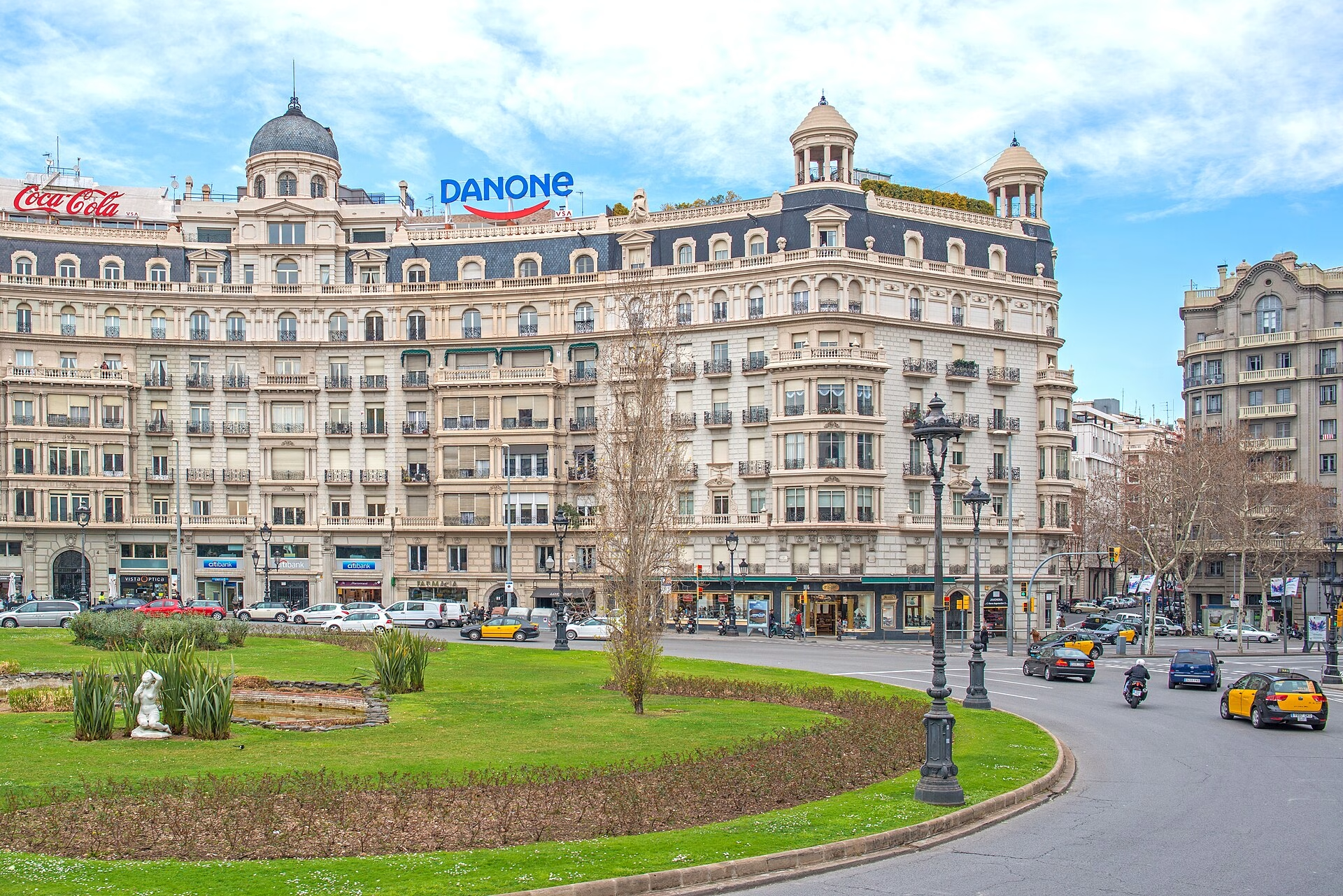
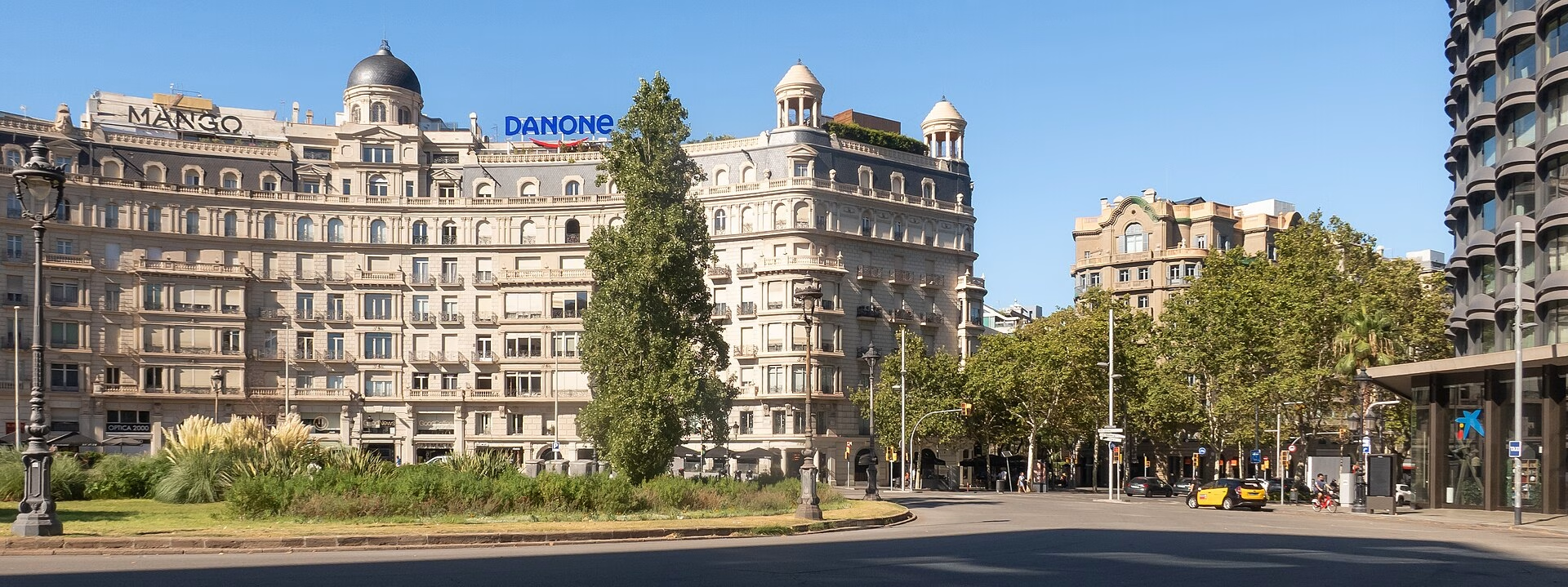
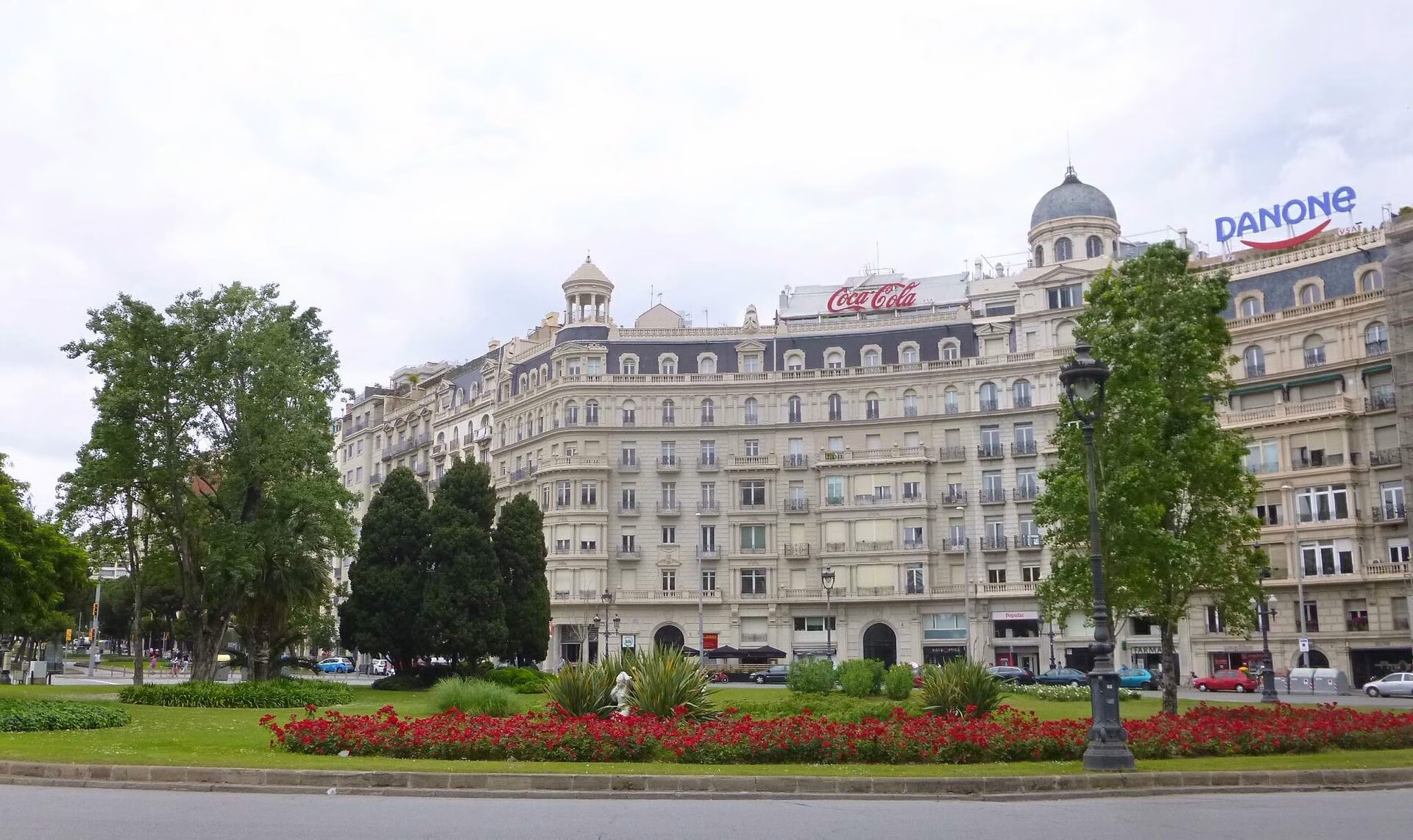
One of the most characteristic buildings in the complex is the one known as Ferrer i Cajigal, located at numbers 1–5 of the square.
It was designed by architect Josep Maria Rodríguez Lloveras and built in 1935.
Its architecture represents a monumental interpretation of the Beaux-Arts tradition, with Central European influences and classical elements.
The semicircular façade follows the geometry of the square and is organised around a strongly defined axis of symmetry.
Its most striking features include the large central dome, the side pavilions, columns, pediments and the upper roof with slate mansard sections.
The result is a stately building reminiscent of certain residential complexes found in major European capitals.
Originally conceived as a residential building, its presence has played a decisive role in defining the architectural character of Francesc Macià.
The former Winterthur Building
Modern architecture from the 1960s
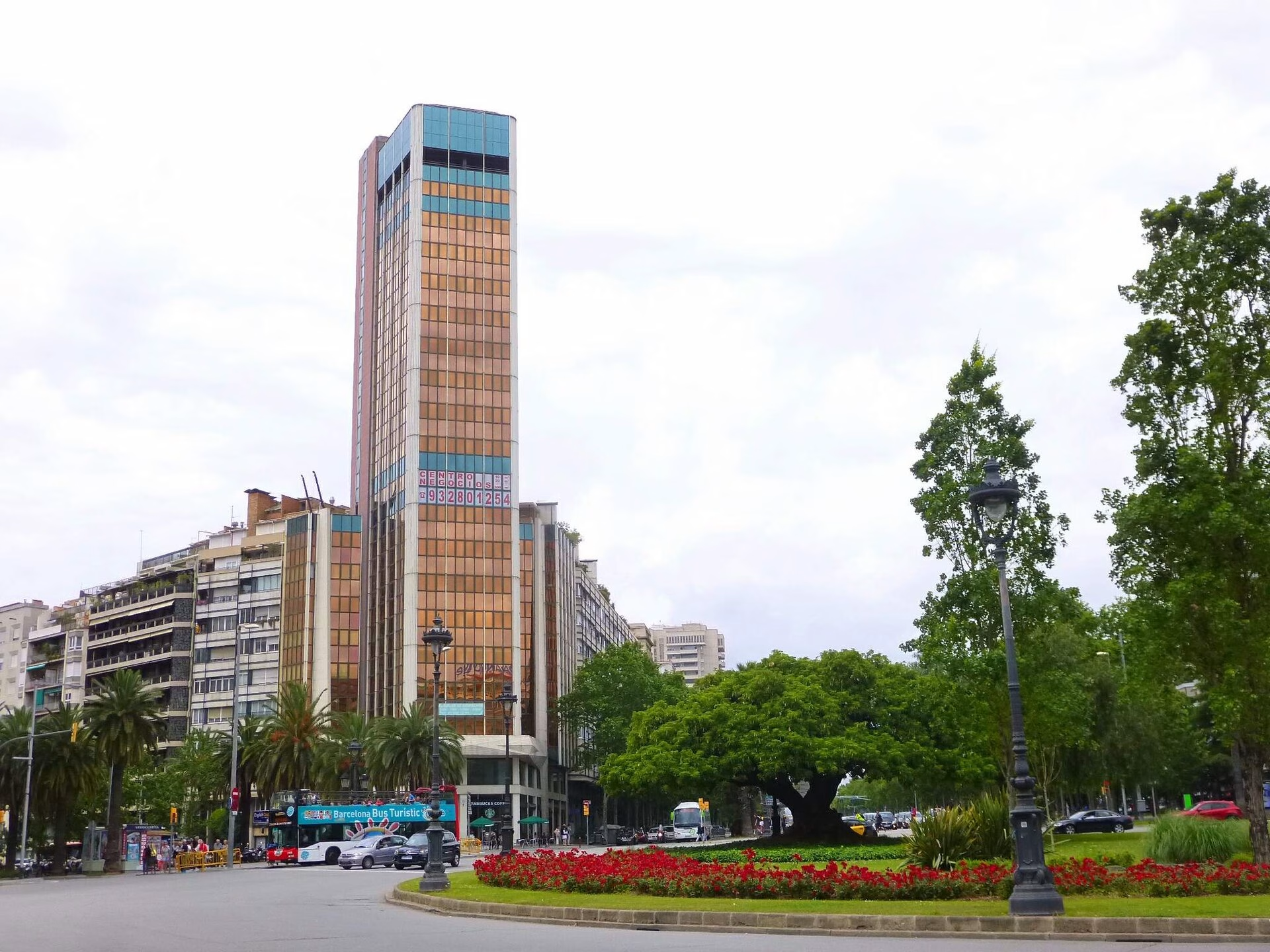
At number 10 of the square stands one of the most notable examples of modern architecture in Barcelona.
Built between 1966 and 1968, the property was designed by Swiss architect Marc-Joseph Saugey and became the headquarters of the insurance company Winterthur, from which it took its name.
Its most striking feature is the façade, with windows protected by curved elements that resemble eyebrows.
This architectural solution earned it the popular nickname “the Eyebrow Building”.
For decades, it was one of the area’s most distinctive office buildings.
In 2003, it ceased to house Winterthur’s headquarters and the property subsequently underwent a major transformation.
Between 2014 and 2016, it was converted into a residential building, with an interior architecture project led by Brazilian architect Marcio Kogan.
The former corporate building was thus transformed into an exclusive residential property while retaining much of its exterior identity.
The La Vanguardia area
Diagonal Avenue and corporate architecture
Near Francesc Macià, further along Diagonal Avenue, stands the building associated with the headquarters of the newspaper La Vanguardia, at number 477.
It is worth clarifying that the building is not actually located within the square itself, but rather in the surrounding Diagonal Avenue area.
The presence of this major media organisation forms part of the corporate and journalistic identity of this area of Barcelona.
Diagonal Avenue has traditionally concentrated corporate headquarters, professional offices and office buildings, reinforcing the economic and representative character of this entire urban district.
The square and its social life
Cafés, terraces, cinemas and cabarets
Throughout the 20th century, Francesc Macià was much more than a traffic intersection.
The square became an important meeting place for Barcelona society, particularly for the wealthy families living in the upper part of the city.
Its cafés, restaurants, shops and entertainment venues created a distinctive identity that remains in the memories of many Barcelona residents.
Among the best-remembered historic establishments were the Lamoga cabaret, the Rialto cinema, Sandor bar, La Oca café and the Pokin’s fast-food restaurant.
The Rialto Cinema
The former Rialto cinema occupied one of the commercial premises in the square and was one of the area’s entertainment venues.
It closed its doors at the end of 1977, specifically on the last day of that year.
Its disappearance paved the way for a commercial transformation that would shape an entire generation of young people in Barcelona.
Pokin’s: a small gastronomic revolution
In 1978, Pokin’s opened at number 3 of the square, becoming one of Barcelona’s first American-style hamburger restaurants.
The establishment occupied the premises of the former Rialto cinema and offered a dining experience that was something of a novelty for the city at the time.
With an interior design inspired by American diners, uniformed waiters and fast-food service, Pokin’s introduced a new way of meeting friends and eating out.
Its menus cost around 500 pesetas and included a hamburger, chips and a drink.
For many young people in the late 1970s and 1980s, going to Pokin’s was almost an event in itself.
On Friday afternoons, the restaurant became a popular meeting point before heading out to the nightclubs in the area.
Over time, the business evolved towards a menu more focused on sandwiches, associated with the Bocatta brand, until it disappeared in the mid-1990s.
In 2022, the commercial revival of the Pokin’s brand was announced, although with a different business model focused on home delivery and without reopening the original Francesc Macià premises.
La Oca
Another important name in the square’s commercial history was La Oca.
This café and meeting place played a prominent role in the social life of the upper part of Barcelona.
Its location and atmosphere helped establish Francesc Macià as a place where people could meet before continuing their day or going out in the evening.
La Oca closed in 2007, leaving behind another gap in the collective memory of the square’s traditional establishments.
The Lamoga cabaret and Mr. Dollar
The square and its immediate surroundings also had an important nightlife dimension.
The Lamoga cabaret is among the entertainment venues that helped shape the character of this area during the 20th century.
On Avinguda de Josep Tarradellas, then known as Avinguda de la Infanta Carlota Joaquina, there was also Mr. Dollar, a nightclub that opened in the late 1960s.
These venues reflect a Barcelona in which cabarets, dance halls and cocktail bars were an integral part of nightlife in the city’s wealthier neighbourhoods.
Sandor: the terrace of an entire era
A classic of Barcelona’s bourgeoisie since 1944
If there is one establishment closely linked to the history of Francesc Macià, it is Sandor.
Opened in 1944, its terrace became one of the places that best represented the social life of the upper part of Barcelona for decades.
The former Sandor was much more than a bar or café. It was a true social showcase, a place to see and be seen.
Its clientele included businesspeople, professionals, wealthy families and well-known figures from Barcelona society.
The terrace, with its distinctive blue chairs, wrought-iron tables and familiar Martini logo, became an essential part of the establishment’s image.
Its distinguished atmosphere, traditional service and the opportunity to enjoy a vermouth or coffee while watching the activity of the square made Sandor an institution.
One of its most curious features was the presence of a shoeshine man at the entrance, a figure that recalled a time when certain establishments offered services and forms of attention that have virtually disappeared today.
The historic establishment closed on 22 March 2013, bringing an end to almost seven decades of history.
However, the Sandor name has returned to the square. Today, Sandor 1944 carries on that historical identity and reflects the continuation of the area’s gastronomic tradition, although the 2013 closure marked a genuine break in the history of the original business.
Its current concept combines a café, restaurant and terrace, offering tapas, meat dishes, Mediterranean cuisine and a cocktail menu.
Its specialities include Galician Blonde beef rib steak, steak tartare and lobster rice.
The terrace remains one of its main attractions, particularly for breakfast, an aperitif, lunch or a leisurely after-meal gathering.
Current establishments
Restaurants, cafés and terraces in Francesc Macià
Today’s offering combines traditional establishments, restaurants, contemporary cafés and gastronomic concepts from different culinary traditions.
The square and its surrounding streets remain active from early morning until well into the evening.
Sandor 1944
Plaça de Francesc Macià, 5.
It is one of the establishments most closely associated with the square’s historical memory.
Its offering includes breakfast, coffee, tapas, meat dishes, rice dishes, lunch and dinner, as well as a selection of cocktails.
Its terrace provides an opportunity to watch the activity along Diagonal Avenue and enjoy an elegant, lively urban atmosphere.
It is a particularly suitable choice for those looking for an establishment with a long historical tradition and a privileged location.
Mery
Plaça de Francesc Macià, 1.
One of the square’s more recent establishments occupies the premises previously home to Camarasa Fruits.
The project initially attracted some controversy because of the possibility of using the name Sotelo, referring to the square’s former name during the Franco dictatorship.
The promoters eventually abandoned this name and opted for Mery.
The new concept was conceived as a restaurant, gastronomic venue and cocktail bar, with an offering that aims to combine dining, gourmet products and social life.
Its location, on one of the square’s most prominent corners, gives it a particularly visible position.
GoodNews
Plaça de Francesc Macià, 3.
A contemporary option for those looking for speciality coffee, prepared drinks, matcha and small takeaway products.
Its concept reflects the pace of a modern city: quick breakfasts, breaks during the working day and short stops before continuing along Diagonal Avenue.
It is an informal establishment, particularly aimed at an urban and younger clientele.
Boldú
Plaça de Francesc Macià, 5.
This well-known Barcelona pastry and coffee brand offers an alternative for breakfast and afternoon snacks.
Its speciality is artisan doughnuts and sweet pastries, served with coffee.
It is an interesting stop for anyone wishing to enjoy something sweet in an informal setting without having to organise a full meal.
Pastisseria Hofmann
Avinguda de Pau Casals, 5.
Just a few steps from the square, next to the Turó Park area, is this pastry shop associated with the prestigious Hofmann culinary school and brand.
Its offering is characterised by carefully crafted pastries, high-quality baked goods and products that are particularly appealing for breakfast, afternoon snacks or takeaway.
It is a more refined option for those who appreciate artisan pastry-making and speciality sweet treats.
Restaurants in the surrounding area
Beyond the establishments located directly on the square, the nearby streets offer an interesting variety of dining options.
Around Carrer de Calvet, Carrer de Buenos Aires, Diagonal Avenue and Avinguda de Josep Tarradellas, visitors will find Italian, Japanese, Mediterranean and international restaurants, as well as tapas bars, cafés and informal dining venues.
Among the options in the vicinity are Luigi, offering Italian cuisine; Nanaya, specialising in Japanese gastronomy; Colmado Wilmot, with its gastronomic and gourmet product concept; and various restaurants specialising in sushi and international cuisine.
The proximity of these establishments makes Francesc Macià a convenient location for a business lunch, breakfast, afternoon snack or informal dinner.
The current atmosphere of Francesc Macià
A square for business, social gatherings and neighbourhood life
Today, Francesc Macià retains much of its bourgeois and commercial character.
In the mornings, the area is dominated by professionals working in nearby offices, breakfast meetings and the steady flow of people crossing Diagonal Avenue.
At lunchtime, restaurants and cafés welcome workers, residents and visitors taking advantage of the area’s gastronomic offering.
In the afternoon, the terraces once again take centre stage. Groups of friends, couples and people meeting after work are a common sight.
At weekends, the atmosphere becomes more relaxed, particularly in establishments with outdoor terraces.
The proximity of Turó Park adds another attraction: visitors can combine a visit to the square with a stroll through one of the most pleasant gardens in this part of Barcelona.
Francesc Macià therefore represents a very particular combination of Barcelona’s business, residential, gastronomic and social life.
How to get to Francesc Macià Square
Public transport and connections
The square’s location makes it easy to reach from different parts of Barcelona.
Tram
The tram has a terminal at Francesc Macià.
Lines T1, T2 and T3 connect the square with different parts of the city and the Diagonal Avenue corridor.
Metro
The square does not have its own metro station.
Hospital Clínic station, on Line L5, is one of the nearest metro options, although it requires a walk of approximately ten to fifteen minutes, depending on the final destination.
Ferrocarrils de la Generalitat (FGC)
Provença and Muntaner stations provide access to the area, although both also require some walking.
City buses
The square is served by several bus routes along Diagonal Avenue and the surrounding streets.
Among the services operating in the area are various routes from the city bus network. It is therefore advisable to consult TMB to select the most suitable connection according to your starting point.
Barcelona Bus Turístic
The Red and Blue sightseeing routes stop at Diagonal–Francesc Macià, making it easy to include the square in a sightseeing tour of Barcelona.
How to get there by private vehicle
Access and parking
The square is located along one of Barcelona’s main road corridors.
It can be reached via Diagonal Avenue, Avinguda de Josep Tarradellas, Avinguda de Pau Casals and Carrer del Comte d’Urgell.
However, visitors should bear in mind that this is a busy traffic intersection, particularly during rush hours.
For those arriving by private vehicle, one nearby option is Parking Peguera, located at Avinguda de Josep Tarradellas, 143.
It is just a few minutes’ walk from the square and offers security surveillance, 24-hour access and a vehicle washing service.
As a reference, its published rates for advance bookings include options of approximately €9.99 for eight hours and €22–27 for twenty-four hours, depending on the booking option and applicable conditions.
Prices may change, so it is advisable to check the rates and availability before travelling.
It is also worth noting that the square is located within Barcelona’s Low Emission Zone (ZBE). Vehicles must comply with the relevant access requirements.
What to visit in the surrounding area
A privileged location for discovering elegant Barcelona
A visit to Francesc Macià can easily be combined with other places of interest.
Turó Park
One of the most pleasant gardens in the upper part of the city, ideal for walking and relaxing among trees, pathways and landscaped areas.
Diagonal Avenue
One of Barcelona’s main urban thoroughfares, featuring office buildings, shops, contemporary architecture and a vibrant commercial atmosphere.
L’Illa Diagonal
A shopping centre and dining destination located within a reasonable distance of the square.
The Sarrià-Sant Gervasi area
Its streets retain a distinctive residential, commercial and gastronomic character, with a wide variety of cafés, restaurants and specialist shops.
A square that preserves Barcelona’s memory
Plaça de Francesc Macià is one of those places that helps us understand how Barcelona has evolved over the past century.
Its political history, architecture, the small pond reproducing the shape of Menorca and the establishments that have accompanied generations of Barcelona residents are all part of an identity that goes far beyond its function as a major traffic junction.
From Nicolau Maria Rubió i Tudurí’s first urban planning projects to the monumental buildings of the 1930s, from the former Sandor to the memories of Pokin’s and the Rialto cinema, the square has witnessed a continuous process of transformation.
Today, it remains a meeting place for different generations, a landmark for the social life of the upper part of the city and one of the most representative gateways to contemporary Barcelona.
Stopping at one of its terraces, admiring its buildings and discovering the stories behind its establishments allows visitors to experience Francesc Macià from a different perspective: that of a city that continues to change while preserving much of its collective memory in its streets and squares.
Copyright © 2016-2026 Magic Dreams Barcelona.