Mirador del Alcalde Gardens: A Balcony Among Gardens.
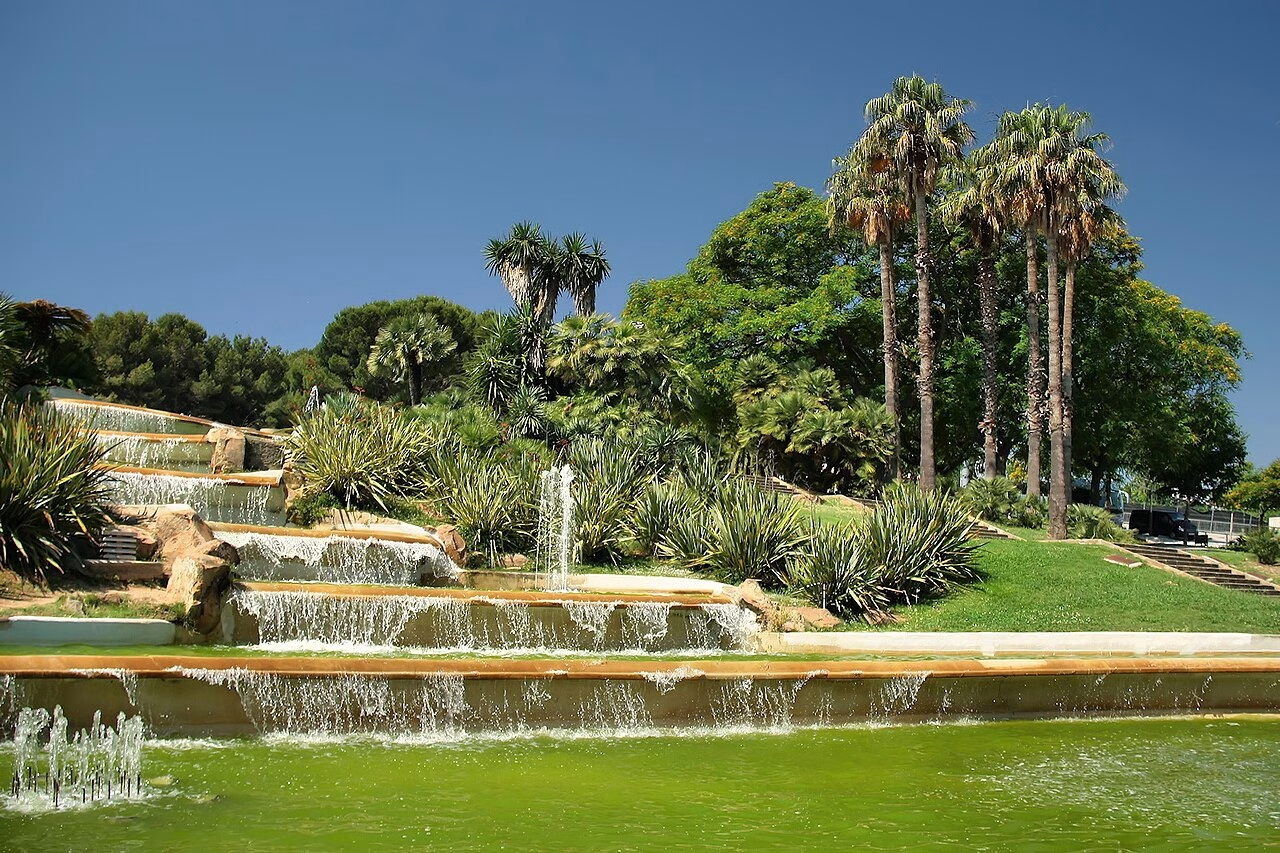
On Montjuïc Mountain, surrounded by terraced gardens, ornamental fountains, sculptures and Mediterranean vegetation, lies one of Barcelona’s most distinctive viewpoints: the Jardins del Mirador de l’Alcalde (Mayor’s Lookout Gardens).
Located at 41–51 Carretera de Montjuïc, very close to Montjuïc Castle, these gardens form a magnificent natural balcony from which visitors can enjoy panoramic views of Barcelona, its harbour, the Mediterranean coastline and much of the city’s urban landscape.
Their appeal lies in much more than their views. The gardens bring together landscape architecture, hydraulic engineering, contemporary art, original mosaics and vegetation that makes the most of the mountain’s natural conditions.
It is a place where water, stone, vegetation and artistic forms interact with the urban landscape, offering a peaceful retreat away from the faster pace of the city centre.
More than just a viewpoint, this is a garden designed to be explored slowly, inviting visitors to discover its different levels, pause in front of its sculptures and admire Barcelona from a privileged perspective.
Location and Surroundings
A privileged viewpoint on Montjuïc Mountain
The gardens are located in the Sants-Montjuïc district, in the Poble-sec area, within one of Barcelona’s most important green and cultural spaces.
- Address: Carretera de Montjuïc, 41–51, 08038 Barcelona, Spain.
- District: Sants-Montjuïc.
- Surroundings: Montjuïc Park.
- Access: Open to the public and free of charge.
- Features: Terraced gardens, viewpoints, fountains, waterfalls and sculptures.
- Nearby landmarks: Montjuïc Castle, Joan Brossa Gardens, Mossèn Cinto Verdaguer Gardens and Mossèn Costa i Llobera Gardens.
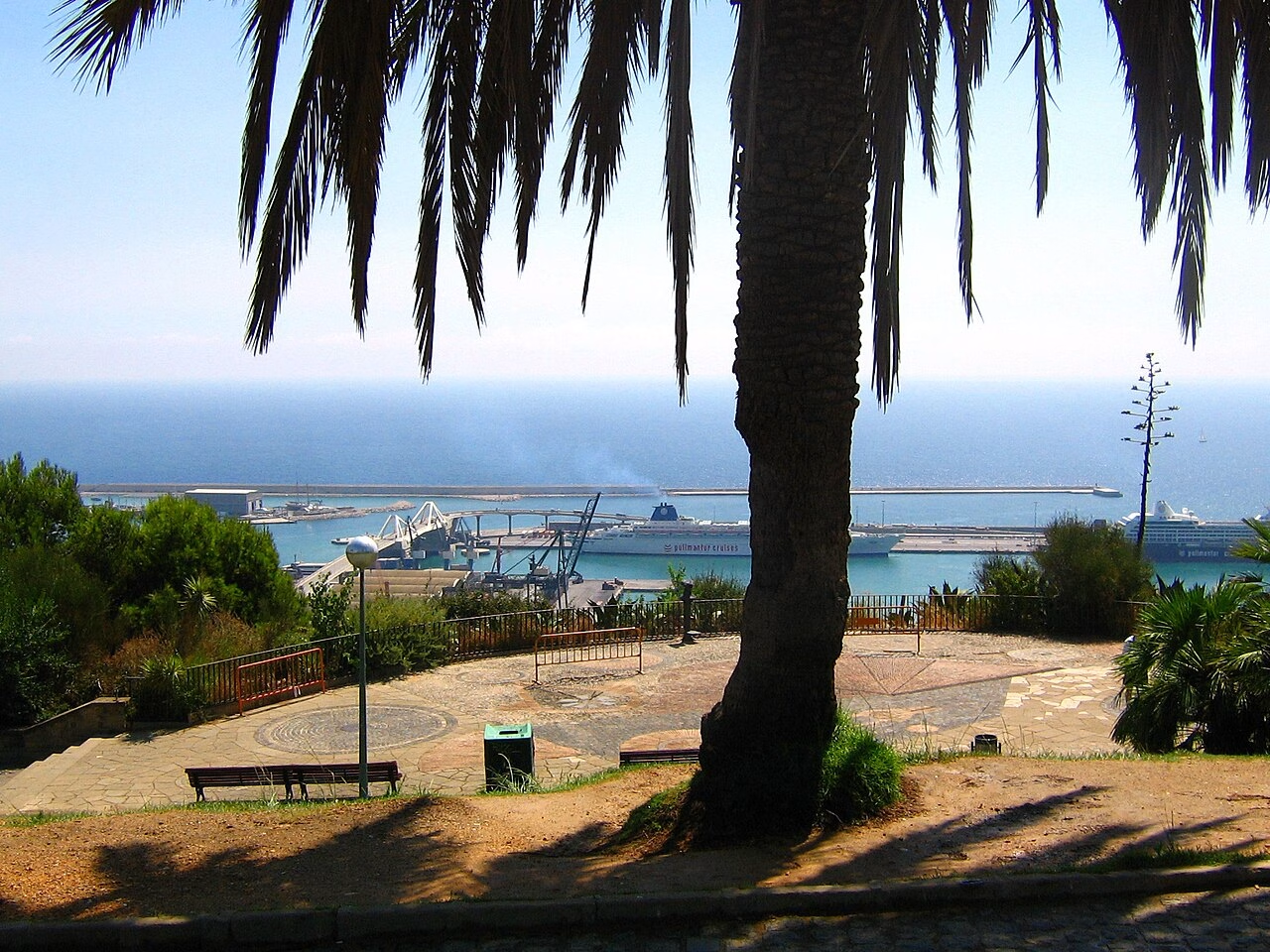
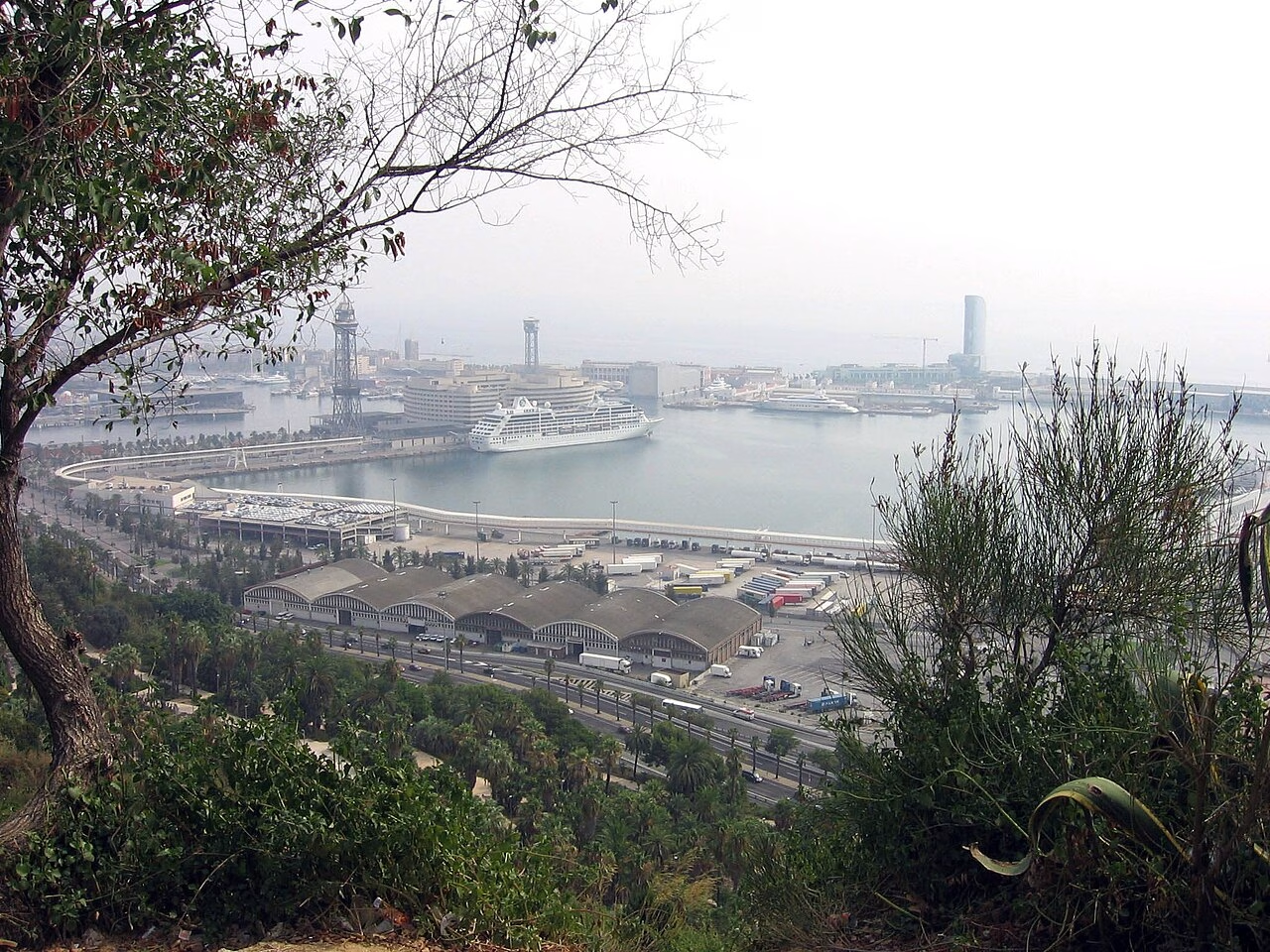
Their elevated position offers views of Barcelona Harbour, the port facilities, the coastline, the Eixample urban district and several of the city’s architectural landmarks.
On clear days, the maritime horizon becomes particularly prominent, allowing visitors to appreciate Barcelona’s historic relationship with the Mediterranean.
The gardens are also part of a wider landscape route through Montjuïc, a mountain that brings together historical heritage, cultural facilities, botanical gardens, sports venues and natural spaces.
History of the Gardens
From the transformation of Montjuïc to a new balcony overlooking Barcelona
The history of these gardens is closely linked to the urban and landscape transformation of Montjuïc during the second half of the 20th century.
In 1960, the Spanish State transferred Montjuïc Castle to Barcelona City Council. This process encouraged the improvement of the areas surrounding the fortress and the creation of public spaces designed for walking and enjoying the views.
Construction of the gardens began in 1962 and was carried out in several stages until the end of the decade.
The complex was inaugurated in 1969 by the then Mayor of Barcelona, Josep Maria de Porcioles, whose name became associated with the viewpoint.
The landscape design is attributed to Joaquim Maria Casamor d’Espona and Lluís Riudor i Carol, with the participation of prominent artists and specialists who helped transform the space into a collective work of art.
Among them were the engineer and fountain designer Carles Buïgas, the artist Joan Josep Tharrats and sculptors Josep Maria Subirachs and Josep Cañas.
The project successfully transformed a steep mountainside into a succession of landscaped terraces, resting areas and platforms from which to admire the city.
Landscape Architecture
A garden arranged across different levels
One of the most interesting features of the complex is the way it adapts to the steep natural slope of Montjuïc.
Rather than radically altering the terrain, the project makes use of the existing topography to organise the space through a series of terraces and platforms connected by staircases and gentler pathways.
This layout allows visitors to discover the garden progressively. Each level offers a different perspective of the vegetation, fountains, sculptures and surrounding urban landscape.
Flowerbeds, lawns, pathways and resting areas are arranged around the central features, creating a balanced composition between architecture and nature.
The succession of terraces also allows the views to open up gradually, turning the walk into a visual experience in which Barcelona unfolds like a vast stage in the background.
Joan Josep Tharrats’ Mosaic
A 420-square-metre work of art beneath our feet
One of the most original artistic treasures in these gardens can be found in the paving itself.
It is an extraordinary mosaic measuring approximately 420 square metres, designed by Joan Josep Tharrats i Vidal (1918–2001), a painter and printmaker and one of the leading figures of the Catalan artistic avant-garde of the 20th century.
Tharrats was one of the founders of the Dau al Set group, an artistic movement that played a fundamental role in the cultural renewal of post-war Spain.
His work at the Mayor’s Lookout offers a distinctive approach to public art, using everyday materials and reclaimed elements to create a visually rich abstract composition.
The materials used include:
- Pebbles and rounded stones.
- Cobblestones and bricks.
- Fragments of tiles.
- Glass from the bottoms of bottles.
- Iron pieces.
- Nuts, bolts, chains and other metal components.
- Fragments of machinery and materials recovered from dismantled installations.
The result is an artistic surface combining textures, colours, reliefs and geometric rhythms.
What makes it particularly remarkable is the way materials that originally had no decorative value acquire a new aesthetic dimension when incorporated into an abstract composition.
The mosaic forms part of Barcelona’s municipal artistic heritage and is one of the city’s most distinctive examples of art integrated into public space.
Its restoration has helped preserve this work for future generations.
It is not simply decorative paving: it is a work of art that visitors discover as they walk across it.
The Fountains and Waterfalls by Carles Buïgas
Water as the central element of the landscape
Water is another essential feature of the garden’s design.
The central ornamental fountain was designed by Carles Buïgas i Sans (1898–1979), the engineer and creator of the famous Montjuïc Magic Fountain, inaugurated for the 1929 Barcelona International Exhibition.
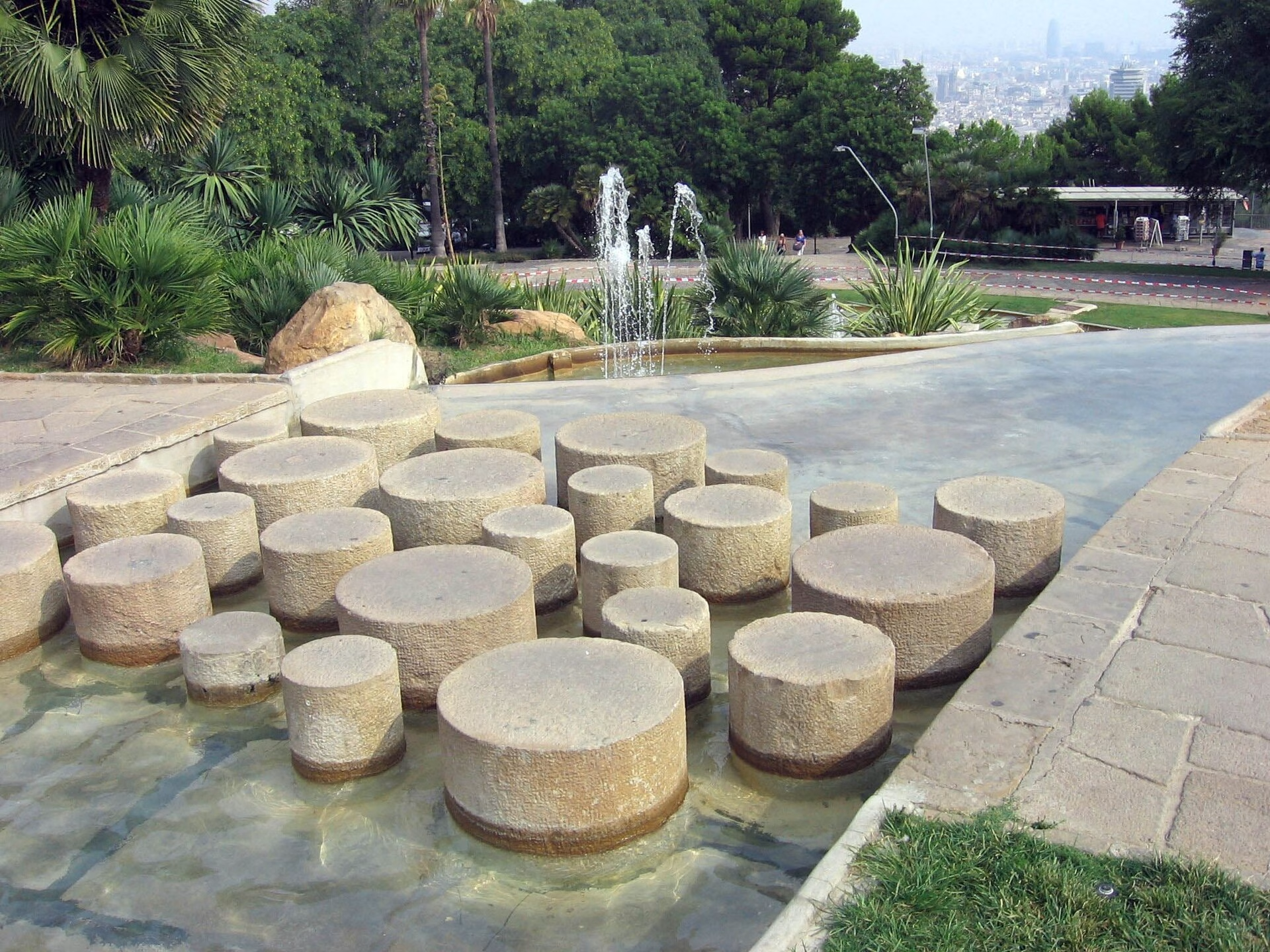
His contribution to these gardens introduces a visual and auditory journey in which water flows down a series of small platforms, creating a waterfall that eventually reaches a lower pond.
The composition is organised through different hydraulic levels, ponds and ornamental features that follow the mountain’s natural slope.
The water reflects the light, softens the atmosphere and creates a sense of tranquillity that contrasts with the activity of the city below.
The combination of vegetation, stone and water makes this one of the most pleasant places to relax during a visit to Montjuïc.
It is worth bearing in mind that the fountains may operate differently depending on maintenance work and conservation requirements.
The Sculptures of the Mayor’s Lookout
Two works that engage with Barcelona’s identity
In addition to its landscape architecture, the gardens contain two sculptures of particular interest within Barcelona’s artistic heritage.
L’Homenatge a Barcelona (Homage to Barcelona), by Josep Maria Subirachs
This work was created by Josep Maria Subirachs i Sitjar (1927–2014), one of Catalonia’s most prominent contemporary sculptors.
The sculpture was commissioned as a tribute to Barcelona on the occasion of the 125th anniversary of the banking institution that donated it to the city in 1969.
Its composition features two large superimposed geometric forms, visually connected by Barcelona’s coat of arms. The work reflects Subirachs’ characteristic artistic language, based on geometry, the tension between volumes and symbolism.
The artist developed a career closely associated with monumental sculpture and the integration of contemporary forms into public spaces. Among his best-known works is his sculptural contribution to the Passion façade of the Sagrada Família.
La Sardana, by Josep Cañas
The second notable work is La Sardana, by sculptor Josep Cañas i Cañas (1905–2001).
It represents the traditional Catalan dance in which participants join hands to form a circle, moving to the rhythm of traditional cobla music.
The sardana is one of the most important symbols of Catalan popular culture and represents values such as unity, collective participation and cultural identity.
Its presence at the entrance to the viewpoint gives the complex a particularly symbolic character, as though its figures were welcoming visitors to this special corner of Montjuïc.
Botany and Vegetation
A Mediterranean landscape with ornamental and subtropical species
From a botanical perspective, the Mayor’s Lookout Gardens offer an interesting combination of Mediterranean vegetation and ornamental species with a subtropical appearance.
The distribution of the plants responds to both aesthetic considerations and the particular conditions of Montjuïc: sun exposure, slope, water availability and soil characteristics.
Among the species found in the area are:
- Aleppo pine (Pinus halepensis): Forms an important woodland presence in different parts of the mountain. It is a Mediterranean species well adapted to drought and limestone soils.
- European fan palm (Chamaerops humilis): One of the few palm species native to Europe. Its fan-shaped leaves and compact growth give it a distinctive Mediterranean character.
- Mexican fan palm (Washingtonia robusta): A palm native to Mexico, notable for its slender trunk and large fan-shaped leaves.
- Canary Island date palm (Phoenix canariensis): A large ornamental palm commonly found in historic gardens and public spaces throughout Barcelona.
- Sago palm (Cycas revoluta): A plant with a primitive appearance and a crown of rigid, pinnate leaves. Although it resembles a palm, it belongs to a different botanical group known as cycads.
There are also lawns, ornamental shrubs and flowerbeds accompanying the different levels of the garden.
The combination of pine trees, palms and cycads creates interesting contrasts in shape, texture and colour, particularly when the Mediterranean sunlight falls on their leaves.
This vegetation helps create a transitional atmosphere between the mountain’s natural landscape and the carefully designed urban garden.
Wildlife and Birdwatching
The urban biodiversity of Montjuïc
The presence of mature trees, green spaces, shrubs and open areas makes Montjuïc a favourable environment for a wide variety of urban wildlife.
The gardens form part of a broader ecological mosaic that includes other parks, historic gardens and woodland areas across the mountain.
Bird species that can be observed in different green spaces throughout Barcelona and Montjuïc include:
- Common blackbird (Turdus merula): Frequently found in tree-filled gardens, where it searches for insects and small invertebrates among the vegetation.
- Eurasian magpie (Pica pica): A highly adaptable member of the crow family, easily recognised by its black-and-white plumage and long tail.
- Common wood pigeon (Columba palumbus): An increasingly common sight in urban green spaces.
- Monk parakeet (Myiopsitta monachus): An introduced species that has established populations in several parts of Barcelona.
- Common kestrel (Falco tinnunculus): A small falcon that can be spotted in open areas and elevated parts of the mountain.
It is also worth paying attention to pollinating insects, particularly bees, bumblebees and butterflies, which find food among the ornamental plants and spontaneous vegetation.
Wildlife observation is especially rewarding in the early morning, when human activity is reduced and many birds are busy feeding and communicating.
These species form part of the wildlife commonly found throughout the Montjuïc area and should not be considered a specific inventory of the gardens themselves.
For nature lovers, a visit can become a small botanical and ornithological experience, complementing the discovery of the site’s artistic heritage.
A Landscape of Panoramic Views
Barcelona, its harbour and the Mediterranean from above
One of the gardens’ greatest attractions is the breadth of their views.
From their platforms, visitors can see Barcelona Harbour, the maritime facilities, the coastline and a considerable part of the city.
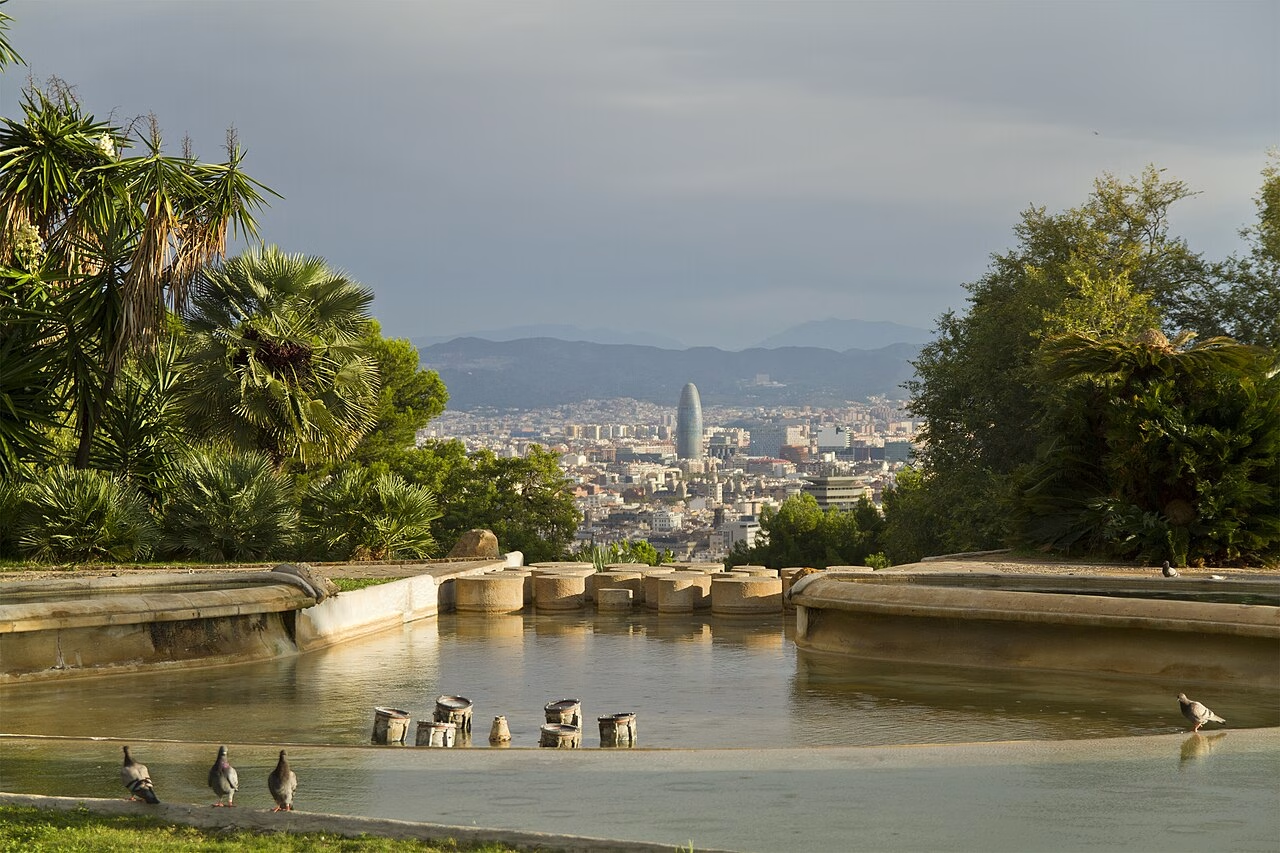
The perspective makes it possible to understand Barcelona’s urban structure and appreciate how the city has developed between the mountain and the sea.
It is also an interesting place to identify some of the city’s main architectural landmarks, depending on visibility and atmospheric conditions.
Sunrise and the late afternoon offer particularly attractive conditions for photography, when the changing light transforms the buildings and the maritime horizon.
At sunset, the changing colours over the harbour and the Mediterranean turn the viewpoint into a particularly evocative setting.
Photography enthusiasts are advised to bring a wide-angle lens to capture the scale of the landscape and a telephoto lens to observe architectural details and the port facilities.
How to Get to the Mayor’s Lookout Gardens
Public transport, cable car and private transport
The gardens’ location makes them accessible from different parts of Montjuïc. The best transport option depends on whether visitors wish to reach the gardens directly or combine their visit with other attractions on the mountain.
City bus
TMB bus route 150 connects Plaça d’Espanya with Montjuïc Castle and passes through several areas of the mountain.
It is one of the most practical ways to reach the area without using the cable car.
Bus route 55 also serves the Montjuïc area, although it is advisable to check its route and the most convenient stop for the chosen itinerary.
Metro and funicular
- Take metro lines L2 or L3 to Paral·lel station.
- From there, connect to the Montjuïc Funicular.
- The funicular connects with the Parc de Montjuïc area, where visitors can continue on foot or connect with the cable car.
Montjuïc Cable Car
One of the most attractive ways to reach the area is by taking the Montjuïc Cable Car.
Its route connects Parc de Montjuïc with the Castle and allows visitors to stop at the Mayor’s Lookout on the return journey.
As a reference, the fares are:
- Adult return ticket: €19.
- Adult one-way ticket: €12.
- Child return ticket (ages 4–12): €13.
- Child one-way ticket: €10.
Children under four travel free of charge. Advance online bookings may offer discounts depending on the operator’s conditions.
The cable car has cabins accessible to passengers with physical disabilities.
Taxi and private transport
Taxis provide direct access to Carretera de Montjuïc and are a convenient alternative for families, small groups and visitors who prefer to avoid transfers.
It is also possible to arrange private chauffeur-driven transfers, particularly useful when combining the gardens with Montjuïc Castle, the Joan Miró Foundation or the Miramar Gardens.
Access by private vehicle and parking
The gardens are located alongside Carretera de Montjuïc. However, it is important not to confuse the availability of parking areas on the mountain with the existence of a dedicated car park belonging to the gardens.
Nearby parking facilities include:
- Hotel Miramar car park, at 16 Carretera Antiga de Montjuïc.
- Mirador del Palau Nacional car park, in the area surrounding the MNAC.
- Parking facilities in the Miramar area and near Montjuïc’s cultural venues.
Prices and availability depend on the facility and length of stay. It is advisable to check parking rates before travelling.
Accessibility and Facilities
A garden to explore at a leisurely pace
The gardens have several routes and connections between levels, including sections with staircases and gentler paths.
It is important to note that the entire complex is not flat: some areas require visitors to negotiate slopes and steps.
There are paths that allow visitors to explore certain sections without encountering stairs, but people with reduced mobility should plan their route carefully and confirm the available access points.
The area offers resting places and public facilities in the surrounding area.
Its layout also makes it attractive for families with children, as visitors can alternate walks, landscape observation and moments of relaxation.
Opening hours:
- From 1 November to 31 March: 10:00 am to 7:00 pm.
- From 1 April to 31 October: 10:00 am to 9:00 pm.
Opening hours may change due to maintenance work, weather conditions or municipal decisions.
Admission: Free. These are public municipal gardens.
For information about possible changes to opening hours, service disruptions and access conditions, visitors can consult the official Barcelona City Council website.
Restaurants and Gastronomy Nearby
Where to eat after visiting the gardens
A visit to the Mayor’s Lookout can be rounded off with a gastronomic experience at one of the establishments in Montjuïc and its surrounding area.
The neighbourhood offers everything from small terraces where visitors can enjoy a drink while admiring Barcelona to restaurants specialising in Mediterranean cuisine, rice dishes, fish and seafood.
Quiosc Bar del Mirador
Located in the immediate surroundings of the gardens, this is an informal option for enjoying a coffee, soft drink, ice cream or light snack outdoors.
It is a convenient choice for visitors who want to take a break without moving away from the viewpoint.
Prices depend on the menu available during each season.
Restaurant Martínez
Located at 38 Carretera de Miramar, this restaurant is known for its Mediterranean and seafood cuisine.
Its specialities include rice dishes, paellas, fish and seafood.
It has a panoramic terrace offering different views of Barcelona.
Prices depend on the rice dishes and other menu choices. It is advisable to check the latest menu and book in advance.
El Xalet de Montjuïc
Located at 31 Avinguda Miramar, this restaurant specialises in Mediterranean cuisine and offers panoramic views over Barcelona.
Its menu includes seafood and fish rice dishes, fish, meat and seasonal products.
The indicative average price is around €45 per person, depending on the selection of dishes and drinks.
Restaurant Studio Miramar
Located inside the Hotel Miramar, at 3 Plaça de Carlos Ibáñez, this restaurant offers contemporary Mediterranean cuisine, featuring seasonal products and carefully presented dishes.
Its menu includes rice dishes, fish, meat, elaborate starters and desserts.
The indicative average price is around €50 per person.
Restaurant prices are indicative and may vary according to the season, drinks, supplements and menu selected. It is advisable to check the official menus and reservation conditions before planning your visit.
Other Places to Visit in Montjuïc
A route to discover the mountain’s heritage
The location of these gardens makes it possible to organise a cultural and scenic day out exploring some of the most interesting places in Montjuïc.
Montjuïc Castle
A historic fortress located at the highest point of the mountain, with an important military past and extraordinary views over the harbour.
Mossèn Costa i Llobera Gardens
One of the city’s most interesting specialist gardens devoted to cacti and succulent plants, featuring species from different regions of the world.
Joan Miró Foundation
A cultural institution dedicated to the artist Joan Miró, housing an important collection of modern and contemporary art.
Joan Brossa Gardens
A green space with a historical and recreational character, ideal for walking among trees and resting areas.
Miramar Gardens
Landscaped areas with terraces and privileged views over the harbour and coastline.
Combining these places allows visitors to discover the different dimensions of Montjuïc: its history, artistic heritage, botanical collections and relationship with the Mediterranean landscape.
Interesting Facts About the Mayor’s Lookout
Details that enrich the experience
- A monumental mosaic: Its approximately 420-square-metre artistic pavement was designed by Joan Josep Tharrats and created using reclaimed materials and industrial elements.
- A collective work of art: The project brings together architects, landscape designers, engineers and sculptors from different disciplines.
- Carles Buïgas’ legacy: The creator of the Magic Fountain also designed the ornamental water system in these gardens.
- A tribute to Barcelona: Subirachs’ sculpture incorporates the city’s coat of arms into its composition.
- A permanent dance: Josep Cañas’ work recalls the importance of the sardana as an expression of Catalan culture.
- A panoramic viewpoint: It offers elevated views of the city, harbour and Mediterranean Sea.
- A garden of botanical contrasts: It combines Mediterranean species with palms and ornamental plants from other continents.
- Free public access: Visitors can enjoy its artistic heritage, gardens and panoramic views without paying an admission fee.
Discover the Mayor’s Lookout Gardens with Magic Dreams Barcelona
Nature, art and tailor-made experiences
Discovering the Mayor’s Lookout Gardens can become a much richer experience when visitors understand the stories behind each sculpture, architectural feature and plant species.
At Magic Dreams Barcelona, we offer a different way to discover Montjuïc, combining heritage, art, botany, landscape and gastronomy through personalised experiences.
Our native guide, specialising in architecture, botany and ornithology, accompanies visitors throughout the experience, sharing insights into the mountain’s history, its historic gardens, plant species, birds and artistic details that often go unnoticed.
We take care of organising each experience, adapting it to our visitors’ pace, interests and preferences.
Our experiences include:
- Private cultural tours with a specialist guide.
- Botanical walks and birdwatching and butterfly-observation experiences.
- Tailor-made itineraries through Montjuïc’s historic gardens.
- Private transport and personalised transfers.
- Gastronomic experiences at selected restaurants.
- Sensory picnics with table linen, decoration and catering, in locations where these activities are permitted.
- Professional photography to preserve memories of the experience.
- Creative workshops in art, trencadís mosaic and Catalan cuisine.
- Private musical experiences, subject to permits and availability.
- Tailor-made excursions along the Costa Brava and through the Catalan Pyrenees.
We also organise multi-day stays and private experiences combining accommodation, gastronomy, culture and nature.
Our aim is to ensure that every visit creates an authentic connection with Barcelona, revealing not only its best-known landmarks but also the small details that give its landscapes their distinctive character.
The Mayor’s Lookout: A Different Perspective on Barcelona
The Mayor’s Lookout Gardens represent one of Montjuïc’s most distinctive landscape-design projects.
Their combination of terraces, fountains, waterfalls, sculptures and vegetation creates a space where art and nature blend seamlessly with the urban landscape.
Tharrats’ mosaic, the sculptures by Subirachs and Cañas, and Buïgas’ fountains form an artistic heritage that deserves to be discovered at a leisurely pace.
Added to this is the botanical richness of the gardens and the opportunity to observe the mountain’s biodiversity, making a visit an experience that goes far beyond simply admiring panoramic views.
From this privileged balcony, Barcelona reveals its full Mediterranean character: a city open to the sea, surrounded by history and shaped by the meeting of nature and architecture.
Copyright © 2016-2026 Magic Dreams Barcelona.